The Brahmi ‘s Girl That Married A Tiger
The Brahmi 's Girl That Married A Tiger: In a small village nestled between the rolling hills of Tamil Nadu, there lived a learned Brahmin who had a beautiful
“Be quiet, or I shall show you my original shape.” — Tamil proverb traditionally explained by this tale.
This story is a Tamil version of one of the oldest and most widely told plot patterns in human storytelling: the marriage between a young woman and a beast-bridegroom whose true nature is hidden beneath a human disguise. In folkloristic catalogues it sits inside the great Aarne-Thompson-Uther tale-type cluster ATU 425 (“The Search for the Lost Husband”), and shares family resemblances with French La Belle et la Bête, Norwegian East of the Sun and West of the Moon, and the Greek myth of Cupid and Psyche. Yet this version, with its sandalwood-and-jasmine wedding, its banyan-shaded forest and its Tamil proverb, is unmistakably South Indian.
Origin and Source
The earliest printed version of this tale comes from Pandit Sangendi Mahalinga Natesa Sastri (1859–1906), a pioneering Tamil folklorist, polyglot, and assistant to the colonial archaeological survey. Natesa Sastri began publishing transcriptions of South Indian tales he had heard from village storytellers, household women, and wandering bards in the late 1880s. The story appears as “The Brâhmiṇ Girl that Married a Tiger” in his four-part collection Folklore in Southern India (Education Society’s Press, Bombay, 1884–1893), and again in the more widely circulated London edition co-edited with Mrs. Howard Kingscote: Tales of the Sun, or Folklore of Southern India (W. H. Allen & Co., London, 1890), Tale No. 10, pp. 119–130. Natesa Sastri introduces the tale with the note that it is “told to explain a Tamil proverb” — the proverb cited at the top of this page, which a wife uses to silence a quarrelsome husband by hinting that he, like the tiger-bridegroom, may not be quite what he seems.
Within the standard tale-type indices the story is closest to ATU 425A (“The Animal as Bridegroom”) with elements of ATU 311 (“Rescue by the Sister”) in older variants, and is structurally tied to the Indian motif clusters indexed by Stith Thompson and Jonas Balys: K1916 (animal disguised as human husband), B651.7 (marriage to tiger in human form), and D113.1.1 (tiger transformation). The Brahmin caste-marker is essential: this is a tale about a learned, scripture-quoting household tricked precisely because its head trusted the suitor’s command of the Vedas. The wonder of the story is therefore inseparable from a quiet South Indian critique of mistaking polished speech for moral substance.
The Story
1. A Suitor Too Perfect to Refuse
In a village folded between the green hills of Tamil Nadu, where temple bells answered the dawn and the smell of jasmine drifted out of every courtyard, there lived a learned Brahmin and his only daughter, Savitri. She was famous for her gentleness, for the careful way she watered the tulasi plant at sunrise, and for a quiet courage her neighbours mistook for shyness. Her father, growing older, prayed each evening that he would live to see her well married.
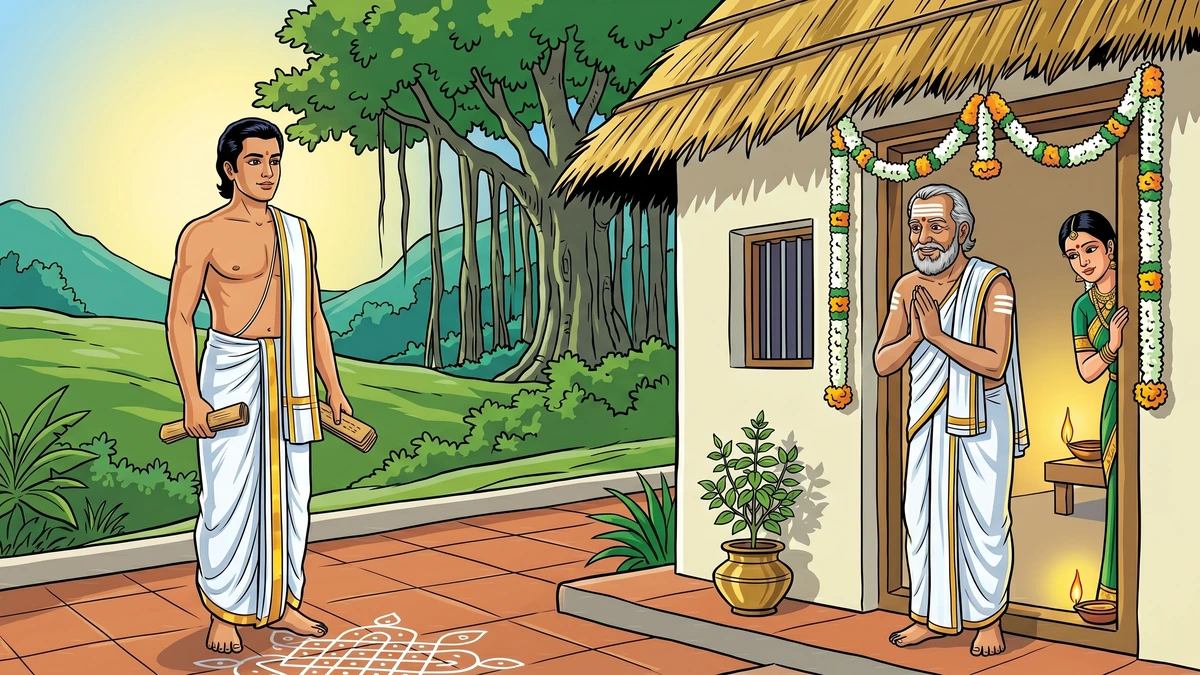
One afternoon a young man arrived at the threshold dressed in a fresh white veshti and a fine silk angavastram. He carried himself with the bearing of a prince. He spoke of the Rig Veda as a man speaks of a familiar river. He quoted Tirukkural. He bowed at exactly the right moment. The Brahmin, who had spent his life testing students by their grammar, was charmed; here at last was a bridegroom worthy of his daughter. The wedding was fixed for the next auspicious day, and the village rejoiced.
2. The Wedding and the First Strangeness
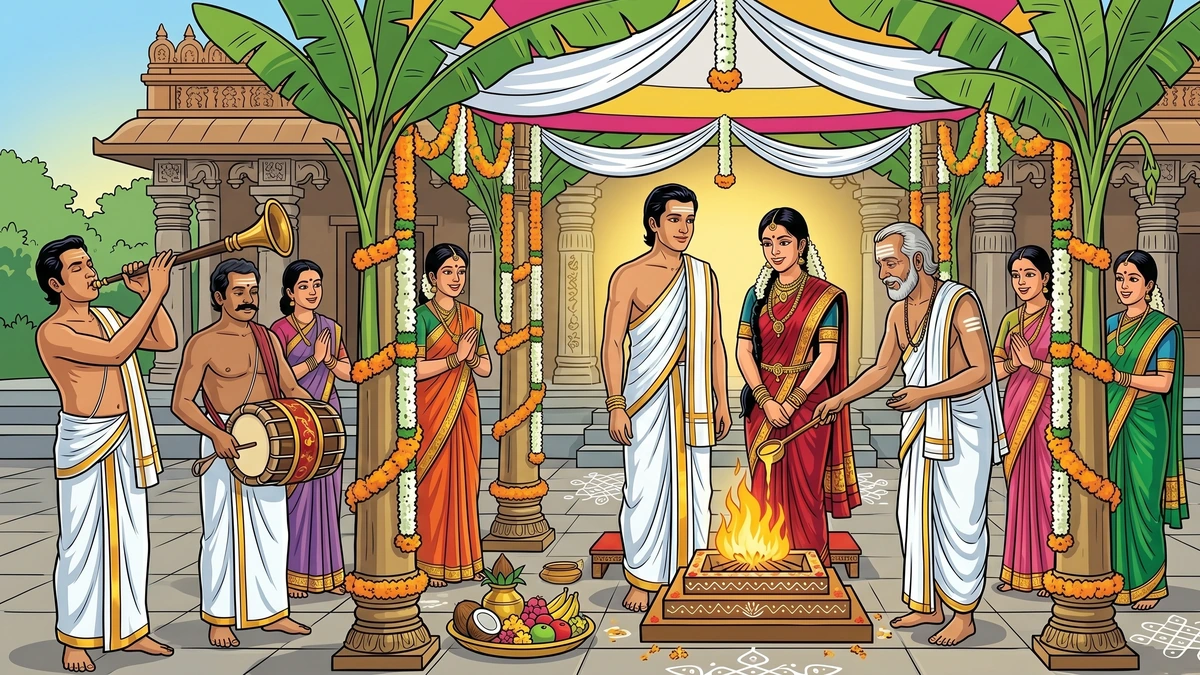
The marriage was performed under the canopy of plantain leaves and white muslin. Garlands of jasmine and marigold crowned every doorway. The nadaswaram wailed sweetly above the drone of the tavil; the priest fed the homa with ghee while the seven steps were taken around the sacred fire. Savitri felt, for one bright hour, a flutter of perfect happiness.
It was after the rituals ended, when the couple settled into the husband’s lonely house at the edge of the forest, that the strangeness began. He would vanish at dusk and return at first light with mud on his hem and a strange, coppery smell on his breath. He refused cooked rice; the smell of vegetables troubled him. He ate alone, behind a curtain, and Savitri noticed that the bones in his refuse pile were not the bones of any animal a kitchen would buy. His eyes, which had been gentle on the wedding night, sometimes shone in the dark with a yellow gleam, like two coins held to a flame.
3. Following Him into the Moonlight
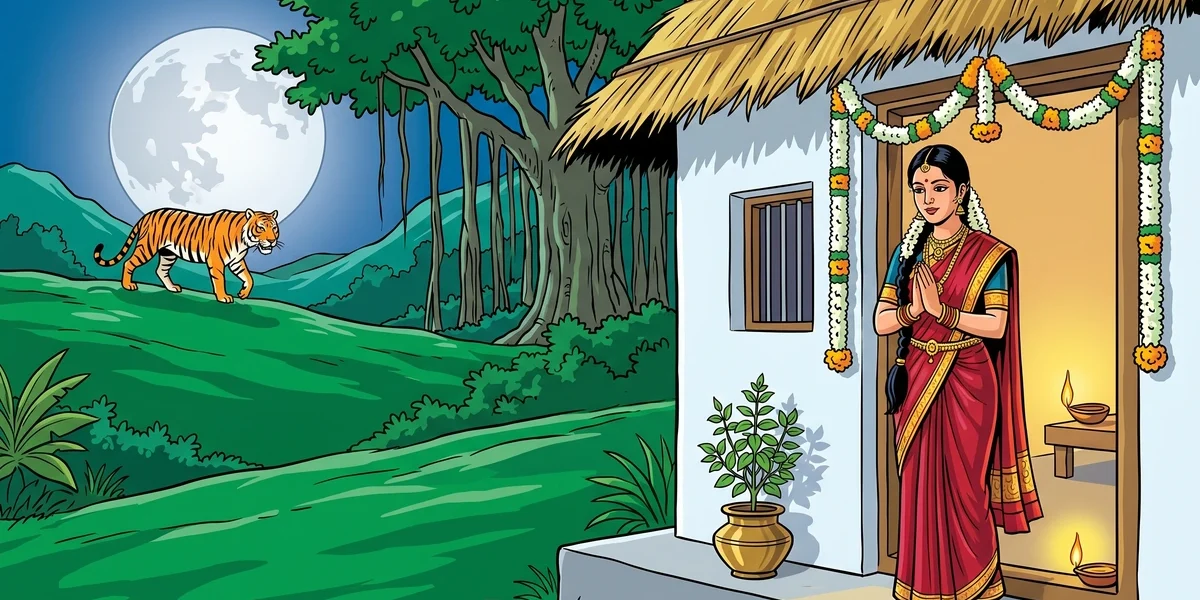
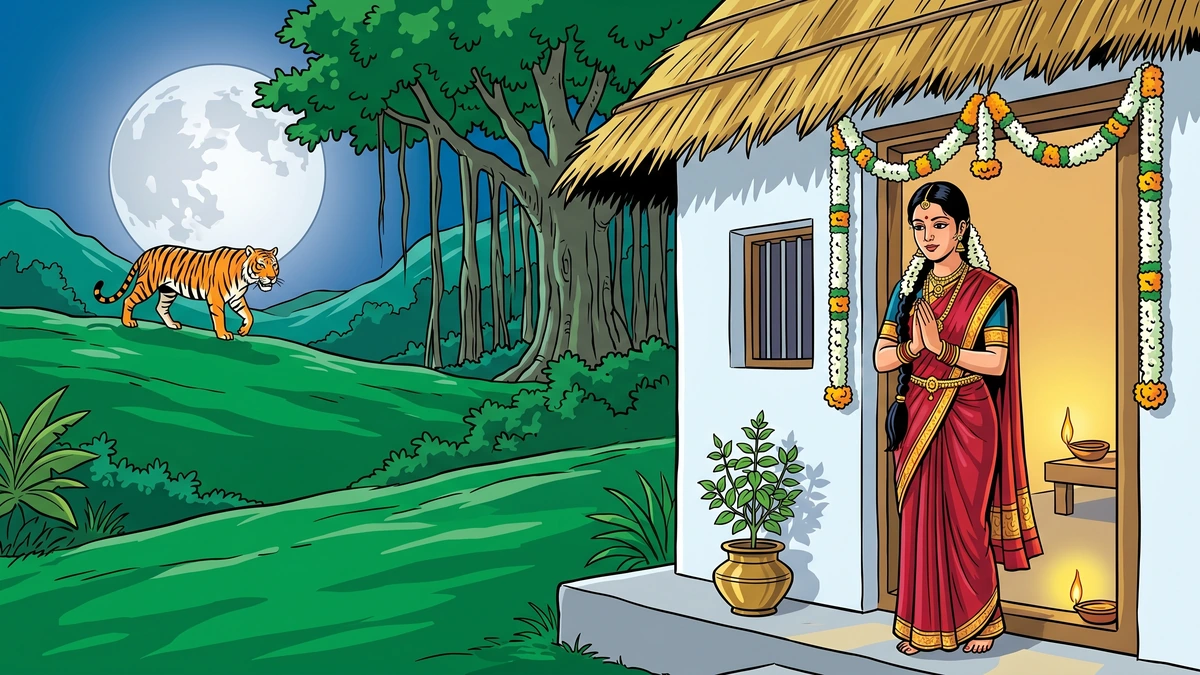
One full-moon night, Savitri could not sleep. She wrapped her shawl around her, slipped out of the house, and followed her husband at a distance into the forest. The moonlight spilled silver through the banyan branches. In a clearing where deer usually grazed, she watched her husband stop, look up at the moon, and tremble. His shoulders hunched; his back arched; black stripes bloomed across his skin like ink dropped on cloth. His face lengthened into a snout. In the space of three breaths a magnificent and terrible tiger stood where her husband had been.
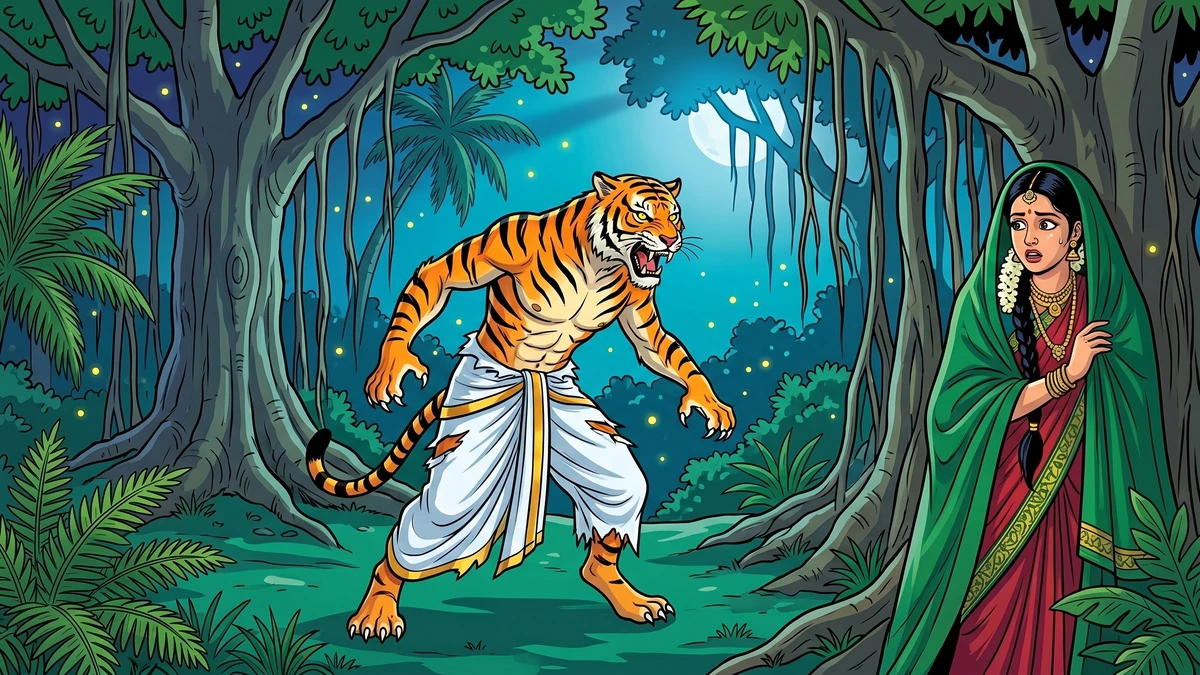
Savitri did not scream. She did not run. She simply pressed her back against the rough bark of a banyan tree and waited for her heartbeat to come back under her command. Then she walked silently home, washed her face, lit the morning lamp, and pretended to know nothing.
4. Truth Spoken at Dawn
The next evening, as the lamp was being lit, Savitri stood before her husband with her hands folded and her voice steady. “I have seen what you become under the moon,” she said. “I am not angry. I am not afraid. But if there is anything left in you that knew the Vedas at my father’s threshold, I ask you to show me, now, your true self — and tell me how you came to be wearing this disguise.”
The tiger-man fell to his knees. Tears, surprisingly human, ran down his face. He confessed: he had been a proud, cruel man in another life, and a forest sage had cursed him to walk between two shapes until a wife — knowing him fully — chose to remain in the room rather than flee from it. “I came to your father’s house meaning only to hunt,” he said. “I did not expect to be loved.”
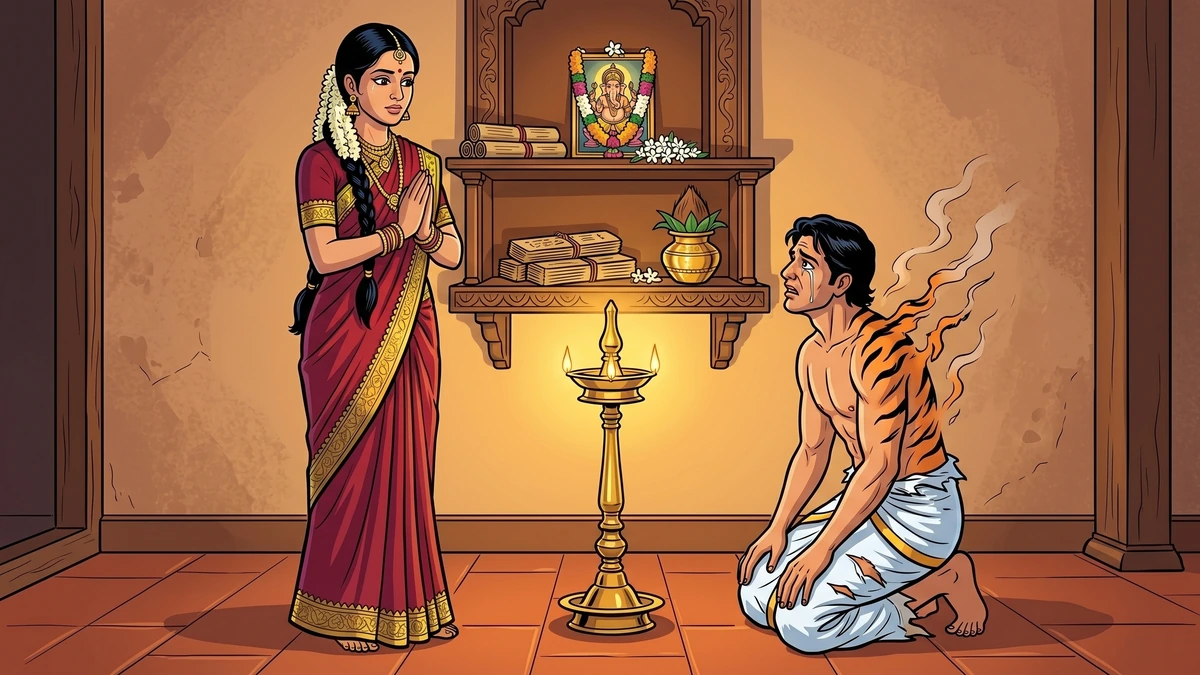
By the courage with which she had stayed, and by the clarity with which she had spoken, Savitri had broken the curse. The tiger-shape unraveled out of him like smoke. What remained was a chastened young man with no claws and no kingdom — only the rest of his life to spend trying to be worthy of the wife who had not run. The villagers, when they heard the story, said that any married woman who suspected her husband of secret beastliness need only hint at the proverb — “Pesāmal iru, ēlēṇṭāl en sōrupam kāṭṭuvēn” — “Be quiet, or I shall show you my original shape” — and the household would settle, at once, into peace.
Moral
“உண்மை பேசுகிற துணிவே மிகப் பெரிய ஆயுதம்.”
“The courage to speak the truth is the greatest weapon of all.” — Tamil moral saying associated with this tale.
The moral of “The Brahmin Girl that Married a Tiger” is not, as a casual reading might suggest, “do not trust strangers.” Its lesson is sharper than that. It is the bride, not the groom, who is the moral hero of the story. Her father is fooled, her husband is monstrous, and the village has no answer to give her. The transformation that breaks the curse is not magical at all in the deepest sense: it is the ordinary, terrifying act of a young woman speaking the plain truth out loud, in her own voice, in her own home, to a man powerful enough to kill her. Tamil grandmothers told this story to daughters not to warn them away from marriage, but to school them in the kind of bravery a marriage may one day require.
Historical and Cultural Context
Tamil folk literature distinguishes carefully between three registers: the formal classical poetry of the Sangam corpus, the devotional bhakti of the Alwars and Nayanmars, and the household oral tradition of katai (“tale”) that women carried through generations of cooking-fire evenings. The bride-and-tiger story belongs squarely to the third register. It is a “kitchen tale,” and its earliest documented appearance in print — Natesa Sastri’s 1884 collection — was, in part, an act of cultural rescue. Natesa Sastri feared that the tales of his grandmother’s generation would be displaced by English schoolbooks; he transcribed them precisely so that the proverbs they explained would not survive without their stories.
The motif of the animal-bridegroom is older than India’s contact with the West. Sanskrit tradition preserves it in the Mahabharata’s account of Ulupi the Naga princess, and in the snake-bridegroom tales of the Kathasaritsagara. In the Dravidian South it is the tiger — the king of the Western Ghats and a recurring figure in Chola sculpture — that takes the role most often given elsewhere to the bear, the wolf, or the snake. The choice is not accidental. The Tamil tiger is both feared and revered: it is the emblem on the Chola flag, the mount of the goddess Durga, and the embodiment of vīram (martial valour). A tiger-bridegroom is therefore a husband whose courage and danger are not merely beastly; they are kingly. The work the bride must do is correspondingly serious — she is not taming a stupid animal, she is civilising a king.
Folklorists comparing this tale to its European cousins (Apuleius’s Cupid and Psyche, the Norwegian East of the Sun and West of the Moon, Madame de Beaumont’s 1756 La Belle et la Bête) note an instructive difference: in many Western variants the bride must travel to the ends of the earth to redeem her beast-husband, performing impossible labours over years. The Tamil version compresses the entire moral movement into a single conversation, lit by a single lamp, on a single evening. The redemption requires no journey, no labours, no fairy godmother — only one young woman willing to say the true sentence out loud. That brevity is itself a Tamil sensibility. The Tirukkural, the great Tamil ethical poem, prides itself on saying enormous things in two lines; this story does the same in one scene.
Comparative Versions
Folktales rarely freeze in a single shape, and “The Brahmin Girl that Married a Tiger” has at least four widely-told endings depending on who is telling it and where:
- The Natesa Sastri 1884 ending. In the printed Tamil version the bride does not confront the tiger directly. She is taken to live in his forest cave, gives birth to a child who is half-tiger, and finally escapes by tying a coded letter around the neck of a temple crow that flies it back to her brothers, who arrive armed and rescue her. The tiger is killed, the child mourned, and the proverb is born from the bride’s bitter cry as she leaves the cave.
- The household “redemption” version. The retelling that has circulated most widely in twentieth-century Tamil children’s books — and that the present version follows — replaces the violent rescue with a confrontation by truth. The cursed husband is freed by his wife’s courage rather than killed by her brothers.
- The Karnataka “snake-husband” cousin. A close Kannada variant collected by A. K. Ramanujan in Folktales from India (Pantheon, 1991) replaces the tiger with a cobra; the structure and the proverb-explaining function are nearly identical.
- The Sri Lankan Jaffna Tamil version. Recorded by S. M. Anantarama Iyer in the 1920s, this variant gives the bride a parrot helper instead of a crow and ends with a long sequence of riddles between bride and tiger before the curse is broken.
Comparing these endings reveals what the storyteller most wants to emphasise. Natesa Sastri’s printed text foregrounds the danger of a poorly-arranged marriage; the household retelling foregrounds the bride’s moral courage; the Kannada cousin foregrounds the cunning of household women; the Jaffna version foregrounds intelligence as a survival tool. All four agree that the central character is the bride, and all four end by giving her the proverb.
Reflection & Discussion
- Why do you think the father, a learned Brahmin, was fooled when his daughter was not? What does this say about the difference between scholarship and discernment?
- The bride could have run home, woken her father, raised the village, and had the tiger killed. She chose instead to confront him alone, with words. What does her choice tell us about how she understood her own power?
- The story explains a proverb used between spouses. What kinds of household conflicts do you think it was originally invoked to settle?
- Compare the tiger-bridegroom to the beast in the European “Beauty and the Beast.” Which one bears more responsibility for his own redemption?
Did You Know?
- Natesa Sastri’s Folklore in Southern India (1884) was one of the very first serious collections of Tamil oral tales transcribed by a Tamil scholar rather than a European missionary.
- The tale-type ATU 425 (“The Search for the Lost Husband”) has been recorded in over forty cultures, from Iceland to Indonesia, but the Tamil “tiger” variant is one of the few in which the bride’s spoken courage alone, without any quest, breaks the enchantment.
- The Tamil proverb the story explains — “Be quiet, or I shall show you my original shape” — was still in living use in rural Tamil Nadu in the early twentieth century; the folklorist A. K. Ramanujan recorded versions of it in his fieldwork in the 1950s.
What This Tale Teaches Us Today
Old stories survive when their lessons keep being useful. Here is how this one still applies, more than a century after Natesa Sastri first wrote it down, and many centuries after grandmothers first told it:
- Charm is not character. A man who quotes scripture beautifully may still be a tiger at night. Look at what someone does after dark, not what they say at noon.
- The truth, spoken plainly, is the most underrated tool in a hard relationship. Savitri’s confrontation works not because she is louder or stronger than her husband, but because she is more honest.
- Courage is quieter than the stories pretend. The bride does not duel the tiger. She lights a lamp, folds her hands, and speaks one true sentence. That is the whole intervention.
- Transformation is real. The story believes — and Tamil culture believes — that even a person carrying a deep curse can become someone better, but only when another person is brave enough to see them clearly first.
Why This Story Still Matters
“The Brahmin Girl that Married a Tiger” has lasted almost a hundred and fifty years in print, and an unknown number of centuries in oral tradition, because it does in one short tale what whole novels strain to do: it shows a young woman acquiring her own moral authority. It begins as her father’s story (a marriage he arranges) and ends as hers (a curse she breaks). It speaks of a Tamil household, but its central scene — a wife confronting a husband whose night-self frightens her, with no weapon but the truth — is recognisable in every culture and every century. That is why it earned a proverb of its own, and why grandmothers in Tamil Nadu still know exactly which moment to bring it out at.
You May Also Like
 Indian Folk Tales
Ages 3-5
Indian Folk Tales
Ages 3-5
The Snake Woman And King Ali Mardan
The Snake Woman And King Ali Mardan: Once upon a time King Ali Mardan went out a-hunting, and as he hunted in the forest above the beautiful Dal lake, which
 Indian Folk Tales
All Ages
Indian Folk Tales
All Ages
The Boy Who Had A Moon On His Forehead And A Sun On His Chin
The Boy Who Had A Moon On His Forehead And A Sun On His Chin: In the magnificent city of Pataliputra, during the golden age of the Mauryan Empire, there lived
 Indian Folk Tales
Ages 9-12
Indian Folk Tales
Ages 9-12
The Legend of the Merlion
The Legend of the Merlion: In the days when the seas between lands were still being charted by explorers and when magic and reality existed in closer proximity