The Tiger, the Brahman, and the Jackal (Alternate Retelling)
The Tiger, The Brahman, and The Jackal: A Tale of Cleverness and Justice In the forests of ancient India, there lived a noble Brahman—a learned man...
An alternate retelling of one of the most beloved cumulative animal-trickster tales of Punjab — the meditation on ingratitude that turns on a clever jackal’s pretended dim-wittedness. Drawn from Flora Annie Steel and Richard Carnac Temple’s Tales of the Punjab, Told by the People (Macmillan, 1894), with parallels in Joseph Jacobs’ Indian Fairy Tales (1892, tale XX), Maive Stokes’ Indian Fairy Tales (1879), Mary Frere’s Old Deccan Days (1868) and the Pali Vyaggha Jataka. Classified as Aarne-Thompson-Uther type ATU 155 – “The Ungrateful Animal Returned to Captivity” – with motifs Stith Thompson J1172.3 (ungrateful animal), W154.2.1 (rescued animal threatens rescuer), J1391 (clever judge tricks animal back into trap) and K581.2 (animal persuaded to demonstrate position).
The Brahman Who Walked the Edge of the Forest
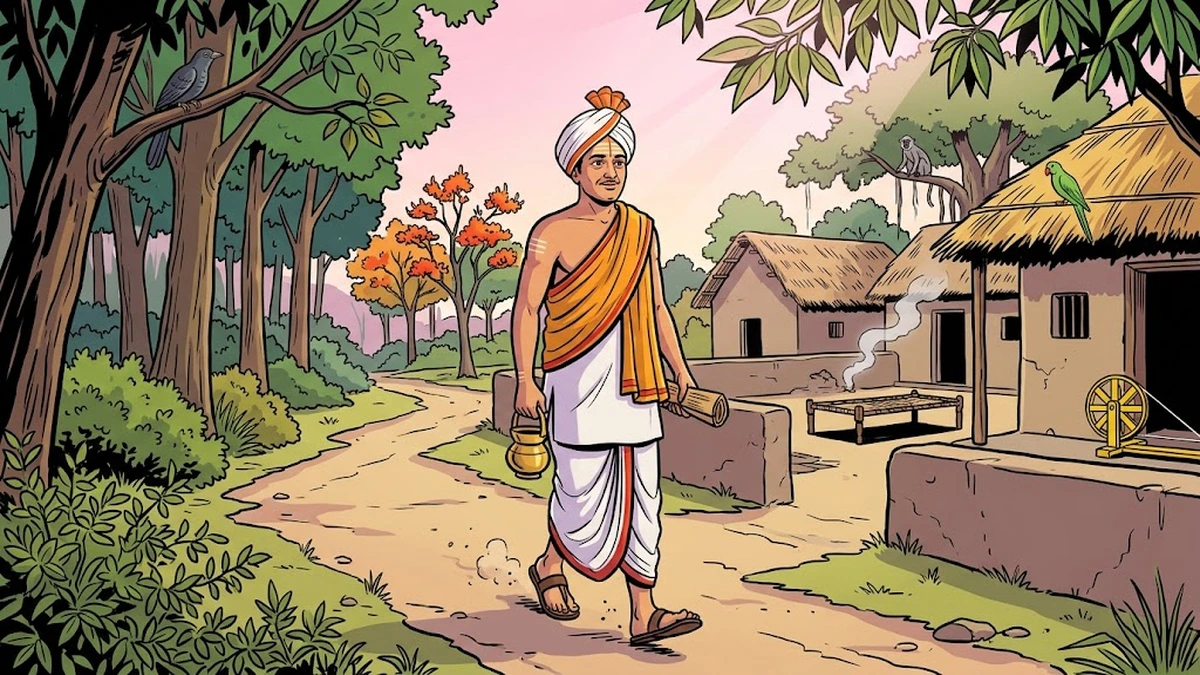
In a small village of the Bari Doab country, between the Ravi and the Beas in the level Punjab plain, there lived a Brahman named Karuna Das. His mud-and-thatch kachcha house stood at the very fringe of the village, where the cluster of yellow-baked walls broke at last into the kikar scrub and the sal-and-shisham forest beyond. He was a learned man – one of those village pandits who could chant the Yajurveda at dawn, recite the Mahabharata by lamplight, and explain a verse of Hitopadesha in slow, kindly Punjabi to a child sitting cross-legged on the threshing floor. People came to him for omens, for the auspicious hour at which a daughter should leave her father’s house, for a charm against fever, for a word of consolation when a buffalo died. He took his rice and his curd, accepted his small offerings of jaggery and ghee, and went home content.
What set Karuna Das apart was a soft heart that had not yet learned the harder verses of the world. He believed, against the lived wisdom of every farmer who had ever lost a calf to a leopard, that wickedness was not in the nature of any creature – that even the tiger, the king of the jungle, was fundamentally a soul (jiva) under the same vast wheel of karma as himself. His wife, a sensible Punjabi woman who had grown up watching her father set fox-traps in the millet fields, often warned him: “Suniyo ji, jangal vich da hai sau khabardar – when you go into the forest, take care.” But the Brahman would only smile, tighten his white turban, and walk out at dawn with his brass lota for water and his palm-leaf bundle of mantras.
The Tiger in the Iron Cage
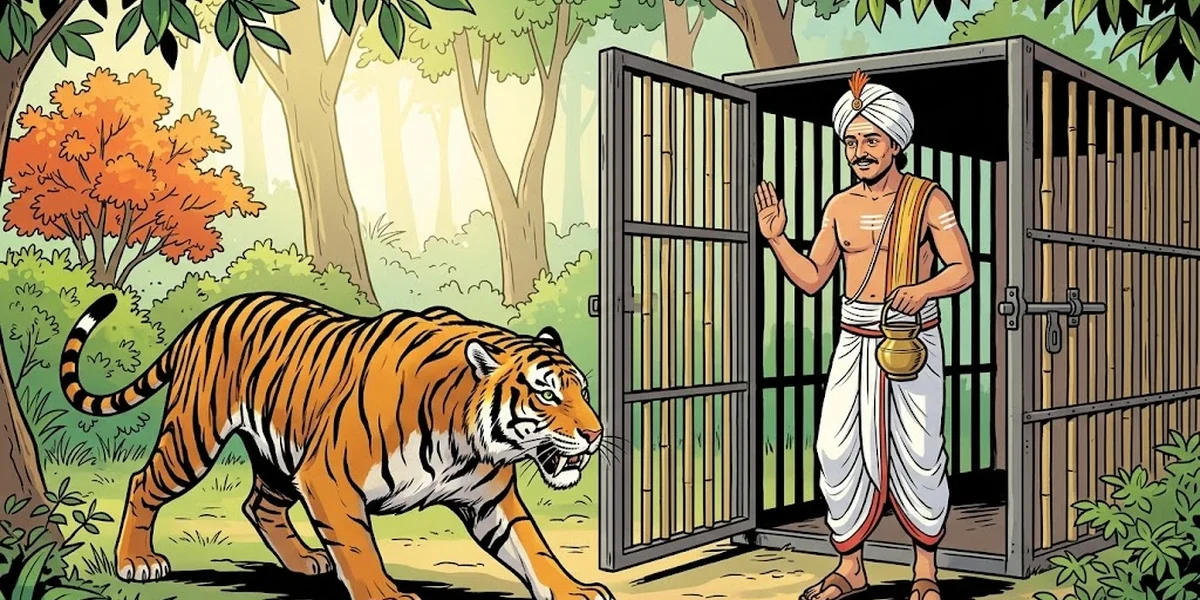
One particular morning he had walked further than usual. The light was pearly through the new mango leaves, the koel was calling somewhere in the deep dhak grove, and the dust of the path was still cool under his sandalled feet. Then, in a clearing where the village hunters were known to set their traps, he came upon a sight that stopped him short.
Inside an enormous cage of split bamboo and iron rods – the kind the Punjab villagers built when the Maharaja’s shikari wanted a tiger taken alive to be sold to some travelling menagerie or to be released for a royal hunt – there paced an enormous Bengal tiger. His coat was the colour of marigolds and burnt earth, striped with the ink-black of a moonless night. His eyes, when they fixed upon the Brahman, were green as the deepest pool of the Beas in winter. He had paced so long that his great paws had worn the dirt smooth in two oval tracks.
“Brother Brahman,” called the tiger softly, in the courteous register a tiger uses when he wants something. “Brother, brother – for the love of all the gods, set me free. The hunters will return at noon and they will drag me away in this cage to a fate I cannot bear. I shall die of thirst before they come, the sun is so hot upon this iron. Slip the bolt, sahib – only slip the bolt, and a creature of the jungle will remember your kindness for a thousand years.”
The Brahman pressed his palms together. “Tiger-ji,” he said, “if I free you, what is to prevent you from eating me? You are hungry, and I am alone here on a forest path.”
“Eat you?” The tiger almost laughed, and his great whiskers lifted. “Brother, am I a beast without honour? I, whose grandfather knew the rishis of these very hills? I swear by the holy banyan tree under which the Buddha sat and by the sacred Ganga and by the milk-white cow of the Kamadhenu – touch your hair I shall not. Free me, and I shall be your bhai-band, your sworn brother. Free me, and I shall escort you safely back to the village.”
The oaths were piled higher and higher: by the Sun, by the Moon, by the milk of the cow, by the steel of his own claws which he would break upon the iron rather than break his word. At last Karuna Das, his eyes glistening, his pious heart melting, went to the cage and drew back the heavy bolt. The door swung open with a long iron sigh.
The Broken Oath
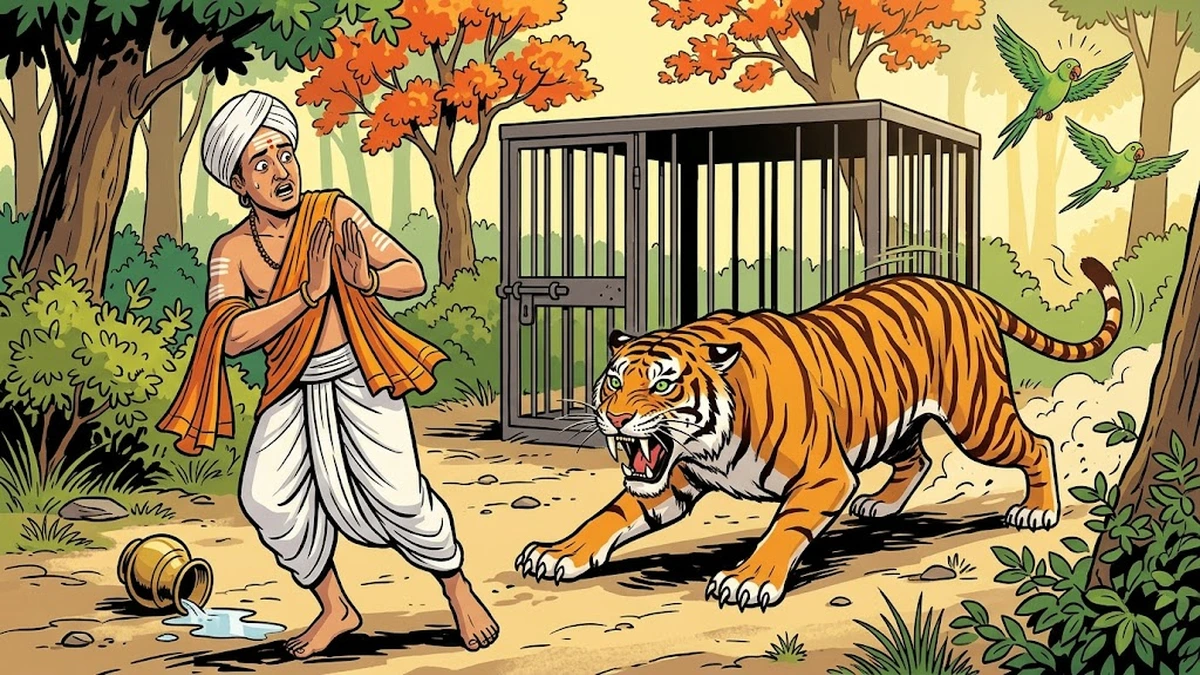
What happened next was the first hard verse of the world that Karuna Das had ever been forced to read. The tiger sprang out – not toward the open jungle, but into a low, terrible crouch six feet from the Brahman. His tail lashed; his ears flattened; the courteous voice was gone, replaced by the deep, vibrating growl that lived under it.
“My friend,” said the tiger, showing the long white scimitars of his teeth, “I have been three days in that cage with nothing in my belly. And here is a Brahman, plump and fragrant with ghee. I shall eat you now.”
“But – but your oaths!” stammered the Brahman, falling back. “You swore by the Sun, by the cow, by the holy Ganga!”
“Oaths are for jungles where men keep them,” said the tiger, “and you are not a jungle. The strong do as they please. That is the law of the forest.”
Karuna Das, his throat dry as a summer brick-kiln, made one last desperate appeal. “Tiger-ji – at least let it be done justly. In our country, a dispute is referred to panchayat, to the council of elders. Let us put the case to the first three creatures we meet on the road. If all three say it is just that you should eat me, I shall lay my head down between your paws and you may take me. But if even one says it is unjust, you must spare my life. Is that not fair?”
The tiger was so far gone in the certainty of his dinner that he agreed indulgently. Three judges, after all, against a man! He flicked his tail, and the two of them – the trembling Brahman and the pacing tiger – set off down the dappled forest path together, like the strangest pair of pilgrims that ever walked in Hindustan.
The First Two Judges: The Banyan and the Buffalo
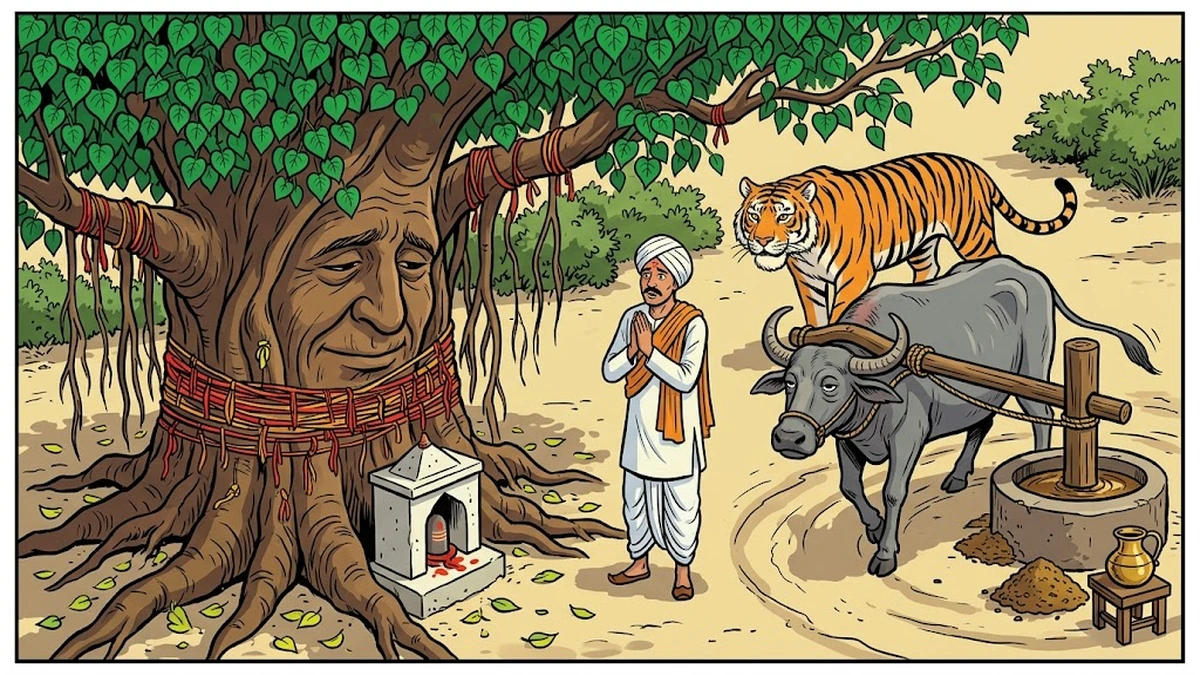
The first judge they came upon was an enormous old peepal tree, the kind whose roots have drunk the rains of two centuries, whose branches are tied with red threads by women asking for sons, whose fallen leaves are pressed into books for charms. The Brahman bowed before the tree as one bows before an elder. “Pitaji,” he said, his voice catching, “I have just freed this tiger from a cage in which he was certain to die. He swore great oaths to me, and now, at the very moment of his freedom, he has turned upon me to eat me. Tell me, tree of wisdom – is this just?”
The peepal stirred its lakhs of leaves and sighed a slow, papery sigh. “Justice?” it whispered. “Brahman, do not speak to me of justice. I stand here at the road’s edge giving shade to every passer-by. Travellers cool themselves under my branches; cattle chew their cud in my shadow; cowherds nap their mid-day naps with their heads pillowed on my roots. And what do men give me in return? They tear off my green twigs to clean their teeth; they break off my branches for firewood; they hang their water-skins in my crown till the bark splits. After a thousand years of giving, they will fell me at last for a temple beam. If even I, who give without ceasing, am repaid only with hatchets – why should you, who freed a hungry tiger, expect anything better? Tiger, eat the man. The world has always been ungrateful.”
The tiger purred. The Brahman shivered, but pressed on, holding the tiger to the bargain – three judges, not one. They walked a little further and came to a buffalo, an old grey she-buffalo, tied to a stake and turning a creaking kolhu, an oil-press, round and round in a dusty circle. Her eyes were blank with the long patience of yoked cattle, her shoulders rubbed raw by the bamboo yoke, her tail flicking listlessly at flies.
“Sister Buffalo,” cried the Brahman, “tell us – is it just for this tiger to eat me after I freed him from his cage?”
The old buffalo did not even stop the wheel. “Just?” she lowed. “What does the word mean? When I was young and strong, when I gave eight pots of milk a day and pulled the heaviest plough in the village, my master fed me green mustard-fodder and let me lie in the cool of his courtyard. Now that I am old, my milk is dry, my hide is ridged with old sores, and they have set me to this oil-press where I shall walk in this circle till I drop. And when I drop, they will skin me for chappals and grind my horns into bone-meal. Such is gratitude in the world. Tiger, eat the man, eat him quickly. Spare him the slow disappointment that comes after.”
The Brahman’s last hope sank. Two judges had spoken, and both against him.
The Third Judge: Sayana the Jackal
They had not gone much further when, in a dust-bowl beside the path, they came upon a thin grey jackal whose name in this country was Sayana, which in the Punjabi means “the wise one” or, depending on how the word is said, “the one who pretends not to understand.” He was scratching idly behind one ear; his amber eyes were half-closed against the sun.
“Jackal-bhai,” said the Brahman wearily, hardly daring to hope, “you are our third judge. Hear our case and rule. The tiger here was caged. I freed him. He swore to be my brother, and now he proposes to eat me. Is this just?”
Sayana opened one yellow eye. He listened with the air of a magistrate at the end of a long, hot day. He yawned. He scratched. Then he said, in the slow, somewhat thick Punjabi of a slightly stupid country jackal: “Forgive me, sahibs. I am only a jackal, and my head is full of fleas. I did not catch a word of all that. Tiger sahib was caged – and the Brahman caged the tiger? Or the Brahman was caged, and the tiger freed him?”
The tiger lashed his tail. “No, fool! I was in the cage. The Brahman let me out.”
“Forgive me,” said Sayana, scratching with his hind leg now, “my poor head. The Brahman was in the cage and the tiger let himself out – and now the cage proposes to eat the Brahman?”
“I propose to eat the Brahman!” roared the tiger. “I was in the cage! I!”
“Pardon, sahib, pardon,” said the jackal, blinking helplessly. “Truly I am a creature of small wits. Your honour will have to show me. Where is this cage? Was the Brahman inside the cage with the tiger? Or was the cage inside the Brahman?”
The tiger by now was nearly mad with frustration. A magnificent dinner was growing cold, so to speak, while a half-witted jackal asked him geometry. “Come!” he snarled. “Come and I shall show you. Then you can pass your fool’s verdict and I can eat my Brahman.”
So the strange council – Brahman, tiger, jackal – turned and walked back along the path to the clearing where the great cage still stood with its iron door swinging open. And here Sayana, blinking and muttering, asked his patient questions a fourth and a fifth time.
The Reversal at the Cage Door
“So the cage was here?” asked the jackal, walking around it.
“Yes,” said the tiger.
“And you, sahib, were – outside the cage?”
“No! I was inside the cage!”
“Pardon, sahib. Inside such a small cage? A tiger so big as your honour? How is this possible? Show me, show me – for if I am to give judgement, I must see.”
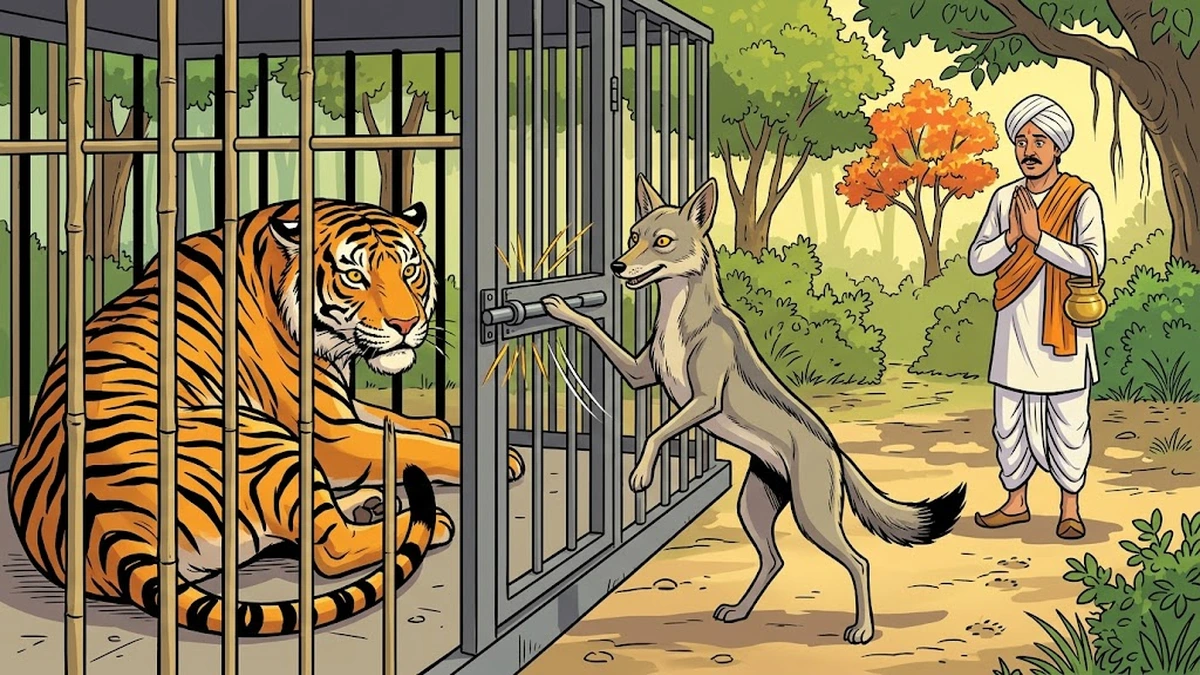
The tiger, growling with the irritation of the magnificent before the dim, stalked into the cage, lay down with his belly on the floor, and curled his great striped tail around his haunches. “There!” he snarled. “I was here, just so, three days and three nights. Now do you understand, you idiot of a jackal?”
Sayana’s eyes opened wide. They were not stupid eyes any more; they were as bright as new copper coins. With one swift movement, quick as a Punjabi farmer’s billhook, he stepped to the door and shot the heavy bolt home. Clang.
“I understand perfectly, tiger sahib,” he said, sitting back on his haunches. “And so does the world. The Brahman was outside; you were inside; and inside is where you shall remain. Brother Brahman, take your bundle and your lota and go home to your wife. Walk a different path next time. As for the tiger – let the hunters return at noon, and let them find their prisoner exactly as they left him.”
The tiger threw himself against the iron with a roar that shook the leaves of the peepal a quarter of a mile away. But the bolt held, as bolts will when the Punjabi blacksmith has hammered them straight.
Of Cleverness, Dharma, and the Word “Sayana”
Karuna Das, his knees still weak, knelt and pressed both hands to the jackal’s grey head in the gesture a Brahman uses when blessing the priest of his own teacher. “Sayana-ji,” he said, “you have given me back my life. Whatever I have, ask it of me, and it is yours.”
The jackal grinned, showing teeth small but very sharp. “A pot of curd at your gate every Tuesday morning, brother, and a piece of jaggery at the New Moon,” he said, “and we are paid in full. Now go. The tiger is loud, and there is a hunter on the way.”
And Karuna Das walked out of the forest a wiser man, never again to confuse the soft heart with the soft head. From that day forward, he carried the lesson into his teaching, and the children of his village learned it before they learned the alphabet: that compassion without discrimination (viveka) is foolishness, and that the world is sometimes saved not by the great and the strong but by the small grey thing in the dust who pretends, until the moment of truth, that he has not understood.
The Moral
“उपकारानां कृतघ्नः न योग्यः साधुसङ्गमे।”
upakaaraanaam kritaghnah na yogyah saadhusangame –
“The ungrateful one is unfit for the company of the wise.”
– from the Sanskrit moral tradition of the Hitopadesha and Pancatantra, paraphrasing the closing of the Vyaggha-Jataka.
The story of The Tiger, the Brahman, and the Jackal teaches three intertwined lessons that Punjabi grandmothers, Tamil schoolmasters, Bengali storytellers and Sanskrit pandits have all carried in their pockets for two thousand years. First: kindness is not a substitute for prudence. The Brahman’s compassion was real – but compassion that ignores the nature of what it rescues is not virtue, it is danger dressed in saffron. Second: oaths are kept by those who are oath-keeping in the first place. A creature accustomed to taking what it pleases will swear anything at the moment it needs swearing. The vow of the powerful is no stronger than the conscience that backs it. Third – and this is the true Punjabi heart of the tale – cleverness, often disguised as foolishness, is the small man’s weapon against the large man’s tooth. Sayana the jackal is the patron saint of every villager who has ever survived a tax collector by appearing not quite to follow the conversation.
Why This Story Has Lasted
The tale is one of the most widely diffused folk plots in the world. The earliest written ancestor is the Pali Vyaggha Jataka of the Buddhist canon (Cowell’s edition, Cambridge, 1895), in which the Bodhisattva himself, born as a forest sprite, intervenes to teach the lesson of ingratitude. From there it travelled into the Sanskrit Pancatantra of Vishnu Sharman, into the Hitopadesha of Narayana, and through the medieval Persian translations of Burzoy and Ibn al-Muqaffa’s Kalila wa Dimna into Arabic, Hebrew (the Mishle Sendebar), Old Spanish, Latin, and the European fable corpus. La Fontaine retold a cousin of it as “Le Villageois et le Serpent” (Book VI, Fable 13). The Aarne-Thompson-Uther index gives it the type number ATU 155, and the great Stith Thompson catalogue marks the central motifs as J1172.3 (“ungrateful animal returned to captivity”), W154.2.1 (“rescued tiger threatens rescuer”), K581.2 (“animal persuaded to demonstrate position”), and J1391 (“clever judge tricks animal back into trap”).
The Punjabi version preserved by Flora Annie Steel and Major Richard Carnac Temple in Tales of the Punjab (Macmillan, 1894), with John Lockwood Kipling’s lithographs from the Mayo School of Art at Lahore, gave the story its definitive Anglo-Indian form for English readers, with the now-iconic substitution of an old peepal tree, a yoked buffalo and a country jackal for the Sanskrit’s tree, cow and fox. Joseph Jacobs, drawing on Steel and on Maive Stokes’ Indian Fairy Tales (1879), included it as the twentieth tale of his Indian Fairy Tales (1892), where it became the form most widely read by English-speaking children. The same plot structure – three judges, two against, one clever – appears in Bengali (in Lal Behari Day’s Folk-Tales of Bengal, 1883, as “The Brahman, the Tiger and the Six Judges”, expanded with road, eagle and buffalo), in Tamil (Natesa Sastri’s Folklore in Southern India, 1884), in Marathi temple stories, and even in versions collected by the Grimm brothers as KHM 99 / KHM 73‘s cousins, where the protagonists are translated into a German peasant, a wolf and a fox.
What gives the Punjabi telling its lasting power is the specificity of its judges. The peepal tree, the buffalo at the oil-press, and the dust-coloured jackal are not arbitrary villagers – they are the three witnesses any Punjabi child of the 1880s would have seen on the way to the village school. The peepal stands at every crossroad; the buffalo turns every oil-press in every village; the jackal slips under every hedge at twilight. To put the universal moral question – “is the world ungrateful?” – into the mouths of these familiar figures is to make a folktale that is at once cosmically true and absolutely local. That is why, more than thirteen decades after Mrs. Steel wrote it down for the first time in the dust of the Bari Doab, children in Lahore, in Amritsar, in Patiala, in Toronto and in Ohio still learn the small grey jackal’s masterful, deliberate stupidity, and still smile when the bolt at last goes home.
And this – the alternate retelling preserved here – keeps every essential bone of the 1894 telling intact, while restoring to the Brahman and to the jackal their proper names from the Sanskrit-and-Punjabi tradition: Karuna Das, “servant of compassion,” and Sayana, “the wise one who knows when not to seem wise.”
Frequently Asked Questions
**Q: Why is this story important?**
You May Also Like
 Indian Folk Tales
All Ages
Indian Folk Tales
All Ages
The King Who Would See Paradise
The King Who Would See Paradise: Once upon a time there was king who, one day out hunting, came upon a fakeer in a lonely place in the mountains. The fakeer
 Indian Folk Tales
All Ages
Indian Folk Tales
All Ages
A Crow And His Three Friends
A Crow And His Three Friends: In a lush forest that stretched from the foothills of the Vindhya mountains to the banks of a winding river, there lived a crow
 Indian Folk Tales
Ages 3-5
Indian Folk Tales
Ages 3-5
How The Rajas Son Won The Princess Labam
How The Rajas Son Won The Princess Labam: In a country there was a Raja who had an only son who every day went out to hunt. One day the Rani, his mother, said