1003+ Stories from Ancient India — Free to Read! Explore all stories →

The Foolish Weaver

A weaver’s foolish obedience to a farmer’s absurd commands nearly destroys him.

Origin: Fairytalez
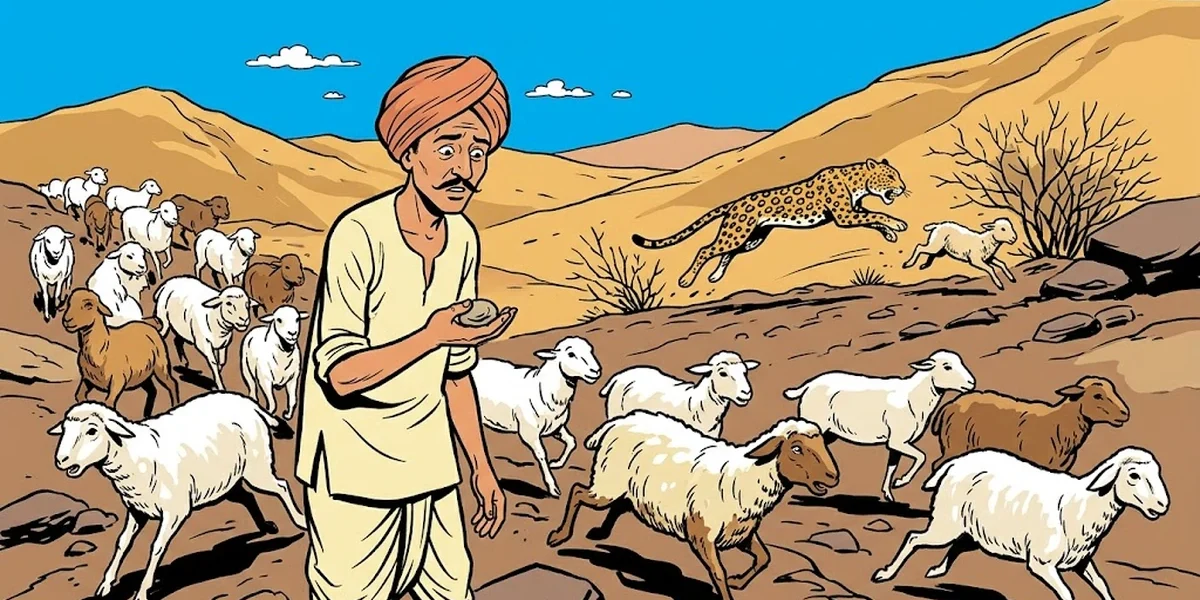
The Foolish Weaver — village shepherd on a Punjab hillside as a leopard attacks the flock

The Foolish Weaver and the leopard on a Punjab hillside

In the dust-blown villages of the Punjab, where artisans once stitched their lives into the warp and weft of cloth, a story grew up about a weaver who tried so hard to be obedient that he became a danger to everyone around him. The tale is short, sharp, and very old. It travelled across the bazaars of Lahore, the tea-stalls of Peshawar, and the mountain passes of the North-West Frontier long before any English traveller wrote it down. When Andrew Lang collected it for The Orange Fairy Book in 1906, he was preserving a Pashtun cautionary tale that had already been polished by hundreds of tellers, each one finding in the foolish weaver a familiar warning about the dangers of literal-mindedness in a world that demands judgement.

Folklorists later catalogued the story as a fusion of two of the world’s most travelled numskull motifs. The opening blunder — a servant told to throw a stone at a wild beast who instead crushes a sleeping woman by hurling one at a fly — is ATU 1586, “The Man Who Killed the Fly on the Sleeper’s Head”, found everywhere from the Indian subcontinent to the Aesopic corpus and the German Schildbürgerbuch. The closing blunder — seven companions who each forget to count themselves and conclude that one has drowned — is ATU 1287, “Numskulls Unable to Count Their Own Number”, the same tale Englishmen tell about the Wise Men of Gotham, Germans about the people of Schilda, and Persians about the Mullahs of Khorasan. The Punjabi version simply yokes both together, giving us one weaver foolish enough to commit them in a single afternoon.

I. A Servant Who Listens Too Well

The story opens, as so many cautionary tales do, with a man who is hungry. The weaver of the title has run out of work — perhaps the looms in his village are silent, perhaps the wool-merchants have moved on — and he hires himself out as a shepherd to a farmer in the hill country. The farmer is a careful man. He has spoken to the weaver and judged him slow, so he gives him meticulous instructions in everything he should do: how to count the sheep at dusk, how to bring them home down the goat-tracks, how to keep the lambs from straying. And then he says the line that will doom the day: “If a wolf or any wild animal attempts to hurt the flock, you should pick up a big stone like this” — and here he picks one up to demonstrate — “and throw a few such at him, and he will be afraid and go away.”

The weaver nods. He has understood every word, in the worst possible sense. When a leopard slinks down from the upper slopes that very afternoon and begins to scatter the flock, the weaver does not pick up the nearest stone. He runs home, the whole long way, to fetch the very stones the farmer had shown him in the courtyard. By the time he returns the leopard is gone, the lambs are dead or scattered across the hillside, and the farmer’s patient instructions have been turned into a slaughter by the very obedience that was supposed to prevent it. The farmer beats him soundly — village justice has always been swift — and snaps the question that gives the tale its philosophical heart: “Were there no stones on the hillside that you should run back to get them, you senseless one?”

Weaver lifting a stone over the sleeping old woman to drive flies

II. The Stone, the Fly, and the Old Mother

The next morning the farmer, sensing he can trust the weaver with nothing wilder than a fly, assigns him to sit beside an old, sick woman who lies on a charpoy in the shaded courtyard — the farmer’s mother. “To-day you shall stay at home and mind my old mother who is sick,” he says, with the tired patience of a man giving the safest task he can think of. “Perhaps you will be able to drive flies off her face, if you can’t drive beasts away from sheep.”

It is a quiet morning. The old woman dozes in the heat, and the flies, drawn by the warmth and her closed eyes, settle on her cheeks. The weaver looks around for something to drive them off. And here the previous day’s lesson rises up in him like a flood. The farmer had scolded him — rightly, he believes — for not picking up the nearest stone. He will not make that mistake again. So he reaches for the closest object he can find: a heavy paving-stone from the edge of the verandah. He raises it carefully, takes aim, and brings it down on the flies. The flies escape. The old mother does not. In one stroke, the weaver has converted his shame from yesterday into a tragedy from which there is no return, and he flees the village before the farmer can come home.

This pairing of motifs — the stone meant for a beast falling on a human, the human dying because a fool obeyed too literally — is the spine of ATU 1586. It travels widely. In a Pancatantra recension we meet the loyal but doltish monkey-servant who slays his sleeping king with a sword to drive away a bee, an episode preserved as the cautionary fable of mürkha-mitra, the foolish friend. In Aesop’s corpus the same logic appears as the moral aphorism that “a fool’s gift is more dangerous than an enemy’s wound.” The Sanskrit verse that traditionally crowns the Pancatantra version — varam śatrur na mūrkho hi mitram, “an enemy is better than a foolish friend” — carries the same warning the weaver now embodies, fleeing into the night while the farmer’s mother lies still upon her bed.

Seven weavers swimming through a dry ravine

III. Seven Weavers and a Dry Ravine

The weaver walks all day and all the next night, and at length comes to a village where many weavers live together — a textile-village of the kind that once dotted the Punjab and the cotton plains of Sindh. They welcome him as a brother of the loom, feed him, and tell him that in the morning six of them are setting out to buy fresh wool for the season’s weaving. Will he make a seventh? He will. So at dawn the seven weavers shoulder their bundles and set out across the country.

On their road they come to a ravine. In the rains it would be a roaring torrent — the kind of seasonal nullah that cuts the Pothohar plateau into ribbons — but the monsoon has long passed, and the bed is now nothing but sand and rock. The weavers, however, are men of habit. They have always swum across this ravine, and so they swim across it now: stripping off their clothes, tying them in bundles upon their heads, and breast-stroking earnestly through the dust. They reach the far bank scratched and bruised at the elbow, but otherwise none the worse, and there one of them, with the cautious instinct of a guild-leader, decides to count the party to make sure they are all safe. He counts every weaver but himself. Six. One of them is missing!

This sets every weaver counting, and every weaver makes the same fatal omission, until they are quite certain that one of their number has drowned in a dry ravine. They run up and down the bank, wringing their hands and weeping for the lost comrade who never existed. A passing farmer asks them what is the matter. “Alas,” says one of them, “seven of us crossed and only six remain.” The farmer eyes them for a moment, takes the measure of the situation, and reaches for his stick.

Farmer beating each of the seven weavers with a stick to count them

IV. A Magician with a Stick

The farmer raises his stick and brings it down on the back of the first weaver. “One!” he calls out. He turns to the second and strikes him in turn. “Two!” And so he proceeds, blow by counted blow, up the line of bewildered weavers, until the seventh man has felt the weight of the stick across his shoulders and the farmer has called out the number seven. The weavers, rubbing their bruised backs, look at one another in astonishment. There are seven of them. There were six only a moment ago. This wandering farmer has somehow conjured a man out of the empty air. They fall to their knees in gratitude, certain that they have met a magician of extraordinary power, and they spend the rest of their journey to the wool-market telling one another, in lowered voices, of the marvel they have witnessed.

This is the closing motif — ATU 1287, “Numskulls Unable to Count Their Own Number” — in its purest form. The same blunder is told in Britain about the Wise Men of Gotham, who count themselves into one short while wading the river Trent; in Germany about the Schildbürger of Schilda, who measure their guests with a length of twine; and in Persia about the simpletons of Khorasan, who travel together and weep for the missing companion who is, of course, the counter himself. The Punjabi version’s twist — that the “magician” who restores the missing man is in fact a farmer with a stick, dispensing arithmetic by way of a beating — preserves a flavour of village rough justice that the European versions soften.

Moral

varam śatrur na mūrkho hi mitram
“Better an enemy than a foolish friend.”
— Pancatantra, Mitrabheda, c. 3rd century CE

The Punjabi tale of the foolish weaver is not, as the title suggests, simply a joke at the expense of weavers. It is a meditation on the dangers of literal obedience without judgement. The weaver fails not because he disobeys the farmer but because he obeys him too well: he picks up the same stone, he applies the same rule, he refuses to use the eyes God gave him to see that the situation has changed. In the rule of the stone, the leopard becomes a fly, the fly becomes the farmer’s mother, and the obedient hand kills what it was meant to protect. The seven weavers fail in the same way: they apply the rule of swimming to a riverbed without water, and the rule of counting to a self they have forgotten to include. In every case the lesson is the same. A rule without a mind to weigh it is more dangerous than no rule at all.

Why This Story Has Lasted

The Foolish Weaver has lived for so long because the kind of foolishness it describes never goes out of fashion. Every generation finds itself cursed with new versions of the weaver: the bureaucrat who applies the regulation while the building burns, the soldier who follows the order without thinking what the order means, the manager who recites the policy at a customer who has clearly been miscategorised, the worker who counts six colleagues and forgets himself. The story is funny because we recognise this person. The story is dark because we suspect, in our quieter moments, that this person is occasionally us.

It has lasted, too, because of the particular comic precision of its construction. Two stupidities, mirrored across a single tale: in the first half the weaver fails by acting; in the second, the weavers fail by counting. In the first half a stone meant for a beast falls on a human; in the second a beating meant as confusion is taken for a miracle. The story’s structure does what the best folk tales do — it traps a moral inside a form so neat that the moral cannot easily escape. Children remember it because it is funny. Adults remember it because, having finished laughing, they discover that the joke is uncomfortably close to home.

And it has lasted because of the world it preserves. The dust-blown ravines of the Pothohar, the village courtyards with their charpoys in the shade, the wool-markets of the Indus plain, the long roads between weaving villages where seven men might walk together with their bundles — all of these are conjured up in a tale of less than a thousand words. When we read it today, we are not only laughing at a bad shepherd; we are walking, briefly, through a Punjab that flourished long before the cartographers of the Raj came to rename its rivers, and that lives on now only in stories like this one, faithfully copied from teller to teller across the slow centuries.

The Punjab That Made the Story

To understand why the foolish weaver became this particular kind of fool — obedient, literal, slow to see the difference between a wolf and a fly — it helps to know a little of the world the tale came from. The Punjab and the North-West Frontier of the late nineteenth century were dense with weaver communities. The cotton looms of Multan, the silk weavers of Lahore, the wool-spinners of the Pothohar — whole villages organised around the loom, with the older men teaching the younger, and a guild structure in which one walked, ate, and travelled to the wool-market with one’s fellow weavers. A man of this culture would not strike out alone for a wool purchase; he would join a party of seven, as the tale says, and they would set off as a group. The story’s detail of seven weavers walking together is not a fairy-tale invention. It is a piece of nineteenth-century Punjabi village reality, transmitted into the comic through nothing more than a missing self-count.

The figure of the weaver as a comic butt is older still. In Sanskrit dramatic and aphoristic literature the kuvinda, the weaver, often appears as a man of low cunning or low intelligence — sometimes both at once — standing in for the artisan-class who, in the eyes of brahmanic authors, lacked the discipline of the priestly castes and the courage of the warrior castes. By the time of the Pancatantra, weaver-jokes are already a recognised genre. The famous Pancatantra story of the Two-Headed Weaver, in which a weaver and a carpenter quarrel over a princess until the weaver makes a counterfeit double of himself with the carpenter’s help, plays on the same stereotype. So does the comic Bengali tale of the weaver who, asked to describe his own beard, gravely lifts up his hands as though to count it strand by strand. None of this means the real weavers of Punjab were fools — quite the opposite, they were among the most sophisticated tradespeople of pre-modern India — but a stereotype, once installed, takes generations to weave back out.

The Two Motifs in the Tale’s DNA

It is worth pausing on the precise folkloric machinery the story has assembled. The Aarne-Thompson-Uther index, the great twentieth-century catalogue of folk-tale types, places this Punjabi tale at the intersection of two very ancient lines.

ATU 1586, “The Man Who Killed the Fly on the Sleeper’s Head”, is one of the oldest comic motifs in world literature. The Indian recension is preserved in the Pancatantra under the title of mürkha-mitra — the foolish friend — and tells of a king with a doltish but devoted monkey-attendant who, seeing a fly settle on his sleeping master’s face, draws the royal sword and brings it down with full force. The king dies. The Sanskrit verse drawn from this story — varam śatrur na mūrkho hi mitram — passed into Persian as the saying that “a wise enemy is better than a foolish friend” and into Arabic through the Kalila wa Dimna translation of Ibn al-Muqaffa in the eighth century. From there it travelled into the medieval Latin Directorium Vitae Humanae of John of Capua and on into every European language. La Fontaine’s fable L’Ours et l’Amateur des jardins — the bear who kills his beloved gardener-friend by hurling a paving-stone at a fly on his nose — is the eighteenth-century French descendant of the same tale. The Punjabi weaver is one more cousin in this enormous family.

ATU 1287, “Numskulls Unable to Count Their Own Number”, has a parallel pedigree. The English version, the Wise Men of Gotham, was already in circulation by the fifteenth century, when the printer Wynkyn de Worde published a chapbook of Merry Tales of the Mad Men of Gotham. The German Schildbürgerbuch (1597) tells the same blunder of the citizens of Schilda. In Persian and Turkish folklore the missing-companion is a regular Mullah Nasruddin episode. The motif is so universal that it suggests a deep psychological truth: it is genuinely difficult to count oneself among one’s own party. The mind, performing the survey from the inside, forgets that the surveyor is also a surveyed object. The Punjabi tale dramatises this with a specifically Indian touch: the wandering farmer with the stick, who restores the missing weaver by means of a cheerful round of beatings, is a figure who could only have come from a culture where village justice was administered with a switch and the whole community accepted that learning sometimes happens at the end of a stick.

Reflection & Discussion

  1. The weaver fails twice for exactly the same reason. What is that reason, and where else in modern life do we see it?
  2. The farmer in the second half of the story is rough — he beats each weaver with a stick. Is the story endorsing his methods, or simply observing them with the dry neutrality of folklore?
  3. What does the story have to say about the difference between obeying a rule and understanding the purpose of the rule?
  4. Why might a culture of weavers, who in real life were highly skilled, have become the butt of a story about foolishness?
  5. The seven weavers are saved only because someone outside their group bothers to count properly. What modern situations does that mirror?

For Young Readers

This is one of the funniest old stories from the Punjab, and one of the saddest at the same time. The weaver is not a bad man. He is just a man who tries very hard to do exactly what he is told and never stops to ask whether the instructions still make sense. When he runs all the way home to fetch a stone, instead of picking up a stone from the hillside, he is being foolish in a way that grown-ups still recognise. When the seven weavers all forget to count themselves and decide one of them must have drowned, they are being foolish in a way you may have been foolish yourself once or twice — counting your friends and somehow leaving yourself out.

If you are reading this story aloud at home, try pausing after the leopard scene and asking the listener: “What should the weaver have done?” Then pause again after the seven weavers reach the dry ravine and ask: “Wait. Why are they swimming through sand?” Half the joy of these old tales is the chance to argue back at them. The story is not insulted. It has been argued back at by listeners for hundreds of years.

Moral of the Story
“Intelligence and quick thinking can overcome obstacles.”

Frequently Asked Questions

**Q: Why is this story important?**

This classic tale from the fairy tales collection teaches timeless lessons about virtue that remain relevant today.nnQ: What age group is this story for?nnThis story appeals to readers of various ages who enjoy traditional folklore and moral tales with deeper meanings.nnQ: How does this story reflect its cultural origins?nnAs part of the fairy tales collection, this story carries the wisdom and values of its cultural tradition through universal themes.nn

Get a New Story Every Week!

Join thousands of parents and teachers who receive our hand-picked folk tales every Friday. Stories with morals your kids will love.

Free forever. No spam. Unsubscribe anytime.