The Wise Jackal
A wise and brave jackal rescues two princesses from danger through kindness, courage, and clever thinking.
The Wise Jackal is an East Indian fairy-tale of two motherless princesses, a jungle palace whose inscription rewrites itself as you read it, and the small slender jackal who befriends the sisters and quietly steers them through every reversal that follows. The version that became canonical in English is the one Hartwell James retold for the Philadelphia publisher Henry Altemus Company in 1906, in The Magic Bed: A Book of East Indian Fairy-Tales, illustrated by John R. Neill — the same line-and-watercolour artist who would later become famous for the Oz books of L. Frank Baum. James drew his version from the great late-nineteenth-century English-language collections of Indian folk literature: Mary Frere’s Old Deccan Days, or Hindoo Fairy Legends Current in Southern India (John Murray, London, 1868), Maive Stokes’s Indian Fairy Tales (Ellis & White, London, 1879), Joseph Jacobs’s Indian Fairy Tales (David Nutt, London, 1892) and Pandit S. M. Natesa Sastri’s Tales of the Sun, or Folklore of Southern India (W. H. Allen, London, 1890). The story belongs to a family of South Asian “two sisters and a forest-house” tales that Hans-Jörg Uther catalogues under ATU 327 (the abandoned-children-and-ogre type), with strong overlay from ATU 510 (the Cinderella-disguise type) and ATU 451 (the lost-sister type) — three migratory frames that the Indian tellers wove together with quiet skill, hung on the small persistent figure of a friendly jackal whose patient counsel knits the whole tale together.
The Stepmother and the Jungle
The story opens in the manner of a hundred Indian household tales — at the threshold of a beautiful palace where two small daughters of a great Rajah have been left to fend for themselves. Their mother had died young; their father, busy day and night with the affairs of his throne, had married a second wife who treated the girls cruelly. Even the palace servants stepped softly around the new Ranee, for her temper carried farther than her voice, and the children’s plates were emptied of all the small comforts that had once been on them — the jaggery, the fresh wheaten cakes, the curd from the household buffalo. The elder sister was called Nala, the younger Dehra. They had inherited their mother’s sweetness; the elder was a finger taller and a shade more graceful, and the younger leaned on her sister in everything from her morning braid to her evening prayer.
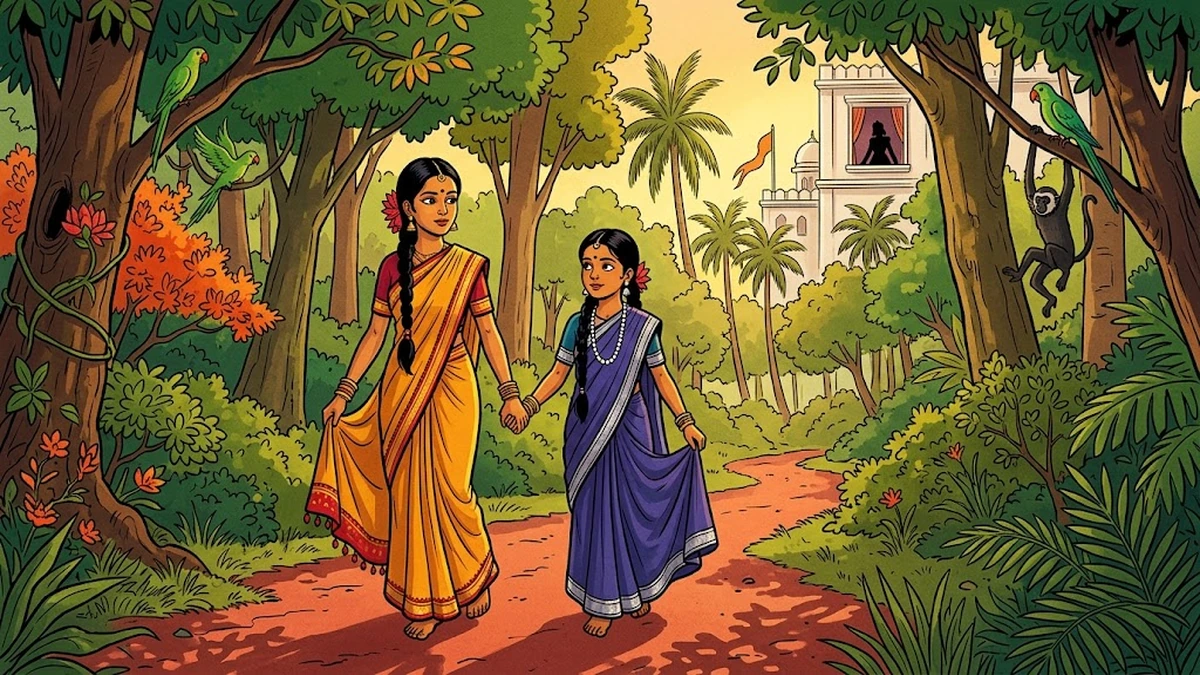
One twilight, with the bats just beginning to wheel out of the courtyard tamarind, Nala turned to Dehra and said the sentence that begins so many of the South Asian runaway-children tales — “Let us go.” They did not pack much. Nala wore her yellow silk saree with the row of small rubies stitched into a corner of the pallu; Dehra wore her blue silk with a string of river pearls. They tied their bangles tight on their wrists, slipped past the gardener as he beat the dust from a carpet, and walked out into the jungle that began at the third milestone of the royal road — the great thorn-and-mahua scrub where pug-marks of leopard and the ash of cooking-fires from old fakirs lay layered together on the path. They walked all afternoon, and they walked into the cool of the evening, and at last in the slow long Indian dusk they came upon a sight that made them both stand still and forget the dust on their feet.
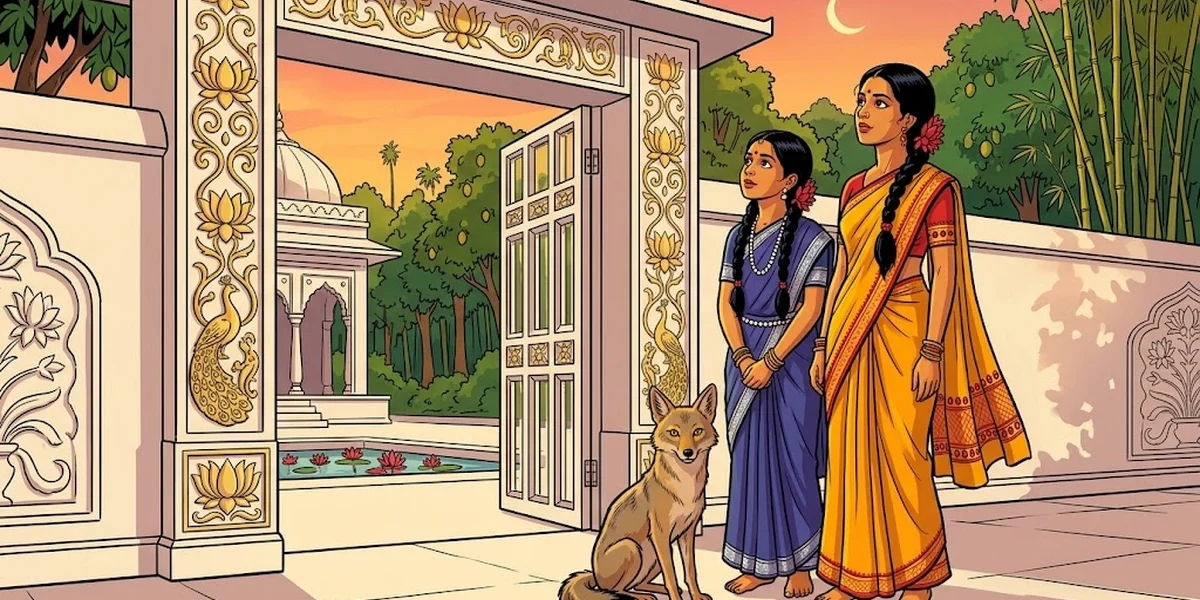
Before them, at the heart of a clearing, rose a small white marble palace — the kind that Mughal princes built as hunting lodges in the cool months — with mango trees set around it and a great gateway that stood wide open as if it had been waiting for them. And over the gate, in golden letters as fresh as new paint, was written a small couplet that seemed to be addressed by name to the elder of the two sisters:
“Enter, Nala, do not fear;
Silver and gold await you here.”
Even as Nala read those lines, the letters shimmered, rearranged themselves, and the inscription showed a different couplet — this one addressed by name to the younger:
“Follow her, Dehra; you shall see
How kind and cruel Fate can be.”
The girls looked at each other in the twilight. “Mine is the colder verse,” Dehra said softly. “It makes me feel shivery.” Nala took her hand. “Mine is no warmer, sister. I think this palace must belong to a Rakshas.” The word — raksasa in the Sanskrit, “ogre” in plain English — was the proper name in every Indian household tale for the kind of man-eating night-creature that was said to keep store-houses of jewels and silks in the deep jungle, the better to lure travellers who would not come willingly to be his supper. The two sisters had begun to step backwards from the gate when a small voice rose from the scrub at their feet.
The Friend at the Gate
It was the jackal — a slender little forest jackal with a friendly face, the sand-grey colour of dry mahua leaves, his amber eyes shining and his ears alert. The jackal of Indian folk tale is not the savage scavenger of the European bestiary but the wise small commentator of the village imagination — close kin to the shrigala of the Pancatantra and the Hitopadesha, who in the Sanskrit tradition is more clever than the lion and more honest than the priest. This jackal greeted the princesses with the easy courtesy of an old neighbour. “The Rakshas has gone away on his evening errand,” he told them, “and you may stay quite safely in his palace for as long as you wish. I will let you know when he is coming home.” So the sisters thanked the small forest-creature, and stepped through the gate into the courtyard.
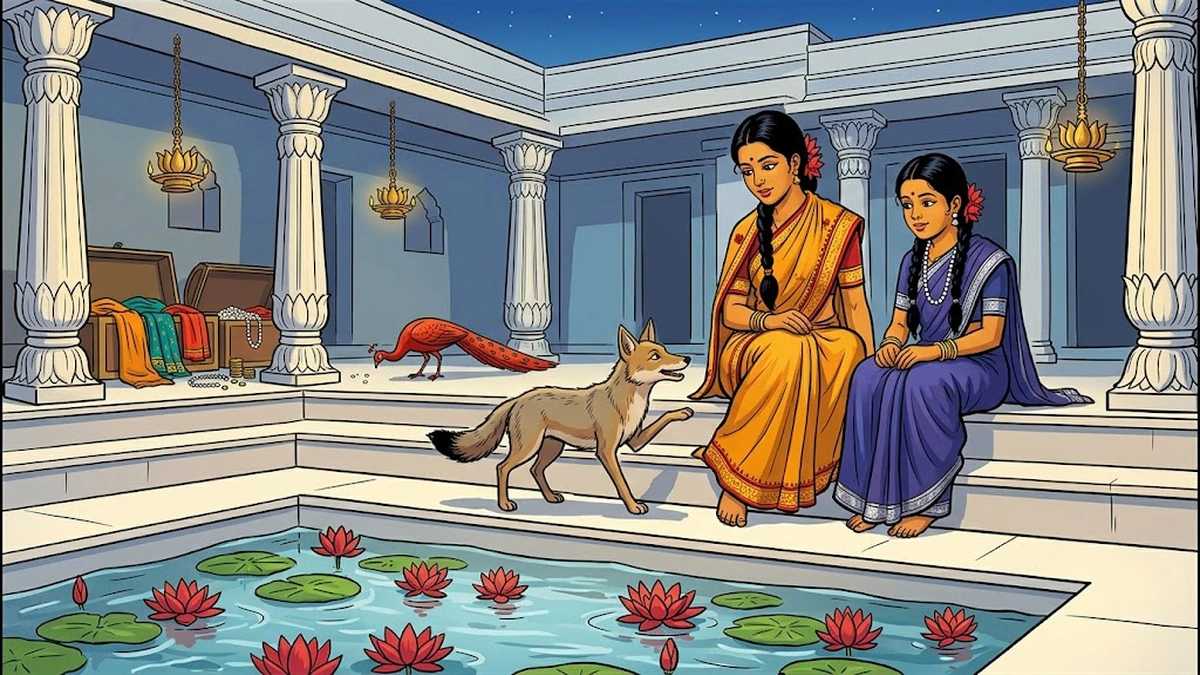
Inside the palace there was every comfort that two royal children could have asked for. The Rakshas had filled his treasure-rooms with bolts of silk in every dye of the bazaar — saffron, peacock, indigo, vermilion — and with chests of gold mohurs and silver rupees and trays of unstrung pearls. There were beds with red lacquered legs and lamps in the shape of brass lotuses and ivory combs and bottles of attar of rose. Best of all there was a great marble bathing-tank in the courtyard, fed by a clear spring, and on its surface floated red lotus flowers — the royal lotus, the raktakamala, that princesses are entitled to wear in their hair. Each morning Nala and Dehra rose at first light, bathed in the tank and twisted lotus-petals into their black braids; through the day they walked the cool corridors with their bangles whispering and their bare feet leaving small prints on the white marble; in the long blue evenings they sat on the steps of the tank and the jackal came up out of the dhak-grass and lay at their feet, and they fed him bits of fresh roti and listened to the small commentaries he made on the affairs of the forest.
“There is one rule,” Nala told her sister, on the third evening. “If a stranger comes to the gate when one of us is alone here, you must rub charcoal on your face and put on the oldest red rags you can find before you let him in. We are too well-known by our beauty. Some hunting prince will see us and carry us off, and then we shall be parted.” Dehra agreed at once. They both knew the proverb that runs through every Indian girl’s upbringing — that beauty is a deer that travels best at night.
The Splash of Water
The danger came almost at once. One mid-afternoon, while Dehra had wandered out to the shade of a peepal tree to talk to the jackal, a young prince of the next country rode into the clearing at the head of a small hunting-party, his white horse damp with sweat and his attendants asking for water. Nala heard the clatter of hooves and remembered her own rule. She rubbed a fresh stick of charcoal across her cheeks and forehead, threw a torn red cotton saree over her yellow silk, made her hair untidy with a quick movement of her hand, and went barefoot to the gate carrying a clay pitcher.
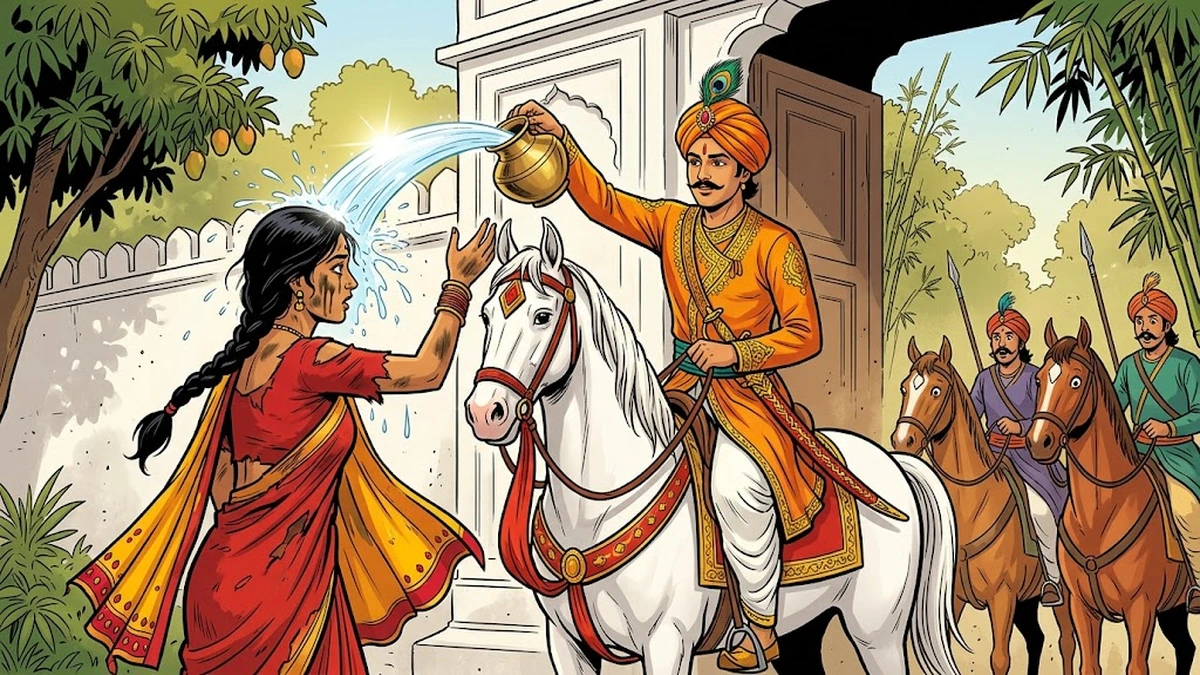
The attendants laughed when they saw the smudge-faced country girl, but the prince was a thoughtful young man, and his eye saw past the charcoal to the small clean line of the chin and the gold flash of the bangle on the wrist. He took the pitcher politely; then, with the small mischievous courage of a man who suspects he is being deceived, he poured a portion of the water not down his own throat but over the head of the girl in front of him. The charcoal ran in dark streaks across the white marble. The torn red saree slipped from Nala’s shoulders. And there she stood in the noon sun, in her yellow silk and her ruby pallu and her bangles and her bare feet, with the water still bright in her eyebrows, the loveliest girl that the prince had ever seen even at the courts of his father.
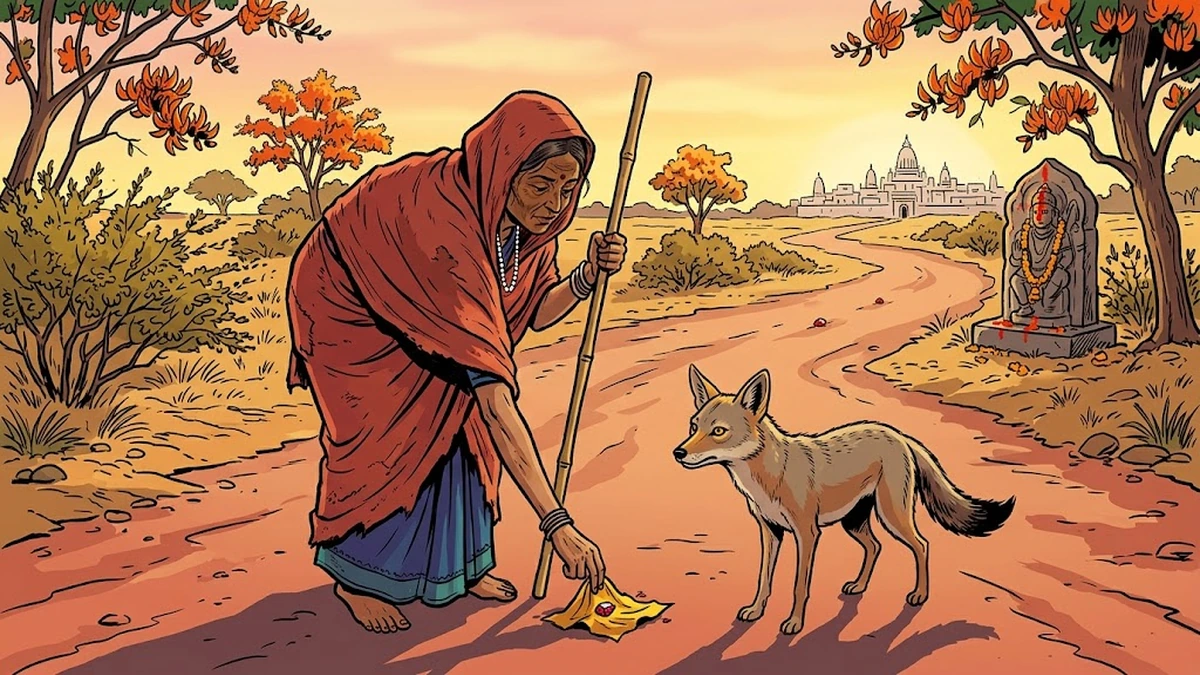
“You shall be my wife,” he said, in the simple way of princes in folk-tales who have made up their minds. He did not so much ask as announce. A palanquin was brought up out of the baggage train. Nala — who had heard the unwritten law of her caste all her childhood, that an unwed daughter does not refuse a king — was carefully placed inside the palanquin between cushions of crimson silk; the prince mounted his white horse again; and the small green column of riders moved away into the jungle, with Nala already weeping behind the curtains and saying, “Oh Dehra, Dehra, what will you do without me?” Then a quick instinct came over her. She tore a tiny corner off her yellow saree, wrapped one of her rubies in it and dropped the small bright bundle on the path. A stride farther on, she did the same. And again. And again. By the time the little column came at evening to the gates of the prince’s father’s white-walled city, Nala had only one ruby left; she dropped it just outside the gate, and whispered to herself, “If Dehra remembers the verse — follow her, Dehra — these will lead her to me.”
The Trail of Rubies
That same evening, Dehra came back from her walk to find the great marble palace empty and her sister gone. She ran from chamber to chamber calling, “Nala! Nala!”, and the only answer was the soft sound of the lotus pads moving on the water in the empty tank. She sat down on the steps of the tank in the gathering dark and she would not move. After a long while the jackal came out of the dhak and sat down beside her. “I have just one piece of news,” he said quietly. “The Rakshas is on his way back. You must leave the palace tonight.” Dehra wept, and the jackal — who had been watching her closely for a longer time than she knew — added, with the dry kindness that small forest creatures know how to give: “It is sure to come right at the end. I have seen many things in this jungle. Will you let me help you find your sister?”
So the wisest jackal of all the great Indian wisdom-collections — the shrigala of the Pancatantra, the kotthaka of the Pali Jatakas, the patient counsellor of the village imagination — set himself to bring Dehra by safe roads through the dangerous country between the Rakshas’s palace and the city where Nala had been carried. He showed her a low-growing herb that, rubbed on the cheeks, turned the skin a wrinkled and unlovely brown. He fetched her in his small clean teeth a coarse red cotton saree drying on a thorn-bush at a washerwoman’s hut. He warned her not to speak above a whisper, and never to lift her veil when the soldiers of any local raja rode by on the road. With his sharp small eyes he found the first ruby in the dust of the path — a tiny bright bundle in yellow silk — and then the second, and then the third, and as the days went on he led her along the line of small bright stones the way a careful field-mouse follows a line of grain.
At the edge of the open country he stopped. “I cannot come further with you, sister,” he said. “Where there are men there are dogs and stones and arrows for jackals. You must go forward alone now. Trust your own feet, and trust the rubies.” Dehra wept again, and bent down, and touched her forehead lightly to the jackal’s small grey one in the old gesture of farewell that only the very young and the very old of India use. Then she went on, an old wrinkled-looking pilgrim woman in a coarse red saree, picking her way one ruby at a time, until at the city gate she found the last ruby of all, glittering in the dust beside the foot of a sentry who had not noticed it.
The Bath in the Lotus Tank
Inside the city, an honest wood-cutter’s wife — feeling the small involuntary pity that good women of the Indian villages have always felt for tired old pilgrims — took the supposed crone into her hut for the night. From this hut Dehra could see, just over a low brick wall, a beautiful marble bathing-tank covered in red lotus flowers. The very same red lotus, she saw, that had floated in the Rakshas’s tank in the jungle: the royal flower, the flower that princesses may wear. Her heart turned over in her chest. Each morning before the city was awake, while the Brahmin priests were still ringing their first temple-bells, Dehra slipped through the garden gate and bathed in the king’s tank. The herb-stain came off her face. The wrinkles dissolved into the still water. She washed the ragged red saree and hung it on a low neem branch to dry, and from a fold inside it she drew out her own folded blue silk saree and her chain of pearls. With red lotus petals worked into her braid she sat on the marble steps of the tank, looked at her reflection in the still water, and felt herself become Dehra again.
This went on for several mornings until the Rajah’s gardeners came to him in puzzlement and reported that someone was stealing his lotus flowers before sunrise. The Rajah grew angry and announced a reward; but his second son — a thoughtful young prince, only a year younger than the elder son who had married the dust-stained girl in the jungle — said, “Father, give me one night. I shall catch your thief without a reward.” So that night the prince hid himself in the bamboo shade by the tank. He meant to keep watch all night; but the dew was heavy and the lotuses gave off their sleep-fragrance, and the prince fell asleep just before dawn. When he opened his eyes the sun was just beginning to silver the marble, and there, leaning against the steps of the tank, in a blue silk saree and a chain of pearls and red lotus flowers in her hair, stood the loveliest young woman he had ever seen even at his father’s court.
“You are no thief,” he said, jumping up. “These are my father’s flowers, and you may have as many as you wish.” Dehra ran in alarm to fetch the old red saree, but the prince blocked her with his open hands and said with a kind of wonder, “You speak with the accent of the Rajah’s other daughter-in-law — she who is married to my elder brother and is called the Star of the Palace. Have you come from Nala’s country?” At those last words the old red saree fell from Dehra’s hands. “Is Nala here?” she whispered. “Is my sister truly here?” The prince led her by the hand straight into the inner chamber where Nala sat in heavy silks and a sad face that had not lifted in a month. The two sisters held each other and the prince’s father — quietly delighted that his second son had also found a worthy bride — gave the marriage his blessing within the same hour. And Dehra said, almost in a whisper, the small sentence she had carried in her chest all the way out of the jungle: “The jackal told me everything would come out right in the end. And so it has.” Nala kissed the top of her head and answered, slowly: “He is a wise jackal. The golden letters above the Rakshas’s gate ought to be changed.” She thought a moment, and then said the lines that have closed every retelling of this story since 1906:
“Seek long, seek far, and you shall find:
To patient seekers Fate is kind.”
Moral
The deepest moral of The Wise Jackal is the proverb that the elder Indian grandmothers murmur into the heads of frightened children at the end of any reverse — that fortune is not a single hand of cards dealt out at the start of life, but a long quiet road on which patience, kindness and small loyalties keep travelling alongside fate until the right door opens. The two princesses suffer twice — first at the hand of a stepmother, then at the lonely separation in the forest — and the storyteller does not pretend either suffering away. What the storyteller insists, however, is that small acts of love (Nala dropping a ruby for her sister with every step, Dehra refusing to abandon hope at the empty tank, the jackal trotting across miles of dust on his clever paws) accumulate into a larger ledger than any cruelty can balance. The single Sanskrit-derived Hindi verse that the village tellers attach to this tale captures the moral exactly — and it is the verse that South Asian parents still mutter when a child cries that life has been unfair:
“धैर्य का फल मीठा होता है”
(dhairya ka phal meetha hota hai)
— Hindi household proverb
“The fruit of patience is sweet.”
The proverb is not original to The Wise Jackal. Variants of it appear in the Sanskrit Hitopadesha (Mitralabha 1.155: kalaḥ-kalaḥ pratiks̃eta, “wait through time and time”), in the Pali Khuddaka-paṭha, in Kabir’s couplets and in Tulsidas’s Ramcharitmanas. But it sits with particular precision on top of this small tale, because the tale’s whole architecture — the runaway, the false haven, the splash of water, the trail of rubies, the lotus-tank reunion — is a long demonstration that what looks like loss is often the slow opening movement of restoration. The wisdom that the small jackal carries is that lesson in animal form, and the storyteller has always known what he is doing in giving it to the smallest, most ordinary creature of the Indian forest rather than to a tiger or a peacock or a sage. The wisdom that helps you survive is rarely the wisdom of strength.
Historical & Cultural Context
The English-language version translated above is the one Hartwell James published in The Magic Bed: A Book of East Indian Fairy-Tales (Henry Altemus Company, Philadelphia, 1906), with the colour plates and full-page line illustrations of John R. Neill — the artist whose work the same generation of American children knew from the second through the fourteenth Oz books. Hartwell James was the pen-name of the British-born American children’s writer William Henry Pierson; his five-tale Indian volume sat alongside companion volumes (The Enchanted Castle, an Italian collection; The Jewelled Sea, a Persian collection) as part of the Altemus “Wonder Stories” series for the Christmas trade. James, like all popular retellers of his generation, drew his material directly from the great late-Victorian English-language collections of Indian folk literature. The Rakshas-palace, the trail of jewels and the lotus-tank reunion are all motifs that he assembled and re-coloured from earlier sources — chiefly Mary Frere’s Old Deccan Days, or Hindoo Fairy Legends Current in Southern India (John Murray, London, 1868), which set the English-language tone for the Indian household tale; Maive Stokes’s Indian Fairy Tales (Ellis & White, London, 1879), collected from ayahs and khansamahs in the Anglo-Indian households of Calcutta; Pandit S. M. Natesa Sastri’s Tales of the Sun, or Folklore of Southern India (W. H. Allen, London, 1890); and Joseph Jacobs’s Indian Fairy Tales (David Nutt, London, 1892).
Hans-Jörg Uther’s The Types of International Folktales (FF Communications 284–286, Helsinki, 2004) catalogues the tale as a hybrid of three migratory types: ATU 327 “The Children and the Ogre,” in which two children flee danger and find a temporary haven in a man-eater’s house; ATU 510 “Cinderella and Peau d’Âne,” whose fingerprint is the charcoal-disguise of the heroine and her chance discovery by a hunting prince; and ATU 451 “The Maiden Who Seeks Her Brothers” (here turned into “The Maiden Who Seeks Her Sister”), with the scattered-objects trail that lets the seeker follow the lost one. Stith Thompson’s Motif-Index of Folk-Literature (Bloomington, 1955–1958) catalogues the tale’s central narrative units as B450 “Helpful birds and animals” (the jackal), D1610.1 “Speaking inscription” (the gold-letter rhyme that rewrites itself), K521.1 “Disguise as a person of low caste” (the charcoal-and-rags trick), R135.1 “Trail of objects” (the dropped rubies), and N825.3 “Old man (woman) helper” (the wood-cutter’s wife who shelters the disguised Dehra). The figure of the wise shrigala traces back at least to the third- or fourth-century Sanskrit Pancatantra of Vishnu Sharman, where the jackals Karataka and Damanaka are the two great talkers of book one (Mitra-bheda); and more directly to the helpful jackals of Pali Jataka 175 (Sigala-Jataka) and 113 (Sigala-Jataka II), where the Bodhisattva himself takes jackal-form to teach upaya, “skill in means.”
The deeper Indian texture of the tale — the courtyard tamarind, the red-lotus-covered kalyani tank, the Rakshas as guardian of unimaginable wealth, the prince on a white horse, the palanquin as the conveyance of the bride — is drawn from the lived nineteenth-century reality of the Deccan and southern Maratha countryside as Mary Frere recorded it from her father’s ayah, Anna Liberata de Souza, between 1865 and 1867. The motif of the inscription that rewrites itself as the reader watches has Sanskrit ancestors in the Kathasaritsagara of Somadeva (Taranga 25, the cave-mouth that announces its riddle in successive verses); and in the broader Asian tradition appears in the Tibetan rNam-thar hagiographies and the Chinese Liaozhai zhiyi of Pu Songling. The trail-of-jewels motif is best known to European children as the Hansel-and-Gretel pebble-trail (KHM 15, ATU 327A), but the Indian version is older: it appears in the Pali Mahosadha-Jataka (no. 546, in Cowell’s Jataka or Stories of the Buddha’s Former Births, Cambridge, 1895–1907) and in the Sanskrit Vetala-Pancavimsati (“Twenty-Five Tales of the Vampire”) preserved in Somadeva. The double-prince marriage that closes the tale — two brothers wedding two sisters in a single ceremony — has its prototype in the Ramayana’s account of Rama’s brothers Bharata, Lakshmana and Shatrughna marrying the sisters Mandavi, Urmila and Shrutakirti at Mithila, and is one of the small structural pleasures the South Asian household tale uses to signal that the reversal is complete and the world has been put back in order.
Reflection & Discussion
- Why does the storyteller make the inscription over the gate change as the two sisters read it? What is the difference between Nala’s couplet and Dehra’s, and what does that small literary trick teach the children listening to the tale about how the same fate can fall differently on two souls?
- Nala’s first action when she is carried away in the palanquin is not to weep alone but to drop a ruby for her sister. What does that single decision tell you about the way the tale measures love?
- The jackal is the only creature in the story who knows what is happening from beginning to end. Why do you think the storytellers gave that part to the smallest and least-feared animal of the Indian forest, rather than to a tiger or a parrot or a holy man?
- Dehra has to disguise herself as an ugly old woman before she is allowed to walk the open road in safety. Boys in this story walk the road as themselves; girls have to hide their beauty to survive. What is the storyteller saying about the world the listening children are growing up into?
- At the end of the tale Nala asks for the inscription over the Rakshas’s gate to be changed. Why is the rewriting of the verse — and not the marriage, or the kingdom, or the jewels — the storyteller’s chosen ending?
Did You Know?
- Hartwell James was the pen-name of William Henry Pierson, a British-born American writer for children whose retellings of Indian, Persian, Italian and Polynesian folk-tales sold tens of thousands of copies in the United States between 1900 and 1915.
- The illustrator of The Magic Bed, John R. Neill, went on to illustrate the second through the fourteenth books of L. Frank Baum’s Oz series, and is the artist whose drawings most modern American readers picture when they think of the Tin Woodman or the Scarecrow.
- The “Rakshas” of the Indian household tale is the same raksasa who appears in the Ramayana — the demonic warrior-race ruled by Ravana of Lanka — but in the children’s version he has shrunk into a kind of solitary jungle ogre, more like a lonely landlord than an army of demons.
- The red lotus (raktakamala) is the flower of the goddess Lakshmi, consort of Vishnu, and is reserved for royal women in the iconography of the Pala and Chola dynasties; the storyteller’s careful insistence that Nala and Dehra wear the red lotus is a coded signal that they are princesses of true royal blood, even when they are dressed in old red rags.
- The trail-of-objects motif (Stith Thompson R135.1) appears across Eurasia from Pali Buddhist literature to the Brothers Grimm’s Hansel and Gretel, and the Indian version with rubies in folded silk is one of the prettiest in the whole catalogue.
Why This Tale Still Matters
The Wise Jackal belongs to that small and precious family of South Asian household tales that quietly teach Indian children — and now, through the Hartwell James retelling, American and English children — that fortune is something that has to be walked towards rather than waited for. The two princesses are not rescued by magic. They are rescued by a string of small, ordinary actions: by Nala’s quick-wittedness with the charcoal stick and the dropped ruby, by Dehra’s refusal to give up at the empty tank, and above all by the patient companionship of a small forest jackal who has neither sword nor spell but simply knows the country and is willing to walk the long miles of it on quiet feet. That moral economy — the conviction that loyalty and patience are themselves a form of fortune — is the deep grammar of every good Indian folk tale; it sits under The Wise Jackal as it sits under the Pancatantra and the Hitopadesha and the Jataka stories, and it is one of the gifts that South Asian grandmothers have been quietly handing down to their grandchildren for a very long time.
The tale also teaches, very softly, the ethics of female friendship under the conditions of an arranged-marriage culture. Nala does not abandon Dehra when she is carried off to a palace; Dehra does not curse Nala when she finds the jungle palace empty. Each sister assumes the best of the other and walks the long road of recovery towards her, and the two find each other again across an entire countryside because of nothing more than mutual loyalty and a handful of dropped rubies. For young Indian girls listening to the story in the long village evenings, the lesson is the older sister’s lesson — that nothing in the world ever entirely separates two children who share a mother. The tale is one of the small Indian classics of sisterhood, and it is still loved across the subcontinent because it tells that truth without ever raising its voice.
Finally, The Wise Jackal is a small and clear example of why the Indian folk-tale tradition has never lost its hold on the imagination of children. The story moves at a kind walking pace; it has the gentleness that the Pancatantra calls komal-bhasa, the soft tongue; it teaches without sermonising; it lets a small animal carry the largest part of the wisdom; and it ends with a couplet that the children themselves can chant as they fall asleep — seek long, seek far, and you shall find: to patient seekers Fate is kind. That sentence, more than any throne or wedding or treasure, is the real gift of the tale, and is the reason South Asian and American children have gone on reading it for more than a hundred and twenty years.
Frequently Asked Questions
**Q: Why is this story important?**
You May Also Like
 Indian Folk Tales
Ages 3-5
Indian Folk Tales
Ages 3-5
How Raja Rasalu Journeyed To The City Of King Sarkap
How Raja Rasalu Journeyed To The City Of King Sarkap: Now, after he had reigned a while in Hodinagari, Rasâlu gave up his kingdom, and started off to play
 Indian Folk Tales
Ages 3-5
Indian Folk Tales
Ages 3-5
Jwaala Ghat
The night was eerie and the eclipse cast shadows of terror. Jwaala, a young girl, gathered her village and taught them the science of celestial events.
 Indian Folk Tales
Ages 3-5
Indian Folk Tales
Ages 3-5
Peasie And Beansie
Peasie worked steadily in her garden while Beansie sought shortcuts. When harvest came, Peasie's patience yielded abundance; Beansie reaped only regret.