The King Who Would See Paradise
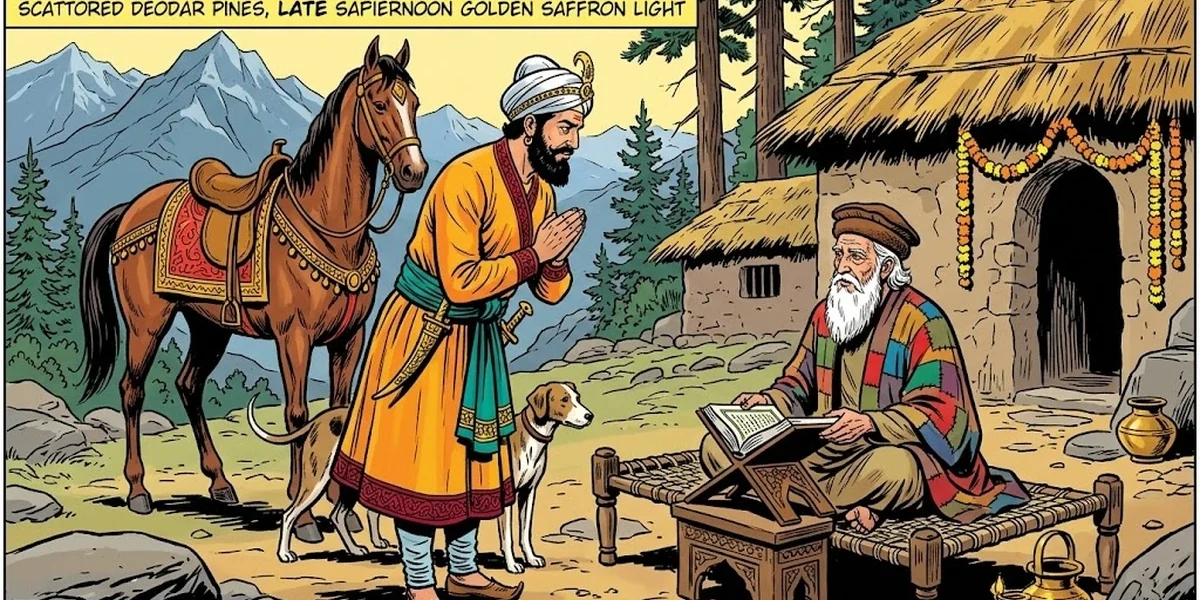
The King Who Would See Paradise: Once upon a time there was king who, one day out hunting, came upon a fakeer in a lonely place in the mountains. The fakeer
The King Who Would See Paradise is a Pathan (Pashtun) folk tale from the high Hindu Kush and Sulaiman mountains of the old North-West Frontier of British India, gathered in the late nineteenth century by Major Campbell from a Pashto storyteller and published in Andrew Lang’s The Orange Fairy Book (Longmans, Green & Co., London, 1906), retold by Mrs Leonora Blanche Lang and illustrated by H. J. Ford. In a few luminous pages it joins one of the oldest threads in world folklore — a thread that runs through the Quranic Surah Al-Kahf, the Talmud of Honi ha-Me’agel, the Buddhist Pali Niddesa, Hindu Puranic accounts of King Kakudmi visiting Brahma, the Christian Seven Sleepers of Ephesus, the Japanese fisherman Urashima Tarō, the Irish bard Oisín in Tír na nÓg, and Washington Irving’s Rip Van Winkle. The motif: a single moment in the otherworld eats up a human lifetime, and the traveller comes home to find that everything he loved has turned to dust.
Origin and Canonical Attribution
The earliest written witness to this exact recension is Andrew Lang’s The Orange Fairy Book, 1906, where it appears as the third tale, “Story of the King Who Would See Paradise,” followed by the bracketed editorial note: [A Pathan story told to Major Campbell.] The Lang Coloured Fairy Books (1889–1910) were a twelve-volume household library that did more than any other Victorian project to bring oral folk tales of the British Empire — Indian, Persian, Turkish, African, Polynesian, Native American — into English nurseries. Andrew Lang (1844–1912), the Scottish folklorist, classicist and anthropologist, edited each volume; his wife Leonora Blanche Lang (1851–1933) did most of the translating and retelling, including the work on this Pathan tale; and Henry Justice Ford (1860–1941) supplied the celebrated colour and ink illustrations whose Indo-Persian costuming influenced four generations of children’s-book artists.
The collector named in the bracket, Major Campbell, is the same officer who supplied “The King Who Would Be Stronger Than Fate” to Lang’s Brown Fairy Book (1904); both tales are reported as taken down on the North-West Frontier from Pashto-speaking informants, very probably during military service in the Khyber, Kohat or Waziristan agencies of British India. The full Project Gutenberg edition (eBook #15238) preserves the 1906 typography and Ford’s plates. Pakistani folklore scholars working in the long tradition of Romesh Chunder Dutt and Aurel Stein — including Khurshid Hasan Hashmi (Peshawar Folklore Society) and Ali Husain Mir — list the tale among the canonical Pakhto wisdom narratives of the trans-Indus belt.
Comparative folklorists have indexed the tale firmly within the international tale-type system. Hans-Jörg Uther’s The Types of International Folktales (FFC 284–286, Helsinki, 2004) places it under ATU 471A “The Monk and the Bird” — the central plot of “centuries pass during a single moment of paradisal vision” — with strong contamination from ATU 470 “Friends in Life and Death”, ATU 681 “Relativity of Time”, and the punishment frame of ATU 750A “The Wishes”. Stith Thompson’s Motif-Index of Folk-Literature catalogues the underlying motifs as F377 “Supernatural lapse of time in fairyland,” D2011 “Years thought days,” F112 “Journey to land of dead,” F171.6 “Otherworld journey through tomb,” V510 “Religious visions,” Q331 “Pride punished,” and L410 “Proud ruler humbled.”
Cultural and Religious Setting: Pathan Sufi Frontier
To read this tale rightly one must hold the Pathan world of the late-nineteenth-century North-West Frontier in the mind’s eye. The “lonely place in the mountains” where the king meets the fakeer is no abstraction. It is the cold, stone-strewn upland country of the Sulaiman Range and Spin Ghar — the country of the Yusufzai, Afridi, Khattak, Mahsud and Shinwari tribes — where for almost a thousand years Sufi faqirs (Persian: darvish; Arabic: faqīr, “the poor one”) have kept solitary chilla-khanas, retreat-cells, in caves above timber-line. The fakeer’s “patched cloak” in Lang’s translation renders the Sufi khirqa muraqqa’a — the symbolic garment of poverty stitched from a hundred coloured fragments, sign of initiation into a tariqa (Naqshbandi, Qadiri, Suhrawardi, Chishti). His “little old bedstead” is the woven charpai rope-cot universal to Pathan village and hermitage alike.
The tale’s moral architecture is fully Islamic, and specifically Sufi. It glances at three Quranic passages whose theme is the relativity of time and the punishment of unbelief through unwanted vision. The first is Surah Al-Baqarah 2:259, in which a man passing a ruined town doubts the resurrection, is caused by God to die, and is raised after a hundred years to find his food still fresh while his donkey is bones. The second is Surah Al-Kahf 18:9–26, the Companions of the Cave (Aṣḥāb al-Kahf), seven youths who hide from a tyrant in a mountain cave and wake three hundred and nine years later to find a new world. The third is Surah Yā-Sīn 36:52, the cry of the resurrected — “Who has raised us from our sleeping-place?” — so closely echoed by the king’s bewilderment in the durbar hall.
The fakeer’s first warning to the king — that he asks “a very difficult, and perhaps a very dangerous thing” — speaks the doctrine of tawakkul (trust in God) and ṣabr (patient endurance) which structures all Sufi practice. To force the unveiling of the unseen (ghayb) before the appointed hour is, in the Sufi reading, the very sin of Iblis: presumption, demanding evidence of what only obedience and longing can earn. The tale dramatises a Pathan saying still current in the Tirah valley: “Beygunaha de da khpal mughazi sara mat shi” — “the rash man breaks himself against his own desire.”
Movement One — The Hunt and the Bargain
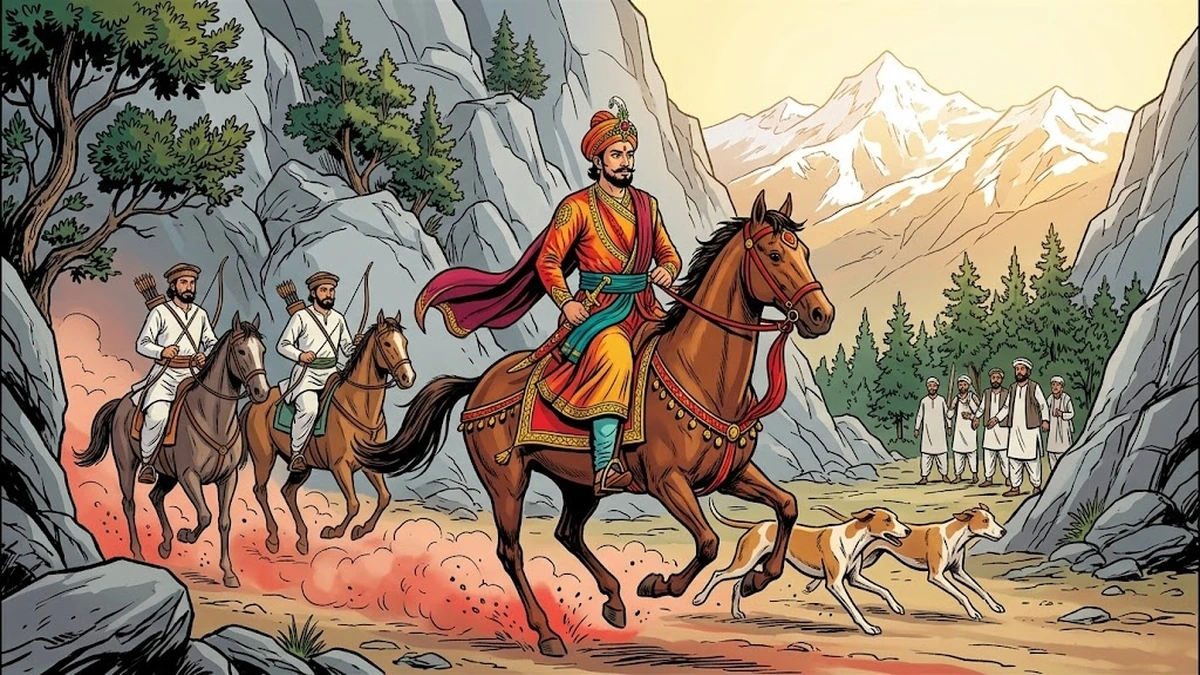
The opening movement is exact and economical: a king at the chase, riding deeper into the hills than his huntsmen, comes upon a faqir alone with the Koran. Pathan storytellers traditionally use this device — the wandering ruler stumbling upon the saint — to mark a collision of two opposite kinds of wealth. The king has gold, soldiers, signet, durbar, throne and pleasures; the faqir has a charpai, a patched cloak, and the only thing the king cannot buy, which is direct knowledge of paradise (jannah). Already the comparison is uneven; already the listener knows where this is going.
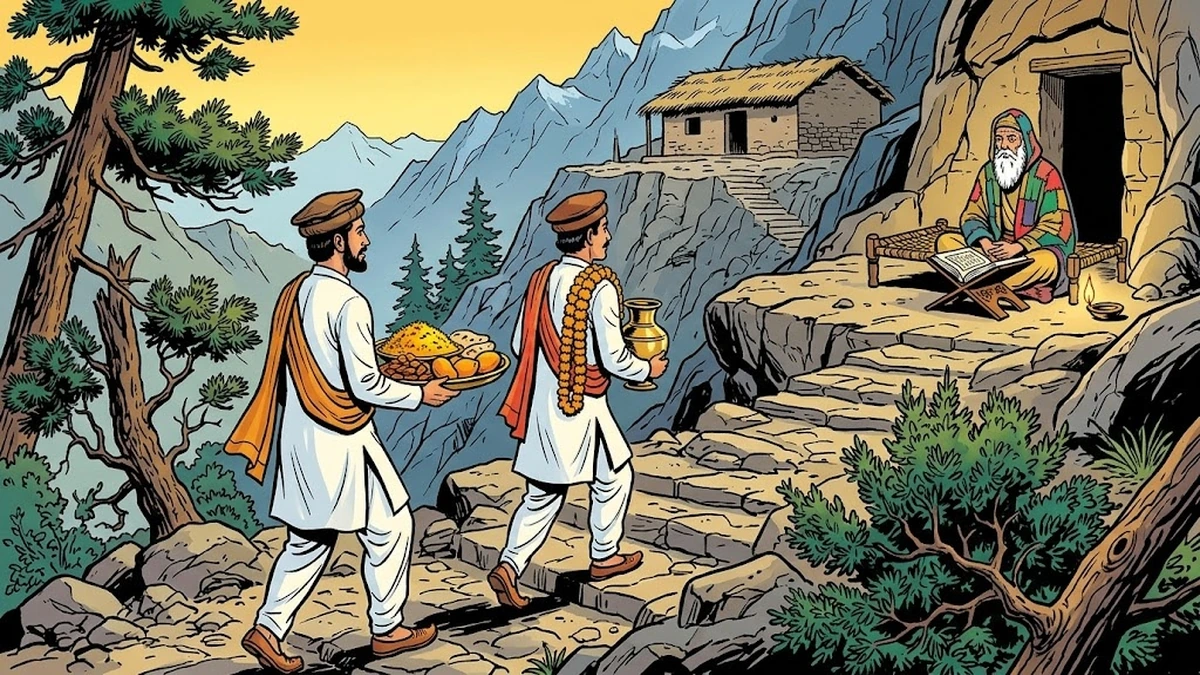
The bargain that follows is precisely calibrated. The king will provide food (nafqa, the lawful sustenance) for life; the fakeer will pray for him and, when fitting, will show him paradise. To the unhurried Pathan ear this is a contract weighted heavily against the king. The faqir gives nothing visible immediately; the king’s gift is a slow, patient, daily duty. This is the inversion that animates the whole tale. To buy paradise, you must first learn to give without seeing what you receive.
Movement Two — Two Years of “Not Yet”
For two years the food goes up the mountain and the answer comes back: “Not yet, not yet!” This twice-spoken “not yet” is the still centre of the tale. It is the answer of every authentic spiritual master — Mansur al-Hallaj’s “hanūz wakt nadārid,” “the time has not yet come”; the Buddhist akāla, “out of season”; the Talmudic “lo zo ha-derekh,” “this is not the way.” The Pathan storyteller draws the listener into the king’s growing, unworthy frustration. Two years of feeding a mountain hermit is the longest spiritual exercise the king has ever undertaken; he wants the receipt cashed.
The tale-type’s deeper warning surfaces here. The faqir’s repeated “not yet” is itself the gift of paradise — patience, restraint, the slow unhurried work of a life of ṣabr. The king does not see this. He hears only delay. So he is already, secretly, half-disqualified. When at last the faqir is ill and dying, the king rides up to demand his promise as a creditor demands payment. The dying saint’s last words ought to settle the matter: “Be content to see Paradise when God calls you there.” The king does not consent. He insists. And so the curse is fixed.
Movement Three — The Hand on the Grave
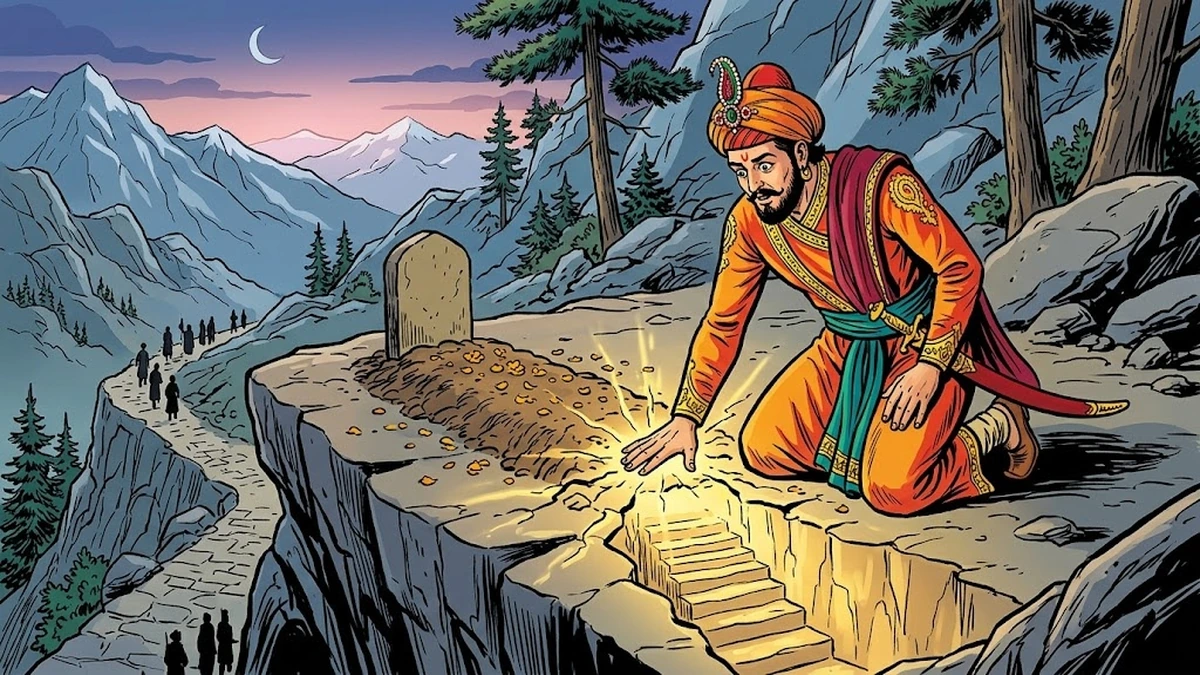
The funeral is over; the mourners disperse; the king alone remains by the new earth. He lays his hand upon the grave. The earth opens. He sees rough stone steps leading down, and at their foot the dead faqir “sitting, just as he used to sit, on his rickety bedstead, reading the Koran.” The image is profound. The Pathan teller is showing us that paradise, for the saint, is not a different place from his old life: it is the same charpai, the same patched cloak, the same Holy Book, only now perfected and timeless. The faqir is in barzakh, the intermediate realm between death and resurrection, and from there he can lift the curtain on what the king has demanded to see.
What lies behind that drawn curtain is famously not described. “No one knows what was there shown to the king, nor did he ever tell anyone.” This withheld revelation is one of the great moments of restraint in world folk literature, comparable to the unspoken third secret in Goethe’s “Märchen,” to the inner room in Bluebeard, to the Pythian utterance, to the unutterable vision of the prophet Muhammad’s Mi’raj. The reader is denied paradise as firmly as the king. We are made to feel the silence around the holy. To describe paradise would be to domesticate it; to refuse to describe it is to keep it, in the tale’s own sentence, “wonderful.”
Movement Four — Seven Hundred Years Lost
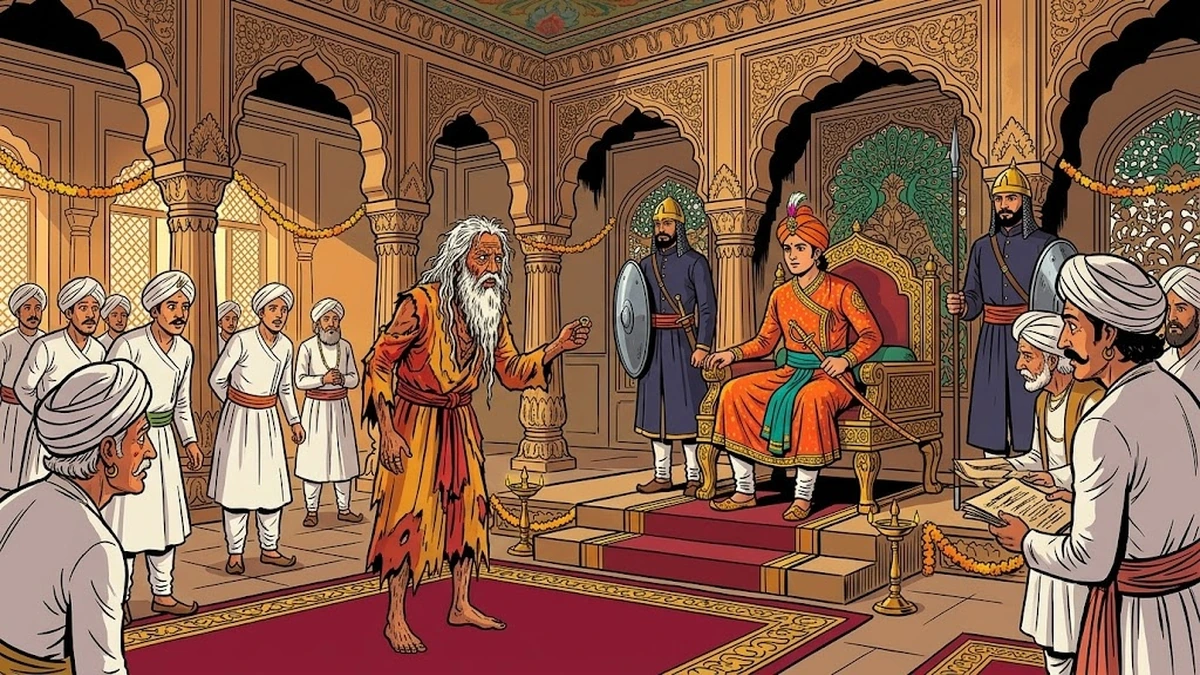
The king returns to his city at dawn. He has been gone, by his reckoning, perhaps five minutes. The streets look strange. The palace gate looks strange. Within the durbar hall sits a stranger king upon his throne. A chamberlain asks the unkempt old man who he is. The king answers, indignant: “The true king of this country.” And then he catches sight of himself in the polished steel shield of the bodyguard. He is old. He is decrepit. His beard is white and tangled to his waist. The signet alone remains.
The new king, kindly, calls for the dusty archives, the old coins, the registers of previous reigns. They are compared with the proffered ring. The verdict, when it comes, is laid down with the weight of judgement: “Old man, such a king as this whose signet thou hast, reigned seven hundred years ago.” The number is exact, deliberate, theological. It is the same order of time as the Surah Al-Kahf’s three hundred and nine years; the same as the seventy years Honi ha-Me’agel sleeps in the Talmud; the same as the centuries that pass for Oisín in Tír na nÓg. Seven hundred years is the canonical Sufi number for “an age beyond restoration,” and it stamps the king’s curiosity with the seal of permanent loss.
The closing strokes are merciful. The old king, broken open, smites his breast. He understands. He goes into the jungle, lives twenty-five years a life of prayer and meditation, and at last is taken by the Angel of Death (Malak al-Mawt, Azrael), “purged and purified through his punishment.” Even this figure is a Sufi grace-note: the rash man is not damned, only delayed. The tale ends not in horror but in a long, slow re-acquisition of the patience he refused at the beginning.
Comparative Folklore: The Mongol Belt of “A Moment in Paradise”
The motif of devastating temporal compression in the otherworld is one of the most widely distributed in world tradition. A short comparative listing locates the Pathan tale in its true library:
- Quran, Surah Al-Kahf 18:9–26 — the Seven Companions of the Cave sleep 309 years and wake to find their coins worthless.
- Quran, Surah Al-Baqarah 2:259 — Uzayr / Ezra raised after 100 years.
- Babylonian Talmud, Ta’anit 23a — Honi ha-Me’agel sleeps under a carob tree for seventy years and returns to find his grandson living in his house.
- Pali Buddhist Nikayas — the bhikkhu Mallaka and the deva-loka tales of kalpa-time.
- Mahabharata, Adi Parva & Bhagavata Purana IX.3 — King Kakudmi takes his daughter Revati to Brahma-loka and returns to find ages have passed and his entire dynasty has died.
- Christian Greek hagiography, c. 5th–6th c. CE — the Seven Sleepers of Ephesus.
- Japanese Nihon Shoki — Urashima Tarō visits the dragon-palace and ages instantly on his return.
- Irish Acallam na Senórach, 12th c. — Oisín in Tír na nÓg.
- Washington Irving, 1819 — Rip Van Winkle, twenty years lost in the Catskills.
- German Brüder Grimm, KHM 175 “Der Mond” & the Barbarossa-im-Kyffhäuser legend.
- Tibetan Padmasambhava cycles — Yeshe Tsogyal’s century in the pure-land.
What unites all of these stories — and what the Pathan teller has refined to a single luminous incident — is the conviction that paradise and ordinary time are incommensurable. To touch the eternal is to step out of the river of human duration; you cannot put your hand back in at the same place you took it out.
Theological Reading: Patience Versus Curiosity
In Sufi commentary the king’s failure is not curiosity in itself — Islam honours the seeker (tālib) — but the demand to see now, on his own terms, what the saint freely warned him cannot be safely seen until the appointed hour. This is the sin the Quran identifies as ‘ujb (self-importance) compounded by isti’jāl (haste). The corresponding virtue is ṣabr (patient steadfastness), which the Quran (Surah Al-‘Asr 103:3) names as one of the four conditions of escape from cosmic loss.
Hindu Vedanta would read the same warning as a parable of aparoksha-anubhuti, direct experience of Brahman, sought too soon by an unprepared soul. Buddhist commentary would speak of asammoha, the danger of prematurely demanded insight. Christian mystical writers from Pseudo-Dionysius to John of the Cross describe it as the via negativa‘s warning against forcing the cloud of unknowing. The tale’s moral, in any of these idioms, is the same: the unseen reveals itself only to the heart that has learned to wait.
Why the Story Has Lasted
This Pathan tale has lasted, and will go on lasting, because every generation produces fresh versions of the king who wants to see paradise on his own clock. We meet him in the executive who insists on enlightenment by Friday afternoon; in the social-media seeker who demands the meaning of life in three hundred-and-twenty characters; in the impatient lover, the consumer of instant spiritual programmes, the rationalist who will not credit any reality he cannot measure. The story knows this man and treats him gently. It does not damn him. It simply lets him see what he asked to see, and live with the cost — until even he, given time enough, can come to the patience he refused.
Moral. “Be content to see Paradise when God calls you there.”
— The dying fakeer to the king, Andrew Lang, The Orange Fairy Book, 1906The patient soul receives in due season what the impatient soul forfeits forever. The unseen is not a debt that can be called in; it is a gift that can only be opened on its own day.
Did You Know?
- The tale’s collector, Major Campbell, also supplied “The King Who Would Be Stronger Than Fate” to Andrew Lang’s earlier Brown Fairy Book (1904) — both tales are Pakhto/Pashto in origin and almost certainly recorded during military duty on the North-West Frontier of British India.
- The “patched cloak” of the fakeer translates the Sufi khirqa muraqqaʿa, the formal initiation-garment of the great Sufi orders (Qadiri, Naqshbandi, Suhrawardi, Chishti).
- The motif of seven hundred years lost in a moment of paradise has parallels in the Quran (Surah Al-Kahf, the Seven Sleepers, 309 years), the Talmud (Honi the Circle-Drawer, 70 years), the Bhagavata Purana (King Kakudmi visiting Brahma), the Japanese fisherman Urashima Tarō, and the Irish Oisín in Tír na nÓg.
- The story is catalogued as Aarne-Thompson-Uther type 471A “The Monk and the Bird,” with motifs F377 (supernatural lapse of time in fairyland) and D2011 (years thought days).
- Andrew Lang’s twelve Coloured Fairy Books (1889–1910) sold more than two million copies in his lifetime and remain the most widely-read Victorian collection of world folklore in the English language.
- The H. J. Ford illustrations for the Orange Fairy Book (1906) drew on Indo-Persian Mughal miniatures Ford studied at the British Museum and the Victoria and Albert Museum, and remain in print in modern Dover Publications facsimile editions.
Reflection & Discussion
- The fakeer warned the king both before and on his deathbed. Why does the king refuse to listen? What is the difference between a sincere seeker and an impatient one?
- The tale never tells us what was behind the curtain. Why is this absence more powerful than any description could be? What other stories use the same technique of withheld revelation?
- Seven hundred years pass for the king during what feels like five minutes. What is the moral logic of this exact disproportion? Why not seventy years, or seven thousand?
- The king’s signet ring is the only thing that survives the centuries. What does it mean that his identity is preserved by an object the world remembers, while everything else he was has dissolved?
- The tale ends not with damnation but with twenty-five years of prayer and meditation, after which the Angel of Death takes the king mercifully. What does this measured ending tell us about the Pathan and Sufi conception of justice?
What This Tale Teaches Us Today
Old stories keep their power because their warnings never go out of date. Here is how this Pathan tale still speaks:
- Patience is itself the gift. The fakeer’s two years of “not yet” were not delay; they were the paradise the king refused to recognise.
- Some knowledge cannot be hurried. Wisdom, intimacy, mastery, faith — all of these grow on their own clock. The demand to see them now is the surest way to lose them.
- The unseen has its own laws. Reality outside the small circle of human time runs differently. Mystics, scientists, parents and grievers have all known this; the tale puts it into a single image.
- Loss can be schooling. The king who lost everything entered the jungle and learned, in twenty-five years, what the fakeer offered him daily for two. We are usually given many chances.
- Restraint is a form of reverence. The teller does not describe paradise. The greatest things are kept by leaving room around them.
Why This Story Still Matters
The Pathan teller who first spoke this tale to Major Campbell in the cold mountain country of the North-West Frontier, more than a century ago, was passing on a wisdom older than the Pakhto language he spoke it in. The king is each of us when we forget that the deep things — love, faith, growth, art, the trust of a child, the slow acquisition of a craft — answer only to time and tending, never to demand. The fakeer is the wise self in each of us that has learned, somehow, to say not yet. The grave is the threshold between asking and receiving. And the seven hundred years are the price the impatient soul pays for what the patient soul receives free, in the ordinary unfolding of an ordinary life.
Modern readers who find this kind of story old-fashioned should listen more carefully. The headlines are full of kings who would see paradise: founders demanding ten-year companies in eighteen months, lovers demanding intimacy by Tuesday, children of grief demanding closure on the calendar of their phone. The tale does not shake a finger at any of them. It only opens a quiet door at the back of the world and lets us see, for an instant, what is on the other side of haste. And then, very gently, it closes the door again, and tells us to go and feed the fakeer.
Cultural Context and Continuing Influence
Pathan folk tales like this one have survived through a remarkable double tradition: the oral one of the Pakhto-speaking villages — where storytellers (dāstān-go) recited around the winter hujra, the men’s guest-house — and the written one initiated by colonial-era collectors like Major Campbell, the Reverend Charles Swynnerton (Romantic Tales from the Panjáb, 1903), and the great folklore inspector Sir Aurel Stein. Each retelling polished a different facet. The Lang version we read today, smoothed and trimmed by Mrs Leonora Blanche Lang’s English ear, is one of those polished versions; somewhere underneath it is a longer, rougher, fully Pakhto telling, full of local proper names, climatic detail, and ritual asides. The bones of the story, however, are exactly the same in both layers. That is the test of a folk tale.
Reading This Tale With Children
This is a tale for older children — eight years and up — because it asks the child to sit with mystery. The unseen behind the curtain, the seven hundred years compressed into five minutes, the white beard the king did not feel growing: these are images that will stay quietly inside a young listener’s mind for years and reveal themselves only later, in moments of patience or of loss. Read it slowly. Pause when the fakeer says “Not yet, not yet.” Pause when the king lays his hand on the grave. Pause when he sees himself in the bodyguard’s polished shield. Children sense, even before they have language for it, that this is not a story to be hurried. They will, very often, ask for it again.
You May Also Like
 Indian Folk Tales
Ages 6-8
Indian Folk Tales
Ages 6-8
Birbal’s Khichdi: The Emperor’s Lesson in Logic
Birbal's Khichdi: The Emperor's Lesson in Logic: The Wager of the Freezing Night In the imperial court of Emperor Akbar, the greatest Mughal ruler of India
 Indian Folk Tales
All Ages
Indian Folk Tales
All Ages
The Interesting Journey
The Interesting Journey: Once upon a time, a little boy named Rohan lived near the foot of the Mt. One day Rohan’s dad woke up bright and early and woke up
 Indian Folk Tales
All Ages
Indian Folk Tales
All Ages
Good Luck to the Lucky One
Good Luck to the Lucky One: In a certain town there lived a wealthy Brâhmiṇ. He wished to build a house - pretty large and spacious - as became his riches. The