The Broken Pot
The Broken Pot: In a small village in ancient India, there lived a poor Brahmin named Svabhavakripana. He owned nothing in the world except a single clay pot
A scholarly retelling of the most famous “castles in the air” tale of world folklore — the brāhmaṇa Svabhāvakṛpaṇa and his pot of barley-meal — preserved as the fifth and final story-within-a-story of Aparīkṣitakārakam, Book V of the Pañcatantra, the great Sanskrit collection of niti-tales attributed to the brahmin teacher Viṣṇuśarman, c. 200 BCE – 300 CE. The tale is the locus classicus, in any Indo-European literature, of the international tale-type ATU 1430, “The Man and his Wife Build Air-Castles.”
Origin and Canonical Attribution
“The Broken Pot” — known to Sanskritists by the proper name of its protagonist Svabhāvakṛpaṇa (“naturally miserly,” स्वभावकृपण) — is the fifth illustrative tale embedded in the fifth and final book of the Pañcatantra (Sanskrit: पञ्चतन्त्र, “the five treatises”). That fifth book is titled Aparīkṣitakārakam (अपरीक्षितकारकम्, “Ill-considered Action,” sometimes rendered “Hasty Action” or “Action without Examination”), and the entire book is given over to stories of characters who plunge into action without thinking, and lose what they had. Of those stories, this one is the most pithy and the most quoted; the proverb it leaves behind — that one must not destroy the real for the sake of the imagined — has been a fixed point of Sanskrit moral discourse for nearly two thousand years.
The Pañcatantra as a whole is traditionally ascribed to the elderly brāhmaṇa Viṣṇuśarman (विष्णुशर्मन्), who according to the frame narrative was hired by King Amaraśakti of the southern city of Mahilāropya to make princes of three indolent royal sons in six months. Viṣṇuśarman accomplished this, the frame insists, by composing the five tantras and using them as a curriculum. The historical kernel under that frame is firmer than most readers expect: comparative philology and the testimony of the Middle Persian translation prove the work existed in something close to its present form by the third or fourth century CE at the latest. The earliest surviving recension is therefore lost, but a chain of derivative texts — the lost Pahlavi Karīrak ud Damanak commissioned by King Khosrow I (Anūshīrwān) c. 570 CE, the eighth-century Arabic Kalīla wa Dimna of Ibn al-Muqaffaʿ, the Hebrew, Old Spanish, and Latin renderings of the medieval European Middle Ages — preserves the architecture of the original. The standard modern critical reconstruction is Franklin Edgerton’s The Panchatantra Reconstructed (American Oriental Society, New Haven, 1924, 2 vols.), which still anchors academic study; Patrick Olivelle’s The Pañcatantra: The Book of India’s Folk Wisdom (Oxford World’s Classics, 1997) is the standard English translation working from the so-called “Southern Pañcatantra.”
In the Aarne-Thompson-Uther international index of folktale types, the central plot of “The Broken Pot” is catalogued unambiguously under ATU 1430, “The Man and his Wife Build Air-Castles”, sometimes listed as “Castles in the Air.” Stith Thompson’s Motif-Index of Folk-Literature places the central motif under J2061 (“Air-castle: counting the chickens before they are hatched”) and the closely related J2061.1 (“Air-castle: the broken pot of grain”), the second of which is named after this very story. The motif then radiates outward across world literature: Aesop’s “The Milkmaid and her Pail” (Perry 423 in the standard Perry index), preserved in Latin in Babrius and given its definitive European poetic form by Jean de La Fontaine as “La Laitière et le Pot au Lait” (Fables, Book VII, fable 10, 1678); the Arabic version in Kalīla wa Dimna; the Persian retellings in the Anvār-e Suhaylī of Ḥusayn Wāʿiẓ Kāshifī (c. 1500) and the ʿIyār-e Dānish of Abu’l-Faẓl (1588); and a long line of European dream-and-fall tales from medieval Latin exempla through Cervantes’ allusion in Don Quixote to the modern English idiom “don’t count your chickens before they hatch.” It is no exaggeration to say that nearly every Indo-European literature has its own descendant of Svabhāvakṛpaṇa’s pot.
The Brahmin Who Was Naturally Miserly
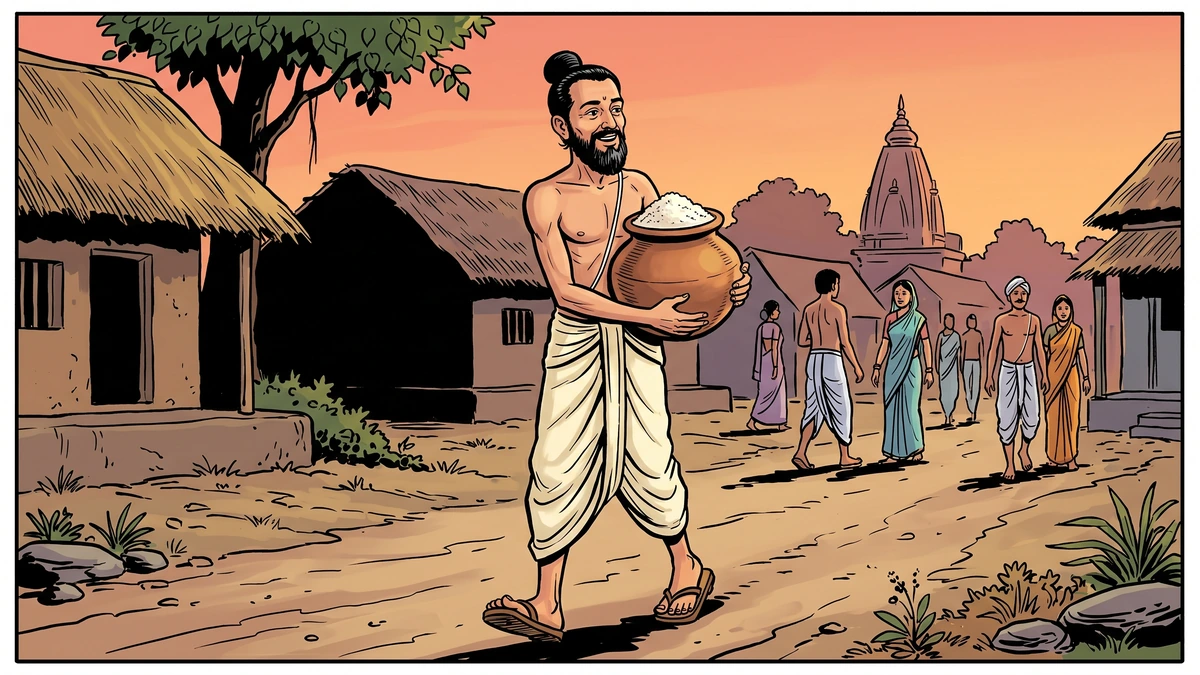
In a certain town of the Madhyadeśa — the old “middle country” of the Sanskrit world, the broad fertile band of the upper Gangetic plain — there once lived a brahmin whose name the storytellers had given him for the simplest of reasons: he was, by his nature, a miser. Svabhāvakṛpaṇa, the name reads, and it means precisely “naturally miserly.” He was not poor through misfortune. He was poor because he could not bear to part with anything he received. Whatever the householders of the town gave him in alms — a handful of rice flour at one door, a measure of barley meal at the next, a knot of clarified butter wrapped in a leaf — he carried back to his small thatched room and tied up in pots and gourds upon the wall. He never used what he had. He saved against famine, against age, against the unspecified disaster of tomorrow; and, like all such savers, he never quite reached the day on which the saving would end.
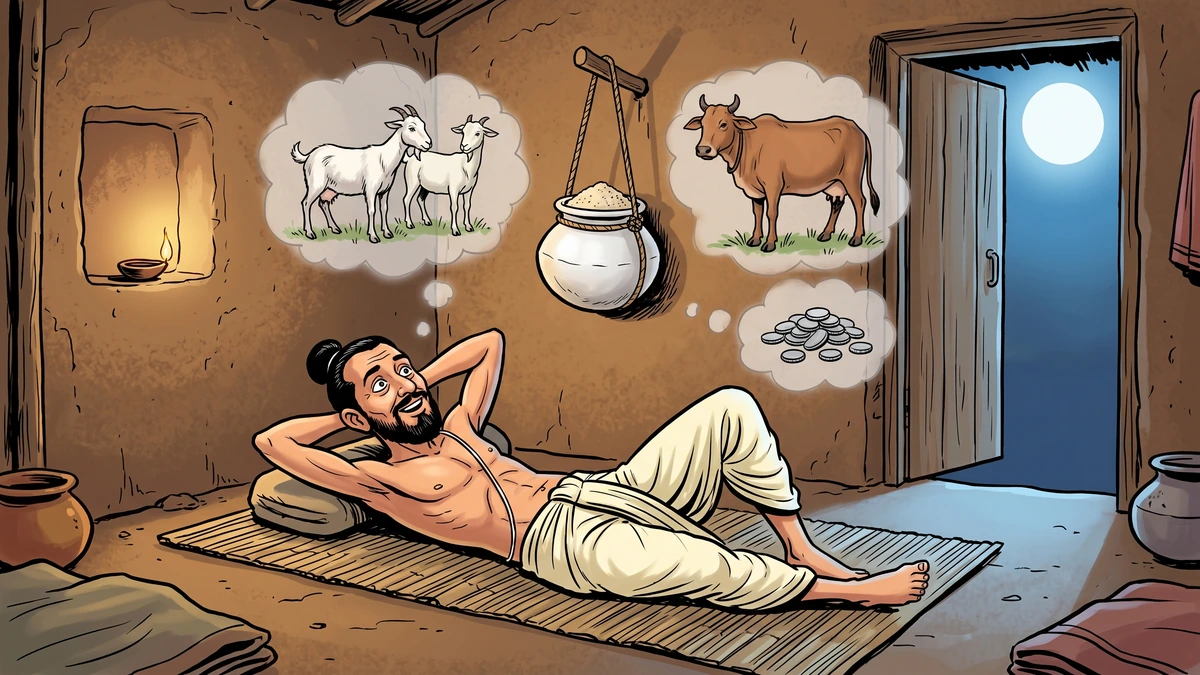
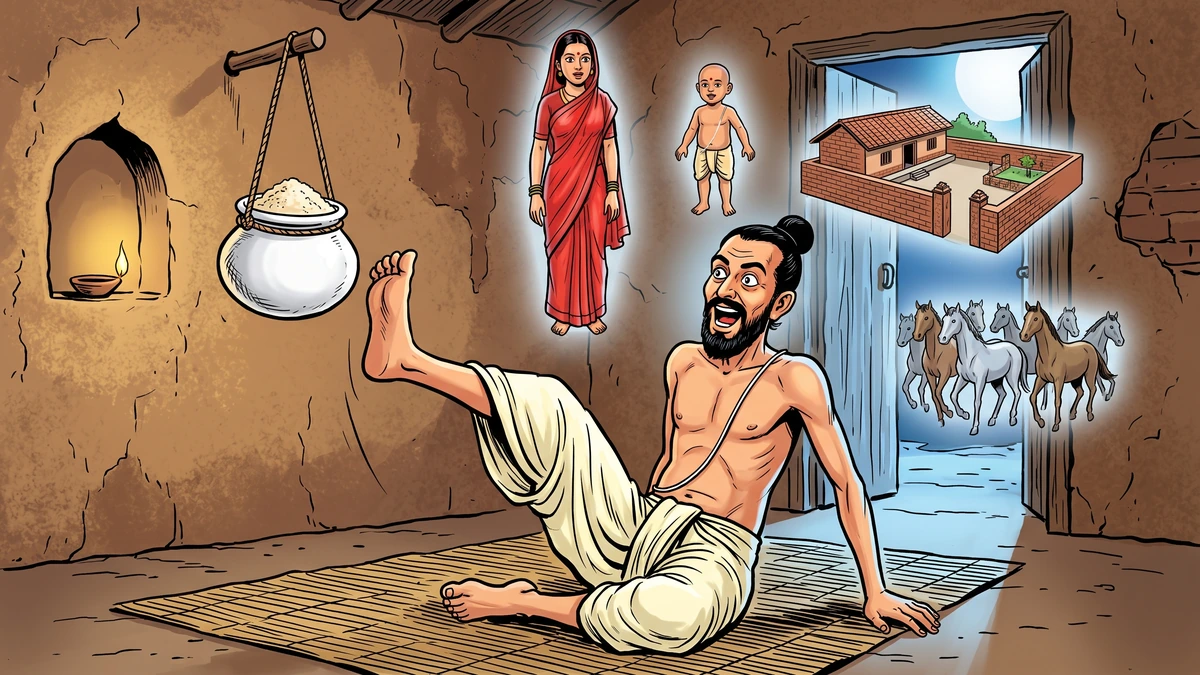
It happened one season that the householders of the town, in the customary spring almsgiving, filled his clay pot to the brim with saktu — coarsely roasted barley-meal, the staple lean food of upper India, ground from parched grain and capable of being kept for months without spoiling. Svabhāvakṛpaṇa carried the pot home as if it were a vessel of gold. He scrubbed a peg into the mud-and-cow-dung wall above his sleeping pallet. He hung the pot from the peg by a length of jute cord. He lay down beneath it on his thin reed mat. The full moon of Caitra rose above the courtyard wall and shone in through the open door, and the round white belly of the pot of saktu caught the moonlight and seemed to glow as if a small lamp were burning inside it.
“This pot,” he said softly to himself, lying on his back with his hands folded behind his head, “is full to the rim with the finest saktu. If a famine should come — and famines do come — I shall surely sell this for a hundred rūpakas in silver. With a hundred rūpakas I shall buy a pair of she-goats. The goats will give kids twice a year, and milk every day; and from the goats I shall trade up to cows, and from cows to buffaloes, and from buffaloes to mares. The mares will breed; and with the herd of horses I shall be at last a man of wealth.”
The pot turned slowly on its cord in the night air. The brahmin’s voice, low at first, grew warmer as his pulse rose with the dream.
The House, the Bride, and the Son Called Somaśarman
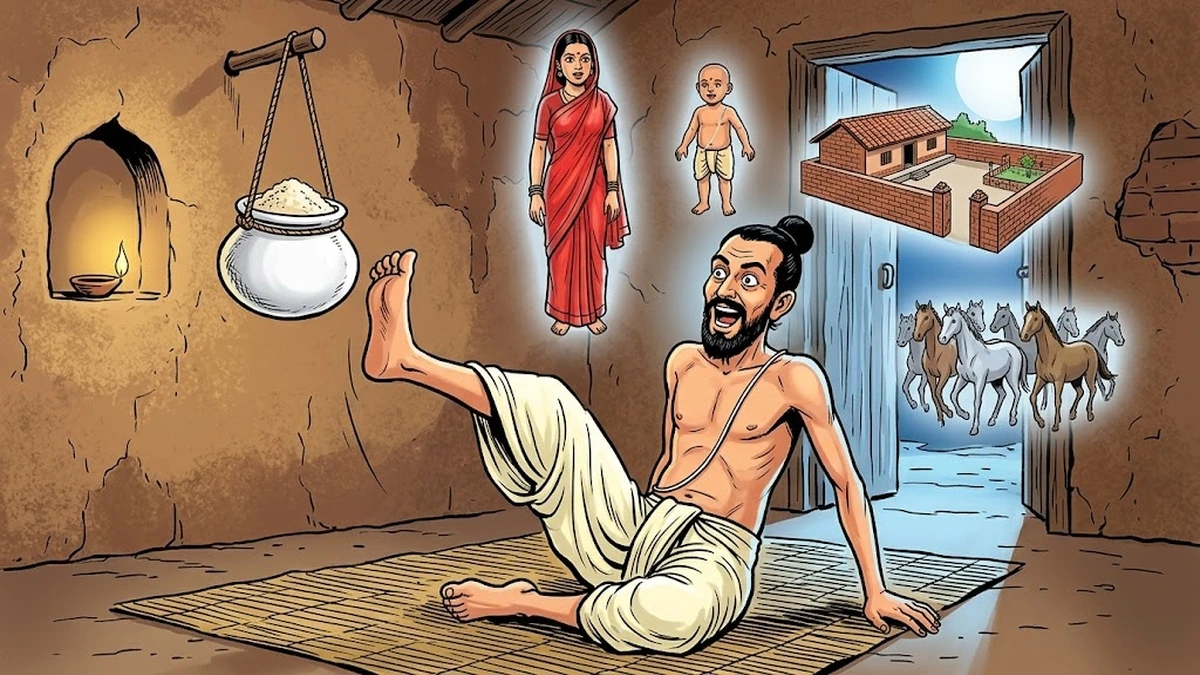
“With the wealth of the herd,” Svabhāvakṛpaṇa whispered, “I shall build a great house — not a hut of mud and thatch, but a brick house with a courtyard and a colonnade and a tank of fresh water in the inner garden, and on the roof a small caitya for the household gods. The fame of the house will go from door to door. The chief brahmins of the town will come to consult me. And then” — here he sat half up on his elbows, eyes bright in the moonlight — “then the most prosperous householder of all the surrounding villages will come to me with the proposal of his daughter. She will be young, fair-skinned, full-lipped, soft of speech and steady of hand, learned in the household duties. Her father will give a heavy dowry; and I, in my dignity as the wealthy brahmin Svabhāvakṛpaṇa, shall accept her with the proper recitation of the marriage mantras.”
His feet began to drum lightly against the reed mat. The pot above him still turned its slow, hypnotic pendulum-circle in the moonlight.
“And in the proper season she shall give me a son. A son! I shall call him Somaśarman — ‘sheltered by the moon’ — for he shall be born under an auspicious lunar conjunction. He shall be the first male child of the household, and the entire town shall come to my door to bless his cradle.”
So the brahmin lay there, his arms now wrapped around an imaginary cradle, his lips shaping syllables of a name he had not yet given anybody. The infant Somaśarman would crawl. He would walk. He would lisp the first oṁ at three. At five he would be initiated into the alphabet by the village schoolmaster; by ten he would chant the Gāyatrī; by fifteen he would have begun the recitation of the Yajur Veda. But — and here the brahmin’s brow began, even in the dream, to crease with the worry of an imagined father — Somaśarman might also be naughty. Somaśarman might run between the legs of the cattle. Somaśarman might wander too close to the well. Somaśarman might forget his lessons and have to be punished for the good of his soul.
“If he forgets the Gāyatrī,” Svabhāvakṛpaṇa muttered, “I shall be obliged, as a father, to chastise him.” His foot twitched. “I shall pick up my staff” — his right hand reached out toward an invisible staff lying across an invisible threshold — “and I shall call out to his mother to bring him to me. And if she, in the soft-heartedness that comes naturally to mothers, does not bring him quickly enough — why, then” — and here his voice rose into a small shout, the way the voice of a man dreaming sometimes does — “I shall kick her, the slow-moving woman, with this very foot, so that she learns to obey her husband at once!”
The Kick That Broke the World
And on the word “kick” he kicked, with the right foot, exactly as he had practised in his dream — full-bodied, full-hearted, the kick of a wealthy householder disciplining a slow-stepping wife.
His bare heel struck the round, full belly of the clay pot of saktu hanging from the peg above his bed.
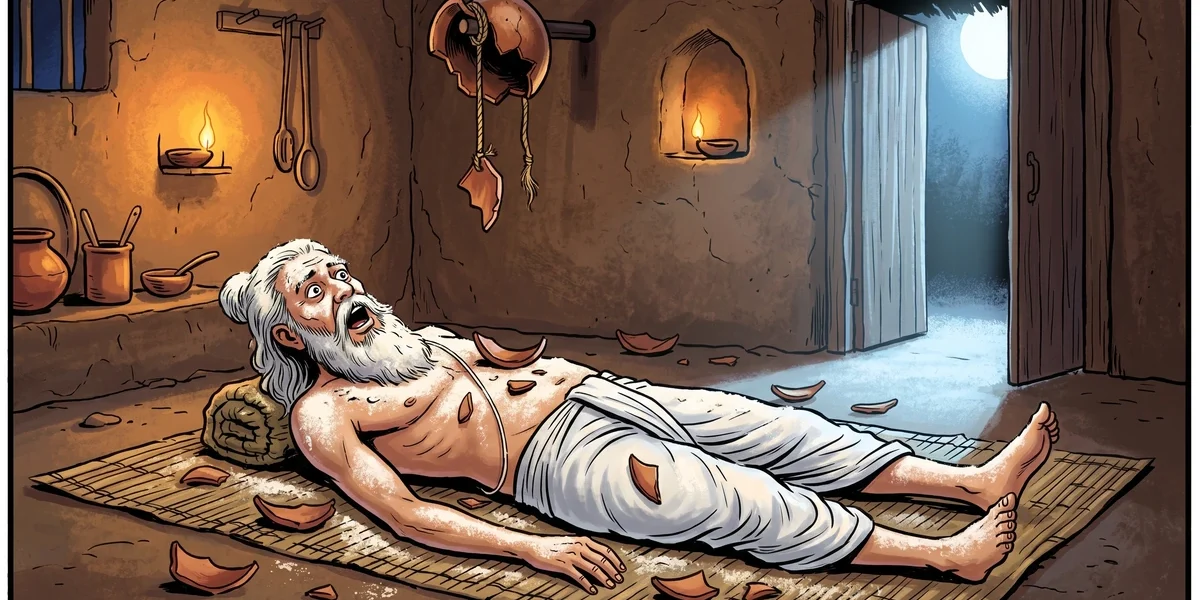
The pot was old. The cord was thin. The blow was hard. The pot swung once, hit the mud wall behind it with the small, deeply final sound of fired clay snapping, and split clean across its widest girth. The two halves fell. They struck the floor on either side of his head and shattered into a hundred curved shards. The roasted barley-meal poured out of them in a slow white avalanche, and Svabhāvakṛpaṇa — who had lifted his head just in time to look up at the descending cloud — was buried to his eyebrows in the entire winter’s worth of saktu, his hair white with it, his beard white with it, his eyelashes white with it, his open mouth white with it.
The dream of the goats and the cows and the mares and the brick house and the dowry and the bride and the boy Somaśarman and the staff with which to chastise the slow-moving wife — all of it left him at the same instant. He sat up, slowly, in the moonlight. He looked at the broken curves of the pot lying on either side of his pallet. He looked at the spoiled, dusty meal cooling on the earthen floor and on his own knees. He licked his lips, tasted barley-meal, and understood, with the sudden completeness of all such understandings, that he had nothing left at all. The kick that was to discipline an imaginary wife had destroyed the only real food in the house.
He sat there until the moon went down. His neighbours, finding him in the morning still seated cross-legged among the shards, asked what had befallen him. He told them — for he was an honest man as well as a foolish one. The neighbours listened in silence; and one old housewife, who had borne five children and lost two, dusted off her hands on the corner of her sari, looked at him with the small bitter wisdom of women who have lived long, and said the line by which the story has been remembered ever since:
“O brahmin, he who builds his house upon what he has not yet earned, kicks down with his own foot whatever he had.”
The Moral and the Sanskrit Verse Behind It
The Pañcatantra seals each of its inset tales with one or more nīti-ślokas — verse maxims in Sanskrit, usually in anuṣṭubh metre, that compress the story’s moral into eight syllables a quarter and four quarters to the verse. The closing śloka attached to Svabhāvakṛpaṇa’s tale is among the most quoted verses in all of Sanskrit didactic literature, and it has been recited by Indian schoolmasters, court pandits, and grandmothers alike for many centuries. Edgerton’s reconstruction gives it as follows:
“अनागतवतीं चिन्तामसम्भाव्यां करोति यः।
स एव पाण्डुरः शेते सक्तुपूर्णापिता यथा॥”
— “anāgatavatīṁ cintām asambhāvyāṁ karoti yaḥ /
sa eva pāṇḍuraḥ śete saktupūrṇāpitā yathā //”
(“He who lets his mind dwell on what has not yet come to pass, on the impossible — he it is who lies sprawled on his back, white with spilled barley-meal, like the man whose pot of saktu emptied itself over his face.”)
The verse is quoted in the same form, with only minor textual variants, in the parallel recension of the Hitopadeśa (the simpler twelfth-century pedagogical retelling by Nārāyaṇa for the boys of King Dhavalacandra), and again — translated word for word into Arabic — in Ibn al-Muqaffaʿ’s Kalīla wa Dimna. The fact that the same eight-syllable image (sprawled flat, white with barley-meal, like the man whose pot emptied itself) survives across Sanskrit, Pahlavi, Arabic, Persian, Hebrew, and Old Spanish is one of the small wonders of comparative literature: the visual snapshot of Svabhāvakṛpaṇa lying flat on his back, dusted in flour, has done what very few other folktale images have done — it has survived the journey from one alphabet to another without losing its meaning or its bite.
The deeper Sanskrit point, however, is not simply a warning against fantasy. It is, more precisely, a warning against asambhāvya cintā — “thought of the impossible.” In the philosophical vocabulary of the early Pañcatantra, planning is not vice. Far from it: every other book of the Pañcatantra is given over to the praise of careful, calculated, examined action; the work as a whole is, after all, a manual of nīti — political and personal prudence — written for princes who must learn to plan. What the fifth book and this story warn against is the special failure of planning that loses contact with what is in front of you. The brahmin’s error is not that he dreamed of a son, or of a brick house, or of a herd of horses; it is that the dream led him by an unbroken chain of imagined causation into a kick of an imagined wife, and the kick passed unnoticed from the imagined world into the real one, and broke a real pot. The Sanskrit nīti tradition reserves a particular contempt for this lapse — for it shows that the planner has lost the discipline of telling the world that exists from the world he wishes existed. The pot is not the moral. The kick is the moral.
Why This Tale Has Lasted
“The Broken Pot” has lasted, first, because of the unparalleled portability of its central image. ATU 1430 has been told, written, painted, and cited under different climates and with different props — a Greek milkmaid and a pail of milk, a Tamil cowherd and a vessel of buttermilk, a French dairy-girl and her crock of cream, a Persian merchant and a bag of glass — but the picture at the centre, of a person flat on the ground, surrounded by the white wreckage of the food they had been planning to multiply by imagination, is the same picture in every version. Any culture that has any quantity of perishable food and any quantity of unrealised ambition has, sooner or later, generated its own retelling. Folklorists studying ATU 1430 in any language reach back to this Sanskrit text as the type-classic, in part because its kick — the moment at which the dream breaks into the real world by means of a real foot — is the cleanest and least ornamented version of the central act anywhere on record.
It has lasted, second, because of the moral economy of the way Sanskrit storytellers tell it. The brahmin is not punished by the gods. He is not visited by demons. He is not robbed by neighbours. He is, in the strictest sense, his own undoing: every link in the catastrophe is supplied by his own person. The pot is on his own peg. The peg is in his own wall. The kick is from his own foot. The dream is in his own mind. The story therefore models with great economy a particular Indian conception of karma in its narrowest, most domestic sense — the small everyday karma by which a man’s fantasies, repeated unchecked, escape the boundary of his head and reach out into his real life and overturn the small real things he had. The brahmin is poor again at the end of the story. But he is poor in a new and worse way, because he has shown himself how he came to be poor. That is the kind of self-knowledge the Pañcatantra is most interested in producing.
It has lasted, third, because of its unmistakable comic warmth. The Pañcatantra is, contrary to the way it is sometimes taught in school, neither pious nor humourless: it is a teacherly, affectionate, often very funny book. The image of Svabhāvakṛpaṇa lying flat on his back, white as a temple statue under a pile of barley-meal, eyebrows clogged, beard clogged, mouth still half open on the unfinished syllable of the kick — this is not the image of a tale told to terrify. It is the image of a tale told with a small smile in the corner of the mouth, by a teacher who knows that all of us, on most evenings of most weeks, have once or twice kicked our own pots of saktu. It is the kindness of the story, as much as its severity, that has carried it across two thousand years and from one alphabet to the next. We laugh at Svabhāvakṛpaṇa — and in laughing, we look up at the peg above our own bed, and check that the pot still hangs there.
You May Also Like
 Indian Folk Tales
Ages 3-5
Indian Folk Tales
Ages 3-5
The Farmer And The Money Lender 2
The Farmer And The Money Lender 2: There was once a farmer who suffered much at the hands of a money-lender. Good harvests, or bad, the farmer was always poor
 Indian Folk Tales
Ages 12+ / YA
Indian Folk Tales
Ages 12+ / YA
Chandralekha and the Eight Robbers | Indian Wit Tale (12+)
Chandralekha, a learned dancing-girl’s daughter, refuses a false bargain and outwits danger with intelligence — classic Indian wit tale.
 Indian Folk Tales
Ages 3-5
Indian Folk Tales
Ages 3-5
The Prince And The Fakir
The Prince And The Fakir: There was once upon a time a King who had no children. Now this King went and laid him down to rest at a place where four roads met