A Crow And His Three Friends
A Crow And His Three Friends: In a lush forest that stretched from the foothills of the Vindhya mountains to the banks of a winding river, there lived a crow
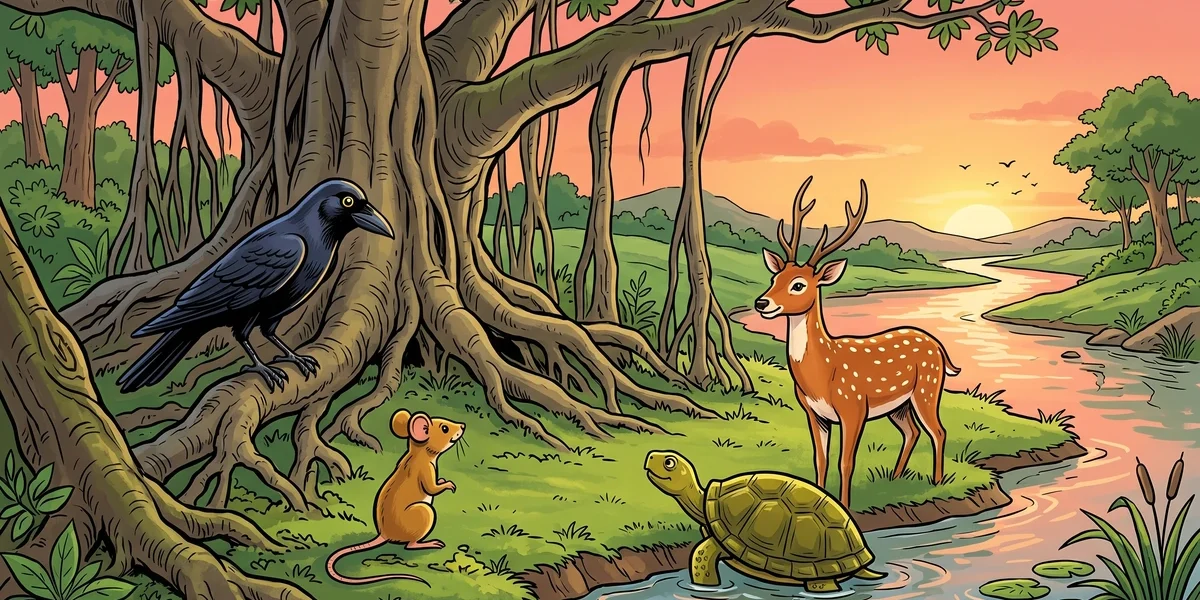
“A Crow and His Three Friends” is one of the most beloved and structurally important tales in the entire Panchatantra (पञ्चतन्त्र). It serves as the frame‑story of the second book, Mitra‑Samprāpti (मित्रसम्प्राप्तिः, “The Winning of Friends”), traditionally dated to the corpus attributed to the Brahmin teacher Vishnu Sharma sometime between c. 200 BCE and c. 300 CE. The four protagonists each carry crisp Sanskrit names that double as character notes: the crow Laghupatanaka (लघुपतनकः, “the light‑flier”), the mouse Hiraṇyaka (हिरण्यकः, “the golden‑one”), the turtle Mantharaka (मन्थरकः, “the slow‑one”), and the deer Chitrāṅga (चित्राङ्गः, “spotted‑limbed”). The cycle’s classical tale‑type is ATU 554, “The Grateful Animals,” with a clear thematic affinity to ATU 75, “The Help of the Weak.”
This story is one of the most widely travelled fables in world literature. It moved out of Sanskrit into the Pahlavi Karīrak ud Damanak commissioned by the Sasanian king Khosrow I (c. 570 CE), then into Ibn al‑Muqaffaʿ’s Arabic Kalīla wa‑Dimna (c. 750 CE), into Symeon Seth’s Greek Stephanites kai Ichnelates (c. 1080), into John of Capua’s Latin Directorium Humanae Vitae (c. 1270), and from there into nearly every European vernacular. Modern English readers most often meet it through Arthur W. Ryder’s The Panchatantra (University of Chicago Press, 1925), Patrick Olivelle’s The Pañcatantra: The Book of India’s Folk Wisdom (Oxford World’s Classics, 1997), and Chandra Rajan’s The Pañcatantra (Penguin Classics, 1995).
The Banyan, the Forest, and the Beginning of Trust
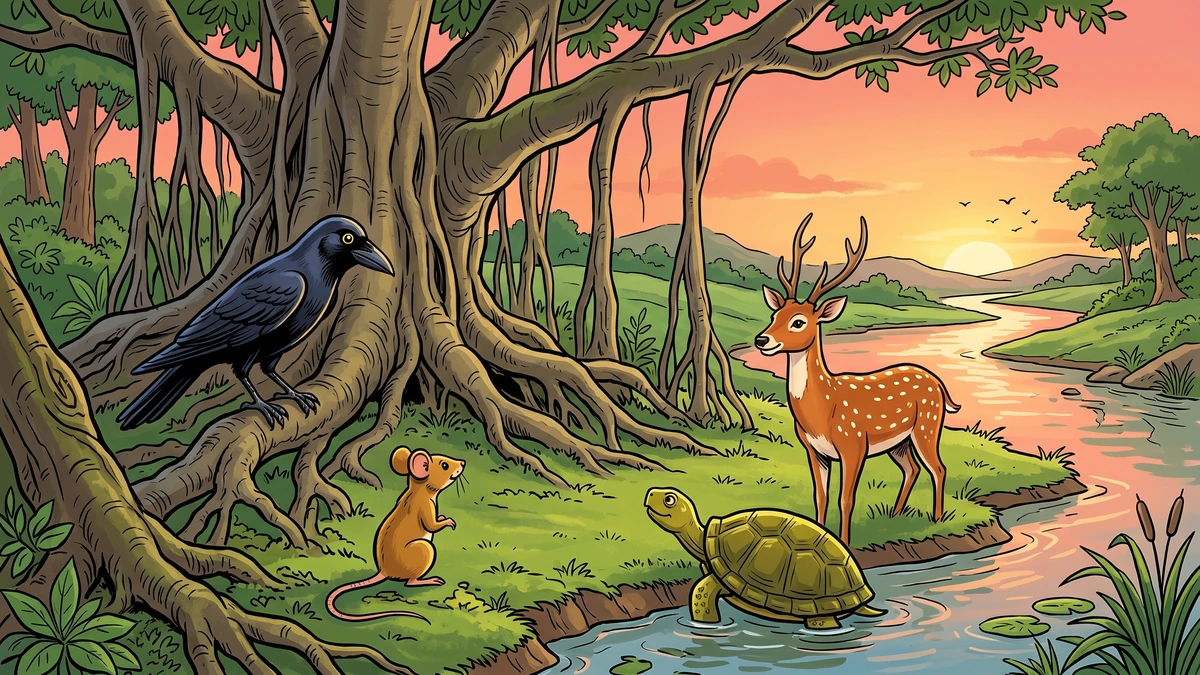
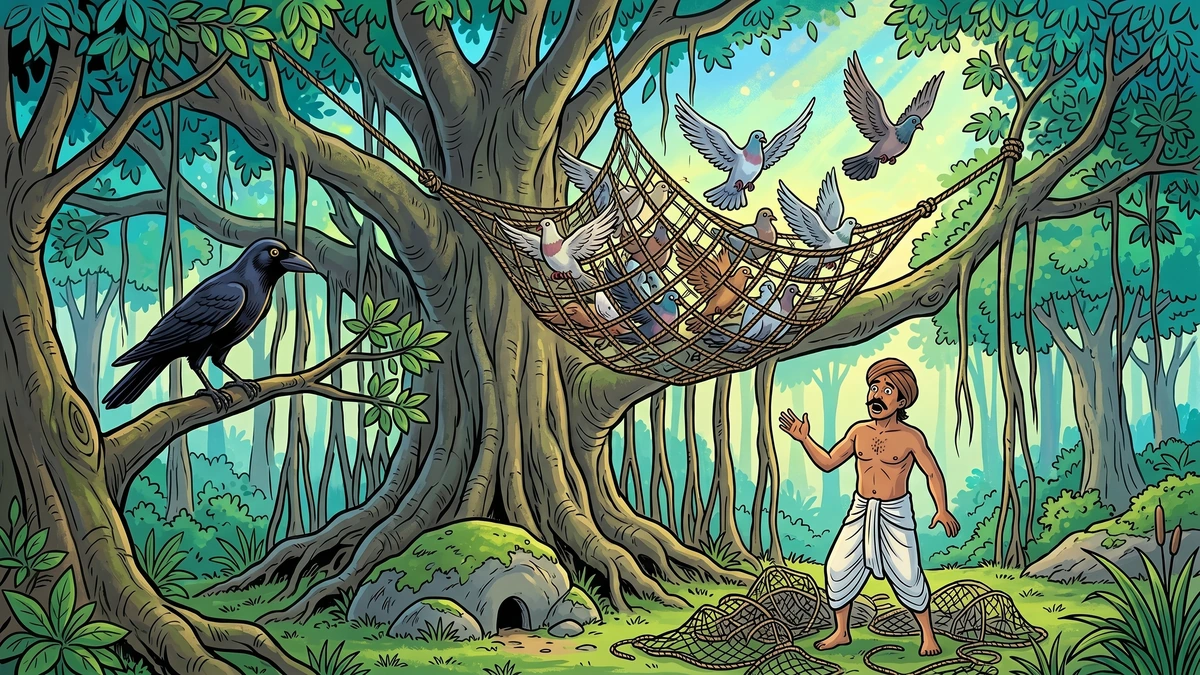
The frame opens beneath an enormous nyagrodha (banyan) tree on the banks of the Godāvarī, where Laghupatanaka the crow has made his nest. From this aerial perch he watches a fowler, vyādha, set out a net for pigeons. When a flock of doves is trapped, their leader Chitragrīva instructs the entire flock to lift the net together — the famous “united we rise” episode that sets the philosophical key for everything that follows. The doves fly with the net to the burrow of Hiraṇyaka the mouse, who frees them by gnawing through the strands.
Watching all of this from above, the crow Laghupatanaka is so moved by the mouse’s generosity that he descends and asks for friendship. Hiraṇyaka refuses at first — the crow, after all, is a natural hunter of mice. The exchange that follows is one of the great set‑pieces of the Panchatantra‘s ethical philosophy: friendship between unequals is possible only when desire to harm has been replaced by śīla, conscious moral conduct. Vishnu Sharma frames the principle in a verse the storytellers still quote:
“न पशुर्न विहङ्गो वा मित्रत्वेन हि बध्यते।
मित्रं तु बध्यते स्नेहाद् यो हि स्नेहं न मुञ्चति॥”
“Beast and bird are not bound by friendship’s title — friendship is bound by affection alone, and only by the one who never forsakes that affection.”
Eventually Hiraṇyaka relents. The two animals are joined by Mantharaka the turtle, an old friend of the mouse who lives in a nearby pool, and finally by Chitrāṅga the deer, who arrives breathless one afternoon, fleeing hunters. The four become inseparable. They meet each evening at the foot of the banyan to share the day’s news — the crow reporting from the sky, the mouse from the underground, the turtle from the river, and the deer from the meadow. Vishnu Sharma’s point is already clear: the four creatures are weak alone, but their information networks together cover every domain — air, earth, water, and pasture.
The Hunter’s Net and the Gnawing of the Ropes
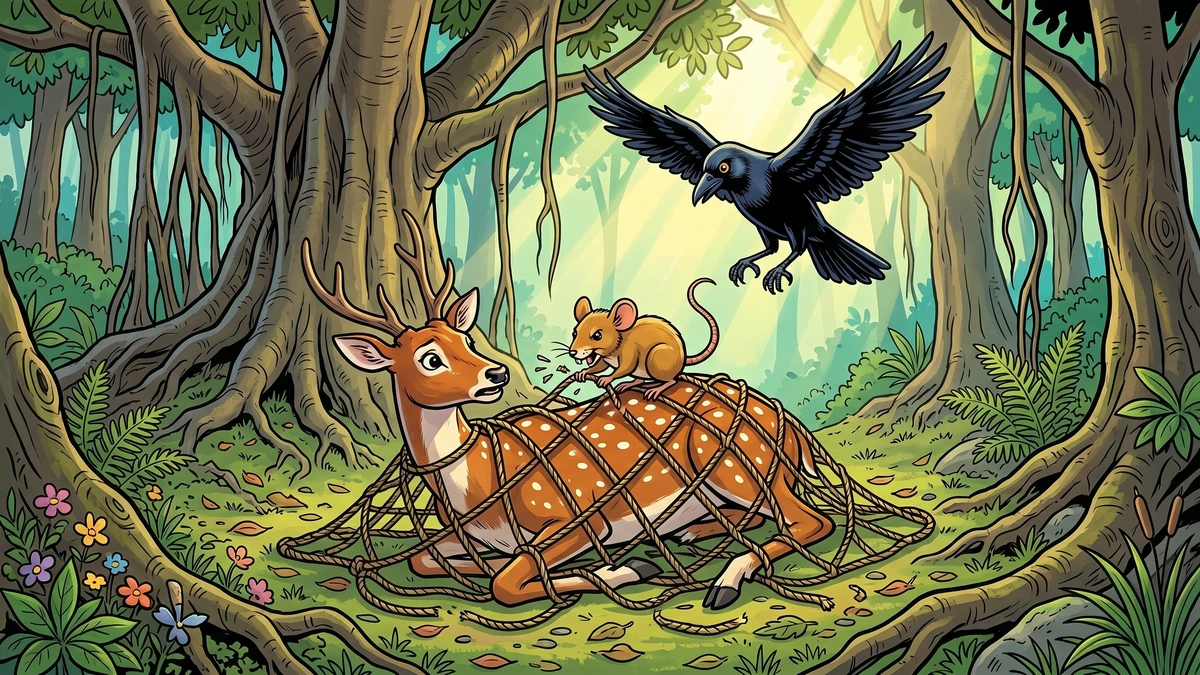
The crisis arrives in the form of a hunter’s net. One evening Chitrāṅga fails to appear at the meeting place. Laghupatanaka takes wing, scans the forest, and finds the deer thrashing in a snare. The crow returns to the others with the news, and Mantharaka — slow but steady — and Hiraṇyaka — quick and small — set out toward the trapped friend. Hiraṇyaka’s teeth go to work on the cords. Vishnu Sharma’s narrator pauses here for a long aside on the metaphysics of intelligence (buddhi): “When intelligence stands by you, weakness becomes irrelevant. Buddhir yasya balam tasya, nirbuddhes tu kuto balam — He who has wisdom has strength; what strength has the witless?”
The episode is structurally important. In Sanskrit poetics the trap and its undoing operate as a pratīka, a visible figure for an invisible truth: the net is not just rope but every social bond that constrains the powerless. The mouse’s tiny incisors cutting strand by strand are the patient counter‑force of community — the small, unglamorous work of a friend who will not stop. Patrick Olivelle, in his 1997 Oxford translation, notes that this very scene is the moment “when the Panchatantra abandons its frequent cynicism about kings and policy and admits something that looks remarkably like love.”
The Turtle Caught and the Diversion of the Hunter
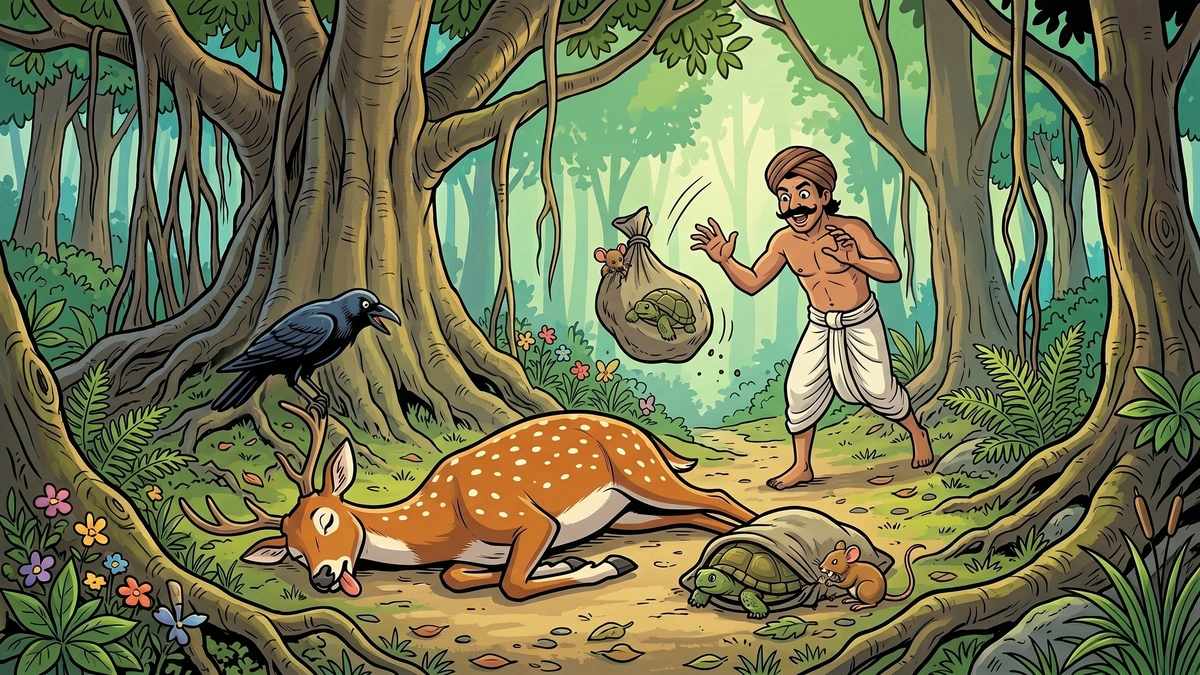
The story now executes a beautiful narrative reversal. Just as the deer is freed, the hunter himself appears. Hiraṇyaka and Chitrāṅga vanish — the mouse into the earth, the deer into the trees. Laghupatanaka rises into the canopy. But Mantharaka, slow by nature, cannot escape. The hunter, robbed of his deer, settles for the turtle. He slings Mantharaka over his shoulder in a sack and starts for home.
The three free friends now invent a rescue. Chitrāṅga lies down at the path’s edge as if dying, his tongue lolling, his sides heaving. Laghupatanaka perches on his head and pecks lightly, miming a vulture working on a fresh corpse. The hunter sees what looks like an unguarded windfall — a whole deer — and drops the sack containing the turtle to claim it. The moment his hands are full, Hiraṇyaka chews through the sack’s seams. Mantharaka slips into the underbrush and rolls toward the river. Chitrāṅga springs up, Laghupatanaka rises into the air, and all four animals scatter to safety while the bewildered hunter is left with neither.
The parallel to the opening dove episode is exact and intentional. The doves were freed by collective lift; the four friends are freed by collective stratagem. In both cases the binding force on the free side is maitrī — friendliness so steady that it becomes a kind of intelligence in its own right. Chandra Rajan’s 1995 Penguin edition observes that the entire second book of the Panchatantra can be read as an extended argument that maitrī is not a sentiment but a survival technology.
Why the Story Has Lasted
The cycle has lasted because it solves a hard problem with imagery a child can hold in mind. The hard problem is this: how do beings who are unlike one another — different in size, in habitat, in instinct, in fear — make alliances stable enough to survive a world that contains hunters? The Panchatantra‘s answer is not a contract or a pledge of strength. It is a daily ritual of meeting, listening, and reporting — and a willingness to act for the friend before acting for the self. Each of the four covers a domain the others cannot reach; each is, in isolation, easy prey; each is, together with the others, almost impossible to catch. The story rewrites the food‑chain logic of the forest as a logic of mitra‑lābha — the gain that comes only by gaining a friend.
Moral
The moral of the tale is the title of the book itself: Mitra‑Samprāpti — the winning of friends. Vishnu Sharma puts the lesson into a single famous verse that the village storytellers of Maharashtra and Karnataka still recite when introducing this story to children:
“मित्रलाभो हि लोकेऽस्मिन् प्रधानं सर्वकर्मसु।
यथा बलं विना राज्यं तथा मित्रं विना सुखम्॥”
“In all the works of this world, the gaining of a friend is the chief work; as a kingdom is nothing without strength, so is happiness nothing without a friend.”
Notes on Sources and Transmission
The earliest surviving Sanskrit witnesses to this cycle are the Tantrākhyāyikā (Kashmirian recension, c. 5th century CE), the Pañcākhyānaka of the Jain monk Pūrṇabhadra (1199 CE), and the so‑called Southern Pañcatantra. The story is faithfully preserved in the Arabic Kalīla wa‑Dimna, where the four animals appear as the crow, the rat, the tortoise, and the gazelle, and from there enters the European mainstream through John of Capua and the Spanish Calila y Dimna commissioned by Alfonso X (1251). It also appears in the Pali Jātaka tradition, which transmits a closely related tale of cooperation among unlike animals, suggesting a Buddhist pre‑form. For modern academic study, see Franklin Edgerton’s The Panchatantra Reconstructed (American Oriental Society, 1924) and Patrick Olivelle’s introduction to his Oxford World’s Classics translation (1997).
The Story in Modern Indian Education and Memory
Few Panchatantra cycles have had a longer afterlife in Indian classrooms. The four‑friend tale appears in the very first generation of NCERT primary‑school readers (1960s onward), in C. Rajagopalachari’s massively reprinted Mahabharata‑adjacent Panchatantra retellings (Bharatiya Vidya Bhavan), in Anant Pai’s Amar Chitra Katha issue No. 13 (“The Brahmin and the Goat & Other Tales”) and again in the dedicated Tales from the Panchatantra volumes of that series, and in the foundational television adaptations produced by Doordarshan in the late 1980s. Generations of Indian children have first encountered the names Hiraṇyaka and Mantharaka not in Sanskrit class but in cheaply printed school‑age comics and picture books. The cycle’s status as an oral lesson in maitrī — friendliness as practice — is one reason A. K. Ramanujan, in Folktales from India (Pantheon, 1991), called the Panchatantra “the textbook of the Indian moral imagination.”
Comparative folklorists have also noted the deep structural similarity between the four‑friends cycle and certain African trickster stories of cross‑species cooperation, and between this cycle and the better‑known European fables of The Bremen Town Musicians (Grimm, KHM 27) and Aesop’s The Lion and the Mouse (Perry 150). All of these tales explore the same paradox the Panchatantra states most plainly: that creatures who are weak in isolation become strong in friendship, and that the act of choosing a friend across natural lines is itself a moral and political act.
You May Also Like
 Indian Folk Tales
All Ages
Indian Folk Tales
All Ages
The Barbers Clever Wife
The Barbers Clever Wife: In a vast and ancient forest in the heart of India, there lived four inseparable friends: a crow named Kala, a mouse named Chuhiya, a
 Indian Folk Tales
Ages 3-5
Indian Folk Tales
Ages 3-5
The Lambikin
The Lambikin: Once upon a time, there was a wee wee Lambikin, who frolicked about on his little tottery legs, and enjoyed himself amazingly. Now one day he set
 Indian Folk Tales
All Ages
Indian Folk Tales
All Ages
The Charmed Ring
The Charmed Ring: In a remote village at the foot of the Himalayan mountains, there lived a poor but honest widow and her only son, Ramu. They owned nothing