Princess Aubergine
Princess Aubergine: Once upon a time there lived a poor Brahman and his wife, so poor, that often they did not know whither to turn for a meal, and were
Princess Aubergine is one of the best-loved tales in the rich corpus of Punjabi folk literature. The vernacular name preserved in the original is Baingan Bâdshâhzâdî — literally “the egg-plant princess” — where baingan (बैंगन / بَینگن), also spelled baigan, begun, or bhāntā, is the common North Indian name for Solanum melongena, known to Anglo-Indians as brinjal and to Europeans as the aubergine or egg-plant. The story was first written down for English readers by Flora Annie Webster Steel (1847–1929) in Tales of the Punjab, told by the people (Macmillan and Co., London & New York, 1894), illustrated by John Lockwood Kipling (Rudyard Kipling’s father, then Curator of the Lahore Museum) and annotated with extensive folkloric notes by Steel’s friend the colonial administrator Sir Richard Carnac Temple. Steel had collected the tale from village storytellers in the districts around Kasur and Patiala during the 1880s, while she was Inspectress of Schools for the Punjab. Folklorists classify Baingan Bâdshâhzâdî under Aarne-Thompson-Uther tale type ATU 302 “The Ogre’s Heart in the Egg” (also called “The External Soul”), with motif clusters E710 (the external soul), E711.10 (soul kept in a box, in a bee, in a fish), F1031 (princess born from a plant), R32.1 (apparently dead bride who lives at night), Z65 (the magical purple-and-white colour pair), and W195 (the jealousy of the sorceress queen).
I. The Brahman’s Egg-Plant: A Princess Born of a Vegetable
The frame opens, as so many Indian tales do, in the household of a poor brahmin (brâhmaṇa) and his childless wife. They live, Steel tells us, in a one-room mud-brick cottage on the edge of the wilderness somewhere in the central Punjab, the great alluvial plain between the Sutlej and the Ravi. Their poverty is extreme but unsensational: they eat jangli sâg, the wild greens and roots of the dry-season scrubland, and on most days do not know “whither to turn for a meal.” The detail is exact ethnography. Late nineteenth-century Punjab census reports record entire upper-caste families subsisting through the lean months of chait and baisâkh on famine-foods: amaranth leaves, wild mustard, and the tubers of the kand creeper. Steel, who had ridden the canal-banks of Montgomery district for seven years, knew the diet from observation, not from the library.
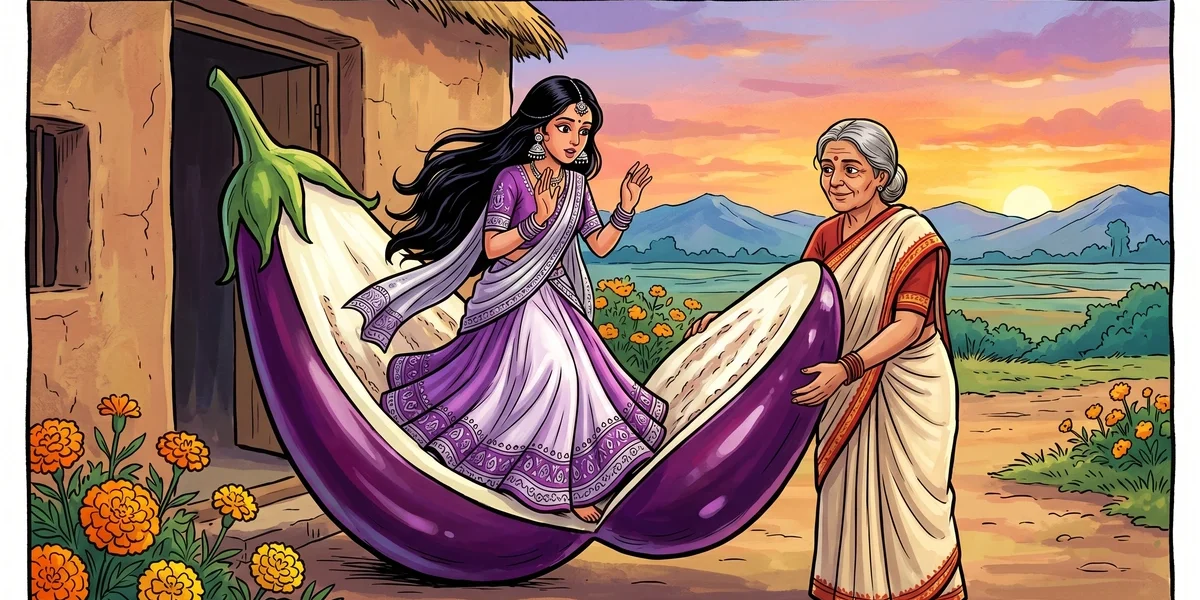
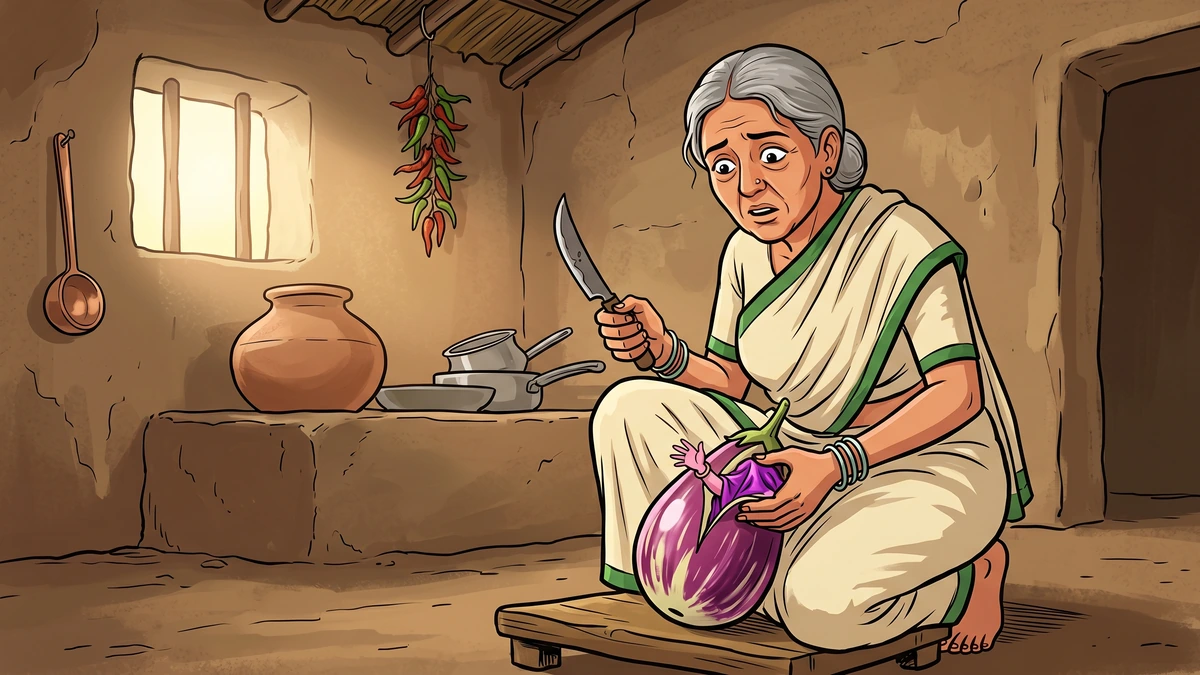
One such morning, gathering herbs, the brahmin finds a wild aubergine seedling. He digs it up, brings it home, plants it by the threshold, and waters it from the household pot. The plant grows wonderfully and bears at last a single fruit, “as big as a pear, purple and white and glossy.” The colour-pairing is the first sign that this is not an ordinary vegetable. Purple-and-white (Sanskrit nīla-śveta; Punjabi kâle-chitte) is the ritual colour-pair of fairy-births in North Indian folk literature: the same pair appears on the dress of the river-fairy in Rasâlu and Sarkap and on the pavilion of the parī in the Sufi romance Sassi-Punnun. The fruit hangs ripening for many days because the brahmin and his wife — childless and tender-hearted — cannot bring themselves to pluck it. Eventually hunger forces the cut. As the wife slices through the rind a small voice cries from inside: “Take care! — oh, please take care! Peel more gently, or I am sure the knife will run into me!” She finishes the cut delicately, and out steps a tiny maiden, dressed in purple-and-white satin.
This is motif F1031 in Stith Thompson’s Motif-Index of Folk-Literature (1932–36): the princess born from a plant. It is one of the most widespread images in world folklore, but the Punjab gives it a particular flavour. The aubergine is a kitchen-garden vegetable of the very poor; the princess emerging from it is therefore not, like the Greek Persephone, a goddess descending from above — she is a fairy quietly arriving at the level of the threshold of a household that has nothing else. The childless brahmin couple, said the village storytellers Steel interviewed, were rewarded for not eating the fruit on the first day they were tempted, even though they were starving. The pause between hunger and the act of cutting is the small ethical hinge on which the entire tale turns. They name her Princess Aubergine, “for, said the worthy couple, if she was not a Princess really, she was dainty and delicate enough to be any king’s daughter,” and they raise her as a daughter of the house.
II. The Slave-Girl, the Veil Exchange, and the Trap of False Sisterhood
Not far from the brahmin’s hut stands a king’s palace. The king is unnamed in Steel’s recension — the village storytellers consistently anonymised local rajas, partly out of caution under the British Raj and partly because the genre prefers types to individuals. He has a beautiful queen and seven stalwart sons. The queen is a sorceress, a dâyan (दायन / ڈائَن), the Punjabi word that Steel and Temple in their notes trace to the Sanskrit ḍâkinī, the female demonic attendant of the goddess Kālī. The Punjab folk-imagination distinguishes the dâyan sharply from the chudail (a hill ghost) and from the perī (a benevolent fairy): the dâyan is a living human woman who knows the dâyan kâ mantar, the “witch’s charm” that allows her to take out the heart of a sleeping victim and so consume their life-force. She is, in short, exactly the kind of creature whom a fairy princess from a vegetable should never trust.
The trap is sprung sociologically rather than supernaturally. A palace slave-girl, fetching a coal from the brahmin’s hut to relight the kitchen fire, sees the princess and reports back to her mistress that “in a hovel close by there lived a Princess so lovely and charming, that were the King once to set eyes on her, he would straightway forget, not only his Queen, but every other woman in the world.” The queen is “of a very jealous disposition.” She sends a flattering invitation. The princess, vain of her beauty, accepts. The queen, pretending astonishment, says: “You were born to live in kings’ houses! From this time you must never leave me; henceforth you are my sister.” And the trap closes with a piece of perfectly observed Punjabi ethnography: the two women exchange veils and drink milk from the same cup. Temple, in his note, explains the custom dryly: “To exchange veils among women, and to exchange turbans among men, is a common way of swearing friendship among Panjâbîs.”
The veil-exchange (chunnī-badal) is a real and binding ritual of fictive kinship, still practised in pockets of rural Indian and Pakistani Punjab in the early twenty-first century. Two women who exchange veils become dharm-bahnen, “sisters by religion,” with all the obligations of blood-sisters: hospitality, defence in quarrels, equal treatment of children. To use the ritual to entrap a guest is therefore the very gravest offence the Punjabi moral code can imagine — a breach not just of friendship but of the sacred order of fictive kinship that holds village life together. Steel’s storytellers reserved a special tone of horror for this scene. The queen has not simply been wicked; she has corrupted a holy thing.

III. Seven Sons for Naught: The Question Repeated at Midnight
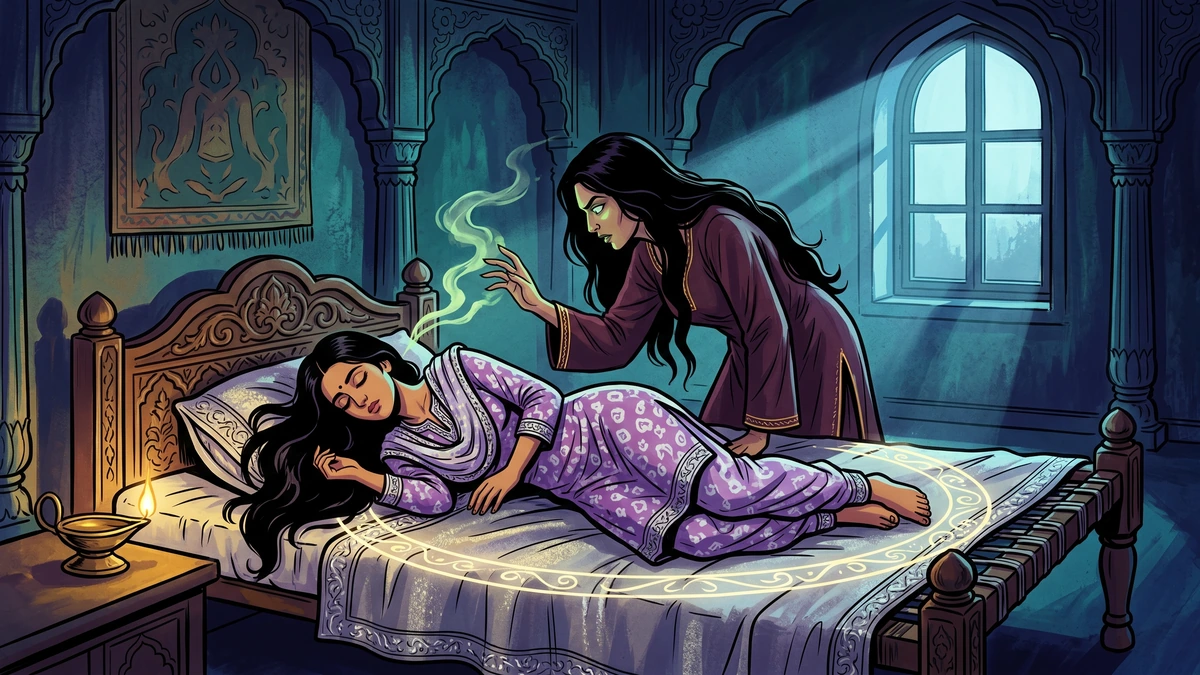
That night, while the princess sleeps, the queen lays a sleeping-spell upon her and asks the question that is the dark heart of every external-soul tale: “Princess Aubergine! tell me true — in what thing does your life lie?” A fairy under such a spell cannot lie, but she can mis-direct, and Princess Aubergine, sensing the danger, does. “In the life of your eldest son,” she answers. “Kill him, and I will die also.” The next morning the queen, with her own hands, kills her eldest son in his sleep — and finds, to her rage, that the princess is alive and well. Six more nights, six more questions, six more murdered sons. The queen has destroyed all seven of her own children for nothing. The repetition is the great Punjabi storytelling device known as satvārā, the seven-fold rhythm: it appears in the seven trials of Rasālu, the seven dishes of Hīr, the seven gates of the City of Sarkap. To kill seven sons by the same misdirection is the Punjab’s most economical image of obsessive evil.
What the princess is doing is what the folktale itself is doing. Each false answer is a delaying tactic, and each delay forces the queen to spend more of her own moral capital. By the seventh murdered son the queen has burned through every reason a woman could have to remain inside her family or her kingdom. She has become, in the moral arithmetic of the tale, exactly what she always was on the inside: a creature whose only desire is to outshine. The princess’s misdirections are therefore not just tricks; they are a slow public unmasking. By the time the queen comes for the seventh question the entire palace knows in its bones that something has gone monstrously wrong, even if no one yet has the words for it.
On the eighth night the queen summons all her sorceress’s art and lays such a spell on the sleeping princess that she can no longer mis-answer. The truth comes out in the most baroque and beautiful sentence in the whole tale: “In a river far away there lives a red and green fish. Inside the fish there is a bumble bee, inside the bee a tiny box, and inside the box is the wonderful nine-lakh necklace. Put it on, and I shall die.” This is the classical Indian form of motif E711.10: the external soul, hidden in a sequence of nested containers across an enormous distance. The Russian variant of ATU 302 hides Koshchei the Deathless’s soul in a needle, in an egg, in a duck, in a hare, in a chest, on an oak, on an island. The Norse variant of Asbjørnsen og Moe (1845) hides the giant’s heart in an egg, in a duck, in a well, in a church, on an island. The Egyptian Tale of the Two Brothers (Papyrus d’Orbiney, c. 1185 BCE) hides Bata’s heart on the topmost flower of an acacia tree. The Punjabi version’s nesting — necklace in box in bee in fish in faraway river — is shorter than the Russian and longer than the Egyptian, and it is unique to South Asia in its choice of jewellery as the innermost vessel.
IV. The Nine-Lakh Necklace: Soul in a Fish in a Bee in a Box
The necklace itself is a real object of Punjabi material culture. Temple, in his note, calls it the nau-lakkhâ hâr — nau-lakh meaning “nine lakhs” or nine hundred thousand rupees, and hâr the long necklace worn over both shoulders. By 1890 the term had become idiomatic for “extremely valuable”: the Maharajas of Patiala called their pleasure-garden the Nau-Lakkhâ Bagh; the Sikhs of Lahore called the great octagonal pavilion of the Lahore Fort the Nau-Lakkhâ Pavilion. Temple records that the last Maharaja of Patiala, Bhupinder Singh’s grandfather, had a real nau-lakkhâ hâr made for himself around 1880, set with the great Sancy diamond, kept on permanent display in the Patiala fort. The princess’s soul, then, is hidden inside the most exact symbol of Punjabi royal wealth that the storyteller could name — an artifact every village child had heard about and no village child had ever seen. The genius of the image is that the princess’s life is at once impossibly remote (a fish, a bee, a box, a faraway river) and immediately recognisable: the necklace itself is something every Punjabi listener could picture.
The queen, having extracted the secret, manipulates her unsuspecting husband. Pretending to weep with longing, she tells him she has set her heart on the nine-lakh necklace; the king, kind and grieving for his seven dead sons (whom the queen has told him died of an “infectious disease”), orders every fisherman in the realm to fish until the red-and-green fish is caught. The fishermen succeed. The fish is opened — the bee taken out — the box prised open — the necklace lifted out — and at the moment the queen clasps it round her own throat the princess, far away in the brahmin’s hut, knows she must die. Before she goes she gives her foster-parents three precise instructions: do not burn her, do not bury her, but dress her in her best clothes, scatter flowers over her, lay her on a bed in the wildest wilderness, and build a high mud wall round her with no door. They obey her, weeping. She dies as the necklace closes round the queen’s neck.
The story now turns. The grieving king goes hunting in every direction except north, because the queen has forbidden it. One day, finding no game in the south, east, or west, he forgets his promise and rides north. He climbs the high wall and finds the princess on her flower-strewn bed — unburnt, unburied, looking as if she has just fallen asleep. He spends the day kneeling beside her, begging her to wake. She does not. He returns the next morning. After a year of these daily vigils — each morning he kneels, each evening he leaves — he finds, one day, a beautiful little boy lying beside her. The boy, when old enough to talk, tells him: “My mother is alive at night and dead by day — she dies whenever the queen puts on the nine-lakh necklace.” This is motif R32.1 (the apparently dead bride who lives by night) and motif T584.0.1 (the boy born to a sleeping mother). Steel’s storytellers said the boy’s daily appearance was the gift of the princess’s own withheld mercy: she did not, even in her half-death, refuse to bear the king a son.
The Moral: Vanity, Sisterhood, and the Soul in Other Things
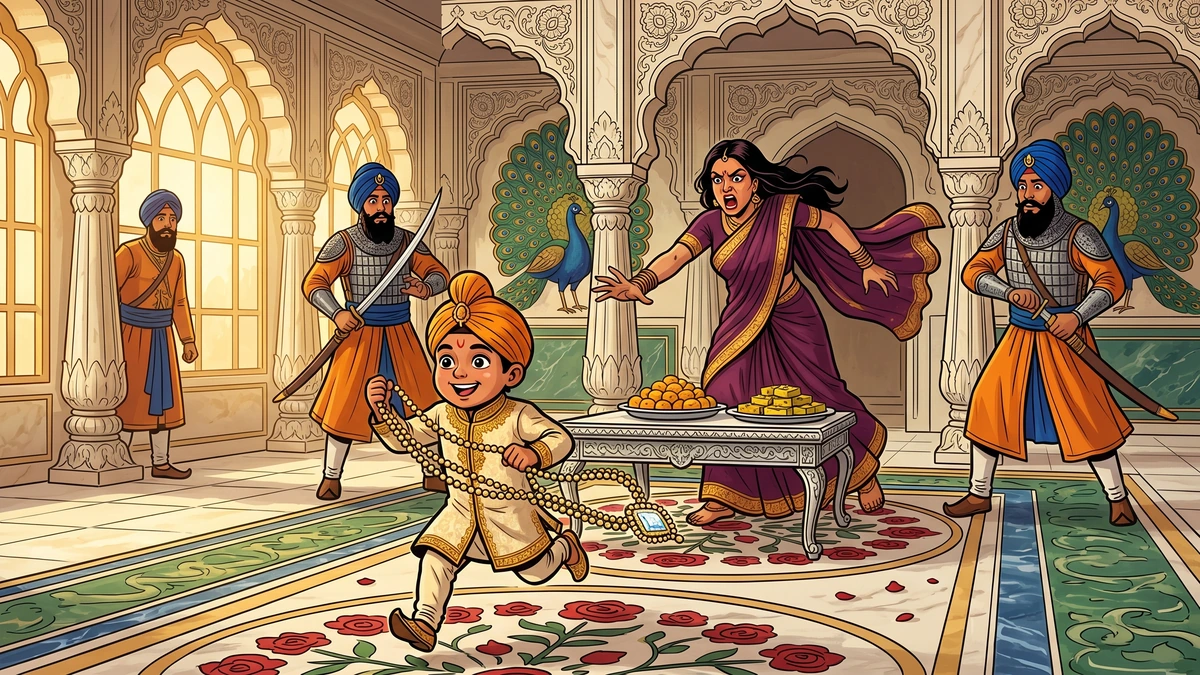
The boy, sent to the palace as the king’s heir, refuses the queen’s poisoned sweetmeats unless she gives him “the glittering necklace round her throat” to play with. The queen, certain she can poison him as soon as he eats, slips off the necklace. He flees the palace at the speed of a fairy’s child, never drawing breath until he reaches his mother in the wilderness, throws the necklace over her head, and brings her back to life. The princess refuses to enter the palace as queen until the sorceress is buried alive in a ditch of scorpions and snakes; the king obeys; the princess walks over the grave to her wedding. The Punjabi storytellers Steel interviewed often added a closing couplet that the manuscript preserves only in vernacular form, here romanised after Temple:
Ji par ji rakh, ji vich ji nā rakh:
Hâr vich ji rakh, te hâr na de jhukh.“Place a life upon a life, but do not place a life inside a life: place the life inside a necklace — and do not part with the necklace lightly.”
— Punjabi closing couplet to Baingan Bâdshâhzâdî, romanisation after R. C. Temple, in Steel, Tales of the Punjab (1894), notes, p. 295.
The proverb is a small village commentary on what the tale is really about. The first line says: never let your sense of yourself depend on another person’s being. The second line says: but if you must depend on something, depend on a thing that you can lock up far from danger — and never give it away. It is the Punjabi grandmother’s practical version of the great theme that James George Frazer would explore three years before Steel’s book, in the celebrated chapter “The External Soul in Folk-Tales” in The Golden Bough (Macmillan, 1890), where he argued that the entire ATU 302 cycle — from Egypt to Ireland to the Punjab to Korea — preserves a primitive religious idea: that the soul is a separable thing, and that human beings are wise to hide it where their enemies cannot find it. Steel’s tale is therefore the Punjab’s richly embroidered local form of one of humanity’s oldest meditations on selfhood.
For the village storyteller, however, the moral was always interpersonal rather than metaphysical. The princess’s great vulnerability is not that her soul is in a necklace; it is that she has accepted a false sisterhood with a sorceress out of vanity for her own beauty. The queen’s great vulnerability is not that she is a witch; it is that she will sacrifice her seven sons rather than acknowledge another woman’s loveliness. The king’s great vulnerability is not that he forgets the north; it is that he never asks his wife why his sons died. The boy’s great strength is not that he is a fairy’s child; it is that he asks for the necklace before he accepts the sweets. The tale, in other words, has at its centre a quartet of choices about what one is willing to look at. The fairy who walks out of an aubergine does not save herself: a small boy who refuses sweets without a toy does.
Why It Lasted: A Punjabi Tale That Travelled the World
The classification of Baingan Bâdshâhzâdî as ATU 302 places it inside one of the largest folk-tale families on earth. Hans-Jörg Uther’s revised index (FFC 284–286, Helsinki, 2004) lists more than 350 distinct attestations of the “ogre’s heart in the egg” type from across Europe, North Africa, the Middle East, Central and South Asia, and indigenous North America. The closest South Asian cognates are the Maive Stokes Indian Fairy Tales (London, 1880) tale “The Boy Who Had a Moon on His Forehead and a Star on His Chin,” collected from a Calcutta ayah, in which a queen’s soul is hidden in a parrot in a tree on the far side of seven seas; the Bengali Thakurmar Jhuli tale of Sat Bhai Champa; and the Tamil Mâdana Kâma Râja recension. The closest non-Indian cognate is the Russian Koshchei the Deathless (Afanasyev, 1855), in which the villain’s soul is hidden in a needle in an egg in a duck in a hare in a chest on an oak on an island. The closest European literary cognate is the Norwegian Risen som ikke hadde noe hjerte på seg (“The Giant Who Had No Heart in His Body”) from Asbjørnsen and Moe’s Norske Folkeeventyr (1845).
What makes the Punjabi telling distinctive within this enormous family is the inversion of who carries the external soul. In the Russian and Norwegian forms the soul belongs to the villain — finding it is what kills him. In Baingan Bâdshâhzâdî the soul belongs to the victim: finding it is what kills her. The story therefore reverses the familiar quest-pattern. The hero of the tale is not the king who rides to the faraway river to fetch the necklace and save his beloved; it is a small boy who walks calmly into the queen’s presence, asks for the necklace as a toy, and runs faster than the palace guards. The story is as much about not eating the poisoned sweet as it is about finding the soul-fish. That double-structure is what gives it its peculiar Punjabi tang: it is at once a wonder-tale and a piece of unsentimental peasant practicality. The fairy’s soul may be in a necklace at the bottom of a faraway river, but the necklace is going to be saved by a child who refuses a sweet.
The folklorist A. K. Ramanujan, in his introduction to Folktales from India (Pantheon, 1991), grouped Princess Aubergine with what he called “tales of the inner room” — Indian folk-tales whose plot turns on what happens inside the women’s quarters of a palace, beyond the king’s sight and beyond his power to intervene. The king in such tales is not a villain but an absentee. The drama is between women: queen and rival, mother and stepmother, sister-in-law and bride. Princess Aubergine is the great Punjabi example of the type, and Ramanujan argued that its long survival in oral tradition was due precisely to this fact — the tale offered village women a structured way of thinking about jealousy, fictive kinship, and the dangers of confiding in a more powerful woman.
Iconography: The Purple-and-White Maiden, the Red-and-Green Fish
The two great visual images of the tale — the small girl in purple-and-white satin stepping out of a sliced aubergine, and the red-and-green fish on a Punjabi fisherman’s line yielding up a bumble bee, a tiny box, and a glittering necklace — entered Indian popular iconography very quickly through the John Lockwood Kipling illustrations to Steel’s 1894 first edition. Kipling’s line drawing of the brahmin’s wife, knife in hand, leaning over the fruit on the threshold while the tiny voice cries from inside, was reprinted in school readers across Punjab for the next half-century. The Bengali artist Nandalal Bose made an ink-and-wash study of the same scene for Tagore’s Visva-Bharati series in the 1920s; the Lahore-born modernist Abdur Rahman Chughtai painted the “Princess of the Egg-Plant” in his unmistakable elongated Mughal manner in 1937. The Amar Chitra Katha series, in its Tinkle issue of 1989, gave the tale its most-circulated twentieth-century form, with the queen drawn in the deep maroon and gold of a Mughal court portrait and the fish in the green-and-vermilion of a Madhubani tile. The image of the necklace coming up out of a fish remains, in 2025, one of the most-shared illustrations on Indian children’s-book social media.
Reading with Children
For parents, teachers, and storytellers reading Princess Aubergine aloud to younger listeners, three details from Steel’s text repay slowing down for. First, the cutting of the aubergine. The child inside the fruit asks to be peeled gently. The wife, hungry as she is, complies. Children grasp at once that the entire tale rests on this small mercy: had she sliced quickly, the princess would never have been born. The opening is therefore not a magical accident but a moral choice, and a small one. Second, the veil exchange. Younger children may need an explanation of the Punjabi sisterhood ritual; once they have it, they will see the queen’s pretence of friendship for what it is. The lesson — that not every offer of sisterhood is honest, and that the right test of sisterhood is what a person does in private, not what they say in public — is one of the most useful things a folk-tale can teach an eight-year-old. Third, the boy and the necklace. The story ends with a child solving a problem his father could not. Children love this. Point out, when reading aloud, that the boy’s strength is not magical: he simply asks for what he wants before he agrees to do what the queen wants. That is a transferable skill, and worth teaching.
A Note on Sources
The version preserved on this page above the moral is the standard text of Flora Annie Steel’s Tales of the Punjab (Macmillan, 1894), pages 76–82, with the Temple notes at pages 295–296. The book is in the public domain and is freely available at Project Gutenberg (e-book 6145). Steel collected the tale in the early 1880s in the districts around Kasur, Lahore, and Patiala, recording the Punjabi original and translating it into a deliberately unfussy English designed for British school readers. Her companion volumes — Wide Awake Stories (1884), the earlier and bulkier collection of which Tales of the Punjab is essentially a children’s edition — preserves the same tale under the alternate title “The Brinjal Princess.” Maive Stokes’ Indian Fairy Tales (1880), the great Bengali parallel, contains six closely related external-soul tales, and serious readers should consult them alongside Steel. For the comparative folklore, the standard reference remains Frazer’s “The External Soul in Folk-Tales” in The Golden Bough, second edition, volume III (1900), chapters X and XI; for the Indian motif inventory, Stith Thompson and Jonas Balys, The Oral Tales of India (Indiana University Press, 1958); for the modern South Asian classification, Heda Jason, Types of Indic Oral Tales (FFC 242, Helsinki, 1989). Above all the retellings stands Steel’s own first edition, with Lockwood Kipling’s line illustrations — short, sharp, and ending in a small girl walking quietly over the grave of a sorceress to her wedding.
Read time: about 10 minutes. Suitable for ages 8 and up; suitable for read-aloud from age 6 with the murder of the seven sons gently summarised as “sent away forever” and the burial of the sorceress described, in Steel’s own gentler words, as “the wicked queen received the punishment she had earned.”
Frequently Asked Questions
**Q: Why is this story important?**
You May Also Like
 Indian Folk Tales
All Ages
Indian Folk Tales
All Ages
A Lac of Rupees for a Piece of Advice
A Lac of Rupees for a Piece of Advice: In a bustling town in ancient India, A merchant paid an enormous sum for a single piece of advice that saved his life.
 Indian Folk Tales
Ages 3-5
Indian Folk Tales
Ages 3-5
Raṇavîrasiṅg
Raṇavîrasiṅg: Once upon a time in the town of Vañjaimânagar there ruled a king, named Śivâchâr, under whom peace and prosperity reigned throughout the land.
 Indian Folk Tales
Ages 6-8
Indian Folk Tales
Ages 6-8
The Legend of Mount Mayon: A Love Written in Stone and Fire
The Legend of Mount Mayon: A Love Written in Stone and Fire: In the Philippines, where the islands rise like emeralds from an azure sea, there stands a