The Jackal And The Partridge
The Jackal And The Partridge: A Jackal and a Partridge swore eternal friendship; but the Jackal was very exacting and jealous. You don’t do half as much for me
This story comes from Tales of the Punjab: Folklore of India, recorded by Flora Annie Steel and annotated by Major R. C. Temple, first published by Macmillan and Co. in 1894 with illustrations by J. Lockwood Kipling. It belongs to the cycle of trickster–friendship tales that runs through the Punjabi village storytelling tradition and also through the older Sanskrit and Pali animal-fable corpora — the Pancatantra, the Hitopadesha, and the Pali Jataka book. In Aarne–Thompson–Uther’s international tale-type index it sits inside the constellation ATU 75 (“The Help of the Weak”), the family of stories in which a small creature outwits or rescues a larger one and so proves that friendship is measured in deeds, not declarations. Stith Thompson’s Motif-Index of Folk Literature tags the four trials as J1771 (friendship test), B450 (helpful birds), K607.3 (animal saved by clever ruse), and K1626 (the boasting friend humbled by deeds).
Origin and Source
The version retold below was collected in the central Punjab in the late nineteenth century by Flora Annie Steel, who lived in the Punjab as the wife of a colonial officer between 1868 and 1889 and devoted herself to writing down the stories told by village women, dais (midwives), and travelling Mirasi bards before they were lost. She published her first folktale gatherings as Wide-Awake Stories in 1884 (Bombay) and then expanded the collection — with the addition of Major R. C. Temple’s scholarly notes, ATU-style “Analysis of Incidents”, and an Appendix mapping the Punjabi tale-types to the wider Indo-European tradition — as Tales of the Punjab: Folklore of India in 1894. The first edition was illustrated by J. Lockwood Kipling, then Principal of the Mayo School of Art in Lahore and the father of Rudyard Kipling, whose pen drawings of the laughing jackal and the perched partridge became the standard visual reference for the tale in English-language children’s books for the next half-century.
The story has deep roots beneath Steel’s Punjabi recension. Its core test-of-friendship structure echoes the framing of Pancatantra Book IV (Labdha-Pranasha, “The Loss of Gains”), in which animals continually probe whether their friends will keep their pledges under hardship. The jackal-as-bullying-companion who is foiled by a smaller bird parallels the Vanarinda Jataka (No. 57) and the Sumsumara Jataka (No. 208), where small or weak animals outwit predators by reading their psychology. The motif of the partridge tricking two travellers into beating each other is a near cousin of the celebrated Tittira Jataka (No. 37), the “Partridge, Monkey, and Elephant” Jataka in which the partridge is again the figure of prudent intelligence. And the river-crossing finale, in which the jackal is nearly drowned by a fish or crocodile, is the same narrative bone as the famous “Monkey and the Crocodile” cycle (Sumsumara Jataka; Pancatantra IV.1) — only the species are switched. Steel’s text therefore preserves a late-nineteenth-century Punjabi village retelling of a tale-type that had already travelled through Buddhist Sanskrit, classical Sanskrit, Persian (the Anvar-i-Suhayli), and back into the regional vernaculars of north India.
The Boast at the Mango Grove
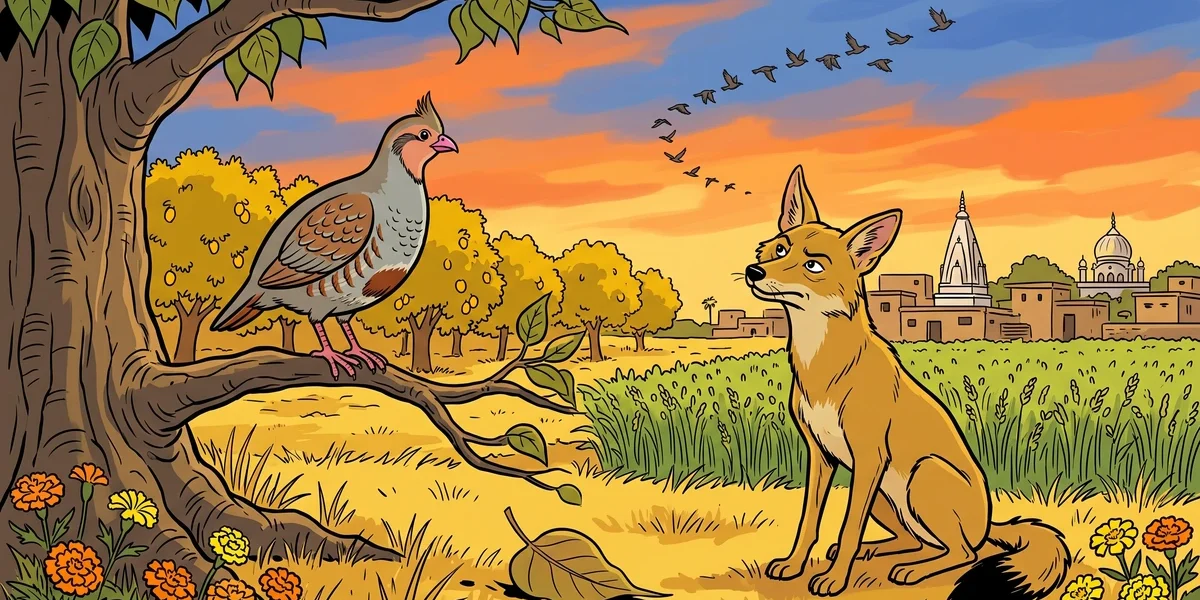
It was the season when the mangoes hang heavy and gold on the trees of the Punjab, and the gram fields stand shoulder-high and ready for the sickle. A jackal — lean, copper-coated, with the long muzzle and black-tipped tail of Canis aureus indicus, the Indian jackal of the canal districts — had taken to spending his evenings under a great pipal tree at the edge of a wheat field. There he met every dusk with a partridge, a small grey-and-russet hen with a pink beak and a little crest of feathers — almost certainly the grey partridge (Francolinus pondicerianus) that whistles its katar-katar-katar through the dust of every Punjabi village at sunset. The two had sworn an eternal friendship, in the village manner: a sip of well-water shared from the same earthen kulhar, a touch of foreheads, a promise that one would die for the other if the day came.
But the jackal was a difficult friend. He was forever counting the favours he had done, weighing them against the favours he had received, and finding the balance against him. “You don’t do half as much for me as I do for you,” he would grumble each evening, his yellow eyes narrow with grievance, “and yet you talk a great deal of your friendship. My idea of a friend is one who can make me laugh or cry, give me a good meal, or save my life if need be. You couldn’t do that.“
The partridge sat very still on her low branch. She did not argue. She had lived long enough in a Punjabi village to know that a boaster is best answered not in words but in the quiet ledger of deeds. “Let us see,” she said, settling her wings smooth against her sides. “Follow me at a little distance. If I do not make you laugh by the time the sun touches the canal embankment, you may eat me.” And she lifted from the branch on her short, whirring wings.
The First Test — How the Partridge Made the Jackal Laugh
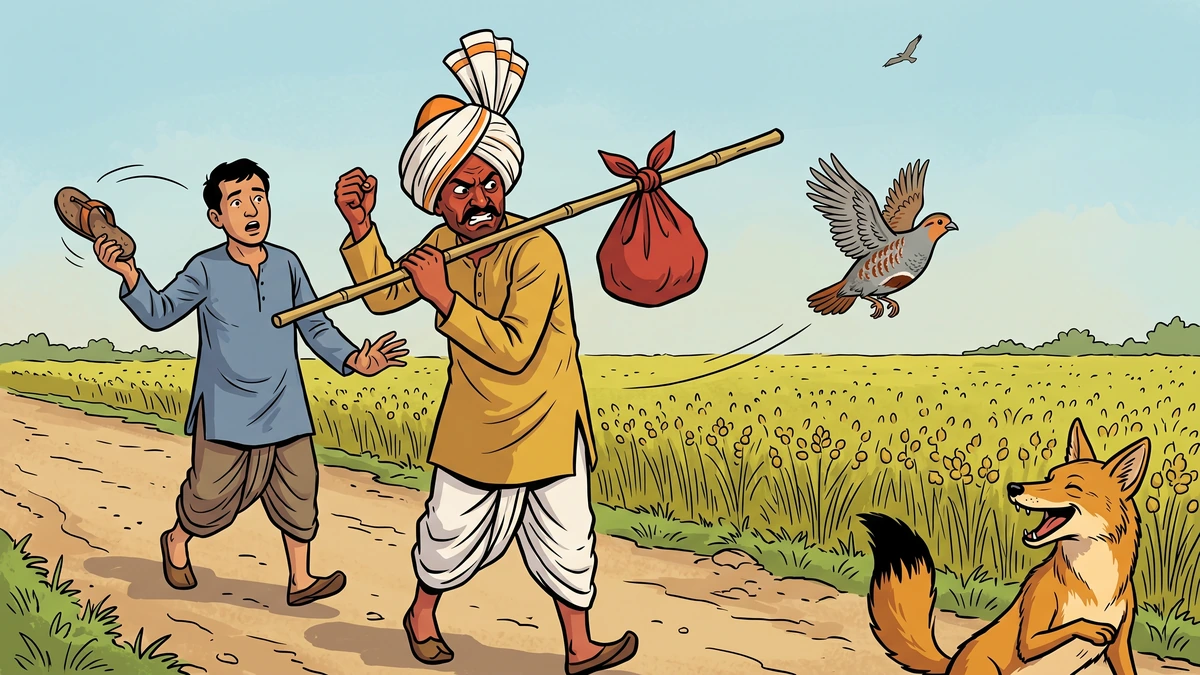
The partridge flew low and neat across the gram field until she came upon two travellers on the kachcha road. They were pardesis — strangers — footsore from the long walk between Lahore and Amritsar, dust-caked to the knees, and the heat had made them quarrelsome though they had not yet quarrelled. The first man trudged ahead with his bundle slung on a stick over his shoulder. The second, who had taken his shoes off to ease his blisters, walked behind with the shoes dangling from his hand by their leather thongs.
The partridge dropped, light as a breath, onto the stick that bobbed above the first traveller’s shoulder. He did not feel her. He trudged on, eyes down on the ruts. But the second traveller, lifting his head, saw the bird sitting plump and tame just within the reach of his arm, and the thought of supper rose in him like a small, sharp song. Without thinking and without speaking he flung one of his shoes at the bird with all the force of a hungry man — and the partridge, who had been waiting for exactly this, tilted her wings and was gone before the leather even left his fingers.
The shoe sailed past the place where the partridge had been and struck the back of the first traveller’s turban with a soft, decisive thump. The turban tipped sideways. The first traveller spun on his heel, his face a sudden dark red. “What plague do you mean?” he shouted. “Why did you throw your shoes at my head?” The second traveller, a mild man, opened his hands and explained in the slow, careful voice that mild men use when they are accused of something they did not intend: “Brother — do not be angry. I did not throw at you. There was a partridge sitting on your stick.” But of course, when the first traveller looked, there was no partridge. There was only the empty stick and the empty road and the dust settling, and the thin laughter of a jackal hidden in the gram field.
“On my stick!” the first traveller bellowed. “Do you take me for a fool? First you insult me with your shoe, and then you lie about it like a coward — but I’ll teach you manners.” And he fell upon his fellow without further argument. They beat each other up and down the road until their noses ran red, their kurtas were torn at the shoulders, and their dust-caked turbans lay unwound in the ruts like long banners of defeat. The jackal in the gram field laughed until he fell over on his side and his ribs hurt, and the partridge, perched once more on her branch, looked at him with the small unblinking patience of a creature that has just won the first of four arguments. “Are you satisfied?” she asked. “Well,” answered the jackal, wiping a tear from his eye with one paw, “you have made me laugh, that is true. But it is easy enough to be a clown. The greater test is to make a hard heart cry.”
The Second Test — How the Partridge Made the Jackal Cry
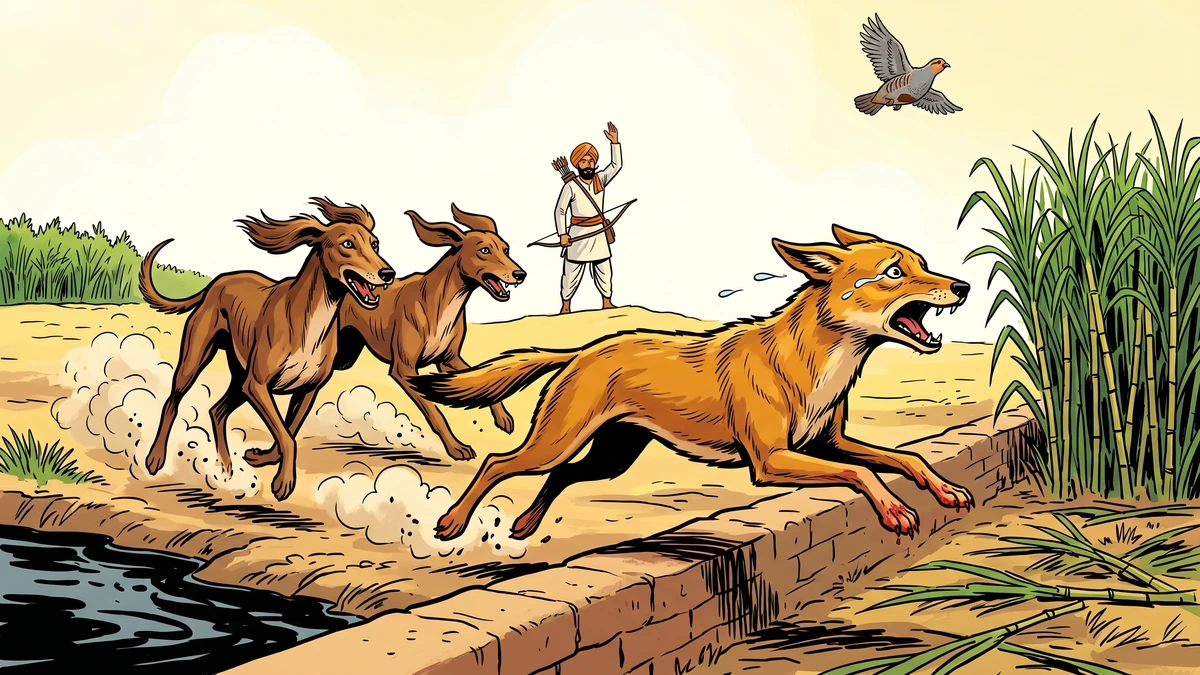
The partridge said nothing, only flew. She crossed two fields and came to a place where a Punjabi shikari — a hunter — was sleeping in the shadow of a kikar acacia, his bow and his sheaf of arrows beside him, his pair of long-eared hunting hounds at his feet, the dogs’ eyes closed but their ribs rising and falling with the dreams of the chase. The partridge settled on the hunter’s chest, light as a falling leaf, and pecked once — softly — at his eyelid. The man woke with a jerk. The dogs woke with him. And the partridge, with the easy contempt of a small bird who knows the geometry of escape, lifted into the air and flew slowly — slowly — towards the gram field where the jackal was still chuckling about the broken turbans.
The hunter saw her flying low. He whistled the dogs onto her trail. The dogs poured across the field like a brown wave. They did not see the partridge, who lifted high and away, but they saw the jackal — a flash of copper fur in the gram, the wrong creature in the wrong field at the wrong moment — and they took him for the prey their master had whistled them after. The chase was loud and ugly. The jackal ran for his life across three fields, leapt a low mud wall, doubled back through a stand of sugarcane, and finally threw himself flat in the muddy ditch behind a buffalo wallow where the dogs lost his scent in the thick black water and went whining home. When he crawled out he was shaking from nose to tail, his fur was matted with mud and burrs, the pads of his paws were bleeding, and tears of pure terror were rolling down the long lines of his snout. He had not cried like that since he was a cub.
The partridge dropped onto a low branch above him. “Are you satisfied?” she asked, in the same soft voice she had used at the beginning. The jackal looked up at her with his wet face and could not, for a long moment, find any breath in which to answer. “You have made me cry,” he said at last, in a small voice. “I will admit it. But to weep from fear is the easy half of crying. A friend who only frightens a friend is no friend at all. The next test is harder. I am hungry — I am very hungry — and a true friend would now find me a good meal.”
The Third Test — How the Partridge Found the Jackal a Good Meal
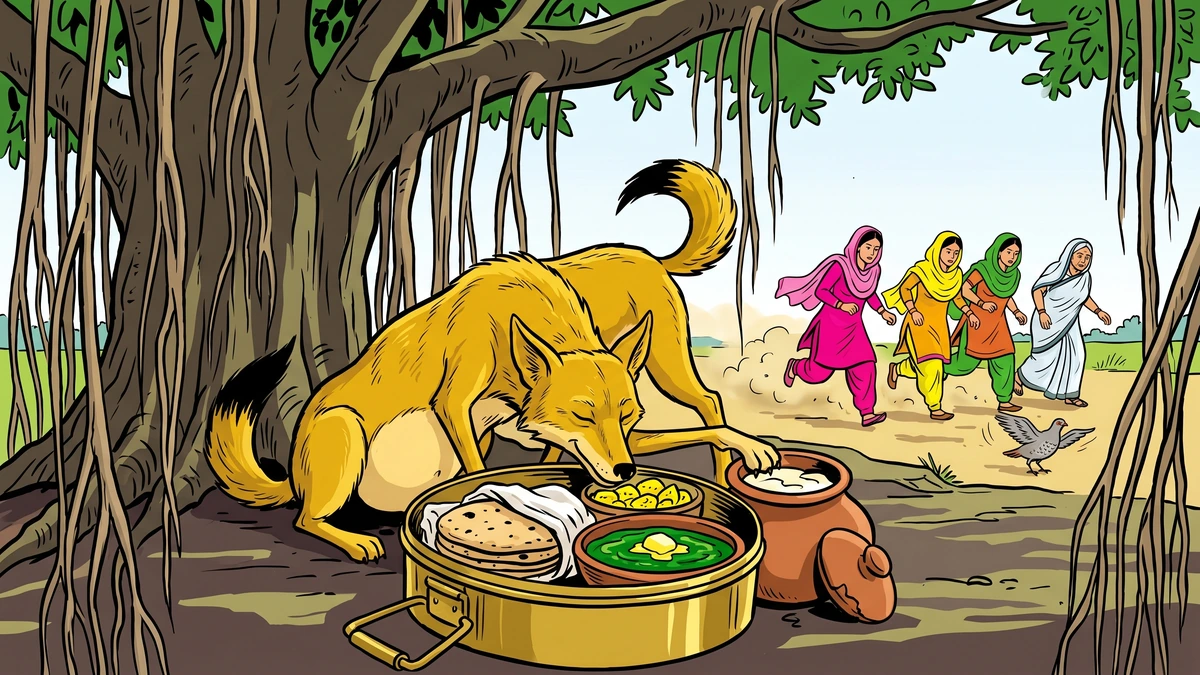
The partridge thought a moment, tilting her crest. Then she flew, and the jackal followed at the prudent distance of a frightened animal. They came at last to a place where a knot of village women — a goatherd’s wife, two daughters-in-law, and a grandmother — had set down their brass tiffin boxes and earthen matkas in the shade of a great banyan, while they themselves squatted a little way off, plaiting cotton thread and grinding their gossip about a wedding in the next village. Inside the brass boxes was the family’s noon meal — wheat rotis still warm in their cotton wrap, a small earthen bowl of sarson da saag (mustard greens) glossy with white butter, a heap of pickled lime, and a clay pot of buttermilk thinned with mint. Inside the matkas was the curd they had brought up from the cool of the well at dawn.
The partridge dropped close to the women. She let herself be seen. She fluttered as if her wing were broken, dragging it along the dusty ground in the old, old broken-wing display that ground-nesting birds use to draw a predator from their nest. The women saw her and their gossip stopped at once. “A wounded partridge!” cried the youngest daughter-in-law. “A bird for the pot!” cried the grandmother, who knew a free dinner when she saw one. They sprang up — all four of them — and gave chase, beating the dust with their chunnis and shouting at one another to head the bird off, to drive her into the gram, to corner her behind the buffalo wallow.
The partridge led them three fields away, dragging her wing always just out of reach, and the moment they were well beyond hearing she folded the false-wounded wing and lifted into a clean steep climb. Behind her, in the shadow of the banyan, the jackal had crept out of the gram and was now eating his way steadily through the tiffin boxes. He licked the white butter out of the saag bowl. He swallowed the soft rotis in single greedy mouthfuls. He drank the buttermilk straight from the pot. He even broke the lid of one of the matkas and ate the curd to its bottom. By the time the women returned — empty-handed, tired, scolding one another for letting the bird get away — the brass boxes were empty, the curd-pots were licked clean, and the jackal was already a quarter of a mile away with his belly stretched tight as the skin of a drum.
The Fourth Test — How the Partridge Saved the Jackal’s Life
“You have made me laugh,” said the jackal that evening, as the moon rose over the canal. “You have made me cry. You have given me the best meal of my life. There is one test left. Save my life — and I will believe you are a friend.” And he settled down in the shade of the pipal with the smug, half-closed eyes of a creature who is sure he is asking the impossible.
“Very well,” said the partridge calmly. “Tomorrow at dawn, follow me to the canal.”
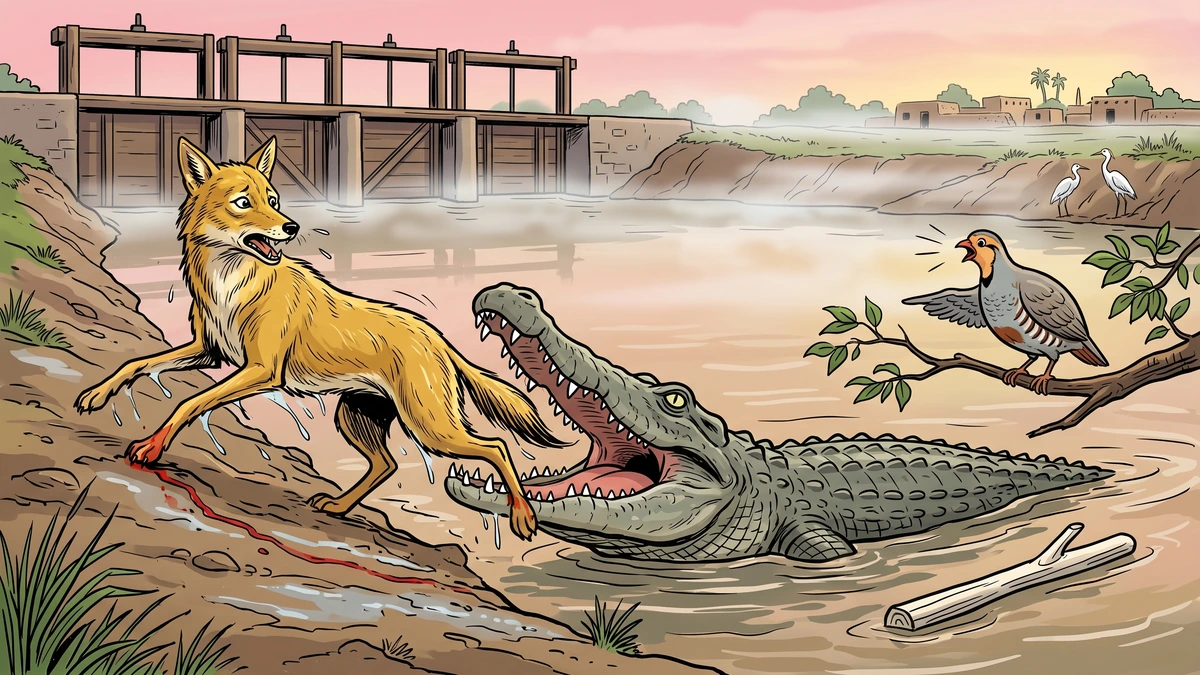
At dawn the jackal followed the partridge to the broad muddy water of the canal where it widened into a slow pool below the lock-gates. The partridge had spoken in the night to an old marsh crocodile (Crocodylus palustris, the broad-snouted magar of the Punjabi canals) who lived under a sunken log on the far bank. She had told the crocodile that a foolish jackal would come at dawn and try to cross. The crocodile, who was old and patient and very hungry, agreed to lie still and wait.
“Cross over,” the partridge told the jackal. “There is a goat carcass on the far bank — you can finish what the kites have left. Step on the brown logs to keep your feet dry.” The jackal stepped onto the first log. He stepped onto the second. He stepped onto the third — and the third log opened a long pale-toothed jaw under his belly and clamped him by the right hind leg. The jackal screamed. The crocodile began to drag him under, slowly, the way the magar always drowns its prey before eating it.
The partridge dropped at once to the surface of the water, just out of the crocodile’s reach, and called in a clear bright voice: “Brother crocodile! You have caught a stick — not a leg! Look — the leg is the white branch you can see in the water beside you! Bite the leg, brother — you have only the stick!” The old crocodile, who had bad eyes and a worse memory, looked sideways into the water. He saw a pale shape — it was a half-submerged peeled stick of shisham wood — and he believed the partridge. He opened his jaws to take what he thought was the leg. The jackal kicked free in the same instant and bolted up the mud bank with his fur streaming water and his right paw trailing blood, but alive — alive, alive.
On the bank he stood shaking and dripping while the partridge settled on a low branch above him. He could not, this time, find any clever speech. He could not say it is easy enough or the greater test is. He could only look at her with his eyes wide as a young cub’s and say, in a voice so quiet it almost was not a voice at all: “You are my friend.“
The Moral — What the Partridge Taught the Jackal
The Punjabi village storyteller closes the tale with a proverb that Major Temple records in his 1894 notes in its original form: “Yaar wahi jo bure waqt kam aave.”
“یار وہی جو برے وقت کام آوے۔”
Yaar wahi jo bure waqt kam aave.
“A true friend is the one who is useful in bad times — not the one who counts favours in good ones.”
The story belongs to the great teaching tradition of the Indian animal fable, in which the moral is never told to the listener — never delivered in the flat sermon-voice — but is built up, brick by brick, in the architecture of the four tests. The partridge does not lecture the jackal. She does not say it is wrong to count favours or friendship is more than words. She simply does all four of the impossible things he demanded — laugh, cry, meal, life — and at the end of the doing the moral is so heavy and so obvious that the jackal cannot help but speak it himself. You are my friend. Three small words from a creature who began the story complaining that no one ever did anything for him.
This is the deep grammar of the Indian fable, from the Pancatantra down to the village baithak: the listener must learn the lesson the same way the wronged jackal learns it — not by being told but by being shown. And the lesson itself is one of the oldest in any human storytelling tradition: friendship is a verb, not a noun. It is not what you swear by the well in the evening. It is what you do when the dogs are at your friend’s throat and the crocodile has him by the leg.
Why This Tale Has Lasted
“The Jackal and the Partridge” has survived for at least two thousand years in some recognisable form — from the Pali Jatakas of the third century BCE through the classical Sanskrit Pancatantra of around 300 CE, into Persian as the Anvar-i-Suhayli, into Arabic as Kalila wa-Dimna, back into the vernacular Punjabi of the nineteenth century with Steel and Temple, and onwards into the Amar Chitra Katha children’s comics of the twentieth century — because it solves a problem every human listener faces: how do you know who your real friends are? The boastful jackal asks the question crudely (can you make me laugh, can you make me cry, can you feed me, can you save me?), but the question itself is universal, and the partridge’s answer is universal too. You know your real friends not by what they say across the brass plate of the wedding feast but by what they do when the dogs are running and the river is rising.
The tale has also lasted because of its perfect four-beat structure. The four tests are arranged in a deliberate ladder — laugh (the lightest demand), cry (the demand for emotion), meal (the demand for material help), and finally life (the demand that consumes everything). Each test is harder than the last, each requires a more cunning improvisation by the partridge, and the cumulative effect is a story that can be told to a child in ten minutes but that contains, in its compressed architecture, an entire ethical theory of friendship. The Brothers Grimm, when they encountered Indian animal fables in the early nineteenth century, recognised this structural purity and noted it in their Kinder- und Hausmärchen appendix. So did Joseph Jacobs in his 1892 Indian Fairy Tales, where he placed Steel’s Jackal-and-Partridge alongside the Grimms’ tit-for-tat tale KHM 73 (Der Wolf und der Fuchs, “The Wolf and the Fox”) as evidence that the same motif of “the small clever creature who outwits the big greedy one” was a single river of tradition flowing across Eurasia.
And finally the tale has lasted because of the partridge herself. She is not loud. She is not vain. She does not boast of her cleverness even at the end, when the jackal admits defeat. She is the figure — repeated again and again across the world’s folklore, from the Punjab to the Cherokee to the Yoruba to the Norse — of the small intelligent creature whose patience and wit redeem the bullying of the larger beast. She is what every village storyteller wants every child in the baithak to grow up to become. Quiet. Kind. Patient. And, when the moment comes, more cunning than the jackal will ever guess until he is in the crocodile’s mouth and her clear voice is calling across the water.
Frequently Asked Questions
What is the moral of The Jackal and the Partridge?
The moral is captured in the Punjabi proverb ‘Yaar wahi jo bure waqt kam aave’ — ‘A true friend is the one who is useful in bad times, not the one who counts favours in good ones.’ Friendship, the story argues, is a verb, not a noun: it is not what you swear by the well in the evening but what you actually do when the dogs are at your friend’s throat and the crocodile has him by the leg. The partridge proves her friendship not by speeches but by performing all four impossible tasks the boastful jackal demanded — making him laugh, making him cry, finding him a meal, and saving his life — until the jackal himself, humbled, can only whisper ‘You are my friend.’
Where does The Jackal and the Partridge come from? Who first wrote it down?
The version most readers know was collected in the central Punjab in the late nineteenth century by Flora Annie Steel, an English colonial-era folklorist who lived in the Punjab from 1868 to 1889 and devoted herself to writing down stories told by village women, midwives, and travelling Mirasi bards. She first published it in ‘Wide-Awake Stories’ (1884) and then included it in the definitive edition, ‘Tales of the Punjab: Folklore of India’ (Macmillan, 1894), with scholarly notes by Major R. C. Temple and pen-and-ink illustrations by J. Lockwood Kipling, principal of the Mayo School of Art in Lahore and the father of Rudyard Kipling. The story, however, is far older than Steel’s collection — it preserves a tale-type that runs back through the Sanskrit Pancatantra (c. 300 CE) and the Pali Jatakas (c. 3rd century BCE).
What are the four tests of friendship in the story?
The boastful jackal demands the partridge prove her friendship by doing four impossible things, arranged as a deliberate ladder of difficulty. (1) Laugh: the partridge perches on a traveller’s stick so that the second traveller flings a shoe at her, knocks off the first traveller’s turban, and starts a roadside brawl that leaves the jackal weeping with laughter. (2) Cry: she wakes a sleeping shikari and his hunting dogs, leads them across the fields, and the dogs mistake the jackal for prey and chase him through three fields, leaving him soaked in mud and weeping with terror in a buffalo wallow. (3) Meal: she fakes a broken wing in front of four village women cooking lunch under a banyan, draws them three fields away in pursuit, while the jackal eats the entire family’s brass tiffin boxes of rotis, sarson da saag, and curd. (4) Life: at dawn at the canal she gets the jackal seized by a marsh crocodile and then tricks the half-blind crocodile into letting go by calling that he is biting a stick instead of a leg. After the fourth test the jackal can only whisper, ‘You are my friend.’
What is the connection to the Pancatantra and the Jataka stories?
Major Temple’s 1894 notes place the tale inside the great cycle of Indian friendship-and-trickster animal fables. The framing of friendship-as-test echoes Pancatantra Book IV (Labdha-Pranasha, ‘The Loss of Gains’), in which animal friendships are continually probed under hardship. The bullying jackal-companion outwitted by a smaller animal parallels the Vanarinda Jataka (No. 57) and the Sumsumara Jataka (No. 208). The motif of the partridge tricking two travellers into beating each other is a near cousin of the Tittira Jataka (No. 37). And the river-crossing finale, where the jackal is nearly drowned by a crocodile and saved by a clever friend, is the same narrative bone as the famous Monkey-and-Crocodile cycle (Sumsumara Jataka; Pancatantra IV.1) — only the species are switched. In the international Aarne–Thompson–Uther tale-type index, it sits inside ATU 75, ‘The Help of the Weak.’
Why has The Jackal and the Partridge survived for over two thousand years?
The tale has lasted because it answers a question every human listener faces — ‘How do you know who your real friends are?’ — through a perfect four-beat dramatic structure. Each test is harder than the last (laugh < cry < meal < life), each requires a more cunning improvisation by the small bird, and the cumulative effect is a story tellable to a child in ten minutes that nevertheless contains an entire ethical theory of friendship. It has travelled from the Pali Jatakas through the Sanskrit Pancatantra into Persian as the Anvar-i-Suhayli, into Arabic as Kalila wa-Dimna, back into vernacular Punjabi with Steel and Temple in 1894, and onwards into the Amar Chitra Katha children's comics of the twentieth century. Joseph Jacobs's 1892 'Indian Fairy Tales' compared it to Grimm KHM 73 (Der Wolf und der Fuchs) as evidence that the motif of 'the small clever creature who outwits the big greedy one' is a single river of tradition flowing across all of Eurasia.
Frequently Asked Questions
**Q: Why is this story important?**
You May Also Like
 Indian Folk Tales
All Ages
Indian Folk Tales
All Ages
Good Luck to the Lucky One
Good Luck to the Lucky One: In a certain town there lived a wealthy Brâhmiṇ. He wished to build a house - pretty large and spacious - as became his riches. The
 Indian Folk Tales
Ages 9-12
Indian Folk Tales
Ages 9-12
The Legend of the Merlion
The Legend of the Merlion: In the days when the seas between lands were still being charted by explorers and when magic and reality existed in closer proximity
 Indian Folk Tales
All Ages
Indian Folk Tales
All Ages
The Wrestlers
The Wrestlers: There was, once upon a time, long ago, a wrestler living in a far country, who, hearing there was a mighty man in India, determined to have a