The Legend of the Durian Fruit: Why the King of Fruits Has a Pungent Crown
The Legend of the Durian Fruit: Why the King of Fruits Has a Pungent: Long ago, in the lush forests where the land meets the endless sky, there grew a magical
The Sumatran (particularly Minangkabau) tradition adds a gendered dimension: the durian is associated with the feminine sphere not because women eat it more but because the matrilineal social structure of Minangkabau culture positions women as custodians of knowledge that is not immediately legible to outsiders. The durian tree, in Minangkabau proverb, is cited alongside the rumah gadang (great house) as an example of something whose value only becomes apparent once you are inside it—a compliment extended to the Minangkabau social system itself, which confounds visitors with its apparent inversions of expected gender hierarchies before revealing its internal logic.
The Colonial Encounter and the Creation of the “King” Title
The durian’s designation as “King of Fruits” is itself a historically situated production, not an immemorial traditional title. While indigenous peoples of Southeast Asia clearly regarded the durian with exceptional reverence—it was reserved for royalty in certain courts, featured in ceremonial offerings, and central to harvest festivals—the specific “King of Fruits” formulation in its current usage owes much to the 19th-century natural historian Alfred Russel Wallace, who encountered the fruit in Borneo and Malaya during his celebrated eight-year survey and declared in The Malay Archipelago (1869) that “it is the king of fruits.” Wallace’s endorsement, coming from the co-discoverer of natural selection and one of Victorian England’s most trusted scientific voices, gave the title an authority in the English-speaking world that durian advocates have leveraged ever since.
Wallace’s account is worth quoting for what it reveals about the dynamics of cross-cultural olfactory calibration: he describes his initial repulsion, followed by gradual acclimation, followed by genuine enthusiasm—a trajectory now so widely repeated by food writers that it has become a genre cliché. The trajectory matters mythologically because it replicates the structure of the traditional origin stories: the durian tests you, you must endure the test, and then you are rewarded. Wallace underwent the initiatory structure of the fruit’s mythology without knowing it, and his account encodes that structure for Western readers. The colonial “discovery” narrative thus accidentally reproduces the folk mythological logic it had no knowledge of, which is either a remarkable coincidence or evidence that the durian’s paradoxical structure is so fundamental that any sustained encounter with it generates the same narrative arc.
Post-independence Southeast Asian nationalism has reclaimed and amplified the “King of Fruits” title with considerable cultural investment. In Malaysia, where durian cultivation is a significant agricultural industry and where durian varieties (particularly the premium Musang King, D52, and Black Thorn cultivars) command prices equivalent to luxury goods, the fruit has become intertwined with national identity in ways that parallel the role of the tiger in the national coat of arms. The Malaysian government’s Durian Industry Development Plan explicitly frames the fruit as cultural heritage, and the Durian Museum in Balik Pulau, Penang—a pilgrimage destination for durian tourists from mainland China, where demand for premium Malaysian durian has exploded—explicitly curates the fruit’s mythological history alongside its agricultural economics.
Contemporary Resonances and the Global Durian Moment
The early 21st century has seen a remarkable expansion in the durian’s global cultural footprint, driven primarily by the fruit’s enormous popularity among Chinese consumers and the resulting explosion of Chinese-language durian content across social media platforms. The Chinese encounter with durian mythology has produced a fascinating hybridization: Chinese folk belief traditions (particularly those associated with luck, abundance, and the propitious properties of difficult-to-obtain foods) have been grafted onto Southeast Asian origin narratives by diaspora communities in ways that echo the historical Tamil-Malay synthesis of centuries earlier. The result is a new stratum of durian mythology in which the fruit’s prosperity-signifying associations in Chinese culture interact with its transformation-and-sacrifice origin stories in Southeast Asian culture.
Food scientists have in recent years attempted to decode the biochemistry of the durian’s infamous smell, identifying thirty-six volatile compounds responsible for the fruit’s aroma profile, with diethyl trisulfide and ethanethiol among the primary culprits. A 2012 study in the Journal of Agricultural and Food Chemistry by Jia-Horng Wang and colleagues identified 19 odour-active compounds that, in combination, produce the fruit’s unique smell—described by researchers as simultaneously fruity, sulfurous, caramellic, and fetid. What the chemistry reveals, and what the folk mythologies have always known, is that the durian’s smell is not simple: it is a compound phenomenon, layered and contradictory at the molecular level, just as its taste is simultaneously sweet, bitter, creamy, and alcoholic. The paradox goes all the way down.
This chemical complexity has a cultural correlate in the sheer number of named varieties now recognized: Malaysia alone recognizes over two hundred named cultivars, each with its advocates and its specific flavor profile (bittersweet, creamy, alcoholic, mild, intensely sulfurous). The variety within the species mirrors the variety of mythological interpretations of the species: there is no single durian, just as there is no single origin story. The fruit has been many things to many peoples—princess and warrior, gift and curse, test and reward, democratic food and royal luxury—and its mythology has been capacious enough to hold all these meanings simultaneously, which may be the deepest secret of its enduring centrality to Southeast Asian cultural life.
The Fruit in Ritual and Festival
Durian’s ritual dimensions extend beyond origin mythology into active ceremonial life. In Sabah (Malaysian Borneo), the Kadazan-Dusun harvest festival Kaamatan features durian as a sacred offering alongside rice wine (tapai) and glutinous rice in ceremonies honouring Bambazon, the spirit of the paddy. The durian’s temporal alignment with the main harvest season—it peaks in June and July, coinciding with post-harvest celebration periods—has made it a natural festival fruit, its availability marking the successful conclusion of the agricultural cycle. In these ceremonial contexts, the durian’s smell is specifically valued as spiritually potent: the bobolian (ritual specialist) may use the smell to mark out sacred space, the fruit’s olfactory intensity functioning as a sensory boundary between ordinary and ritual time.
The Batak communities of North Sumatra preserve a durian ritual (mangulosi durian) associated with weddings in which the groom’s family presents durian to the bride’s family as part of the ceremonial exchange (tuhor). The number of fruits presented, their size and quality, and the specific varieties chosen all carry communicative weight within the gift economy of Batak marriage exchange—the durian functioning as a condensed symbol of the groom’s family’s wealth, taste, and social standing. Anthropologist Susan Rodgers, in her study of Angkola Batak narrative traditions, notes that the durian appears in wedding songs as a metaphor for the bride herself: rare, sought after, worth the effort of the journey, and sweetly rewarding to the one who earns the right to open her.
In peninsular Malaysia’s Orang Asli communities—the indigenous peoples predating Malay settlement—durian holds a particularly deep ritual significance as one of the forest gifts that the Cenoi (spirit helpers of the shaman) may provide to a halak (Temiar shaman) in dreams. The durian tree is a “dreamed” plant—one whose use rights are established through dream encounters with its spirit rather than through physical cultivation—and durian groves in Temiar territories are collectively managed through a system of spirit-ownership rights that has no exact parallel in Malay adat (customary law) or in modern Malaysian property law. This creates ongoing tensions in land-rights disputes, as Temiar communities assert spirit-contract claims over durian-forest land that Malaysian law cannot recognize.
Literary and Artistic Afterlives
The durian has accumulated a substantial literary and artistic tradition in Southeast Asian creative work. Malay poet Usman Awang’s celebrated 1961 poem “Durian Runtuh” (Fallen Durian)—a satirical commentary on unexpected good fortune—gave the Malay language one of its most durable idioms: durian runtuh (a durian falls) has become the standard expression for a windfall or unexpected luck, encoding the tree’s dangerous abundance directly into everyday speech. The image of fruit falling unexpectedly from great height—both a physical danger and a sudden gift—captures something essential about how Malay culture conceptualizes fortune: it arrives without warning, it can injure you if you’re not ready, and it is deeply, overwhelmingly sweet.
Contemporary Malaysian and Singaporean writers have increasingly turned to the durian as a vehicle for postcolonial reflection. Tan Twan Eng, Rani Manicka, and Kevin Kwan (of Crazy Rich Asians fame) have all used durian consumption as a scene of cultural negotiation—typically staging the moment when a Western-educated or Western-partnered character must decide whether to eat the durian as a test of their relationship to their own heritage. In these literary moments, the durian’s mythological function (as test, as filter, as barrier that rewards persistence) is transplanted from the forest spirit’s domain into the dining table and the identity politics of the postcolonial self.
Visual artists have found the durian’s formal properties irresistible: its radial symmetry, its weaponized exterior, and the baroque intricacy of its opened chambers make it a natural subject for artists exploring the relationship between beauty and danger. Singaporean artist Donna Ong’s installation work has incorporated durian forms as symbols of inherited cultural knowledge—beautiful and forbidding simultaneously, demanding initiation before they yield their gifts. The fruit’s increasingly iconic status in contemporary Southeast Asian visual culture mirrors its status in the folk traditions: it is a thing that means many things, and its capacity for symbolic resonance appears as inexhaustible as its olfactory presence.
The legend of the durian fruit, in all its regional variants, ultimately tells a story about the relationship between beauty and difficulty that is not specific to any one culture or era. Whether the custard within the thorned shell is a transformed princess, a warrior’s redistributed courage, a prince’s filial love, or a forest deity’s demonstration of power, the moral structure is consistent: genuine value is always partially concealed, always requiring something of the seeker, always rewarding those who persist through the initial barrier of discomfort. In a world that increasingly prizes the immediately accessible and the frictionlessly pleasurable, the durian stands as a fruit-shaped argument for the proposition that the best things are sometimes the hardest things to approach—and that the smell that drives away the faint of heart is exactly what makes the reward available to those who remain.
Frequently Asked Questions
What is the legend behind the durian fruit’s pungent smell?
According to Malay folklore, the durian’s powerful odor is the scent of transformation itself. The most widespread version tells of a princess who was transformed into the durian tree to cure her terminal illness — her royal sweetness imprisoned within the fruit, her pride encoded in the thorns, and her liminal state between human and plant expressed as the fruit’s penetrating smell. In Austronesian cosmology, pungent odor marks the boundary between the human world and the spirit world.
Why is the durian called the King of Fruits?
The title ‘King of Fruits’ was popularized in the West by Victorian naturalist Alfred Russel Wallace, who declared it so in his 1869 book The Malay Archipelago. However, in Southeast Asia, the durian’s royal status long predated Wallace — it was reserved for royalty in certain courts, featured in ceremonial offerings, and held sacred in harvest rituals from Borneo to the Thai peninsula. The title reflects both its supreme flavor and its paradoxical nature: a fruit that tests the worthiness of those who seek it.
How do different Southeast Asian cultures explain the durian’s origin?
Regional origin stories vary fascinatingly: Malay tradition tells of a transformed princess; Dayak (Borneo) tradition speaks of a warrior’s virtues redistributed into fruit form; Thai legend centers on Prince Pung who sacrificed himself to heal his mother; and Javanese philosophy uses the durian as a symbol of ngelmu (esoteric wisdom deliberately concealed behind difficulty). Despite theological differences, all traditions share the same moral: the durian’s forbidding exterior is a filter that rewards the patient and persistent.
What is the Indian connection to durian mythology?
While the durian is not native to India, ancient Tamil maritime trade routes connecting South India with the Malay Peninsula brought Hindu cosmological frameworks into contact with Austronesian folk belief. The Selangor tradition preserves a story of a Hindu raja from across the sea who prompted the forest spirits to create the durian specifically as a philosophical puzzle — a king’s fruit that only the humble can appreciate. Tamil concepts of spiritually significant forest fruits (kattu pazham) also provided a framework that Malay-Tamil communities readily integrated with local durian lore.
What does ‘durian runtuh’ mean in Malay culture?
Durian runtuh (literally ‘a durian falls’) is one of the most common Malay idioms for an unexpected windfall or sudden good fortune. The expression captures the durian tree’s characteristic of dropping its heavy, thorned fruit without warning from great heights — an event that is simultaneously dangerous and enormously lucky. Malaysian poet Usman Awang’s celebrated 1961 poem of this name cemented the phrase in modern Malay literary culture, and today it appears in everyday speech, financial journalism, and colloquial conversation across the Malay-speaking world.
Northern Thai and Shan variants introduce additional complications, including a romantic subplot in which Prince Pung’s beloved weeps over his transformation, her tears falling onto the tree’s roots and infusing the fruit with an additional note of bittersweet longing. This “tears of the beloved” motif connects to a much broader Southeast Asian folk pattern in which emotions—particularly unrequited or sacrificed love—are encoded into the flavor profiles of domesticated plants, a form of affective agriculture that parallels the Indian concept of bhavana (the cultivation of mental states) applied to literal cultivation.
Indian Subcontinental Connections: Trade, Myth, and the Tamil Influence
The durian is not native to the Indian subcontinent and does not appear in classical Sanskrit botanical literature (Charaka Samhita, Sushruta Samhita, or the agricultural sections of the Arthashastra). Yet the Indian presence in the durian’s mythological landscape is real and historically grounded: the ancient maritime trade networks connecting South India (particularly Tamil Nadu and Kerala) with the Malay Peninsula—the routes of the Nakhoda (sea captains) celebrated in Tamil Sangam poetry as conduits to the golden land of Suvarnabhumi—brought Tamil Hindu cosmological frameworks into contact with indigenous Austronesian belief systems in ways that permanently shaped how Southeast Asian peoples narrate the natural world.
The most direct Indian influence on durian mythology appears in the Malay narrative of Raja Durian (King Durian), a tale preserved in the Selangor oral tradition and partially transcribed in Zainal Abidin bin Ahmad’s (Za’ba’s) early 20th-century folklore collections. In this story, a Hindu raja from across the sea (clearly coding as Indian) arrives in the Malay archipelago and challenges the local forest spirits to produce a fruit worthy of a king. The spirits, in consultation with the nature deity Sang Gembira (the Joyful One), create the durian specifically as a demonstration of their power to exceed human expectation—giving the raja not merely food but a philosophical puzzle: a king’s fruit that only the humble can stomach, because pride blocks the senses to its beauty. The moral—that royal pretension is an obstacle to genuine pleasure—carries distinct resonances with Vaishnavite devotional philosophy as mediated through Malay-Hindu syncretic traditions.
The Tamil concept of kattu pazham (forest fruit, wild fruit)—a category of spiritually significant fruits found in forest rather than garden settings—provides another point of contact. In Tamil folk medicine and worship, certain wild fruits are believed to embody divine energy because they have not been tamed by human cultivation; they must be sought rather than grown. The durian, requiring the seeker to venture into dangerous forest and contend with its thorned exterior and powerful smell before accessing its treasure, maps well onto this framework. Tamil traders settling in the Straits Settlements (Penang, Malacca, Singapore) in the 18th and 19th centuries are documented importing Indian folk medicine frameworks that valorized sought-for wild foods as spiritually superior to cultivated ones—a framework that the Malay-Tamil intermarried communities of the baba-nyonya type readily integrated with local durian lore.
The Smell Paradox as Moral Metaphor
What unifies the regional variants—Malay, Dayak, Thai, Indonesian Javanese, and the hybrid Malay-Indian forms—is the consistent use of the durian’s olfactory paradox as a teaching device. In virtually every traditional context, the smell is not presented as a defect but as a filter: the fruit is sweet and rewarding for those who can see past (or through) first impressions, and its inaccessibility to those with weak tolerance is a feature, not a flaw. This moral logic is remarkably consistent across cultures with otherwise significant theological differences, suggesting either diffusion from a common source or independent convergence on an obvious natural metaphor.
The Indonesian Javanese tradition articulates this most explicitly through the concept of ngelmu—esoteric knowledge that is deliberately concealed behind difficulty and apparent repugnance to protect it from the superficial seeker. The durian in Javanese folk philosophy is frequently cited as a natural example of ngelmu logic: its exterior (thorned, smelly, heavy, dangerous to carry) is the difficulty that separates sincere seekers from casual ones. This framing has been taken up by modern Javanese writers—most notably the short story writer Ahmad Tohari in his Ronggeng Dukuh Paruk trilogy—who use durian imagery to explore the paradox of beauty concealed by social stigma, extending the folk metaphor into literary modernism.
The Sumatran (particularly Minangkabau) tradition adds a gendered dimension: the durian is associated with the feminine sphere not because women eat it more but because the matrilineal social structure of Minangkabau culture positions women as custodians of knowledge that is not immediately legible to outsiders. The durian tree, in Minangkabau proverb, is cited alongside the rumah gadang (great house) as an example of something whose value only becomes apparent once you are inside it—a compliment extended to the Minangkabau social system itself, which confounds visitors with its apparent inversions of expected gender hierarchies before revealing its internal logic.
The Colonial Encounter and the Creation of the “King” Title
The durian’s designation as “King of Fruits” is itself a historically situated production, not an immemorial traditional title. While indigenous peoples of Southeast Asia clearly regarded the durian with exceptional reverence—it was reserved for royalty in certain courts, featured in ceremonial offerings, and central to harvest festivals—the specific “King of Fruits” formulation in its current usage owes much to the 19th-century natural historian Alfred Russel Wallace, who encountered the fruit in Borneo and Malaya during his celebrated eight-year survey and declared in The Malay Archipelago (1869) that “it is the king of fruits.” Wallace’s endorsement, coming from the co-discoverer of natural selection and one of Victorian England’s most trusted scientific voices, gave the title an authority in the English-speaking world that durian advocates have leveraged ever since.
Wallace’s account is worth quoting for what it reveals about the dynamics of cross-cultural olfactory calibration: he describes his initial repulsion, followed by gradual acclimation, followed by genuine enthusiasm—a trajectory now so widely repeated by food writers that it has become a genre cliché. The trajectory matters mythologically because it replicates the structure of the traditional origin stories: the durian tests you, you must endure the test, and then you are rewarded. Wallace underwent the initiatory structure of the fruit’s mythology without knowing it, and his account encodes that structure for Western readers. The colonial “discovery” narrative thus accidentally reproduces the folk mythological logic it had no knowledge of, which is either a remarkable coincidence or evidence that the durian’s paradoxical structure is so fundamental that any sustained encounter with it generates the same narrative arc.
Post-independence Southeast Asian nationalism has reclaimed and amplified the “King of Fruits” title with considerable cultural investment. In Malaysia, where durian cultivation is a significant agricultural industry and where durian varieties (particularly the premium Musang King, D52, and Black Thorn cultivars) command prices equivalent to luxury goods, the fruit has become intertwined with national identity in ways that parallel the role of the tiger in the national coat of arms. The Malaysian government’s Durian Industry Development Plan explicitly frames the fruit as cultural heritage, and the Durian Museum in Balik Pulau, Penang—a pilgrimage destination for durian tourists from mainland China, where demand for premium Malaysian durian has exploded—explicitly curates the fruit’s mythological history alongside its agricultural economics.
Contemporary Resonances and the Global Durian Moment
The early 21st century has seen a remarkable expansion in the durian’s global cultural footprint, driven primarily by the fruit’s enormous popularity among Chinese consumers and the resulting explosion of Chinese-language durian content across social media platforms. The Chinese encounter with durian mythology has produced a fascinating hybridization: Chinese folk belief traditions (particularly those associated with luck, abundance, and the propitious properties of difficult-to-obtain foods) have been grafted onto Southeast Asian origin narratives by diaspora communities in ways that echo the historical Tamil-Malay synthesis of centuries earlier. The result is a new stratum of durian mythology in which the fruit’s prosperity-signifying associations in Chinese culture interact with its transformation-and-sacrifice origin stories in Southeast Asian culture.
Food scientists have in recent years attempted to decode the biochemistry of the durian’s infamous smell, identifying thirty-six volatile compounds responsible for the fruit’s aroma profile, with diethyl trisulfide and ethanethiol among the primary culprits. A 2012 study in the Journal of Agricultural and Food Chemistry by Jia-Horng Wang and colleagues identified 19 odour-active compounds that, in combination, produce the fruit’s unique smell—described by researchers as simultaneously fruity, sulfurous, caramellic, and fetid. What the chemistry reveals, and what the folk mythologies have always known, is that the durian’s smell is not simple: it is a compound phenomenon, layered and contradictory at the molecular level, just as its taste is simultaneously sweet, bitter, creamy, and alcoholic. The paradox goes all the way down.
This chemical complexity has a cultural correlate in the sheer number of named varieties now recognized: Malaysia alone recognizes over two hundred named cultivars, each with its advocates and its specific flavor profile (bittersweet, creamy, alcoholic, mild, intensely sulfurous). The variety within the species mirrors the variety of mythological interpretations of the species: there is no single durian, just as there is no single origin story. The fruit has been many things to many peoples—princess and warrior, gift and curse, test and reward, democratic food and royal luxury—and its mythology has been capacious enough to hold all these meanings simultaneously, which may be the deepest secret of its enduring centrality to Southeast Asian cultural life.
The Fruit in Ritual and Festival
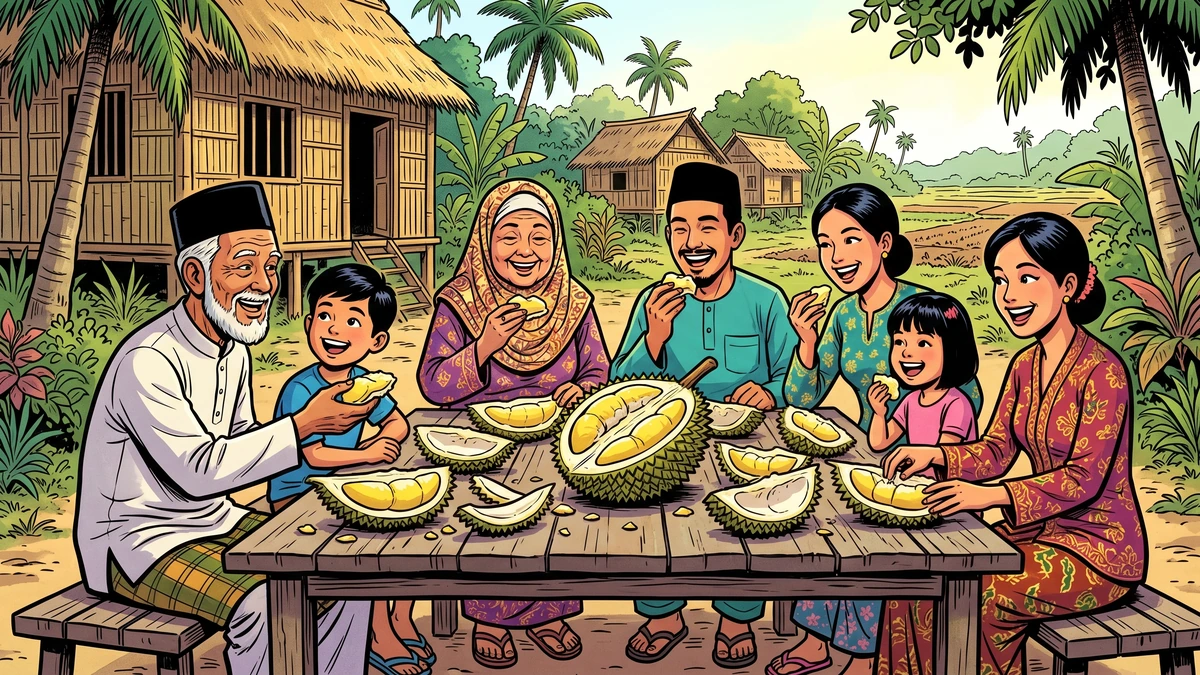
Durian’s ritual dimensions extend beyond origin mythology into active ceremonial life. In Sabah (Malaysian Borneo), the Kadazan-Dusun harvest festival Kaamatan features durian as a sacred offering alongside rice wine (tapai) and glutinous rice in ceremonies honouring Bambazon, the spirit of the paddy. The durian’s temporal alignment with the main harvest season—it peaks in June and July, coinciding with post-harvest celebration periods—has made it a natural festival fruit, its availability marking the successful conclusion of the agricultural cycle. In these ceremonial contexts, the durian’s smell is specifically valued as spiritually potent: the bobolian (ritual specialist) may use the smell to mark out sacred space, the fruit’s olfactory intensity functioning as a sensory boundary between ordinary and ritual time.
The Batak communities of North Sumatra preserve a durian ritual (mangulosi durian) associated with weddings in which the groom’s family presents durian to the bride’s family as part of the ceremonial exchange (tuhor). The number of fruits presented, their size and quality, and the specific varieties chosen all carry communicative weight within the gift economy of Batak marriage exchange—the durian functioning as a condensed symbol of the groom’s family’s wealth, taste, and social standing. Anthropologist Susan Rodgers, in her study of Angkola Batak narrative traditions, notes that the durian appears in wedding songs as a metaphor for the bride herself: rare, sought after, worth the effort of the journey, and sweetly rewarding to the one who earns the right to open her.
In peninsular Malaysia’s Orang Asli communities—the indigenous peoples predating Malay settlement—durian holds a particularly deep ritual significance as one of the forest gifts that the Cenoi (spirit helpers of the shaman) may provide to a halak (Temiar shaman) in dreams. The durian tree is a “dreamed” plant—one whose use rights are established through dream encounters with its spirit rather than through physical cultivation—and durian groves in Temiar territories are collectively managed through a system of spirit-ownership rights that has no exact parallel in Malay adat (customary law) or in modern Malaysian property law. This creates ongoing tensions in land-rights disputes, as Temiar communities assert spirit-contract claims over durian-forest land that Malaysian law cannot recognize.
Literary and Artistic Afterlives
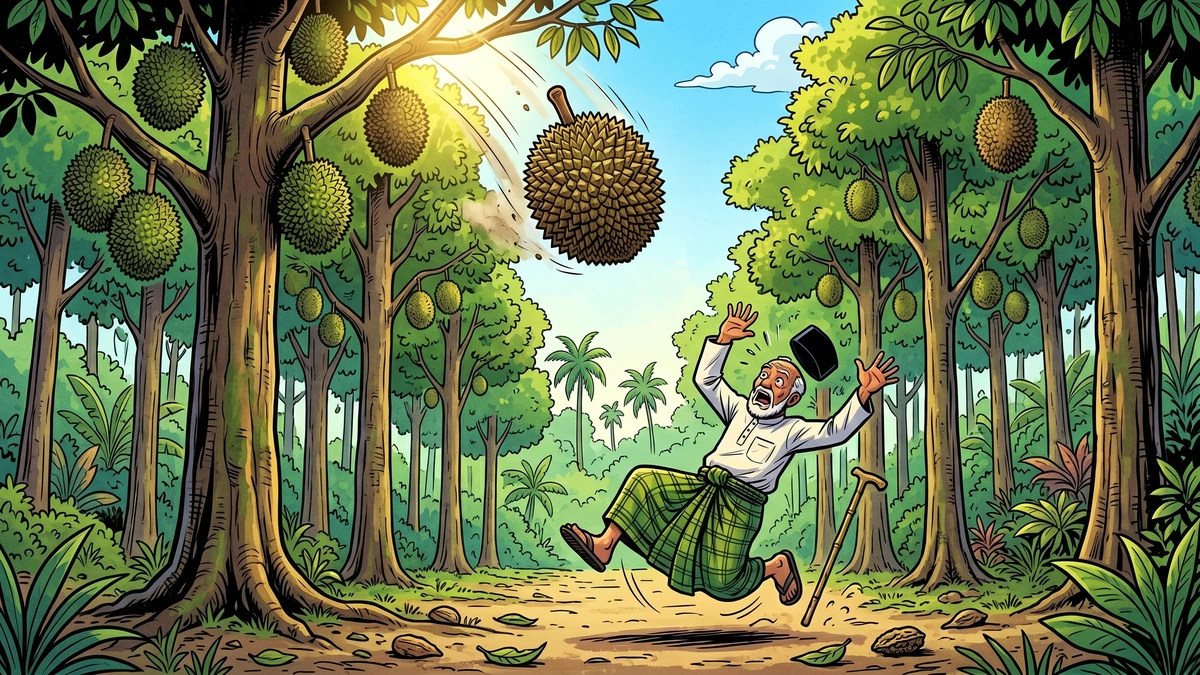
The durian has accumulated a substantial literary and artistic tradition in Southeast Asian creative work. Malay poet Usman Awang’s celebrated 1961 poem “Durian Runtuh” (Fallen Durian)—a satirical commentary on unexpected good fortune—gave the Malay language one of its most durable idioms: durian runtuh (a durian falls) has become the standard expression for a windfall or unexpected luck, encoding the tree’s dangerous abundance directly into everyday speech. The image of fruit falling unexpectedly from great height—both a physical danger and a sudden gift—captures something essential about how Malay culture conceptualizes fortune: it arrives without warning, it can injure you if you’re not ready, and it is deeply, overwhelmingly sweet.
Contemporary Malaysian and Singaporean writers have increasingly turned to the durian as a vehicle for postcolonial reflection. Tan Twan Eng, Rani Manicka, and Kevin Kwan (of Crazy Rich Asians fame) have all used durian consumption as a scene of cultural negotiation—typically staging the moment when a Western-educated or Western-partnered character must decide whether to eat the durian as a test of their relationship to their own heritage. In these literary moments, the durian’s mythological function (as test, as filter, as barrier that rewards persistence) is transplanted from the forest spirit’s domain into the dining table and the identity politics of the postcolonial self.
Visual artists have found the durian’s formal properties irresistible: its radial symmetry, its weaponized exterior, and the baroque intricacy of its opened chambers make it a natural subject for artists exploring the relationship between beauty and danger. Singaporean artist Donna Ong’s installation work has incorporated durian forms as symbols of inherited cultural knowledge—beautiful and forbidding simultaneously, demanding initiation before they yield their gifts. The fruit’s increasingly iconic status in contemporary Southeast Asian visual culture mirrors its status in the folk traditions: it is a thing that means many things, and its capacity for symbolic resonance appears as inexhaustible as its olfactory presence.
The legend of the durian fruit, in all its regional variants, ultimately tells a story about the relationship between beauty and difficulty that is not specific to any one culture or era. Whether the custard within the thorned shell is a transformed princess, a warrior’s redistributed courage, a prince’s filial love, or a forest deity’s demonstration of power, the moral structure is consistent: genuine value is always partially concealed, always requiring something of the seeker, always rewarding those who persist through the initial barrier of discomfort. In a world that increasingly prizes the immediately accessible and the frictionlessly pleasurable, the durian stands as a fruit-shaped argument for the proposition that the best things are sometimes the hardest things to approach—and that the smell that drives away the faint of heart is exactly what makes the reward available to those who remain.
Frequently Asked Questions
What is the legend behind the durian fruit’s pungent smell?
According to Malay folklore, the durian’s powerful odor is the scent of transformation itself. The most widespread version tells of a princess who was transformed into the durian tree to cure her terminal illness — her royal sweetness imprisoned within the fruit, her pride encoded in the thorns, and her liminal state between human and plant expressed as the fruit’s penetrating smell. In Austronesian cosmology, pungent odor marks the boundary between the human world and the spirit world.
Why is the durian called the King of Fruits?
The title ‘King of Fruits’ was popularized in the West by Victorian naturalist Alfred Russel Wallace, who declared it so in his 1869 book The Malay Archipelago. However, in Southeast Asia, the durian’s royal status long predated Wallace — it was reserved for royalty in certain courts, featured in ceremonial offerings, and held sacred in harvest rituals from Borneo to the Thai peninsula. The title reflects both its supreme flavor and its paradoxical nature: a fruit that tests the worthiness of those who seek it.
How do different Southeast Asian cultures explain the durian’s origin?
Regional origin stories vary fascinatingly: Malay tradition tells of a transformed princess; Dayak (Borneo) tradition speaks of a warrior’s virtues redistributed into fruit form; Thai legend centers on Prince Pung who sacrificed himself to heal his mother; and Javanese philosophy uses the durian as a symbol of ngelmu (esoteric wisdom deliberately concealed behind difficulty). Despite theological differences, all traditions share the same moral: the durian’s forbidding exterior is a filter that rewards the patient and persistent.
What is the Indian connection to durian mythology?
While the durian is not native to India, ancient Tamil maritime trade routes connecting South India with the Malay Peninsula brought Hindu cosmological frameworks into contact with Austronesian folk belief. The Selangor tradition preserves a story of a Hindu raja from across the sea who prompted the forest spirits to create the durian specifically as a philosophical puzzle — a king’s fruit that only the humble can appreciate. Tamil concepts of spiritually significant forest fruits (kattu pazham) also provided a framework that Malay-Tamil communities readily integrated with local durian lore.
What does ‘durian runtuh’ mean in Malay culture?
Durian runtuh (literally ‘a durian falls’) is one of the most common Malay idioms for an unexpected windfall or sudden good fortune. The expression captures the durian tree’s characteristic of dropping its heavy, thorned fruit without warning from great heights — an event that is simultaneously dangerous and enormously lucky. Malaysian poet Usman Awang’s celebrated 1961 poem of this name cemented the phrase in modern Malay literary culture, and today it appears in everyday speech, financial journalism, and colloquial conversation across the Malay-speaking world.
The durian tree itself is a forest giant, reaching thirty to forty meters in mature specimens, and flowers nocturnally—its blooms, borne directly on the trunk and major branches (a habit called cauliflory), pollinated primarily by the dawn bat (Eonycteris spelaea) in one of Southeast Asia’s most celebrated examples of plant-animal mutualism. The tree is thus a creature of darkness and heights, its reproductive act invisible to human observation, its fruit falling from the canopy with bone-breaking force when ripe. Durian orchards in Malaysia and Thailand are marked by warning signs identical to those used at construction sites. This combination of nocturnal mystique, aerial danger, and olfactory extremity has made the durian an almost inevitable focus of supernatural narrative.

The Thai Tradition: Prince Pung and the Fruit of Sacrifice
In the Central Thai folk tradition, the most widely circulated origin story centers on a prince named Pung (or Phung in some transcriptions)—a figure of extraordinary filial devotion. When his mother falls gravely ill and no medicine suffices, Prince Pung undertakes a journey into the deep forest to seek a cure from a hermit sage (ruesi). The sage agrees to help but demands the prince’s own body as the medium of the cure: Pung must allow himself to be transformed, and the energy of his transformation will heal his mother. The prince consents. The sage performs the ritual; the mother recovers; and where Prince Pung stood, there grows a new kind of tree whose fruit contains his love—sweet as devotion, generous as sacrifice, but armored against casual taking because what is given freely must still be earned.
This narrative follows the ATU 550 structural family (the quest for the extraordinary) but grafts onto it specifically Theravada Buddhist values of metta (loving-kindness) and upekkha (equanimity in the face of suffering). The Thai variant is the most explicitly didactic of the regional origin stories: scholars including Pattana Kitiarsa, writing on Thai folk Buddhism, have noted how durian mythology in Central Thailand functions as a vehicle for teaching the value of filial piety (katanyu katavedhi), with the fruit’s sweetness explicitly glossed in village tellings as the taste of a son’s love for his mother. Temple murals in Phetchaburi Province have been documented depicting scenes consistent with the Pung narrative, suggesting the story has achieved a semi-canonical status in local religious culture.
Northern Thai and Shan variants introduce additional complications, including a romantic subplot in which Prince Pung’s beloved weeps over his transformation, her tears falling onto the tree’s roots and infusing the fruit with an additional note of bittersweet longing. This “tears of the beloved” motif connects to a much broader Southeast Asian folk pattern in which emotions—particularly unrequited or sacrificed love—are encoded into the flavor profiles of domesticated plants, a form of affective agriculture that parallels the Indian concept of bhavana (the cultivation of mental states) applied to literal cultivation.
Indian Subcontinental Connections: Trade, Myth, and the Tamil Influence
The durian is not native to the Indian subcontinent and does not appear in classical Sanskrit botanical literature (Charaka Samhita, Sushruta Samhita, or the agricultural sections of the Arthashastra). Yet the Indian presence in the durian’s mythological landscape is real and historically grounded: the ancient maritime trade networks connecting South India (particularly Tamil Nadu and Kerala) with the Malay Peninsula—the routes of the Nakhoda (sea captains) celebrated in Tamil Sangam poetry as conduits to the golden land of Suvarnabhumi—brought Tamil Hindu cosmological frameworks into contact with indigenous Austronesian belief systems in ways that permanently shaped how Southeast Asian peoples narrate the natural world.
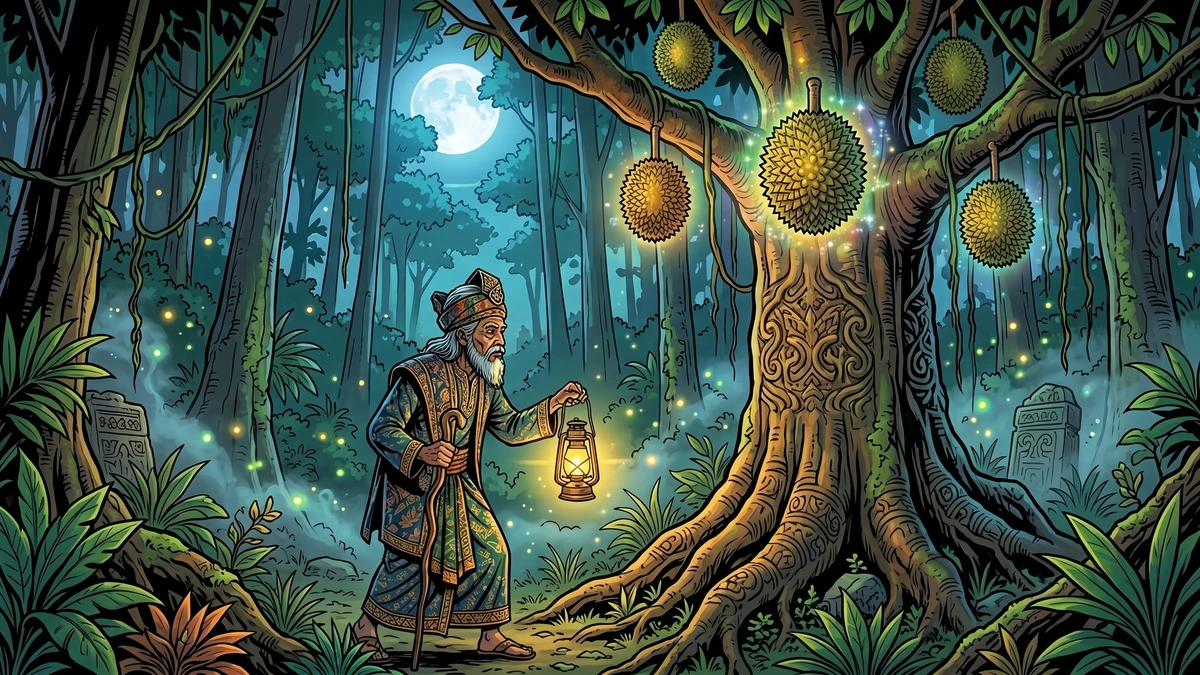
The most direct Indian influence on durian mythology appears in the Malay narrative of Raja Durian (King Durian), a tale preserved in the Selangor oral tradition and partially transcribed in Zainal Abidin bin Ahmad’s (Za’ba’s) early 20th-century folklore collections. In this story, a Hindu raja from across the sea (clearly coding as Indian) arrives in the Malay archipelago and challenges the local forest spirits to produce a fruit worthy of a king. The spirits, in consultation with the nature deity Sang Gembira (the Joyful One), create the durian specifically as a demonstration of their power to exceed human expectation—giving the raja not merely food but a philosophical puzzle: a king’s fruit that only the humble can stomach, because pride blocks the senses to its beauty. The moral—that royal pretension is an obstacle to genuine pleasure—carries distinct resonances with Vaishnavite devotional philosophy as mediated through Malay-Hindu syncretic traditions.
The Tamil concept of kattu pazham (forest fruit, wild fruit)—a category of spiritually significant fruits found in forest rather than garden settings—provides another point of contact. In Tamil folk medicine and worship, certain wild fruits are believed to embody divine energy because they have not been tamed by human cultivation; they must be sought rather than grown. The durian, requiring the seeker to venture into dangerous forest and contend with its thorned exterior and powerful smell before accessing its treasure, maps well onto this framework. Tamil traders settling in the Straits Settlements (Penang, Malacca, Singapore) in the 18th and 19th centuries are documented importing Indian folk medicine frameworks that valorized sought-for wild foods as spiritually superior to cultivated ones—a framework that the Malay-Tamil intermarried communities of the baba-nyonya type readily integrated with local durian lore.
The Smell Paradox as Moral Metaphor
What unifies the regional variants—Malay, Dayak, Thai, Indonesian Javanese, and the hybrid Malay-Indian forms—is the consistent use of the durian’s olfactory paradox as a teaching device. In virtually every traditional context, the smell is not presented as a defect but as a filter: the fruit is sweet and rewarding for those who can see past (or through) first impressions, and its inaccessibility to those with weak tolerance is a feature, not a flaw. This moral logic is remarkably consistent across cultures with otherwise significant theological differences, suggesting either diffusion from a common source or independent convergence on an obvious natural metaphor.
The Indonesian Javanese tradition articulates this most explicitly through the concept of ngelmu—esoteric knowledge that is deliberately concealed behind difficulty and apparent repugnance to protect it from the superficial seeker. The durian in Javanese folk philosophy is frequently cited as a natural example of ngelmu logic: its exterior (thorned, smelly, heavy, dangerous to carry) is the difficulty that separates sincere seekers from casual ones. This framing has been taken up by modern Javanese writers—most notably the short story writer Ahmad Tohari in his Ronggeng Dukuh Paruk trilogy—who use durian imagery to explore the paradox of beauty concealed by social stigma, extending the folk metaphor into literary modernism.
The Sumatran (particularly Minangkabau) tradition adds a gendered dimension: the durian is associated with the feminine sphere not because women eat it more but because the matrilineal social structure of Minangkabau culture positions women as custodians of knowledge that is not immediately legible to outsiders. The durian tree, in Minangkabau proverb, is cited alongside the rumah gadang (great house) as an example of something whose value only becomes apparent once you are inside it—a compliment extended to the Minangkabau social system itself, which confounds visitors with its apparent inversions of expected gender hierarchies before revealing its internal logic.
The Colonial Encounter and the Creation of the “King” Title
The durian’s designation as “King of Fruits” is itself a historically situated production, not an immemorial traditional title. While indigenous peoples of Southeast Asia clearly regarded the durian with exceptional reverence—it was reserved for royalty in certain courts, featured in ceremonial offerings, and central to harvest festivals—the specific “King of Fruits” formulation in its current usage owes much to the 19th-century natural historian Alfred Russel Wallace, who encountered the fruit in Borneo and Malaya during his celebrated eight-year survey and declared in The Malay Archipelago (1869) that “it is the king of fruits.” Wallace’s endorsement, coming from the co-discoverer of natural selection and one of Victorian England’s most trusted scientific voices, gave the title an authority in the English-speaking world that durian advocates have leveraged ever since.
Wallace’s account is worth quoting for what it reveals about the dynamics of cross-cultural olfactory calibration: he describes his initial repulsion, followed by gradual acclimation, followed by genuine enthusiasm—a trajectory now so widely repeated by food writers that it has become a genre cliché. The trajectory matters mythologically because it replicates the structure of the traditional origin stories: the durian tests you, you must endure the test, and then you are rewarded. Wallace underwent the initiatory structure of the fruit’s mythology without knowing it, and his account encodes that structure for Western readers. The colonial “discovery” narrative thus accidentally reproduces the folk mythological logic it had no knowledge of, which is either a remarkable coincidence or evidence that the durian’s paradoxical structure is so fundamental that any sustained encounter with it generates the same narrative arc.
Post-independence Southeast Asian nationalism has reclaimed and amplified the “King of Fruits” title with considerable cultural investment. In Malaysia, where durian cultivation is a significant agricultural industry and where durian varieties (particularly the premium Musang King, D52, and Black Thorn cultivars) command prices equivalent to luxury goods, the fruit has become intertwined with national identity in ways that parallel the role of the tiger in the national coat of arms. The Malaysian government’s Durian Industry Development Plan explicitly frames the fruit as cultural heritage, and the Durian Museum in Balik Pulau, Penang—a pilgrimage destination for durian tourists from mainland China, where demand for premium Malaysian durian has exploded—explicitly curates the fruit’s mythological history alongside its agricultural economics.
Contemporary Resonances and the Global Durian Moment
The early 21st century has seen a remarkable expansion in the durian’s global cultural footprint, driven primarily by the fruit’s enormous popularity among Chinese consumers and the resulting explosion of Chinese-language durian content across social media platforms. The Chinese encounter with durian mythology has produced a fascinating hybridization: Chinese folk belief traditions (particularly those associated with luck, abundance, and the propitious properties of difficult-to-obtain foods) have been grafted onto Southeast Asian origin narratives by diaspora communities in ways that echo the historical Tamil-Malay synthesis of centuries earlier. The result is a new stratum of durian mythology in which the fruit’s prosperity-signifying associations in Chinese culture interact with its transformation-and-sacrifice origin stories in Southeast Asian culture.
Food scientists have in recent years attempted to decode the biochemistry of the durian’s infamous smell, identifying thirty-six volatile compounds responsible for the fruit’s aroma profile, with diethyl trisulfide and ethanethiol among the primary culprits. A 2012 study in the Journal of Agricultural and Food Chemistry by Jia-Horng Wang and colleagues identified 19 odour-active compounds that, in combination, produce the fruit’s unique smell—described by researchers as simultaneously fruity, sulfurous, caramellic, and fetid. What the chemistry reveals, and what the folk mythologies have always known, is that the durian’s smell is not simple: it is a compound phenomenon, layered and contradictory at the molecular level, just as its taste is simultaneously sweet, bitter, creamy, and alcoholic. The paradox goes all the way down.
This chemical complexity has a cultural correlate in the sheer number of named varieties now recognized: Malaysia alone recognizes over two hundred named cultivars, each with its advocates and its specific flavor profile (bittersweet, creamy, alcoholic, mild, intensely sulfurous). The variety within the species mirrors the variety of mythological interpretations of the species: there is no single durian, just as there is no single origin story. The fruit has been many things to many peoples—princess and warrior, gift and curse, test and reward, democratic food and royal luxury—and its mythology has been capacious enough to hold all these meanings simultaneously, which may be the deepest secret of its enduring centrality to Southeast Asian cultural life.
The Fruit in Ritual and Festival
Durian’s ritual dimensions extend beyond origin mythology into active ceremonial life. In Sabah (Malaysian Borneo), the Kadazan-Dusun harvest festival Kaamatan features durian as a sacred offering alongside rice wine (tapai) and glutinous rice in ceremonies honouring Bambazon, the spirit of the paddy. The durian’s temporal alignment with the main harvest season—it peaks in June and July, coinciding with post-harvest celebration periods—has made it a natural festival fruit, its availability marking the successful conclusion of the agricultural cycle. In these ceremonial contexts, the durian’s smell is specifically valued as spiritually potent: the bobolian (ritual specialist) may use the smell to mark out sacred space, the fruit’s olfactory intensity functioning as a sensory boundary between ordinary and ritual time.
The Batak communities of North Sumatra preserve a durian ritual (mangulosi durian) associated with weddings in which the groom’s family presents durian to the bride’s family as part of the ceremonial exchange (tuhor). The number of fruits presented, their size and quality, and the specific varieties chosen all carry communicative weight within the gift economy of Batak marriage exchange—the durian functioning as a condensed symbol of the groom’s family’s wealth, taste, and social standing. Anthropologist Susan Rodgers, in her study of Angkola Batak narrative traditions, notes that the durian appears in wedding songs as a metaphor for the bride herself: rare, sought after, worth the effort of the journey, and sweetly rewarding to the one who earns the right to open her.
In peninsular Malaysia’s Orang Asli communities—the indigenous peoples predating Malay settlement—durian holds a particularly deep ritual significance as one of the forest gifts that the Cenoi (spirit helpers of the shaman) may provide to a halak (Temiar shaman) in dreams. The durian tree is a “dreamed” plant—one whose use rights are established through dream encounters with its spirit rather than through physical cultivation—and durian groves in Temiar territories are collectively managed through a system of spirit-ownership rights that has no exact parallel in Malay adat (customary law) or in modern Malaysian property law. This creates ongoing tensions in land-rights disputes, as Temiar communities assert spirit-contract claims over durian-forest land that Malaysian law cannot recognize.
Literary and Artistic Afterlives
The durian has accumulated a substantial literary and artistic tradition in Southeast Asian creative work. Malay poet Usman Awang’s celebrated 1961 poem “Durian Runtuh” (Fallen Durian)—a satirical commentary on unexpected good fortune—gave the Malay language one of its most durable idioms: durian runtuh (a durian falls) has become the standard expression for a windfall or unexpected luck, encoding the tree’s dangerous abundance directly into everyday speech. The image of fruit falling unexpectedly from great height—both a physical danger and a sudden gift—captures something essential about how Malay culture conceptualizes fortune: it arrives without warning, it can injure you if you’re not ready, and it is deeply, overwhelmingly sweet.
Contemporary Malaysian and Singaporean writers have increasingly turned to the durian as a vehicle for postcolonial reflection. Tan Twan Eng, Rani Manicka, and Kevin Kwan (of Crazy Rich Asians fame) have all used durian consumption as a scene of cultural negotiation—typically staging the moment when a Western-educated or Western-partnered character must decide whether to eat the durian as a test of their relationship to their own heritage. In these literary moments, the durian’s mythological function (as test, as filter, as barrier that rewards persistence) is transplanted from the forest spirit’s domain into the dining table and the identity politics of the postcolonial self.
Visual artists have found the durian’s formal properties irresistible: its radial symmetry, its weaponized exterior, and the baroque intricacy of its opened chambers make it a natural subject for artists exploring the relationship between beauty and danger. Singaporean artist Donna Ong’s installation work has incorporated durian forms as symbols of inherited cultural knowledge—beautiful and forbidding simultaneously, demanding initiation before they yield their gifts. The fruit’s increasingly iconic status in contemporary Southeast Asian visual culture mirrors its status in the folk traditions: it is a thing that means many things, and its capacity for symbolic resonance appears as inexhaustible as its olfactory presence.
The legend of the durian fruit, in all its regional variants, ultimately tells a story about the relationship between beauty and difficulty that is not specific to any one culture or era. Whether the custard within the thorned shell is a transformed princess, a warrior’s redistributed courage, a prince’s filial love, or a forest deity’s demonstration of power, the moral structure is consistent: genuine value is always partially concealed, always requiring something of the seeker, always rewarding those who persist through the initial barrier of discomfort. In a world that increasingly prizes the immediately accessible and the frictionlessly pleasurable, the durian stands as a fruit-shaped argument for the proposition that the best things are sometimes the hardest things to approach—and that the smell that drives away the faint of heart is exactly what makes the reward available to those who remain.
Frequently Asked Questions
What is the legend behind the durian fruit’s pungent smell?
According to Malay folklore, the durian’s powerful odor is the scent of transformation itself. The most widespread version tells of a princess who was transformed into the durian tree to cure her terminal illness — her royal sweetness imprisoned within the fruit, her pride encoded in the thorns, and her liminal state between human and plant expressed as the fruit’s penetrating smell. In Austronesian cosmology, pungent odor marks the boundary between the human world and the spirit world.
Why is the durian called the King of Fruits?
The title ‘King of Fruits’ was popularized in the West by Victorian naturalist Alfred Russel Wallace, who declared it so in his 1869 book The Malay Archipelago. However, in Southeast Asia, the durian’s royal status long predated Wallace — it was reserved for royalty in certain courts, featured in ceremonial offerings, and held sacred in harvest rituals from Borneo to the Thai peninsula. The title reflects both its supreme flavor and its paradoxical nature: a fruit that tests the worthiness of those who seek it.
How do different Southeast Asian cultures explain the durian’s origin?
Regional origin stories vary fascinatingly: Malay tradition tells of a transformed princess; Dayak (Borneo) tradition speaks of a warrior’s virtues redistributed into fruit form; Thai legend centers on Prince Pung who sacrificed himself to heal his mother; and Javanese philosophy uses the durian as a symbol of ngelmu (esoteric wisdom deliberately concealed behind difficulty). Despite theological differences, all traditions share the same moral: the durian’s forbidding exterior is a filter that rewards the patient and persistent.
What is the Indian connection to durian mythology?
While the durian is not native to India, ancient Tamil maritime trade routes connecting South India with the Malay Peninsula brought Hindu cosmological frameworks into contact with Austronesian folk belief. The Selangor tradition preserves a story of a Hindu raja from across the sea who prompted the forest spirits to create the durian specifically as a philosophical puzzle — a king’s fruit that only the humble can appreciate. Tamil concepts of spiritually significant forest fruits (kattu pazham) also provided a framework that Malay-Tamil communities readily integrated with local durian lore.
What does ‘durian runtuh’ mean in Malay culture?
Durian runtuh (literally ‘a durian falls’) is one of the most common Malay idioms for an unexpected windfall or sudden good fortune. The expression captures the durian tree’s characteristic of dropping its heavy, thorned fruit without warning from great heights — an event that is simultaneously dangerous and enormously lucky. Malaysian poet Usman Awang’s celebrated 1961 poem of this name cemented the phrase in modern Malay literary culture, and today it appears in everyday speech, financial journalism, and colloquial conversation across the Malay-speaking world.
In the rainforests of Maritime Southeast Asia, where the canopy closes over pathways of red laterite earth and the air carries the weight of centuries, there grows a tree whose fruit has confounded, enchanted, and divided humanity for as long as memory reaches. Durio zibethinus—the durian—is a paradox made flesh: armored in spike-studded husks of deepest green, containing within its chambers a custard of ambrosial sweetness and a fragrance so violently pungent that hotels across Singapore, Kuala Lumpur, and Bangkok post explicit prohibition signs at their entrances. No other fruit has inspired such passionate devotion and such visceral revulsion in equal measure, and no other fruit, among the peoples who have loved it longest, has accumulated such a depth of mythological explanation for its contradictions.
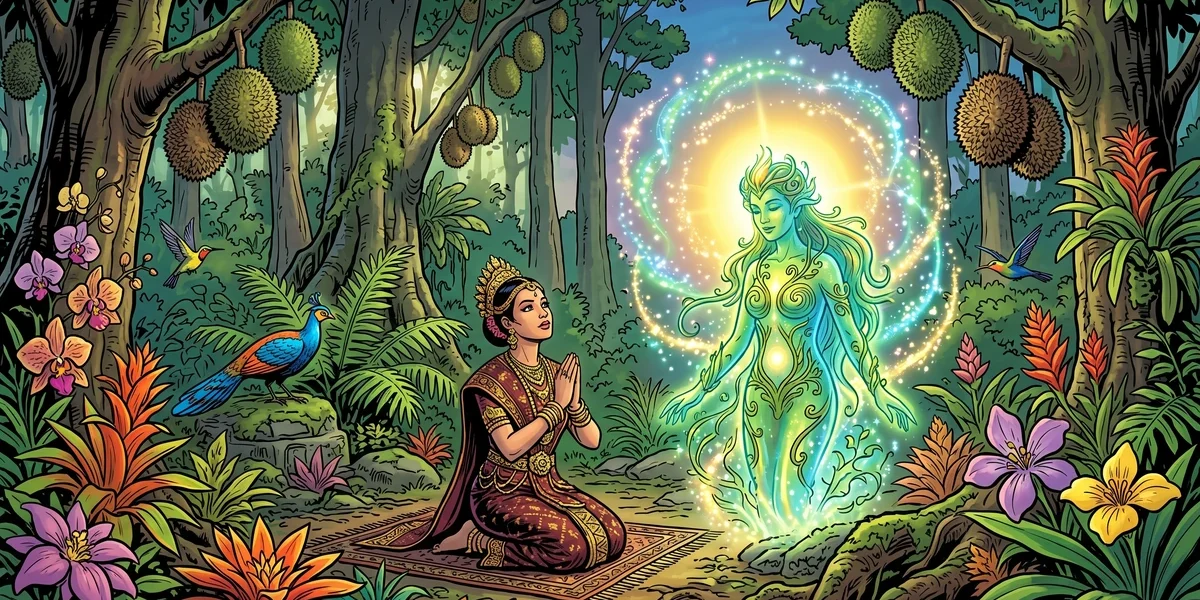
The Malay oral tradition preserves the oldest and most widespread of these explanations in a story archetype scholars have catalogued under the regional designation of “the forbidden transformation.” A princess—sometimes named Puteri Mayang Sari, sometimes left nameless as a cipher for every beautiful daughter of every raja who ever ruled a forest kingdom—falls into a terminal illness beyond the power of any royal physician to cure. Her father the king, frantic with grief, summons a forest spirit (semangat hutan) or, in some variants, a venerable pawang (shaman-healer) of great power, who promises a cure but sets an impossible condition: the king must surrender something of equal beauty and worth. In the Perak variant recorded by colonial-era ethnographer William Skeat in Malay Magic (1900), the spirit demands the princess herself—not as a bride but as a vessel—and transforms her into the durian tree at the moment of her healing, her sweetness imprisoned within the fruit, her pride and royal separation encoded in the thorns.
The pungent odor in this telling is not incidental but interpretive: it is the smell of transformation itself, the scent of a human soul newly housed in vegetable form, the olfactory signature of the boundary between worlds. This is consistent with broader Austronesian cosmological frameworks in which smell functions as a marker of spiritual status—the dead smell of putrefaction, the spirits of the forest smell of damp earth and resin, and the newly transformed carry the odor of their liminal state indefinitely. The durian’s paradox (beautiful within, repellent without) maps precisely onto the princess’s story: royal beauty concealed behind a barrier designed to discourage the unworthy.
Indonesian variants from Kalimantan (Borneo) complexify this narrative significantly. Among the Dayak communities of the interior—who have cultivated durian in forest gardens (tembawang) for at least two millennia, as evidenced by archaeobotanical studies cited in Victor King’s The Peoples of Borneo (1993)—the origin story centers not on a princess but on a dispute between a warrior and the forest deity Bunsu Antu. The warrior, having slain a deer sacred to the deity, is cursed: his strength is taken from him and pressed into a fruit that will always be found by those who seek it but never be easy to possess. The thorns are the warrior’s weapons turned against him; the flesh is his courage, now available to those brave enough to endure the smell. The Kalimantan version is thus less a story of tragic transformation and more a story of redistributed virtue—the warrior’s qualities democratized into the forest for all to claim, if they can stomach the challenge.
The Botanical King and Its Southeast Asian Kingdom
The genus Durio comprises approximately thirty species, of which nine produce edible fruit; D. zibethinus is the only species commonly exported internationally, though within Malaysia, Indonesia, and Thailand, connoisseurs prize the rarer D. kutejensis (orange-fleshed), D. graveolens (red-fleshed, milder scented), and D. oxleyanus as superior fruits for local consumption. The word “durian” derives from the Malay duri (thorn, spine), the diminutive suffix creating “thorned thing”—a purely functional designation that nonetheless carries aesthetic weight in a language where naming is itself a cosmological act. The Portuguese explorer Tomé Pires recorded the fruit in his Suma Oriental (c. 1515) as something his sailors could barely stomach but local populations consumed with evident ecstasy, marking one of the earliest European documentary encounters with what would become, six centuries later, a subject of fierce contemporary debate about globalization, biodiversity, and cultural relativism in food.
The fruit’s scientific epithet zibethinus derives from the civet cat (Viverra zibetha), reflecting early European naturalists’ association of the fruit’s odor with civet musk—itself a prized perfume ingredient in 17th-century Europe. The irony is profound: the same smell Europeans associated with a luxury perfume animal became the reason Western travelers rejected the fruit. This olfactory relativism has been studied by food anthropologist Annia Ciezadlo and others as a case study in how cultural conditioning shapes sensory perception at a near-physiological level—the same volatile sulfur compounds (ethanethiol, propanethiol, diethyl disulfide) that trigger revulsion in the durian-naive trigger anticipatory pleasure in those raised with the fruit.
The durian tree itself is a forest giant, reaching thirty to forty meters in mature specimens, and flowers nocturnally—its blooms, borne directly on the trunk and major branches (a habit called cauliflory), pollinated primarily by the dawn bat (Eonycteris spelaea) in one of Southeast Asia’s most celebrated examples of plant-animal mutualism. The tree is thus a creature of darkness and heights, its reproductive act invisible to human observation, its fruit falling from the canopy with bone-breaking force when ripe. Durian orchards in Malaysia and Thailand are marked by warning signs identical to those used at construction sites. This combination of nocturnal mystique, aerial danger, and olfactory extremity has made the durian an almost inevitable focus of supernatural narrative.
The Thai Tradition: Prince Pung and the Fruit of Sacrifice
In the Central Thai folk tradition, the most widely circulated origin story centers on a prince named Pung (or Phung in some transcriptions)—a figure of extraordinary filial devotion. When his mother falls gravely ill and no medicine suffices, Prince Pung undertakes a journey into the deep forest to seek a cure from a hermit sage (ruesi). The sage agrees to help but demands the prince’s own body as the medium of the cure: Pung must allow himself to be transformed, and the energy of his transformation will heal his mother. The prince consents. The sage performs the ritual; the mother recovers; and where Prince Pung stood, there grows a new kind of tree whose fruit contains his love—sweet as devotion, generous as sacrifice, but armored against casual taking because what is given freely must still be earned.
This narrative follows the ATU 550 structural family (the quest for the extraordinary) but grafts onto it specifically Theravada Buddhist values of metta (loving-kindness) and upekkha (equanimity in the face of suffering). The Thai variant is the most explicitly didactic of the regional origin stories: scholars including Pattana Kitiarsa, writing on Thai folk Buddhism, have noted how durian mythology in Central Thailand functions as a vehicle for teaching the value of filial piety (katanyu katavedhi), with the fruit’s sweetness explicitly glossed in village tellings as the taste of a son’s love for his mother. Temple murals in Phetchaburi Province have been documented depicting scenes consistent with the Pung narrative, suggesting the story has achieved a semi-canonical status in local religious culture.
Northern Thai and Shan variants introduce additional complications, including a romantic subplot in which Prince Pung’s beloved weeps over his transformation, her tears falling onto the tree’s roots and infusing the fruit with an additional note of bittersweet longing. This “tears of the beloved” motif connects to a much broader Southeast Asian folk pattern in which emotions—particularly unrequited or sacrificed love—are encoded into the flavor profiles of domesticated plants, a form of affective agriculture that parallels the Indian concept of bhavana (the cultivation of mental states) applied to literal cultivation.
Indian Subcontinental Connections: Trade, Myth, and the Tamil Influence
The durian is not native to the Indian subcontinent and does not appear in classical Sanskrit botanical literature (Charaka Samhita, Sushruta Samhita, or the agricultural sections of the Arthashastra). Yet the Indian presence in the durian’s mythological landscape is real and historically grounded: the ancient maritime trade networks connecting South India (particularly Tamil Nadu and Kerala) with the Malay Peninsula—the routes of the Nakhoda (sea captains) celebrated in Tamil Sangam poetry as conduits to the golden land of Suvarnabhumi—brought Tamil Hindu cosmological frameworks into contact with indigenous Austronesian belief systems in ways that permanently shaped how Southeast Asian peoples narrate the natural world.
The most direct Indian influence on durian mythology appears in the Malay narrative of Raja Durian (King Durian), a tale preserved in the Selangor oral tradition and partially transcribed in Zainal Abidin bin Ahmad’s (Za’ba’s) early 20th-century folklore collections. In this story, a Hindu raja from across the sea (clearly coding as Indian) arrives in the Malay archipelago and challenges the local forest spirits to produce a fruit worthy of a king. The spirits, in consultation with the nature deity Sang Gembira (the Joyful One), create the durian specifically as a demonstration of their power to exceed human expectation—giving the raja not merely food but a philosophical puzzle: a king’s fruit that only the humble can stomach, because pride blocks the senses to its beauty. The moral—that royal pretension is an obstacle to genuine pleasure—carries distinct resonances with Vaishnavite devotional philosophy as mediated through Malay-Hindu syncretic traditions.
The Tamil concept of kattu pazham (forest fruit, wild fruit)—a category of spiritually significant fruits found in forest rather than garden settings—provides another point of contact. In Tamil folk medicine and worship, certain wild fruits are believed to embody divine energy because they have not been tamed by human cultivation; they must be sought rather than grown. The durian, requiring the seeker to venture into dangerous forest and contend with its thorned exterior and powerful smell before accessing its treasure, maps well onto this framework. Tamil traders settling in the Straits Settlements (Penang, Malacca, Singapore) in the 18th and 19th centuries are documented importing Indian folk medicine frameworks that valorized sought-for wild foods as spiritually superior to cultivated ones—a framework that the Malay-Tamil intermarried communities of the baba-nyonya type readily integrated with local durian lore.
The Smell Paradox as Moral Metaphor
What unifies the regional variants—Malay, Dayak, Thai, Indonesian Javanese, and the hybrid Malay-Indian forms—is the consistent use of the durian’s olfactory paradox as a teaching device. In virtually every traditional context, the smell is not presented as a defect but as a filter: the fruit is sweet and rewarding for those who can see past (or through) first impressions, and its inaccessibility to those with weak tolerance is a feature, not a flaw. This moral logic is remarkably consistent across cultures with otherwise significant theological differences, suggesting either diffusion from a common source or independent convergence on an obvious natural metaphor.
The Indonesian Javanese tradition articulates this most explicitly through the concept of ngelmu—esoteric knowledge that is deliberately concealed behind difficulty and apparent repugnance to protect it from the superficial seeker. The durian in Javanese folk philosophy is frequently cited as a natural example of ngelmu logic: its exterior (thorned, smelly, heavy, dangerous to carry) is the difficulty that separates sincere seekers from casual ones. This framing has been taken up by modern Javanese writers—most notably the short story writer Ahmad Tohari in his Ronggeng Dukuh Paruk trilogy—who use durian imagery to explore the paradox of beauty concealed by social stigma, extending the folk metaphor into literary modernism.
The Sumatran (particularly Minangkabau) tradition adds a gendered dimension: the durian is associated with the feminine sphere not because women eat it more but because the matrilineal social structure of Minangkabau culture positions women as custodians of knowledge that is not immediately legible to outsiders. The durian tree, in Minangkabau proverb, is cited alongside the rumah gadang (great house) as an example of something whose value only becomes apparent once you are inside it—a compliment extended to the Minangkabau social system itself, which confounds visitors with its apparent inversions of expected gender hierarchies before revealing its internal logic.
The Colonial Encounter and the Creation of the “King” Title
The durian’s designation as “King of Fruits” is itself a historically situated production, not an immemorial traditional title. While indigenous peoples of Southeast Asia clearly regarded the durian with exceptional reverence—it was reserved for royalty in certain courts, featured in ceremonial offerings, and central to harvest festivals—the specific “King of Fruits” formulation in its current usage owes much to the 19th-century natural historian Alfred Russel Wallace, who encountered the fruit in Borneo and Malaya during his celebrated eight-year survey and declared in The Malay Archipelago (1869) that “it is the king of fruits.” Wallace’s endorsement, coming from the co-discoverer of natural selection and one of Victorian England’s most trusted scientific voices, gave the title an authority in the English-speaking world that durian advocates have leveraged ever since.
Wallace’s account is worth quoting for what it reveals about the dynamics of cross-cultural olfactory calibration: he describes his initial repulsion, followed by gradual acclimation, followed by genuine enthusiasm—a trajectory now so widely repeated by food writers that it has become a genre cliché. The trajectory matters mythologically because it replicates the structure of the traditional origin stories: the durian tests you, you must endure the test, and then you are rewarded. Wallace underwent the initiatory structure of the fruit’s mythology without knowing it, and his account encodes that structure for Western readers. The colonial “discovery” narrative thus accidentally reproduces the folk mythological logic it had no knowledge of, which is either a remarkable coincidence or evidence that the durian’s paradoxical structure is so fundamental that any sustained encounter with it generates the same narrative arc.
Post-independence Southeast Asian nationalism has reclaimed and amplified the “King of Fruits” title with considerable cultural investment. In Malaysia, where durian cultivation is a significant agricultural industry and where durian varieties (particularly the premium Musang King, D52, and Black Thorn cultivars) command prices equivalent to luxury goods, the fruit has become intertwined with national identity in ways that parallel the role of the tiger in the national coat of arms. The Malaysian government’s Durian Industry Development Plan explicitly frames the fruit as cultural heritage, and the Durian Museum in Balik Pulau, Penang—a pilgrimage destination for durian tourists from mainland China, where demand for premium Malaysian durian has exploded—explicitly curates the fruit’s mythological history alongside its agricultural economics.
Contemporary Resonances and the Global Durian Moment
The early 21st century has seen a remarkable expansion in the durian’s global cultural footprint, driven primarily by the fruit’s enormous popularity among Chinese consumers and the resulting explosion of Chinese-language durian content across social media platforms. The Chinese encounter with durian mythology has produced a fascinating hybridization: Chinese folk belief traditions (particularly those associated with luck, abundance, and the propitious properties of difficult-to-obtain foods) have been grafted onto Southeast Asian origin narratives by diaspora communities in ways that echo the historical Tamil-Malay synthesis of centuries earlier. The result is a new stratum of durian mythology in which the fruit’s prosperity-signifying associations in Chinese culture interact with its transformation-and-sacrifice origin stories in Southeast Asian culture.
Food scientists have in recent years attempted to decode the biochemistry of the durian’s infamous smell, identifying thirty-six volatile compounds responsible for the fruit’s aroma profile, with diethyl trisulfide and ethanethiol among the primary culprits. A 2012 study in the Journal of Agricultural and Food Chemistry by Jia-Horng Wang and colleagues identified 19 odour-active compounds that, in combination, produce the fruit’s unique smell—described by researchers as simultaneously fruity, sulfurous, caramellic, and fetid. What the chemistry reveals, and what the folk mythologies have always known, is that the durian’s smell is not simple: it is a compound phenomenon, layered and contradictory at the molecular level, just as its taste is simultaneously sweet, bitter, creamy, and alcoholic. The paradox goes all the way down.
This chemical complexity has a cultural correlate in the sheer number of named varieties now recognized: Malaysia alone recognizes over two hundred named cultivars, each with its advocates and its specific flavor profile (bittersweet, creamy, alcoholic, mild, intensely sulfurous). The variety within the species mirrors the variety of mythological interpretations of the species: there is no single durian, just as there is no single origin story. The fruit has been many things to many peoples—princess and warrior, gift and curse, test and reward, democratic food and royal luxury—and its mythology has been capacious enough to hold all these meanings simultaneously, which may be the deepest secret of its enduring centrality to Southeast Asian cultural life.
The Fruit in Ritual and Festival
Durian’s ritual dimensions extend beyond origin mythology into active ceremonial life. In Sabah (Malaysian Borneo), the Kadazan-Dusun harvest festival Kaamatan features durian as a sacred offering alongside rice wine (tapai) and glutinous rice in ceremonies honouring Bambazon, the spirit of the paddy. The durian’s temporal alignment with the main harvest season—it peaks in June and July, coinciding with post-harvest celebration periods—has made it a natural festival fruit, its availability marking the successful conclusion of the agricultural cycle. In these ceremonial contexts, the durian’s smell is specifically valued as spiritually potent: the bobolian (ritual specialist) may use the smell to mark out sacred space, the fruit’s olfactory intensity functioning as a sensory boundary between ordinary and ritual time.
The Batak communities of North Sumatra preserve a durian ritual (mangulosi durian) associated with weddings in which the groom’s family presents durian to the bride’s family as part of the ceremonial exchange (tuhor). The number of fruits presented, their size and quality, and the specific varieties chosen all carry communicative weight within the gift economy of Batak marriage exchange—the durian functioning as a condensed symbol of the groom’s family’s wealth, taste, and social standing. Anthropologist Susan Rodgers, in her study of Angkola Batak narrative traditions, notes that the durian appears in wedding songs as a metaphor for the bride herself: rare, sought after, worth the effort of the journey, and sweetly rewarding to the one who earns the right to open her.
In peninsular Malaysia’s Orang Asli communities—the indigenous peoples predating Malay settlement—durian holds a particularly deep ritual significance as one of the forest gifts that the Cenoi (spirit helpers of the shaman) may provide to a halak (Temiar shaman) in dreams. The durian tree is a “dreamed” plant—one whose use rights are established through dream encounters with its spirit rather than through physical cultivation—and durian groves in Temiar territories are collectively managed through a system of spirit-ownership rights that has no exact parallel in Malay adat (customary law) or in modern Malaysian property law. This creates ongoing tensions in land-rights disputes, as Temiar communities assert spirit-contract claims over durian-forest land that Malaysian law cannot recognize.
Literary and Artistic Afterlives
The durian has accumulated a substantial literary and artistic tradition in Southeast Asian creative work. Malay poet Usman Awang’s celebrated 1961 poem “Durian Runtuh” (Fallen Durian)—a satirical commentary on unexpected good fortune—gave the Malay language one of its most durable idioms: durian runtuh (a durian falls) has become the standard expression for a windfall or unexpected luck, encoding the tree’s dangerous abundance directly into everyday speech. The image of fruit falling unexpectedly from great height—both a physical danger and a sudden gift—captures something essential about how Malay culture conceptualizes fortune: it arrives without warning, it can injure you if you’re not ready, and it is deeply, overwhelmingly sweet.
Contemporary Malaysian and Singaporean writers have increasingly turned to the durian as a vehicle for postcolonial reflection. Tan Twan Eng, Rani Manicka, and Kevin Kwan (of Crazy Rich Asians fame) have all used durian consumption as a scene of cultural negotiation—typically staging the moment when a Western-educated or Western-partnered character must decide whether to eat the durian as a test of their relationship to their own heritage. In these literary moments, the durian’s mythological function (as test, as filter, as barrier that rewards persistence) is transplanted from the forest spirit’s domain into the dining table and the identity politics of the postcolonial self.
Visual artists have found the durian’s formal properties irresistible: its radial symmetry, its weaponized exterior, and the baroque intricacy of its opened chambers make it a natural subject for artists exploring the relationship between beauty and danger. Singaporean artist Donna Ong’s installation work has incorporated durian forms as symbols of inherited cultural knowledge—beautiful and forbidding simultaneously, demanding initiation before they yield their gifts. The fruit’s increasingly iconic status in contemporary Southeast Asian visual culture mirrors its status in the folk traditions: it is a thing that means many things, and its capacity for symbolic resonance appears as inexhaustible as its olfactory presence.
The legend of the durian fruit, in all its regional variants, ultimately tells a story about the relationship between beauty and difficulty that is not specific to any one culture or era. Whether the custard within the thorned shell is a transformed princess, a warrior’s redistributed courage, a prince’s filial love, or a forest deity’s demonstration of power, the moral structure is consistent: genuine value is always partially concealed, always requiring something of the seeker, always rewarding those who persist through the initial barrier of discomfort. In a world that increasingly prizes the immediately accessible and the frictionlessly pleasurable, the durian stands as a fruit-shaped argument for the proposition that the best things are sometimes the hardest things to approach—and that the smell that drives away the faint of heart is exactly what makes the reward available to those who remain.
Frequently Asked Questions
What is the legend behind the durian fruit’s pungent smell?
According to Malay folklore, the durian’s powerful odor is the scent of transformation itself. The most widespread version tells of a princess who was transformed into the durian tree to cure her terminal illness — her royal sweetness imprisoned within the fruit, her pride encoded in the thorns, and her liminal state between human and plant expressed as the fruit’s penetrating smell. In Austronesian cosmology, pungent odor marks the boundary between the human world and the spirit world.
Why is the durian called the King of Fruits?
The title ‘King of Fruits’ was popularized in the West by Victorian naturalist Alfred Russel Wallace, who declared it so in his 1869 book The Malay Archipelago. However, in Southeast Asia, the durian’s royal status long predated Wallace — it was reserved for royalty in certain courts, featured in ceremonial offerings, and held sacred in harvest rituals from Borneo to the Thai peninsula. The title reflects both its supreme flavor and its paradoxical nature: a fruit that tests the worthiness of those who seek it.
How do different Southeast Asian cultures explain the durian’s origin?
Regional origin stories vary fascinatingly: Malay tradition tells of a transformed princess; Dayak (Borneo) tradition speaks of a warrior’s virtues redistributed into fruit form; Thai legend centers on Prince Pung who sacrificed himself to heal his mother; and Javanese philosophy uses the durian as a symbol of ngelmu (esoteric wisdom deliberately concealed behind difficulty). Despite theological differences, all traditions share the same moral: the durian’s forbidding exterior is a filter that rewards the patient and persistent.
What is the Indian connection to durian mythology?
While the durian is not native to India, ancient Tamil maritime trade routes connecting South India with the Malay Peninsula brought Hindu cosmological frameworks into contact with Austronesian folk belief. The Selangor tradition preserves a story of a Hindu raja from across the sea who prompted the forest spirits to create the durian specifically as a philosophical puzzle — a king’s fruit that only the humble can appreciate. Tamil concepts of spiritually significant forest fruits (kattu pazham) also provided a framework that Malay-Tamil communities readily integrated with local durian lore.
What does ‘durian runtuh’ mean in Malay culture?
Durian runtuh (literally ‘a durian falls’) is one of the most common Malay idioms for an unexpected windfall or sudden good fortune. The expression captures the durian tree’s characteristic of dropping its heavy, thorned fruit without warning from great heights — an event that is simultaneously dangerous and enormously lucky. Malaysian poet Usman Awang’s celebrated 1961 poem of this name cemented the phrase in modern Malay literary culture, and today it appears in everyday speech, financial journalism, and colloquial conversation across the Malay-speaking world.
You May Also Like
 Indian Folk Tales
All Ages
Indian Folk Tales
All Ages
The Brahmarakshas And The Hair
The Brahmarakshas And The Hair: Long ago, in a small town near the banks of the river Narmada, there stood an ancient banyan tree so vast that its aerial roots
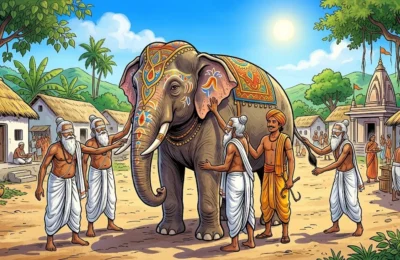 Indian Folk Tales
Ages 9-12
Indian Folk Tales
Ages 9-12
The Blind Men and the Elephant
The Blind Men and the Elephant: In a city famous for its universities and temples, there lived six blind men who were considered among the most learned in the
 Indian Folk Tales
Ages 3-5
Indian Folk Tales
Ages 3-5
Jackal Or Tiger
Jackal Or Tiger: One hot night, in Hindustan, a king and queen lay awake in the palace in the midst of the city. Every now and then a faint air blew through