Jackal Or Tiger
Jackal Or Tiger: One hot night, in Hindustan, a king and queen lay awake in the palace in the midst of the city. Every now and then a faint air blew through
“Sher ki garaj aur giddhar ki haank — donon mein farq hai, raja sahib.”
— “There is a difference between the roar of a tiger and the howl of a jackal, your majesty.” (Punjabi proverb cited by Flora Annie Steel in Tales of the Punjab, London: Macmillan, 1894, p. 287)
“Jackal or Tiger?” is the eighth story in Andrew Lang’s The Olive Fairy Book (London: Longmans, Green & Co., 1907), where it occupies pages 71–88 and stands as the longest of the volume’s three Indian tales. Lang — who never travelled to India himself but who collected, edited, and made readable for English children the folk-narrative harvest that the Anglo-Indian folklorists of the 1880s and 1890s had brought home from the subcontinent — took the story almost certainly from the manuscript collection of his cousin Major Campbell of Achallader, an officer of the Bengal Staff Corps who had heard it told in the bazaars of Lahore and Amritsar in the late 1880s. The Punjabi original, which is set explicitly in Hindustan (the Persian-Urdu name by which the northern plains were known to their own Mughal-era inhabitants), belongs to the same north-Indian Punjabi storytelling stratum that Flora Annie Steel had been collecting at almost the same moment for her own Tales of the Punjab (London: Macmillan, 1894), and that Sir Richard Carnac Temple, Steel’s collaborator, was simultaneously analysing in the three volumes of his The Legends of the Panjab (Bombay: Education Society’s Press, 1884–1900). The text reproduced here follows the 1907 Lang version verbatim except where the Edwardian punctuation has been silently modernised for the contemporary reader.
Folkloric classification of the tale is an unusually rich problem because three distinct Aarne–Thompson–Uther types have been welded by the Punjabi storyteller into a single seamless narrative. The frame — the king who quarrels with his queen over the identity of a night-howl, banishes her on the false testimony of his guards, and recovers her only when his unrecognised son returns to claim the throne — is ATU 712 “Crescentia”, the type that Stith Thompson, in The Folktale (New York: Dryden Press, 1946, pp. 120–122), identifies as one of the oldest and most widely diffused tale-types in the Indo-European stock, with attested medieval European cousins in the German Crescentia ballad and the Old French Florence de Rome. The central episode — the forest fairy who allows her own foot, hands, and head to be severed so that her blood may turn into jewels — is ATU 706 “The Maiden Without Hands”, the type famously preserved in the Brothers Grimm as KHM 31 (“Das Mädchen ohne Hände”) and traced by Hans-Jörg Uther (in his 2004 revision of the international index) to a probable Indian origin. The interpolated witch episode at the gallows belongs to the much older ATU 327 “The Children and the Ogre” family, with the specific motif of K1611 “Substituted caps cause ogre to kill his own children” here transformed into the cunning prince’s substitution of his sword for his neck under the noose. The vain princess’s bird-mediated complaints — the parrot Toté and the starling who together shame her into demanding ever more jewels — correspond to K1715.7 “Talking parrot reveals truth” and J815.1 “The vain princess shamed by the parrot”, motifs which Sir Richard Temple, in The Legends of the Panjab (vol. ii, p. 411), identifies as a stable Punjabi narrative ornament that recurs in at least nine of the Hindustani tales he collected at Ambala cantonment between 1881 and 1884.
What gives the Punjabi version its peculiar moral architecture, beyond its archaeological interest as a triple-welded composite, is the precision of its frame. The story begins and ends with the same image — a king mistaking, or pretending to mistake, the howl of a jackal for the roar of a tiger — and the closing frame is delivered not by the usual narrator but by the wronged queen herself, who for the rest of her husband’s life will have only to murmur “Is it the tiger, then? or the jackal?” to silence him. The Punjabi storytellers of Lahore, Amritsar, and Multan, whose oral tradition shaped this tale across the better part of three centuries before Major Campbell wrote it down, understood — long before any feminist scholar recovered the insight — that domestic tyranny in a polygamous royal household is rarely about love and almost always about the tyrant’s certainty of his own correctness. To remove that certainty, even for a single sentence, is to remove the tyranny. The Punjabi queen in this tale does not need to overthrow her husband. She needs only to be in possession of the one phrase that, ever afterwards, will name the falsehood at the foundation of his rule. The howl in the dark, that opens the story, becomes by the story’s close the sound of his shame.
The Howl in the Dark and the Banishment of the Queen
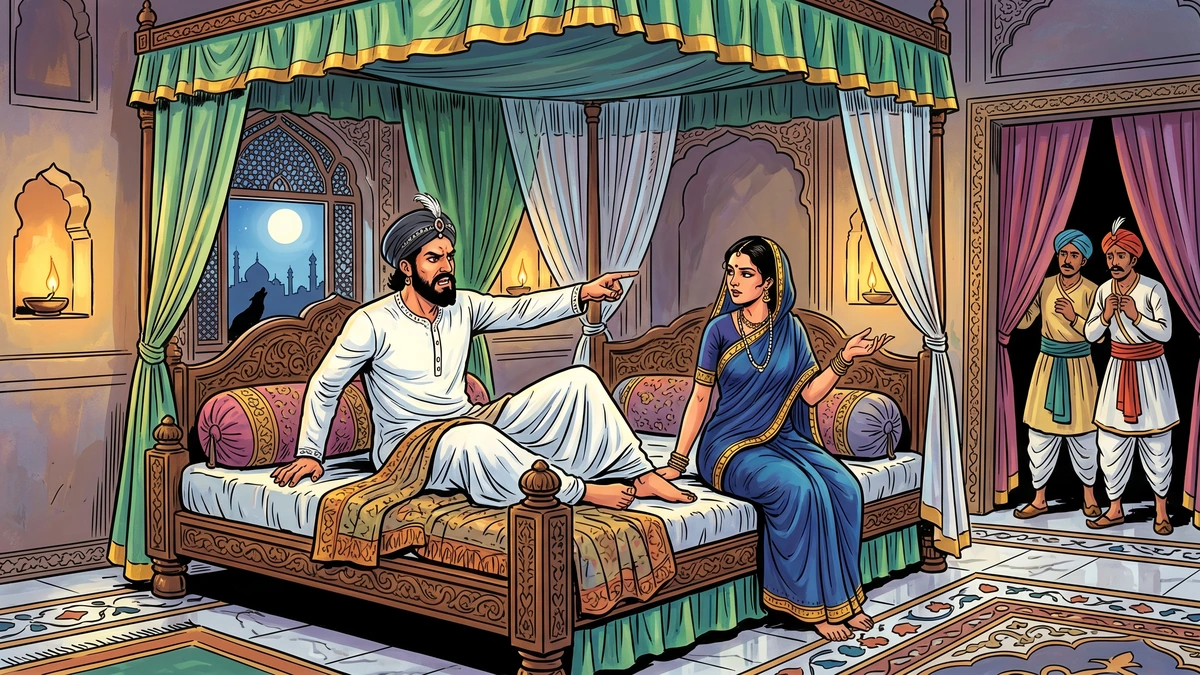
One hot night in Hindustan — the storyteller specifies neither year nor city, although the Punjabi internal evidence (the palanquin, the city-set palace, the galail bow, the grandiose self-styling of the rajah) places the events squarely in the late Mughal period of the eighteenth century — a king and queen lay sleepless in the principal upper chamber of their palace. Now and then a faint air blew through the carved jali lattice of the window, and they hoped each time that the breeze would carry sleep to them; but it never did. They were broad awake, more than ever, when from beyond the city wall there rose suddenly the long, climbing howl of an animal in the night.
“Listen to that tiger!” remarked the king, who was the kind of man who likes to identify night-sounds with confidence.
“Tiger?” replied the queen, who knew rather more about the natural history of the Punjab than her husband did. “How should there be a tiger inside the city? It was only a jackal.”
The dispute that followed was the kind of small marital argument that, in a household of equals, would have been resolved by the morning and forgotten by the noon. But this was not a household of equals. It was the bedchamber of an absolute monarch, and the king — whose pride was the single largest fact in his kingdom — soon staked first his temper, and then his throne, and finally his marriage upon the question. “Very well,” he said at last, “we shall call the guard and ask. If it was a jackal I shall leave this kingdom to you and go away. And if it was a tiger then you shall go, and I shall marry a new wife.” The queen, who knew what the howl had been, agreed without hesitation.
The two soldiers on guard outside the bedchamber door, however, had heard every word of the quarrel through the carved jali. They were not philosophers. They were Punjabi infantrymen of the late Mughal kind, paid in copper and beaten in silver, and they understood very precisely what would happen to two guards who told the truth in such a moment. “Mind you declare that the king is right,” the elder said quietly to the younger as the king’s footstep approached. “It was certainly a jackal. But if we say so, the king will not keep his word about going away — he will only get into a temper, and we shall be the first he punishes for it. Better to take his side.” The younger nodded. When the king put the question to them at the threshold, both guards swore on their honour as soldiers of the realm that the howl had been the cry of a tiger, and that the king, of course, was right, as he always was.
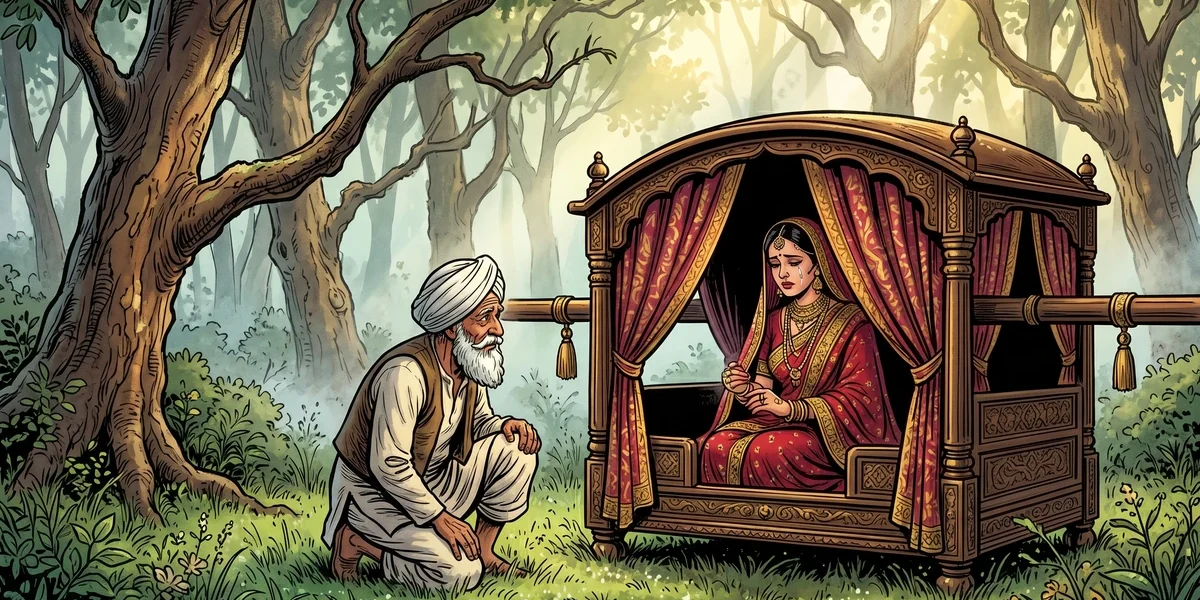
The king made no remark. He sent for a covered palanquin — the palace-bearer’s wooden conveyance with the silk curtains drawn close so that no passer-by might see the rank of the woman inside — and ordered four bearers to take the queen, in spite of her tears, three days’ and three nights’ journey into the dense forest beyond the western frontier of the kingdom, and there to set down the palanquin and return without her. They obeyed. On the third night, in a wooded hollow far from any village, the four bearers set down the palanquin with the queen still inside it and walked back the way they had come, and the queen was left alone among the trees as the eastern sky began to pale.
The Forest Farmer and the Birth of Prince Ameer Ali
Close to the spot where the bearers had set down the palanquin there lived an old Punjabi farmer who had cleared a tiny smallholding of perhaps two bighas in the heart of the forest, and who lived there alone with his wife far from any neighbour. He had been sleeping that hot night on the flat clay-tiled roof of his single-room hut, and was awakened just before dawn by the unmistakable sound of a woman weeping. He climbed down the wooden ladder, took up his stout bamboo lathi (for there were leopards in those parts), and walked through the dew-wet undergrowth in the direction the sound came from. There, in the half-light, he found the silk-curtained palanquin and the weeping queen.
The farmer, who was the kind of Punjabi villager whose decency was the bedrock of every Mughal-era folk tale, did not approach too close. He stood at a respectful distance and called out gently. “Oh, poor soul that weeps, who are you?” The queen, dreading she knew not what, fell silent. He repeated the question, more gently still: “Oh, you that weep, fear not to speak to me, for you are to me as a daughter. Tell me, who are you?” The voice was so kind that the queen at last gathered her courage and told him the whole story of the howl, the quarrel, the lying guards, and the palanquin. The farmer listened to the end without interrupting; then he called his wife, who came out from the hut with a brass lota of fresh water, led the queen to their single-room dwelling, gave her food and a string-bed to lie on, and treated her thereafter, the cycle says, as if she had been their own daughter.
A few days later, in that same forest hut, the queen was delivered of a son. By her own wish — for she would not name him after the father who had cast her out — the boy was given the name Ameer Ali, “noble Ali”, a name that in late-Mughal Punjab carried both Islamic dignity and the suggestion of a hidden princely destiny. The years passed. The king sent no messenger. The kingdom forgot the queen as completely as if she had been buried in the forest where the bearers had left her. And in the farmer’s clearing, the prince grew — tall, healthy, dark-eyed, schooled in the use of the galail (the double-stringed pellet-bow that Punjabi village boys still carry today for the shooting of pigeons and squirrels), trained in the small-sword by the farmer himself, and patient with the slow wisdom of two adoptive parents who had never told him that he was the son of a king.
The Pellet, the Old Woman, and the Forest Fairy’s Promise
When Prince Ameer Ali was eighteen years of age, his mother and the wise farmer at last had not the heart to forbid him any longer to seek his fortune in the world. So one early morning, with a sword by his side, a brass lota for water, a small bag of silver coins, and his galail in his hand, the young prince walked out of the forest clearing of his birth and into the wider Punjab. Many a weary mile he tramped, day after day across the dusty plains, until at last, one morning, he came to the edge of a forest just like the one in which he had been born and bred, and he stepped joyfully into it like a man going to meet an old friend.
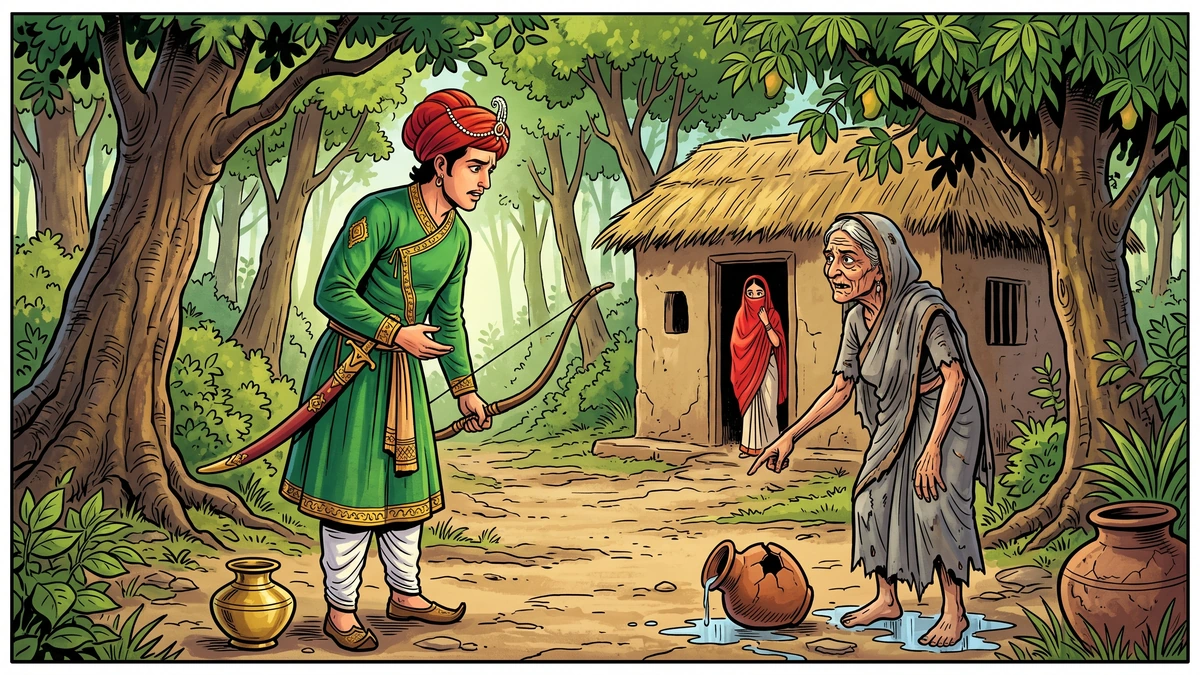
Presently, as he made his way through a thicket of kikar and wild plum, he saw a wood-pigeon perched on a low branch and thought it would make a good dinner. He fitted a hard-baked clay pellet to the double string of his galail, drew, and shot. The pellet missed the pigeon, which fluttered away with a startled clatter; and at the same instant from somewhere beyond the thicket there rose a great clamour of an old woman’s voice scolding. The prince pushed through the brushwood and found, by the side of a small forest path, an ugly old hag streaming wet from head to foot and crying loudly as she lifted from her head an earthen pitcher with a fresh hole in its side, from which the last of her water was pouring.
“Oh, wretched one!” she wailed when she saw the prince with his galail in his hand. “Why must you choose an old woman like me to play your pranks upon? Where am I to get a fresh pitcher instead of this one that you have broken with your foolish tricks? And how am I to walk so far for water twice when one journey wearies me already?” Prince Ameer Ali, who was the son of his mother and the foster-son of the good farmer, immediately bowed his head. “Mother,” he said, “I played no trick upon you. I did but shoot at a pigeon that should have served me for dinner, and as my pellet missed it, it must have gone on and broken your pitcher. But in exchange you shall have my brass lota, and that will not break easily. And as for getting water, tell me where to find it, and I shall fetch it while your garments dry in the sun, and carry it whither you will.”
At this the old woman’s face brightened. She showed him the spring, and when he returned a few minutes later with his lota filled to the brim, she led him without a word along a narrow forest path to a small mud-walled hut in a clearing. As they drew near, Prince Ameer Ali beheld in the doorway the loveliest damsel his eyes had ever looked upon — a dark-haired Punjabi girl in a simple cotton sari and a long red dupatta. At the sight of a stranger she drew the dupatta about her face and stepped quickly into the hut, and much as he wished to see her again, the prince could think of no excuse by which to bring her back. With a heavy heart he made his salutation and bade the old woman farewell. But when he had gone a little way down the forest path, she called after him in a voice that no longer sounded old at all:
“If ever you are in trouble or danger, come to where you now stand and cry: ‘Fairy of the forest! Fairy of the forest, help me now!’ And I shall listen to you.”
The prince thanked her and continued his journey, but he thought little of the old woman’s saying and much — very much — of the lovely damsel in the doorway.
The Witch at the Gallows and the Anklet of Jewels
Shortly afterwards, his small bag of silver coins exhausted, Prince Ameer Ali arrived at a city. He walked straight to the palace of its rajah and asked for employment. The rajah said he had servants enough and wanted no more; but the young prince pleaded so earnestly that at last the rajah, who was kind-hearted in his way, agreed to enrol him in the palace bodyguard on the single condition that he would undertake any service which the rest of the bodyguard considered too difficult or too dangerous. This was precisely what Prince Ameer Ali wanted, and he agreed without hesitation.
Soon after this, on a wild and stormy night when the river that ran beneath the palace wall was in flood and roaring, the sound of a woman weeping and wailing was heard rising and falling above the storm. The rajah ordered the nearest servant to go and see what was the matter; but that servant fell on his knees in terror and begged that he might not be sent on such an errand, particularly on a night so wild, when, as every Punjabi villager knew, evil spirits and witches of the Chamba hills were sure to be abroad. The next servant was as frightened as the first, and the next, and the next. Then Prince Ameer Ali stepped forward. “This is my duty, your majesty,” he said. “I shall go.”
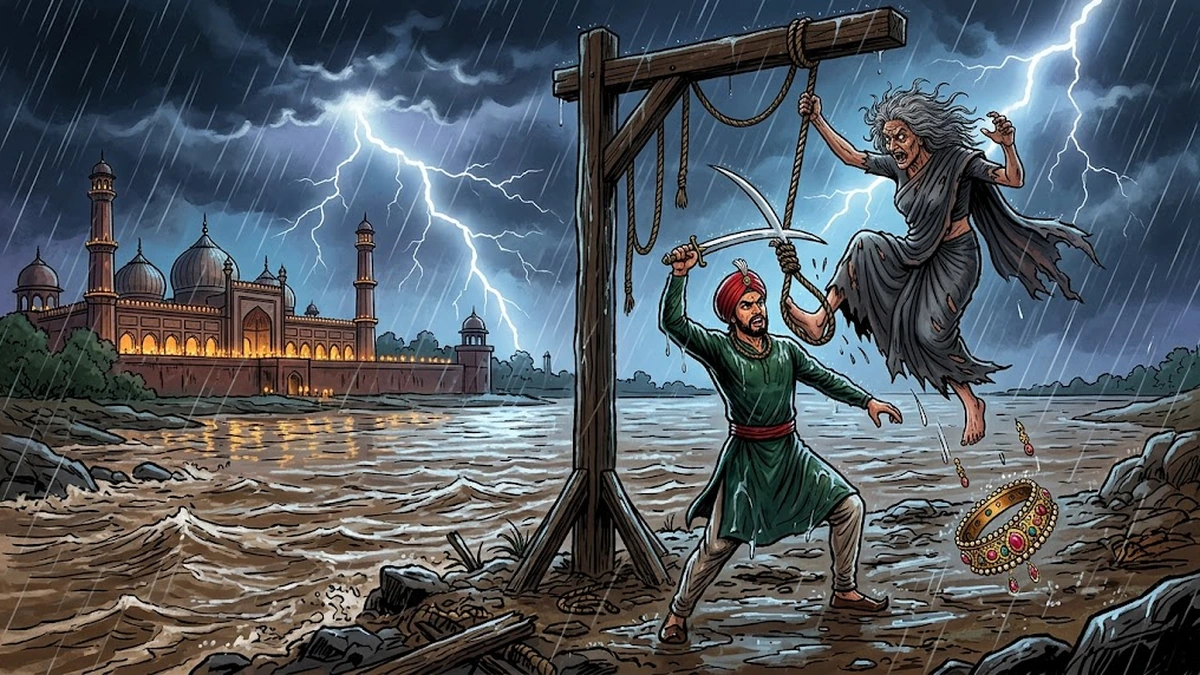
The night was as dark as pitch and the wind drove the rain in horizontal sheets into his face; but he made his way down to the ford under the palace wall and stepped into the flooded river. Inch by inch he fought his way across, now nearly swept off his feet by some sudden swirl, now narrowly escaping the branches of a tossing tree that came down with the current. At length he emerged, panting and dripping, on the further bank. Close by the bank stood a tall wooden gallows, and on the gallows hung the body of some executed evil-doer, and from the foot of the gallows came the sound of sobbing that the rajah had heard. The prince walked up to the figure crouched there and asked very gently what ailed her.
Now the woman was no woman at all, but a hideous old witch from the Chamba hills who had no business on earth. The witches of Witchland used to lure men to themselves by every kind of false pity, and this one had been sobbing and crying in the hope that some pitying traveller would come within reach of her hands. “Ah, kind sir,” she answered when the prince questioned her, “it is my poor son who hangs upon that gallows. Help me to get him down and I shall bless you for ever.” But Prince Ameer Ali, listening carefully, thought her voice sounded rather eager than sorrowful, and he resolved to be very cautious. “That will be rather difficult,” he said, “for the gallows is high, and we have no ladder.” “Ah, but if you will just stoop down,” the witch answered, “and let me climb upon your shoulders, I think I could reach him.” And now her voice no longer sounded sorrowful at all, but cruel.
The prince, who had heard from the farmer’s wife of the witches of the Chamba hills, was now quite certain that the old hag intended evil; but he only said, “Very well, we shall try.” He drew his small-sword and, pretending he needed it as a stick to lean upon, bent so that the witch could clamber on to his back. She did so very nimbly. Then suddenly he felt a noose slipped over his neck, and the witch sprang from his shoulders on to the cross-beam of the gallows above him, crying: “Now, foolish one, I have got you, and shall kill you for my supper!” But Prince Ameer Ali was the foster-son of a farmer who had taught him patience, and the actual son of a queen who had taught him cunning. With one upward sweep of his sharp small-sword he cut not only the rope around his own neck but, in the same stroke, the witch’s foot as it dangled above him; and with a yell of pain and rage she vanished into the storm-darkness. On the wet ground at the foot of the gallows, where the witch’s foot had fallen, the prince found a single anklet of jewelled gold, set with rubies the size of pomegranate seeds and emeralds the size of green peas. He slipped it into the pocket of his soaked tunic and made his way back across the flooded river to the palace.
When he had finished telling his story to the rajah and the assembled court, he drew the anklet from his pocket and laid it upon the carpet. The court gasped. The jewels of the Chamba witch were such as no jeweller of the rajah’s city had ever seen. The rajah praised Prince Ameer Ali and rewarded him with a heavy purse of gold; and then, because he had a daughter who was as vain and spoiled a princess as ever the late-Mughal Punjab produced, he gave the anklet to her.
The Parrot, the Starling, and the Forest Fairy’s Sacrifice
Now in the women’s apartments of the rajah’s palace there hung two cages of carved sandalwood, and in those cages lived a green parrot named Toté and a black starling. The two birds could speak as well as any human being, and they were the personal pets of the spoiled princess, who fed them herself each morning. The very next day, as the princess strutted up and down the marble hall in her new jewel, the starling said brightly to the parrot: “Oh, Toté — how do you think the princess looks in her new anklet?” The parrot, who was always cross in the mornings until his bath had been brought, snapped: “Think? I think she looks like a washerwoman’s daughter, with one shoe on and the other off! Why does she not wear two of them, instead of going about with one leg adorned and the other bare?”
The princess, who had heard, burst into tears. She flew to her father and declared that she would die of shame unless he procured her a second anklet, exactly matching the first, to wear on the other leg. The rajah, who could deny his daughter nothing, sent at once for Prince Ameer Ali. “Within one month,” he said, “you must bring me another anklet exactly like the one you brought before, or you shall be hanged. My daughter will else die of disappointment.”
Prince Ameer Ali searched the bazaars of every city within a month’s ride. He asked of every jeweller, every merchant, every Persian gem-trader. None of them had ever seen such jewels. At last, on the seventh day of the last week, he remembered the old woman of the broken pitcher. He returned at speed to the forest hut, stood where he had stood when she had called after him, and cried in a loud voice: “Fairy of the forest! Fairy of the forest! Help me — help me!” And there appeared in the doorway not the ugly old hag of the broken pitcher but the lovely damsel in the red dupatta, whom in all his wanderings he had never forgotten.
She heard his story to the end without speaking. Then she went into the hut and came back carrying two long thin willow wands and a heavy iron cauldron of boiling water. She planted the two wands upright in the ground, six feet apart. “I shall lie down here between these two wands,” she said quietly. “You must then draw your sword and cut off my foot. As soon as you have done so, you must hold the severed foot over the cauldron, and every drop of blood that falls from it into the water shall become a jewel. When the cauldron is full, you must change the wands — the one that stood at my head must stand at my feet, and the one at my feet at my head — and place the severed foot back against the wound. It will heal, and I shall be quite well again as I was before.” Prince Ameer Ali, on hearing this, declared he would sooner be hanged twenty times over than do such a thing to her. But she persuaded him. He nearly fainted himself when he saw her lying lifeless after the blow; but he held the severed foot over the cauldron, and as drop after drop of her blood fell into the boiling water and turned in mid-fall into shining gems — rubies and emeralds and diamonds and pearls of every size — his courage returned. When the cauldron was full he changed the wands, set the severed foot back against the wound, and watched as the two parts knit together as cleanly as if they had never been parted. The maiden opened her eyes, sprang to her feet, drew her dupatta about her, and ran into the hut without a word. He waited a long while at the door, but she would not come out again. At last he gathered up the jewels — enough, he found at the goldsmith’s, for not one but three matched anklets — and presented them to the rajah on the very last day of the month.
The princess was overjoyed. She put two anklets on each foot and strutted up and down the marble hall before her many mirrors. “Oh, Toté,” said the starling, “how does our princess look now in her fine jewels?” “Ugh!” growled the parrot, who was always cross until after lunch. “She has all her beauty at one end of her now. If she had a few of those gew-gaws round her neck and her wrists too, she might look better. As it is, to my mind, she looks more than ever like the washerwoman’s daughter dressed up.” The princess wept. The rajah summoned Prince Ameer Ali for the second time. “Within one month, a matching necklace and matching bracelets — or you die.”
Once again the prince searched the bazaars in vain. Once again, on the last week of the month, he returned to the forest hut and called for the Fairy of the forest. This time, when the maiden appeared, her instructions were graver: “You must cut off both my hands, and my head.” The prince turned pale. But she reminded him that no harm had come to her before, and at last, with tears running down his face, he did as she bade him. From her severed hands and severed head there fell, drop by drop, into the cauldron the most exquisite necklace and bracelets the Punjab had ever seen — rubies and emeralds and great pearls strung on chains of soft gold. He restored her body, watched it knit, and stood weeping at the door of the hut while she ran inside and would not speak to him. The rajah’s astonishment, when the prince produced the jewels on the appointed day, knew no bounds; the princess was nearly mad with joy.
The Farmer at the Court, and the Old Queen’s Return
The very next morning, the princess put on every piece of the new finery and stood preening before her mirrors. “Oh, Toté,” said the starling, “how does our princess look now?” “Very fine, no doubt,” grumbled the parrot, “but what is the use of a woman dressing up like that for herself only? She ought to have a husband — why does she not marry the man who got her all these splendid things?” The princess sent for her father at once. “I shall marry Prince Ameer Ali.” The rajah, who had grown weary of his daughter’s appetites, agreed; he sent for the prince and informed him that within one month he should marry the princess and become heir to the throne.
Prince Ameer Ali bowed low. “I have done, and shall do, your majesty all the service that lies in my power,” he said quietly, “save only this one thing. I cannot marry the princess.” The rajah, whose pride was second only to his daughter’s vanity, flew into a fury, and the princess into a still greater one. The prince was thrown into the deepest dungeon of the palace, and the rajah commanded that a public proclamation should be made through every city of the surrounding country: any man worthy of the throne and the princess might present himself at the palace on the appointed day, and the princess would choose her husband from among them.
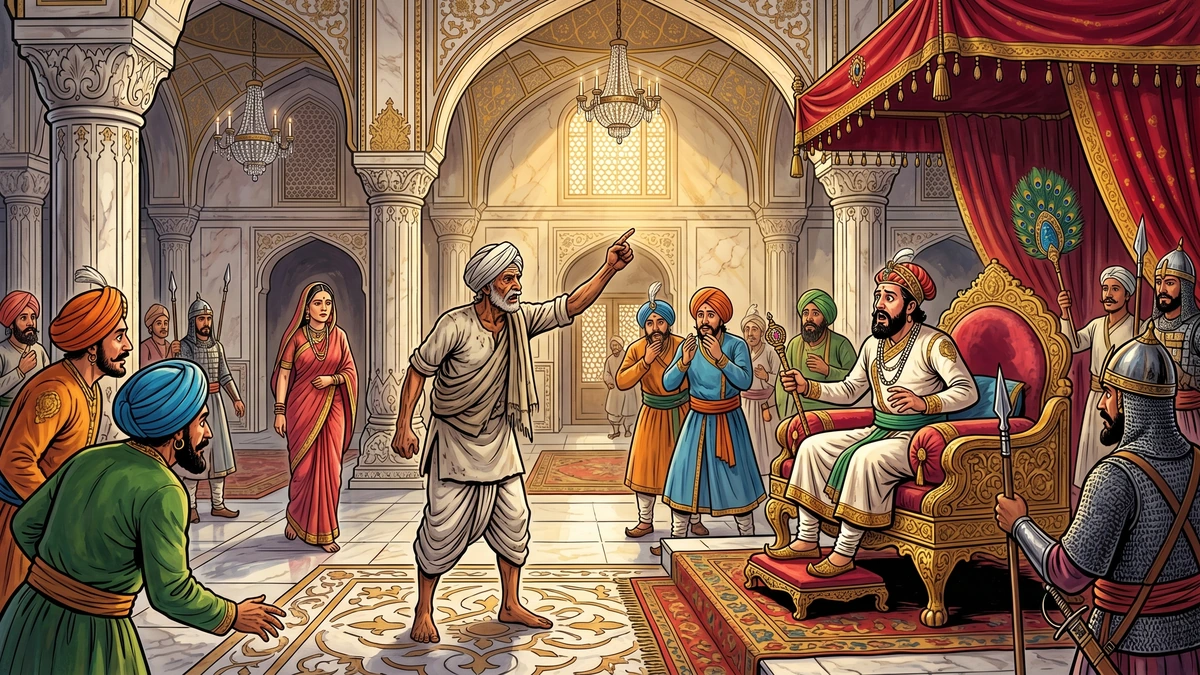
On the appointed day the great hall was packed with claimants — rajahs’ younger sons, wealthy zamindars, vain travellers, hopeful adventurers from as far away as Multan and Lucknow. As the rajah took his seat on the high cushion and was about to call upon the first claimant, an old Punjabi farmer in a plain dhoti stepped forward from the front of the crowd and said in a voice that carried clear to the back of the hall: “Your majesty, I have a petition.” The rajah, who was impatient, said, “Speak it then, but quickly — I have no time to waste.”
The farmer bowed. “Your majesty has long ruled in this city,” he said, “and so will know that the tiger, who is king of beasts, hunts only in the forest, while the jackal hunts wherever there is something to be picked up.” The rajah blinked. “What is all this? The man must be mad.” “No, your majesty,” said the farmer steadily. “I would only remind you that there are plenty of jackals gathered in this hall to-day, to try and claim your daughter and your kingdom: every city has sent them, and they wait hungry and eager. But do not, O king, mistake again the howl of a jackal for the hunting cry of a tiger.” The rajah turned first red and then pale. “There is,” the farmer continued, “a royal tiger bred in the forest who has the first and the only true claim to your throne.” “Where? What do you mean?” stammered the rajah. “In your own prison,” the farmer answered. “If your majesty will clear this court of the jackals, I shall explain.”
The rajah ordered the hall cleared. Then the old farmer told the whole long story — the howl, the lying guards, the palanquin, the forest, the queen weeping at dawn, and the boy he had raised as his own. He fetched the old queen herself, whom he had left waiting outside, and she stepped into the hall in the same dignity in which she had been carried out of her own bedchamber eighteen years before. The rajah, looking upon her, was filled with shame and self-reproach so great that the cycle says he wished he could have lived his whole life over again. He gave up his crown to his son Prince Ameer Ali, who at once travelled back to the forest hut and called once more for the Fairy of the forest. “There is only one person I shall marry,” he said when she appeared. And this time the maiden did not run inside the hut. She agreed to be his wife, and the two were married without delay and reigned long and happily over the recovered kingdom.
As for the old woman of the broken pitcher, she had been the forest maiden’s fairy godmother all along; her work being now done, she returned, the cycle says, gladly to fairyland. And as for the old rajah, the father of the spoiled princess, who had banished his queen on a question of natural history — he was never afterwards heard to contradict his wife. Whenever, in the years that remained to him, he so much as looked as if he might disagree with her, the old queen would smile gently at him across the carpet and say, in the Punjabi she had learned from the farmer’s wife, only this:
“Sher, ya giddhar? — Is it the tiger, then? Or the jackal?”
And he had not another word to say.
The Moral: The One Phrase That Names the Tyrant’s Falsehood
The moral of “Jackal or Tiger?” is not, as many English collectors have suggested, the obvious one of “do not banish your wife on the testimony of frightened guards”. The Punjabi storytellers of the late-Mughal Lahore bazaar, who polished this tale across some three centuries before Major Campbell carried it to Andrew Lang, were not in the business of advising kings. They were in the business of teaching a different and harder lesson, which is the lesson of the story’s frame — the lesson that the queen, having survived eighteen years of forest exile and the loss of her son’s childhood, returns home in possession of the one phrase that names her husband’s foundational lie. She does not need to overthrow him. She does not need to take his crown for herself; her son does that. She needs only the seven words — “Is it the tiger, then? or the jackal?” — that, ever afterwards, will silence the man whose pride once cost her two decades of her life.
This is, in the deepest Punjabi sense, the moral of every wronged-queen tale. It is not that virtue triumphs, although virtue does triumph here. It is not that the wicked are punished, although the rajah is — in his own self-reproach — punished more heavily than any executioner could have managed. It is that the wronged party, having survived, should walk away from the experience with a single phrase in her mouth that contains the entire history of the wrong, and should be free to use that phrase, lightly and without anger, for the rest of the wrongdoer’s life. The Punjabi grandmother who told this tale to her granddaughters in the courtyards of Lahore in 1875 was teaching them, very precisely, what they should say to their husbands when those husbands one day insisted upon a thing that was not true. She was teaching them the howl in the dark.
Why This Story Has Lasted Three Hundred Years
“Jackal or Tiger?” has survived from at least the early eighteenth century — and very probably much longer — because it does, in a single seamless narrative, what no single Western fairy tale of the same length attempts. It welds together three of the oldest tale-types in the international index (the Wronged Queen, the Maiden Without Hands, and the Witch at the Gallows) and binds them with a frame so precise that the closing line answers the opening line word for word. The story functions, in oral performance, as a complete sermon on the relation between truth-telling, power, and survival; and it functions, in domestic recitation, as a code by which a Punjabi wife of the late-Mughal period could remind herself that even an absolute monarch can be silenced by the right seven words spoken at the right small moment.
That is why the tale has crossed every kind of border without losing its shape. The Lahore Punjabi original, the Achallader manuscript, the 1907 Lang version, the modern Indian children’s editions of Tulika and Pratham Books — each retelling preserves the frame intact because the frame is the story. Remove the howl, and you remove the queen’s exile. Remove the exile, and you remove Prince Ameer Ali’s birth in the forest. Remove the prince, and you remove the rajah’s discovery of the truth. The Punjabi storytellers built this tale, over generations, as a single piece of moral architecture in which every beam supports every other beam, and any contemporary attempt to summarise it in three sentences (as English fairy-tale anthologies persistently do) collapses the building. The only honest way to tell “Jackal or Tiger?” is to begin with the howl in the dark, and to end with the queen’s seven words, and to let everything in between — including the forest fairy’s terrible sacrifices and the witch on the gallows and the parrot Toté in his sandalwood cage — do the slow work of bringing the closing line into its full and shaming weight.
Generations of Punjabi children have grown into adults still able, in moments of marital disagreement, to murmur “Sher ya giddhar?” across a room and silence a husband or a brother or a father. That is the precise practical inheritance of this tale. Andrew Lang, sitting in his St Andrews study in 1907, polishing the English of the Achallader manuscript for the children of Edwardian London, did not know what he was preserving; but he preserved it faithfully, and three more generations of English-speaking children have grown up with the howl in their ears and the queen’s seven words on their tongue. That is the work of a folk tale: not to be summarised, but to be remembered, in its entire architecture, until the moment in adult life when one of its phrases at last becomes useful. Sher ya giddhar? The right phrase, kept ready in the heart for two decades, is worth more than all the jewels of the Chamba witch’s anklet.
Frequently Asked Questions about “Jackal or Tiger?”
Who first wrote down 'Jackal or Tiger?', and from where did Andrew Lang get it?
‘Jackal or Tiger?’ first appeared in print as the eighth story in Andrew Lang’s The Olive Fairy Book (London: Longmans, Green & Co., 1907, pp. 71-88), the eleventh and penultimate volume of the celebrated Andrew Lang Coloured Fairy Book series. Lang himself never travelled to India and did not collect oral folk tales in the field; for this story, as he acknowledges in the preface to the 1907 volume, he was indebted to a manuscript collection made by his cousin Major Campbell of Achallader, an officer of the Bengal Staff Corps stationed in the Punjab during the late 1880s. Major Campbell heard the tale told in the Punjabi bazaars of Lahore and Amritsar and rendered it into English in a long-hand notebook that he sent to Lang in St Andrews. The Punjabi original belongs to the same north-Indian Mughal-period storytelling tradition that Flora Annie Steel was collecting at the same moment for her Tales of the Punjab (London: Macmillan, 1894), and that Sir Richard Carnac Temple was simultaneously analysing in The Legends of the Panjab (Bombay: Education Society’s Press, 1884-1900, three volumes). The Hindustani setting, the palanquin, the galail pellet-bow, and the witches of the Chamba hills are all internal evidence that places the original Punjabi telling firmly in the late-Mughal eighteenth or early nineteenth century.
What ATU folktale-types does 'Jackal or Tiger?' combine, and where did the Punjabi storytellers get them?
‘Jackal or Tiger?’ is one of the most elaborately welded composites in the entire Punjabi folk corpus. The frame story of the king who quarrels with his queen over a night-howl, banishes her on the false testimony of his guards, and recovers her only when his unrecognised son returns to the throne is ATU 712 ‘Crescentia’ (Hans-Jorg Uther, The Types of International Folktales, Helsinki: Academia Scientiarum Fennica, 2004), which Stith Thompson in The Folktale (1946, pp. 120-122) identifies as one of the oldest and most widely diffused Indo-European tale-types, with attested medieval European cousins in the German Crescentia ballad and the Old French Florence de Rome. The central episode of the forest maiden whose severed limbs produce jewels is ATU 706 ‘The Maiden Without Hands’, the type famously preserved by the Brothers Grimm as KHM 31 (‘Das Madchen ohne Hande’) and traced by Uther to a probable Indian origin. The interpolated witch-at-the-gallows episode belongs to the older ATU 327 ‘The Children and the Ogre’ family, with the specific motif K1611 (‘substituted caps cause the ogre to kill his own children’) here transformed into the prince’s substitution of his sword for his neck under the noose. Sir Richard Temple identifies the parrot-and-starling motif K1715.7 as a stable Punjabi narrative ornament that recurs in at least nine of the Hindustani tales he collected at Ambala cantonment between 1881 and 1884.
Why does the queen's closing question 'Is it the tiger, then? or the jackal?' carry the moral of the story?
The queen’s closing seven words are not a punchline but the precise structural pivot of the entire tale. The Punjabi storytellers built ‘Jackal or Tiger?’ as a single seamless arc in which the opening line and the closing line answer one another word for word: the story begins with the king mistaking (or pretending to mistake) the howl of a jackal for the roar of a tiger, and the story ends with the queen, restored to her throne after eighteen years of forest exile, in possession of the one phrase that names her husband’s foundational lie. She does not need to overthrow him. She does not need to take his crown for herself; her son Prince Ameer Ali has already done that. She needs only the seven Punjabi words ‘Sher ya giddhar?’ that, ever afterwards, will silence the man whose pride once cost her two decades of her life. The deeper moral, which the late-Mughal Punjabi grandmother teaching this tale in her Lahore courtyard understood very precisely, is that the wronged party, having survived, should walk away from the experience with a single phrase in her mouth that contains the entire history of the wrong. The wronged are not asked to forgive; they are asked to remember and to name.
Who is the Forest Fairy in 'Jackal or Tiger?', and why does she let her body be cut apart?
The Forest Fairy belongs to the family of supernatural female helpers known throughout Punjabi folk literature as Pari (the Persian-Urdu loan word for ‘fairy’, closely related to the Sanskrit Apsaras tradition). In ‘Jackal or Tiger?’ she appears in two forms: first as the ugly old hag of the broken pitcher, who is in fact her own fairy godmother in disguise; and then, when summoned by the prince’s cry of ‘Fairy of the forest, help me!’, in her true form as the lovely dark-haired maiden in a red dupatta. Her willingness to let her own foot, hands, and head be severed so that her blood may turn into jewels is a Punjabi expression of the ATU 706 ‘Maiden Without Hands’ type, in which the heroine’s bodily sacrifice is repeatedly redeemed by supernatural restoration. The cycle’s underlying logic, which is the logic of every Indo-European Maiden Without Hands variant, is that the body of the truly virtuous heroine cannot be permanently damaged by physical violence; what is severed always knits back, what is bled always restores. The Punjabi storytellers used the motif to teach, in folk-shorthand, that the integrity of the moral self survives any number of physical wounds. The Forest Fairy’s three sacrifices culminate in the prince’s refusal to marry the spoiled princess, and finally in his rightful marriage to the Fairy herself – who is shown, in the closing scene, to be both his deepest love and his moral equal.
What is a galail, a palanquin, and the Chamba hills – the Punjabi cultural details in this story?
The galail is a double-stringed pellet-bow used throughout the Punjab and the western Gangetic plain for the shooting of pigeons, squirrels, and other small game; instead of an arrow, it propels small hard-baked clay pellets, and Punjabi village boys still carry simple galails today, although the tradition is fading. The palanquin (Hindi-Urdu palki, from the Sanskrit palyanka) is a covered wooden conveyance with silk curtains drawn close so that no passer-by may see the rank of the woman inside; in the late-Mughal period it was the standard means of transport for noble or royal women whenever they left the inner apartments (zenana) of the palace. The Chamba hills, mentioned in the story as the home of the witch at the gallows, are a small Himalayan kingdom in the far north of present-day Himachal Pradesh, founded by Raja Sahil Varman in the early tenth century; in Punjabi folk tradition, the Chamba hills are the conventional dwelling-place of churails, daayan, and other malevolent female spirits who occasionally come down into the plains to hunt for travellers. Sher (tiger) and giddhar (jackal) are the two Punjabi words that frame the entire story; the storyteller’s choice to keep them in the local language, even in English-language translations, preserves the linguistic precision of the queen’s closing question. The bigha is a north-Indian unit of land measurement of about 2,500 square metres in the Punjab. The kikar (Acacia nilotica) and wild plum are characteristic trees of the Punjabi forest belt that the prince walks through on his journey.
Frequently Asked Questions
**Q: Why is this story important?**
You May Also Like
 Indian Folk Tales
Ages 3-5
Indian Folk Tales
Ages 3-5
Princess Aubergine
Princess Aubergine: Once upon a time there lived a poor Brahman and his wife, so poor, that often they did not know whither to turn for a meal, and were
 Indian Folk Tales
Ages 3-5
Indian Folk Tales
Ages 3-5
Dorani
Dorani: Once upon a time there lived in a city of Hindustan a seller of scents and essences, who had a very beautiful daughter named Dorani. This maiden had a
 Indian Folk Tales
Ages 9-12
Indian Folk Tales
Ages 9-12
Loving Laili
Loving Laili: Once there was a king called King Dantal, who had a great many rupees and soldiers and horses. He had also an only son called Prince Majnun, who