A Clever Thief
A Clever Thief: In the great city of Varanasi, during the reign of a wise but strict king, there lived a man known as Chatur, which means “the clever one.”
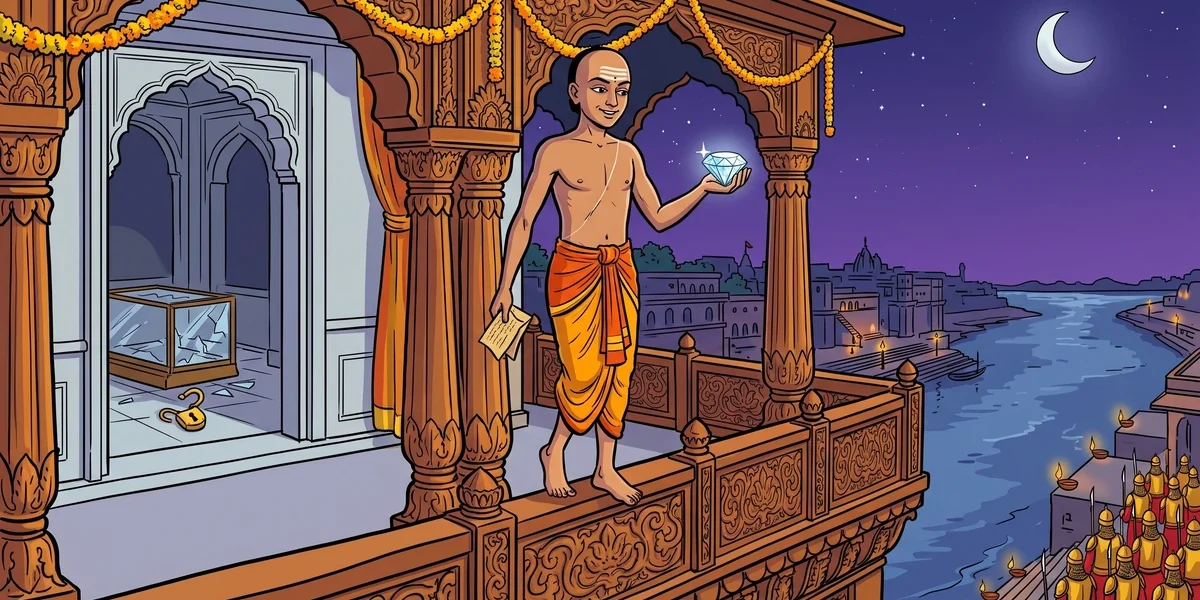
A Clever Thief: The Indian Master-Thief Cycle from Somadeva’s Kathāsaritsāgara to Varanasi Folk Memory
A Clever Thief belongs to one of the oldest and most travelled story-cycles in world folklore — the cycle of the master-thief who outwits king and council not by violence but by sheer buddhi (wit), and who is finally rewarded with high office instead of a noose. The tale’s deepest Sanskrit ancestor is the long-celebrated narrative of Ghaṭa and Karpara (“Pot and Potsherd”) embedded in Somadeva Bhatta’s eleventh-century Kathāsaritsāgara (“Ocean of the Streams of Story”), a 22,000-stanza retelling of Guṇāḍhya’s lost Bṛhatkathā, finished about 1063–1081 CE for the Kashmiri queen Sūryavatī. The Karpara-Ghaṭa story occupies tarangas 64–65 of Book X (Śaśāṅkavatī Lambaka) and was translated into English by Charles Henry Tawney as The Ocean of Story (Calcutta, Asiatic Society of Bengal, 1880–1884) and re-edited in ten illustrated volumes by N. M. Penzer with notes by Sir Richard Carnac Temple (London, Chas. J. Sawyer, 1924–1928), the canonical reference text used by every modern Indologist. The independent translation of the same Sanskrit by C. H. Tawney’s student Sir Aurel Stein and by Friedrich Max Müller in his Sacred Books of the East miscellany also preserved the text. A separate Anglo-Indian recension of the “Clever Thief” legend, naming the thief Hari-Sarman of Varanasi and his wife Vidyā, was popularised in Hindu Tales from the Sanskrit by S. M. Mitra and Nancy Bell (London, Macmillan & Co., 1919, Tale VII, pp. 71–94), where Mitra credited his oral source to Banaras-Pandit storytellers of the Vishvanath quarter. Folklorists have classified the tale as Aarne-Thompson-Uther type ATU 1525 “The Master Thief,” with affinities to ATU 1525A “The Tasks for a Thief” and ATU 950 “Rhampsinitus,” the latter being the famous Egyptian narrative recorded by Herodotus (Histories II.121) about the architect’s son who robs the treasure-chamber of King Rhampsinitus and is finally married to the king’s daughter. Stith Thompson’s Motif-Index of Folk-Literature (Indiana, 1955–1958) lists relevant motifs K301 “Master thief,” K306 “Stealing by trickery,” K341 “Owner’s interest distracted while goods are stolen,” K366 “Thieves stealing from each other,” J1141 “Confession obtained by ruse,” and L113.7 “Thief becomes king’s minister.” Theodor Benfey, in his pioneering Pantschatantra introduction (Leipzig, 1859, vol. I § 195), traced the tale’s migration from India to Persia and Greece, citing it as a textbook example of the Indo-European Wandersagen — the literary thread he believed had carried Indian narrative motifs into Aesopic and Herodotean Greek antiquity.
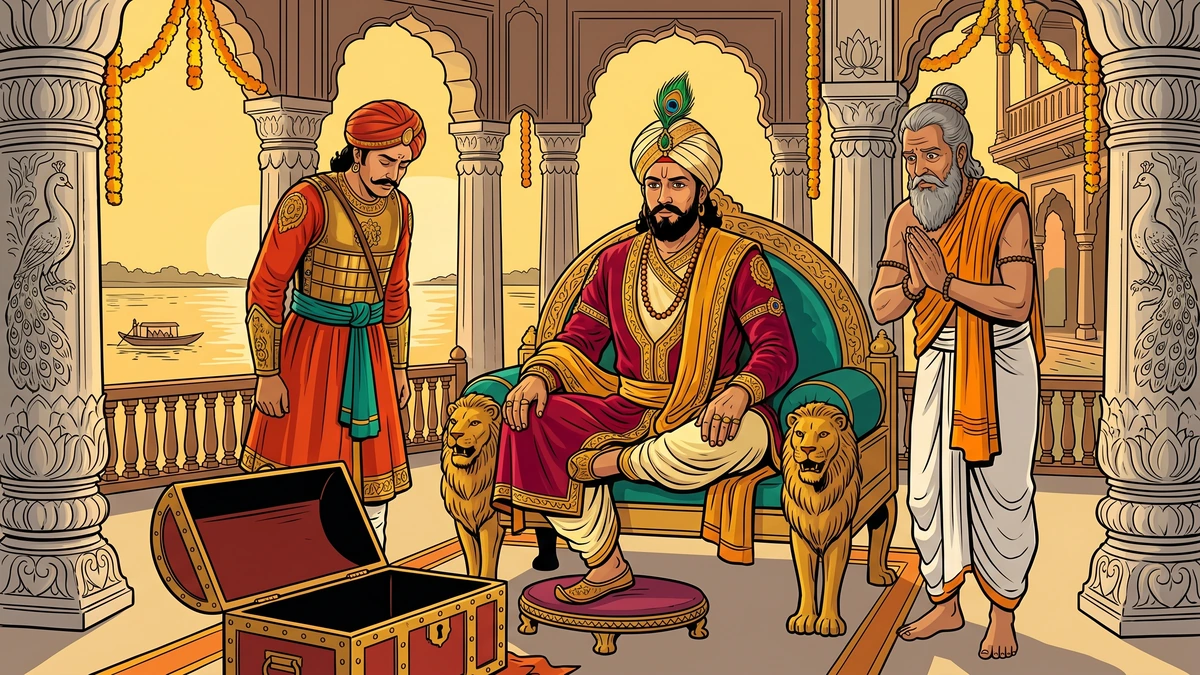
The Setting: Eleventh-Century Varanasi and the World of the Sanskrit Niti-Shastras
The Varanasi (Sanskrit Vārāṇasī, Pali Bārāṇasī) of this tale is the same holy city of saffron-cotton dhotis and brass kalasha pots, the same maze of ghats above the slow Ganges, that Bana wrote of in the seventh century and that Tulsidas would walk in the sixteenth. In Somadeva’s eleventh-century telling, the urban backdrop is a Pala-Sena-period Indian court — sandalwood balconies, marble pavilions roofed in sukha-niwāsa red tile, lattice-windowed jharokhas looking down on the bazar, lampblack-eyed elephants in caparison, royal guards in saffron angarakha tunics turbaned with peacock-feather kalgi — against which the figure of the master-thief moves like a quicksilver shadow. Sanskrit literature gives the master-thief a respectable name and even a manual of his own: the Steyaśāstra (“treatise on theft”) is alluded to in the Mahabharata, the Mānava-dharma-śāstra (Manu IX.270–278), and most extensively in chapter LXIV of Daṇḍin’s seventh-century Daśakumāracarita (“Tales of the Ten Princes”), where the exiled prince Apahāravarman is taught the eight-fold method of breaking-and-entering. Daṇḍin’s thief-prince has every tool the Varanasi cleric-thief of our story would need: knowledge of locks (tāla-vidyā), of disguise (veṣa-parivartana), of soporifics (nidrāñjana), of map-making (citra-rekhā), and of rāja-niti — the science of how kings think. Set against this learned tradition, the “clever thief” is not the rude bandit of Western imagination but a learned vidyādhara, a kind of trickster-scholar whose theft is in the end a public examination of the kingdom’s justice. The very name Chatur (Sanskrit caturaḥ, “the four-fold quick one”) is a known Sanskrit epithet of the god Gaṇeśa and of every buddhimān (man-of-wits) hero in the Pancatantra and Hitopadeśa.
Beat I — The Master-Thief of Varanasi and the King’s Three-Times-Robbed Treasury
In the high noon of the Pala dynasty, when Varanasi’s ghats were crowded with pilgrims and her bazars heavy with the smell of marigold garlands and roasted gram, there lived in the Khojwan quarter of the lower city a man whom everyone called Chatur — the Quick One. He was a thief, and known to be one, but he was so unlike the bandits of the wilderness and the cutpurses of the Daśāśvamedha steps that the people had long since stopped fearing him. He never struck a blow. He never lifted a coin from a beggar’s bowl, nor a brass amulet from a widow’s neck. Instead he made a careful study of the great houses of Varanasi — the merchants of the silk-road who underpaid their weavers, the temple-officials who skimmed offerings, the tax-collectors who sold royal grain at famine prices — and one by one, by an art that seemed to be half intelligence and half magic, he relieved them of just so much of their hoarded wealth as could be turned into rice and copper for the poor of the lanes behind the Manikarnika ghat.
Word of his exploits at last reached the throne of King Brahmadatta of Kashi, a strict and learned monarch who had read his Manu and his Kautilya and was grimly determined that no man in his city should be cleverer than the law. Three times the royal treasury had been entered without alarm, three times the great brass-bound chests had been emptied of their gold dinars and Pala silver, and once, most provoking of all, the jewelled turban of the captain of the guard had been lifted clean from the head of its sleeping owner. “Is it possible,” the king demanded of his chief minister at dawn-durbar, “that the discipline of my watch is so loose that one man defeats fifty?” The minister bowed and answered honestly: “Your Majesty, it is not the slackness of fifty soldiers but the wit of one Chatur. He is, I am told, no ordinary caura — he is a buddhimān, a strategist. To catch him we shall need to outthink him.” The king tugged his beard, half angry and half intrigued, and decreed that very afternoon a trap should be laid such as no clever man could resist.
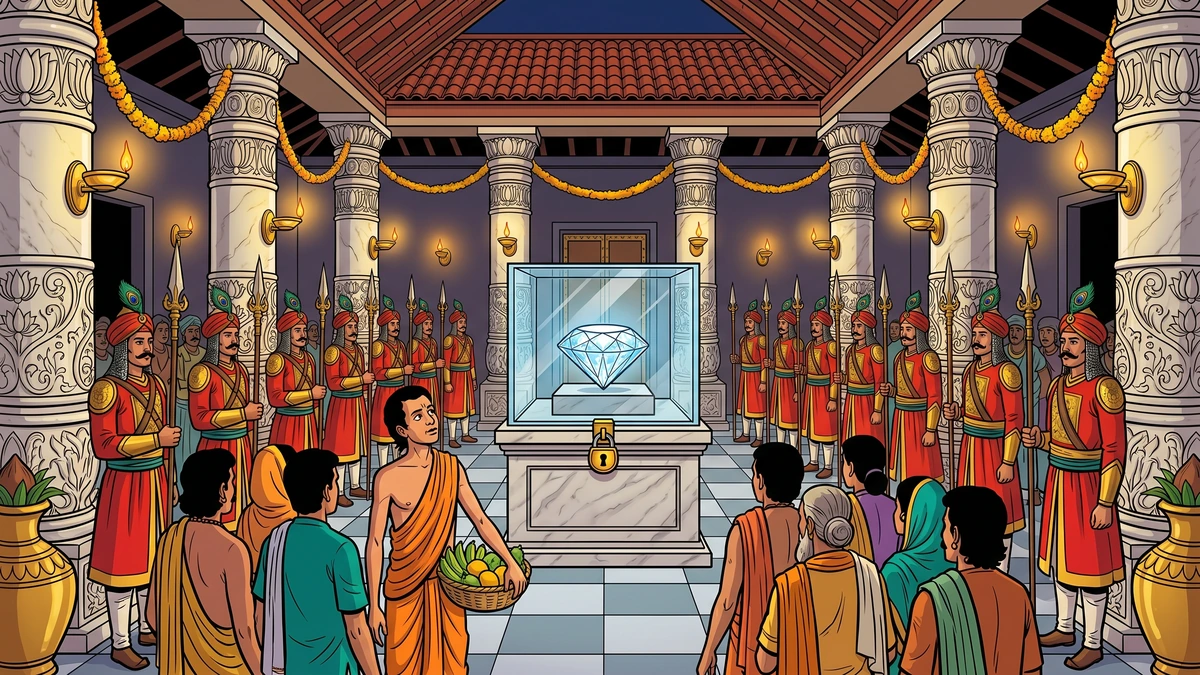
Beat II — The Diamond of Kashi and the Three-Night Trap
The trap was the great diamond of Kashi — a stone the size of a hen’s egg, said to have been cut from a Golconda rough by the lapidaries of Hyderabad and presented to King Brahmadatta’s grandfather by the Bahmani sultan. Royal heralds were sent into every quarter of the city to proclaim that the diamond would be on public display for three days and three nights in the great pillared hall of the royal museum, locked in a glass case in a locked inner chamber, behind double-bolted teakwood doors, surrounded at all hours by fifty hand-picked Rajput soldiers in red-and-gold ceremonial armour. Pilgrims and merchants and curious householders thronged in to see the famous stone; and somewhere in their midst, dressed in a saffron-and-orange dhoti and the white sandalwood tilak of a fruit-seller from Mirzapur, walked Chatur, his eyes scarcely seeming to take in the diamond at all but instead reading the room like a treatise — the changing of the watch at the second prahara, the brief congestion at the back-stair when the bearer of jasmine-garlands came up from the bazar, the gilded latch of the inner door that turned out, on closer inspection, to be only brass under a thin gold-leaf wash.
On the second night Chatur returned in the guise of a wandering Pashupata ascetic with matted hair and ash-streaked brow, carrying a brass bowl of fragrant kheer cooked in his sister’s house in Khojwan. He approached the rear sentry, a homesick young Mewar boy who had not seen his mother in eighteen months, and offered him the bowl with a quiet blessing. The boy — touched by the holy man’s kindness — ate, drank, and within an hour had slipped into the soft sleep that follows a measured dose of jala-puṣpa (water-lily extract), an old Ayurvedic nidrāñjana known to every caura who had read the eighth chapter of Daṇḍin’s Daśakumāracarita. Chatur did not steal that night; he had merely confirmed his timetable.
On the third and last night he came in his masterstroke. He had, by gold and forged signature, obtained a khil‘at uniform of a colonel of the king’s own bodyguard, complete with brass shoulder-mountings and a heavy seal-ring. Walking with a parade-ground stride and an unblinking authority that no man dared to question, he marched up to the captain of the museum-watch and barked an order in clipped Sanskritised Hindustani: “The king has received intelligence in this hour. Chatur strikes the front entrance tonight. Move every man to the front. Now.” The captain, seeing the seal, the uniform, the unhesitating face, obeyed without a question. Fifty Rajputs swept around to the front portico; the rear chamber was deserted; and Chatur, in less time than it takes a fakir to chant the Gāyatrī, picked the gilded lock, lifted the diamond from its glass case, and replaced it with a folded palm-leaf note that read: Ye gem is given to the orphans of Temple Street. With my respects, Chatur.
Beat III — The King’s Word and the Thief’s Confession
When the loss was discovered at sunrise the king was first speechless, then wrathful, then — for he was a king of some humour — quietly impressed. His soldiers, sent in haste to the orphanage on Temple Street, returned not only with the diamond intact in its silk wrapper but with a further pouch of gold dinars that the orphan-master swore had appeared in the night with the same careful palm-leaf signature. The king sat long in his marble durbar-hall and weighed the matter. To behead such a man would be the simple danda of Manu IX; but the king had read Kautilya’s Arthaśāstra too — and in chapter II.7 he remembered the dictum buddhi-mān bhūtāntara-jñātā tena rakṣyate jana-padaḥ, “The wise man who knows the inner workings of beings — by such a one is a kingdom protected.”
So King Brahmadatta did a thing without precedent in the chronicles of Kashi. He sent for his court herald and dictated a public proclamation to be drummed in every quarter: “I, Brahmadatta of Kashi, give my royal word, sealed by my royal hand, that the thief known as Chatur shall not be punished if he will but present himself at the palace. I wish to converse with him. Let no man harm him on his way.” For two days the city held its breath. On the third morning a slim figure in plain white cotton, his head shaved and his eyes downcast in the courtesy of a Brahmin novice, walked up the long marble stairs of the durbar, prostrated himself before the throne, and rose with a quiet smile.
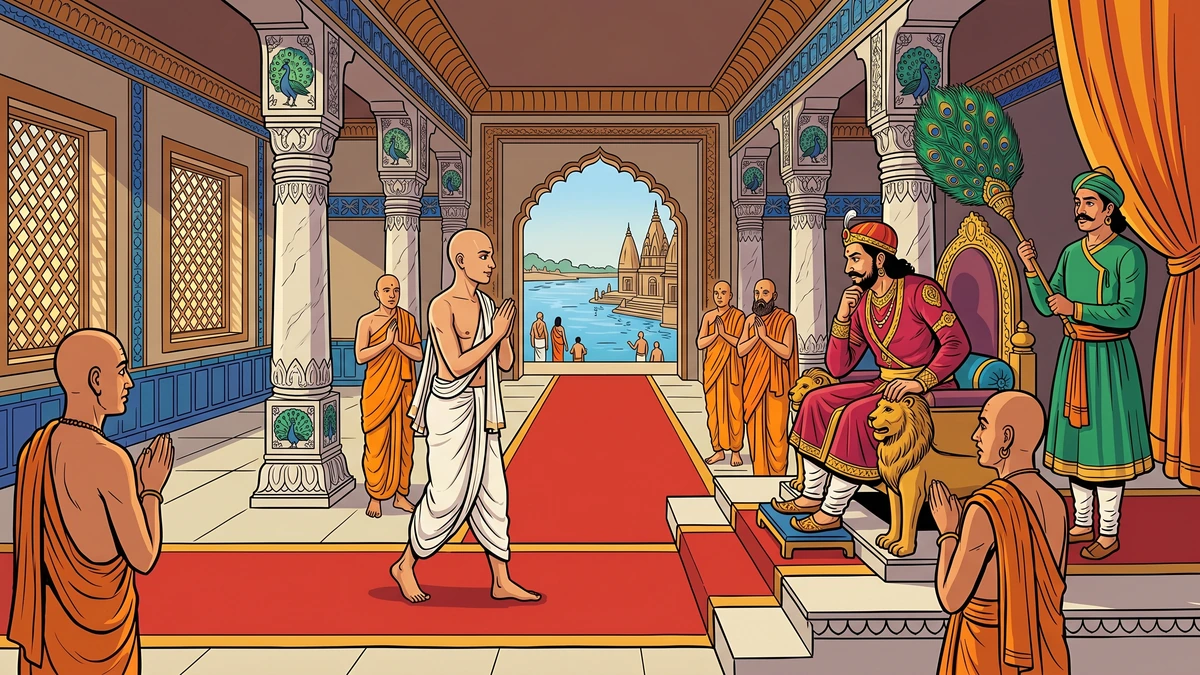
“Tell me, Chatur,” the king said, leaning forward on his lion-armed throne, “why does a man of your intelligence choose the road of theft, when ten honest professions in this city would have made you rich? You read the laws, you write a clean Devanagari, you speak Persian and Sanskrit. Why a thief?” Chatur was quiet for a long moment, the murmur of the Ganges audible through the open jharokha. Then he answered, in the simple unbroken voice of a man who has long since given up apology: “Your Majesty, I was born in a low quarter to a widowed mother who washed the clothes of the temple priests for a few copper paisa. I was given no upanayana thread, no school, no land, no caste-protection. The only inheritance the gods left me was a quick wit. I judged it a waste to use such a wit to pull a hand-cart. So I used it to take from those who had taken from many, and to give back to those many in the only way they could be repaid — in rice. I am sorry only that the diamond delayed the orphans’ supper by half a night.”
Beat IV — The King’s Offer and the Lasting Reform
The king did not laugh, did not strike his thigh in anger; he laid his palms together in the gesture of añjali-mudrā, as one teacher salutes another, and replied: “A wit such as yours, Chatur, is wasted on locks and false uniforms. I am in need of a counsellor who can think as my enemies think — who can sit in a thief’s mind, a forger’s mind, a tax-evader’s mind, even a courtier’s mind — before they have even crossed my threshold. Will you accept the post of buddhi-mantri, my Minister of Cunning, with land and palanquin, and on condition only that you do not steal from me again?” Chatur, who had walked up the stairs expecting at best a Brahmin’s exile to a pilgrimage-town and at worst a quiet death, was for an instant utterly speechless. Then he knelt and accepted with the formula of the eldest student of the gurukul: tathāstu, mahārāja — “Be it so, my king.”
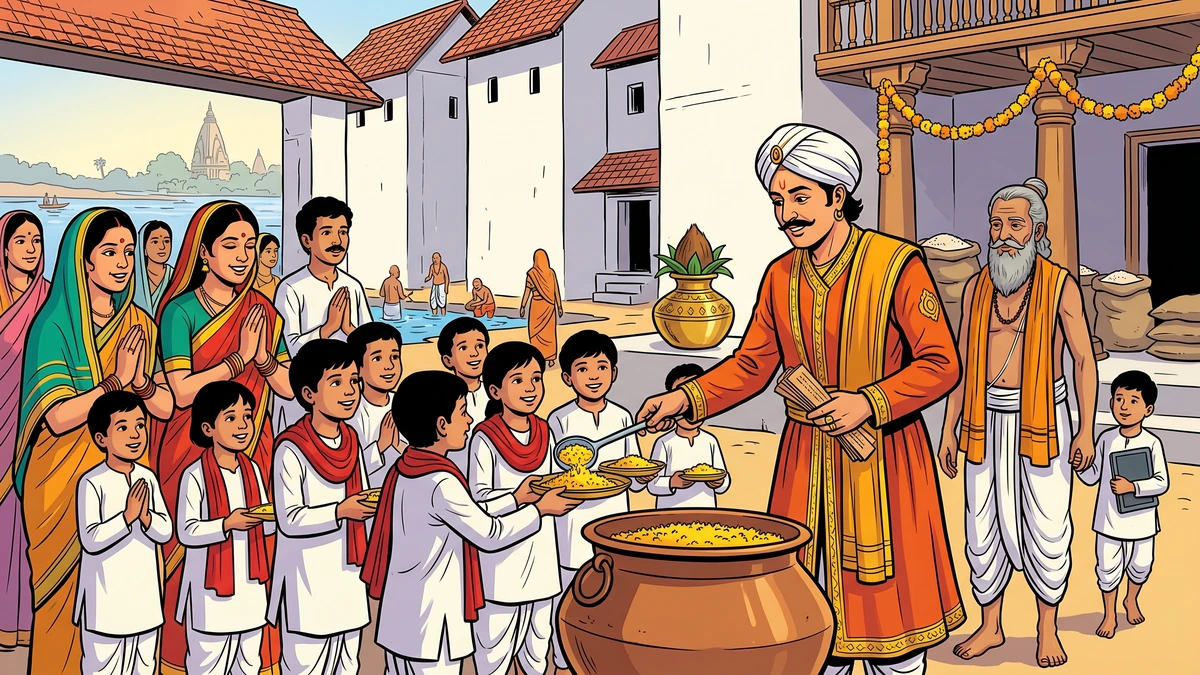
From that day forward Chatur served Brahmadatta with the same intelligence with which he had once outwitted him. He reformed the bazar-watch into a system of plain-clothed patrols (the unrecognised ancestor of every Indian kotwāl arrangement). He drafted a tax-code that for the first time taxed the wholesale grain-merchants in proportion to their hidden stocks rather than their declared receipts, and he established the great free granaries on the south bank of the Asi rivulet that fed the city through the famine of the next decade. The thieves of Kashi, hearing that their cleverest brother now read the king’s daily intelligence, quietly retired into honest trades; the orphans of Temple Street were given a free school. And in the fullness of time the people of Varanasi began to whisper that the cleverest thief in the kingdom had stolen no diamond at all but had stolen, instead, the heart of a stern king and the future of his city.
Moral — Buddhiḥ yaṣya balaṃ tasya, nirbuddhes tu kuto balam?
बुद्धिर्यस्य बलं तस्य, निर्बुद्धेस्तु कुतो बलम् ।
— Buddhir yasya balaṃ tasya, nirbuddhes tu kuto balam.
“Strength belongs to the one who has wisdom; how can the witless have strength?”
— Hitopadeśa I.78 (attributed to Nārāyaṇa Paṇḍit, c. 12th c.) and almost identically in Pancatantra II
The deepest moral of A Clever Thief is the Sanskrit moral of every great buddhi-kathā: that the highest of human powers is not strength of arm or accident of birth but buddhi, the discrimination that sees past the surface of things. Chatur outwits King Brahmadatta’s fifty Rajputs not because he is stronger but because he is more intelligent, more observant, more humanly compassionate. King Brahmadatta in turn shows the higher buddhi of the philosopher-king of Plato or Manu — he understands that intelligence misdirected is a public loss, and that the truest punishment of the gifted criminal is the offer of an honest field for the same gifts. The story does not romanticise theft. It rather exposes a truth older than Manu — that in any society which forgets the talented poor and feeds only the dull rich, theft is no anomaly but an inevitable critique. The Mahabharata says it more grimly: vacanād daridrasya na śṛṇoti hi kaścana — “no one listens to the speech of a poor man.” Chatur, in robbing the king and feeding the orphan, is forcing the king to listen.
Why A Clever Thief Has Lasted a Thousand Years
The Karpara-Ghaṭa cycle of Somadeva’s Kathāsaritsāgara, the Hindu Tales recension of S. M. Mitra, the Hari-Sarman Banaras retelling of 1919, the bazar-storyteller’s Chatur of the Vishvanath quarter — together these are merely a thousand-year sample of a tale that older still appears in the Greek Herodotus (mid-fifth century BCE) as the architect’s son who robs King Rhampsinitus, in the medieval Egyptian Arabian Nights as the cycle of “The Rogueries of Dalilah and Her Daughter Zaynab,” in the Persian Hazār-afsāna and Sindbād-nāma, in the Italian Boccaccio (Decameron Day VIII Tale 10), in the Grimms’ Der Meisterdieb (KHM 192, 1857 edition), and in the Russian byliny of Novgorod. The reason for this thousand-year endurance is plain: the master-thief is not a criminal at all. He is the figure of resistant intelligence — the unprivileged citizen who, denied a place at the table, picks the lock and earns it. Every generation of listeners recognises him. He is Robin Hood in Sherwood; he is the Loki of the Eddas; he is the trickster Anansi of West Africa; he is Birbal at Akbar’s court; he is the small clerk who outsmarts the corrupt inspector. The Indian version is gentler than most, because in the Indian version the king is wise enough to convert him rather than crush him. That softer ending — the redemption of the gifted poor man by a king who has the imagination to use his gift — is the special gift of the Sanskrit storyteller to world folklore, and it is why a child in Varanasi today, hearing the tale of Chatur for the first time, leaves the lamp-lit verandah quietly hopeful that wit and kindness, in the end, may yet outlast the locked door.
Frequently Asked Questions about A Clever Thief
Where does the Indian folk tale A Clever Thief come from, and what is its earliest written source?
The deepest written ancestor of A Clever Thief is the Sanskrit Kathasaritsagara (Ocean of the Streams of Story) of Somadeva Bhatta, completed about 1063-1081 CE for the Kashmiri queen Suryavati. The cycle of Ghata and Karpara (Pot and Potsherd) appears in the Sasankavati Lambaka of Book X. Charles Henry Tawney translated the Sanskrit into English as The Ocean of Story (Calcutta, Asiatic Society of Bengal, 1880-1884), and N. M. Penzer republished it in ten illustrated volumes (London, Sawyer, 1924-1928), the standard reference. A separate Anglo-Indian recension titled A Clever Thief, naming the protagonist Hari-Sarman of Varanasi and his wife Vidya, appears as Tale VII of Hindu Tales from the Sanskrit by S. M. Mitra and Nancy Bell (London, Macmillan, 1919, pp. 71-94), drawn from oral Banaras-Pandit storytellers of the Vishvanath quarter.
What is the ATU folk-tale-type classification of A Clever Thief?
Hans-Jorg Uther’s revised Aarne-Thompson index classifies A Clever Thief as ATU 1525 The Master Thief, with overlapping affinity to ATU 1525A Tasks for a Thief and ATU 950 Rhampsinitus, the latter being the famous Egyptian narrative recorded by Herodotus in Histories II.121 about the architect’s son who robs King Rhampsinitus’s treasure-chamber. Stith Thompson’s Motif-Index of Folk-Literature (Indiana, 1955-1958) gives the relevant motifs: K301 Master thief, K306 Stealing by trickery, K341 Owner’s interest distracted while goods are stolen, K366 Thieves stealing from each other, J1141 Confession obtained by ruse, and L113.7 Thief becomes king’s minister. Theodor Benfey, in his Pantschatantra introduction (Leipzig, 1859, vol. I para 195), traced the cycle’s migration from India to Persia and Greece as a textbook Indo-European Wandersage.
What is the moral of A Clever Thief and what Sanskrit verse expresses it?
The moral is that buddhi – intelligent discrimination – is the highest of human powers, greater than birth, beauty, or rank. The Hitopadesa of Narayana Pandit (c. 12th century CE) distills the dictum: buddhir yasya balam tasya, nirbuddhes tu kuto balam – ‘Strength belongs to the one who has wisdom; how can the witless have strength?’ (Mitralabha I.78). The same line appears almost verbatim in Pancatantra Book II. King Brahmadatta of Kashi displays the higher buddhi of the philosopher-king of Manu and Plato by recognising that intelligence misdirected is a public loss, and that the truest punishment of the gifted criminal is the offer of an honest field for the same gifts. The Mahabharata adds the grim corollary: vacanad daridrasya na shrnoti hi kashchana – ‘no one listens to the speech of a poor man.’ Chatur, in robbing the king and feeding the orphan, is forcing the king to listen.
Who is the master-thief Chatur, and what does the Sanskrit Steyashastra tradition say about his craft?
Chatur (Sanskrit caturah, the four-fold quick one) is a known Sanskrit epithet of the god Ganesha and a stock name for any buddhiman trickster-hero of the Pancatantra and Hitopadesa. Sanskrit literature gives the master-thief a respectable name and even a manual: the Steyashastra (treatise on theft) is alluded to in the Mahabharata, in Manava-dharma-shastra IX.270-278, and most extensively in chapter LXIV of Dandin’s seventh-century Dasakumaracarita (Tales of the Ten Princes), where the exiled prince Apaharavarman is taught the eight-fold method of breaking-and-entering: tala-vidya (knowledge of locks), vesha-parivartana (disguise), nidranjana (soporifics), citra-rekha (map-making), and raja-niti (the science of how kings think). Chatur uses every one of these in the three-night museum trap of A Clever Thief, marking him as a learned vidyadhara rather than a rude bandit.
Why has the Master-Thief tale endured for over two thousand years across so many cultures?
The Indian Ghata-Karpara and Hari-Sarman recensions are merely a thousand-year sample of a tale older still in Greek Herodotus (mid-fifth century BCE) as the architect’s son who robs King Rhampsinitus, in the medieval Arabian Nights cycle of The Rogueries of Dalilah and Her Daughter Zaynab, in the Persian Hazar-afsana and Sindbad-nama, in Boccaccio’s Decameron Day VIII Tale 10, in the Brothers Grimm Der Meisterdieb (KHM 192, 1857 edition), and in the Russian byliny of Novgorod. The reason for this endurance is plain: the master-thief is the figure of resistant intelligence – the unprivileged citizen who, denied a place at the table, picks the lock and earns it. He is Robin Hood in Sherwood, Loki of the Eddas, Anansi of West Africa, Birbal at Akbar’s court, and the small clerk who outsmarts the corrupt inspector. The Indian version is gentler than most because the king has the imagination to convert him rather than crush him – the special gift of the Sanskrit storyteller to world folklore.
You May Also Like
 Indian Folk Tales
Ages 3-5
Indian Folk Tales
Ages 3-5
How Raja Rasalu Journeyed To The City Of King Sarkap
How Raja Rasalu Journeyed To The City Of King Sarkap: Now, after he had reigned a while in Hodinagari, Rasâlu gave up his kingdom, and started off to play
 Indian Folk Tales
Ages 3-5
Indian Folk Tales
Ages 3-5
How The Rajas Son Won The Princess Labam
How The Rajas Son Won The Princess Labam: In a country there was a Raja who had an only son who every day went out to hunt. One day the Rani, his mother, said
 Indian Folk Tales
Ages 3-5
Indian Folk Tales
Ages 3-5
Dorani
Dorani: Once upon a time there lived in a city of Hindustan a seller of scents and essences, who had a very beautiful daughter named Dorani. This maiden had a