The Magic Grove of Wishes
The Magic Grove of Wishes: There existed, in the regions beyond the mapped world, a place that legends spoke of but few had ever found - a grove of trees so

The Magic Grove of Wishes is one of the most quietly philosophical of Indian wisdom-tales — a story that wears the bright clothes of folk-fantasy but, beneath the surface, carries the entire weight of two and a half millennia of subcontinental thought about desire, effort and the meaning of an earned life. In the older Sanskrit tradition the wish-granting tree is called Kalpavriksha (कल्पवृक्ष, also Kalpataru), one of the great gifts that emerged at the Samudra Manthana, the cosmic churning of the ocean of milk described in the Bhagavata Purana (canto 8, chapters 7–8), the Vishnu Purana (book 1, chapter 9) and the Adi Parva of the Mahabharata. According to these texts, when the gods and asuras together churned the primordial ocean for the nectar of immortality, fourteen treasures rose to the surface; among them were Kamadhenu the wish-fulfilling cow, the goddess Lakshmi, the moon, the divine physician Dhanvantari and the Kalpavriksha — five of which, the Puranas say, Indra carried home and planted in his paradise of Devaloka under the names Mandana, Parijata, Santana, Kalpavriksha and Harichandana. The Pali Buddhist canon preserves the same image as kapparukkha, growing in the heaven of the Tavatimsa devas. The story you are about to read is a folk descendant of that long lineage, set down on the human side of the boundary, where wishes are dangerous.
The earliest written versions of this fable circulated in the great Sanskrit story-collections of medieval India: it is structurally cousin to several apologues in the Panchatantra (book IV, Labdhapranasham — “Loss of Gains”), and a near twin to a tale in Somadeva’s eleventh-century Kathasaritsagara (the Ocean of Streams of Story) about a merchant who finds a celestial garden and learns the price of asking. Folklorists catalogue the type within the Aarne–Thompson–Uther family ATU 750A–D (“Wishes”), the same broad cluster that produced King Midas in the Greek world, the Fisherman’s Wife in the Brothers Grimm and W. W. Jacobs’s Monkey’s Paw in modern English. In the Indian recension, the moral is not principally about greed; it is about trishna (तृष्णा, Pali tanha) — thirst, craving — which the Buddha names in the second of the Four Noble Truths as the root cause of dukkha, the dissatisfaction at the heart of all conditioned life. This is the story.

The Merchant Who Heard a Whisper

There was once, in a land beyond the marked maps of the sub-continent, a merchant named Devesh — a careful and prosperous trader of cardamom and silk who had spent his middle years building a respectable house in a respectable bazaar. He had heard, from caravan-drivers and pilgrims and the mouths of half-mad sadhus, that somewhere far inland, past the desert and over the white-snow passes, there grew a grove of trees so old and so strange that they granted wishes to anyone who walked among them. He listened politely the first time. He listened carefully the second. By the tenth telling, in a serai outside Multan from a one-eyed jewel-merchant who had nothing left to lie for, Devesh had begun to believe.
He was not a young man. He left his counting-house in the hands of his cousins and set out alone with a single mule and a leather sack of provisions, and he walked. He walked for one full season through the Thar, where the wind is hot enough to crack a bowl. He walked for a second season through hill-country forests where the leeches climb you in silence. He asked questions in every village. He followed every rumour that promised a tree, a grove, an old man who knew. He found nothing but mirages and cheats and the patient kindness of strangers who fed him and laughed at him and sent him on his way. The years thinned him. His beard turned grey. His mule died at a ferry-crossing and he buried her under a tamarind tree and walked on.
Then, on a morning when he had nearly given up, when his sandals were strapped together with twine and his leather sack contained only one stale chapati and the small brass image of his family’s Lakshmi, Devesh pushed aside a curtain of vine — and stopped. He had stepped through a parting in the forest into a place that the rest of the world did not know about. The light here was different: green-gold, slow, the way light moves through honey. The trees were so tall their crowns hid the sky, and their bark shimmered with colours he had no word for, colours that were not in the dyer’s market in Surat or the silk-houses of Benaras. Streams of crystal water ran between the roots. The grass under his feet was the soft, deliberate green of the inside of a fresh fig. The air smelled of every blossom Devesh had ever loved, and several he had only dreamed about. He understood, with a clean certainty that arrived all at once, that he had found the grove.

The First Wish, and the Second, and the Third

Devesh walked deeper between the trees, and as he walked he began to think — that quick, fizzing kind of thinking the human mind does when it has been told that a door has just been opened. He was a merchant. The grove granted wishes. He could ask for anything. He paused beneath an enormous tree whose trunk was wider than three elephants standing shoulder to shoulder, and he framed his first wish very carefully, the way a bania frames a contract. “I wish,” he said aloud, “for unlimited wealth — gold and silver and gemstones that multiply without end, so that I will never again know the sour anxiety of money.” The words hung in the green air a moment, like incense smoke. Then the earth at his feet shivered, and gold coins began to push up through the soil the way petals push out of a bud. Within an hour Devesh was sitting on a small hill of mohurs, and rubies the size of pigeon eggs lay scattered around him like dropped fruit. He laughed out loud — a deep, surprised laugh that startled even himself — and gathered what he could carry and walked further into the grove.
The second wish came easily. “I wish for a palace,” he said, “a palace fit for a man who has just become richer than three rajas combined.” The forest hummed for a moment, and then, through the trees ahead of him, walls of white marble rose up out of nothing as if they had always been there: cool courtyards, lotus-tanks, halls of pillared shade. Inside there were silken couches, peacock-feather fans, ivory carving on every door, fountains of perfumed water in the women’s apartments. He walked from room to room running his palm along the polished stone, and for three days he did almost nothing else. The third wish, which arrived on the morning of the fourth day, was for company. “I wish for a wife,” he said aloud in his throne-room, “a woman of extraordinary beauty and sweetness, to share my palace and my bed and my table.” She appeared in the doorway as if she had been about to walk in anyway — slender, with kohl-darkened eyes and a smile that seemed to know him from somewhere old. Her sari was the colour of evening river-water. She bowed slightly and called him swami. Devesh’s heart lifted in the unmistakable way the heart lifts when a long loneliness is about to be cured.
The Hollowness Inside the Granted

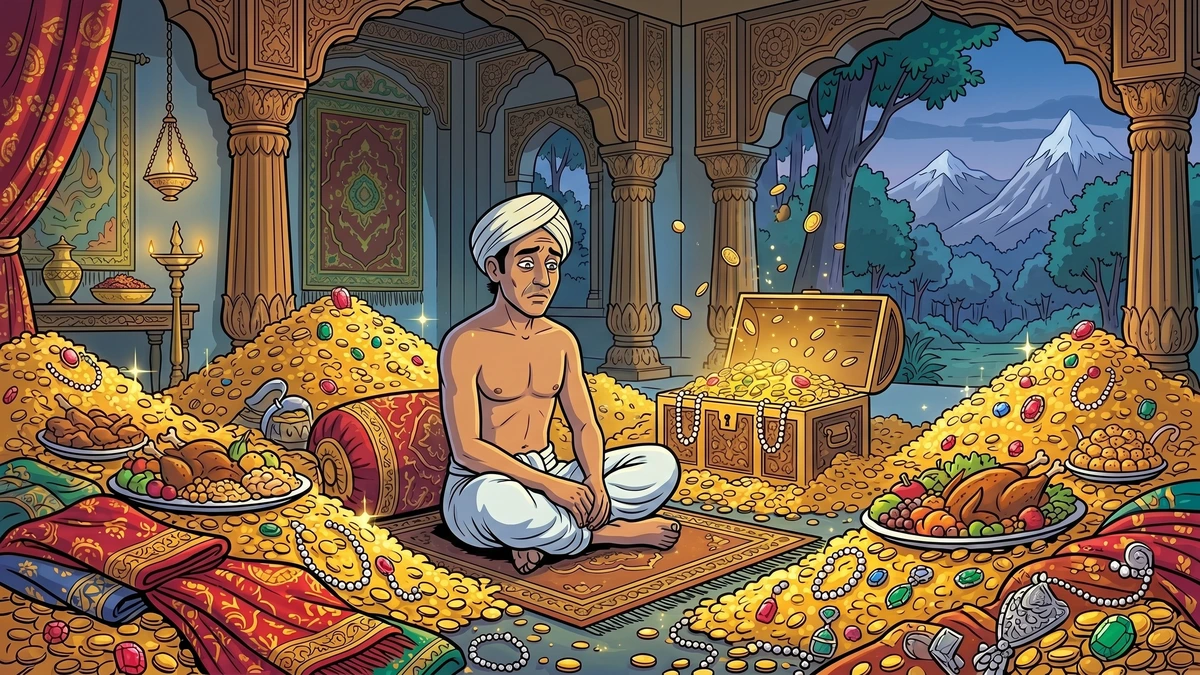
It is hard to say exactly when Devesh first noticed that something was wrong. Perhaps it was the fourth or fifth evening of his marriage, when he made some small joke about a goat in a story from his childhood and his wife laughed at exactly the right moment, with exactly the right warmth — and he realised, with a small cold drop in his chest, that she had laughed because she was supposed to. Perhaps it was the morning he tried to argue with her about whether the marble in the eastern courtyard ought to be replaced with sandstone — a deliberately silly disagreement, the kind that long-married couples enjoy — and she agreed with him before he had finished speaking, agreed sweetly and completely, agreed without a flicker of her own. Perhaps it was when he walked through his own palace and noticed that the servants who polished the lamps did not, when he was not looking, talk among themselves; that the cooks in the kitchen did not laugh at each other or quarrel about the lentils. Everything in this place existed only because he had wished for it, and so everything in this place arranged itself, instantly and exactly, around the shape of his desire. He had asked for a paradise and he had been given a paradise. What he had not understood, until now, was that a paradise without friction is not a paradise at all. It is a mirror.
He tried to fight back. He wished for friends — real friends — companions who would tell him the truth and challenge his ideas and laugh at his pomposity. Five men appeared, and they were charming, and they argued with him, and they seemed, on the surface, exactly what he had asked for. But after the second cup of wine he caught one of them watching his face for cues, and he understood that the argument had been arranged for his benefit, and the disagreement had been rationed for his pleasure, and these were not friends at all. They were the shape of friends, conjured around the wish for friends, with no flame of their own behind their eyes. He wished for a son — and a beautiful boy was born to his beautiful wife, in a beautiful labour without pain, and the boy never cried in the night and never resisted his father’s lessons and grew tall and obedient and was, in some essential way, not really his son.
Devesh sat down on the marble step of his lotus-tank one evening, alone, and let his head fall into his hands. He was the wealthiest man who had ever lived. He had a palace, a wife, a son, friends, gardens, libraries, peacocks, three hundred horses, mango groves, his own gilded barge on his own private river. He had every external thing a human being can want. And he was, in the centre of his chest, more empty than he had been on the day he had buried his mule under the tamarind tree. The grove had granted him everything, and in granting everything had quietly stolen the one thing he had not known to ask for: the chance to want, to strive, to fail and to earn. He understood, sitting on that warm step in the perfumed dusk, what every wisdom tradition of his subcontinent had been telling him since he was a small boy in his mother’s lap. Trishna — craving — is not satisfied by getting. It is only sharpened by getting. The Buddha had said it. The Gita had said it. His own grandfather, a salt-trader with calloused hands, had said it without saying it every time he sat down at the end of a long day and ate his rice with quiet relish. The thing that gives a meal its flavour is the work that earned it.

The Wish That Set Him Free

For three days and three nights Devesh did not eat. He sat in the centre of his palace courtyard with his face turned toward the rising sun, and he thought, and he did not pray, and slowly something inside him cleared. On the fourth morning he stood up. He walked to the doorway of his throne-room. He did not look back at his wife or his son, because he understood that they were not real and that grieving for them would only deepen the very wanting that had imprisoned him in this place. He spoke his last wish into the green-gold air of the grove, very quietly, the way a man addresses something larger than himself.
“I wish to leave,” he said. “I wish to forget that this grove exists. I wish to return to the world where wishes are not granted, where bread must be earned, where love must be won, where I can fail. Take all of this back. Give me my old hands and my old debts and my old uncertainty. Let me go home.”
The grove did not flash or thunder. It simply, gently, complied. Devesh found himself standing at the edge of an ordinary forest in the late afternoon light, his sandals strapped together with twine, his leather sack containing one stale chapati and a small brass Lakshmi. He had no memory of a palace, of a wife, of a son. He had only an aftertaste in his mouth, as of something rich he had once over-eaten and would not eat again, and a piece of new knowledge folded behind his heart. He walked back the way he had come, season by season, and after a long road he reached his own bazaar, where his cousins had kept the counting-house only just barely solvent and were greatly relieved to see him alive. He set to work. He rebuilt the firm slowly, hour by stubborn hour, taking small honest profits and absorbing small honest losses. He courted a widow from a neighbouring village, a sharp-tongued woman who teased him until he laughed and was not afraid to disagree with him in front of his cousins. They had three children, who fought with each other and with their parents and were entirely, exhaustingly real. He grew old. His beard went all white. He became, in the bazaar, the kind of elder whom younger merchants consulted before they signed any large contract — not because he had been to a magic grove, which he did not remember, but because he had the rare and earned air of a man who knew exactly what his life was worth, having paid for every rupee of it himself.
And sometimes, late in his life, when a young trader full of dreams came to him asking after the legendary grove of wishes — for the rumour persisted, as such rumours always do — Devesh would smile a slow smile that did not quite explain itself, and he would say only: “If you find it, my son, ask the grove for one thing. Ask it to send you home.”

The Moral
The Sanskrit tradition preserves the moral of this fable in a single half-line that the elder pandits of Benaras still chant when explaining the four purusharthas (the legitimate ends of human life) to their students:
“Na tu prāptyā kāmānāṁ upaśāntir bhavaty alam — / havyena kṛṣṇavartmeva bhūya evābhivardhate.”
“Desire is not stilled by the granting of desires — / It only flares the higher, as fire fed with ghee.”
The verse, attributed in slightly varying forms to the Bhagavata Purana (9.19.14) and the Mahabharata‘s Shanti Parva, is the philosophical seed from which a thousand Indian fables of the Devesh kind have grown. Its meaning rhymes precisely with the Buddha’s second Noble Truth in the Pali Dhammacakkappavattana Sutta: “yāyaṁ taṇhā ponobhavikā nandirāgasahagatā” — “this craving, productive of further becoming, accompanied by relish and lust.” The same warning appears in Lao Tzu’s Tao Te Ching (chapter 46): “There is no calamity greater than not knowing what is enough; no greater fault than the desire for getting.” And it surfaces, gently, in La Fontaine’s seventeenth-century French rendering of an older Aesopic motif in Le Héron et la Demoiselle: “Gardez-vous de rien dédaigner, / Surtout quand vous avez à peu près votre compte” — “Be careful to scorn nothing, especially when you have nearly enough.” Across four traditions, in four languages, the world’s elders are saying one quiet thing: a life of pure granting is not a life. The flavour is in the earning.
Why This Story Has Lasted
Almost every adult who reads this tale recognises, somewhere in the soft tissue behind the breastbone, that they have already met the magic grove. They met it the first time a long-coveted promotion arrived and turned out, after the first weekend, to feel like an ordinary Tuesday. They met it the first time a relationship they had pursued for three years came good and revealed itself, six months in, to have been more interesting in the wanting than in the having. They met it the first time they purchased an expensive thing they had been imagining for a year, brought it home, set it on the table, and sat looking at it with the strange flat sadness of a desire that had been satisfied a moment before they had stopped enjoying the wanting. The grove is in every shopping mall and every dating app and every brokerage account in the world. Devesh is the patron saint of every human being who has ever stood in front of an open refrigerator at midnight, full and not full, and reached, with a small confused hand, for one more thing.
The Indian wisdom tradition has been thinking carefully about this problem for at least three thousand years. The Vedic seers called the human predicament kama (काम, desire) and built around it a sophisticated four-fold ethic of purushartha — dharma (right conduct), artha (legitimate gain), kama (desire and pleasure) and moksha (release) — in which kama is not denied but is set inside a structure that prevents it from devouring the self. The Buddha refined the diagnosis a step further: it is not desire as such that is the disease, he said, but tanha, a particular grasping quality of desire, which can be loosened by insight. The Bhagavad Gita’s third chapter offers what may be the most practical version of the medicine: “karmaṇy evādhikāras te mā phaleṣu kadācana” — “you have the right to the work alone, never to its fruits.” Devesh’s grove violated that ancient prescription perfectly: it offered him the fruit without the work. And so the fruit, when he ate it, had the taste of nothing, and he was forced — in a small private revelation that millions of human beings will recognise — to wish his way back to the soil.
There is also a striking ecological and political reading of this story that has emerged among modern Indian readers. The grove can be seen as an early parable of any civilisation that learns to obtain too much without effort: the colonial extractor who takes the spice without the grower’s labour; the modern consumer who takes the convenience without the supply chain’s truth; the algorithm that grants attention without earning it. In every case the story is the same. What is taken without effort cannot finally be enjoyed. The Sanskrit folktale collections from Hitopadesha to Kathasaritsagara are unusually unsentimental on this point, and so are the modern descendants — Premchand’s bania-stories, R. K. Narayan’s Malgudi merchants, the post-colonial novels of Anita Desai. They all carry the Devesh genome. They all whisper the same warning into the same ear: when something appears to give you everything, ask, very carefully, what it is taking.
The tale has lasted, finally, because it tells the truth about a human being’s relationship with their own wanting, and it tells that truth with extraordinary tenderness. It does not condemn Devesh. He is not punished for his greed; he is only allowed to taste, in absolute purity, what he has been chasing. His freedom comes not from a god’s intervention but from his own dawning understanding — the same understanding the Buddha called vipassana, the seeing-into. And the story leaves him not with riches or magic, but with a counting-house in a real bazaar, a sharp-tongued widow he had to court for two years, three children who scrape their knees and lose their tempers, and the rare, settled inner air of a man who knows the value of his own life because he paid for it. Every child who hears this story tucks it away somewhere inside the chest. Every adult who re-reads it, decades later, finds that it has been quietly waiting all along — a small wisdom planted in the green-gold light of an imaginary grove, sturdier and more nourishing than any real tree, because it grew for free out of the ground of the listener’s own attention. The Indian grandmother who first told this fable to her grandchildren beneath the verandah lamp knew exactly what she was doing. She was sending the children, gently, into a world where wishes are not granted automatically — and giving them, in advance, the only blessing that would let them be happy there.
Frequently Asked Questions
What is the Kalpavriksha, the wish-fulfilling tree in Indian mythology?
The Kalpavriksha (कल्पवृक्ष, also Kalpataru) is one of the sacred wish-fulfilling trees in Hindu scriptures, said to have emerged during the Samudra Manthana — the cosmic churning of the ocean of milk — as described in the Bhagavata Purana (canto 8, chapters 7–8), Vishnu Purana (book 1, chapter 9) and the Adi Parva of the Mahābhārata. It resided in Indra’s paradise (Svarga) and could grant any wish to those who stood beneath it. In Indian folk traditions, this concept survived in village stories about sacred groves (devaravana) where tree spirits granted boons to virtuous petitioners who approached with sincere hearts.
What is the moral lesson of The Magic Grove of Wishes?
The story teaches that unlimited wish-fulfillment without inner transformation leads to spiritual emptiness that no material gift can fill. The central character receives everything he desires and discovers that each fulfilled wish merely reveals the next unfulfilled one. The resolution — the final wish for something beyond personal gain — encodes the insight that genuine contentment arises from giving rather than receiving. This connects to the Vedantic concept of santosha (contentment) and the Buddhist teaching on taṇhā (craving) as the root of suffering.
What role do sacred groves play in Indian folk traditions?
Sacred groves (devaravana, orans, sarna, or kovil kadu by region) are patches of forest left uncut and community-protected as dwelling places of nature spirits, ancestor spirits, or local deities. India has tens of thousands of such groves, representing one of the oldest continuous conservation traditions in the world. In folk tales, they function as liminal zones — boundaries between the human world and the spirit world where ordinary rules are suspended and extraordinary transactions become possible. The magic grove in this story belongs to this living tradition, still observable across India today.
How does this story connect to Indian philosophical teachings on desire?
The tale engages with one of the central problems of Indian philosophy: the relationship between desire (kāma), effort (karma), and fulfillment (phala). The Bhagavad Gita (chapter 2, verse 47) states that one has the right to action but not to the fruits of action. The Kalpavriksha story tests this by inversion: what if fruits were available without action? The answer — consistent across Hindu and Buddhist frameworks — is that desire satisfied without inner growth does not produce lasting contentment, because the psychological structures generating desire remain unchanged. The story provides an experiential illustration of this abstract philosophical argument.
Are there similar wish-fulfilling object stories in other world traditions?
Wish-granting objects and beings appear across world mythology. Norse tradition has Yggdrasil containing cosmic knowledge; Celtic tradition has the apple trees of Avalon; Arabian Nights has magic lamps and rings. The European ATU 555 (“The Fisherman and his Wife”) catalogues repeated wishes escalating to hubris and reversal. What distinguishes the Indian Kalpavriksha tradition is its philosophical framing: rather than focusing on punishment of greed, it examines the internal experience of the wish-granted state — the discovery that satisfaction is structural rather than acquisitive. This gives Indian versions a meditative depth absent from many Western parallels.
You May Also Like
 Indian Folk Tales
Ages 3-5
Indian Folk Tales
Ages 3-5
The Legend Of Gwashbrari The Glacier Hearted Queen
The Legend Of Gwashbrari The Glacier Hearted Queen: Once upon a time, ever so long ago, when this old world was young, and everything was very different from
 Indian Folk Tales
Ages 3-5
Indian Folk Tales
Ages 3-5
The Farmer And The Money Lender 2
The Farmer And The Money Lender 2: There was once a farmer who suffered much at the hands of a money-lender. Good harvests, or bad, the farmer was always poor
 Indian Folk Tales
Ages 6-8
Indian Folk Tales
Ages 6-8
The Mouse Deer and the Crocodile: How Wit Overcomes Danger
The Mouse Deer and the Crocodile: How Wit Overcomes Danger: In the dense forests of Indonesia, where the rivers flow like liquid silver and the jungle is alive