Keong Emas: The Golden Snail and the Kindness That Breaks Curses
Keong Emas: The Golden Snail and the Kindness That Breaks Curses: In the verdant mountains of Java, where mist clings to ancient temples and the earth speaks
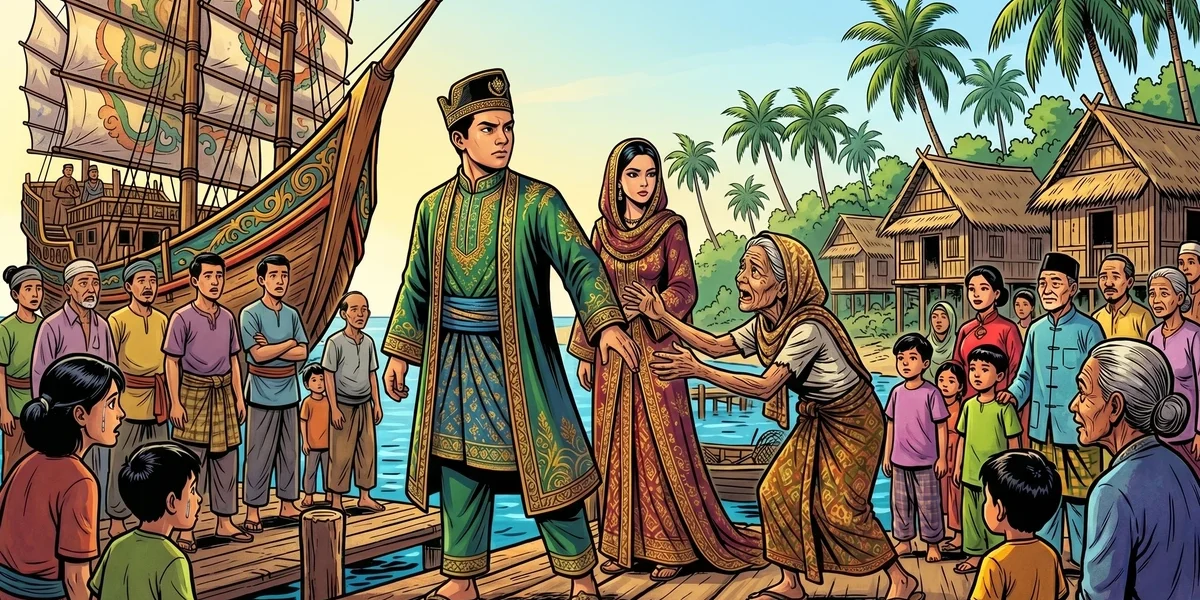
In the rice paddy fields of Java, where shallow water mirrors the sky at dawn and the air smells of wet earth and ripening grain, there lived a golden snail. She was not an ordinary creature of mud and motion. She was a princess in exile, condemned by sorcery to a shell of gleaming gold, waiting in the cold water for someone whose heart was large enough to see past appearances and offer kindness without expectation of reward. The story of Keong Emas — the Golden Snail — is one of the most beloved folk narratives of the Indonesian archipelago, carried in Javanese wayang shadow-puppet theatre, Balinese dance-drama, oral tradition across Kalimantan and Sulawesi, and the living memory of farming communities who still find meaning in the tale’s moral architecture. It is a story about the power of ikhlas — sincere, unconditional generosity — to dissolve the cruelest magic, and about the way that the humblest figures in society are often the ones who carry the world’s deepest grace.

The Story in Its Classic Form
The most widely told Javanese version of Keong Emas begins with Princess Candra Kirana, a young woman of radiant beauty and noble character, betrothed to the prince Raden Inu Kertapati (also known as Panji Asmara Bangun in the related Panji cycle). The princess’s happiness is threatened by the machinations of a jealous sorceress — sometimes identified as a witch (penyihir), sometimes as a rival queen or stepmother — who envies Candra Kirana’s virtue and the prince’s love for her. Seizing a moment of vulnerability, the sorceress casts a powerful curse, transforming the princess into a golden snail and casting her into a river. The original human world is torn apart in an instant: the prince searches desperately but cannot find his beloved, the kingdom mourns, and the princess finds herself trapped in a gilded shell at the bottom of the paddy water, unable to speak or identify herself.
Into this condition of suspension enters Mbok Rondo, an elderly widow of the humblest circumstances who lives alone near the rice fields. One day, wading through the paddy shallows to tend her plot, she notices an unusually beautiful snail — its shell shimmering gold in the morning light. She does not seek to sell it or use it for food. She simply feels a tenderness for the small brilliant creature and takes it home, placing it carefully in a clay water jar in her simple cottage. From that act of gratuitous kindness, everything begins to change. The next morning, Mbok Rondo returns from the fields to find her cottage swept, her rice cooked, and fresh flowers arranged on the household altar. This happens again, and again. She pretends to leave but watches through a crack in the bamboo wall and sees the snail transform: the golden shell opens and a beautiful young woman emerges, cooks and cleans with swift grace, then slips back into the shell before the widow returns. Mbok Rondo confronts her gently, and Candra Kirana, moved by the old woman’s compassionate reception, reveals the truth of her curse. The widow’s unstinting kindness has not yet broken the spell — but it has created the conditions of trust and shelter under which the curse can ultimately be dissolved. When the prince Panji, still searching, eventually finds the cottage — guided by rumor, by dreams, by the magnetic pull of unresolved love — and reunites with Candra Kirana, the curse shatters completely. Love, compassion, and persistence together accomplish what power and sorcery could not undo.

The Javanese Cosmological Frame: Snails, Water, and the Sacred
To understand why a snail — specifically a golden snail — was chosen as the vessel for this tale’s enchanted princess, it is necessary to step into the cosmological worldview of Javanese and broader Austronesian cultures, where the natural world is densely populated with spiritual significance. In Javanese cosmology, the snail (keong or siput) occupies a liminal and numinous position. It carries its house on its back, moving between water and land, between the seen and the hidden — precisely the kind of creature that traditional knowledge systems across Southeast Asia associate with transformation, concealment, and the passage between states of being.
Water itself holds exceptional cosmological weight in Javanese and Balinese thought. The rice paddy — sawah — is not merely an agricultural space but a sacred one, governed by the rice goddess Dewi Sri, whose cult represents one of the oldest continuous religious traditions of island Southeast Asia. Dewi Sri is simultaneously the goddess of rice, of fertility, of the moon, and of the underworld, and her association with water and serpentine forms (she is sometimes depicted as a naga or snake-deity) creates a symbolic field in which a golden creature found in paddy water carries instant numinous weight. The golden snail discovered in the sawah is, in this symbolic register, simultaneously a creature of Dewi Sri’s realm and a royal being in disguise — two kinds of sacredness compressed into one small glowing shell. The color gold (emas) is itself cosmologically loaded: in Javanese court tradition and Hindu-Buddhist iconography absorbed through centuries of Indian cultural contact, gold represents divine radiance, incorruptible virtue, and royal legitimacy.
The clay water jar in which Mbok Rondo places the snail is also significant. The kendi or pot is a domestic sacred object in Javanese household ritual — water kept in clay jars is believed to absorb spiritual qualities from the environment. Placing the golden snail in a kendi rather than releasing her into a river or cooking pot enacts a ritual of protection and respect, suggesting that Mbok Rondo’s instinctive reverence is itself a form of spiritual wisdom, even if she cannot articulate it. The widow treats the found creature as sacred without knowing why, and this instinctive correctness of response is precisely what the narrative rewards.
The Panji Cycle: Keong Emas in Its Regional Epic Frame
Keong Emas belongs to, or is closely associated with, the vast narrative universe known as the Panji cycle — one of the great literary systems of Southeast Asia, comparable in scope and cultural reach to the Ramayana and Mahabharata traditions, though far less known in the Western scholarly tradition. The Panji stories center on the adventures of a Javanese prince (known variously as Panji, Inu Kertapati, Raden Panji Asmara Bangun, and dozens of regional equivalents) and his beloved, the princess Candra Kirana, who are repeatedly separated by supernatural agency and must find each other through journeys, disguises, tests, and acts of love. The cycle originated in East Java around the twelfth to fourteenth centuries, during the Kediri and Majapahit periods, and subsequently radiated outward across maritime Southeast Asia with extraordinary vitality: Panji stories appear in Thai, Cambodian, Malay, Balinese, Sundanese, Sasak (Lombok), and Burmese traditions, each local version adapting the core romantic quest to its own cultural aesthetic.
Keong Emas functions within this larger cycle as one of the most emotionally concentrated episodes — the moment of maximum separation and the test of the princess’s endurance, the old woman’s compassion, and the prince’s perseverance. In some versions of the Panji cycle, Candra Kirana is not cursed into a snail but disguised as a man or transformed into other forms; the golden snail episode represents one of the tradition’s most visually and dramatically striking variants. The UNESCO recognition of the Panji story cycle as an Intangible Cultural Heritage of Humanity (inscribed 2017, proposed by Indonesia, Malaysia, Thailand, and Cambodia jointly) reflects the cycle’s extraordinary geographical range and the depth of its cultural embedding across the region.
In Balinese performing arts traditions, the Keong Emas story is rendered through gambuh dance-drama, the oldest surviving form of Balinese court dance, which uses archaic Kawi language and is considered a sacred form rather than merely entertainment. The princess-as-snail episode in Balinese gambuh emphasizes the cosmological dimensions of the transformation, the dancer’s movements conveying the constrained quality of the cursed princess through slow, compressed gestures quite different from the expansive movement vocabulary of the human heroine. This performance tradition demonstrates how the folk tale has been elevated into ritual art form — the story is not merely told but embodied and consecrated in performance.

The Indian Connection: Curse, Transformation, and Liberation
The structural core of Keong Emas — a virtuous being cursed into animal or non-human form, sustained by a compassionate stranger, ultimately liberated by love — has deep roots in the Sanskrit literary tradition, absorbed into Javanese culture through more than a thousand years of Hindu-Buddhist contact beginning around the second century CE. The Sanskrit concept of shaapa (curse) is central to this connection. In Hindu narrative literature — the Mahabharata, the Puranas, the Ramayana, the Kathasaritsagara — transformation through curse is one of the primary mechanisms of plot. Divine or semi-divine beings are cursed into animal, plant, or stone form by offended rishis (sages), jealous deities, or angry relatives, and must endure their transformed state until a specific condition is fulfilled. The curse is not a punishment without end: it has a built-in redemptive mechanism, usually involving an act of love, recognition, or compassion by another being.
The most direct Sanskrit parallel to Keong Emas is the story of Ahalya in the Ramayana, who is turned to stone by her husband Gautama’s curse and restored to human form when Rama’s foot touches the stone — his purity and divinity dissolving the enchantment. But equally relevant are the many Purana stories of apsaras (celestial nymphs) and gandharvas (celestial musicians) cursed into earthly forms and eventually liberated by encounters with saintly figures. What Keong Emas shares with all of these is the theological logic: the curse does not have absolute power; virtue and compassionate encounter can dissolve it. The old widow Mbok Rondo occupies a role structurally analogous to Rama in the Ahalya story — not a divine warrior, but a being of such pure, unconditional goodness that her presence creates the conditions for liberation.
The Old Javanese literary tradition (kawi literature) that formed the cultural substrate from which stories like Keong Emas grew was deeply shaped by Sanskrit models. Works like the Kakawin Ramayana (ninth century CE, composed in Central Java) and the Bharatayuddha (twelfth century, East Java) domesticated Sanskrit narrative forms into Javanese aesthetic and moral frameworks. The shapeshifting curse, when it appears in Javanese folk narrative, draws on this long Sanskrit inheritance while adding distinctively Javanese elements: the rice paddy setting, the specific valuing of ikhlas over heroic action, the prominent role of the poor elderly woman rather than a royal savior. Tamil and other South Indian connections are also traceable: the extensive trade networks between Tamil Nadu and Java from at least the ninth century CE brought not only commodities but stories, and Tamil folk traditions of women cursed into birds and animals (appearing in Sangam-era poetry and later folk balladry) may have contributed to the regional Southeast Asian pool of shapeshifting narratives.
The Rice Paddy as Moral Landscape
The choice of the sawah — the irrigated rice field — as the landscape in which the golden snail is discovered and in which the story’s moral drama unfolds is not incidental. The rice paddy is the central economic and spiritual space of Javanese village life, and it carries a dense symbolic charge that the story activates deliberately. Javanese agricultural ritual is organized around the propitiation of Dewi Sri, whose presence is invoked at every stage of the rice-growing cycle from planting to harvest. The paddy is not merely a food-production space; it is a site of ongoing negotiation between human communities and the spiritual forces that govern abundance, fertility, and the rhythms of life. To find something precious and sacred in the paddy water is to find it in the most important threshold space in Javanese cultural geography.
The widow Mbok Rondo’s poverty is inseparable from this setting. She is a sawah farmer — the most basic form of Javanese rural existence — and her daily passage through the paddy fields is the passage of someone who works directly with the sacred earth. In Javanese moral thought influenced by both Hindu-Buddhist ethics and Sufi Islamic traditions (which became dominant in Java from the fifteenth century onward), the poor farmer who lives close to the earth occupies a morally privileged position: detached from the corruptions of wealth and court life, she is capable of a quality of pure attention and uncalculating generosity that is much harder for the wealthy to achieve. This is why the princess does not reveal herself to a noble or a merchant but to a widow, and why the widow’s instinctive reverence for the golden snail is treated as wisdom rather than mere sentiment.
The rice that Candra Kirana cooks in the cottage is also symbolically rich. Rice in Javanese cosmology is not a neutral staple: it is the body of Dewi Sri herself, and the act of cooking rice with skill and love is a form of ritual service. When the princess-snail transforms and cooks for the old widow, she is performing an act of devotion — repaying kindness with the most sacred domestic gift in her cultural repertoire. The Javanese concept of gotong royong (mutual aid, collective labor) resonates through this exchange: the widow shelters the princess without asking why; the princess nourishes the widow without revealing herself. Two forms of unconditional generosity mirror each other across the divide of their very different social positions.
The Widow’s Compassion: Ikhlas and the Ethics of Care
The moral heart of Keong Emas lies in the figure of Mbok Rondo (Mbok is a Javanese honorific for an elderly woman; Rondo means widow). She is the story’s true protagonist in moral terms, even though Candra Kirana is the princess and Panji the prince. It is Mbok Rondo’s act — the small, unremarkable decision to pick up a pretty snail and bring it home in a pot of water — that makes everything else possible. Her compassion is not heroic, does not require courage or sacrifice in any obvious sense; it is simply the spontaneous expression of a heart that has been kept open despite hardship.
The Javanese concept most relevant to Mbok Rondo’s action is ikhlas — a word of Arabic origin embedded in Javanese ethical vocabulary through centuries of Islamic influence, meaning sincere, unconditional, self-forgetful generosity. Ikhlas is distinguished from ordinary generosity by the absence of any expectation of return or recognition. One gives ikhlas not for social credit, not out of obligation, and not even with conscious intention of doing good: one gives because the heart is so naturally open that withholding would require deliberate effort. Sufi ethical thought, which profoundly shaped Javanese spiritual culture through the work of the Wali Songo (the nine saints credited with Islamizing Java in the fifteenth and sixteenth centuries), taught that ikhlas was the highest form of human virtue — the spiritual state in which the ego is sufficiently dissolved that generosity flows as naturally as water. Mbok Rondo embodies this ideal without any religious or philosophical framing: she simply acts with a pure heart and the universe responds.
This ethical logic — that unconditional kindness is the most powerful force in the moral universe, capable of dissolving curses that no warrior’s sword can cut — appears across world folk literature, from European fairy tales involving enchanted beasts (Beauty and the Beast, the Frog Prince) to Indian tales of cursed beings liberated by compassionate strangers. What distinguishes the Javanese version is the social specificity: the liberating agent is not a princess or a hero but a widow farmer, and the liberation is achieved not through a dramatic act but through the daily practice of care — the repeated offering of shelter, of patience, of gentle attention over time. This is not a heroic narrative but a domestic one, and its domesticity is precisely the point: the moral universe of Keong Emas insists that the kitchen and the rice paddy are as much sites of cosmic significance as the battlefield or the royal court.
Regional Variants and the Balinese Tradition
While the Javanese Keong Emas is the most widely disseminated version, the golden snail story belongs to a broader regional family of Southeast Asian tales involving enchanted beings discovered in agricultural or aquatic settings and liberated through acts of kindness. In the Balinese version (known through gambuh and arja dance traditions), the emphasis on court aesthetics is heavier: the princess’s beauty is described in elaborate poetic language derived from Old Javanese kawi poetry, and the prince’s search involves a series of ordeals and disguises that recall the Panji cycle’s characteristic concern with hidden identity and confused recognition. The Balinese tradition has preserved the story in living performance contexts longer and more robustly than the Javanese, partly because Bali maintained its Hindu-Buddhist cultural forms after the Islamization of Java and therefore continued to perform the Panji cycle stories in their original cosmological register.
In Sundanese tradition (West Java), a related tale involves a princess transformed into a fish discovered in a river, sheltered by a fisherman rather than a widow farmer; the moral structure is identical but the aquatic setting shifts from rice paddy to river, reflecting the different ecological emphasis of Sundanese storytelling. In Lombok (the island east of Bali), Sasak oral tradition preserves a version closely following the Javanese Keong Emas but embedded in local Islamic interpretive frameworks that emphasize the princess’s patience and resignation during her cursed state — a theological overlay that does not eliminate the original folk-tale structure but reframes its moral logic through Sufi concepts of tawakkal (trust in God) and sabar (patient endurance).
Across mainland Southeast Asia, the Panji cycle stories that include Keong Emas variants traveled through Malay literary culture and were adapted into Thai tradition as the Inao story (the name is the Thai form of Inu Kertapati), performed in khon masked dance and lakhon court dance. The Thai Inao versions were among the favorites of the Thai royal court for centuries — the Thai king Rama II (1767–1824) personally composed a celebrated version. The golden snail episode appears in various forms in this mainland tradition, demonstrating that the folk tale had become integrated into the highest levels of royal literary culture across the region, ascending from village story to classical court performance.

Contemporary Resonances: Film, Wayang, and Living Heritage
Keong Emas has remained vigorously alive in Indonesian popular culture through repeated adaptation across modern media. The story was made into a widely watched Indonesian feature film in 1980 which introduced the tale to urban Indonesian audiences who may not have had direct exposure to wayang kulit (shadow puppet) or gambuh performances. The film’s success reflected the story’s capacity to speak across class and regional lines: it is simultaneously a court romance, a folk tale of peasant virtue, and a supernatural adventure, giving it appeal across different audience registers.
In the wayang kulit tradition, Keong Emas episodes are performed by skilled dalang (puppet masters) who must navigate the story’s emotional complexity: the pathos of the trapped princess, the comedy and warmth of the widow, the romantic intensity of the prince’s search, and the supernatural drama of the curse and its dissolution. The dalang’s role is not merely to narrate but to inhabit multiple perspectives simultaneously, and the Keong Emas story provides exceptional material for this multi-perspectival art. In Central Javanese court traditions centered on Yogyakarta and Surakarta, the story continues to be performed in wayang wong (human dance-drama) forms as part of the living classical repertoire maintained by royal and post-royal cultural institutions.
Keong Emas has also entered the Indonesian school curriculum as a canonical folk tale representing national cultural heritage, and it appears in children’s book versions, animated television productions, and educational materials across the archipelago. This institutionalization has inevitably simplified the story — the cosmological complexity, the Panji cycle connections, and the Sufi ethical dimensions tend to be stripped away in school versions, leaving a morally clear but less culturally dense narrative. Nevertheless, the story’s core remains intact: kindness breaks curses, the humble can accomplish what the mighty cannot, and the universe has a moral structure that rewards compassion. These are messages that translate across every age and every medium, which is why Keong Emas, like all great folk tales, shows no sign of exhausting its capacity to speak to new audiences in new forms while remaining, at its heart, recognizably itself.
The golden snail in the paddy water is still there, gleaming, waiting. She waits for the right kind of attention — not the attention of the powerful or the clever, but the simple, warm, unconditional attention of a heart that finds beauty in a small creature in the mud and cannot help but reach down and carry it home. In that reaching down is everything: the breaking of curses, the reunion of lovers, the nourishment of the hungry, and the demonstration that the moral fabric of the universe is woven not from heroic deeds alone, but from the ten thousand small acts of unremarked kindness that sustain ordinary life in the fields and cottages of the world.
You May Also Like
 Indian Folk Tales
Ages 6-8
Indian Folk Tales
Ages 6-8
The Monkey With The Tom Tom
The Monkey With The Tom Tom: In a remote wood there lived a monkey, and one day while he was eating wood-apples, a sharp thorn from the tree ran into the tip
 Indian Folk Tales
All Ages
Indian Folk Tales
All Ages
The Cat, the Mouse, the Lizard, and the Owl
The Cat, the Mouse, the Lizard, and the Owl: This is the story of four creatures, none of whom loved each other, who lived in the same banyan tree in a forest
 Indian Folk Tales
Ages 3-5
Indian Folk Tales
Ages 3-5
The Story Behind The Congress Party’s Hand Symbol – Story of Hemambika
Behind the Congress Party's hand symbol lies Hemambika's story of sacrifice and faith. Her virtue became the rallying emblem of a nation's conscience.