The Cat, the Mouse, the Lizard, and the Owl
The Cat, the Mouse, the Lizard, and the Owl: This is the story of four creatures, none of whom loved each other, who lived in the same banyan tree in a forest
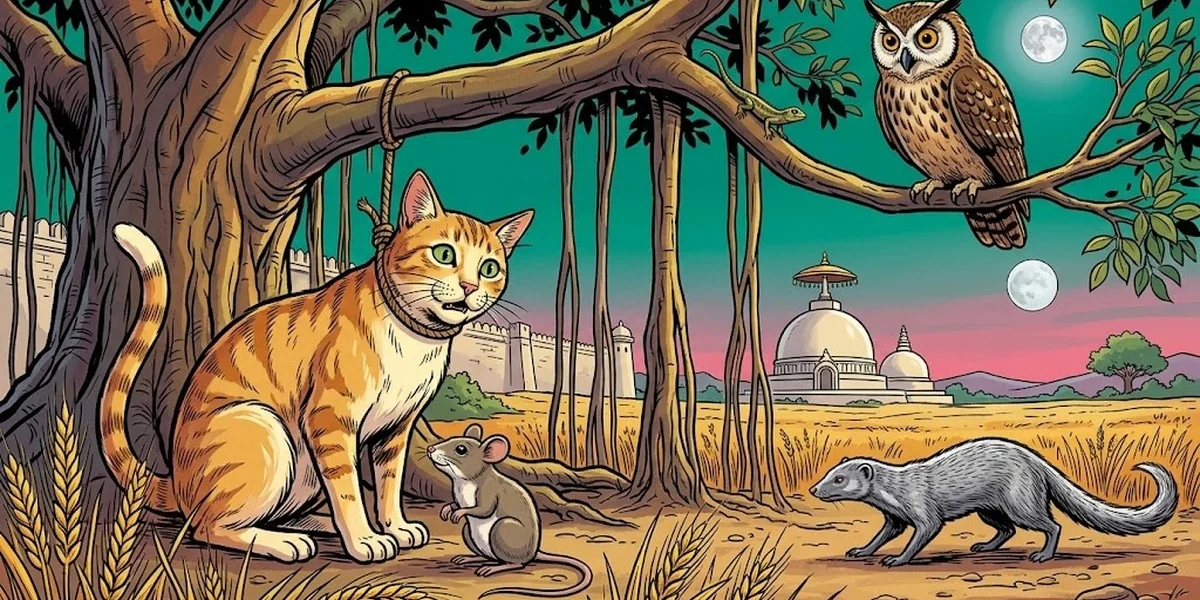
Outside the white walls of Vidisha — the river-city of stone elephants and Buddhist stupas, capital of the ancient Dasarna kingdom on the bank of the Vetravati — there once stood a banyan tree so vast and so old that the merchants of the bazaar called it vata-raja, the king of trees. From its arched roots to its crown of leaves four hundred birds could perch unseen. In its hollow trunk lived Lomasha the cat, in its high foliage roosted Chandraka the owl, in the warm sunlit roots basked a small green lizard, and in a tunnel among damp leaves on the cool side dwelt Palita the mouse. Four enemies, four hungers, four kingdoms separated by inches of bark — and one terrible night when a hunter’s snare changed everything.
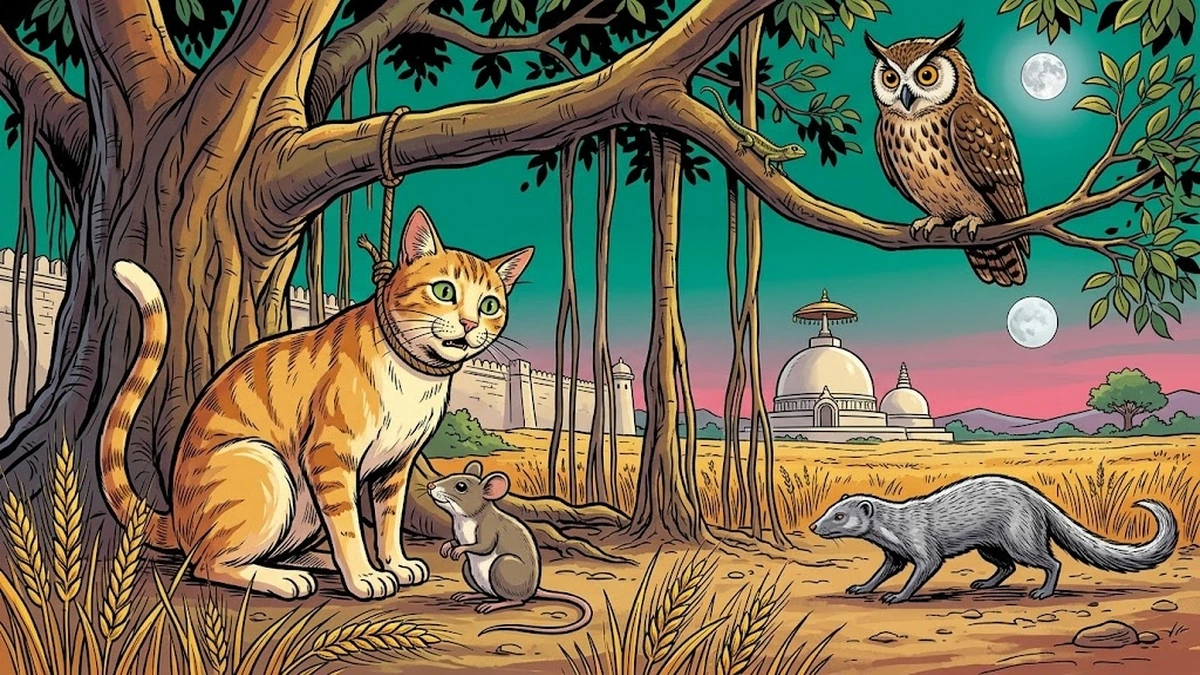
A Banyan Outside the Walls of Vidisha
The town of Vidisha — known today as Besnagar near Bhilsa in Madhya Pradesh — was already old when the Mahābhārata was first sung. By the second century BCE its merchants were importing turquoise from Bactria and exporting cotton to the Roman East; by the time the Greek ambassador Heliodorus raised his Garuḍa pillar there in 113 BCE the great banyan groves outside its gates had been a meeting-place for storytellers for generations. It was in just such a tree, says the bard Bhīṣma to the dying Yudhiṣṭhira, that the parable of the cat and the mouse must be told.
The banyan tree, says the Skanda Purāṇa, is the lord of trees because no other shelters so many kinds of life. Lomasha the cat had her bed in a smooth-sided hole some way up the trunk, where the bark curled over her like a hood; she slept curled with her tail across her nose, dreaming of the chapters of birds that would come at dawn. Chandraka the owl roosted higher still, in the matted gloom near the crown, where his children had once peeped from a nest of grass. The lizard, of the species the Sanskrit grammarians called kṛkalāsa, lay flattened along a south-facing root, body the colour of old copper, throat ticking with each fly. And Palita the mouse — wise, watchful, prince of the under-leaves — kept his door tunnels and his back doors hidden among the damp green moss on the north side, where the cat seldom troubled to look.
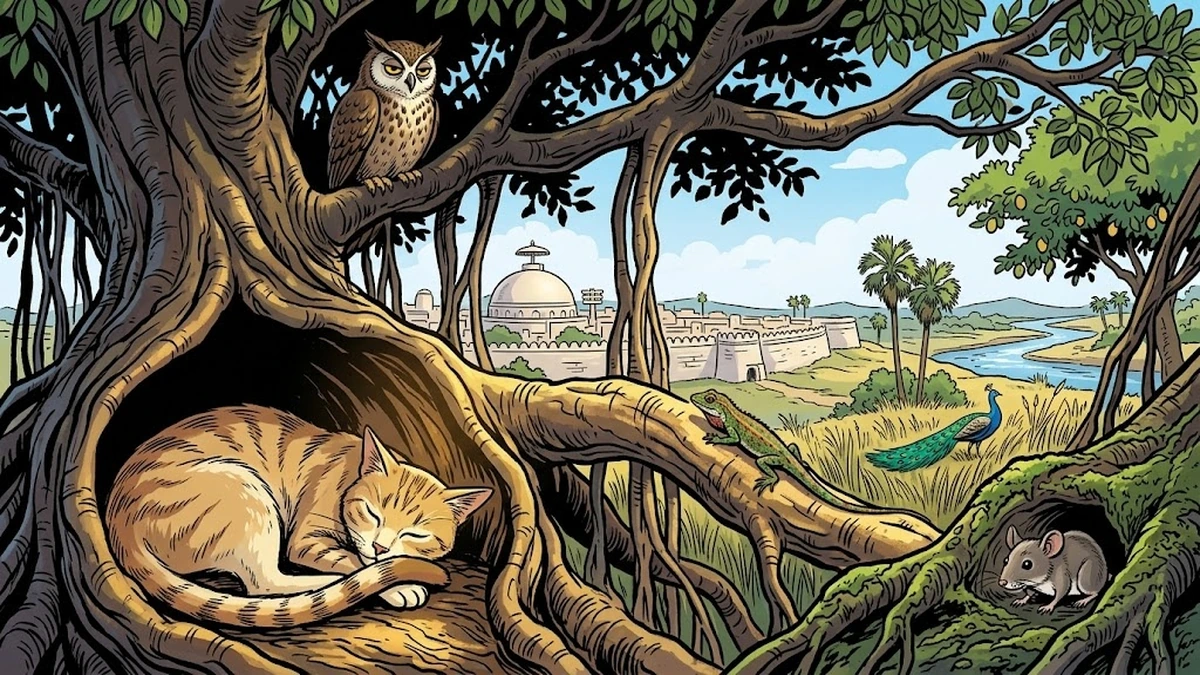
Each of the four had reason to fear the others. Lomasha could not climb to Chandraka’s branch but she could leap upon him in the dust. Chandraka could not enter the cat’s hollow but he could carry off the lizard in his talons. The lizard could not bite the cat but a flicked tongue would do for the mouse. And the mouse — the mouse had to fear them all. So the four lived as kingdoms live: each wary, each jealous, each waiting. There was no friendship among them; there was only the truce of distance and the calendar of hunger.
The Hunter and the Snare
Beyond the banyan tree the barley-fields began — the long terraced strips that ran down to the Vetravati river, golden in the season the farmers call śarad, autumn. Palita went there at dawn to nibble the heavy ears, slipping through the stems like a brown thought. Lomasha had learned this. Night after night, with the patient malice of her tribe, she lay in wait in the same place, flattening a tunnel in the barley as a path of ambush. She thought no eye could read those signs. She was wrong.
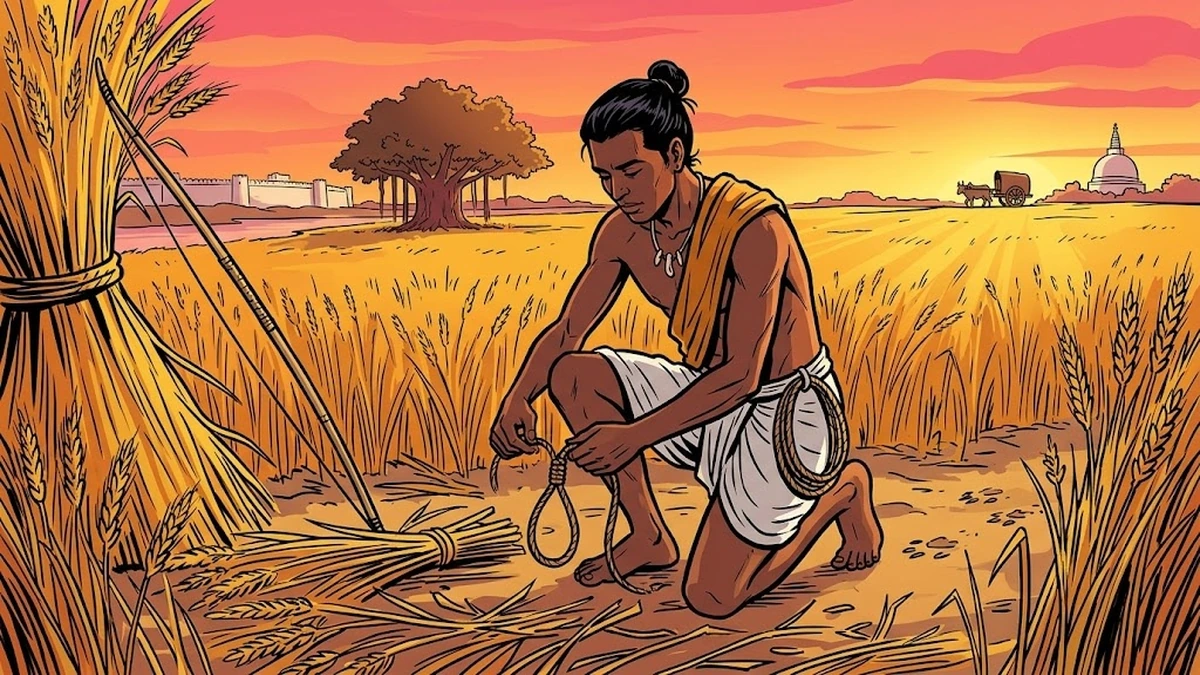
One morning a Niṣāda hunter — one of the forest-dwelling fowlers the Manusmṛti classes outside the four varṇas, the men whose nets and snares fed the city’s appetite for songbirds — came along the field edge, looking for the small disturbances that betray game. He saw the path Lomasha had made. He saw the cat-prints in the dust. Mārjārī, he said to himself, ‘a she-cat. She will come again at dusk.’ And as the sun went down he set the snare he carried in his hunting-pouch: a noose of stout twisted antelope-sinew, hidden under the broken stalks, with the slipping knot that tightens when the throat fills it.
Lomasha came at twilight, soft on her cushioned feet, ears forward, eyes the colour of new leaves. She caught sight of Palita running across the path; she sprang; and the noose closed on her neck. She could not breathe enough to roar. She could only emit one feeble, choking mew — and Palita the mouse, hidden three hand-spans away, saw his enemy in the snare and felt for one single instant the joy of the hunted who outlives the hunter.
Four Eyes in the Barley
That joy lasted no longer than a heartbeat. Palita lifted his nose, and what he saw on the air froze him. The lizard, shy and quick, was darting away into the last patch of sunlight; that was no harm. But on a low branch of a thorn-bush sat Chandraka the owl, large pale eyes already fixed on the mouse with the cold attention of one who has at last waited long enough. And in the dust at the field edge — the hot dust where the cobras leave their tracks — the mouse caught the smell of Harīta, the long-bodied mongoose of the riverbank, the eater of mice and snakes alike, who had followed his scent up from the stream.
Palita stopped where he stood. He was a small grey vegetarian creature in a barley-field at dusk, and he was now exactly equidistant from three predators. The cat in the snare in front of him; the mongoose behind him; the owl above him; the lizard he could discount. The Mahabharata says of him, buddhimān palitaḥ — paśya tasya ca cintanam: ‘Wise was Palita; observe his thinking.’ He thought, and what he thought is still taught in Indian schools of strategy two thousand five hundred years later.
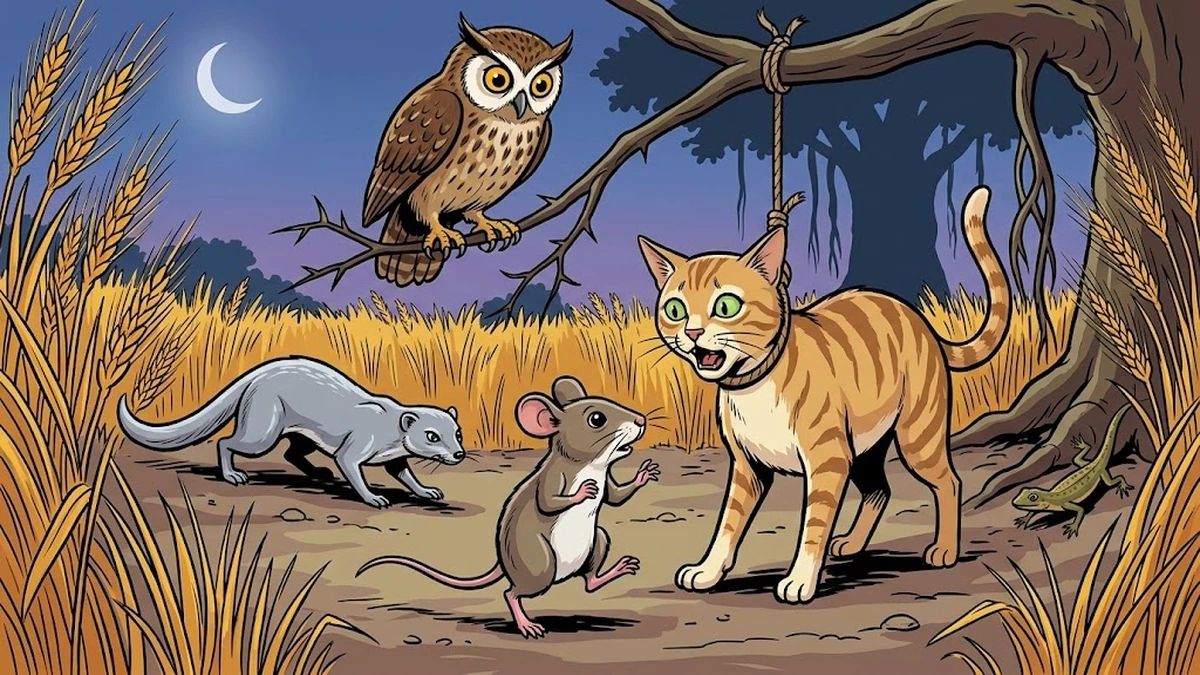
‘If I run from the mongoose,’ Palita reasoned, ‘the owl will take me from above. If I climb to escape the owl, the mongoose will take me at the foot of the tree. If I freeze, both will reach me at once. There is only one creature in this barley-field tonight who cannot harm me — and that is the cat in the noose. The cat, my hereditary enemy, has become for one night and one night only my temporary fortress. I shall walk into the lion’s mouth, because the lion’s teeth are tied.’
He stepped softly out into the open path. He sat down within easy reach of Lomasha’s claw — and he made a polite Sanskrit speech, the kind the Pañcatantra teaches young princes to make when they wish to bind an enemy to a treaty without seeming to. ‘Saumya,’ he said — gentle one — ‘we are both in trouble tonight. The hunter will return at dawn and his knife will be for you. The mongoose and the owl wait for me. Your one chance is my teeth, which can cut antelope-sinew though they cannot fight a cat. My one chance is your body, which can shelter me from the others though it cannot fly. Let us make a sandhi, a peace. I will lie under your warm flank, where the owl cannot stoop and the mongoose dare not come, and at the moment before sunrise — not before, not after — I will gnaw through your noose, and we will both go home.’
The Bargain Beneath the Cat
Lomasha was no fool. Half-strangled, unable to swing a paw, she understood the offer at once. She knew the boy-trick of cats — that they cannot, when hungry, refrain from striking even at a kitten that walks too close. She also knew that one strike now would end her life with the dawn knife. So she purred, as well as she could with a noose at her throat, and gave the consent the bard records as sādhu, mūṣikarāja, saṃvidaṃ kuru — ‘good, prince of mice, make the agreement.’
Palita walked under the cat’s chest as a child walks under the porch of a great house. He felt Lomasha’s heart battering above him, the warm fur arching like a palace roof, the smell of her predator-breath. Above them the owl watched, baffled; below them in the dust the mongoose paced and snarled and at last drew off, balked of two prey at once. The lizard, who had seen everything, slipped under his root and slept. The four animals who had divided the banyan tree with hatred had been brought, by a noose, to a single configuration of bodies — and only the smallest of them had read the pattern.
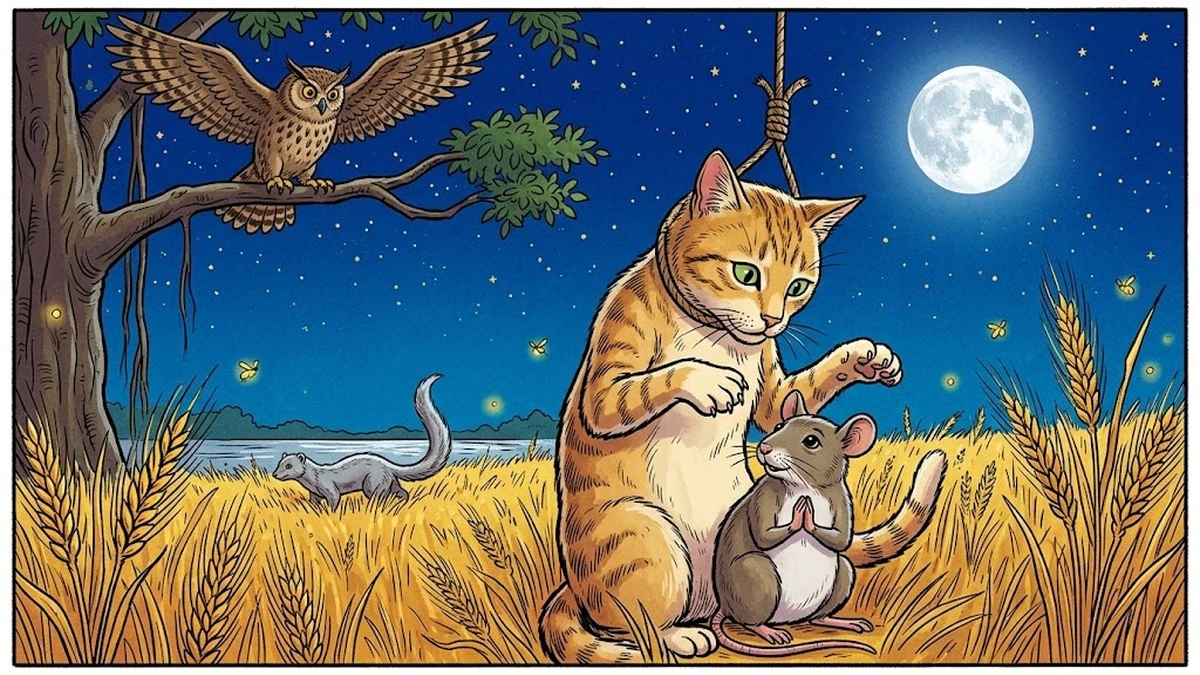
Now came the most delicate part of the night. The mouse had promised to gnaw the rope at the moment before sunrise — not earlier. Why not earlier? Because if the cat were freed before the owl and mongoose left, the cat would, the next instant, eat the mouse. Sva-bhāvo duratikrama, says the Hitopadeśa: nature is hard to overcome. The mouse therefore worked the strands of the noose with his teeth slowly, weakening them but not parting them, all through the cold hours, while above him Chandraka the owl flew off at last in disgust, and behind them the mongoose Harīta withdrew to the river. As the first true grey of dawn touched the barley, and not a moment before, Palita gave one last neat bite — and the rope sprang — and Lomasha, freed, leaped.
She leaped not at the mouse but up into the safety of her tree. ‘Mitram,’ she called down, ‘friend! Why do you not come and live with me? I owe you my life.’ But Palita, already deep in his hole, replied with the line that has become a Sanskrit proverb: kāryārtham anyaḥ kriyate, kārya-ante sa parityajyate — ‘an alliance is made for a purpose; when the purpose is fulfilled the alliance is also abandoned.’ The cat, ashamed and admiring, climbed back into her hollow. The mouse cleaned his whiskers. The lizard yawned. The owl sulked. And the banyan tree of Vidisha stood as it had stood the day before, four kingdoms in one tree — but no longer four ignorant ones.
The Moral the Mahabharata Names
न विश्वासः सहस्ताश्च बलिनां शत्रुणाम् अपि।
कृत्वापि सन्धिं सततं विश्वस्तस्य भयं भवेत्॥
— na viśvāsaḥ sahastāś ca balināṃ śatruṇām api / kṛtvāpi sandhiṃ satataṃ viśvastasya bhayaṃ bhavet
‘Trust never wholly, even among armed strong enemies who have made peace with you. The one who trusts entirely lives always in fear.’
— Mahābhārata, Śānti Parva 138.13
The Mahabharata’s frame is political. Bhīṣma is teaching Yudhiṣṭhira how to govern after the war: when may a king ally with his enemy, when must he break the alliance, what is owed and what is not? The cat-and-mouse parable is offered as a perfect miniature of sandhi-vigraha, the doctrine of treaty and breach. A weaker creature in danger from many strong ones may bind itself to a single strong enemy provided three conditions hold: (1) that enemy is, for the duration, more endangered than itself; (2) the alliance can be ended at the precise moment the danger ends; (3) the weaker creature retains the only key — here, the teeth — that can dissolve the bond. Palita has all three. He survives because he sees them.
Why the Tale Has Lasted
The Cat and the Mouse of the Mahābhārata travelled out of India along every road that Indian books took. In the Pañcatantra, Vishnu Sharma rewrote it for his own Book III, Kākolūkīyam (‘Of Crows and Owls’), where it became one of the master parables of why a small kingdom should accept the embrace of a momentarily-weakened larger one. Through the Pahlavi Karīrak ud Damanak and the Arabic Kalīla wa Dimna of Ibn al-Muqaffaʿ (c. 750 CE) it reached Baghdad; through Symeon Seth’s Greek translation it reached Byzantium; through John of Capua’s Latin Directorium humanae vitae (c. 1270) it entered medieval Europe, where La Fontaine’s Le Chat et le Rat (Fables, VIII.22, 1678) is its lineal descendant. Aarne, Thompson and Uther catalogue the cycle as ATU 75 and place beside it the Aesopic fable Perry 581. Stith Thompson’s index gives it the motif numbers J624 (strange bedfellows in adversity) and J581 (foresight in alliances).
The story matters today for the same reason it mattered in 200 BCE. In any negotiation between unequal parties — small business and big buyer, junior partner and senior, refugee state and great power — the question is whether the weaker side has a key the stronger side cannot duplicate. If it does, the alliance is real. If it does not, the alliance is, as Palita says, only a pause before being eaten. The Indian schools of strategy from Kauṭilya’s Arthaśāstra (c. 4th c. BCE) onward treat sandhi not as friendship but as engineering: a question of leverage, timing and the exact moment at which the smaller creature gnaws through the rope.
And there is the deeper lesson the Mahabharata never quite spells out. The four animals of the banyan tree are images of the four temperaments of any community: the predator who relies on stealth (the cat), the predator who relies on height (the owl), the predator who relies on speed (the mongoose), and the small clever vegetarian who relies on intelligence (the mouse). Of the four, only the last — the smallest — survives the night, because only the smallest sees that survival is a matter of pattern, not of strength. Palita lives because he counts. The cat, the owl and the mongoose live by appetite alone, and appetite never counted anything in its life.
Did You Know?
- The town of Vidiśā in the Mahabharata version is the modern Bhilsa-Besnagar in Madhya Pradesh, where the famous Heliodorus pillar (Garuḍa-dhvaja) was erected by a Greek ambassador in 113 BCE — making this one of the oldest still-named locations in any folk tale.
- The proper names — Lomasha for the cat, Palita for the mouse, Chandraka for the owl, Harita for the mongoose — appear in the Sanskrit critical text but were dropped in many later retellings; S. M. Mitra restored them for the 1919 Macmillan edition.
- Lomasha (लोमश) literally means ‘the hairy one’ or ‘the wool-covered’; Palita (पलित) means ‘the grey-haired’ or ‘the venerable’ — the mouse is named for wisdom, the cat for her fur.
- The same cat-and-mouse alliance reappears in nearly identical form in La Fontaine’s Fables Book VIII, fable 22 (1678) and in the Burmese Maha-Vagga; the migration route is from Sanskrit to Pahlavi to Arabic to Spanish Latin to French.
- The modern Hindi proverb ‘matlab ke sang sang chalna’ (‘to walk together only as long as it serves your purpose’) is a direct descendant of Palita’s parting line to Lomasha.
What This Story Teaches Us Today
An old story keeps its power because its lessons never expire. Here are three ways Palita’s night under the cat applies to the choices we make now:
- An ally in a crisis is not the same as a friend in calm weather. Palita does not pretend the cat will love him at sunrise; he knows the truce ends with the rope. The most dangerous workplace mistake is mistaking a temporary alliance for a permanent friendship.
- Always retain the key that can dissolve the bond. The mouse keeps his teeth between himself and the rope until the last possible moment. In any negotiation — a contract, a partnership, a marriage of inconvenience — the side that holds the only key to the exit holds the bargain.
- Time the moment of release with care. If Palita gnaws the rope too early, the cat eats him; too late, the hunter kills the cat and the mouse loses his tool. Strategy in the Mahabharata is a question of timing more than of strength. The smallest creature in the room often controls the clock.
Why This Tale Still Matters
Two thousand five hundred years after Bhīṣma told it from his bed of arrows, the parable of the cat, the mouse, the lizard and the owl is still taught in Indian war colleges, foreign-policy schools, and corporate negotiation seminars from Bengaluru to Boston. Its claim is austere: that the world is composed of unequal creatures with overlapping appetites, and that wisdom is the small art of reading the pattern in time. The mouse Palita is not strong, not fast, not high-flying, not poisonous; he is only attentive. He counts the predators, weighs the geometries, picks the one alliance that exactly fits the night, and at the precise moment before sunrise — not before, not after — he takes his teeth to the rope and walks home. The Mahabharata calls this buddhi, the kind of intelligence that is also a virtue. The banyan tree of Vidisha still stands somewhere in every life that contains more than one enemy.
Canonical Attribution:
Mahābhārata, Śānti Parva (Book of Peace), Āpaddharma-anuśāsana sub-parva, Adhyāyas 138–140 (Bidāla-Mūṣaka-saṃvāda) · Bhandarkar Oriental Research Institute Critical Edition, Poona, 1933–66 · English retelling: S. M. Mitra & Mrs. Arthur Bell (N. D’Anvers), Hindu Tales from the Sanskrit, Macmillan & Co., London 1919, Tale XII (Project Gutenberg #11310) · Pañcatantra Book III, Kākolūkīyam, Vishnu Sharma, c. 3rd c. CE · Hitopadeśa, Nārāyaṇa Paṇḍita, c. 12th c. · Kauṭilya, Arthaśāstra, Book VII (sandhi-vigraha) · ATU 75 · Stith Thompson J624, J581, K2295, B435.4 · Translation chain: Sanskrit → Pahlavi Karīrak ud Damanak → Arabic Kalīla wa Dimna (Ibn al-Muqaffaʿ, c. 750) → Greek (Symeon Seth, c. 1080) → Latin (John of Capua, c. 1270) → La Fontaine, Fables VIII.22 (1678).
You May Also Like
 Indian Folk Tales
All Ages
Indian Folk Tales
All Ages
The Ass in the Lion’s Skin
The Ass In The Lions Skin: In a dense forest near a small Indian village, there lived a washerman named Dhobi who owned a tired old donkey. The poor donkey had
 Indian Folk Tales
Ages 6-8
Indian Folk Tales
Ages 6-8
Tenali Raman and the Brinjal Curry: A Tale of Clever Logic
Tenali Raman and the Brinjal Curry: A Tale of Clever Logic: The Brinjal Curry Dispute In the golden kingdom of Vijayanagara, during the reign of King joins a
 Indian Folk Tales
All Ages
Indian Folk Tales
All Ages
The Cruel Crane Outwitted
The Cruel Crane Outwitted: Deep in the forests of ancient India, near the holy city of Kashi, there stood a magnificent fig tree so tall that its topmost