The Cruel Crane Outwitted
The Cruel Crane Outwitted: Deep in the forests of ancient India, near the holy city of Kashi, there stood a magnificent fig tree so tall that its topmost

The Cruel Crane Outwitted — known to the Pali canon as the Baka-Jātaka (Jātaka No. 38) — is one of the oldest surviving fish-fables of the world. It belongs to the Khuddaka Nikāya of the Pali Tipiṭaka, redacted at the Buddhist councils more than two thousand years ago, and was first translated into English by Robert Chalmers under the editorship of E. B. Cowell and W. H. D. Rouse in The Jātaka, or Stories of the Buddha’s Former Births (Cambridge University Press, 1895, Vol. I, pp. 93–95). Joseph Jacobs reprinted it as Tale VIII of Indian Fairy Tales (David Nutt, London, 1892), making the heron-and-crab parable a fixture of every English nursery for the next century. In the international tale-type catalogue it is listed as ATU 227 “The Crane and the Crab” with cross-references to ATU 232 (“The Bird and the Fish”) and to motif numbers K815 (victim lured by promise of safe passage), K832 (deceiver killed by intended victim) and K1626 (would-be killer killed). It is the parent text of the heron-and-crab episode in the Sanskrit Pañcatantra (Book I, Mitra-bheda), the Persian Kalīla wa Dimna of Ibn al-Muqaffaʿ (c. 750 CE), the Hebrew Mishle Sendabar, La Fontaine’s Le Héron (Fables VII.4) and Aesop’s “The Heron and the Eel” (Perry 204). The Bodhisatta, in this birth, was a Rukkha-Devatā — the tree-sprite who watches the pond from the branches of a wide-crowned varaṇa tree.

I. The Drying Pond and the Watching Sprite
In a forest in the Kingdom of Kāsi — the great kingdom whose capital was Bārāṇasī, the holy city now called Varanasi — there lay a small natural pond fed by springs and shaded on every side by old varaṇa (Crateva religiosa) and jambu (rose-apple) trees. The Bodhisatta had been reborn in that lifetime as the Rukkha-Devatā, the spirit who dwelt invisibly in the largest of those varaṇa trees. From his high perch among the silver-green leaves he could see the whole bowl of the pond — its lotus pads, its sleeping turtles, its quick silver fish, its solitary great crab who lived among the roots of the bank.
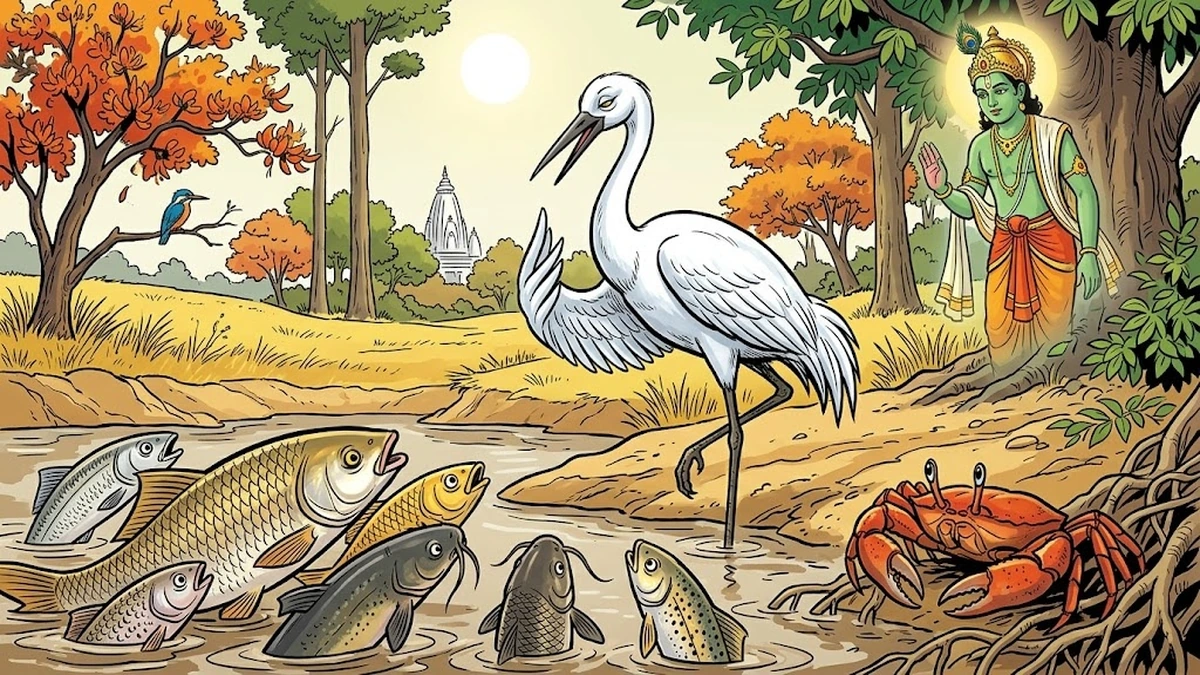
It was the season of gimha, the great heat before the monsoon. For weeks the sun had hammered down on the lily-pads. The springs had failed. The pond had shrunk to a glittering puddle the size of a threshing-floor, and the fish, who once flashed in deep cool water, were now packed shoulder to shoulder in the warm shallows, their gills working anxiously above the mud. They were many: silver rohu, golden katla, dark magur, the speckled punti, and far more besides. And among them lived one very old crab, broad as a brass dish, with great pincers the colour of polished iron.
It was at this season that the white crane, the baka, came to know the pond.
II. The Crane’s Sweet Lie
He was a tall, snow-white bird with long stilt-legs and a beak as sharp as a fisherman’s spear. Day after day he stood on one foot at the edge of the pond, motionless as a heron-shaped lamp, and watched the panting fish. He was hungry. He was very, very cunning. He could have stabbed the fish where they lay, but the pond was crowded and the fish were fast, and the crane wanted not one or two but every fish in the pond — and the great crab too. So he spoke aloud to himself in a sad, soft voice that the fish could just hear.
“Alas, alas,” sighed the crane, “poor things. So little water left, and so many of you. Tomorrow, perhaps, or the day after, this pond will be dry mud. And then what will become of you?”
The fish heard, and were afraid. They swam to the bank in a glittering little crowd and lifted their heads. “Sir Crane,” said the eldest rohu, “you fly far over the forest. You see the green country. Is there any pond left to us?”
“Alas, friends,” said the crane, putting on a face of great holiness, “there is — but it is far. Five yojanas through the forest there is a great five-petalled lotus pond, deep and cold and fed by mountain streams. The lotuses there are as wide as elephant-ears. There are no nets, no fishermen, no kingfishers. But how would little fish like you ever reach so far?”
The fish wept. “Holy Crane,” they said, “take pity on us. Carry us in your beak, one by one, to that lotus pond, and we will be your friends for life.”
The crane, in his heart, was already laughing. But aloud he said, with much sighing, “It is a heavy work. But I am old and have seen many sorrows. I will do this thing for you. Send me first one fish, that I may show him the way and bring back his testimony.”
III. The Tree of Bones
The boldest of the silver rohu volunteered. The crane took him gently in his long beak and rose with great slow strokes of his wings above the varaṇa trees. The Bodhisatta tree-sprite, watching from his green canopy, saw the crane wheel away — but not toward any lotus pond. The crane flew only as far as the next clearing, where a single great spreading varaṇa tree stood at the edge of a stony field. There, in the highest fork of that tree, the crane laid the trembling fish on the branch, drove his sharp beak through its silvery side, ate the soft flesh, and let the bones fall down among the dry leaves below.
Then he flew calmly back to the pond. “Brothers,” he announced, “your friend swims now in the cold lotus pond and sends you his salutation. Who is next?”
One by one — the golden katla, the dark magur, the speckled punti — the fish gave themselves up to the long sharp beak. One by one they were carried to the high fork of the lonely varaṇa tree. One by one their flesh was torn out, and one by one their small white bones were added to the heap of bones below, until at the foot of that tree there lay a hill of fish-skeletons higher than a man’s knee. The crane, gorged each evening, slept with one foot tucked into his white feathers and dreamed of the morning.
And at last only the great old crab was left in the puddle.
IV. The Pincers of the Crab
The crane returned to the pond and put on his most wheedling voice. “Friend Crab,” he said, “all your kinsmen the fish are now in the cold lotus pond. Will you not also come? It is a long flight, but I will carry you safely.”
The old crab tilted his eye-stalks at the white bird. He had watched the fish go and never come back. He had heard the crane’s teeth clack each evening with the satisfied click of a full belly. He was, after all, a great old crab who had lived under the bank of that pond since before the present king of Kāsi was born, and crabs are not as foolish as fish. But he answered politely.
“Holy Crane, I will come gladly. But your beak is long and slender, and my shell is smooth and round, and I should slip from it on the wing and fall into the forest and break to pieces. Let me, rather, hold on around your neck with my pincers. So I shall not fall.”
The crane, still confident, agreed. “As you please, friend.” The crab climbed up the bird’s smooth back and locked his iron-coloured pincers gently — but firmly — about the long white neck. The crane spread his wings and rose into the hot air.
He did not fly toward any lotus pond. He flew, as before, straight to the lonely varaṇa tree at the edge of the stony field. He came down on a low branch and prepared to drop his rider on the heap of bones.
The crab, looking down, saw the white bones glittering in the dry leaves: the curved spine of his old friend the rohu; the flat skull-plate of the katla; the fine combs of the magur’s ribs. The crab understood everything. He tightened his pincers very slowly, the way a man tightens a vice, until the crane could neither swallow nor breathe.

“Friend Crane,” said the crab in his quiet, scraping voice, “your lotus pond is a tree, and your fishes’ testimony is this hill of bones. You have eaten my brothers. I am about to eat you. Turn round at once and carry me back to my own pond, or I will pinch your head from your shoulders here on this branch.”
The crane, choking, tried to plead. He could only croak. The crab squeezed harder, and a thin trickle of blood ran down the white feathers. The crane, shuddering, lifted his wings and flew, slow and trembling, back the way he had come, with the crab still clamped about his neck. He came down at the very rim of the muddy puddle from which he had carried so many.
The crab did not loosen his grip. “Lay your neck on the bank, deceiver,” he said, “and put your head a little lower, and let me step down.” The crane, half-fainting, obeyed. The instant the crane’s long throat lay flat on the wet clay, the crab brought his great pincers together with one slow, deliberate, scissoring squeeze — and the cruel white head of the crane rolled off into the water-weeds.

V. The Voice From the Tree
The Bodhisatta, watching all of this from the green crown of his varaṇa tree, spoke aloud in a clear voice that filled the whole forest, so that every leaf trembled and every grasshopper grew still. He uttered the verse for which the Baka-Jātaka is remembered:
“Na hi sādhu sadā saṭho
Saṭho saṭhena haññati;
Akāsi pāpakaṃ kammaṃ —
So bako kakkaṭakena hato.”“The cunning man is not for ever clever; / Cunning is overcome at last by cunning. / He who has done an evil deed — / That very crane is by the crab undone.”
— Baka-Jātaka, Jātaka 38, gāthā at close (trans. Chalmers, Cowell & Rouse 1895, I.95)
And the crab, holding the white head between his pincers like a trophy, walked back through the lily-pads to his old hole among the roots of the bank, and there he ate the head of the cruel crane, slowly, and with great satisfaction.
The Moral
The teaching attached to this Jātaka by the commentator Buddhaghoṣa, in his fifth-century gloss, is the simplest possible: pāpa-kammaṃ pāpena yujjati — “an evil deed is paid back in kind.” The Buddha, telling this story to a backbiting tailor of Jetavana who had cheated his fellow monks, identified himself as the Tree-Sprite, the wronged fish as the cheated brethren, and the cunning crane as the tailor himself. The lesson is not merely “crime does not pay” but the deeper karmic principle of the Dhammapada 165: “Attanā va kataṃ pāpaṃ, attanā saṃkilissati” — “by oneself is evil done; by oneself is one defiled.” The crane is not undone by some vengeful god or by accident; he is undone by exactly the trick that he himself had perfected. His shrewdness becomes the instrument of his own death. As the Sanskrit Pañcatantra says of the same heron in Mitra-bheda: upāyenābhyupāyena hanyate śatru-cintakaḥ — “he who plots a stratagem is destroyed by stratagem.”
Why It Has Lasted
For two and a half millennia this small story has refused to die. The reason, surely, is that it does what almost no other early fable does: it lets the prey win, and lets the prey win on a moral, not a magical, footing. The fish are gone. They are not resurrected by any god. They are not the heroes — they are stupid, trusting, and dead. The hero is the crab, who is heavy, slow, ugly, fitted with no eloquence, and equipped with nothing but two pincers and a long memory. He survives because he is suspicious of sweet talk, because he watches what others do as well as what they say, and because, when the moment of truth arrives, he uses the deceiver’s own tools — the long flight, the trusting body-contact, the secluded killing-place — to kill the deceiver. The crab is the patron-saint of every old peasant who has ever distrusted a smooth-talking landlord, every village widow who has ever distrusted a smiling money-lender, every reader who has ever wondered whether the holy-looking stranger at the edge of the pond is, in fact, holy. The Buddhist editors of the Jātaka book preserved the tale because it teaches the working of kamma in this very life, on this very afternoon, before the sun goes down — not in some distant heaven or hell. The Aesopic and Pañcatantra editors preserved it because it teaches the same lesson in the language of practical wisdom. La Fontaine, putting it into French Alexandrines for the court of Louis XIV, preserved it because la ruse est punie par sa propre ruse. We retell it now, after twenty-five centuries, for exactly the same reason: because somewhere this afternoon, a smiling crane is bending over a drying pond, and somewhere among the lily-pads a quiet old crab is sharpening his pincers, and waiting.
Canonical Attribution & Sources
Primary Pali source: Baka-Jātaka, Jātaka No. 38, in the Eka-Nipāta of the Jātakaṭṭhakathā, Khuddaka Nikāya, Pali Tipiṭaka. Standard English translation: Robert Chalmers (trans.), in E. B. Cowell & W. H. D. Rouse (eds.), The Jātaka, or Stories of the Buddha’s Former Births, Vol. I, Cambridge University Press, 1895, pp. 93–95. Critical Pali edition: V. Fausbøll (ed.), The Jātaka together with its Commentary, Vol. I, Trübner & Co., London, 1877, pp. 220–222. English literary retelling: Joseph Jacobs, Indian Fairy Tales, David Nutt, London, 1892, Tale VIII (illustrations John D. Batten). Tale-type: Hans-Jörg Uther, The Types of International Folktales, FFC 284, Helsinki 2004, ATU 227 (“The Crane and the Crab”); cf. ATU 232. Motif numbers: Stith Thompson, Motif-Index of Folk-Literature, K815 (lured by promise of better land), K832 (deceiver killed by intended victim), K1626 (would-be killer killed), J644 (provident animal). Sanskrit cousin: Pañcatantra, Book I (Mitra-bheda), “The Heron, the Fish and the Crab” (Edgerton 1924; Olivelle 1997). Persian–Arabic descent: Ibn al-Muqaffaʿ, Kalīla wa Dimna, c. 750 CE; Hebrew Directorium Humanae Vitae of John of Capua, c. 1270. French descent: Jean de La Fontaine, Fables VII.4, “Le Héron”, Paris 1678. Greek cousin: Aesop, “The Heron and the Eel”, Perry Index 204. Modern critical study: Norman Brown, “The Pañcatantra in Modern Indian Folklore,” JAOS 39 (1919), pp. 1–54; Patrick Olivelle, The Pañcatantra: The Book of India’s Folk Wisdom, Oxford World’s Classics, 1997, Introduction. Read time: ~10 minutes.
You May Also Like
 Indian Folk Tales
A Story Weaver by Chance: Interview with Vani Balaraman
Interview with Bengaluru storyteller Vani Balaraman on Pratham Books Champions, Cuddles and Reads, and finding storytelling while juggling a tech career.
 Indian Folk Tales
All Ages
Indian Folk Tales
All Ages
The Brahmi ‘s Girl That Married A Tiger
The Brahmi 's Girl That Married A Tiger: In a small village nestled between the rolling hills of Tamil Nadu, there lived a learned Brahmin who had a beautiful
 Indian Folk Tales
Ages 9-12
Indian Folk Tales
Ages 9-12
Loving Laili
Loving Laili: Once there was a king called King Dantal, who had a great many rupees and soldiers and horses. He had also an only son called Prince Majnun, who