The Boy Who Had A Moon On His Forehead And A Sun On His Chin
The Boy Who Had A Moon On His Forehead And A Sun On His Chin: In the magnificent city of Pataliputra, during the golden age of the Mauryan Empire, there lived

A scholarly retelling of one of Bengal’s most beloved oral folktales — collected from village storytellers in the nineteenth century, classified by international folklorists as Aarne-Thompson-Uther type 707 (“The Three Golden Children”), and inscribed in print by the Reverend Lal Behari Day in his landmark 1883 collection.
Origin and Canonical Attribution
“The Boy who had a Moon on his Forehead and a Sun on his Chin” — sometimes published as “The Boy with the Moon on his Forehead” — is a Bengali household tale (in Bengali tradition, a rupkatha, “story of beauty” or fairy-story). Its first authoritative print appearance is in the celebrated Folk-Tales of Bengal, written and edited by the Reverend Lal Behari Day (1824–1892) and published by Macmillan and Company in London in 1883. The volume gathers twenty-two oral tales that Day, a Bengali Christian convert and lecturer at Hooghly College, set down from memory and from village informants in rural Burdwan and Hooghly districts. He himself notes in his preface that as a small boy he had heard “hundreds, if not thousands” of such tales recited at twilight by an old family nurse remembered only as “Sambhu’s mother.” A closely related variant — in which the boy bears the moon on his forehead and a star (rather than a sun) on his chin — was independently collected slightly earlier by Maive Stokes in Indian Fairy Tales (Calcutta, 1879; London, 1880), tale number XVI, and was later anthologized by the great folklorist Joseph Jacobs in his Indian Fairy Tales (1892).
The collection itself was suggested to Day by Captain (later Sir) Richard Carnac Temple of the Bengal Staff Corps, then one of the most active European workers in Indian folklore and editor of The Indian Antiquary. Day inscribed the volume to him. The 1912 reissue carried the now-famous colour plates of Warwick Goble, which fixed the visual imagination of the moon-browed prince in the European mind for a generation.
In the international Aarne-Thompson-Uther Index of folktale types, the story belongs to ATU 707, “The Three Golden Children” — one of the most widely diffused tale-types on earth, with attested oral variants from Iceland to Indonesia and from Brazil to the Bengal delta. Stith Thompson and Jonas Balys, in their Oral Tales of India (1958), record at least 44 distinct South Asian variants of ATU 707. The cross-cultural family of this tale also overlaps the “Calumniated Wife” cycle (ATU 706, ATU 705, ATU 710), and Linda Dégh has argued for a common Indo-European ancestry for the whole group, since their motifs interbreed so freely in field collection.
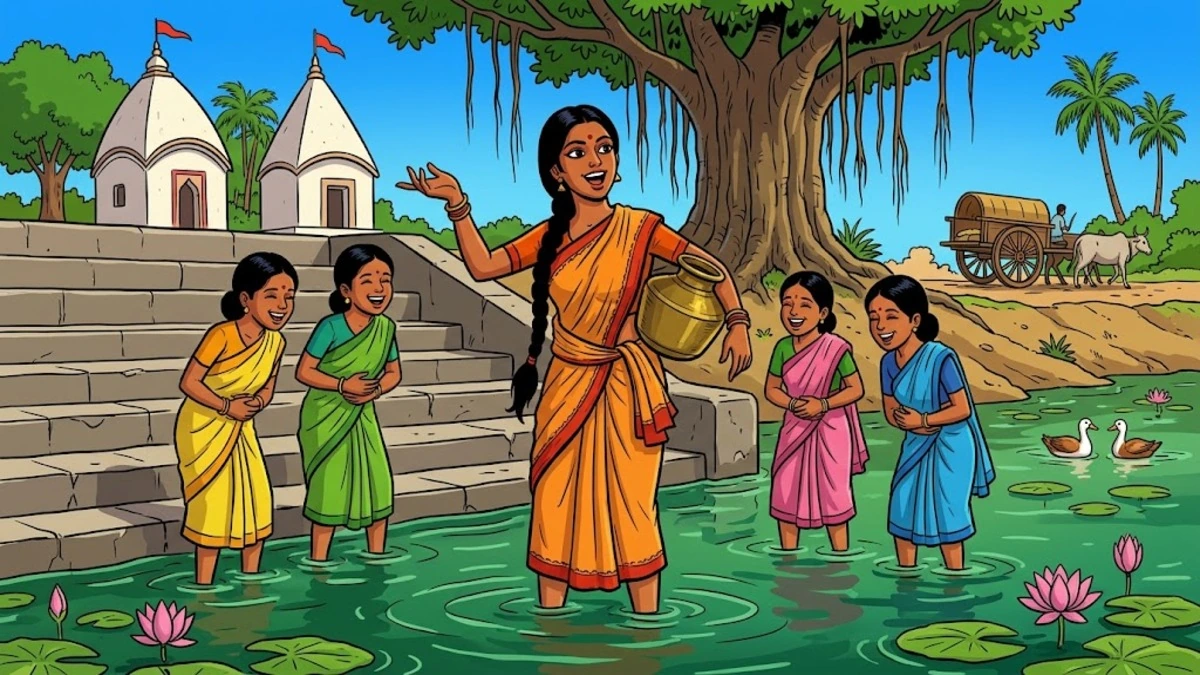
The Cow-Dung Seller’s Daughter Speaks Her Boast
In the bright old days of Bengal, when the sky still came close enough to touch and brahminy ducks still spoke a little human, there reigned a king of unrivalled splendour. He had not one queen but seven — for, says the storyteller, in those years a king’s greatness was measured by the number of wives whose marriage palanquins he had ever set down inside his palace gates. And yet, despite seven queens and seven separate apartments and seven sets of attendants, this king had no son. Year after year his treasure-rooms grew heavier and his heart grew lighter, because there was no child to inherit either.
Now in a poor lane on the outer edge of his city there lived a girl whose father sold cow-dung cakes for fuel — the lowest of village trades. She was so beautiful, the storytellers say, that the women at the village pond stopped pounding their wet clothes when she walked past. One afternoon, gossiping with her companions while she filled her brass water-pot, she laughed and made the boast that became her destiny:
“If the king himself were to take me to wife, I would bear him a son with the moon shining upon his forehead and the sun upon his chin, and a daughter with stars upon the palms of her hands.”
The other girls clutched their sides and laughed. But a court spy chanced to be drinking at the well, and that night the boast was repeated, gravely, in the king’s audience-hall. The king, weary of waiting for an heir and willing now to credit any wonder, sent his palanquin for the cow-dung seller’s daughter the very next morning. She was bathed in milk, dressed in fine silk and gold, and married as his seventh queen.
The other six queens watched from behind the lattices and bit their lips till they bled.
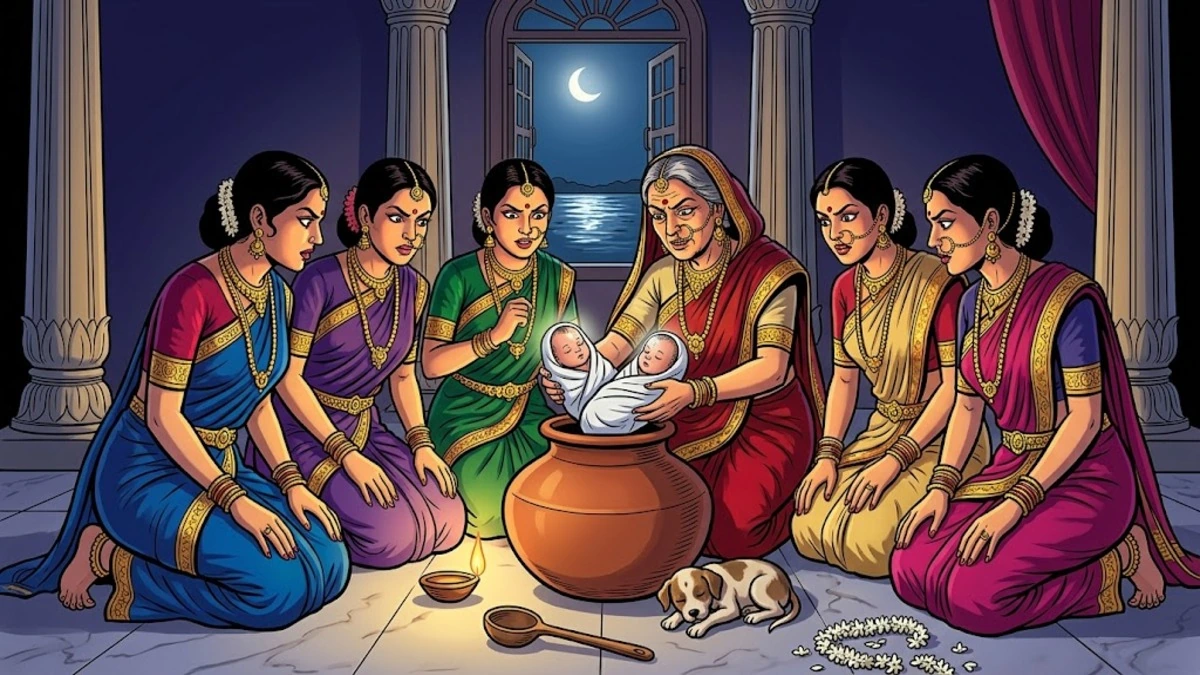
The Treachery of the Six Co-Wives
In due course the seventh queen’s pains came upon her. By the king’s command she was confined in the inner pavilion, and — by the queens’ jealous arrangement — she was attended only by the six elder wives themselves, who had told the king they wished to nurse their new sister “with their own loving hands.” When the midnight hour came, the seventh queen gave birth to twins of supernatural beauty: a boy bearing a thin moon-mark of light upon his forehead and a small golden sun upon his chin, and a girl bearing a constellation of tiny stars upon the palms of her two hands. The six queens looked at one another. They wrapped the newborn babies quickly in a clay water-pot, sealed it with mud, and at first cock-crow they rolled it down the slope of the river-ghat into the dark waters of the Ganga. In place of the babies they laid down at the seventh queen’s side a small puppy and a wooden ladle.
When the king came in the morning, the eldest queen pointed at the cradle and shook her head sorrowfully.
“O lord of the world, look what your seventh queen has brought forth — a puppy and a kitchen ladle. So much for the moon and the sun.”
The king was thunderstruck. He had been mocked, he believed, by an imposter, and his honour as a sovereign demanded a public answer. The seventh queen was stripped of her ornaments, dressed in coarse cotton, and exiled to a hut at the back of the palace stables, where the grooms threw her the leavings of their meals. There she lived for twelve long years, weeping in silence and never speaking the truth, because she did not know it.
The clay pot, meanwhile, did not sink. It floated on the wide breast of the river all that night, past temple ghats and burning grounds, and at sunrise it bumped to a stop against the bathing-steps of an old, childless gardener and his wife who had spent their whole lives praying the goddess for a child. The gardener saw the pot, broke it open with a fearful tap of his pruning-hook, and there inside lay two perfect babies, breathing as quietly as if they slept in a royal cradle. The moon-mark on the boy’s forehead glowed faintly; the stars on the girl’s palms twinkled. The old couple wept for joy and carried the foundlings home.
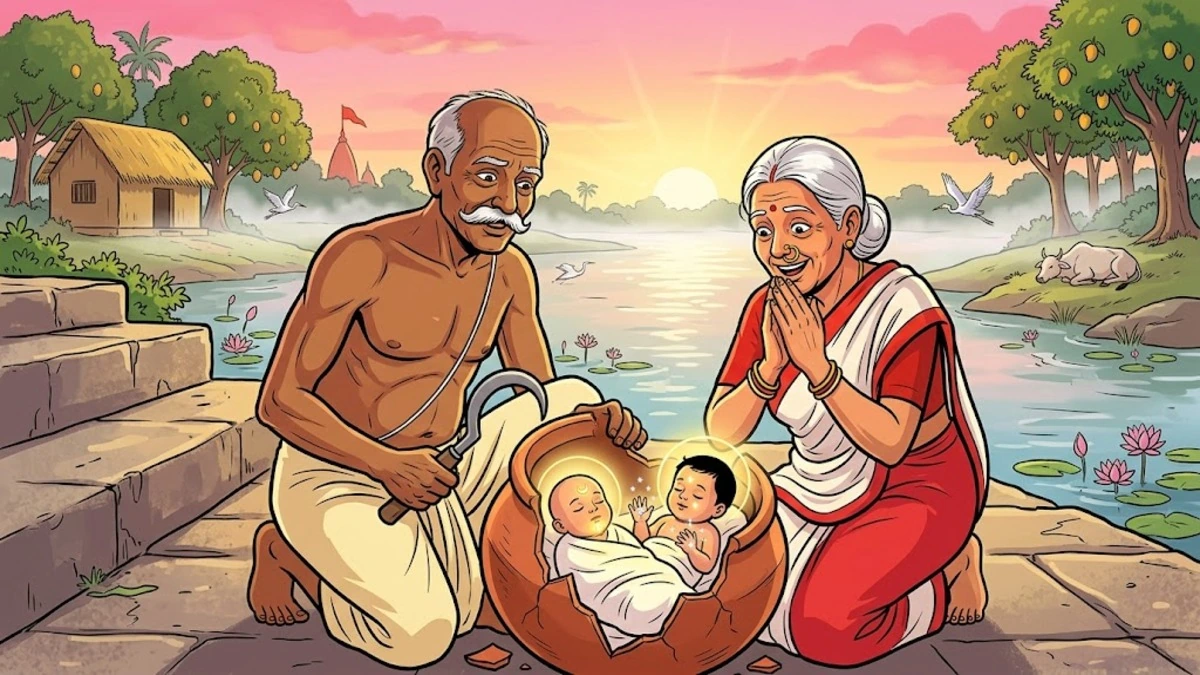
The Moon-Browed Prince Grows up in the Garden
Twelve years passed. Under the hands of the gardener and his wife the boy and his sister grew straight and brilliant. The boy could shoot an arrow that found its target through three thicknesses of plantain trunk; the girl could weave garlands so fine that bees mistook the threads for honey-stems and crawled along them. The moon-mark on the boy’s forehead and the sun-mark on his chin were so bright that the old gardener made him wear a turban very low and a chin-cloth very high, lest pilgrims walking past the hut should fall down and worship him for a god. The villagers called him only Chand-mukh, “Moon-face.”
One dry summer, a hunting party from the palace rode through the gardener’s lane. The king himself, grown old and white in the beard, reined in his horse to ask for a drink of water. The gardener’s daughter — twelve years old now, with stars hidden under her sleeves — carried out a brass tumbler on a tray. Her brother followed, head down. As he handed the tumbler up to the king, a gust of summer wind lifted his turban; the king saw the moon-mark of his prophecy looking back at him from the boy’s open forehead. The king did not speak. He drank his water, set down the tumbler with a hand that had begun to tremble, and rode home.
That evening he ordered the eldest of the six queens brought before him.
“Twelve years ago, you said my seventh wife had given birth to a puppy and a ladle. Today, in a gardener’s lane, I drank water from the hand of a boy with the moon on his forehead. Tell me again the story you told me twelve years ago.”
The queen turned the colour of cold ashes. The truth, as it always does in these tales, came out a little at a time, then all at once. The six queens confessed. The river-pot was remembered, the gardener’s hut was recalled, and on the seventh morning of investigation the seventh queen was lifted from her hut behind the stables, washed in milk, anointed with sandal-paste, and set again upon her old throne with her two recovered children one on each side of her.

The King’s Justice and the Restoration
The king then asked his court what should be done with the six women whose envy had cost an innocent woman twelve years of widowhood. The judges quoted the law-books, the priests quoted the scriptures, and at the end the king pronounced his own sentence: the six wives were to live, but to live as servants in the very stable-hut where the seventh queen had wept for so long, and their children — if they had any — were to be raised at court but never to inherit. The boy with the moon on his forehead became Yuvaraja, the prince-regent, and was crowned king in time, and his sister with the stars on her palms was married to a neighbouring rajah whose own seven queens (says the storyteller, with a small dry smile) had been wise enough never to make boasts at any village pond.
The old gardener and his wife were summoned to the palace, given houses with their names painted on the lintels, and provided for as the foster-parents of an heir to a kingdom should be. They begged, however, to be allowed to keep the original mud-walled hut by the river, “because that is where the children landed, and we like to remember it.” The king granted this also. The hut still stands, says the storyteller, in some village in Bengal whose name has been forgotten — and on certain moonlit nights the old gardener can still be seen dimly, leaning on his pruning-hook, looking out over the water.
The Moral and the Bengali Sentiment Behind It
Bengali grandmother-tellers used to seal this story with a saying that has outlived their own names. It is recorded in slightly varying forms in field-collections from the late nineteenth century; one of the simplest runs:
“সত্য কখনো জলে ডোবে না, আগুনে পোড়ে না।”
— “Sotyo kokhono jole dobe na, agune pore na.”
(“Truth never sinks in water, nor burns in fire.”)
This is the moral the tale is told for. The seventh queen is innocent — she does nothing in the story but speak a true prophecy, marry the king, give birth, and weep — and yet she suffers twelve years of disgrace because the truth has been physically thrown into a river. But the truth, the storytellers insist, has a hydrodynamics of its own: a clay pot full of truth does not sink. It floats. It drifts. It bumps against some other person’s bathing-step at the right hour of the right morning, and the truth steps out alive, and after twelve years it walks up to a king with a brass tumbler of water and lets the wind do the rest. The story trains a child’s instinct that justice may be slow, but slowness is not the same as failure.
A second sentiment, almost equally important to the Bengali listener, is the gentle dignity awarded to the cow-dung seller’s daughter. Bengali oral tradition, perhaps more than any other South Asian regional tradition, repeatedly chooses its heroines from the lowest castes — fisher-girls, oil-pressers, gardeners’ daughters, cowherd children — and elevates them not by changing their birth but by revealing that an honest tongue and a true word are nobler than seven palanquins. This is sometimes read as a Vaishnava influence (the Chaitanya tradition that swept Bengal in the 16th century preached equality of devotion), and sometimes simply as the kindness that long-suffering village women have always written into the stories they tell their daughters.
Why This Tale Has Lasted
“The Boy who had a Moon on his Forehead and a Sun on his Chin” has lasted, first, because it is one of the most narratively complete versions of ATU 707 ever recorded. The full type contains six obligatory beats — the bride’s promise, the magical birth, the substitution by jealous rivals, the casting-out of the children, the unmasking of the truth, and the punishment of the slanderers — and the Lal Behari Day version delivers all six in clean succession, with no missing parts and no accidental contradictions. Folktale scholars have used it as a “type-specimen” the way naturalists use the type-specimen of a species in a museum drawer. When you want to know what ATU 707 looks like in its purest form, you reach for this Bengali version first.
It has lasted, second, because of the haunting visual conceit: a boy whose body carries the cosmos in miniature, the moon on his forehead and the sun on his chin. This is not idle decoration. The image draws on a deep Indic motif that one finds also in the iconography of certain temple sculptures of Vishnu and the cosmic child — the godhead carrying day and night in his own face, light and reflected light, the male and the female of the heavens. To the village listener this child is a king-elect not by accident of birth but by visible cosmological appointment; his face is his coronation document.
It has lasted, third, because it gives children a workable model of patience. Twelve years is a very long time for a wronged woman to wait in silence; it is also exactly the length of time a small child cannot quite imagine, which is why it works on small children as a frightening but bearable abstraction. The story tells them that, although twelve years may be required, the gardener’s hut by the river is real, the floating pot is real, and the moment when the wind lifts the turban will eventually arrive. There is no contemporary self-help message that has ever quite replaced this. A grandmother who tells this story is teaching, very precisely, the long-form virtue that nervous adults have rebranded as “resilience.”
And it has lasted, finally, because of the small, marvellous economy of the closing. The king does not slaughter the six queens, as he might in a more violent tradition. He sentences them only to live in the hut where the seventh queen lived, and to feel for themselves what twelve years of stable-straw and groom’s leavings taste like. This is not Western retribution; it is the older, slower Indic principle of karma-phala, the fruit-of-the-deed: the queens are made to eat the meal they themselves had cooked. It is justice as a closed circuit. A child listening to this in a Bengali courtyard learns a kind of moral physics that no separate ethics lesson could teach: the wheel turns, the boy’s forehead shines, and the truth — which never sinks and never burns — comes home at last.
You May Also Like
 Indian Folk Tales
All Ages
Indian Folk Tales
All Ages
The Beetle And The Silken Thread
The Beetle And The Silken Thread: In a bustling town in ancient India, A tiny beetle accomplished what seemed impossible by following a silken thread. The
 Indian Folk Tales
All Ages
Indian Folk Tales
All Ages
Shakespeare Visits the Globe Theatre
Shakespeare Visits the Globe Theatre: It had been four hundred and fifty years or was it more? Shakespeare had for gotten. He had grown used to the constant
 Indian Folk Tales
Ages 9-12
Indian Folk Tales
Ages 9-12
The Jackal And The Crocodile
The Jackal And The Crocodile: Once upon a time, Mr. Jackal was trotting along gaily, when he caught sight of a wild plum-tree laden with fruit on the other