The Jackal And The Crocodile
The Jackal And The Crocodile: Once upon a time, Mr. Jackal was trotting along gaily, when he caught sight of a wild plum-tree laden with fruit on the other
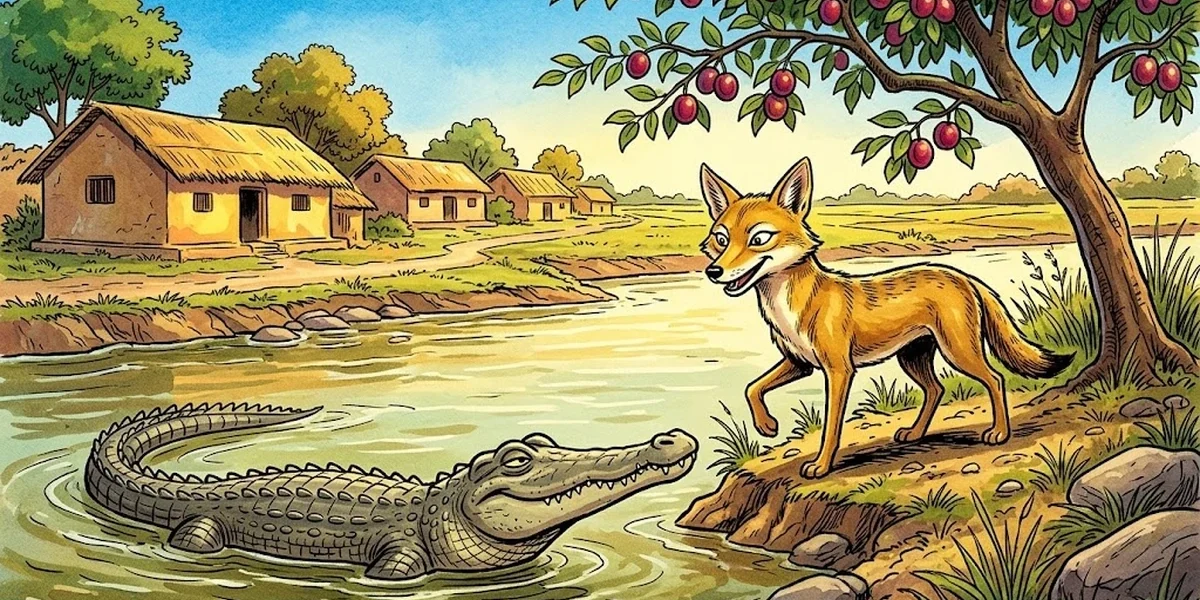
The Jackal and the Crocodile is one of the briskest of the trickster-tales collected by Flora Annie Steel and Captain (later Sir) Richard Carnac Temple in their Tales of the Punjab told by the People (Macmillan & Co., London 1894; first serialised in the Indian Antiquary 1880–1882). Mrs Steel had grown up in the canal-towns of the Punjab and the Jhelum valley, and she took the tale down in the late 1870s from the village women of Kasur, Lahore district, in the Punjabi register that her ear had been trained on since childhood; Captain Temple, then on duty with the Bengal Staff Corps in Ambala, supplied the comparative folkloric notes that fill the appendix of the volume and that turn the small playful animal-fable into a useful piece of comparative philology. The tale is short — in the 1894 edition it occupies barely four pages — but it preserves a particular Punjabi flavour of chālākī or trickster-cunning, in which the seemingly weaker animal escapes the larger predator by a final trick of misdirection that turns the predator’s own anger against him.
This study-companion sets the tale inside its long Indian and comparative inheritance. Sources consulted include Flora Annie Steel and R. C. Temple’s Tales of the Punjab told by the People (Macmillan, London 1894), with the Temple notes and the J. Lockwood Kipling line-illustrations of the first edition; Joseph Jacobs’s Indian Fairy Tales (David Nutt, London 1892), in which a closely related recension was reprinted for English children; the Pañcatantra in Franklin Edgerton’s reconstructed text (American Oriental Series 1924) and Arthur W. Ryder’s translation (Chicago 1925), Book IV Labdha-praṇaśa (The Loss of Gains), in which the parallel monkey-and-crocodile tale stands; the Suṃsumāra Jātaka (Pali Jātaka no. 208) and the Vānarinda Jātaka (Pali Jātaka no. 57), edited by V. Fausbøll (London 1877–1896) and translated by E. B. Cowell and others (Cambridge 1895–1907) for the older Buddhist substrate; Sir Richard Carnac Temple’s own three-volume Legends of the Panjāb (Trübner London 1884–1900) for the Punjabi proverbial register; A. K. Ramanujan’s Folktales from India (Pantheon 1991) and The Collected Essays of A. K. Ramanujan (OUP 1999) on the Indian trickster-cycle; Hans-Jörg Uther’s The Types of International Folktales (FFC 284–286, Helsinki 2004) where the closing motif belongs to ATU 78A and ATU 91 with strong colouring from ATU 1310; and Stith Thompson’s Motif-Index of Folk-Literature (Bloomington 1955–1958) for motifs K544 (Escape by misrepresenting the nature of captor’s grip), K607.3 (Predator deceived into biting a tree-root), K561.1 (Animal escapes by misdirected captor) and J1771 (Object mistaken for a body-part).
Provenance and Tale-Type
The Steel–Temple recension belongs to the Indian jackal-and-water-creature family, which has at its head two famous Buddhist Jātakas. In the Vānarinda Jātaka (Jātaka 57), the Bodhisatta is born as a monkey-king who outwits a crocodile lying on a rock pretending to be still and innocent, and he leaps over the river with a clever cry that betrays the crocodile’s silence. In the Suṃsumāra Jātaka (Jātaka 208), the Bodhisatta is again a monkey, this time tricked into riding upon a crocodile’s back across the river, and he saves himself by claiming that his heart is hanging back on a fig-tree on the further shore. The Pañcatantra Book IV (Edgerton’s reconstruction, c. 200 BCE – 300 CE) preserves the same monkey-and-crocodile fable as Labdha-praṇaśa, “The Loss of Gains,” with the heart-on-the-tree trick at its centre. The Steel–Temple Punjabi recension keeps the river-and-fruit setting and the false-friendship motif, but substitutes the jackal for the monkey and adds the romantic-deception opening (the jackal’s pretended courtship of the crocodile) that is peculiar to North Indian and Punjabi village storytelling.
Hans-Jörg Uther’s Types of International Folktales (FFC 284 vol. I, pp. 81–83) classifies the parent type as ATU 91 Monkey (Cat) Who Left His Heart at Home, with sub-type 91A for the river-crossing variants. The Steel–Temple tale is a Punjabi flowering of ATU 91 with a closing motif drawn from ATU 78A Animal Tied to the Bull and ATU 1310 Drowning the Crayfish as Punishment, the great “Br’er Rabbit and the briar patch” type in which the trickster escapes by inducing the captor to seize a substitute object — here the wooden root of a riverbank tree mistaken for a leg. The motif is catalogued by Stith Thompson as K607.3 (Predator deceived into biting a tree-root), and it occurs across the Indo-European folk-tale world: in the African-American Br’er Rabbit cycle of Joel Chandler Harris (Uncle Remus, His Songs and His Sayings, New York 1881), in the Russian Lis i Volk (“Fox and Wolf”) of Afanasyev’s Narodnye russkie skazki (Moscow 1855–1864 vol. I no. 1), and in the Greek Aesop fable The Wolf and the Lamb at the Brook (Perry index 155).
The romantic-deception opening — in which a male trickster proposes marriage to a female aquatic creature in order to be carried across a river to a fruit-tree — is a Punjabi village invention that does not appear in the older Sanskrit and Pali sources. R. C. Temple’s note in the appendix of the 1894 edition (pp. 287–289) suggests that the village storytellers of Kasur grafted the courtship motif onto the older monkey-and-crocodile fable in order to make the trickster’s deceit doubly satisfying, since false friendship is bad enough but false love is worse, and the crocodile’s revenge therefore feels more dramatic when it comes. Mrs Steel herself, in her brief preface (1894 p. xiv), credits the tale specifically to “an old grand-mother of the village of Pattoki” and notes that the same grand-mother sang her a Punjabi tappa — a short rhyming distich — in which the same trick reappears in human form, with the cunning shepherd of Kasur and the foolish moneylender of Lahore.
The Tale as Steel Recorded It
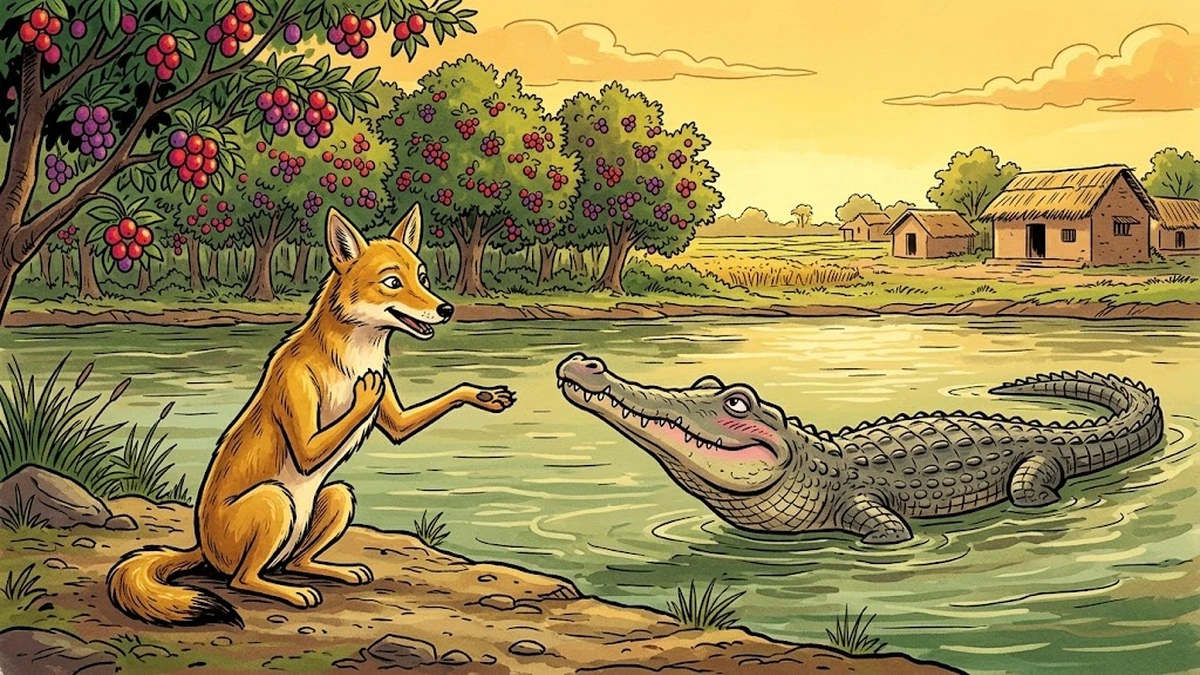
The Steel–Temple recension opens, as the village grand-mother of Pattoki opened it, with the jackal trotting along the bank of a broad deep stream in the late summer, when the wild-plum trees of the Punjab are at their full ripeness and the water is at its low slow flow before the autumn cold begins. The jackal sees the plums on the further bank, sits down to consider his hunger, and cannot find a way across. Just then a young female crocodile (magar in Punjabi, the marsh crocodile Crocodylus palustris that still inhabits the Indus and Jhelum tributaries) comes drifting down the stream with her snout in the air. The jackal at once turns courtier: he praises the crocodile’s smooth skin, her elegance in the water, the proud way she carries herself, and proposes that the two of them — if only she would carry him across — might share a fine feast of plums together on the further bank.
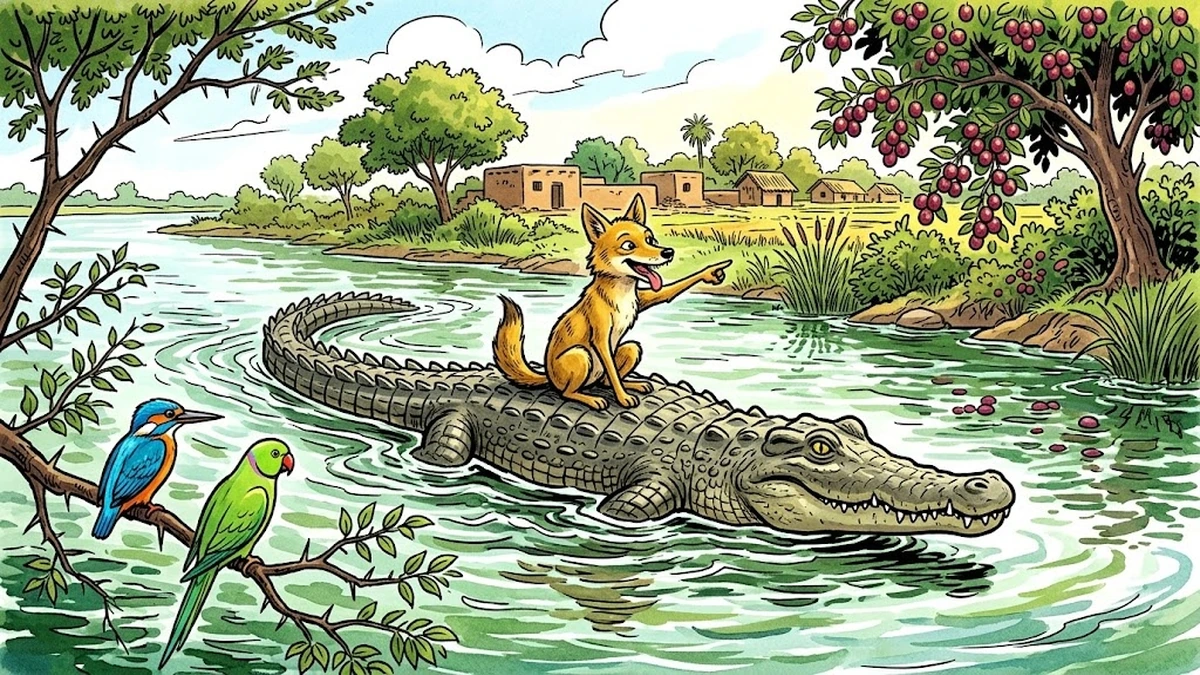
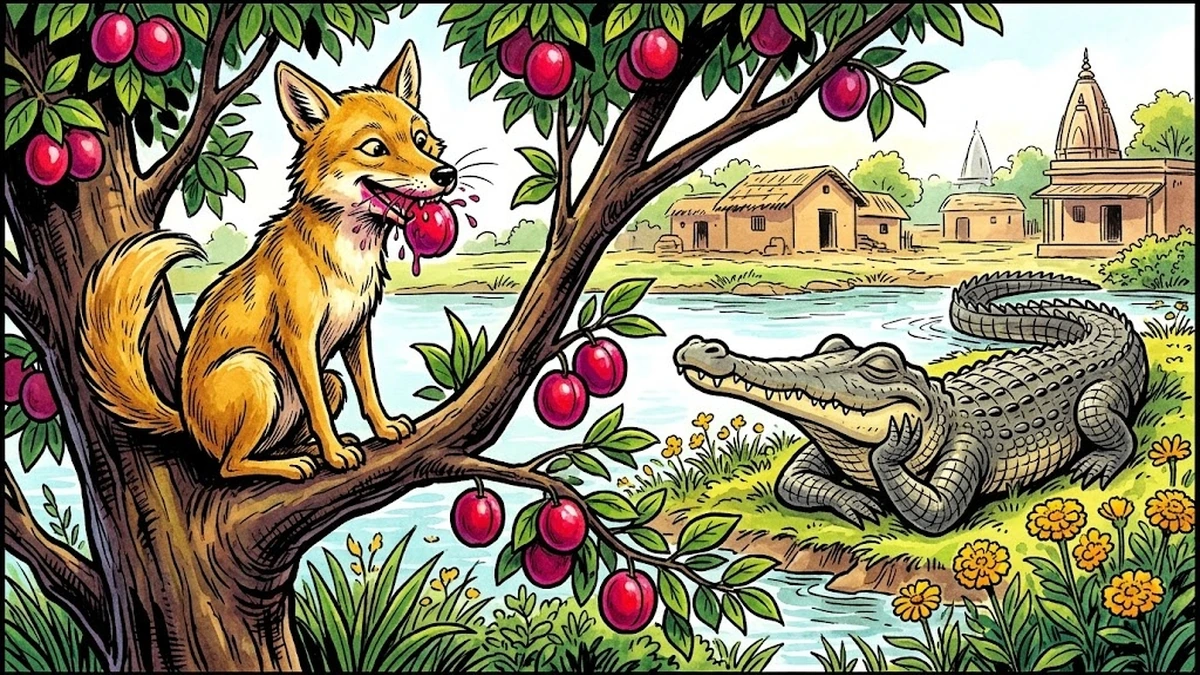
The crocodile, who has been told by no one before that she is elegant, simpers and blushes (in the storyteller’s good comic register) and says that she could not possibly go out to dinner with a male of her acquaintance unless something more were settled between them — unless, she ventures at last, the two of them were going to be married. The jackal, with the practised glibness of every village trickster from the Suṃsumāra Jātaka onwards, replies that of course they shall be married, and that he himself will go and fetch the village barber to draw up the betrothal — but he is so weak with hunger at this moment that he could not walk to the village; if she will only carry him across to the plums he will eat enough to gain strength, and then return with her to the proper ceremonies. The crocodile, charmed and a little frightened, carries him across. The jackal climbs the wild-plum tree, eats his fill, comes down with his belly tight, and is carried back across the stream in the same warm gallant manner. As soon as his paws touch the home bank he calls out a careless farewell, says he will be back as soon as he has found the barber and the proper witnesses, and trots off into the long grass with his tail held high.
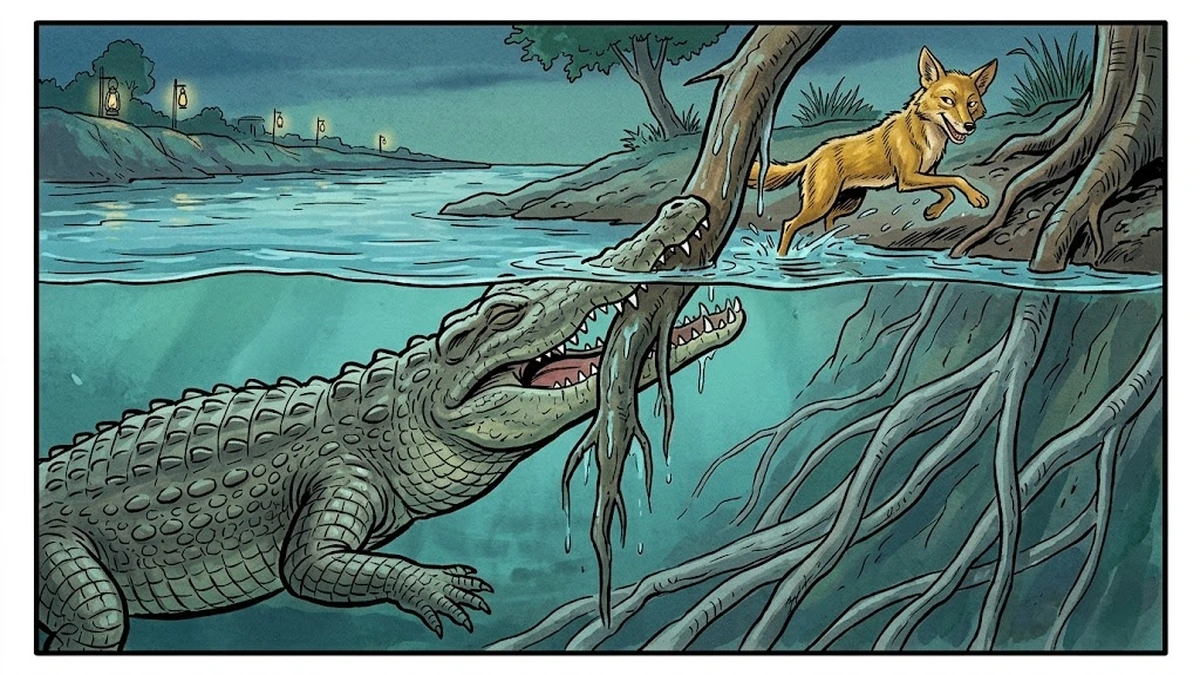
It is the second half of the tale that gives it its particular Punjabi flavour. The crocodile, of course, waits at the water’s edge for the bridegroom who never returns. By and by she begins to suspect; by and by she begins to know; and at last she resolves on her revenge. She slides into the water, she swims down to the village ford where the jackal always comes to drink in the evening, and she hides herself among the long submerged roots of an old kikar tree (Acacia nilotica, the thorn-acacia of every Punjabi watercourse) close under the bank. When the jackal comes lilting along in his self-satisfied way, dips his snout into the water for a long evening drink, the crocodile seizes his right foreleg in her jaws and holds on.
The jackal, in the moment before pain has fully reached his thinking, plays the only card a trickster ever has — he reverses the picture in the captor’s mind. He calls out, in a voice of patient amused disappointment, that the silly crocodile has caught hold of an old root from the kikar tree by mistake, and that if she really wants to drown him she had better let go of that and seize the leg next door, which she can plainly feel under her snout. The crocodile, whose anger has been growing for many days and whose mind in this moment is more full of revenge than of seeing-what-is-actually-there, opens her jaws to release the supposed root, snaps them shut on the supposed leg — and the jackal, freed, springs out of the water and away up the bank with a final loud laugh that the storyteller of Pattoki rendered, in the Punjabi village register, as tuṛṛam, magar-i sāṛūn! — “you are a fool, my crocodile-bride!”
The Indian Antecedents: Monkey, Crocodile, and Jackal
The trick of the substituted body-part — in which the captive misdirects the captor’s bite onto a stick, a stone, a tree-root, or a piece of bone — is one of the oldest patterns in the Indian fable. In the Suṃsumāra Jātaka (Cowell ed. vol. II, pp. 110–112) the Bodhisatta as monkey is carried across the Ganges on the back of a crocodile and learns midstream that the crocodile means to drown him for the sake of his heart, which his crocodile-wife has demanded as a remedy for her pregnancy-craving; the Bodhisatta replies that monkeys keep their hearts hanging on the fig-tree at home (so as to keep them safe while leaping among thorny branches) and that, if the crocodile will only carry him back to the home shore, he will gladly fetch his heart from the tree. The crocodile, persuaded, swims back; the monkey leaps to safety; the Bodhisatta finishes the story with a four-line Pāli verse on the worthlessness of friendship that does not survive a single journey across a river. The Pañcatantra Book IV preserves the same fable as the centrepiece of Labdha-praṇaśa (“The Loss of Gains”), and Edgerton in his reconstruction places it at the very head of the book.
The Punjabi grandmother who told the tale to Mrs Steel knew, of course, neither the Pāli nor the Sanskrit text directly. What she had inherited was the village afterlife of those texts — the substance, the structure, the moral — refracted through five hundred years of oral retelling and rearranged for the particular mountain-and-canal landscape of the Lahore-and-Kasur countryside. The substitution of the jackal for the monkey is itself a North Indian preference: the monkey is a Bengal-and-Konkan animal, but the jackal is the trickster par excellence of the Punjab and the United Provinces, where the dry plains and the canal-bank thickets are his proper habitat. Sir Richard Carnac Temple, in his appendix note (1894 pp. 287–289), assembles a long list of Punjabi jackal-tales in which the same animal performs this same trickster role: the jackal who tricks the cobbler in Tales of the Panjāb tale XII, the jackal who teaches the lion to fish in tale XVIII, the jackal-and-iguana of the Hoshiarpur cycle, and the great Siār-nāma (“Jackal-tales”) of the Punjabi kissa tradition collected by William Crooke in his Folk-Lore of Northern India (Allahabad 1894 vol. II, pp. 227–236).
The romantic-deception opening of the Steel–Temple recension — the jackal’s pretended courtship of the crocodile — is a Punjabi addition to the older fable. In the Jātaka and Pañcatantra forms the monkey and the crocodile are merely friends, or at most acquaintances; the monkey climbs onto the crocodile’s back out of friendly trust, not love. By making the crocodile’s offer of the river-crossing depend upon a false promise of marriage, the Punjabi storyteller has sharpened both the crocodile’s later anger and the jackal’s later cleverness. False love, in the Punjabi village register, is the most contemptible of crimes; the jackal’s escape is therefore not merely the trickster’s customary cleverness but a positive moral re-balancing — the crocodile, having been deceived in her affections, now wishes only to kill the deceiver, and her excess of revenge is what permits the jackal’s substitution-of-the-root trick to succeed.
The Closing Trick: The Wooden Root and the Substituted Leg
The closing motif — in which the captive misdirects the captor’s bite from a real leg onto a wooden root, or vice versa — is the single most travelled pattern in the world’s trickster-fable repertoire. Stith Thompson (Motif-Index of Folk-Literature vol. IV, p. 404) catalogues it as motif K607.3, and gives a long list of cognates: the African-American Br’er Rabbit and the tar-baby (Joel Chandler Harris, 1881), the Russian fox-and-wolf cycle (Afanasyev 1855–1864), the Aesop fable of The Wolf and the Lamb at the Brook (Perry 155), the Ethiopian Amharic qənə ləndilas in Enno Littmann’s Publications of the Princeton Expedition to Abyssinia (Leyden 1910 vol. II, pp. 212–215), the Tibetan Buddhist Kārmajātikalpadrumāvalī tale 17, the West African Anansi-and-the-Tiger cycle of the Akan oral tradition (R. S. Rattray, Akan-Ashanti Folktales, OUP 1930 nos. 31–34), and the Caribbean Compère Lapin tales recorded by Lafcadio Hearn (Two Years in the French West Indies, New York 1890). In every cognate the captive offers the captor an alternative target, the captor accepts the misdirection, and the captive escapes — the structural identity is exact across four continents.
The Punjabi inflection of the trick is the kikar tree-root setting and the river-bank ford. In the dry plains of the Lahore district, every village watercourse is bordered by long thorn-acacias whose roots, washed bare by the seasonal floods, hang into the water like a grey lattice of submerged ropes. A village child who comes to the ford in the evening to fetch water, or a hunter who comes to the ford to drink, would have seen those roots a thousand times and would have known how easy it is, in the dim light of the dusk, to mistake one for the other. The Punjabi storyteller is asking the listener, in effect, to remember her own village ford and her own kikar roots, and to feel through her own remembered hand the moment in which the crocodile’s snout closes on the wrong target.
That sensory specificity is what marks a real folk-tale off from a literary borrowing. Mrs Steel, in her preface (1894 p. xv), notes that the village storytellers of Kasur “always had something in their hand or under their foot — a piece of cooking-stick, a flake of dung, a corner of the cot — which they would point to in the middle of the tale, as if to say, this is the very kind of stick that the jackal sat upon, this is the very kind of branch the bandar climbed.” The Steel–Temple recension preserves a little of that pointing-finger immediacy: the wild-plum tree on the further bank, the kikar root at the ford, the magar who is plainly the local marsh crocodile and not some abstract sea-monster. The tale is therefore not only a fable but a small piece of Punjabi village topography.
The Moral and Its Original-Language Form
ਅਕਾਾਸ਼ ਜੇਹਾ ਹਮਿਆਾਂ ਨਹੀਂ।
akl jehā hathĭyār nahīṅ.
“There is no weapon like wit.”
So runs the Punjabi proverb that Mrs Steel and Captain Temple chose as the verbal moral of the tale, recorded in Captain Temple’s Legends of the Panjāb vol. I appendix p. 312 (Trübner London 1884) and again in the appendix of the Tales of the Punjab 1894 edition p. 292. The literal translation is sharper than the English: akl is not “wit” in the sense of mere humour but the practical reasoning intelligence which the Punjabi village register places at the head of all virtues; hathĭyār is not any weapon but specifically the cutting edge of a steel weapon, the sāber or the dagger, the sharp-edged tool that can do what brute strength cannot. The proverb says, in effect, that no axe and no sword can cut what the practical reasoning intelligence cannot cut, and conversely that the practical reasoning intelligence will cut what no axe can. The jackal of the tale, weaker than the crocodile in tooth and skin, defeats her by exactly this akl, by reading her mind and turning her own anger into the lever of his escape.
The same lesson is preserved across Indian and Persian wisdom-literature in close cousins. The Sanskrit Pañcatantra Book III (the Kākolūkīya, “Crows and Owls”), in Edgerton’s text (1924 vol. I p. 293), gives it as buddhir yasya balaṃ tasya, nirbuddhes tu kuto balam — “He who has wisdom has strength; the witless, where can he get strength?” The Hitopadeśa of Nārāyaṇa Paṇḍita (c. 1200 CE) Book I.34, in Sir Edwin Arnold’s English version (London 1861 p. 48), gives it as “the strong are the slaves of the wise, as the elephant is the slave of the man with the goad”. The Persian Saʻdī in the Gulistān (1258 CE) Book VIII.14 puts it: tadbīr-i zūrmand-rā az tadbīr-i dānā nashāyad — “the strong man’s strategem is no match for the wise man’s.” Aesop’s Greek fable The Lion and the Mouse (Perry 150) makes the same point with a different beast-pair, and Phaedrus’s Latin Vulpes et Cervus (Phaedrus I.13) lays it down as vires astutia vincit — “cunning conquers strength.” Across the wisdom-literatures of Hellas, Iran, Bhārata and the Punjab, the lesson is the same: the practical reasoning intelligence, in extremity, beats tooth and claw.
Why The Tale Has Lasted
The careful reader will notice that The Jackal and the Crocodile is one of the shortest tales in the entire Steel–Temple volume, but that it carries one of the densest moral payloads. Two characters, four short scenes, one substitution-trick — and yet it carries on its small back the full weight of the Jātaka and Pañcatantra inheritance, the Punjabi village topography, the Indo-Persian wisdom-literature, and the Aesopic motif-tradition of the wider Indo-European world. That density is part of the answer to the question of why the tale has lasted: a folk tale survives across centuries not because it is large but because it is well made, not because it is full of incident but because every incident has been turned into something useful.
The other part of the answer is that the lesson of akl jehā hathĭyār nahīṅ — “there is no weapon like wit” — is exactly the lesson that the listener of any age most needs. We do not all have crocodile teeth and crocodile skin, and very few of us are likely to find ourselves seized by the leg in a village ford; but every child encounters, sooner or later, a situation in which the larger thing or the stronger person is leaning over her and she has only her own head to save herself with. The tale is a rehearsal of that universal moment. By the time the child has heard the jackal’s “you are a fool, my crocodile-bride!” once or twice, she has already learnt the inner pattern of the trick — that fear closes the eyes, that anger closes the eyes, that the captive who can stay calm enough to look around her may find a wooden root close under her hand which the captor will accept as a substitute. That is a piece of akl as useful in a 21st-century classroom or office as in an 1880 Punjabi ford.
It is also worth saying that the tale is funny. Mrs Steel’s voice in the 1894 retelling is plainly amused: the crocodile’s romantic blushes, the jackal’s mock courtship, the deadpan substitution of the kikar root for the leg, are all rendered with the comic timing of a storyteller who has seen the village grand-mother of Pattoki land each laugh exactly where she meant to. The presence of comedy is not incidental to the moral: a child remembers a moral she has laughed at, but she forgets a moral she has only been told. The Paṇḍita Nārāyaṇa knew that, and the village grand-mother of Pattoki knew it, and Mrs Steel knew it, and that is why the tale crossed the seven hundred years between the Hitopadeśa and the 1894 Macmillan edition with its laughter still intact.
Why does it matter still, in 2026, that an old grand-mother of a Lahore-district village told a tale about a jackal and a crocodile and a wild-plum tree? It matters because the practical reasoning intelligence is not a luxury but the only weapon that the smaller and weaker animal — that the child, the powerless, the new arrival, the unjustly cornered — ever has. The lesson cannot be told often enough. As long as there are children there will be ways for them to find themselves cornered, and as long as there are folk tales there will be small reusable rehearsals of how a clever head can re-balance a contest that brute strength has tried to fix. The Jackal and the Crocodile is one such rehearsal. It is small. It is funny. It is entirely to the point. And, four pages long in the 1894 edition, it has done its quiet teaching for a hundred and thirty years and is ready to do another hundred and thirty.
Bibliographic apparatus. Primary text: Flora Annie Steel and R. C. Temple, Tales of the Punjab told by the People, with notes by R. C. Temple and illustrations by J. Lockwood Kipling (Macmillan & Co., London 1894), serialised earlier in the Indian Antiquary 1880–1882. Reprint for children: Joseph Jacobs, Indian Fairy Tales (David Nutt, London 1892), tale 25. Indian antecedents: the Pañcatantra in Franklin Edgerton, The Pañcatantra Reconstructed, American Oriental Series vols. 2–3 (New Haven 1924); Arthur W. Ryder, The Panchatantra (Chicago 1925), Book IV; the Suṃsumāra Jātaka (no. 208) and Vānarinda Jātaka (no. 57) in V. Fausbøll, The Jātaka, together with its Commentary 6 vols. (Trübner London 1877–1896), trans. E. B. Cowell et al., The Jātaka, or Stories of the Buddha’s Former Births 6 vols. (CUP Cambridge 1895–1907); the Hitopadeśa of Nārāyaṇa Paṇḍita (c. 1200 CE), trans. Sir Edwin Arnold (London 1861); the Muṇḍaka Upaniṣad III.1.6 for satyam eva jayate. Punjabi comparative: R. C. Temple, Legends of the Panjāb 3 vols. (Trübner London 1884–1900); William Crooke, Folk-Lore of Northern India 2 vols. (Allahabad 1894); Charles Swynnerton, Romantic Tales from the Panjāb (Constable London 1903); the Siār-nāma recensions in the Punjabi kissa tradition. Persian and Arabic comparative: Saʻdī, Gulistān (1258 CE), trans. Edward Eastwick (Hertford 1852); the Kəlīla wa-Dimna of Ibn al-Muqaffaʻ (c. 750 CE), trans. Wyndham Knatchbull (Oxford 1819); the Anvār-i Suhaylī of Husayn Vāʻiẓ Kāshifī (c. 1500 CE), trans. Edward Eastwick (Hertford 1854); the Aesopic Greek Vita et Fabulae Perry index nos. 150, 155; Phaedrus I.13. European and African comparative: A. N. Afanasyev, Narodnye russkie skazki 8 vols. (Moscow 1855–1864), tales 1–15; Joel Chandler Harris, Uncle Remus, His Songs and His Sayings (New York 1881); R. S. Rattray, Akan-Ashanti Folktales (OUP 1930); Enno Littmann, Publications of the Princeton Expedition to Abyssinia (Leyden 1910); Lafcadio Hearn, Two Years in the French West Indies (New York 1890). Tale-type and motif: Hans-Jörg Uther, The Types of International Folktales 3 vols. (FFC 284–286, Helsinki 2004), ATU 91, 78A, 1310; Stith Thompson, Motif-Index of Folk-Literature 6 vols. (Bloomington 1955–1958), K544, K561.1, K607.3, J1771. Modern critical reception: A. K. Ramanujan, Folktales from India (Pantheon 1991); Wendy Doniger, The Hindus: An Alternative History (Penguin 2009); Sadhana Naithani, The Story-Time of the British Empire (UP Mississippi 2010) on the Steel–Temple archive; Patricia Sieber and Sara Marzioli, How To Read Chinese Drama (Columbia 2022) on the comparative Asian trickster cycle. Iconography: J. Lockwood Kipling, line-illustrations to Tales of the Punjab (Macmillan 1894); the Pahari Kangra and Basohli paintings of the Pañcatantra cycle, c. 1750–1800 (National Museum, New Delhi); the Mughal Akbar-nāma workshop animal-fable folios c. 1590 (V&A IS.2:1–1896); Warwick Goble’s plates for Folk-Tales of Bengal (Macmillan London 1912); Edmund Dulac’s plates for Stories from the Arabian Nights (Hodder & Stoughton London 1907).
The Jackal and the Crocodile is a small story about a hungry jackal, a foolish crocodile, a wild-plum tree on the far side of a Punjabi stream, and the kikar-root trick at the village ford. It is also, in the Punjabi storyteller’s careful framing, a long argument that there is no weapon like wit — that the smaller animal who keeps her head is worth more, in the long run, than the larger animal who lets her anger close her eyes. That argument has been making its way, quietly, through Punjabi village evenings since long before Mrs Steel and Captain Temple wrote it down in 1894. It is making its way still. The work of a study-companion is only to make sure that, when the next storyteller picks the tale up — by the riverside on a school trip, or beside the heater in a Lahore flat, or on the screen of a child’s phone in a London suburb — the listener recognises what is being asked of her, and answers, with the jackal of Pattoki and the village grand-mother who first told the tale, that akl jehā hathĭyār nahīṅ: there is no weapon like wit.
Frequently Asked Questions
Who recorded The Jackal and the Crocodile and when?
The English-language recension is by Flora Annie Steel, who took it down from a village grandmother of Pattoki in the Lahore district of the Punjab in the late 1870s. It was first published with comparative notes by Captain (later Sir) Richard Carnac Temple in the Indian Antiquary 1880–1882, and collected into the Macmillan volume Tales of the Punjab told by the People in 1894 with line-illustrations by J. Lockwood Kipling. The Punjabi oral substrate the village grandmother was working from is much older, drawing on Pañcatantra Book IV and the Pali Suṃsumāra Jātaka (no. 208) and Vānarinda Jātaka (no. 57).
What ATU and Stith Thompson motifs does the tale belong to?
Hans-Jörg Uther’s Types of International Folktales (FFC 284 vol. I pp. 81–83) classifies the parent type as ATU 91 ‘Monkey (Cat) Who Left His Heart at Home’, with sub-type 91A for river-crossing variants. The closing kikar-root trick belongs to ATU 78A and ATU 1310 ‘Drowning the Crayfish as Punishment’, the Br’er Rabbit-and-the-briar-patch family. In Stith Thompson’s Motif-Index of Folk-Literature the trick is K607.3 (predator deceived into biting a tree-root), with relatives at K544 (escape by misrepresenting the captor’s grip), K561.1 (animal escapes by misdirected captor) and J1771 (object mistaken for a body-part).
How does this Punjabi recension differ from the older Pañcatantra and Jātaka forms?
Two Punjabi additions distinguish the Steel–Temple recension. First, the trickster is a jackal rather than a monkey — a North Indian preference, since the jackal is the trickster animal of the Punjab dry plains while the monkey is more typical of Bengal and Konkan recensions. Second, the romantic-deception opening, in which the jackal pretends to court the crocodile in order to be carried across the river, is a Punjabi invention not present in the Pañcatantra Labdha-praṇaśa or in the Suṃsumāra Jātaka. Captain Temple’s appendix note (1894 pp. 287–289) suggests the village storytellers grafted the false-courtship motif onto the older fable to sharpen the crocodile’s later revenge: false love, in the Punjabi village register, is the most contemptible of crimes.
What is the original-language moral and what does it mean?
The Punjabi proverb that Steel and Temple chose as the verbal moral is akl jehā hathīyār nahīṅ (‘there is no weapon like wit’), recorded in Temple’s Legends of the Panjāb vol. I appendix p. 312 and again at Tales of the Punjab 1894 p. 292. Akl is not humorous wit but the practical reasoning intelligence; hathīyār is specifically the cutting edge of a steel weapon. The proverb says that no axe and no sword can cut what practical reasoning cannot, and that practical reasoning will cut what no axe can. Cousins of the lesson appear in Pañcatantra III as buddhir yasya balaṃ tasya (‘he who has wisdom has strength’), in Saʻdī’s Gulistān VIII.14, in Aesop’s Lion and Mouse (Perry 150), and in Phaedrus I.13 vires astutia vincit (‘cunning conquers strength’).
Why does this small four-page tale still matter for modern readers?
Because the practical reasoning intelligence is not a luxury but the only weapon the smaller and weaker animal — the child, the powerless, the unjustly cornered — ever has. The closing kikar-root substitution is a small reusable rehearsal of the universal moment in which a larger thing leans over the listener and only her own head is left to save herself with. The tale is also funny: the crocodile’s romantic blushes, the jackal’s mock courtship, the deadpan substitution of the kikar root for the leg are all delivered with the comic timing of a Pattoki village grandmother who has seen each laugh land. As the Paṇḍita Nārāyaṇa knew and Mrs Steel knew, a child remembers a moral she has laughed at but forgets a moral she has only been told — which is why the tale crossed the seven hundred years between the Hitopadeśa and the 1894 Macmillan edition with its laughter still intact.
Frequently Asked Questions
**Q: Why is this story important?**
You May Also Like
 Indian Folk Tales
Ages 9-12
Indian Folk Tales
Ages 9-12
How Raja Rasalu Was Born
How Raja Rasalu Was Born: Once there lived a great Raja, whose name was Sâlbâhan, and he had two Queens. Now the elder, by name Queen Achhrâ, had a fair young
 Indian Folk Tales
All Ages
Indian Folk Tales
All Ages
The Billy Goat And The King
The Billy Goat And The King: In the ancient kingdom of Varanasi, there lived a king who was known for his piety and his devotion to religious rituals. The
 Indian Folk Tales
Ages 3-5
Indian Folk Tales
Ages 3-5
The Son Of Seven Queens
The Son Of Seven Queens: Once upon a time there lived a King who had seven Queens, but no children. This was a great grief to him, especially when he The