Why the Fish Laughed
When a fish in a basket laughs out loud at the queen, the king gives his chief minister six months to find out why, or lose his life.
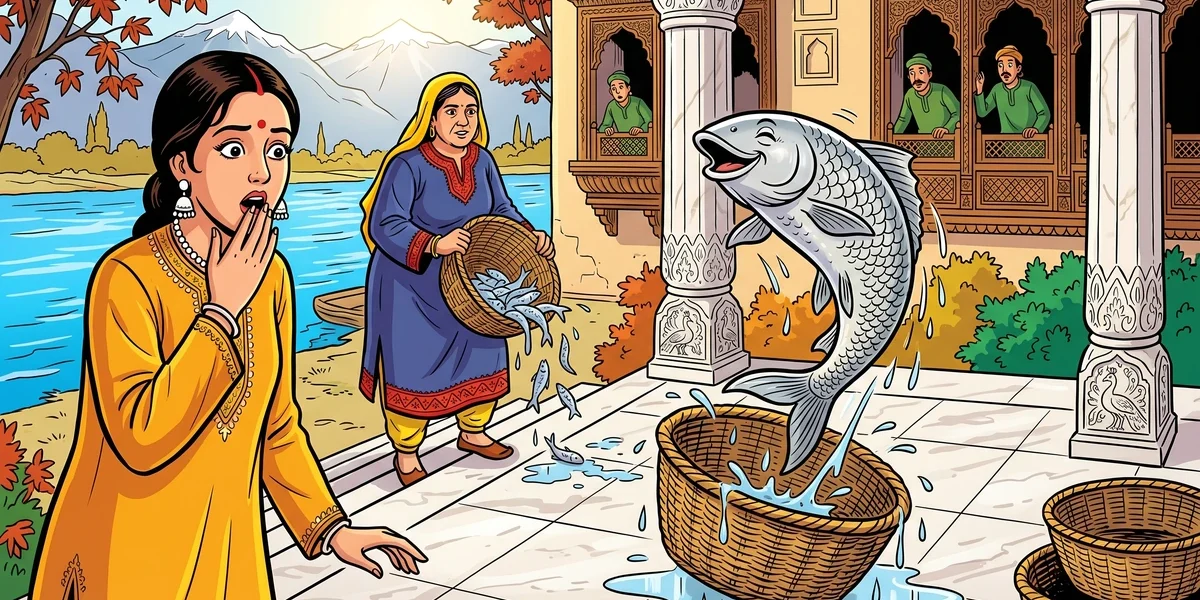
A fisherwoman was walking past a palace, calling out that she had fish to sell. The queen came to a window and waved to her to come closer and show what she had. Just then a very big fish jumped about in the bottom of the basket.
“Is it a he or a she?” asked the queen. “I want to buy a she-fish.”
When the fish heard this, it laughed out loud!
“It’s a he,” said the fisherwoman, and she went on her way.
The queen went back to her room in a terrible temper. When the king came to see her that evening, he could tell that something had upset her.
“Are you unwell?” he asked.
“No, but I am very cross about a fish. A woman brought one to me today, and when I asked whether it was a he or a she, the fish laughed at me, most rudely.”
“A fish laughed? Impossible! You must have been dreaming.”
“I am not silly. I saw it with my own eyes and heard it with my own ears.”
“How very strange! Well, I will find out about it.”
The next day the king told his vizier, his chief minister, what the queen had said. He ordered him to find out why the fish had laughed and bring a good answer within six months, or he would be put to death. The vizier promised to do his best, though he was almost sure he would fail. For five months he worked without rest. He asked everyone, everywhere. He asked the wise and the learned, and people who knew magic and all kinds of tricks. But nobody could explain it. So he went home with a broken heart and began to put his affairs in order, for he knew the king never went back on his word. He told his son to go travelling for a while, until the king’s anger had cooled.
The son was clever and handsome, and he set off wherever fate might lead him. After some days he met an old farmer who was walking to a certain village. The old man was pleasant company, so the young man asked if he could walk with him, saying he was going to the same place. The farmer agreed. The day was hot, and the road was long and tiring.
“Don’t you think it would be nicer if we gave each other a lift now and then?” said the young man.
“What a silly fellow!” thought the old farmer.
Soon they passed a field of ripe wheat, waving like a golden sea in the breeze. “Is this eaten or not?” asked the young man.
The old man did not understand, so he said, “I don’t know.”
When they reached a big village, the young man handed his companion a pocket knife. “Take this, friend, and get two horses with it,” he said. “But be sure to bring it back, for it is very precious.”
The old man pushed the knife away, half amused and half annoyed, and muttered that either his friend was a fool or he was trying to make a fool of him. The young man pretended not to hear, and said hardly a word until they reached the city, near the farmer’s home. They walked through the market and went to the mosque, but nobody greeted them or invited them in to rest.
“What a big graveyard!” said the young man.
“Calling a city full of people a graveyard?” thought the farmer. “Whatever does he mean?”
As they left the city, their path went through a graveyard, where some people were praying beside a grave and handing out bread to passers-by in memory of someone they had loved. They waved the two travellers over and gave them as much as they wanted.
“What a splendid city this is!” said the young man.
“He really must be out of his mind,” thought the farmer. “Next he’ll be calling land water and water land, and day night and night day!” But he kept his thoughts to himself.
Next they had to wade across a stream at the edge of the graveyard. The water was rather deep, so the old farmer took off his shoes and trousers to cross. But the young man waded through with his shoes and trousers on.
“Well! I never saw anyone so foolish, in word and deed,” said the old man to himself. All the same, he liked the young man, and thinking he would amuse his wife and daughter, he invited him to stay at his house for as long as he was in the village.
“Thank you very much,” said the young man. “But first may I ask whether the beam of your house is strong?”
The old farmer gave up and went indoors, laughing. “There’s a man out in the field,” he told his family. “He’s walked most of the way with me, and I asked him to stay. But he’s such a fool I can’t make head or tail of him. Now he wants to know if the beam of this house is all right! He must be mad!” And he burst out laughing.
“Father,” said his daughter, who was very sharp and wise, “whoever this man is, he is no fool. He only wants to know whether you can afford to have a guest.”
“Oh! Of course,” said the farmer. “I see. Perhaps you can explain some of his other puzzles. As we walked, he asked whether he should carry me or I should carry him, to make the walk more pleasant.”
“Of course,” said the girl. “He meant that one of you should tell a story to pass the time.”
“Oh, yes. Then, when we passed a wheat field, he asked me whether it was eaten or not.”
“Didn’t you see what he meant, Father? He wanted to know whether the farmer who owned it was in debt. If he was, the crop was as good as eaten already, because it would all go to the people he owed.”
“Yes, yes, of course! Then, in a village, he told me to take his knife and get two horses with it, and bring the knife back.”
“Aren’t two good walking sticks as good as two horses on a long road? He was asking you to cut two sticks and not to lose his knife.”
“I see,” said the farmer. “In the city we didn’t see anyone we knew, and nobody gave us a crumb to eat. But in the graveyard some people called us over and gave us bread. So he called the city a graveyard and the graveyard a city.”
“That makes sense too, Father. A city should be a place where you can get anything you need, and unkind people are no better than the dead. For you, the crowded city was as good as dead, while in the graveyard, full of the dead, kind people greeted you and gave you food.”
“True, true!” said the farmer, amazed. “And just now, when we crossed the stream, he waded through without taking off his shoes and trousers.”
“I admire him for that,” said the girl. “I’ve often thought how foolish people are to wade that fast stream barefoot over those sharp stones. One slip and they’re soaked from head to foot. Your friend is very wise. I would like to meet him and talk to him.”
“Very well,” said the farmer. “I’ll go and bring him in.”
“Tell him our beams are strong enough, Father, and then he’ll come. I will send a present ahead, to show him we can afford to have him as our guest.”
So she called a servant and sent him to the young man with a bowl of ghee, twelve flat breads and a jar of milk, and this message: “O friend, the moon is full, twelve months make a year, and the sea is overflowing.”
On the way the servant met his little boy, who saw the food and begged for some. His father gave him some of the food entrusted to him. Then he found the young man and gave him what was left, with the message.
“Give your mistress my greetings,” said the young man, “and tell her that the moon is new, I can find only eleven months in the year, and the sea is not full at all.”
The servant did not understand, so he repeated the words exactly as he had heard them, and that is how his mistress found out that he had taken some of the present. Soon afterwards the young man arrived with the old farmer. They treated him as if he were the son of a great man, though they knew nothing about where he came from. At last he told them everything, about the laughing fish, his father’s danger and his own banishment, and asked what he should do.
“The fish laughed,” said the girl, “because there is a man hiding in the palace who is plotting against the king’s life.”
“Hooray!” cried the vizier’s son. “There’s still time to go back and save my father from an unjust death, and the king from danger.”
The next day he hurried home, taking the farmer’s daughter with him. As soon as he arrived, he ran to tell his father what he had heard. The vizier, by now half dead with dread, was carried straight to the king and told him the news.
“Never!” said the king.
“But it must be so, Your Majesty,” said the vizier. “To prove it, have a pit dug, and order all the maids in the palace to jump over it. We will soon find out whether there is a man among them.”
The king had the pit dug and ordered all the palace maids to jump over it. They all tried, but only one of them managed it, and that one turned out to be a man in disguise!
So the queen had her answer, and the faithful old vizier was saved. Soon afterwards the vizier’s son married the farmer’s clever daughter, and they were very happy together.
About this story
This tale comes from Indian Fairy Tales, edited by Joseph Jacobs (1892), who took it from J. Hinton Knowles’ Folk-Tales of Kashmir (1888). Jacobs’s source note points to pages 484–490 of Knowles’s collection.
The young man speaks in riddles all the way, and only the farmer’s daughter understands him. Stories of a clever young person who decodes strange sayings are told across India, and often, as here, the riddle-solver ends up marrying the person who set the riddles.
Read the original: Joseph Jacobs, Indian Fairy Tales (Project Gutenberg #7128)
Reading guidance: For ages 9–12 with discussion of the threatened execution and the ending’s unreliable assumption about gender and jumping ability.
A closer reading
The journey teaches the reader to look for a second meaning before judging a speaker. A ‘horse’ becomes a walking stick because both ease travel, while ‘eaten’ wheat means a harvest already owed to creditors. The food message then turns metaphor into a checkable record: the returned counts reveal that the delivery differs from what was sent.
The final mystery works differently. The girl’s claim about the hidden man arrives without a chain of clues comparable to the food message. The pit test resolves the plot by assuming a man can jump where the women cannot; athletic performance is not a reliable way to establish sex or gender. This conventional ending should not be mistaken for the careful inference used in the earlier riddles.
The vizier is in danger because the king makes an unexplained event a capital offense. Solving the mystery saves him, but it does not justify the threat. The farmer’s hospitality, offered even while he doubts his guest’s sense, contrasts with the court’s harsh demand for certainty.
Try this with the story
Choose three journey riddles and write their literal meaning, intended meaning and connecting clue. Compare them with the girl’s final assertion: which conclusion can you work out from information already given, and which must the story ask you to accept?
Think about it
- Which of the young man’s riddles did you work out before the farmer’s daughter explained it?
- How did the young man know that the servant had eaten some of the present?
- Why do you think the fish laughed when the queen asked if it was a he or a she?
Related stories
- The Tale of Three Fishes — another Indian tale about fish and clever thinking
- The Brahmin and the Cobra — another tale from Jacobs’ Indian Fairy Tales
- The Gardeners Cunning Wife — another Indian tale where a clever woman sees what others miss
Frequently Asked Questions
Why did the fish laugh?
Who solved the riddle of the laughing fish?
What happens if the minister fails?
You May Also Like
 Indian Folk Tales
The Wonderful Mango Fruit
A pet parrot fetches youth-giving mangoes from beyond seven oceans; a rash king’s cruelty costs the bird, though age and sight are restored.
 Indian Folk Tales
Good Will Grow Out of Good
A king orders a deadly trap after an untested accusation against an old Brahmin. A breakfast invitation changes who reaches the executioners first.
 Indian Folk Tales
Ages 9-12
Indian Folk Tales
Ages 9-12
The Thanksgiving of the Wazir
A wise old wazir gives thanks when his king cuts off a fingertip, and is thrown in prison—until that missing fingertip saves the king from sacrifice.