The Lambikin
The Lambikin: Once upon a time, there was a wee wee Lambikin, who frolicked about on his little tottery legs, and enjoyed himself amazingly. Now one day he set
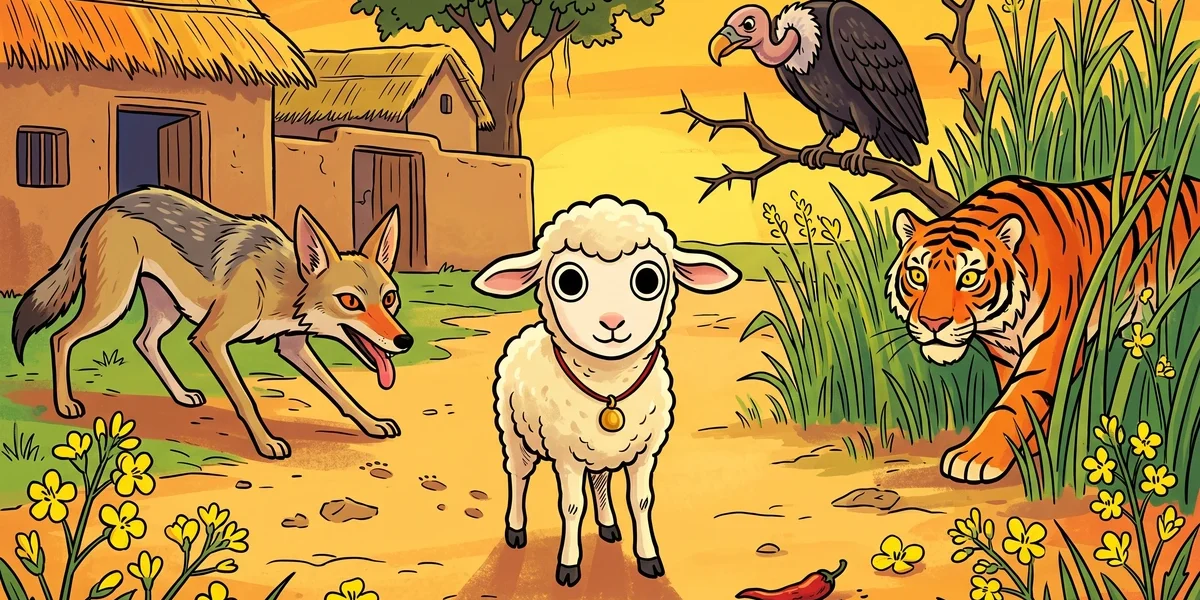
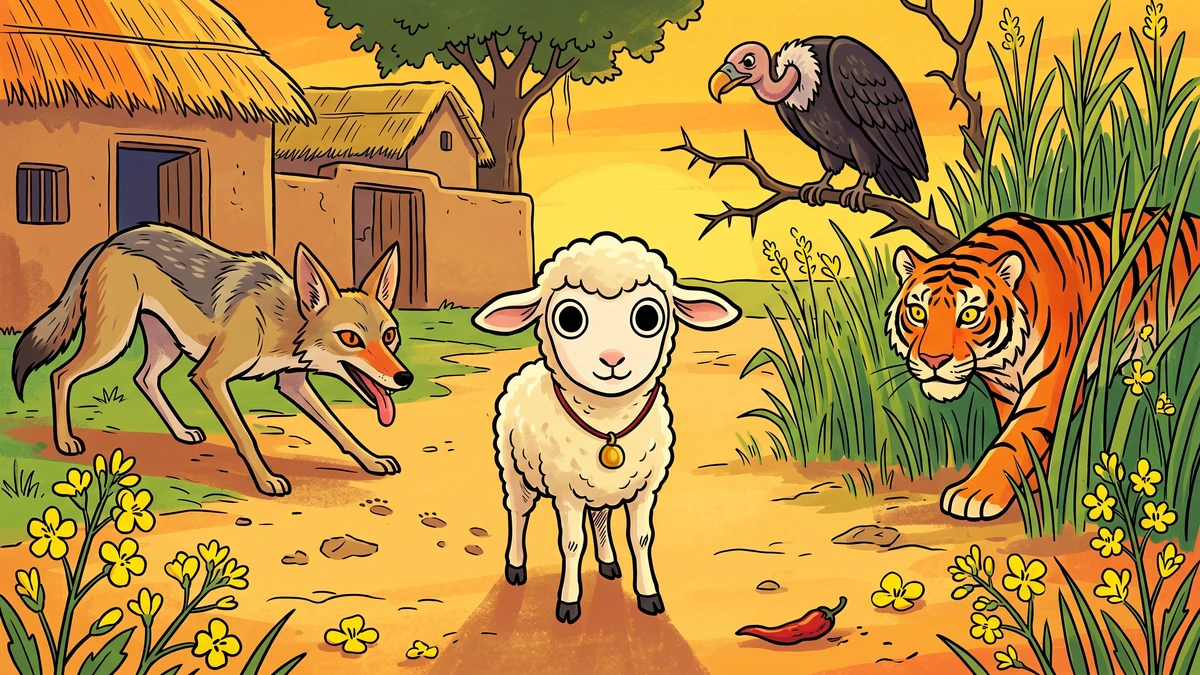
The Lambikin is one of the most cherished and most quietly cunning of all Indian folk tales — a Punjabi village fable in which a tiny lamb outwits a parade of forest predators, not by strength or speed, but by the irresistible logic of rhyme. The story was first recorded in English by Flora Annie Steel and Major Richard Carnac Temple in the landmark collection Tales of the Punjab: Told by the People (Macmillan & Co., London, 1894), illustrated with line drawings by John Lockwood Kipling, the curator of the Lahore Museum and father of Rudyard Kipling. Steel had spent twenty-two years in the Punjab as the wife of an Indian Civil Service officer, learning Punjabi well enough to take the stories down directly from the lips of the village women and grandmothers who told them by lamplight in mud-walled courtyards.
The tale is classified by folklorists as ATU 2033 / Type 122F — “Wait Till I Am Fat Enough” in the Aarne–Thompson–Uther International Tale Type Index, a chain-tale that belongs to the same broader family as the Russian “Kolobok,” the English “Gingerbread Man,” and the Norwegian “Pannekaken” — but with a distinctly Punjabi twist of cleverness, music, and the rhythm of the village drum. Where the Western variants end in the small protagonist’s destruction, the Punjabi Lambikin lives — and that is the whole moral.
The Wee Wee Lambikin Goes to Visit His Granny
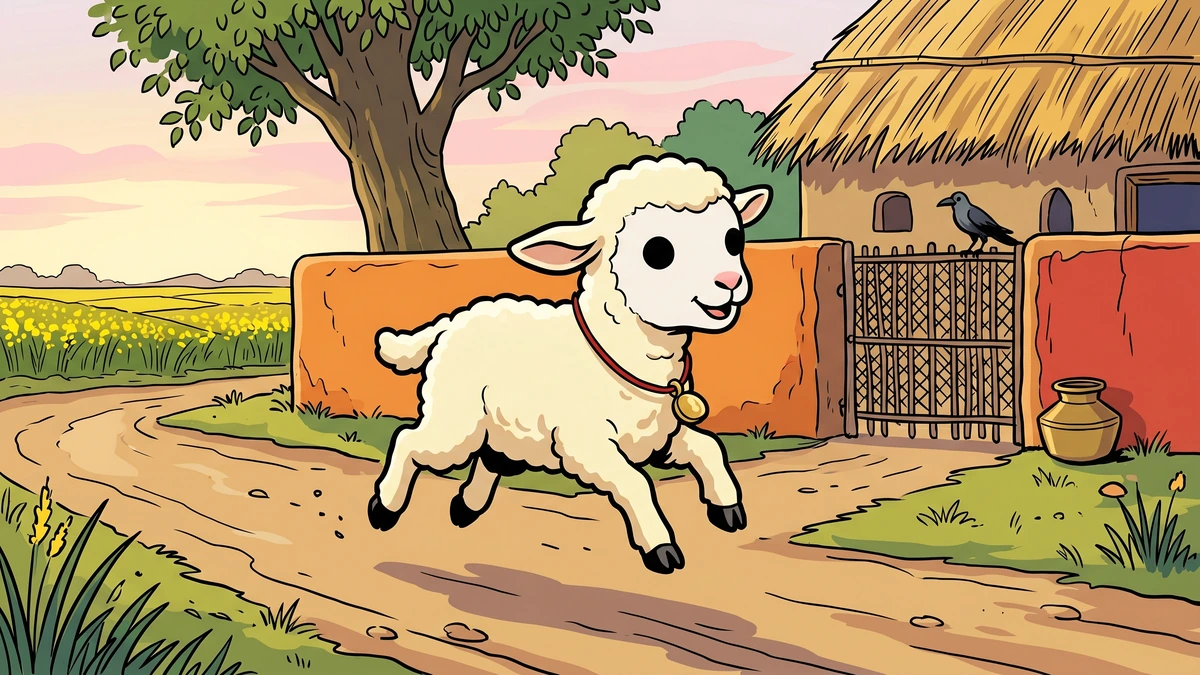
The story opens in the deep peace of a Punjabi village morning. A tiny lamb — wee wee Lambikin, as Steel renders the affectionate Punjabi diminutive menḍhūā / menḍhī jiā — frolics on his “tottery little legs” and decides, in the irrepressible curiosity of all small creatures, to set off to visit his Granny. He has been promised khichri, sweet milk and warm jaggery gur; he has been promised the company of an elderly ewe in her saffron-bordered dupatta. And so out he toddles, alone, onto the dust road, between the yellow mustard fields and the kikar thorn bushes, his brass tola amulet swinging on its thin red mauli thread.
It is a setup as old as fable itself: the smallest, softest, most edible creature in the world, alone in a hungry landscape. The reader knows what is coming. So does every grandmother who has ever told this tale. The pleasure of The Lambikin is not surprise — it is the slow, repeated, increasingly preposterous ritual of survival by formula.
“Lambikin! Lambikin! I’ll EAT YOU!” — The Chain of Predators
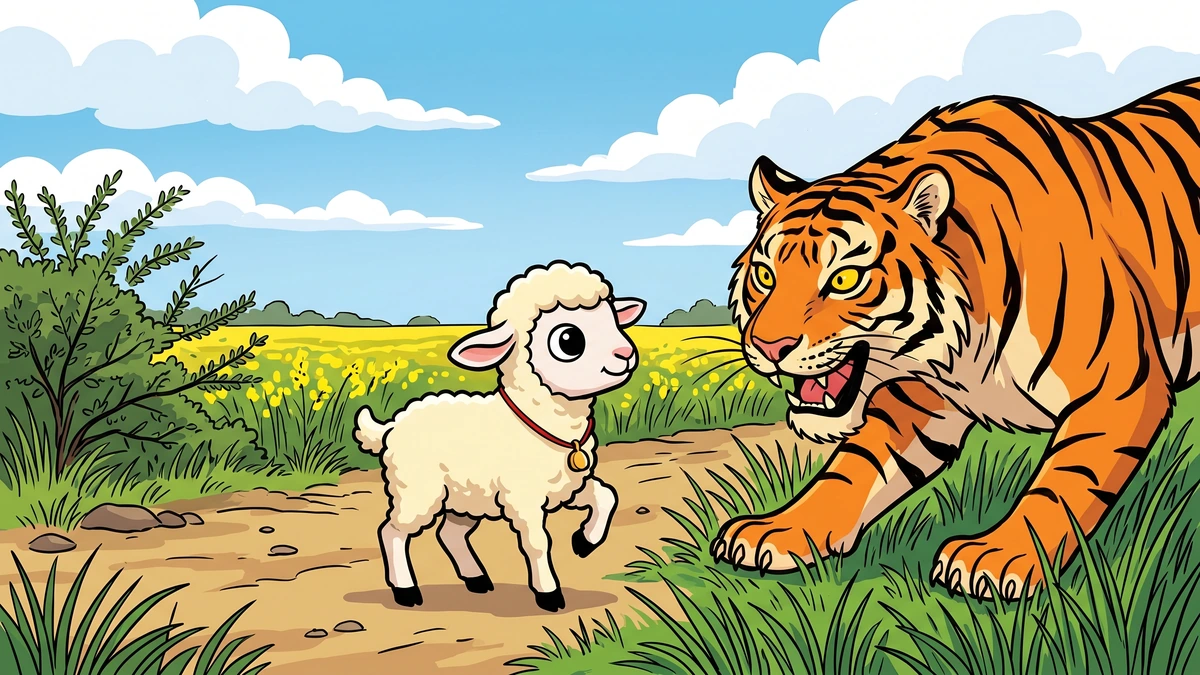
What follows is the structural heart of the tale: a chain of six escalating encounters, each repeating the same beat. Steel records them with the patient cadence of oral performance, each predator hungrier and more fearsome than the last. First a Jackal emerges from the kikar thorns. Then a Vulture drops from a peepal branch. Then in succession come a Tiger, a Wolf, a Pariah Dog, and finally a great Eagle. Each lifts its head, sees the small white morsel toddling along the dust road, and delivers the formulaic threat that every Punjabi child of 1894 — and every reader since — has known by heart:
“Lambikin! Lambikin! I’ll EAT YOU!“
And to each, the wee Lambikin gives the same little frisk — a scholarly note: Steel’s word “frisk” preserves a precise Punjabi gesture of bouncy fearlessness, the body-language of a creature who refuses to read the danger he is in — and answers in a singing, perfectly metrical Punjabi couplet that Steel recorded in English translation as:
To Granny’s house I go,
Where I shall fatter grow,
Then you can eat me so.
The original Punjabi rhyme runs roughly: “Nāniyāṅ ghar jāṇā, mottā ho ke āṇā, phir maiṅ tuhāḍī khurāk.” — “I’m going to Granny’s, I’ll come back fat, then I am your food.” The cadence is a tight three-beat line, the kind of tappa rhythm village mothers used to soothe babies, and the kind of formula Punjabi storytellers leaned on for their listeners to chant along. Each predator hears the singing rhyme, weighs the offer, considers the much larger and tenderer lamb that is being promised, and — crucially — lets him pass. Folklorists call this device deferral by promise: the trickster does not deny the threat, but offers a better one in the future. It is the same logic by which Brer Rabbit begs not to be thrown in the briar patch, and by which Anansi argues his way out of a thousand stewpots.
Inside the Corn-Bin: Seven Days of Eating
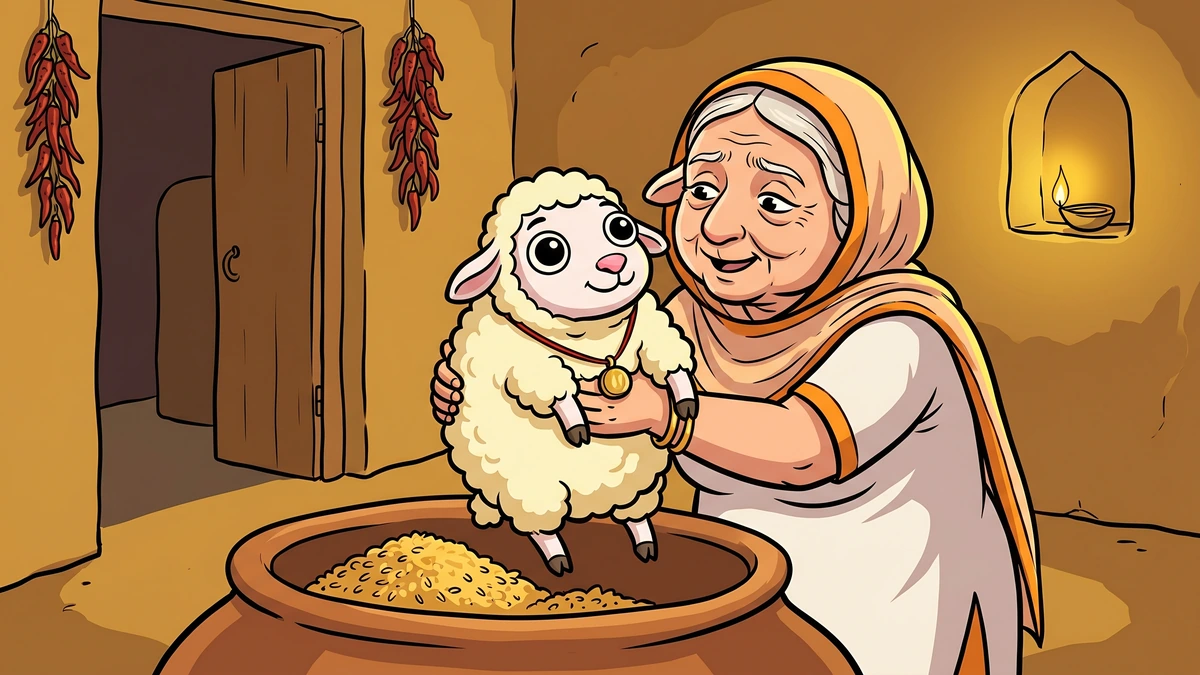
Lambikin reaches Granny’s mud-walled compound at last and, panting from the road, tells her in one breathless rush that he has promised six wild creatures he will return to them fat, and a promise is a promise — so she must, immediately, put him into the corn-bin. The corn-bin (kothi or bohra) was the great clay storage vessel of every Punjabi farmhouse: a half-buried jar two or three feet across, sealed with mud, holding the family’s jowar millet, barley, and chickpea flour for the year. To put a child in the corn-bin was the most extravagant indulgence imaginable in the rural Punjab of 1894 — a household economy of careful saving, suddenly upended for one greedy small lamb.
For seven days Lambikin eats. Steel notes the number seven precisely; in Punjabi folk numerology seven is the number of completion (the saptarshi stars, the seven sacred rivers of the Sapta Sindhu, the seven days of navratri double-counted, the seven rounds of marriage). He eats and eats “until he could scarcely waddle.” His wool puffs out like a dandelion clock. His cheeks bulge. His brass tola swings loose on his thread. And then, with his Granny’s astonished blessing — “You are fat enough for anything, my pet, you must go home” — the second movement of the tale begins.
The Drumikin: Cleverness Made Round and Hollow
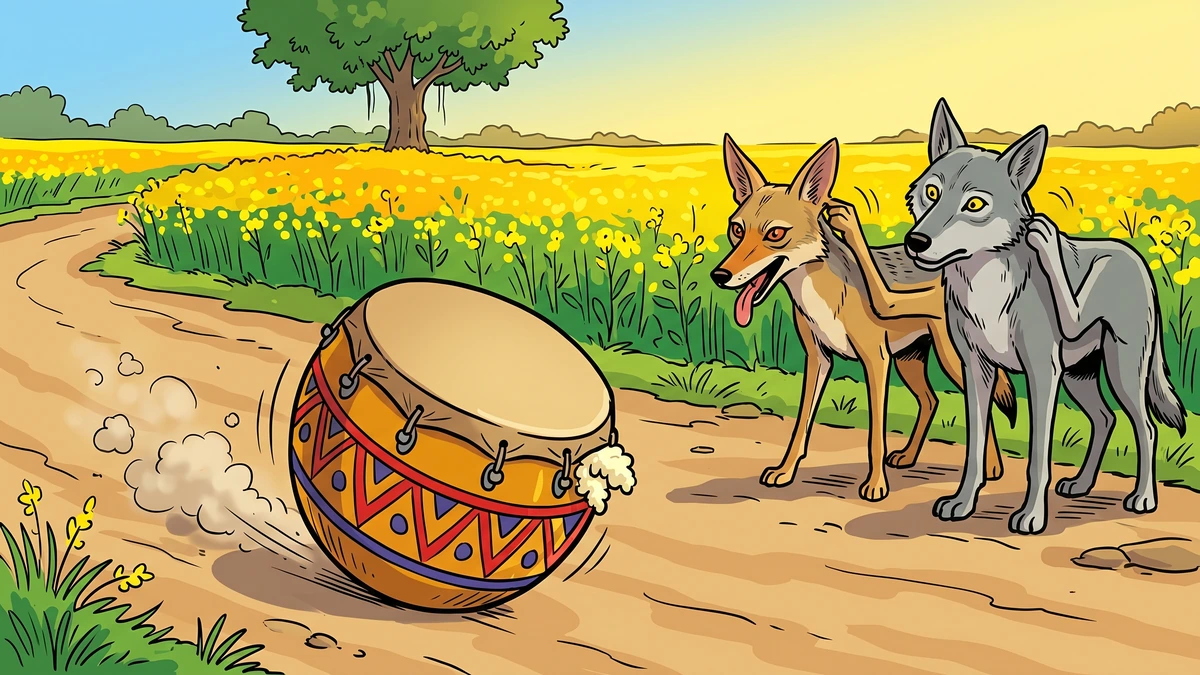
Lambikin will not walk home. He knows the predators are waiting. So he gives Granny one of the most charmingly precise instructions in all of children’s literature:
“You must make a little drumikin out of the skin of my little brother who died, and then I can sit inside, and roll along nicely; for I’m as plump as plump can be.”
Granny does. She makes a drumikin — Steel’s coinage, a delightful diminutive built on the English word drum by adding the affectionate Punjabi suffix-feel of “-ikin” (as in lamb-ikin). In the original Punjabi telling the object is a ḍholki or ḍhamāru, a small two-headed barrel drum painted in ochre and indigo geometric patterns, the kind that travelled with itinerant musicians and the jogi snake-charmers of the road. Lambikin curls inside, Granny laces the drum-head shut, and the drumikin trundles down the dust road of its own accord — bouncing, rolling, jingling.
The genius of the trick is that it converts the very thing that endangered him — his fattened, plump little body — into a hollow vessel of disguise. He is literally inside a musical instrument. And as the drumikin bounces past each waiting predator in turn — the Eagle, the Pariah Dog, the Wolf, the Tiger, the Vulture, and finally the Jackal — each calls out:
“Drumikin! Drumikin! Have you seen Lambikin?”
And from inside the rolling drum, his voice muffled by stretched cow-hide, comes the gleeful taunt that closes the tale:
“Lost in the forest, and so are you,
On, little Drumikin! Tum-pa, tum-too!”
“Tum-pa, tum-too” — the onomatopoeic drum-beat — is the most beautiful thing in the entire story. It is the sound of cleverness in motion. It is the sound the listener’s child is meant to chant along with. And by the time the Jackal finally recognises the trick and rips the drum open, Lambikin has already vanished into the high mustard. He is home. He is alive. The fable is over.
The Moral: Cunning and Rhyme Are the Small Creature’s Armour
“Buddhi balavān, na tu balaṁ buddhi-hīnam” — “Wisdom is strong; strength without wisdom is nothing.” (Sanskrit proverb cited in the Hitopadesha tradition that underlies much Punjabi village wisdom.)
The moral of The Lambikin is not the simple “outwit the bully” lesson it first appears. The deeper Punjabi reading — the one Steel heard in the village courtyards — is about the power of sound, formula, and timing. Lambikin survives the outward journey because the predators agree to a future bargain: a smaller meal now is exchanged for a larger meal later, and predators, like all gamblers, prefer the larger. He survives the return because he has wrapped himself inside the very sound — the rhythmic drum-beat — that delights the predators’ attention without alerting their hunger. The same voice that on the way out said “eat me later, fatter” on the way home sings “tum-pa, tum-too”. Both are music. Both are misdirection. The Lambikin’s gift is not muscle, not speed, not size: it is rhythm.
This is why the tale survives: it is a parable for every small person — every child, every village, every weak nation under empire — about the power of cleverness, song, and timing to slip past predators much larger than oneself. Flora Annie Steel, recording it in 1894 under the British Raj, may not have seen the political reading. But the village grandmothers who taught it to her certainly did.
Why The Lambikin Has Lasted
It is now over a century and a quarter since Flora Annie Steel sat in a Punjabi courtyard and wrote down the wee wee Lambikin’s verses, and the tale shows no sign of fading. It is read every year in primary-school Hindi and Punjabi readers across India and Pakistan, in English readers across the British Commonwealth, in Amar Chitra Katha comic adaptations, in animated retellings on Indian children’s television, and in countless village renditions where it never needed a book in the first place. It survives for at least four reasons.
First, it is structurally perfect. The chain-tale form — six predators, six promises, six escapes, then the same six in reverse with the drumikin — is an almost mathematical pleasure for a child’s developing memory. Each repetition reinforces the rhyme. Each new predator raises the stakes by one notch without breaking the pattern. Folklorists Vladimir Propp and Stith Thompson identified this exact structure as one of the most universally beloved across world traditions; it is the same engine that drives The Three Billy Goats Gruff, The Old Woman Who Swallowed a Fly, and This Is the House That Jack Built.
Second, the rhyme is sticky. Children who hear “To Granny’s house I go, where I shall fatter grow, then you can eat me so” once will chant it for weeks. The Punjabi original works because of its tukbandī (rhyming couplet) tradition — the same metric tradition that produces nursery rhymes and the sung verses of village folk drama. Sound carries the story.
Third, it is comparative-folklore gold. The Lambikin is part of the global ATU 2033 family — the Gingerbread Man family. But where the European versions end in the protagonist’s death (eaten by the fox), the Indian version ends in survival, which makes it almost unique in the world repertoire of this tale-type. This makes it a favourite among scholars of children’s literature, who use it as a teaching text on cultural variation in moral conclusions: the European tale punishes pride, the Indian tale rewards cleverness. Both are correct; they live in different moral universes.
Fourth, and most beautifully, it is a tale that celebrates the small. In an India that has known empire after empire, the wee wee Lambikin is the children’s hero precisely because he is the smallest, weakest, and tenderest creature on the road, and he goes home alive. He does not become big. He does not eat the predators. He simply survives — by song, by rhyme, by hiding inside a drum. That, more than any moral lesson, is what makes Punjabi grandmothers tell The Lambikin to their grandchildren on warm spring nights, and why the story will be told again, in some courtyard, somewhere, tonight.
Story source: Flora Annie Steel and R. C. Temple, Tales of the Punjab: Told by the People (Macmillan & Co., London, 1894), pp. 79–82, with line illustrations by John Lockwood Kipling. Tale-type ATU 2033 — “Wait Till I Am Fat Enough” — in the Aarne–Thompson–Uther International Tale Type Index. Comparative cognates include Kolobok (Russian), Pannekaken (Norwegian), and The Gingerbread Man (English).
Frequently Asked Questions
**Q: Why is this story important?**
You May Also Like
 Indian Folk Tales
Ages 9-12
Indian Folk Tales
Ages 9-12
The Princess of Mount Kinabalu
The Princess of Mount Kinabalu: On the northern coast of Borneo, where the island rises dramatically from the South China Sea, there stands Mount Kinabalu - a
 Indian Folk Tales
All Ages
Indian Folk Tales
All Ages
The Brahmi ‘s Girl That Married A Tiger
The Brahmi 's Girl That Married A Tiger: In a small village nestled between the rolling hills of Tamil Nadu, there lived a learned Brahmin who had a beautiful
 Indian Folk Tales
Ages 9-12
Indian Folk Tales
Ages 9-12
The Magic Grove of Wishes
The Magic Grove of Wishes: There existed, in the regions beyond the mapped world, a place that legends spoke of but few had ever found - a grove of trees so