The Prince And The Fakir
The Prince And The Fakir: There was once upon a time a King who had no children. Now this King went and laid him down to rest at a place where four roads met
The Prince and the Fakir is one of the great Baluchi-Punjab tales of unholy holiness — a story in which the white robe and the rosary do not, by themselves, make the saint. The version printed for English readers in 1892 was supplied to the folklorist Joseph Jacobs (1854–1916) by Mansel Longworth Dames (1850–1922) of the Indian Civil Service, and Jacobs published it as Tale XXIII of his Indian Fairy Tales (London: David Nutt, 1892, pp. 158–163), with John D. Batten’s Pre-Raphaelite line-drawings as illustrations. Jacobs’s own attribution is laconic and exact: “Source. — Kindly communicated by Mr. M. L. Dames from his unpublished collection of Baluchi tales. Remarks. — Unholy fakirs are rather rare. See Temple, Analysis, I. ii. a, p. 394.” (Jacobs, op. cit., p. 250). Dames was at the time the most learned European student of Balochi, the Iranian language of the Baloch people of the Pakistan–Iran–Afghanistan borderlands. He had been Deputy Commissioner of Dera Ghazi Khan in the southern Punjab, the great frontier district where Balochi tribes met the Punjabi peasantry, and he had learnt his Balochi from the camp-fires of the Mazari, Marri, and Bugti horsemen who served the British political agents. The tale Dames sent Jacobs is therefore not, strictly, an “Indian” folk tale at all in the modern political sense: it is a Balochi–Punjabi border tale, told in the Saraiki-and-Balochi-speaking Indus Valley, gathered in late-nineteenth-century Dera Ghazi Khan, and set in the half-imaginary geography where the simurg of Persian myth still flies and the markhor still climbs the Sulaiman ranges. Folklorists place the narrative within the Aarne-Thompson-Uther type ATU 314 “Goldener” (the Iron-John / hero-as-menial subtype), with strong contamination from ATU 327A “Hansel and Gretel” (the witch killed in her own oven), and motif clusters T511.1.1 (conception by eating sweetmeats), S221 (child promised to a sorcerer), K1920 (substituted children), B481.1 (helpful ant), G526 (ogre deceived by feigned ignorance), G512.3.1 (witch burned in her own oven), B32 (the simurg), K1816 (menial disguise), and T55 (princess declares her love by sprinkling scent on the chosen bridegroom).
I. The Sleepless King at the Crossroads
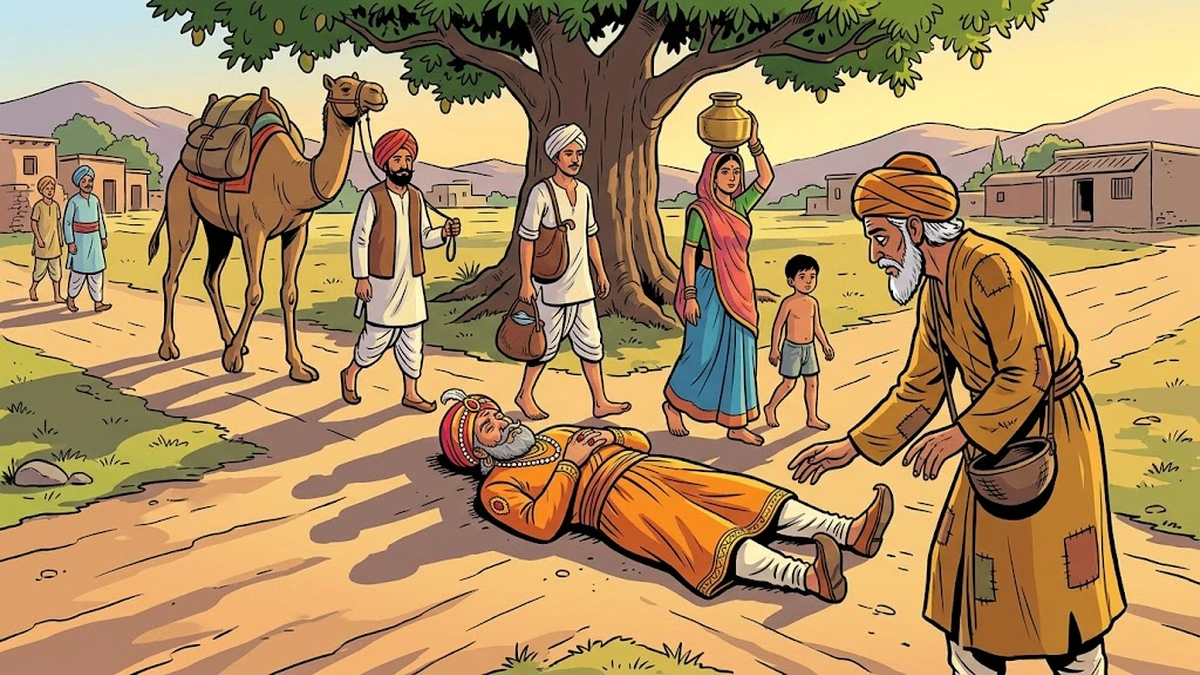
The tale opens in a way that has no real European parallel. A Baloch or Punjabi king, broken by years of childlessness, leaves his palace, walks down to a place where four roads meet (the Persian-Urdu chau-râhâ, “four-road”, the Punjabi chaurâhâ), and lies down in the dust at the centre of the crossing. He stays there day after day. Whoever passes that way — merchant, cameleer, water-carrier, beggar — must step over his body. He is doing this, he tells anyone who asks, as an act of public contrition. “My sins and offences have been very many,” he says in Dames’s text, “so I have come and am lying here that men may pass over me, and perchance my sins may be forgiven me, and God may be merciful, and I may have a son.” A modern reader looks at this and sees a king almost mad with grief; a nineteenth-century Baloch listener would have heard it as a precise religious manoeuvre. Crossroad penance is one of the oldest sub-Indo-Iranian fertility rituals, prescribed in the Atharva Veda for childless kings, recorded among the rural Sufis of Sindh and Multan as the chaurâhê kâ darshan (“the meeting-of-roads vigil”), and still performed at certain shrines (the maqbarah of Shah Hussain in Lahore, the dargah of Sakhi Sarwar in Dera Ghazi Khan) by women who have buried their infants. The king has chosen a ritual in which the entire kingdom — every traveller of every caste and creed — must literally tread on him before God will hear him. It is a public act of self-erasure, undertaken because the king has reached the limit of private prayer.
The tale’s opening sentence has the cool, hard, almost flat surface of the best oral Balochi narrative. Dames preserves it in Jacobs’s text in a register that imitates the Balochi shâ’ir tradition: short clauses, no metaphor, a refusal to dramatise. “A thousand men have come and passed by; you pass on too,” the king tells the fakir who finally stops to ask his trouble. The flatness is the storyteller’s art. The whole spiritual drama of the tale will be carried by what its characters refuse to say aloud.
II. The Fakir’s Sweetmeats and the Two Boys Hidden Underground
The fakir who finally pauses for the king is the central figure of the tale, and it is essential to grasp from the start that he is a false fakir — an unholy one, a charlatan ascetic, the kind of figure the Punjabi storytellers called a jhûthâ pîr (“false saint”) and the Sufi tradition itself denounced in countless cautionary stories. The Arabic-Persian word faqîr (فقير, “poor one”) properly designates a Muslim mendicant who has renounced wealth in order to beg his way to God. In the Baluchi-Punjab borderlands of the 1880s such figures were everywhere: most were genuine, some were not, and the storytellers Dames listened to drew an unsentimental distinction between them. Jacobs himself flags this: “Unholy fakirs are rather rare,” he writes in his notes, citing Sir Richard Carnac Temple’s great Analysis of the Tales of the Punjab (Bombay, 1884–1900). They are rare in the printed corpus precisely because they were a social embarrassment: every village had a story of one, but to print such tales was, in the colonial editor’s eye, to slander Islam. Dames, who knew his Baloch hosts too well to share that anxiety, sent Jacobs the tale uncensored.
The fakir offers to pray for the king on a single condition: of the two sons that will be born to him, one is to belong to the fakir. He hands the king two mit’hai — sweetmeats, the magical food of Indo-Persian tale, the same halwâ or peḍâ that mothers still feed to brides on wedding night for fertility — and instructs him to give one to each of his two favourite wives. A year later both queens give birth to sons. The king, full of dread, hides both boys in an underground chamber (a tahkhânâ, the cool basement room with which every great house of the Indus Valley was equipped against the summer heat), and waits for the fakir to come back.
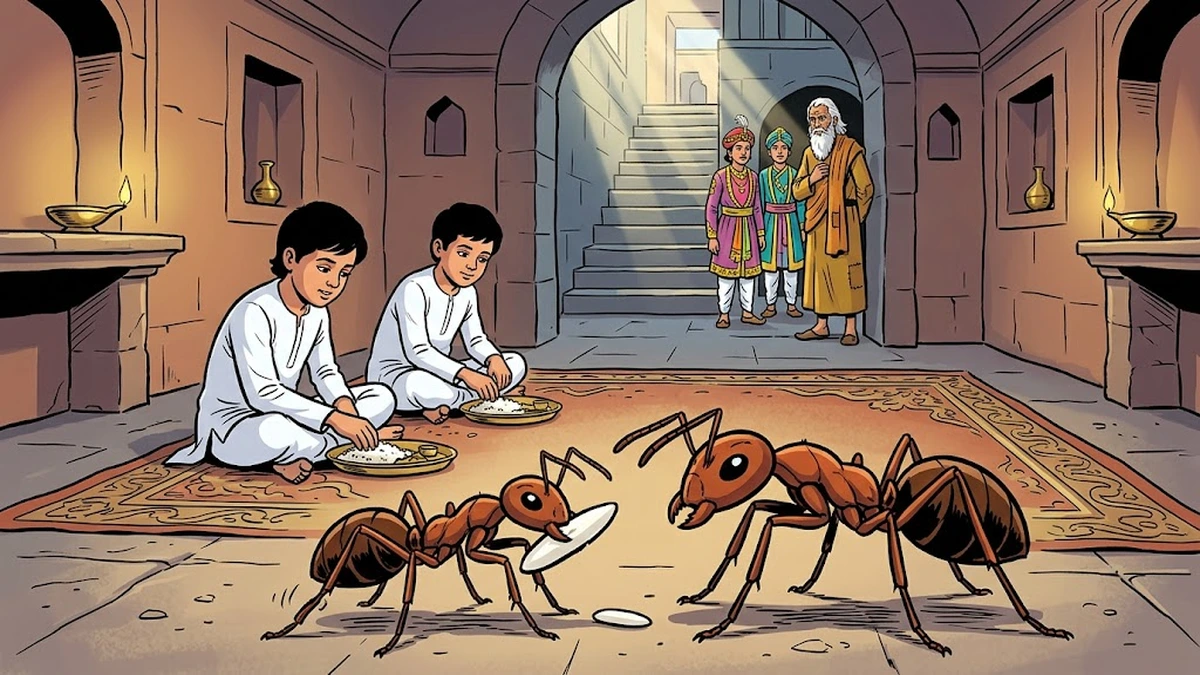
When the fakir does come back, the king tries the oldest of all evasions in the substitution-by-children corpus: he produces two slave-girls’ sons instead of his own. These two boys, dressed in royal silks, are presented to the fakir at the door of the palace. Below the palace, in the cool gloom of the tahkhânâ, the king’s real sons are eating their lunch — rice, in Dames’s text. And it is at this moment that the tale’s most beautiful and most morally specific image enters the story.
III. The Ant Who Could Not Be Fooled
A hungry ant has been picking among the rice the princes are eating in the cellar. She has carried away one grain — one single grain — for her children. As she limps along the dust of the floor (the Balochi storytellers add, with anatomical precision, that she is lame in her feet), a second, larger ant attacks her and tries to take the grain. The lame ant pleads. “I have long been lame in my feet,” she says in Dames’s text, “and I have got just one grain, and am carrying it to my children. The King’s sons are sitting in the cellar eating their food; you go and fetch a grain from there; why should you take mine from me?” The larger ant, satisfied that there is more rice to be had upstairs, lets her go.
The fakir, sitting in the courtyard above, hears the ant. He is a magician; he understands the speech of insects; and the lame ant’s small, exact piece of testimony has just exposed the king’s deception. “King!” the fakir says. “These are not your sons. Go and bring those children who are eating their food in the cellar.” The king, his trick discovered, fetches his real sons. The fakir chooses the elder boy and walks him out of the palace.
The brilliance of this episode — and the reason it has lasted — is that it inverts the moral arithmetic of every previous scene. Through the first chapters the storyteller has been showing us a great king, who lies in the dust at a crossroads to atone for his unnamed sins, who hides his children in a cellar to keep them safe from a devil’s bargain, who lies to a sorcerer in order to save his sons. He is a man of noble dimensions. And then a single half-paralysed ant, by an act of perfectly truthful speech in a dispute about a grain of rice, undoes everything the king has built. The tale’s point is structural and almost theological: in the moral economy of the universe, no quantity of human cleverness can outweigh one true sentence spoken by the smallest creature. This is the kind of doctrine the Punjabi Sufis were quietly teaching their disciples in the Sulaiman foothills when Dames was collecting his tales. The Persian poets called it nukta-yi maur, “the point of the ant”: a phrase used by Saadi (Bûstân, Bk. II) in exactly this sense.
IV. The False Fakir’s Cauldron: “Master First, and Pupil After”
The fakir leads the prince home to his hut (his khânâ in the desert), and the boy quickly learns what kind of master he has acquired. The fakir tells the prince to go out and gather fuel; the prince obeys, and brings back a heap of dried cow-dung cakes (uplê, the universal fuel of the Indus plain). The fakir has built a great oil cauldron over the fire — a degh (Persian/Urdu دیگ), the same enormous pot the Sufi langar-kitchens used to feed the poor, but here turned to a sinister purpose: the fakir means to throw the prince into the boiling oil and use his rendered fat for a magical operation. (Compare the kashkûl-cauldron tales recorded among the Qalandars of Multan, in which a false saint kills his disciples to make a paste against snake-bite.)
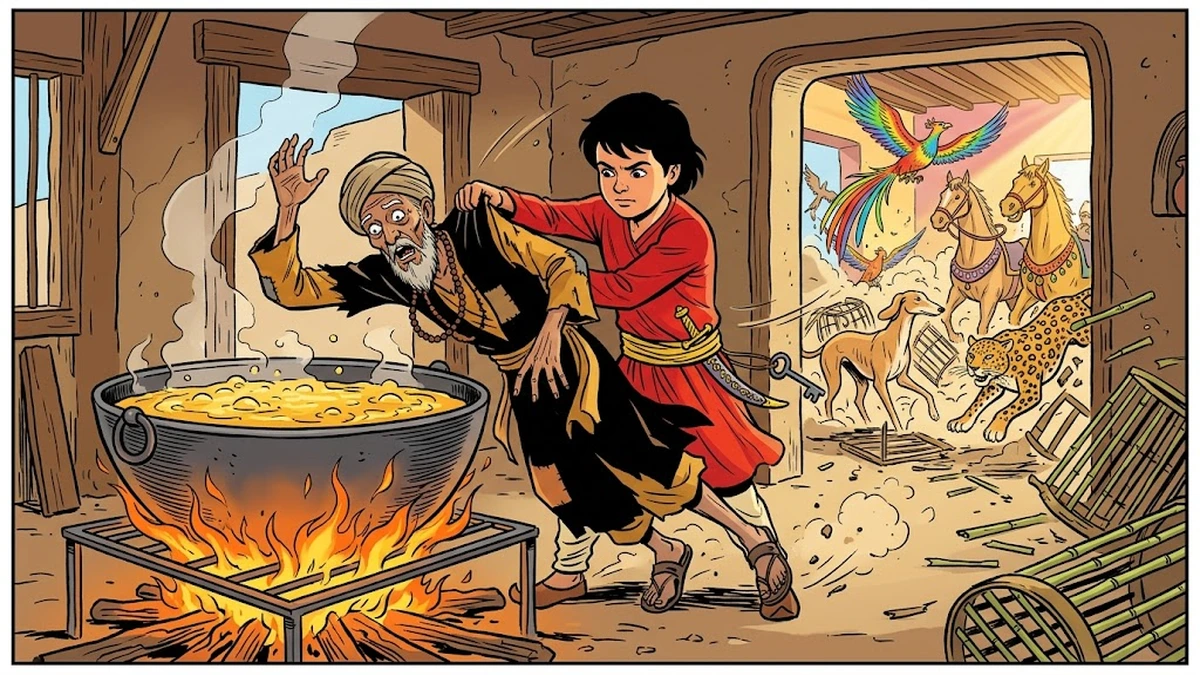
The fakir’s instruction to the boy is one of the great lines of South Asian folk-tale. “Come round here, my pupil,” he says — meaning: walk past the open mouth of the cauldron, where I can shove you in. The prince, who has been raised in a king’s house and knows perfectly the etiquette of the Persianate court, refuses with a single courtly formula: “Master first, and pupil after.” In the Punjabi-Persian original the line runs pîr pêhlê, murîd pîchhê (پیر پہلے، مرید پیچھے): “the master first, the disciple behind”. It is a phrase from the Sufi protocol of tarîqâ, the way of discipleship, in which the master walks ahead and the disciple follows three steps behind in token of humility. The fakir orders him a second time. “Master first, and pupil after,” the boy answers. A third time. “Master first, and pupil after.” And on the third refusal the fakir loses his temper, lunges at the boy — and the boy, with the hard-trained reflexes of a king’s son taught wrestling (kushtî) from the age of six, lifts the fakir bodily, jerks him over the rim of the cauldron, and tips him into a hundred gallons of his own boiling oil. The fakir is roasted in his own kitchen.
The motif is ATU 327A — the witch burned in her own oven — transposed into the Indo-Persian Sufi register. The boy’s line is its turning point: he refuses, three times, to break the formal etiquette of master and disciple. By insisting that the master walk first, he forces the master to commit himself to action first — and the master’s commitment is what destroys him. The Punjabi storytellers Dames listened to had a dry comment on this scene, recorded in Temple’s Analysis: jo â p kuê khôdê, ô usî kuê meiñ girê (“he who digs a pit, falls into it himself”). The proverb is universal; the cauldron is local.
V. The Released Menagerie: Horses, Greyhounds, Tigers, Simurgs
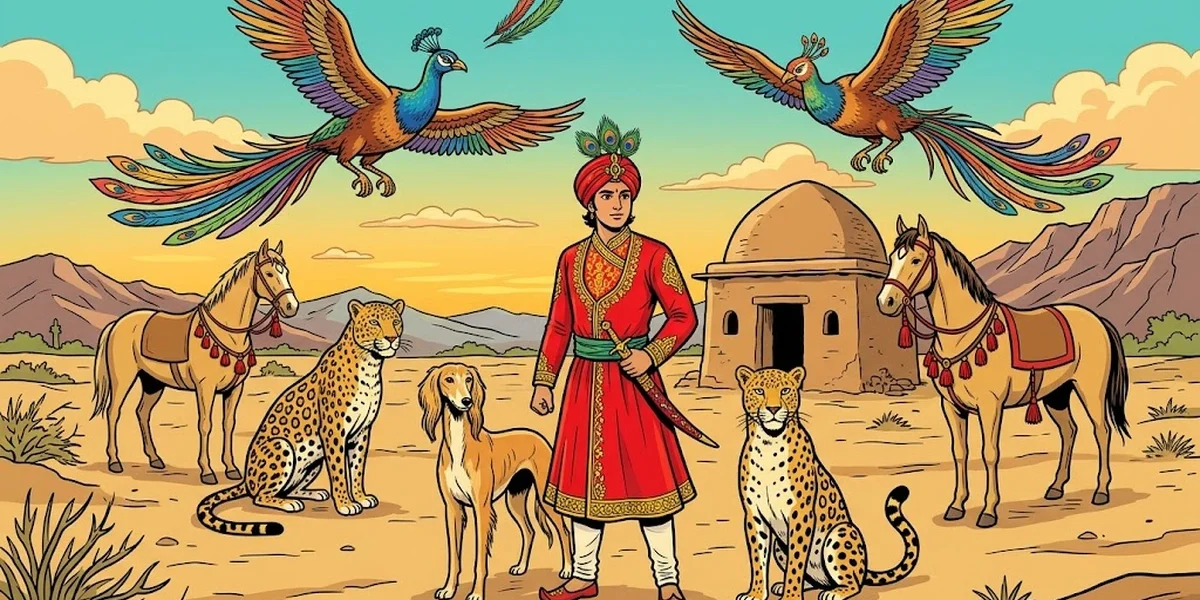
The prince finds the fakir’s key — the storytellers always say it was hung at the saint’s belt — and unlocks the inner rooms of the hut. What he finds there is a small zoo of imprisoned creatures, each pair representing a different stratum of Indo-Persian magical fauna. There are two horses (probably the famous Baluchi breed of the Sulaiman foothills, light-boned and sand-coloured, prized by the Marri tribesmen who supplied Dames’s text). There are two greyhounds, which in the Balochi context can only be the Tâzî — the slender Saluki-type sighthound of Iranian-Arab descent, the great hunting dog of the desert. There are two tigers (in Balochi palang, more probably the leopards of the Sulaimans than true Bengal tigers, but rendered “tiger” by Dames in the colonial-English habit of conflating the two great cats). And there are two simurgs.
The simurg (Persian سیمرغ sîmurg, from Avestan saēna mərəγa, “eagle bird”) is the Iranian world-bird, ancestor of the Indian Garuḍa and cousin of the Arabic ‘Anqâ. In Ferdowsi’s eleventh-century Shâhnâmâ the simurg nests on the world-mountain Alburz and raises the abandoned hero Zâl as her foster-son. By the time Dames was collecting Baluchi tales eight centuries later, the simurg had become a stock figure of Balochi epic poetry — the Daptar Shâ’ir war-songs Dames himself published in Popular Poetry of the Baloches (London: Royal Asiatic Society, 1907) repeatedly invoke her. To find a pair of simurgs in the cellar of a sinister fakir is, for the Balochi listener, a precise mythical signal: this man has trapped not just animals but cosmic animals, beings whose proper place is on the slopes of Mount Alburz. To free them is, in the storyteller’s logic, to restore the structure of the world.
The boy releases all the creatures, opens every locked door, lets out the human prisoners as well (mostly previous “disciples”, men who fell for the fakir’s “pupil-first” trap), and rides away with his menagerie at his heels. On the road he meets a bald herdsman grazing a herd of calves — the kal of Punjabi tale, a stock comic figure whose baldness is the visible sign of his low station and stupid bravado. The bald man challenges the prince to a wrestling match: “If I throw you, you shall be my slave; and if you throw me, I will be your slave.” The prince throws him. The bald man becomes the prince’s slave, joins the menagerie, and is set as guard over the prince’s horses, hounds, tigers, and simurgs while the prince walks on alone into the next city. The detail of leaving a tiger as second guard, with the bald man as first, is a Balochi storyteller’s small joke about the reliability of the bald-man character. The prince is taking no chances.
VI. The Henna-Dish in the Hall of Audience
The prince comes to a city, finds a pleasant pool, and stops to bathe. The detail seems casual; it is in fact pivotal. As he strips off the worn fakir’s cloak he has been wearing as travelling-dress, his royal marks (the Sanskrit-Persian râja-cihna; in Punjabi shâhî nishânî) become visible on his body — the auspicious moles, the lotus-line on the palm, the chakra-mark on the foot, that classical Indian iconography ascribes to the body of a future king. The princess of that city is sitting on her palace roof at exactly that moment, watching the pool through her open lattice. She sees the marks. She decides, on the spot, that she will marry him and no one else.
The wedding scene that follows is one of the most beautiful set-pieces in nineteenth-century Indian folk literature, and it depends entirely on a piece of Punjabi-Baluchi marriage etiquette that requires explanation. When a princess of this region wished to choose her own husband, she could ask her father to hold a swayamvara (Sanskrit स्वयंवर, “self-choosing”), the ancient bride-choice ceremony in which all eligible suitors were assembled in the court and the princess walked through them carrying a garland or, in the Indus-Valley Muslim variant, a small dish of henna paste (mehndî; Arabic ḥinnāʾ, Lawsonia inermis). She would touch the garland or sprinkle the henna on the man of her choice, and that touch was, by immemorial custom, an irrevocable proposal of marriage. The ceremony is referred to in the Mahâbhârata (Draupadî’s swayamvara, in Ādi Parva, ch. 188), in the Persian Khusrau-o-Shîrîn of Nizami, and in dozens of Punjabi qissâ texts.
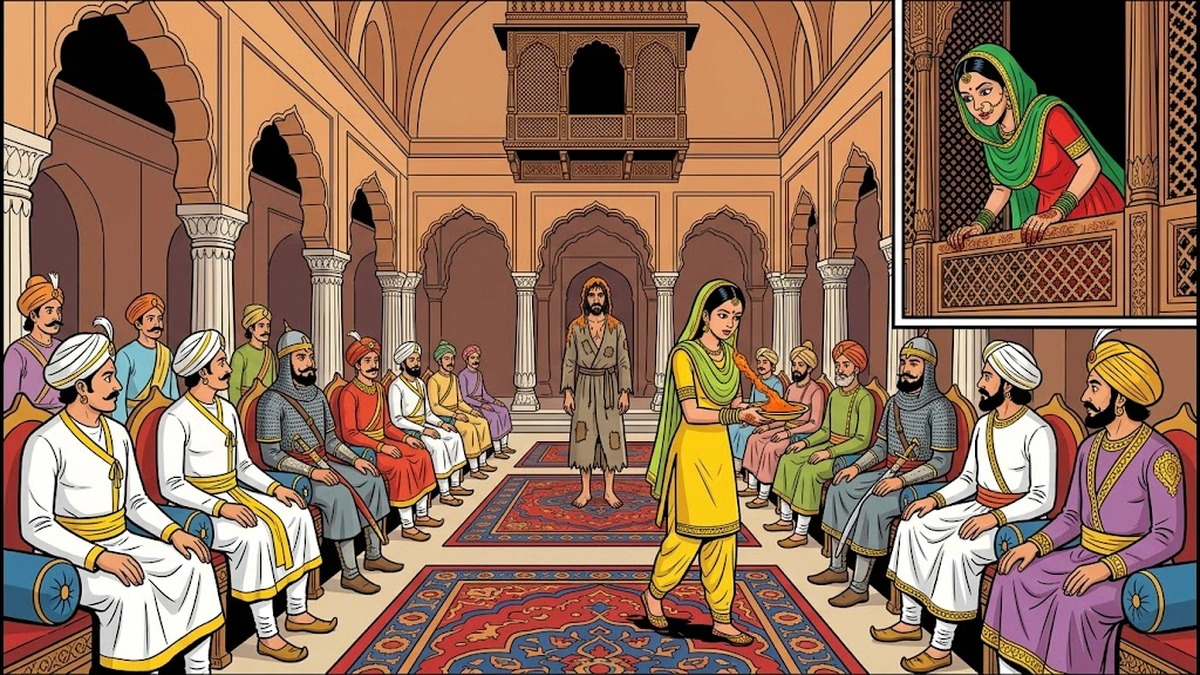
The king of the city, his daughter’s wishes being absolute, summons all the great men of the land to the dîwân-i-âm, the public hall of audience. They come in their full court dress — nobles in jâmâ robes, military officers in chain-mail, merchants in their gold-bordered turbans — and they sit in their assigned ranks. The traveller-prince, dressed still in the dead fakir’s patched and oily robes, slips in at the back to watch the spectacle. The princess takes her place in the lattice gallery. She looks once around the assembly. She sees the man she saw at the pool. She turns to her handmaid. “Take this dish of henna,” she says, “go to that traveller dressed like a fakir, and sprinkle scent on him from the dish.” The handmaid, scandalised but obedient, walks the length of the hall and tips the henna across the patched coat of the strange beggar at the back. “The slave-girl has made a mistake,” the courtiers say. The handmaid’s reply is the single greatest sentence of the tale, and Jacobs prints it in italics: “The slave-girl has made no mistake; ‘tis her mistress has made the mistake.” — meaning, with the perfect Punjabi double-edge, that this is the bridegroom her mistress has chosen, and if the choice looks wrong it is for the world, not the slave, to take the consequences. The marriage is performed that day.
VII. The Hunting Match and the Returning Prince
The king of the city is appalled at his daughter’s choice. He says nothing in public — royal anger is suffered in silence, in the Indo-Persian court convention — but the storyteller tells us, with quiet satisfaction, that “he kept these thoughts concealed in his heart.” The other sons-in-law — the king’s daughters had married well, before this disgraceful ragged man arrived — jeer at the new arrival behind their fans. The new prince proposes a hunt. “What is this fakir, that he should go a-hunting?” they say.
The new prince’s hunt is the tale’s closing trick. He rides out, alone, to the place in the desert where he had left his menagerie under the bald man’s charge. He whispers to his tigers; he whispers to his hounds; he whispers to his simurgs. The hounds course; the tigers spring; the simurgs (in the Balochi version Dames recorded, but not in Jacobs’s edited print) drive the larger game from the air. By dusk the prince has more game than the entire combined party of the king’s sons-in-law: piles of gazelle (the chinkârâ of the Sulaiman foothills), of hog-deer (the pâṛâ of the Indus tamarisk-jungles), and above all of markhor (the great wild goat of Baluchistan, Capra falconeri, today the national animal of Pakistan, then as now the most prestigious quarry of any Baloch hunter). He carries the spoils back to the appointed pool, where the other sons-in-law are emptyhanded.
The arrival at the king’s court is staged for maximum effect. The new prince, splashed with the blood of markhor, kneels before his father-in-law and confesses, finally, what he is: not a fakir but a king’s son. The old king takes him by the hand, embraces him, and makes him heir. Dames’s closing sentence in the Balochi original (transmitted to Jacobs and only lightly Anglicised) is the formulaic ending of the Balochi heroic shâ’ir: “I make over my kingdom to you.”
The Moral: The Saint Is Known by His Walking
The Balochi storytellers Dames listened to ended this tale with a Sufi proverb that is preserved in his unpublished notebooks (now in the British Library, Oriental MSS Or. 5326) and printed in fragmented form in his later A Sketch of the Northern Balochi Language (Calcutta, 1881). The proverb runs, in the Balochi original and in Roman transliteration:
Pîr pêhlê chalê, murîd pîchhê chalê.
Jo pîr pîchhê chalê, ô pîr nahîñ — ô shaitân hai.“The master walks first, the disciple walks after.
The master who walks behind is no master — he is the devil.”— Punjabi-Balochi closing proverb to The Prince and the Fakir, in M. L. Dames, communicated to Joseph Jacobs, Indian Fairy Tales (London, 1892), tale XXIII.
The doctrine the proverb encodes is the central ethical doctrine of the Punjabi-Sindhi Sufi tradition, and it is this: holiness is recognised by behaviour, not by costume. A real pîr (the Persian-Punjabi word for a Sufi master, literally “old man”) walks ahead of his disciple because he is willing to take on himself the first risk, the first stone in the road, the first arrow in the ambush. A fake pîr walks behind because he intends to use the disciple’s body as a shield. The fakir of this tale fails the test by attempting to send the boy first into the cauldron; the boy passes the test by recognising the fraud. The doctrine is a precise instance of what Hujwiri (the eleventh-century Punjabi Sufi buried at Lahore as Data Ganj Bakhsh) called dast-i-tawakkul, “the hand of trust”: the master’s readiness to put his own hand first into whatever fire he is asking the disciple to walk through. Where this readiness is missing, the master is no master.
Why It Lasted: Goldener in a Balochi Cap
The placement of The Prince and the Fakir within ATU 314 puts it in one of the great trans-Eurasian folk-tale families. Hans-Jörg Uther’s revised Types of International Folktales (FFC 284–286, Helsinki, 2004) records over four hundred attestations of the “Goldener” type from Iceland to Bengal. The closest European cognate is the Brothers Grimm’s Eisenhans (KHM 136, “Iron John”, in Kinder- und Hausmärchen, 6th edition, 1850), in which a wild iron-skinned man kept in the king’s cellar releases a young prince who serves him as a kitchen-boy and finally wins the princess by performing prodigies at a tournament — the same shape as our Indus-Valley tale, with cellar, magical helper, menial disguise, and tournament-by-hunt all intact. The closest Persian cognate is the framing tale of Hâtim Tâ’î in the late-Safavid Hatim-nâmâ, in which a king’s son escapes from a sinister desert dervish and rides home with magical animal helpers. The closest Russian cognate is Sivko-Burko (“Bay-Brown Roan”) in Afanasyev’s Russkie Narodnye Skazki, where the menial-disguise hero leaps a magical horse over the princess’s tower window. The closest Bengali cognate is the “Garib’s Daughter” tale in Lal Behari Day’s Folk-Tales of Bengal (Macmillan, 1883). Even the Arabic Sîrat ‘Antar contains a related formula in its account of the boy ‘Antar bin Shaddâd serving a desert holy man.
What makes the Balochi version distinctive within this enormous family is the relentless realism of its moral attention. The European tales tend to focus on the magical objects (Iron Man’s well, the golden hair, the magical horse). The Balochi-Punjab version of Dames focuses on the ethics of master-and-disciple: the hidden cellar, the lying king, the truthful ant, the courtly formula pîr pêhlê, the boiling cauldron, the henna-dish, and the silently appalled father-in-law. There are still magical helpers (the simurg, the tigers, the hounds, the horses), but they are pushed to the margins of the story; the centre is held by a small lame ant and a single sentence of court etiquette. A. L. Basham, writing about this tradition in The Wonder That Was India (Sidgwick & Jackson, 1954, ch. XII), called this tendency “the ethical Indianisation of the Iranian fairy-tale”: where the Persian original delights in the marvellous, the Indian retelling presses every marvel into the service of a moral point. The Balochi storyteller, working at the precise frontier between Iran and India, gives us both at once.
Iconography: Cellar, Cauldron, Henna
Three iconic visual scenes of the tale — the king lying at the four-roads while travellers step over him, the lame ant pleading with the larger ant in the dust of the cellar floor, and the henna-dish tipped onto the prince in the hall of audience — entered Punjabi popular iconography through John D. Batten’s pen-and-ink illustration to Jacobs’s 1892 first edition (a Pre-Raphaelite vision of the cauldron scene, with the prince throwing a black-clad fakir into a pot of oil, while two simurgs perch in cages on the wall). The image was reproduced almost unaltered in the Madras Mail’s 1903 illustrated reprint of Jacobs, and from there into vernacular adaptations in Urdu (Lahore: Tej Kumar Press, 1925) and Punjabi (Amritsar: Bhai Vir Singh, 1937). The Tanjore-school painter C. Kondiah Râju made a celebrated calendar print of the henna-dish scene around 1953 that hung for decades in the railway waiting-rooms of the Northwestern (Lahore) Railway. The Amar Chitra Katha series, drawing on the same iconographic tradition, gave the tale its widest twentieth-century circulation in its 1979 issue “Tales from the Indus Frontier”, in which Pratap Mulick’s rendering of the lame ant remains, for many older readers in Punjab and Sindh, the indelible image of the story.
Reading with Children
For parents and teachers reading The Prince and the Fakir aloud, three details from the Dames–Jacobs text repay slowing down for. First, the king at the crossroads. Children grasp at once the moral weight of a king lying in the dust to be stepped over by his subjects; they will not need it explained that this is what humility looks like in its most literal form. Pause and let them feel the image. Second, the lame ant. Younger children can be invited to retell the ant’s little speech in their own words, paying attention to the fact that she is lame, hungry, and outnumbered — and that none of these disadvantages prevent her from speaking the truth. The point generalises easily: the smallest, weakest, most disadvantaged voice in the room may turn out to be the only one that says what is real. Third, the cauldron formula. The phrase “Master first, and pupil after” is worth memorising with children. It is, very precisely, a portable test for distinguishing trustworthy adults from untrustworthy ones in any setting whatever. An adult who insists that you go first into anything frightening, while declining to go first himself, is not the adult he is pretending to be. The boy survives the fakir because he has internalised the rule and is willing, three times, to refuse. That is a transferable skill, and worth teaching.
A Note on Sources
The version preserved on this page is the standard text of Joseph Jacobs, Indian Fairy Tales, Selected and Edited by Joseph Jacobs, Illustrated by John D. Batten (London: David Nutt, 1892), Tale XXIII, pp. 158–163, with editorial notes on p. 250. Jacobs received the text from Mansel Longworth Dames (1850–1922), then Deputy Commissioner of Dera Ghazi Khan, from his unpublished collection of Baluchi tales gathered in the 1880s. Dames’s wider Balochi materials were eventually printed in Popular Poetry of the Baloches (London: Royal Asiatic Society, Asiatic Society Monographs vol. IX, 1907) and in The Baloch Race: A Historical and Ethnographical Sketch (Royal Asiatic Society, 1904). The standard reference for the Punjabi parallel-tradition is Sir Richard Carnac Temple, The Legends of the Panjâb (3 vols., Bombay and London, 1884–1900), to whose Analysis (vol. I, ii. a, p. 394) Jacobs himself directed his readers. For the comparative folklore, the indispensable references are Stith Thompson’s Motif-Index of Folk-Literature (revised edition, Indiana University Press, 1955–58); Stith Thompson and Jonas Balys, The Oral Tales of India (Indiana University Press, 1958); and Heda Jason, Types of Indic Oral Tales (FFC 242, Helsinki, 1989). For the Iranian-Avestan background of the simurg, the indispensable reference is Marijan Molé, L’Iran ancien (Bloud & Gay, 1965); for the Sufi etiquette of master-and-disciple, A. J. Arberry, Sufism: An Account of the Mystics of Islam (George Allen & Unwin, 1950), ch. V. Above all the retellings stands Dames’s Balochi original, transmitted to Jacobs in 1891 and printed in 1892, the foundational document of Balochi folk-narrative in English.
Read time: about 10 minutes. Suitable for ages 8 and up; suitable for read-aloud from age 6 with the cauldron episode rendered, in the Punjabi storytellers’ gentler phrase, simply as “the wicked fakir’s great pot of oil.”
Frequently Asked Questions
**Q: Why is this story important?**
You May Also Like
 Indian Folk Tales
Ages 12+ / YA
Indian Folk Tales
Ages 12+ / YA
The Story Behind The Congress Party’s Hand Symbol – Story of Hemambika
The Pallassana goddess of two raised palms — Parashurama’s remorse, temple lore, and the debated link to the Congress hand symbol.
 Indian Folk Tales
All Ages
Indian Folk Tales
All Ages
Why Brahma Cannot Eat in the Dark
Why Brahma Cannot Eat in the Dark: Among Hindûs, especially among Brâhmaṇs of the Madras Presidency - and I now see from personal observation that it is the
 Indian Folk Tales
Ages 3-5
Indian Folk Tales
Ages 3-5
Prince Half A Son
Prince Half A Son: Once upon a time there was a King who had no children, and this disappointment preyed so dreadfully upon his mind that he chose the dirtiest