A Lac of Rupees for a Piece of Advice
A Lac of Rupees for a Piece of Advice: In a bustling town in ancient India, A merchant paid an enormous sum for a single piece of advice that saved his life.
A Lac of Rupees for a Piece of Advice is a Kashmiri Pandit folk-tale gathered in the snow-rimmed Vale of Kashmir by the Reverend J. Hinton Knowles between 1885 and 1888 and printed as Tale LIX of Folk-Tales of Kashmir (Kegan Paul, Trench, Trübner & Co., London, 1888; second edition 1893, pp. 32–41). Joseph Jacobs lifted the same tale into Indian Fairy Tales (David Nutt, London, 1892), where it stands as Tale XV. The story is a frame-narrative of the international tale-type ATU 910 — “The Wise Counsels”, with Kashmiri colouring drawn from the bazaars of Srinagar, the marble courts of the Jhelum, and the Pir Panjal foothills. Within the frame is nested a celebrated dog-and-merchant exemplum cognate with Pañcatantra Book I (Mitra-Bheda) and Book V (Aparīkṣitakāraka) — the cycle of “things done without reflection.”
The Bargain in the Bazaar
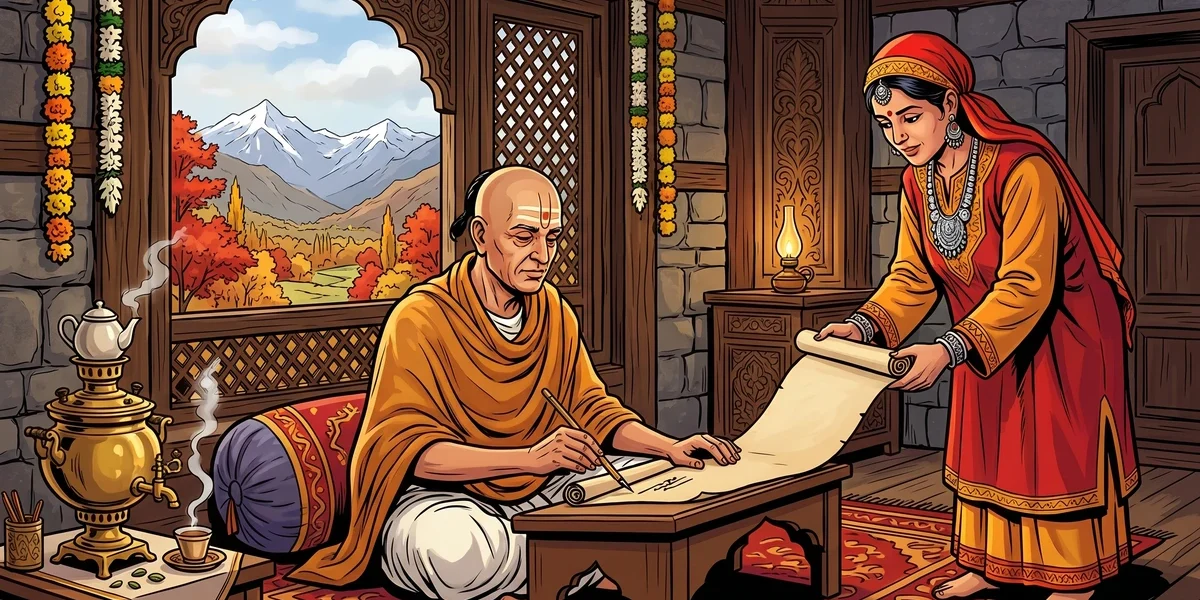
It is the cold mid-winter of a year in the late nineteenth century. In a stone-and-deodar-wood hovel on the banks of the Jhelum lives a blind Brahman pandit, his blind wife, and their grown son. The household has outlived its prosperity — the temple offerings have shrunk, the saffron harvest has failed at Pampore, and what little rice the son begs by walking the ghats of Srinagar will no longer keep four bellies through the long Kashmiri winter. One morning, his patience worn through, the son shoulders a bundle of dried apricots and walnut-bread, embraces his blind parents, kisses his wife at the threshold of their walnut-wood door, and walks south through the Banihal pass to seek work in the rich plains beyond.
For weeks he wanders. He passes the apricot orchards of Bhaderwah, the Chenab fords at Akhnoor, the Sikh haveli quarters of Jammu. At last he sits, footsore, before a corner shop in a strange city’s chowk, where a kindly Khatri merchant in a saffron pheran pours him watery rice-broth, hears his tale, and conducts him to the durbar of the local raja. The raja, a Dogra prince freshly converted to temple-building, has just finished raising a new gilded shrine and needs a clean-handed Brahman to administer it. Fifty kharwars of rice and a hundred silver rupees a year — a wage almost beyond imagining — are settled upon the wandering pandit, who falls at the king’s feet and weeps from gratitude.
Two months pass. The Brahmani at home, having heard nothing, exhausts the last of the rice, leaves the parents in the care of a temple cook, and walks south after her husband. By the kindness of strangers and the rumour of free alms at a new golden temple, she comes — by what villagers always call bhāgya, fate — to the very square where her husband sits at his daily devotions. He is dismayed: who will feed his blind parents now? In a flash of impatience he scribbles on a scrap of palm-leaf paper three quick aphorisms, presses it into her hand, and tells her, “Take this to the king. He will give you a lakh of rupees for it.” A lakh — one hundred thousand silver rupees — is the wealth of an entire Pandit clan for a generation. She walks the dusty road towards the palace, the scrap of paper trembling in her hand.
The Three Counsels and the Banished Prince
On that scrap of palm-leaf, in cramped Sharada script, the Brahman has written three counsels of the kind every wandering renunciate carries on the rim of his memory:
“Yatra rātrau prapadyase, na nidrā tatra te bhavet — sā nidrā mṛtyu-tulyā syāt.
Where thou alightest by night in a strange place, sleep not — for that sleep may be the sleep of death.A married sister, when thou comest to her in pomp, will receive thee for the sake of what she may have; but if thou comest in poverty, she will frown on thee and disown thee.
And if there be any work to be done, do it thyself, and do it with might, and without fear.”
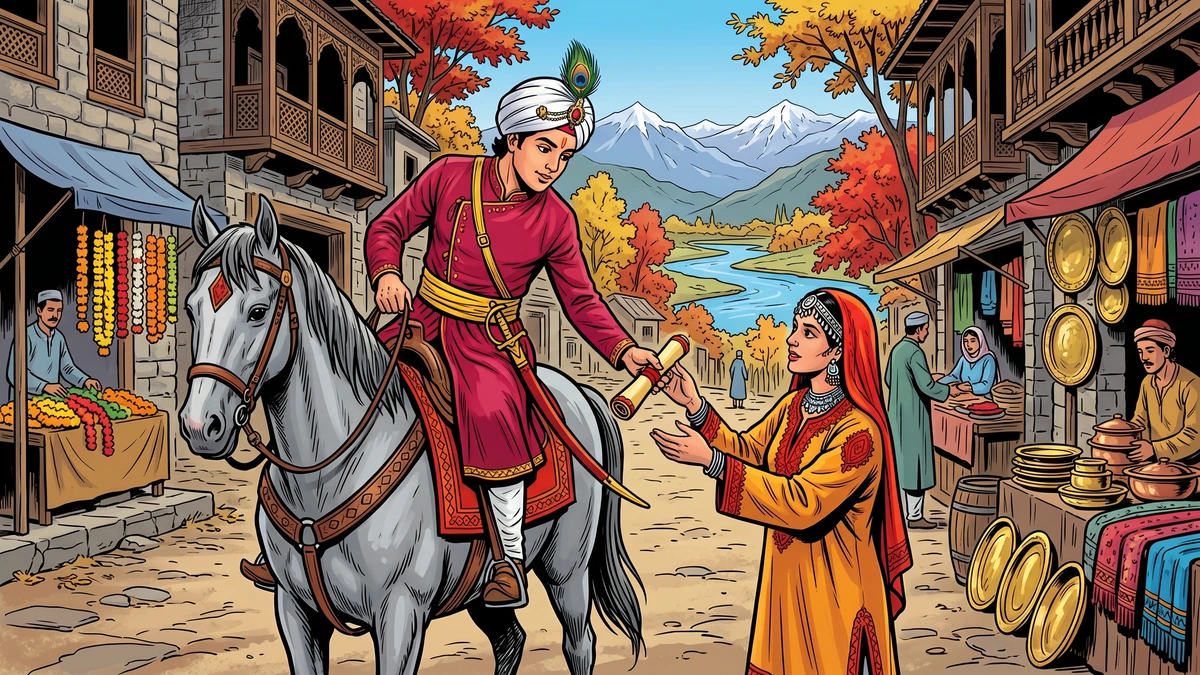
The king, when he reads the paper, takes it for impudence and orders the elder relation who carries it to be flogged out of the gate. But on the second morning the Brahmani herself walks to the durbar, the slip of palm-leaf in her own thin fingers, and reading the counsels aloud as she goes. The crown prince — young, hot-eyed, already half in love with foolishness — passes her in the lane, asks what she is reading, takes the paper, reads it twice, and on the spot writes her a parwana, a sealed treasury order, for one full lakh of rupees. The Brahmani goes home laden with rice, oil, dried apricots, and silver bangles for her mother-in-law. The blind parents weep aloud for joy. The household, for the first time in three years, does not go hungry.
The king, however, learning that his son has poured a lakh of treasury silver into the lap of an unknown woman for three lines of palm-leaf scribble, is incandescent. He banishes the prince. The young man bows, kisses his weeping mother, mounts his Yarkandi pony, and rides out of the gate alone — the three counsels folded inside his silken kamarband, all the inheritance left to him.
The First Counsel — The Sleepless Night
By dusk of the first day’s ride the prince comes, footsore and famished, to a clearing of pine and walnut where a man with very kind eyes and a very heavy ring of keys stands at the gate of a comfortable house. The traveller is welcomed with a great show of hospitality — a copper bath, a brass plate of mutton rogan-josh and saffron rice, a quilted razai spread on a low charpoy, a pot of fragrant kahwa tea steaming with almond and cardamom. The host bows the prince to his bed and withdraws.
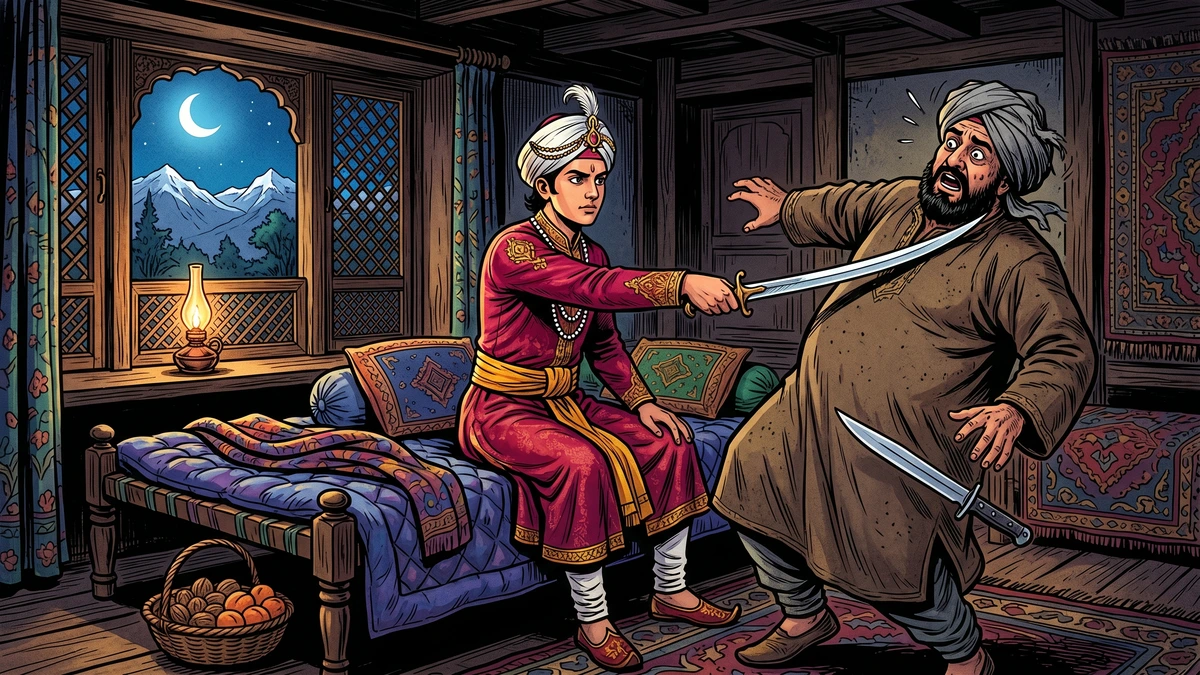
The prince lays himself down, but does not sleep. The first counsel rings in his ears — where thou alightest by night in a strange place, sleep not. He keeps his hand on the hilt of his curved Kashmiri tulwar beneath the quilt, and watches through half-closed lids. At the third watch of the night the door eases open. The kind-eyed host steals in with a long knife raised, intending to cut his throat for the saddle-bags of treasure he has assumed the prince must carry. The prince is up in an instant, the bare tulwar at the host’s throat, and disarms him.
“Do not slay me,” the man pleads, his kindness extinguished. “What profit would my blood bring you?” The prince, instead of striking, lowers the sword. “I will not slay you,” he says, “for if you killed me you would be sorry afterwards, like that merchant who killed his dog.” And then, by the light of a guttering oil-lamp on the windowsill, the prince tells him the story-within-the-story that has come down to us — the tale of the rich merchant, his pet hound, the loaned five thousand rupees, the burgled second shop, the dog that tracked the thieves to their cave, the letter rolled and tucked beneath the dog’s collar, and the brother-merchant who, jumping to a bitter conclusion, struck down the faithful animal at his threshold before unrolling the scrap of paper that would have forgiven him every paisa of debt. “Beware,” the prince concludes, “lest you do that which afterwards you would give your life not to have done.”
The host, weeping, returns the prince’s saddle-bags untouched and at first light shows him the safe road. The first counsel has saved the young man’s life, and a parable nested within it has saved the host’s soul.
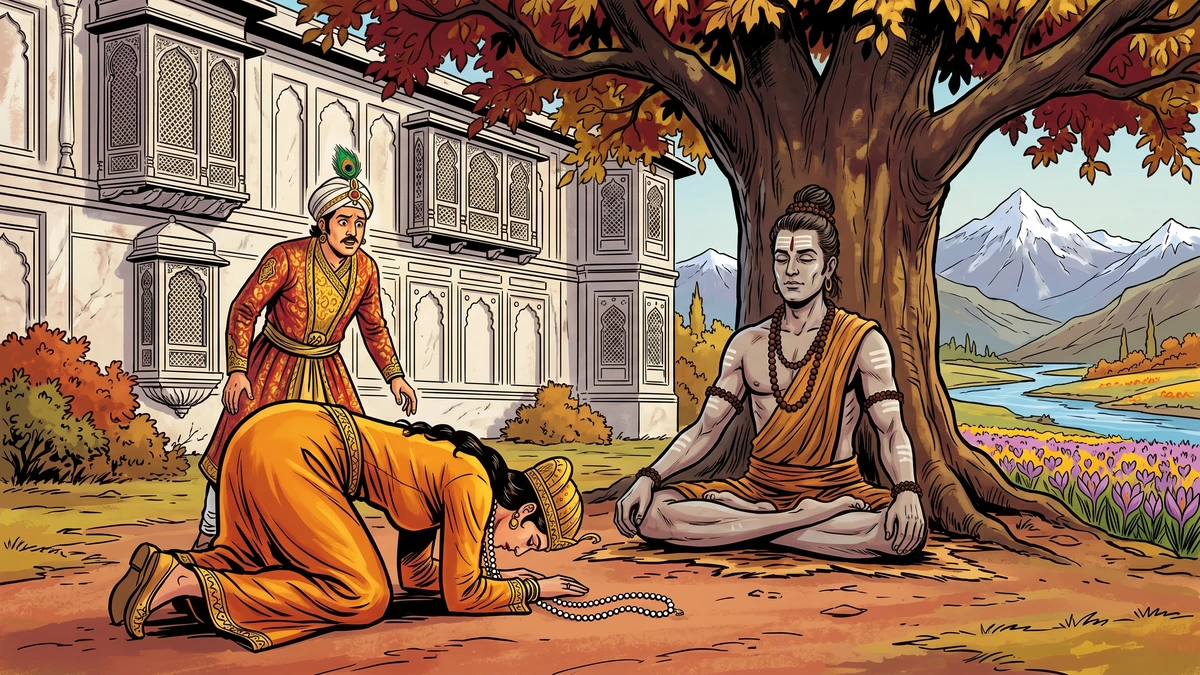
The Second Counsel — The Sister Who Will Not Know Him
Riding now in the disguise of a wandering jogi — ash-streaked forehead, ochre cloth, knotted hair — the prince comes to the country of his married sister, whose husband he has never met. He sits in dust beneath a chinar tree near the palace gate and pretends to be drowned in tapas. Word of the holy man’s stillness travels into the women’s quarter. The queen, his sister, has been ill these many months; no hakim has helped her. The brother-in-law sends servants to fetch the jogi; the jogi, refusing to enter a roof of stone, demands the queen be brought out to him under the chinar. They obey. He bids her prostrate on the bare earth before him for three full hours; rises her up; declares her cured. She walks back into the palace lighter on her feet than for a year.
That same evening the queen’s pearl māla, her great rosary of one hundred and eight Hyderabadi pearls, is missing. The māla, by simple bad luck, has slipped from her neck during her prostration and is found in the dust beside the jogi‘s seat. The brother-in-law, without question, orders the holy man executed at sunrise. The prince, who has watched his own sister say not one word in his defence — for she does not penetrate his disguise, and even if she did, the second counsel runs grimly true: a sister will receive thee for what she may have, but in poverty she will disown thee — bribes the executioner with the last of the king’s gift-gold and slips away in the dark. He has lost a country and a sister; but he has saved his neck and proved the second counsel.
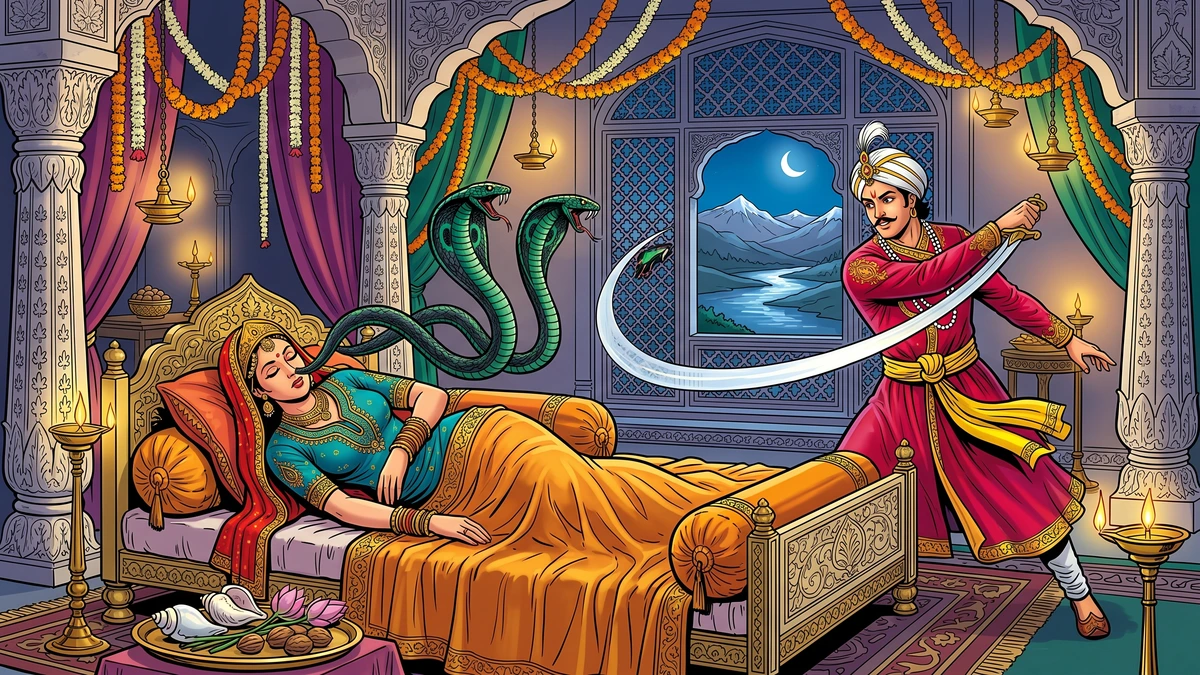
The Third Counsel — The Snake-Princess and the Potter’s Boy
In the third country he comes to a humbler scene — a potter’s hovel where the man and his wife and their small son are weeping and laughing together at once. The prince asks why. The potter explains: this kingdom labours under a strange royal calamity. The king’s only daughter is so beautiful that princes from every land have asked for her hand; but every bridegroom who lies down beside her on the wedding night is found dead at dawn. The neighbouring princes have been used up; the ministers have been used up; now, by sheer attrition, the lot has fallen on the potters’ sons of the city. Their boy is the next to be summoned. They laugh because a potter’s child is to wed a princess; they weep because tomorrow she will be a widow at five years old.
The prince, remembering the third counsel — if there is work to be done, do it thyself, and do it with might, and without fear — offers, on the spot, to take the boy’s place. The potters dress him in their last good jama; he goes to the palace, marries the princess in the moonlight under marigolds and conch-shell, and is conducted to the bridal chamber. He lays down his curved tulwar openly across his knees and sits.
At the third watch, from the nostrils of the sleeping princess, two long black shahmars — Kashmiri water-cobras of monstrous size — slide silently into the room with their hoods spread, intending to strike. The prince, awake and ready, severs both their heads with two clean strokes. By dawn the princess wakes, free for the first time in her life from the curse that her own breath had carried; the king finds his daughter alive and her bridegroom alive, and proclaims the prince his heir. He stays a full year; receives elephants, war-horses, jewels, and ten lakhs; and at last asks leave to ride home and see his blind mother again. On the road he passes through his sister’s country, where the brother-in-law now meets him with rope-tied wrists and bowed head, ready for any vengeance; the prince, magnanimous, gifts him two elephants, two horses, fifteen soldiers, and a casket of jewels. Reaching home, he lays his hands upon his old father’s eyes and his old mother’s eyes — both of them blinded these many years from weeping for him — and they see again. He tells his father every adventure. The king embraces him and weeps. All is joy, and the three counsels that he bought for a lakh of rupees have, between them, saved his life three times and bought him an empire.
The Moral — Wisdom is the Cheapest Treasure One Ever Buys
The moral the Kashmiri storyteller drives home is the most ancient one in Indo-Aryan ethics: that the price of wisdom looks dear only to fools. The Pandit’s three lines on a scrap of palm-leaf cost a lakh of rupees — an absurd, princely sum — but every counsel is repaid a thousandfold within the year. The Hitopadeśa opens with the same conviction:
“Vidyā nāma narasya rūpamadhikaṁ pracchanna-guptaṁ dhanam,
Vidyā bhogakarī yaśaḥ-sukhakarī vidyā gurūṇāṁ guruḥ.”(“Wisdom is the truest beauty of a man, a hidden treasure secretly stored — wisdom yields enjoyment, fame and happiness; wisdom is the teacher of teachers.” — Hitopadeśa, Prastāvikā 6, ed. Peterson 1887)
The same conviction lies behind the celebrated couplet of the Bhartṛhari Nītiśataka 16: vidyā vivādāya dhanaṁ madāya — “knowledge in the wise leads to discrimination, but wealth in the foolish only to arrogance.” The Kashmiri tale, in its homely Pandit voice, simply translates that Sanskrit aphorism into the bazaar where the value of advice can be priced in silver and the silver can be measured in saved heartbeats.
Why It Has Lasted
The tale belongs to a deep Indo-European stratum. International folk-narrative scholars, following Antti Aarne and Stith Thompson, classify it as ATU 910 — “The Three Counsels (Wise Counsels)”, with the dog-and-merchant exemplum a type-940-class “things done in haste” story (Stith Thompson motifs J21 “counsels proved wise by experience”, J2103 “things done without reflection”, K2155.1.1 “blood smeared on innocent person”; the snake-princess episode is motif B765.6 “snake emerges from sleeping princess’s nostrils” with cognates in Kathāsaritsāgara and Grimm KHM 60). The frame is older than Knowles by at least a thousand years; a fully Sanskritised version stands in Somadeva’s Kathāsaritsāgara (Book XII), and a Buddhist analogue in the Jātaka (No. 425, the Aṭṭhāna Jātaka). Variants are found from the Talmud to Chaucer’s Pardoner; in Spain as Los tres consejos; in Russia as Tri sovieta; in Iceland as the third tale of the Þiðrekssaga‘s appendix.
What gives the Kashmiri version its peculiar staying-power is the way it weds two rhythms — the proverb and the parable. Each of the Brahman’s three counsels is a single sentence that almost any grandmother in Anantnag could quote from memory; each is then dramatised by an extended episode that turns the proverb into lived experience. This is exactly the rhetorical pattern of the Pañcatantra, where each maxim of nīti is carried by a beast-fable. Knowles, who collected the tale across thirty winters of pastoral visiting in the Vale, noted in his preface that “the wisdom of Kashmir is folded into proverb and unrolled by story” (Knowles, Folk-Tales of Kashmir, Preface vii); and this tale is the most exact specimen of that folding-and-unrolling. It survives in modern Kashmir oral tradition still, told by Pandit grandmothers in Jammu camps and Srinagar back-streets, the proverbs almost unchanged, the elephants and saffron a little dimmed by the century, but the bargain — a fortune for three sentences — as good a bargain as ever.
Canonical Attribution
Primary text: J. Hinton Knowles, Folk-Tales of Kashmir (Kegan Paul, Trench, Trübner & Co., London, 1888; 2nd ed. 1893), Tale LIX, “A Lach of Rupees for a Bit of Advice,” pp. 32–41 — collected in Kashmiri (Kāśur) from Pandit informants in Srinagar between 1885 and 1888 and translated into English by Knowles. Re-anthologised in Joseph Jacobs, Indian Fairy Tales (David Nutt, London, 1892; illus. John D. Batten), Tale XV, pp. 81–88 (Project Gutenberg eBook 7128). Internationally indexed: Hans-Jörg Uther, The Types of International Folktales (FF Communications 284–286, Helsinki, 2004), ATU 910 — Wise Counsels, with subtype 910A “Wise through experience” and 910B “The servant’s good counsels”; embedded type ATU 893 “The unreliable friends (the Half-friend)”; Stith Thompson, Motif-Index of Folk-Literature (Indiana University Press, rev. ed. 1955–58), motifs J21, J21.2, J21.5, J2103, B765.6, D1741. Sanskrit and Pali analogues: Somadeva, Kathāsaritsāgara XII (tr. C. H. Tawney, 1880; rev. N. M. Penzer, 1924–28); Jātaka No. 425 (Aṭṭhāna Jātaka, Pāli Text Society ed. Cowell 1895); Pañcatantra Book V (Aparīkṣitakāraka — “Action without examination”), tr. Edgerton 1924. Sanskrit aphorisms: Hitopadeśa Prastāvikā 6 (ed. Peter Peterson, Bombay 1887); Bhartṛhari, Nītiśataka 16. Kashmiri-language proverb parallels: J. Hinton Knowles, A Dictionary of Kashmiri Proverbs and Sayings (Education Society’s Press, Bombay, 1885), nos. 312, 414, 1008. Knowles dedicated the volume to George Buhler and to the memory of his Pandit teacher Pandit Govind Kaul; Jacobs’s notes (1892, p. 243) cross-list the tale to the Cuban-Spanish, French, Russian, and Talmudic recensions of ATU 910.
Read More Indian Folk Tales
If you enjoyed this Kashmiri Pandit moral tale, you may also like these closely related stories from indianfolktales.com:
- Why the Fish Laughed — another Kashmiri Pandit tale collected by Knowles, on a vazir’s clever daughter and the proverb that wisdom is strength.
- A Clever Thief — a Kashmiri trickster tale on the costly value of foresight.
- Sir Buzz — Steel and Temple’s beloved Punjabi tale of a clever bee and a poor Brahman.
- Princess Aubergine — Steel-Temple’s Kashmiri-Punjabi border tale of clever wisdom outwitting witchcraft.
- The Barber’s Clever Wife — Punjabi proverb-and-parable tale on the price of wisdom in a household.
You May Also Like
 Indian Folk Tales
All Ages
Indian Folk Tales
All Ages
Mr Bunnys Carrot Soup
Mr Bunnys Carrot Soup: Once upon a time Mr. Bunny picked four carrots. I will make carrot soup, he thought. Rat asked, “May I have a carrot please?” “Yes, take
 Indian Folk Tales
Ages 3-5
Indian Folk Tales
Ages 3-5
Raja Rasalu
Raja Rasalu: Once there lived a great Raja, whose name was Salabhan, and he had a Queen, by name Lona, who, though she wept and prayed at many a shrine, had
 Indian Folk Tales
Ages 6-8
Indian Folk Tales
Ages 6-8
The Mouse Deer and the Crocodile: How Wit Overcomes Danger
The Mouse Deer and the Crocodile: How Wit Overcomes Danger: In the dense forests of Indonesia, where the rivers flow like liquid silver and the jungle is alive