Good Luck To The Lucky One Or Shall I Fall Down
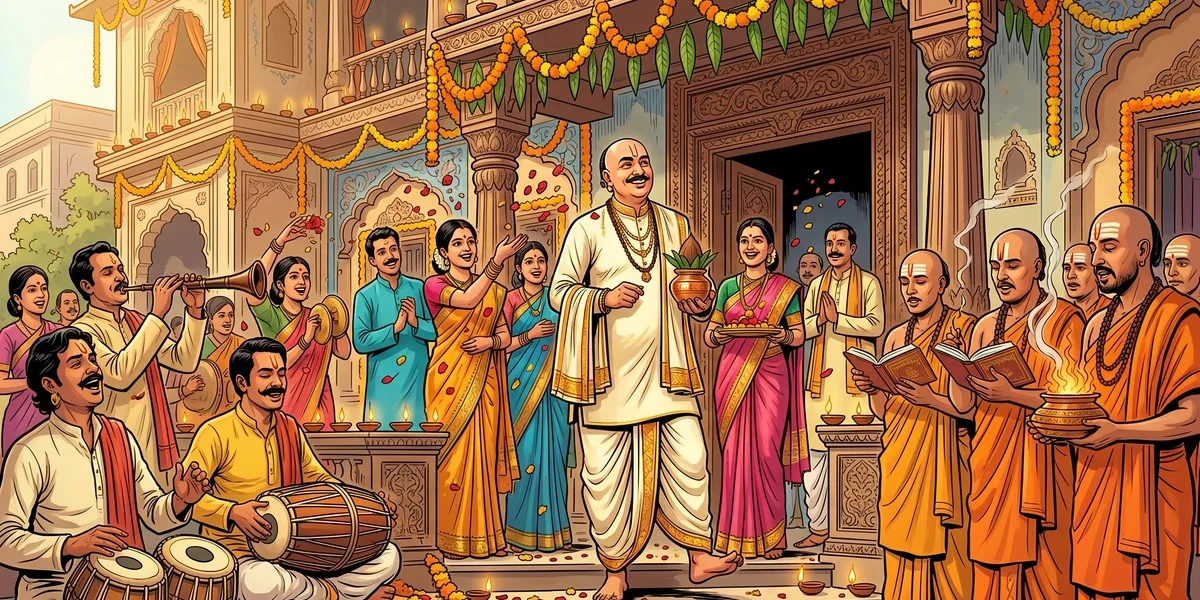
Good Luck To The Lucky One Or Shall I Fall Down: In a certain town there lived a wealthy Brâhmiṇ. He wished to build a house - pretty large and spacious - as
Good Luck to the Lucky One, or Shall I Fall Down: Fortune, Envy, and the Destructive Wish
Among the most unnerving tales in the moral inventory of world folk narrative is the type sometimes called “the destructive wish” — a story in which a character, offered any wish they desire, chooses not something that would benefit them but something that would harm their neighbour. The governing irony is that the wish, granted, also harms or destroys the wisher, because the wisher had defined their own wellbeing as dependent on the neighbour’s destruction rather than on any positive good of their own. The Aesopic tradition, along with Persian, Indian, and Slavic folk traditions, returns to this story repeatedly because it encodes a precise psychological observation: that envy, taken to its logical conclusion, is self-destroying.
The tale’s governing concept is phthonos kata heauton—envy turned against the self—the way that organising one’s desire around another’s diminishment rather than one’s own flourishing produces a wish that can only harm the wisher, regardless of whether the neighbour suffers. The character who says “let my neighbour’s cow die” or “let the lucky one fall down” has revealed that their deepest desire is not for their own good but for the removal of another’s — a desire that the universe, in these tales, grants with terrible precision.
“He was given any wish he wanted. He could have wished for anything at all. He wished that the lucky one would fall down. And so something fell.”
Beat I — The Lucky One and the Envious One
The tale establishes two neighbours or two characters: one who is perceived as fortunate — prosperous, celebrated, loved, or simply happier — and one who experiences the other’s fortune as a personal injury. The envious one has not been robbed; the lucky one’s good fortune does not come at the envious one’s expense. But envy does not require that structure: it requires only the perception of an unacceptable disparity, and the experience of that disparity as unbearable. The envious one’s life is not terrible by objective measure; it has simply been made to feel terrible by the existence of someone doing better.
Beat II — The Wish and Its Precision
When the opportunity for a wish arises — through a supernatural encounter, a fairy, a genie, a divine figure — the envious one faces the full inventory of human desire. They could wish for health, wealth, love, long life, talent, peace. They wish for the lucky one to fall. The precision of this choice is the tale’s central diagnosis: the envious character has spent so long organising their inner life around the lucky one’s diminishment that they have lost the capacity to imagine their own flourishing as a separate matter. To wish is to reveal what you actually want; the envious character reveals that what they want, most fundamentally, is not their own good but the removal of another’s.
Beat III — The Wish Granted and Its Return
In many versions of this tale, the wish granted for another’s harm rebounds to the wisher: the neighbour’s cow dies, and so does the wisher’s; the lucky one falls, and the fall takes the envious one with it. In some versions the rebound is immediate and literal; in others it is delayed and metaphorical. But the structural point is consistent: organising your desire around another’s diminishment creates a wish whose satisfaction offers you nothing positive, and whose granting leaves you in the same relationship of dependency on the lucky one as before — except now you are both diminished, and the gap between you may be identical.
Story type: ATU 555.1 (The Destructive Wish) and related types
Themes: Phthonos kata heauton (envy turned against the self), the destructive wish, zero-sum thinking, the impossibility of satisfaction through another’s harm
Related tales: The Fisherman and His Wife (Grimm), versions in Panchatantra and Hitopadesha
Beat IV — What the Destructive Wish Reveals
The tale’s deepest argument is about the logical endpoint of envy: that if you follow it all the way to its conclusion — if you are given exactly what envy wants — you discover that what envy wants is not satisfying. The lucky one falls. What do you have now? You have the absence of someone else’s good fortune, which is not the same as the presence of your own. The gap between you may be smaller, but you are in a worse position than before, and the lucky one’s fall has given you nothing that will last, because the source of your dissatisfaction was not really the lucky one — it was your own relationship to what you have. The tale proposes, by negative example, the only solution: to want something for yourself, in your own terms, that does not depend on another’s state.
Why This Story Lasted
Good Luck to the Lucky One has lasted across many cultures because the wish it describes — the destructive wish — is genuinely tempting, and the tale is honest about that. It does not pretend that envying the lucky one is incomprehensible; it understands the feeling. What it insists on is the futility: that even if the wish is granted, even if the lucky one falls, you are left with nothing. The tale is a thought experiment in the satisfaction of envy, run all the way to its conclusion, and the conclusion is that envy is not a route to happiness but a route to the same unhappiness you started with, at greater cost.
Frequently Asked Questions
What is the “destructive wish” story type?
The destructive wish is a folk-tale type (ATU 555.1 and related) in which a character, given unlimited wishes, chooses something harmful to a neighbour rather than something beneficial to themselves. The type appears across Aesopic, Persian, Slavic, Indian, and European traditions, suggesting it addresses a universal feature of human psychology: the tendency for envy to override self-interest.
Is this the same as the “one eye” tale?
A closely related variant involves a character offered any wish who wishes to lose one eye — because that way their envied neighbour will lose both. This variant makes the self-harm of the destructive wish even more explicit: the wisher literally accepts personal damage as the price of another’s greater damage. Both versions encode the same psychological insight about envy’s self-destructive logic.
Why can’t the envious character just wish for their own prosperity?
This is precisely the tale’s diagnostic question. The envious character cannot wish for their own prosperity because their sense of wellbeing has become entirely tied to relative rather than absolute position — they feel bad not because they lack something specific but because someone else has more. Wishing for their own prosperity would help, but it would not solve the problem if the lucky one remained luckier. Only the lucky one’s fall would satisfy, and the tale demonstrates that even that satisfaction would be empty.
Does this tale have a lesson for modern competitive cultures?
Yes, directly. Competitive cultures — especially those organised around rankings, comparisons, and zero-sum status — systematically cultivate the envious orientation the tale diagnoses. When people define success relative to others rather than in absolute terms, they are structurally primed for the destructive wish: better to see competitors fail than to improve themselves. The tale suggests this orientation is not only morally bad but practically self-defeating.
What is the healthy alternative to the destructive wish?
The tale implies rather than states the alternative: a wish grounded in one’s own genuine values and needs, formulated in terms that do not depend on the lucky one’s state. What would make your life genuinely better, measured by your own terms rather than by comparison? This is a harder question than it sounds, because comparative thinking tends to displace it — but it is the only question whose answer can produce lasting satisfaction.
Frequently Asked Questions
**Q: Why is this story important?**
You May Also Like
 Aesop's Fables
Ages 3-5
Aesop's Fables
Ages 3-5
The Tortoise and the Hare: A Tale of Arrogance and Determination
The Tortoise and the Hare: A Tale of Arrogance and Determination: In the heart of a vast forest where ancient oaks stretched their limbs toward an endless sky
 Aesop's Fables
Ages 3-5
Aesop's Fables
Ages 3-5
The Three Calamities
The Three Calamities: From that time these four young men became the confidential advisers of king Alakesa in all important affairs of state, and, as night is
 Aesop's Fables
All Ages
Aesop's Fables
All Ages
The Ant and the Grasshopper
The Ant and the Grasshopper: One summer day, a grasshopper was hopping about, playing his fiddle, chirping and singing to his heart’s content. An ant passed by