At The Airport Lounge
At The Airport Lounge: Her connecting flight to London was after six hours. Sia was sitting in Doha airport lounge, lazily watching the hustle-bustle of
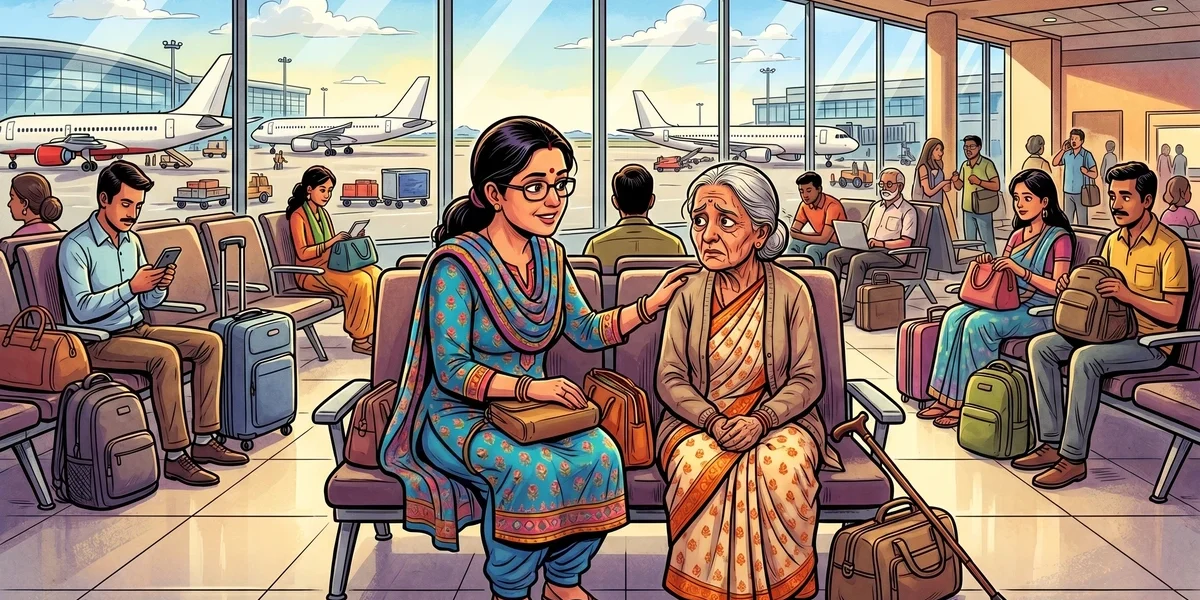
At the Airport Lounge: The Threshold Space and What Waiting Reveals About Character
The airport lounge is among the most democratic and most revealing spaces in modern life: a temporary gathering of strangers who have been sorted by ticket class and frequent-flier status but who share, regardless of those distinctions, the condition of waiting. They are between places — not yet where they are going, no longer where they were. The ancient philosophical traditions called such spaces metaichmioi—threshold places—and recognised them as sites of particular psychological exposure, where the masks that social roles provide are temporarily unavailable and something more essential becomes visible.
The Aesopic tradition is interested in exactly these moments of exposure. Many of its best fables take place at the edge of one condition and another — the animal about to cross from safety to danger, the traveller between towns, the moment before the decision that cannot be undone. “At the Airport Lounge” transposes this interest into contemporary terms: what do we do with the enforced pause, the unexpected gift of unscheduled time, the stranger who sits beside us and offers or withholds what we need? The governing concept is kairos en mesō—the opportune moment in the middle—the idea that threshold spaces offer encounters that would not be possible in either origin or destination.
“They were all going somewhere. For a few hours, they were nowhere. In that nowhere, someone offered a kindness, and someone accepted it, and something small and unremarkable happened that neither of them would forget.”
Beat I — The Condition of Waiting
The airport lounge concentrates waiting into a visible form. Passengers arrive with the energy and intention of people in motion, then discover that motion is suspended — indefinitely, in the case of delays, or for precisely measured intervals in the ordinary case. This suspension produces a particular social state: strangers who are temporarily residents of the same micro-community, sharing space without the social contracts that normally govern shared space (neighbourhood, workplace, family). The social norms are unclear; the interactions that develop are therefore self-selecting in interesting ways — people who talk to strangers in airport lounges are revealing something, as are people who do not.
Beat II — The Encounter That Threshold Spaces Make Possible
The Aesopic structure of the lounge story typically involves an encounter that would not occur in the ordinary flow of either person’s life — a conversation with a stranger that reveals something unexpected, a small kindness offered or received, a moment of connection across the social sorting that ticket classes attempt to maintain. The lounge strips away the usual context cues — workplace, home, neighbourhood — and leaves the person more exposed to who they are when those contexts are removed. Aesop understood this as the condition in which character becomes most legible: the fox’s cunning is most visible when it has no territory to hide in; the wolf’s nature is most visible at the waterhole where it cannot avoid encountering others.
Beat III — What We Carry Through the In-Between
The passengers in the lounge carry their usual burdens — worries about the meeting at the destination, grief or joy or ordinary tiredness from the place they left. The lounge does not dissolve these burdens; it suspends the contexts in which they operate. A person who is domineering at work has no office in the lounge; a person who is lonely at home is surrounded by others. The in-between space equalises by removing context, and in the equalisation something is briefly visible that the contexts normally conceal. The Aesopic interest is in these moments of brief visibility: what do people do with unexpected exposure? Do they connect or retreat? Do they offer or withhold? Do they see the stranger or look through them?
Setting: The airport lounge — a modern threshold space
Ancient parallel: Metaichmioi — the in-between spaces of Greek geography and mythology, sites of transformation and encounter
Themes: Kairos en mesō (the opportune moment in the middle), threshold space, character revealed in waiting, the stranger encounter
Beat IV — The Gift of the In-Between
The airport lounge’s suspended time is often experienced as loss — time stolen from productivity, from arrival, from the purposeful activity of already-being-there. The Aesopic reframe is different: the lounge is time given for something that the ordinary flow of purposeful movement does not permit. An unexpected conversation. The book that a stranger recommends. The observation of an interaction between two people that teaches something about how patience or impatience actually look from the outside. The child in the seat across the aisle whose play reminds the worried executive that play exists. The in-between is not empty time; it is time that has been freed from one agenda without yet being captured by another, and in that freedom something is possible that purpose usually forecloses.
Why This Story Matters
Stories set in threshold spaces — airport lounges, waiting rooms, train compartments, queue lines — matter because they name the experience of enforced pause and invite a reinterpretation of it. The culture of productivity treats waiting as waste; the Aesopic tradition treats it as occasion. What happens to us while we are waiting is not nothing — it is often the most unguarded, and therefore most revealing, encounter with what we are and what we might do differently. The airport lounge is the metaichmioi of modern life: the in-between where the story that was not planned can still occur, if the person waiting is willing to look up from their screen.
Frequently Asked Questions
What is the Aesopic connection to this modern setting?
Aesop’s fables consistently use the moment of encounter — at the waterhole, on the road, at the edge of the forest — as the occasion for moral revelation. The encounter between different creatures in a shared space of temporary co-presence is the structural DNA of most fables. The airport lounge is the contemporary version of the waterhole: a place where different kinds of people must share space regardless of their ordinary territories.
What does “threshold space” mean philosophically?
Threshold spaces (liminal spaces, from Latin limen, threshold) are places of transition between defined states — neither origin nor destination, neither one thing nor another. Anthropologist Victor Turner developed the concept of liminality to describe ritual passages in which the initiate is temporarily between social identities. The airport lounge is secular liminality: you have left but not arrived; you are between your two selves.
Why do meaningful conversations sometimes happen with strangers on planes?
The conditions of air travel create what sociologists call “stranger intimacy” — the phenomenon in which people disclose more to strangers they will never see again than to people they know well. The lack of social consequence (the stranger cannot damage your reputation at home or at work), combined with the suspension of normal social context, makes certain kinds of honesty easier. The fable captures this as a feature rather than a bug of the in-between.
Is enforced waiting always an opportunity?
The fable does not claim this — it offers a reinterpretation of waiting that is available rather than mandatory. Some waits are simply difficult, and the invitation to treat them as opportunity can feel like another burden. The more modest claim is that the in-between has potential that purposeful movement forecloses, and that occasionally — not always — that potential is worth attending to.
What does this tale reveal about social class and airport lounges?
The airport lounge is nominally a space of privilege — access is gated by ticket class or card membership — yet even within the lounge, the condition of waiting equalises in interesting ways. The fable’s interest is in what persists and what dissolves when the usual sorting mechanisms are suspended. Some things persist — people maintain their devices, their postures, their sense of entitlement or deference. Other things dissolve surprisingly quickly when a flight is cancelled and everyone is suddenly on the same side of the same inconvenience.
Frequently Asked Questions
**Q: Why is this story important?**
You May Also Like
 Aesop's Fables
Ages 9-12
Aesop's Fables
Ages 9-12
The Talkative Tortoise
The dual-rooted Indian fable of Kambugrīva — "Conch-Necked," the tortoise of Phullotpala pond — and his two wild-goose friends Saṅkaṭa and Vikaṭa, who try to lift him out of a drought by carrying him on a stick. The story comes to us through two ancient traditions at once: the Buddhist Pali Canon as Kacchapa Jātaka No. 215, and the Hindu Panchatantra as Book I, Mitrabheda. It is not, as is often claimed, a tale of Aesop. T.W. Rhys Davids' 1880 translation is preserved in full alongside the Sanskrit retelling, with Sanskrit names restored, the dual-tradition origin explained, and the story's two-thousand-year journey through Pahlavi, Arabic, Persian, Hebrew, Latin, and finally La Fontaine's French traced.
 Aesop's Fables
Ages 3-5
Aesop's Fables
Ages 3-5
Retaliation
Retaliation: There is a proverb in Tamil̤ called Palikkuppali vâṅgukiradu which would best be translated by the expression “tit for tat,” and the following
 Aesop's Fables
Ages 3-5
Aesop's Fables
Ages 3-5
The Three Deaf Men
The Three Deaf Men: When any awkward blunder occurs from a person acting under a mistaken notion, there is a common proverb in Tamil to the effect that the