The Three Deaf Men
The Three Deaf Men: When any awkward blunder occurs from a person acting under a mistaken notion, there is a common proverb in Tamil to the effect that the
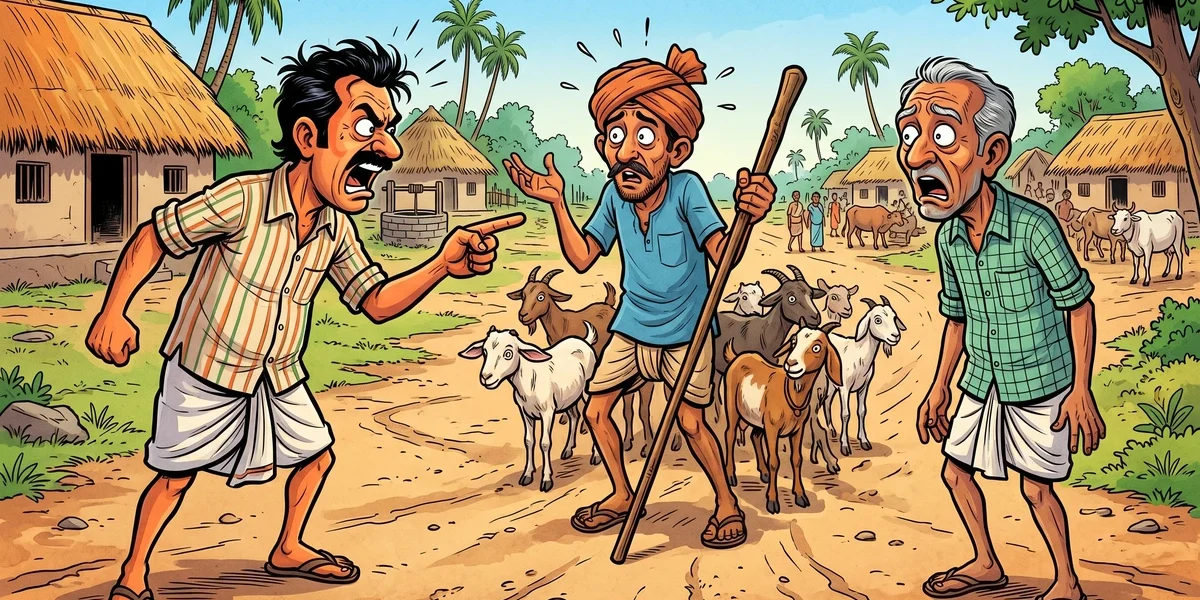
Three Deaf Men and a Conversation That Never Happened
Among the most universally beloved comic structures in world folk narrative is the dialogue of the hard-of-hearing: three people who cannot hear each other, each responding to what they imagined was said rather than what was actually said, producing a conversation of perfect formal coherence and total semantic absurdity. The Three Deaf Men belongs to this international tale-type (AT 1698: Deaf Men and Their Foolish Answers), attested across India, Turkey, Russia, China, and medieval Europe, and its endurance across cultures testifies to a universal human recognition: we are all, in some register, conducting conversations based on our assumptions about what others said rather than what they actually said.
In the Indian folk tradition, this tale circulates both as a standalone comic piece and as an illustrative story within larger didactic frameworks. The Nasreddin Hodja tradition — which spread through Mughal India along with Persian and Turkish cultural currents — preserves similar deaf-man tales, and several Indian versions are explicitly attributed to Nasreddin or his analogues (Goha in Arabic, Mullah Nasruddin in Persian). The tale’s cross-cultural mobility reflects its status as a comic demonstration of a philosophical point: the gap between speech and understanding, between what is uttered and what is received, is not merely a disability but a structural feature of all communication.
Anumana Run Amok: The Cognitive Comedy of False Inference
Indian epistemology (pramana-shastra) identifies anumana — inference from signs — as one of the four valid sources of knowledge. But the Three Deaf Men tale demonstrates what happens when anumana is applied to a signal that has not been correctly received: the inference is formally impeccable but substantively absurd. Each deaf man hears (or mishears, or imagines) a fragment of speech, fills the gap with contextual plausibility, and constructs a response that is internally coherent yet completely unrelated to the actual exchange. The result is a perfect parody of reasoning — correct procedure, catastrophically wrong data.
This comic structure anticipates the philosophical concern with abhasa (semblance or fallacious appearance) in Indian logic: the case where something appears to be valid knowledge but is not. The Nyaya school distinguished genuine pratyaksha (direct perception) from the distorted perceptions produced by faulty sense organs. Deafness is the limiting case of sensory distortion: the deaf man’s “perception” of the conversation is entirely constructed from inference and assumption, with no authentic perceptual input. His confident participation in the exchange is therefore a demonstration of abhasa-anumana — the fallacy of reasoning from corrupted evidence.
The Three-Character Structure and Its Comic Logic
Why three deaf men rather than two or four? The three-character structure serves both comic and philosophical purposes. With two, the exchange could be bilateral and might resolve accidentally into something coherent. With four, the comic absurdity might become tedious rather than escalating. Three provides the optimal comic rhythm: the first exchange establishes the pattern (one deaf man misunderstands), the second confirms it (a second deaf man misunderstands in a different direction), and the third provides the punchline (the absurdity reaches its logical culmination). This three-beat structure is the same rhythm that drives the three-wish tales, the three-brother tales, and the three-trial tales — it is the rhythm of satiation: enough repetition to demonstrate a pattern, not so much as to exhaust it.
The tales’ traditional settings often involve socially charged exchanges — a court case, a neighborly dispute, a commercial transaction — which amplifies the comedy. The formal gravity of a legal proceeding combined with the total semantic chaos of deaf-man inference creates the kind of incongruity that laughter theory (from Bergson’s mechanical encrusted on the living to Freud’s tension-release) identifies as comedy’s engine. The more seriously the deaf men take their absurd exchange, the funnier it becomes — because their seriousness reveals the degree to which social form can persist entirely without semantic content.
What the Three Deaf Men Teach About Listening
Behind the laughter, the tale carries a serious epistemological message: how often do we conduct real conversations the way the three deaf men conduct theirs? Research in communication psychology consistently finds that listeners hear approximately 50% of what speakers actually say, and of that 50%, they accurately remember perhaps 25%. The gap is filled — necessarily, automatically — by inference, assumption, and projection. The three deaf men are extreme cases of a universal condition: we are all partially deaf to each other, responding at least partly to what we expected to hear rather than what we actually heard.
Indian philosophy’s insistence on careful shravana (listening) as the first prerequisite of genuine understanding (before manana — reflection — and nididhyasana — deep contemplation) reflects an awareness of exactly this problem. The Upanishads were transmitted orally precisely because their teachers understood that the quality of listening was more important than the quality of the text. The Three Deaf Men tale is a comic inversion of this tradition: a demonstration of what understanding looks like when shravana is absent — which is to say, it looks like a perfectly conducted conversation about nothing whatsoever.
“Each man heard nothing and answered everything — and their conversation was a marvel of agreement about matters none of them had discussed.”
Why This Story Lasted
The Three Deaf Men has lasted because it makes us laugh at ourselves. Every audience recognizes — if only in the laughing — that they have participated in conversations where the gap between what was said and what was heard was wider than anyone admitted. The tale’s comedy is not cruel (the deaf men are not villains but victims of their own plausible inferences) but diagnostic: it reveals the fragility of communication as a social institution, the immense work that normally successful exchange requires, and the comedy available when that work fails in a sufficiently systematic way. Every generation of listeners has had this experience; every generation has needed to laugh at it.
Frequently Asked Questions
Is The Three Deaf Men tale unique to India?
No — it belongs to the international tale-type AT 1698 (Deaf Men and Their Foolish Answers), attested across India, Turkey, Russia, China, and medieval Europe. In India it circulates both independently and within the Nasreddin Hodja tradition, which spread through Mughal India via Persian and Turkish cultural currents.
What is anumana and why does it produce comedy in this tale?
Anumana is inference from signs — one of the four valid sources of knowledge in Indian epistemology. In the tale, each deaf man applies formally correct inference to corrupted (unheard) data, producing responses that are internally logical but semantically absurd. This is abhasa-anumana — the fallacy of reasoning from faulty perceptual input — which Indian Nyaya philosophy identifies as a category of false knowledge.
Why does the tale use exactly three deaf men?
Three provides the optimal comic rhythm: the first exchange establishes the pattern, the second confirms it, the third delivers the punchline. Two might resolve accidentally into coherence; four might exhaust the joke. The three-beat structure is the same rhythm that drives three-wish and three-trial tales — enough repetition to demonstrate a pattern, not enough to exhaust it.
What does the tale reveal about communication in general?
The tale dramatizes the universal gap between speech and understanding. Research shows listeners hear approximately 50% of what speakers say and accurately remember 25% of that — the rest is filled by inference and projection. The deaf men are extreme cases of a universal condition: everyone conducts conversations partly by responding to what they expected to hear, not what was said.
How does this tale connect to the Indian philosophical tradition of shravana?
Shravana (careful listening) is the first prerequisite of understanding in the Upanishadic tradition — before manana (reflection) and nididhyasana (deep contemplation). The Upanishads were transmitted orally because teachers understood that listening quality was paramount. The Three Deaf Men tale is a comic inversion of this tradition: a demonstration of what understanding looks like when shravana is entirely absent.
Frequently Asked Questions
**Q: Why is this story important?**
You May Also Like
 Aesop's Fables
Ages 9-12
Aesop's Fables
Ages 9-12
The Lord Of Death
The Lord Of Death: Once upon a time there was a road, and every one who travelled along it died. Some folk said they were killed by a snake, others said by a
 Aesop's Fables
Ages 3-5
Aesop's Fables
Ages 3-5
At The Airport Lounge
At The Airport Lounge: Her connecting flight to London was after six hours. Sia was sitting in Doha airport lounge, lazily watching the hustle-bustle of
 Aesop's Fables
Ages 3-5
Aesop's Fables
Ages 3-5
The Mother In Law Became An Ass
The Mother In Law Became An Ass: Little by little the mother-in-law became an ass - vara vara mâmi kaludai pôl ânâl̤, is a proverb among the Tamil̤s, applied