How Did Stories Begin – A Zulu Folktale
How Did Stories Begin – A Zulu Folktale: Zulus live in Africa. Like you, the children who live there also like to listen to stories. But what would happen if
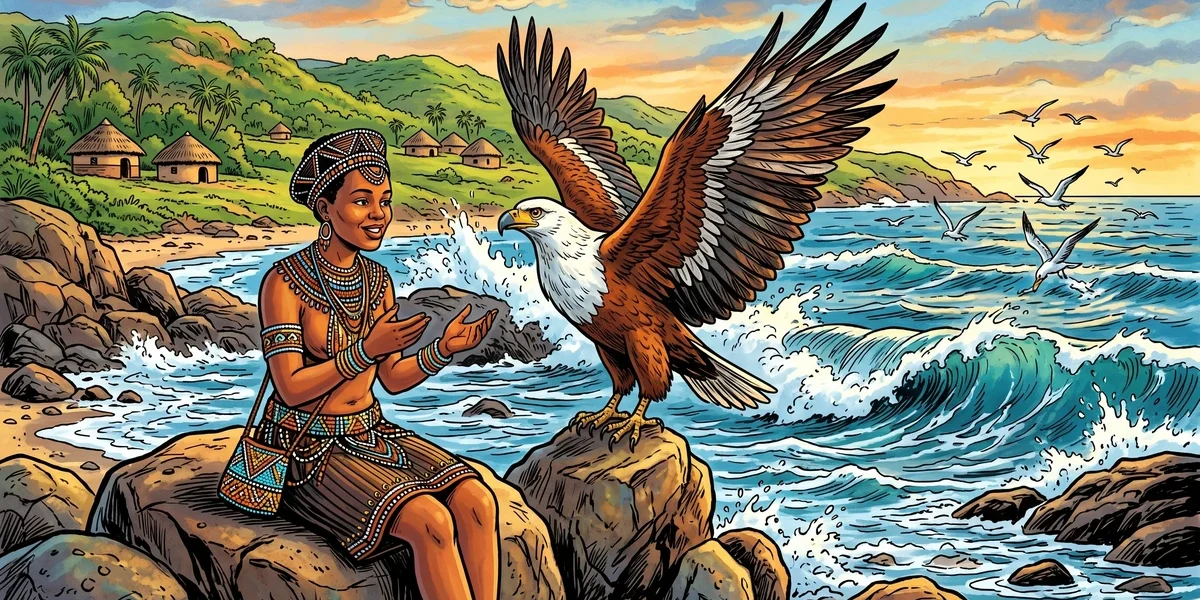
How Did Stories Begin: The Zulu Origin of Narrative and the Gift That Feeds Itself
Among the most philosophically interesting of all folk tales are the stories that explain themselves — the tales about how tales began, the narratives that account for the existence of narrative. The Zulu tradition, like many African oral traditions, possesses such an origin story: an account of how stories entered the world, what they are for, and what happens to communities that lose them. These meta-narratives are among the oldest and most self-aware things in human storytelling: they know they are stories, and they use that knowledge to make a claim about why stories exist at all.
The Zulu tale of story’s origin — in various versions — typically involves a creature or entity from whom stories must be obtained, a person or community who makes the journey to get them, and a transformation of the world that follows when stories enter it. The governing concept is ubuntu nge-ndaba—personhood through story—the Zulu philosophical framework in which the capacity to be a full person is connected to the capacity to participate in the community’s narrative life. A person who cannot tell or receive stories is incomplete; a community without stories is not a community.
“Before there were stories, there were events — things that happened and then were lost. The first story was the moment someone refused to let something be lost.”
Beat I — The World Before Stories
In the telling, the world before stories had events but no meaning — things happened, seasons turned, people were born and died, animals hunted and were hunted, but none of this had narrative shape. It was experienced but not remembered, endured but not understood. The absence of story is described not as peaceful but as a kind of poverty: the community exists in a present that cannot learn from the past or prepare for the future, because without story there is no past that persists and no future that can be imagined. This is the world’s initial condition, and it is the condition the story’s hero sets out to change.
Beat II — The Journey to Obtain Stories
In many Zulu and related Southern African traditions, stories must be obtained from a specific source — a creature or spirit who possesses them and must be approached with the right combination of courage, respect, and the correct exchange. The journey to obtain stories is itself a story, which is the tradition’s elegant recursion: to earn the right to tell stories, one must be the protagonist of a story; to receive the gift of narrative, one must already be living inside narrative. The traveller who makes the journey and returns with stories is performing the archetype of all storytelling: the descent into the realm of the extraordinary and the return with a gift for the community.
Beat III — Stories as Living Gifts
What distinguishes stories from other gifts in these origin tales is that they multiply in the giving. Physical gifts diminish as they are shared — a goat divided among ten people is less goat per person. A story told to ten people is ten stories; each person carries the whole story and adds to it what their own experience makes possible. The Zulu tradition understands this multiplication as one of the defining features of story: it is a gift that feeds itself, a resource that grows with use rather than diminishing. This is why the acquisition of stories for the community is understood as a gift of inexhaustible abundance — not ten goats but ten thousand stories, growing as they are told.
Related traditions: Many Southern and Central African oral traditions have origin-of-story narratives with similar structures
Philosophical framework: Ubuntu — “I am because we are” — and its extension to narrative: personhood through participation in communal storytelling
Themes: Ubuntu nge-ndaba (personhood through story), the world before stories, the multiplication of narrative gifts, the storyteller as hero
Beat IV — What This Origin Story Claims
The Zulu origin of stories makes a strong claim: that narrative is not ornamental to human community but constitutive of it. The world without stories is not a community but a collection of isolated experiences that cannot accumulate into wisdom, cannot be shared across time, cannot teach the dead’s experience to the living. Stories are, in this framework, the technology that transforms a group of people who happen to be alive at the same time into a community that persists across time — that carries the knowledge of the grandmother into the life of the grandchild, that makes the long-dead present enough to teach. To lose stories is not to lose entertainment; it is to lose the capacity for this kind of temporal community.
Why This Story Lasted
The story of how stories began has lasted because it is the story that validates all other stories — the foundational narrative on which the entire edifice of oral tradition rests. Every story told in the community implicitly invokes this origin; every storyteller who speaks is participating in the transaction that the origin story describes. The Zulu tale of how stories entered the world is not merely charming; it is the philosophical justification for the storytelling practice that carries it, a story that proves its own necessity by being the kind of thing that only story can carry.
Frequently Asked Questions
What is Ubuntu and how does it relate to storytelling?
Ubuntu is a Nguni Bantu philosophical concept usually translated as “I am because we are” — the idea that personhood is fundamentally relational and communal rather than individual. In the context of storytelling, it implies that the capacity to participate in a community’s narrative life is part of what makes one fully a person within that community. Stories are not private property but communal resources that define and sustain the “we” that makes the “I” possible.
Where do stories “live” in Zulu oral tradition before they are told?
Different versions of the origin story locate stories in different places — sometimes in a specific creature (a chameleon, a spider, an elder being), sometimes in the earth, sometimes in a spirit world that the traveller must visit. The specific location varies; what is consistent is the idea that stories pre-exist any particular telling and must be obtained rather than invented, which frames the storyteller as transmitter and custodian rather than creator.
How does the “gift that multiplies” concept work in oral tradition?
In oral tradition, a story given to the community is not diminished by giving — each telling adds new listeners who now carry the story, and each teller’s interpretation adds nuance that future listeners will carry. Unlike physical goods that are depleted by distribution, stories grow with distribution. This is why oral communities have understood stories as forms of wealth that are created by, rather than consumed through, sharing.
Are there similar origin-of-story narratives in other African traditions?
Yes, widely. Ashanti (Ghana) tradition has the Anansi spider stories, which explain how stories entered the world through Kweku Anansi’s bargain with the sky god Nyame. Yoruba, Kikuyu, Igbo, and many other traditions have their own accounts of story’s origin. The specific mechanisms differ, but the structural insight — that stories are gifts obtained through effort and multiplied through sharing — is remarkably consistent across the continent.
What happens to a community that loses its stories?
The Zulu and related traditions are explicit about this: a community that loses its stories loses its connection to the accumulated wisdom of its dead, its capacity to transmit values across generations, and ultimately its sense of itself as a community that persists through time. Many African scholars and writers — Chinua Achebe, Ngugi wa Thiong’o, Ben Okri — have written about the colonial destruction of oral traditions as a form of cultural violence precisely because it attacks this constitutive function of storytelling. To lose stories is to lose the particular form of temporal community that stories make possible.
Frequently Asked Questions
**Q: Why is this story important?**
You May Also Like
 Aesop's Fables
Ages 3-5
Aesop's Fables
Ages 3-5
The Lion and the Mouse: Friendship Across Worlds
The Lion and the Mouse: Friendship Across Worlds: The savanna stretched endlessly beneath the African sun, a landscape of golden grasses and scattered acacia
 Aesop's Fables
Ages 3-5
Aesop's Fables
Ages 3-5
The King Who Was Fried
The King Who Was Fried: Once upon a time, a very long time ago indeed, there lived a King who had made a vow never to eat bread or break his fast until he had
 Aesop's Fables
Ages 9-12
Aesop's Fables
Ages 9-12
The Lord Of Death
The Lord Of Death: Once upon a time there was a road, and every one who travelled along it died. Some folk said they were killed by a snake, others said by a