The Story of Eklavya and Dronacharya – Stories from Indian Mythology
<p>Eklavya’s devotion to his teacher Dronacharya leads him to make a sacrifice that tests the meaning of loyalty and the price of mastery.</p>
Eklavya and Dronacharya: The Thumb, the Dakshina, and the Unresolved Injustice
The Autodidact Prince: Eklavya’s Self-Created Mastery
The story of Eklavya appears in the Adi Parva (First Book) of the Mahabharata, and it is one of the most morally uncomfortable episodes in the entire epic. Its discomfort is the point: the Mahabharata consistently presents moral complexity without resolution, asking its readers to hold the tension rather than releasing it into easy judgment.
Eklavya is a prince of the Nishada people — a forest-dwelling tribe outside the varna system of the Brahminic social order. As a young man, he seeks instruction from Dronacharya, the greatest archery teacher of the age, who teaches the Kuru and Pandava princes at the royal court of Hastinapura. Drona refuses him. The reasons given vary in different readings: some say Drona refused because he had committed to teaching only the Kuru and Pandava princes; others suggest the refusal was explicitly caste-based, that Drona would not teach a Nishada. The text is not entirely clear, and the ambiguity is significant: the Mahabharata does not want to let Drona off with a clean explanation.
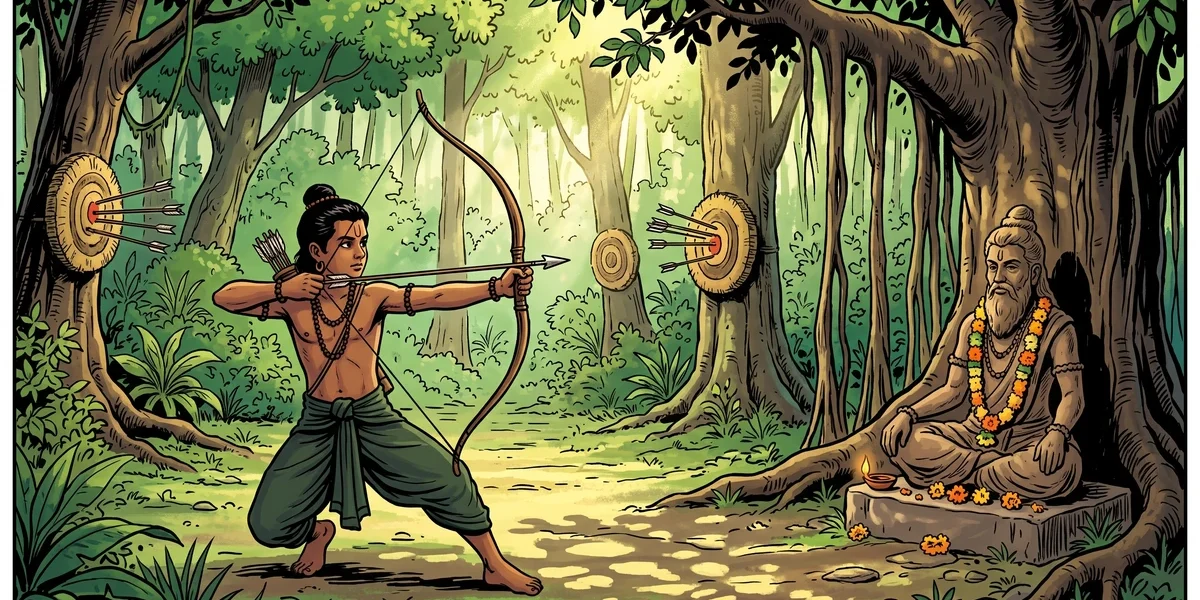
Eklavya returns to the forest. He makes a clay image of Dronacharya and treats it as his guru, practising before it with total devotion. Through years of solitary, self-directed practice of extraordinary intensity, he becomes an archer of surpassing skill — by some accounts, a better archer than Arjuna, whom Drona had pledged to make the greatest archer in the world. His mastery is entirely self-created, fuelled by devotion to an imagined teacher who never taught him anything.
The Encounter: Recognition and Its Dangerous Consequences
The Pandava princes, hunting in the forest, encounter a dog that has had its mouth filled with arrows — the arrows placed precisely, harmlessly, sealing the mouth without injury. This is a feat of extraordinary archery. Following the trail, they find Eklavya and discover what he has accomplished. Arjuna is disturbed: Drona had promised him there would be no archer greater than himself, and here, in the forest, is someone who appears to have surpassed him through self-directed practice alone.
Arjuna raises the matter with Drona. The guru then goes to Eklavya. The young Nishada greets him with great reverence, identifying Drona as his guru — the image he had made in clay, before which he had practised for years. He offers Drona whatever is asked as guru-dakshina — the gift traditionally made by a student to a teacher upon the completion of their education.
Drona asks for Eklavya’s right thumb. The thumb of an archer. Without the right thumb, the archer cannot draw the bow — cannot shoot, cannot practise, cannot maintain the mastery he has spent years building. The dakshina is, in effect, the destruction of Eklavya’s archery. Eklavya cuts off his thumb and gives it to Drona without hesitation, without complaint, with the same devoted obedience that had characterised his entire self-directed practice.
“He did not weep. He did not protest. He cut off his thumb and gave it as if it were a flower. This is what the epic shows us — and does not explain. The discomfort is the teaching.”
The Moral Architecture: What the Mahabharata Does and Does Not Say
The Mahabharata’s treatment of the Eklavya episode is remarkable precisely for what it declines to do. It does not condemn Drona explicitly. It does not offer Eklavya consolation. It does not resolve the injustice through a later reversal or reward. It simply presents what happened — Drona’s refusal, Eklavya’s self-directed mastery, the dakshina demand, the cutting of the thumb — and moves on, leaving the reader with the full weight of what has occurred.
This is the Mahabharata’s characteristic moral method: it does not preach. It shows. And what it shows here is a structure of injustice embedded within a form — the guru-dakshina — that the culture regards as sacred. The guru-dakshina is supposed to express gratitude for teaching received; Drona never taught Eklavya. The guru-dakshina is supposed to be proportionate and asked in a spirit of blessing; Drona’s demand is destructive and asked in a spirit of competitive protection of his prize student. The sacred form has been used to enact something that violates the sacred form’s own logic.
Commentators across centuries have offered Drona various defenses: he was bound by his commitment to Arjuna; he was enforcing the social order; he was testing Eklavya’s devotion and found it perfect. Each defense has its problems. The most honest reading of the text acknowledges that Drona’s action is presented as morally troubling — that the epic includes this episode because the discomfort it generates is important, not because it endorses what Drona did.
The Dalit and subaltern readings of the Eklavya story — developed particularly in the 20th century — have emphasised what the epic’s framing made implicit: that Eklavya’s exclusion from formal education was caste-based, that his extraordinary accomplishment was then appropriated through the mechanism of dakshina, and that this double dispossession (first the refusal to teach, then the destruction of self-taught mastery) is a story about structural exclusion and extraction that remains relevant to contemporary discussions of educational access and social justice in India.
The Paradox of Devotion: What Eklavya’s Compliance Means
The most philosophically difficult aspect of the Eklavya story is his compliance. He does not hesitate. He does not protest. He gives the thumb with the same serene devotion that animated his entire practice. The epic presents this compliance as evidence of his extraordinary character — of his perfection as a devotee, his completeness as a person who honours his commitments absolutely regardless of their cost.
But modern readers, particularly those reading from perspectives shaped by contemporary understandings of justice and rights, find this compliance deeply troubling. The devotion that the text presents as admirable looks, from another angle, like the internalisation of oppression — the person from the excluded community who has so thoroughly absorbed the sacred authority of the dominant institution that he cannot conceive of refusing its demands, even when those demands are unjust.
The Mahabharata does not resolve this tension. It holds both simultaneously: Eklavya’s compliance is genuinely extraordinary, genuinely noble, and also genuinely tragic. These are not contradictory assessments. The epic’s wisdom is precisely that they are both true. The young man from the forest who taught himself the highest archery and then gave away his thumb with the serenity of a sage is a figure of both moral greatness and moral sorrow — and the story insists on holding both, refusing to collapse the complexity into a single lesson.
For children encountering this story, it opens questions that remain genuinely open: Was Eklavya right to comply? Was Drona justified in asking? What is the duty of the powerful toward those they exclude? What do we owe to those who teach themselves in the shadow of our institutions? These are not questions with clean answers, and the Mahabharata knows this — which is why it tells the story without resolving it, and why the story has refused to be forgotten.
Why This Story Lasted
The story of Eklavya has lasted for more than two thousand years because it refuses to let its audience be comfortable. In an epic that contains countless moments of heroism, divine intervention, and moral clarity, the Eklavya episode stands out as a moment of unresolved darkness — a reminder that the institutions through which skill and wisdom are transmitted can also be instruments of exclusion and dispossession. Every generation has found in Eklavya a mirror for its own experience of talent excluded, of self-made mastery not recognised, of devotion exploited by the institution it serves. The story endures because the questions it raises have not been answered.
Frequently Asked Questions
Who was Eklavya in the Mahabharata?
Eklavya (एकलव्य) was a young prince of the Nishada people — a forest-dwelling tribal community outside the Brahminic varna system — who appears in the Adi Parva (First Book) of the Mahabharata. He sought instruction in archery from Dronacharya, the royal archery teacher, and was refused. He then practised before a clay image of Drona in the forest, teaching himself to become an archer of extraordinary skill through years of solitary devotion. When discovered by the Pandavas, Drona demanded his right thumb as guru-dakshina, which Eklavya gave without hesitation. He is remembered as a symbol of self-taught mastery, devotion, and — in modern interpretations — as a victim of caste-based exclusion.
What is guru-dakshina and why is Drona’s demand controversial?
Guru-dakshina (गुरु दक्षिणा) is the traditional gift or fee offered by a student to a teacher upon completion of their education, as an expression of gratitude for the teaching received. It is a sacred institution in the Indian educational tradition, symbolising the student’s acknowledgment that learning is a gift and that the teacher’s investment of knowledge deserves reciprocal honour. Drona’s demand is controversial for several reasons: he had never taught Eklavya (having refused him); the dakshina he demanded — Eklavya’s right thumb — was specifically designed to destroy Eklavya’s archery; and the demand appears motivated by the desire to protect Arjuna’s status rather than by any principle of the guru-dakshina tradition itself.
How do Dalit and subaltern scholars interpret the Eklavya story?
Dalit and subaltern scholars, particularly in the 20th and 21st centuries, have read the Eklavya story as an allegory of caste-based educational exclusion and the extraction of labour and talent from excluded communities. In this reading, Eklavya represents the tribal and lower-caste communities who have been systematically denied access to formal knowledge institutions, who develop their own forms of expertise through self-directed effort, and whose accomplishments are then appropriated or destroyed by the dominant social order. B.R. Ambedkar and later scholars in the Dalit intellectual tradition have cited Eklavya as a founding figure of subaltern self-reliance and the harm caused by Brahminic educational gatekeeping.
Is Dronacharya presented as a villain in the Mahabharata?
The Mahabharata does not present Dronacharya as a straightforward villain; he is one of the epic’s most complex figures. He is a great teacher, a man of learning and dedication, a warrior of formidable skill — and also a man who participates in the killing of Abhimanyu in an unjust ambush and who uses the guru-dakshina institution to protect his star student at the cost of Eklavya’s mastery. The epic holds these aspects together without resolving them into a simple moral verdict. This moral complexity is characteristic of the Mahabharata’s approach to virtually all its major characters: none is wholly good or wholly bad, and the epic refuses to simplify human nature for the reader’s comfort.
What can children take from the Eklavya story?
Children encountering the Eklavya story can take several lessons, offered with appropriate acknowledgment of the story’s complexity. First: that self-directed learning — the determination to master something without formal instruction, guided by devotion to the craft — can produce extraordinary results. Second: that talent and dedication exist everywhere, independent of social status or institutional access. Third: and most importantly for older children — that institutions and authority figures do not always behave justly, and that recognising injustice is the beginning of addressing it. The Eklavya story is one of Indian literature’s most powerful prompts for thinking about fairness, access, and the responsibilities of those in positions of educational authority.
Frequently Asked Questions
**Q: Why is this story important?**
You May Also Like
 Aesop's Fables
All Ages
Aesop's Fables
All Ages
The Boy Who Cried Wolf
The Boy Who Cried Wolf: Age Group: 0-5 years. Aesop’s fables are ideal for bedtime stories and moral stories to teach kids simple lessons. Once there was a boy
 Aesop's Fables
Ages 3-5
Aesop's Fables
Ages 3-5
The Journey – A Short Story About Love and Longing
The Journey – A Short Story About Love and Longing: It was an evening of pluvial delicacy. The monsoon had set in. In the month of Sravan the sky was overcast
 Aesop's Fables
Ages 9-12
Aesop's Fables
Ages 9-12
The Oak and the Reed
The Oak and the Reed: Along the banks of a slow, meandering river, there grew two very different plants in close proximity to one another. One was a mighty oak