The Ass and The Mule
A stubborn ass rejects the mule's help and dies from pride. Humility saves; ego destroys.

This is one of the small quiet teaching-tales of the Aesopic corpus that has perhaps the highest ratio of practical wisdom to number of lines: a fable that takes only a few sentences to tell but that has, for two and a half thousand years, sat at the very centre of every honest discussion of cooperation, partnership, and the small daily mathematics of who is willing to carry whose burden when. The fable belongs to Aesop, the Greek storyteller of the sixth century BCE, in whose corpus it is catalogued as Perry 411 under the Greek title Onos kai hēmionos — “The Ass and the Mule.”
The principal Greek source-form survives in the Augustana recension of the prose Aesopica (1st-2nd c. CE). It was retold in Greek choliambic verse by Babrius as Fable 7 in the second century CE, and entered Latin through the medieval Romulus collections, the verse-Aesop of Walter of England, and Marie de France’s Ysopet. It came into modern English through William Caxton’s first printed Aesop in 1484, then Roger L’Estrange (1692), Samuel Croxall (1722), Thomas Bewick (1818), and Joseph Jacobs (1894). Jean de La Fontaine retold a closely related horse-and-ass version as Book VI Fable 16 of his Fables (1668) — Le Cheval et l’Âne. The fable is classified in the Aarne-Thompson-Uther index as type ATU 207A — Ass Refuses to Help Horse Carry the Burden — and has parallels in Indian, Persian, and Russian story-tradition.
This is the story.
The Merchant’s Two Companions
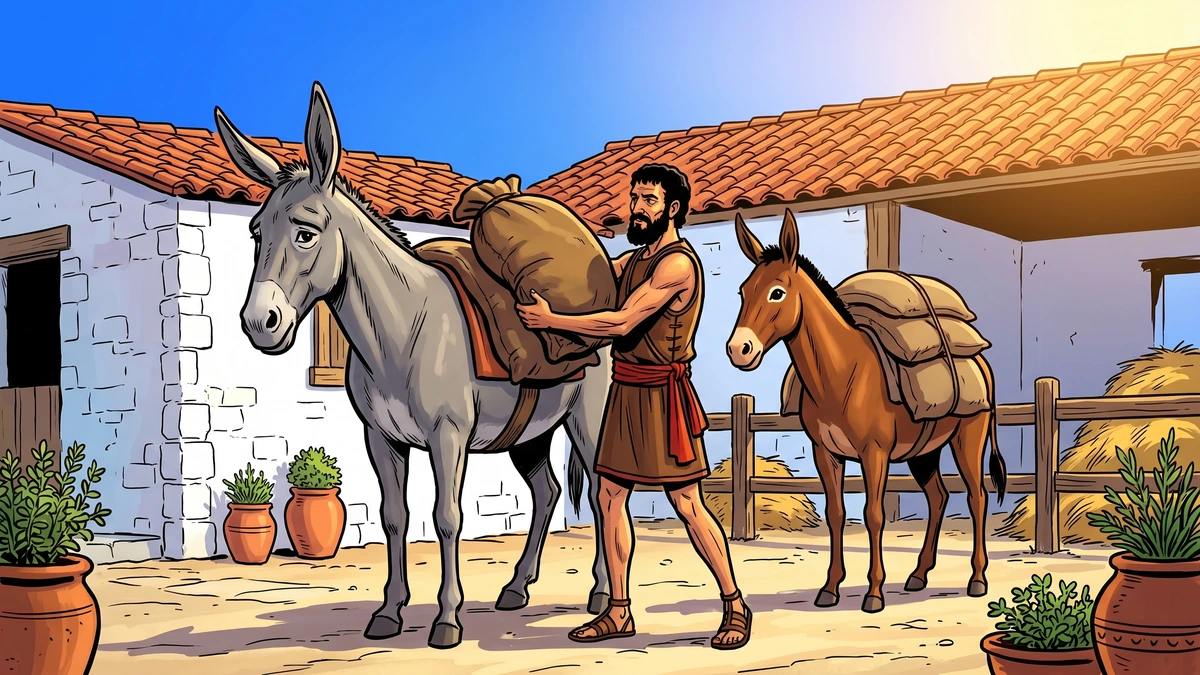
It happened, the old tellers said, on the long stony Greek trade roads that ran over the mountains of central Greece in the days before there were carriages or wheels for any but the richest carts. A travelling wool-merchant of perhaps forty years, lean and weather-tanned, with a black beard and a long wooden walking-staff, had set out at dawn from the small farming village of his birth in the foothills of Mount Pindus to carry, on the backs of his two pack-animals, eight heavy bulging sacks of his own wool to the great market in the coastal city three days’ walk away.
His two pack-animals were these: a tall lean older grey ass, perhaps twelve years of age, who had been with the merchant since he was a boy of fifteen and was now beginning, in the slow gentle way of all old animals, to feel the weight of her years; and a stronger younger brown mule, perhaps four years of age, in the prime of her life, whom the merchant had bought at the spring market the year before for a good price. The merchant loved the old grey ass. He had grown up with her. He had ridden on her back to school as a child. But he was, at the same time, a practical man, and he understood that his old grey ass was, by the simple mathematics of her age, no longer the equal of the younger mule.
And so when he came to load his eight sacks of wool that morning in the courtyard of his small white-stone farm, he made — with the small unconscious carelessness that all of us sometimes make about the burdens we ask of others — a small mistake.
He divided the eight sacks of wool not equally between the two animals, but slightly unequally. He put four sacks on the grey ass — the old one, the weaker one. He put four sacks on the brown mule — the young one, the stronger one. The two animals stood in the morning courtyard with the same number of sacks on each back, and the merchant, looking at them in the bright morning sunlight, told himself that this was fair.
It was not, of course. Fairness, when the two animals were of equal strength, would have been four and four. But the two animals were not of equal strength, and fairness, in such a case, would have been three for the old ass and five for the strong mule. The merchant did not see this. The mule saw it. The ass saw it. But the ass — old and patient and trained over a long life never to complain — said nothing, and the merchant strapped the sacks into place, and the three of them set out on the long stony mountain road to the city.
The Mountain Path
The road climbed.
For the first hour the grey ass walked steadily, in the slow patient way of all working asses, with her four heavy sacks of wool tied tightly across her grey-furred back. The mule beside her walked with the same load and the same easy stride. The merchant walked behind them both with his long wooden staff, whistling. The cicadas were not yet singing; the morning sun was still cool. The pace was good.
By the second hour the road had begun to climb steeply. The grey ass’s breath had become noticeably heavier than the mule’s. By the third hour the grey ass was walking with her head bowed low and her grey ears flattened back against her skull, and small beads of sweat were beginning to darken the grey fur of her flank. By the fourth hour, when the sun was high and the mountain road had narrowed to a stony track between cypress trees, the grey ass was — with the small soft humiliation of a proud old animal who has begun to fail — gasping for breath at every other step.
The mule beside her was not gasping. The mule beside her was breathing, in fact, almost easily. The mule was younger. The mule was stronger. The mule’s four sacks of wool were, on her young strong back, no real difficulty.
The Ass’s Plea

The grey ass turned her head, the old tellers said, and looked sideways at the brown mule walking beside her on the narrow stony track. And in a small soft voice that was not quite a whisper but was lower than her ordinary voice — the voice of a creature who has, for the first time in her long working life, found that she cannot carry what she has been asked to carry — she spoke to the mule.
“Sister mule,” the grey ass said. “I do not ask easily. I have never, in twelve years of carrying loads on this road, asked another animal to carry any of my burden. But I am old now, and the road today is steep, and the four sacks on my back are — I am ashamed to say — too heavy for me. If you would take one — only one — of my four sacks, just for the steep stretch of the climb, I think I could finish the journey. Otherwise — otherwise, sister, I do not believe I will be able to. Will you?”
The brown mule walking beside her did not, the old tellers said, turn her head. The brown mule walking beside her did not, in fact, even slow her stride. The brown mule lifted her young brown snout into the air with the small careful tilted-up haughtiness of a creature who is focused entirely on her own load and her own pace, and she said, in a clipped flat voice without any warmth in it at all:
“Sister ass. The merchant gave you four sacks because the merchant believed you could carry four sacks. He gave me four sacks because he believed I could carry four sacks. The sacks on my back are exactly the load that has been allotted to me. They are not light. I am not, at any rate, willing to carry any extra. I am sorry. Do please carry your own.”
And the brown mule, having said this, turned her face away and continued walking up the mountain road with her four sacks balanced easily on her young strong back.
The grey ass said nothing more.
She bent her head a little lower and walked on.
The Ass Falls

It was perhaps a quarter of an hour later, on the steepest part of the mountain road, with the merchant walking some twenty paces behind the two pack-animals and whistling softly to himself in the bright noon sun, that the grey ass — without a sound, without a stagger, without any warning — simply put her front knees down on the dusty stony track in the slow gentle way of an old animal who has at last reached the end of her strength, lay down on her side, breathed three slow rasping breaths into the bright Greek sunlight, and stopped.
Her four sacks of wool tumbled off her back into the dust beside her.
The merchant, who had heard the small soft thump, came running. He knelt beside her in the dust. He laid his weather-tanned hand on her grey flank. He felt no breath. He listened. He felt for her old heart. He listened again.
The old grey ass who had carried him to school when he was a boy of seven, who had carried his eight sacks of wool to market every season for twelve years, who had asked exactly one favour of the world in her whole long working life and had been refused, was dead.
The merchant sat down on the dusty mountain road beside her and did not, for a long minute, say anything at all.
The Whole Burden

At last, when the long minute had passed, the merchant stood up. He looked at the grey ass on the dusty road. He looked at the four sacks of wool that had tumbled off her back. He looked at the young brown mule who had stopped a little further up the path and was looking back, with the small slow dawning realization of a creature who has only just understood what has happened.
The merchant did, the old tellers said, what any practical merchant would have done. He bent down. He picked up the first of the grey ass’s four sacks. He carried it the few paces to the brown mule, and he tied it on top of the mule’s existing four sacks. He went back. He picked up the second sack. He tied it on. The third. The fourth.
And then, because the merchant did not wish to leave the body of the old grey ass — who had carried him to school as a boy — for the wolves of the mountain to find at sunset, he bent down once more, and with a slow effort he lifted the lifeless body of the old grey ass herself onto the back of the brown mule, on top of the eight sacks of wool, and he lashed her there with the long leather strap.
The brown mule stood under the entire combined load — eight sacks of wool, plus the body of the dead grey ass — with her young brown legs trembling, and her young brown breath rasping in her chest, and her young brown eyes wide with the small clear horror of a creature who has, in a single instant, understood the exact sum of what she has done.
“Walk,” said the merchant, very quietly, with no anger in his voice but no kindness either. “We are still half a day from the city. Walk.”
And the brown mule, with her trembling brown legs and her rasping young breath, took her first staggering step up the steep mountain road under a load that was, at last, perfectly fair.
The Last Words
It is said, in the older tellings of the fable, that the brown mule was heard, somewhere on the long heavy climb up the rest of the mountain road, to mutter to herself between her gasps for breath the small bitter line that the world has remembered as the lesson of the tale:
If only I had taken one sack when she asked.
It is the small bitter line that has been spoken, in one form or another, in every century since, by every creature who has refused a small favour to a companion in trouble and has then found, by the small clear mathematics of consequence, that the favour refused was less than the cost of the refusal.
The Moral
The Greek prose Aesopica preserves the moral in this form:
“Ho mythos deloi hoti dei tous syntrophous allelois epikourein.”
“The fable shows that we must help our companions when they ask.”
The pithy modern English form, descending through Croxall and Jacobs:
“He who refuses to share the burden may end up carrying it all.”
And the Sanskrit teachers in India, who taught the same teaching for as long as Aesop’s tellers have, summed it up in three words: sahakaranam balam — “cooperation is strength” — and its negative counterpart: that the small selfish refusal of a small favour today may, by the small unbending laws of consequence, become the great unbearable burden of tomorrow.
Why This Story Has Lasted
It has lasted because every adult who has ever been asked, by a colleague or a partner or a sibling or a friend in trouble, to take just one small sack of someone else’s burden — and has, for a small careful selfish reason, said no — already knows the exact taste of the brown mule’s young trembling legs on the long steep mountain road afterward. It has lasted because the fable teaches, with the small clear cold mathematics that fables do better than any sermon could, that the refusal of a small favour is almost never, when the books are finally closed, cheaper than the granting of it would have been.
The mule was not malicious. The mule was not cruel. The mule was simply focused, in the small careful way that we are all sometimes focused, on her own load and her own pace and her own four sacks. She did not, in the moment, see the larger arithmetic. She did not understand that the burden she was being asked to share was a burden that, refused, would still find its way onto her own back — and find its way doubled, and with the cost of the dead companion as interest. She did not, until the trembling moment on the steep road afterward, see what every wise teacher in every tradition has always tried to teach: that cooperation is not, fundamentally, an act of charity. It is an act of self-interest correctly understood.
Two and a half thousand years after Aesop, the small clear voice of the brown mule on the long heavy climb is still telling us the same thing, in our own age of partnerships and teams and small daily decisions about whose burden to share. If only I had taken one sack when she asked. Take the sack. The sack is, almost always, lighter than the consequence of refusing it.
Frequently Asked Questions
**Q: Why is this story important?**
You May Also Like
 Aesop's Fables
Ages 3-5
Aesop's Fables
Ages 3-5
Red A Fairy Tale
Red A Fairy Tale: Not very long ago, there lived a girl called Red, with her brother, Chad, and her mother, in a small house in a very small town situated near
 Aesop's Fables
Ages 3-5
Aesop's Fables
Ages 3-5
The Hare and the Tortoise
The Hare and the Tortoise: Original Story from Aesop’s fables, told with a twist. Age group: 1 – 100 years. There was once a Hare who always bragged about how
 Aesop's Fables
Ages 3-5
Aesop's Fables
Ages 3-5
The Fox and the Grapes: Pride, Desire, and Self-Deception
The Fox and the Grapes: Pride, Desire, and Self-Deception: Autumn had arrived in the woodland with a quiet intensity, painting the leaves in shades of amber