Mr Wont Give And Mr Wont Leave
Mr Wont Give And Mr Wont Leave: In a certain town there lived a clever old Brâhmaṇ, named Won’t-Give(Vidâmundan). He used to go out daily and to beg in all the
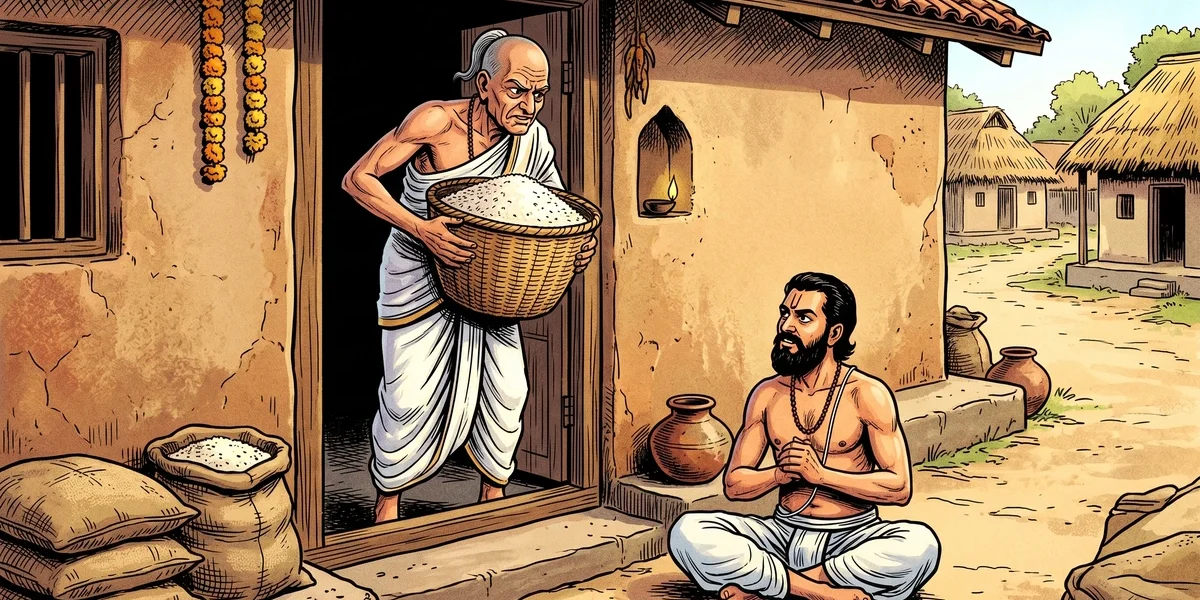
Mr Won’t Give and Mr Won’t Leave: The Comedy of Matched Stubbornness
Two Vices, One Stalemate: The Architecture of the Title
The title “Mr Won’t Give and Mr Won’t Leave” is a piece of folk comedy so economical it deserves to be analysed as carefully as a poem. In four words, it establishes two characters, two defining traits, and the structural conflict that will generate the entire narrative. Unlike titles that present a single character with a flaw, this title is explicitly relational: the two figures are defined in terms of each other, each the necessary counterpart of the other. Mr Won’t Give requires Mr Won’t Leave in order to become a joke; Mr Won’t Leave requires Mr Won’t Give in order to have an opponent worth obstinacy against. They are a matched pair — equal and opposite, locked in a comic stalemate that neither can win.
The folk tradition has always known that the best comedy arises not from a single character’s flaw but from the collision of two complementary flaws. One stubborn person is annoying; two stubborn persons in opposition are a narrative. The miser who will not part with anything meets the mooch who will not part with anyone — and the resulting deadlock is a mirror held up to the social comedy of possession, hospitality, and the unspoken rules that regulate both.
Both figures are recognisable archetypes in world folk literature. The miser appears in the Panchatantra, in Plautus’s Aulularia (The Pot of Gold), in Molière’s L’Avare, in Dickens’s Ebenezer Scrooge, in countless Hindi folk tales about the kanjus (miser) whose hoarding creates comic catastrophe. The freeloader — the uninvited guest who cannot take a hint, the taker who confuses hospitality with permanent entitlement — appears in equal abundance: the parasite (kolax) of Athenian comedy, the sponger in Sanskrit hasya drama, the “permanent guest” who becomes a proverb in many cultures. When the two meet, the folk tale produces its most efficient comedy.
The Grammar of the Miser: What “Won’t Give” Reveals
The miser is one of the oldest and most stable comic character types in world literature because the psychology he embodies is both universal and universally misunderstood by its possessor. The miser does not experience his own hoarding as a vice — he experiences it as prudence, as realism, as the only rational response to an uncertain world. He has convinced himself, with great thoroughness, that his accumulation is reasonable and his refusals are justified. This gap between the miser’s self-understanding and the audience’s perception is the primary engine of the comedy.
“Won’t give” is importantly different from “can’t give.” The miser is not poor — the comedy depends on his actually having something worth giving. His refusal is volitional, chosen, and repeated. It is a sustained policy of social withdrawal dressed up as economic prudence. What he fails to understand — and what the story gradually reveals — is that the social reciprocity he refuses to participate in is also the social protection he needs when things go wrong. The miser who refuses to give has also refused to build the social bonds that giving creates; he is rich and alone and ultimately more vulnerable, not less, than the person who has given freely and earned genuine allies.
In the context of this particular tale, the miser’s “won’t give” also applies beyond material possessions: he will not give comfort, will not give welcome, will not give the social performance of hospitality that every community expects of its members. His home is a fortress, and the fortress is both his pride and his problem — because it has attracted exactly the kind of opponent who treats fortresses as challenges rather than deterrents.
“The man who gives nothing will eventually meet the man who leaves with nothing. And neither will move first. This is not a tragedy. It is a comedy — which is to say, it is a tragedy that knows it is funny.”
The Grammar of the Freeloader: What “Won’t Leave” Reveals
The freeloader is a less sympathetic figure than the miser in most cultural assessments — and yet the folk tale tradition is surprisingly even-handed about the two. If the miser has refused to participate in the social exchange of giving, the freeloader has refused to participate in the social exchange of reciprocity. Both are extractive strategies; they simply operate from opposite positions.
“Won’t leave” is the freeloader’s defining trait, and it too is importantly volitional. The freeloader is not lost, not in danger, not unable to depart — he simply has no intention of doing so as long as there is anything to be extracted from the situation. His stubbornness is the stubbornness of appetite, of strategic passivity, of the person who has discovered that simply remaining in a place is often sufficient to receive what one wants. If the miser’s strategy is active refusal, the freeloader’s strategy is passive persistence.
In the folk comic tradition, the freeloader is often portrayed with a kind of cheerful shamelessness that makes him oddly appealing — he is transparent about his intentions in a way that is almost honest, and his persistence has a certain performative quality, a stubbornness-as-art that the audience can appreciate even as they recognise its essential parasitism. Compared to the miser’s anxious, defensive hoarding, the freeloader’s cheerful immovability has the quality of committed performance.
The Stalemate and Its Resolution: What Matched Vices Teach
The comedy of matched stubbornness reaches its peak in the stalemate: the miser will not give, the freeloader will not leave, and neither will yield first because each has made yielding a matter of identity and principle. This stalemate is the story’s comic set-piece — the moment in which the audience sees clearly what both characters cannot see: that they are not fighting each other but fighting themselves, defending positions that are equally absurd.
Resolutions in this type of folk tale tend to fall into two categories. In the first, an external agent — a wise judge, a clever third party, a sudden change of circumstance — breaks the deadlock in a way that exposes the absurdity of both positions simultaneously. In the second, one character is pushed far enough that their stubbornness actually defeats the other, producing a “winner” whose victory is so Pyrrhic as to be indistinguishable from loss. Both resolutions affirm the same moral: intransigence as a life strategy is expensive, and matched intransigence is self-defeating.
For children, the story is a lesson in the social cost of stubbornness — not just one kind of stubbornness, but its many manifestations, including the stubbornness of refusing to share and the stubbornness of refusing to respect boundaries. What makes the tale more sophisticated than a simple moral lesson is its insistence on symmetry: neither character is entirely wrong in their assessment of the other, and yet both are entirely wrong in their response to that assessment. The miser correctly perceives that the freeloader is exploitative; the freeloader correctly perceives that the miser is unjustly withholding. Both are right about each other and equally incapable of the social intelligence that might resolve the situation. This is the comedy — and the instruction.
Why This Story Lasted
The tale of Mr Won’t Give and Mr Won’t Leave has lasted because it captures something structurally permanent in human social life: the comedy that arises when two people, each in the grip of an extreme position, are forced into sustained contact. The miser and the freeloader are both deformations of normal social virtues — prudence pushed to stinginess, hospitality exploited into freeloading — and their collision is the folk tale’s way of illustrating that virtues taken to extremes become vices, and that matched vices create not conflict but comedy. Every community recognises both characters, which is why the story survives translation across every culture that has told it.
Frequently Asked Questions
What makes the miser such a durable comic character across cultures?
The miser endures as a comic character because he embodies a misunderstanding of value that every culture recognises: the confusion of accumulation with security, of hoarding with happiness. He has typically convinced himself that his refusals are rational and his accumulation is prudent, which creates the gap between his self-perception and the audience’s perception that is the engine of comedy. The miser also represents a refusal to participate in social reciprocity — which is both morally problematic and practically counterproductive, since the social bonds created by giving are also forms of protection. Across cultures, the miser’s comedy is inseparable from his isolation: he has his hoard and no one to share it with.
What does the “freeloader” character type reveal about social norms?
The freeloader reveals, by negative example, the social norms of reciprocity and proportionality that underpin hospitality in every culture. Hospitality — the willingness to host, to share food and shelter, to extend welcome — exists within an implicit economy of reciprocity: guests are expected to be temporary, to show gratitude, and eventually to leave or to return the favour in some form. The freeloader violates all three expectations. His persistence in overstaying is not just personally annoying; it is a structural disruption of the social exchange that hospitality represents. Folk tales featuring the freeloader serve as a social reminder of the obligations that come with receiving hospitality.
Are there famous paired-stubbornness tales in Indian folk tradition?
Indian folk and literary tradition has a rich vein of “matched opponent” comedy. The Panchatantra includes tales of mismatched pairs — the crow and the serpent, the lion and the jackal — whose opposing natures create comic and instructive conflict. Birbal tale cycles feature matched wits between the clever Birbal and adversaries whose opposing stubbornness or pride creates the comic situation. In Sanskrit hasya (comic) drama, the matched dialogue of the vidushaka (jester) and the pompous character is a structural cousin of the “won’t give / won’t leave” dynamic. The specific pairing of miser and freeloader also appears in regional tale traditions across Maharashtra, Bengal, and Rajasthan, often featuring the kanjus (miser) and the parasitic houseguest as comic antagonists.
What does stubbornness cost us according to folk wisdom?
Folk wisdom across cultures consistently identifies stubbornness — particularly stubbornness as an end in itself rather than as principled commitment — as a vice that costs more than it saves. The miser’s stubbornness costs him social connection, goodwill, and the genuine security that reciprocal relationships provide. The freeloader’s stubbornness costs him dignity, respect, and the kind of welcome that is freely and genuinely given. Both pay a high price to maintain a position that yields less than the alternative would. The folk tradition suggests that the capacity for flexibility and social intelligence — knowing when to give, when to go, when to compromise — is a form of wisdom that stubbornness systematically destroys.
How can children learn from stories about social vices like miserliness and freeloading?
Stories featuring social vices like miserliness and freeloading work on children through the mechanism of comic recognition: children already have direct experience of both dynamics (the classmate who never shares, the friend who overstays their welcome) and can immediately map the story’s characters onto their lived experience. The comedy of the tale makes the lesson palatable — children laugh at the miser and the freeloader rather than feeling lectured at. Implicitly, the story helps children develop social intelligence: a sense of the implicit reciprocity that underlies healthy social exchange, and an awareness of what happens when that reciprocity is violated in either direction.
Frequently Asked Questions
**Q: Why is this story important?**
You May Also Like
 Aesop's Fables
Ages 3-5
Aesop's Fables
Ages 3-5
Retaliation
Retaliation: There is a proverb in Tamil̤ called Palikkuppali vâṅgukiradu which would best be translated by the expression “tit for tat,” and the following
 Aesop's Fables
Ages 3-5
Aesop's Fables
Ages 3-5
Bholu’s Freedom | What Does Freedom Mean?
Bholu’s Freedom | What Does Freedom Mean?: The construction site looked like a huge maze, filled with the various sounds emanating from men and machinery. True
 Aesop's Fables
Ages 6-8
Aesop's Fables
Ages 6-8
Mr Mighty Of His Mouth
Mr Mighty Of His Mouth: In two adjoining villages there lived two famous men. The one was called Mr. Mighty-of-his-mouth - one that could accomplish wonders