Mr Mighty Of His Mouth
Mr Mighty Of His Mouth: In two adjoining villages there lived two famous men. The one was called Mr. Mighty-of-his-mouth - one that could accomplish wonders
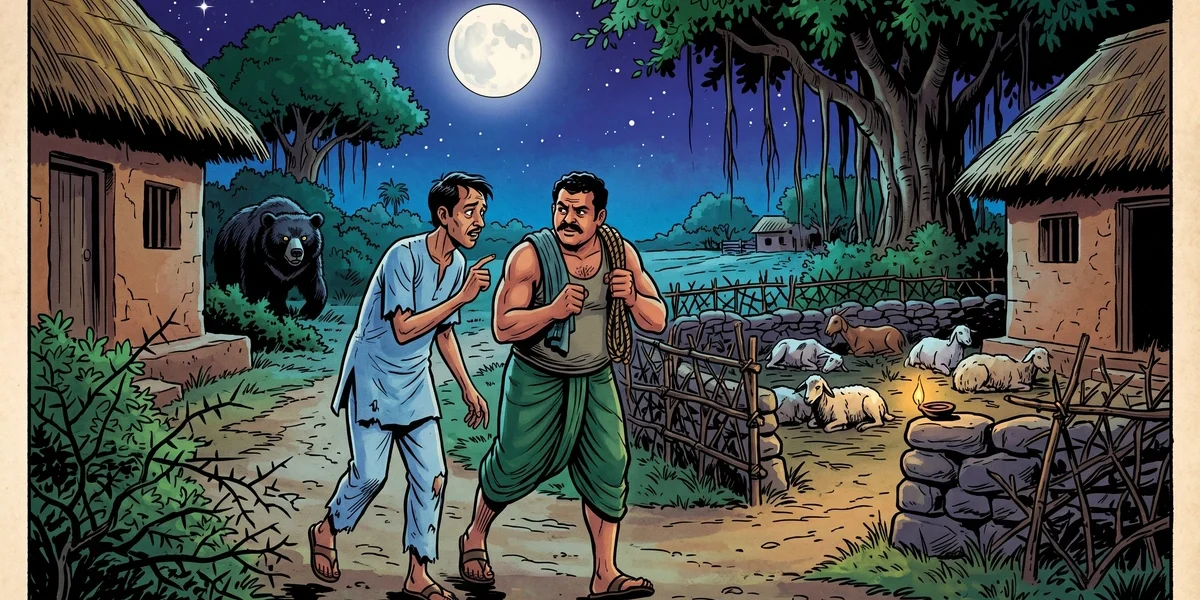
Mr Mighty of His Mouth: Alazoneia and the Comedy of the Braggart
The Alazon: A Figure as Old as Storytelling
Every storytelling tradition has a name for the same figure: the person whose self-presentation wildly and consistently exceeds their actual capacity. In ancient Greek comedy, he is the alazon — the impostor, the braggart, the self-deceiving boaster. Aristotle identified the alazon as one of three basic character types in comedy, alongside the eiron (the self-deprecating one, who pretends to less than he has) and the bomolochos (the buffoon). The alazon claims more than he is; the eiron claims less; only the balanced person claims exactly what they are. Comedy, Aristotle observed, arises from the gap between claim and reality — and nowhere is that gap more reliably comic than in the mouth of the braggart.
“Mr Mighty of His Mouth” is a title that crystallises this character type with elegant economy. The name itself is the joke: his power is entirely verbal, entirely self-reported, residing in nothing more substantial than his own claims. He is a man whose mouth is his only weapon and whose weapon is also his only weakness. In him, the comic and the moral are inseparable: his boastfulness is funny, and his punishment (when it comes) is just, and both the laughter and the justice arise from the same source — the gap between word and deed.
Across world folk traditions, the Mighty-of-Mouth appears under many names and in many forms: the cowardly knight, the ineffectual wizard, the village tough who runs at the first sign of real danger. In the Panchatantra, a donkey brays to intimidate the other animals and is discovered to be merely a donkey. In Aesop, a frog inflates himself trying to match the size of an ox — and bursts. In West African trickster tales, the boastful hyena meets the lion he has been claiming to be friends with. The character is universal because the underlying psychology is universal: the person who compensates for inner inadequacy with outer noise.
The Grammar of Bragging: How the Braggart’s Speech Works
What makes the braggart narratively interesting — rather than merely annoying — is the specific way in which his speech operates. Boastful claims have a distinctive grammar: they are always comparative (“I am the strongest in the village”), always untestable in the immediate moment (“You should have seen what I did to the lion last year”), and always escalating (“But that was nothing compared to what I once did in the northern provinces”). Each claim generates the need for a slightly larger claim to sustain credibility; the braggart’s speech is structurally inflationary.
This inflationary structure is both comic and self-defeating. The audience — both the characters within the story and the listeners of the tale — understands intuitively that each escalation makes the eventual exposure more catastrophic. The taller the tale, the harder the fall. The braggart digs his own trap with his own words, constructing a reputation that reality must eventually measure itself against and find wanting.
There is also a social dimension to the braggart’s speech that folk tales consistently illuminate: bragging is a bid for status, a verbal attempt to occupy a position in the social hierarchy that one cannot hold through action or genuine accomplishment. The village braggart — Mr Mighty of His Mouth — is typically not entirely without self-awareness; he knows, at some level, that his claims are inflated. But the social attention they produce, the temporary dominance they create in conversation, the deference they extract from those who do not yet know better — these are real rewards, even if built on false foundations. The folk tale tradition recognises this and refuses to be entirely cruel: the braggart is ridiculous, but his need for recognition is human.
“He who speaks loudest of his deeds is generally the man who has done fewest of them. The great warrior does not need to announce his victories — those who were there already know, and those who were not there will never quite believe it anyway.”
The Moment of Testing: When Reality Arrives
The narrative function of every braggart tale is the moment of testing — the point at which reality is brought into direct contact with the claim, and the gap is exposed. This moment has a formal name in rhetorical tradition: elenchos, the cross-examination that reveals the truth beneath the performance. In Socratic dialogue, elenchos is the philosophical tool for stripping away false belief. In folk comedy, it is the bear that actually appears, the rival who actually shows up, the trial that actually tests the alleged courage or skill.
The testing moment is where the comedy and the moral instruction converge. The braggart, confronted with the actual situation his claims had led him toward, must choose between two equally unpleasant options: attempt to perform the deed and fail spectacularly, or run and thereby publicly confirm that his claims were empty. Either way, the gap is exposed. Either way, the audience gets its moment of vindicated common sense.
What varies across traditions is the aftermath. In some versions, the braggart is humiliated and learns his lesson — a straightforward moral resolution. In others, the braggart remains entirely unlearned, continuing to boast even in the face of demonstrated failure — a darker, more psychologically realistic resolution that has its own satirical force. The character who cannot learn from humiliation, who returns to boasting within moments of being exposed, is a recognisable human type, and the folk tale tradition does not always refuse to acknowledge this truth.
The Moral and Its Limits: What Bragging Actually Costs
The immediate moral of the braggart tale is obvious and universal: do not claim what you cannot deliver; deeds speak louder than words; the empty vessel makes the most noise. These are among the most widely distributed moral maxims in human culture, and the braggart tale is one of the primary vehicles through which they are transmitted. Children hearing the story of Mr Mighty of His Mouth receive an intuitive lesson in the relationship between credibility and behaviour: that reputation is a long-term construction, and that the braggart’s strategy of verbal self-promotion is not merely dishonest but ultimately counterproductive.
But the richer reading attends to what the braggart’s boasting costs him beyond reputation. The consistent boaster loses the ability to accurately assess himself — each inflated claim, once spoken and tacitly accepted, becomes part of the self-image, creating a psychological architecture of false competence that makes real growth impossible. If one is already, in one’s own account, the greatest warrior or the most skilled craftsman or the most courageous adventurer, there is no internal pressure to actually become those things. Bragging, in this sense, is not only socially dishonest but personally stunting.
Conversely, the tale implicitly valorises the figure who does not boast — who performs without announcement, who allows deeds to create reputation organically, who understands that genuine confidence has no need of self-promotion. This figure — the eiron in Greek comedy, the understated hero in folk tradition — is the structural opposite of the alazon, and the tales of the braggart always carry his shadow. The laughter at Mr Mighty of His Mouth is also, quietly, an appreciation of those who need no mouth to establish their might.
Why This Story Lasted
The braggart tale has survived across every culture and every era because the character it depicts never goes away. The gap between self-presentation and reality — between claim and capacity, between the mouth and the deed — is a permanent feature of human social life. Every community has its Mr Mighty of His Mouth, and every community needs a story that names him, laughs at him, and exposes the mechanism of his failure. The story is both descriptive (this is how braggarts work) and prescriptive (this is what happens to them) — a rare combination of comedy and instruction that children understand immediately and adults never stop finding relevant.
Frequently Asked Questions
What is the “alazon” character type in storytelling?
The alazon (ἀλαζών) is one of three basic character types identified by Aristotle in his Nicomachean Ethics and Poetics: the person who claims more than they have or are. Opposite to the eiron (who claims less) and the bomolochos (the buffoon), the alazon is specifically the impostor or braggart — someone whose self-presentation consistently exceeds their actual capacity or accomplishments. The character appears in ancient Greek comedy (notably the Miles Gloriosus, the “Braggart Soldier”), in Plautus and Roman comedy, in the Panchatantra, in Aesop’s fables, and in folk traditions worldwide. He is one of the most universally distributed comic and cautionary characters in world literature.
What does boasting reveal about a person’s psychology?
Folk tales and modern psychology converge on similar observations about chronic boasting: it typically compensates for felt inadequacy, represents a bid for status that cannot be earned through actual accomplishment, and creates a self-reinforcing cycle in which the boaster’s inflated self-image prevents the genuine growth that might resolve the underlying inadequacy. Research in social psychology suggests that while modest self-promotion can be socially effective, chronic boasting tends to undermine trust and credibility over time, particularly in communities where the boaster’s claims can be tested. The folk tale tradition captures this pattern with comic efficiency: the braggart’s mouth is both his strategy and his undoing.
Are there famous braggart characters in Indian folk and literary tradition?
Yes. The Panchatantra includes several stories featuring characters who boast beyond their capacity. The donkey who brays to pretend he is a tiger and is caught, the jackal who claims great powers to manipulate other animals, and the crow who adopts peacock feathers to improve his status — all are variants of the braggart archetype. In Sanskrit drama, the vidushaka (jester) figure sometimes takes on alazon qualities, and the sycophants in political satire (such as those described in Kautilya’s Arthashastra) are recognisable as socially functional braggarts. The theme runs through Birbal tales, where Akbar’s courtiers who overstate their wisdom are regularly exposed by the sharper Birbal.
How should children respond when they encounter boastful peers?
Folk tales about braggarts offer children an implicit social education: recognise the pattern (large claims, no evidence), maintain your own assessment independently of others’ self-reports, and wait for the testing moment rather than accepting claims at face value. More constructively, children can learn that boasting is often a sign of insecurity rather than genuine confidence — which makes it an occasion for understanding rather than contempt. Responding to braggarts with calm confidence rather than either credulity or mockery is the socially and ethically mature response, and one that tales like this model through the reactions of the other characters who see through the boaster.
What is the difference between confidence and boasting?
The folk tale tradition consistently implies a distinction between genuine confidence and boasting, even without naming it explicitly. Genuine confidence is grounded in actual capacity — the confident person knows what they can do because they have done it, and they do not need to announce it because the doing is its own evidence. Boasting, by contrast, substitutes the announcement for the deed — it is the attempt to claim the social benefits of capacity without possessing the capacity itself. The psychological research literature describes a related distinction between high self-efficacy (accurate belief in one’s ability to perform specific tasks, associated with better outcomes) and narcissistic self-promotion (exaggerated self-claim, associated with social friction and performance anxiety).
Frequently Asked Questions
**Q: Why is this story important?**
You May Also Like
 Aesop's Fables
Ages 9-12
Aesop's Fables
Ages 9-12
The Wonderful Mango Fruit
The Wonderful Mango Fruit: The night was now over: darkness, the harbourer of vice, fled away; the day dawned. King Alakesa left his bedchamber, bathed and
 Aesop's Fables
Ages 3-5
Aesop's Fables
Ages 3-5
The Ass and The Mule
A stubborn ass rejects the mule's help and dies from pride. Humility saves; ego destroys.
 Aesop's Fables
Ages 3-5
Aesop's Fables
Ages 3-5
Boy Cried Wolf
An Aesop's Fable story. A boy's cries of wolf are ignored when the wolf finally comes. Lies destroy trust forever.