The Good Husband And The Bad Wife
The Good Husband And The Bad Wife: In a remote village there lived a Brâhmiṇ whose good nature and charitable disposition were proverbial. Equally proverbial
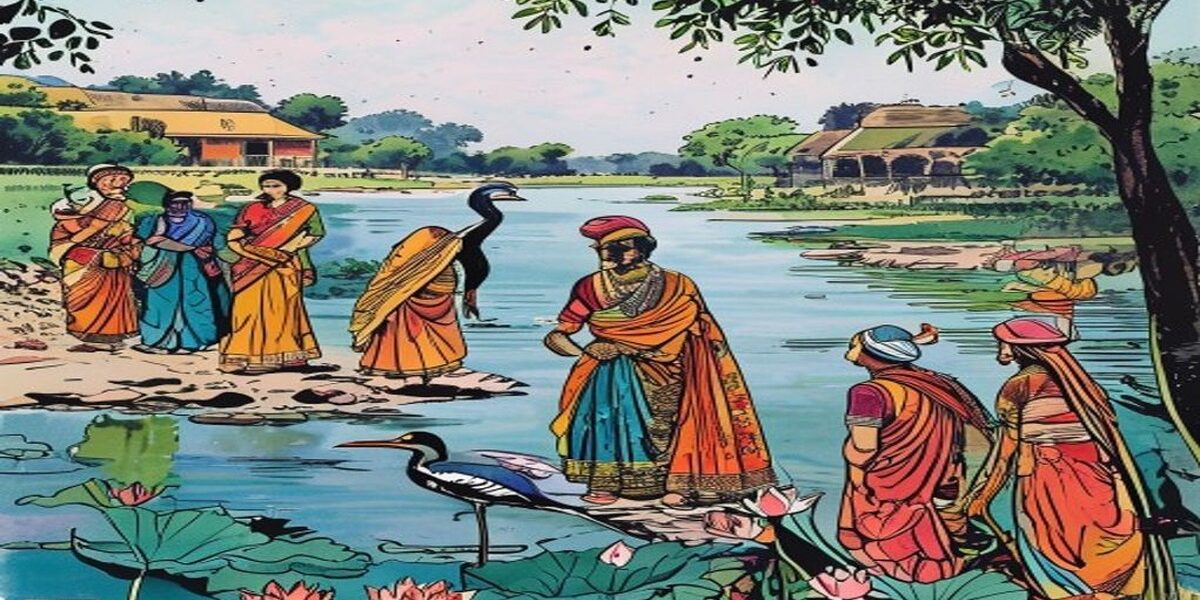
The title announces an asymmetry: one half of the marriage is good; the other is bad. Indian folk narrative had a long tradition of such asymmetric marriage tales — stories in which virtue and vice are unequally distributed between spouses, and the narrative explores what the virtuous partner does, how the marriage endures or breaks, and what the community owes to each. The “good husband and bad wife” tale is the less common inversion of the far more numerous “bad husband, long-suffering wife” type — and its relative rarity makes it an unusually revealing document of the folk tradition’s assumptions about domestic gender and virtue.
I. The Asymmetric Marriage Tale: A Taxonomy
South Asian folk narrative contains an enormous corpus of asymmetric marriage tales — stories in which one spouse is virtuous and one is deficient, and the narrative explores the dynamics that result. The most common type, by far, is the patient wife paired with a difficult, absent, or morally compromised husband: Savitri and Satyavan (she must rescue him from death), Sita and Rama (she endures unjust banishment), the folk tale wives of travelling merchants who must manage household and adversity alone. The patient, virtuous wife paired with a flawed or absent husband is so dominant a type that scholars have called it the “sati narrative complex” — stories organised around the wife’s capacity for endurance and devotion.
The good husband paired with a bad wife is a genuine inversion, and its relative scarcity in the tradition is itself significant. Why are there fewer tales of this type? Partly because the dominant social ideology placed primary domestic virtue-responsibility on the wife; the “bad wife” was therefore a more charged figure, more threatening to the social order, requiring more careful narrative management than the “bad husband.” Partly because the folk audience’s sympathies were structured differently around the two cases: a wife’s suffering was something audiences were expected to feel keenly; a husband’s suffering in a difficult marriage was more likely to be treated as comic or as evidence of his failure to manage his household.
The “good husband and bad wife” tale thus enters more complicated territory than its inverse. It must acknowledge male suffering without comic deflation; it must characterise the wife’s defects without simply demonising her; and it must navigate a social world in which the husband has, in principle, the authority to resolve the domestic situation by means unavailable to the wife in the inverse tale — and yet, in the story’s world, those means are somehow insufficient or unavailable. This navigation is what makes the tale worth examining.
II. The Bad Wife Figure: What Folk Narrative Encodes
The “bad wife” in Indian folk tradition is typically not evil in the manner of a villain — she is not plotting harm or pursuing malice. She is most commonly characterised through domestic failures: shrewishness (sharp tongue, constant complaint), laziness (the household unmaintained, the food unprepared), extravagance (resources wasted, wealth dissipated), or infidelity (the most extreme form of the bad wife, which appears in a distinct sub-genre). Each defect maps onto a specific failure of the wifely role as the folk tradition defined it.
What is interesting, from a structural perspective, is what the bad wife’s presence reveals about the husband’s situation. A husband whose wife is bad in the domestic-failure sense is exposed as someone who cannot exercise the authority the patriarchal system nominally grants him. He cannot compel good domestic conduct; he cannot shame his wife into change; he cannot, without severe social disruption, simply replace her. His goodness — his patience, his continued provision of care and resources despite receiving nothing comparable in return — is thus a form of powerlessness as much as virtue. The folk tale creates a male figure who is simultaneously morally superior and structurally impotent, and its narrative interest lies in exploring that paradox.
The folk tradition is rarely simple in its treatment of the bad wife. While the explicit frame may be condemnatory — she is “bad” — the tale’s details often reveal a more complex situation: a wife whose sharpness is a response to her own frustrated competence, or whose extravagance is the one domain of agency available to her, or whose conduct has been shaped by a marriage she did not choose and circumstances she cannot change. The folk audience was sophisticated enough to read between the lines, and the best of these tales reward that sophistication.
III. Patience, Endurance, and the Question of Change
The good husband’s response to his difficult marriage is typically patience — the same virtue celebrated in the patient-wife tales, now distributed to a male figure. This gendered transfer of the patience virtue is significant: it suggests that patience in domestic adversity is not simply a female or a male virtue but a structural one, available to whichever partner occupies the position of enduring rather than causing the domestic difficulty.
The Indian ethical tradition has a rich vocabulary for this kind of patient endurance: titiksha (forbearance), ksama (forgiveness), dhairya (steadiness under difficulty). These virtues are not passive; they are active resistances to the temptation of retaliatory action, of complaint, of the dissolution of the domestic unit in the face of its internal tensions. The good husband who practises titiksha is not merely suffering silently; he is making a repeated moral choice not to respond to difficulty with difficulty.
Whether patience changes the bad wife is a question different tales answer differently. In some versions, the wife is transformed by her husband’s consistent goodness — shamed or softened by the contrast between his conduct and hers, and gradually becoming the partner his patience deserved. In others, the wife does not change, and the tale ends with a community recognition of the husband’s virtue rather than a domestic resolution. In the most pessimistic versions, the husband’s goodness is simply wasted on a wife whose character is fixed — and the tale acknowledges, without easy consolation, that virtue does not always produce transformation in those it is directed toward.
“A good husband married to a bad wife is a lamp in a room with no windows — the light is real, but it does not reach anyone.”
— Proverb from the Indian domestic folk tradition
Why This Story Lasted
The Good Husband and the Bad Wife lasted because asymmetric domestic partnerships — in which one partner’s virtues are met not with reciprocal virtue but with indifference, complaint, or active difficulty — are among the most common and painful of human experiences. The tale provides a vocabulary for this experience and, in its most sophisticated versions, a nuanced rather than simple account of how it arises and what might be done about it.
The tale also lasted because it participates in the folk tradition’s ongoing negotiation of gender and virtue: in a world where domestic virtue was primarily coded as female, the tale of the good husband and the bad wife is a small but significant complication, demonstrating that the structures of domestic virtue and domestic failure are not fixed to particular genders but can distribute themselves in any pattern the human family produces. The folk tradition’s willingness to tell this tale — and to treat its male suffering with seriousness — is evidence of a genuine, if partial, moral evenhandedness.
What is an asymmetric marriage tale in Indian folk tradition?
An asymmetric marriage tale is a folk narrative in which virtue and vice are unequally distributed between spouses, and the story explores the dynamics, suffering, and potential transformation that result. The most common type in Indian tradition is the patient, virtuous wife paired with a difficult husband — the sati narrative complex. The good husband and bad wife type is a rarer inversion that reveals, by contrast, the folk tradition’s assumptions about gender, domestic authority, and the distribution of virtue-responsibility within marriage.
How is the “bad wife” figure characterised in Indian folk tales?
The “bad wife” in Indian folk tradition is typically characterised through domestic failures rather than active malice: shrewishness (constant complaint, sharp tongue), laziness (unmaintained household, unprepared food), extravagance (wasted resources), or in the most extreme sub-genre, infidelity. Each defect maps onto a specific failure of the wifely role as traditionally defined. More complex readings often reveal that the wife’s conduct is shaped by frustrated competence, lack of agency, or circumstances she did not choose — the folk tradition’s best tales reward this more nuanced reading.
What virtues does the good husband practise in such tales?
The good husband in these tales typically practises titiksha (forbearance), ksama (forgiveness), and dhairya (steadiness under difficulty) — the same virtues celebrated in patient-wife tales, now distributed to a male figure. These are active rather than passive virtues: the husband repeatedly chooses not to retaliate, not to publicly complain, not to dissolve the domestic unit in the face of its tensions. The tale treats these as genuine moral achievements rather than mere weakness, and the community’s recognition of the husband’s virtue is frequently part of the narrative’s resolution.
Does the bad wife change in these tales?
Different versions resolve this differently. In optimistic versions, the wife is transformed by her husband’s consistent goodness — shamed or softened by the contrast between his conduct and hers. In middle versions, the narrative ends with community recognition of the husband’s virtue without domestic resolution. In the most pessimistic versions, the wife does not change and the tale acknowledges, without easy consolation, that virtue does not always transform those it is directed toward. This range of endings reflects the folk tradition’s genuine realism about the limits of patience as an instrument of change.
Why is the good husband and bad wife tale rarer than its inverse?
The good husband and bad wife tale is rarer than the patient wife and difficult husband type because the dominant social ideology placed primary domestic virtue-responsibility on the wife, making the bad wife a more charged and socially threatening figure requiring careful narrative management. Additionally, the folk audience’s sympathies were structured differently around the two cases: a wife’s suffering was expected to evoke keen sympathy; a husband’s domestic suffering was more likely to be treated as comic evidence of failed household authority. The rarer good husband tale navigates this more difficult territory and is therefore a revealing document of the tradition’s limits and assumptions.
Frequently Asked Questions
**Q: Why is this story important?**
You May Also Like
 Aesop's Fables
Ages 9-12
Aesop's Fables
Ages 9-12
The Shepherd Boy and the Wolf
The Shepherd Boy and the Wolf: In a valley where green meadows rolled like gentle waves beneath endless sky, there lived a young shepherd boy named Thomas.
 Aesop's Fables
Ages 3-5
Aesop's Fables
Ages 3-5
The King Who Was Fried
The King Who Was Fried: Once upon a time, a very long time ago indeed, there lived a King who had made a vow never to eat bread or break his fast until he had
 Aesop's Fables
Ages 3-5
Aesop's Fables
Ages 3-5
The Boy Who Cried Wolf: Loneliness and the Price of Deception
The Boy Who Cried Wolf: Loneliness and the Price of Deception: The village of Ashford clung to the edges of the Westwood Forest like a child reluctant to let