The Beggar And The Five Muffins
The Beggar And The Five Muffins: In a bustling town in ancient India, A clever beggar who received five muffins devised an ingenious plan. This tale, beloved

In a small village of the Tamil country, somewhere along the slow brown ribbon of the Kāvēri where coconut-trees lean over the field-bunds and white herons stand stock-still in the rice, there lived a poor Madhva-Brāhmaṇa beggar and his wife. The man was thin as a sugarcane stalk, his pleated dhoti was patched in three places, and the white sandalwood gōpī-candana mark on his forehead — the U-shaped Madhva sect-mark with its slim vertical line of tilaṃa — was the only thing about him that ever looked freshly polished. Each morning, before the sun struck the temple gopuram, he would tuck his brass alms-bowl under one arm, knot a clean folded cloth around his waist, and walk out through the village gateway with the long slow steps of a man who has walked this same road since boyhood. By midday he would be back, the bowl half-filled with a little raw rice, a fistful of split tuvarai dal, perhaps a clove of garlic dropped in by a kindly housewife, perhaps a knot of jaggery. His wife — a small, sharp-faced woman whose hair was always oiled flat into a single iron-grey braid — would meet him at the threshold, take the bowl with a tired smile, and from these scraps cook the day’s one meal. They were poor; they had been poor since their wedding-day; and they expected, with the patient resignation of the village poor everywhere, to be poor until the funeral pyre.
And yet, like all of us, they had their secret hungers. Among Tamil Madhvas there is a particular dish that opens the gates of paradise on every festival day: the tôśai — the great, golden, lace-edged rice-and-pulse pancake, hot from the iron griddle, smelling of asafoetida and curry-leaves and the toasted breath of the kitchen. In Sastri’s English the dish is called a “muffin,” for in 1890 the word still meant any small flat griddle-cake, and “dosai” had not yet entered the Anglo-Indian dictionary. Whatever it is named, it is the food of feasts: served piled like a stack of saffron coins on a banana-leaf, eaten with coconut chutney and a thin red saṁbār. And in the small mud-walled hut at the edge of the village, neither husband nor wife had tasted a tôśai in years.
I · The Feast, the Longing, and the Five Pancakes
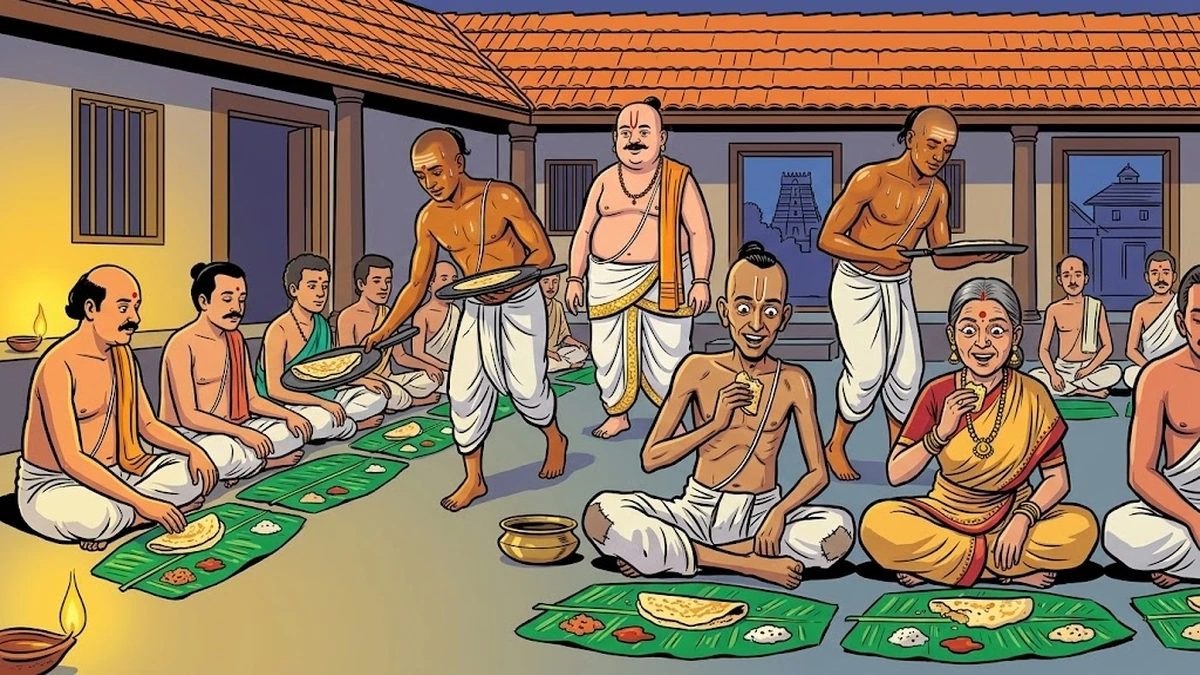
One bright kārttikai evening, a wealthier Madhva neighbour — a portly, kindly man with a great red sect-mark and a fondness for inviting the unfortunate — sent word that he was holding a feast for his daughter’s first birthday. Our beggar and his wife, dressed in their cleanest patched cloth, sat cross-legged on the verandah of the rich man’s house with thirty other guests, and before each of them was unrolled a long, glossy plantain leaf. The cooks — sweat shining on their bare bronze chests, sacred threads looped over one shoulder — came down the row of guests with iron griddles balanced on their forearms, sliding hot golden tôśai after hot golden tôśai onto the leaves. The beggar ate three; his wife ate four. They drank the thin red saṁbār until their lips burned. They ate until their stomachs were tight as drum-skins. And then they walked the long dusty road home in the moonlight, and for the first time in their married life they walked without speaking — not because they were angry, but because they were both, in the secret theatre of the heart, still tasting the flavour of the lost tôśai and grieving, very softly, that the feast was over.
“Husband,” said the wife at last, when they had reached their own dim threshold, “I shall make us tôśai in our own house. I have decided. From tomorrow, every day you bring home rice in your bowl, I shall set aside a small handful — only a small handful, husband, no one will starve — and I shall hide it in the brass pot behind the cooking-stones. When I have collected enough, I shall borrow a little black uṫund dal from our neighbour Saradamma — she is kind, and she will give it without asking why — and on a fine moonlit night I shall set the soaked rice and dal on the stone, and I shall grind a fresh white batter, and I shall make us tôśai on our own iron griddle. We shall taste them again before we die.” The husband, who had been thinking exactly the same thought without daring to speak it, took her thin hand in the darkness and squeezed it once, and that was the whole agreement.

Day after day a small handful of rice went into the brass pot. The beggar walked his rounds with his alms-bowl and brought home his thin earnings; the wife, with the cunning patience of a household that has decided to save for a single luxury, set aside a fistful and pressed the rest into the day’s gruel. After three weeks the brass pot was full. The neighbour Saradamma, asked sweetly for a little uṫund, gave a small white heap of the black-skinned lentil with both hands and a smiling “pôy vā” — “go and come” — the soft Tamil farewell. Salt was already in the house. Green chillies grew on a bush by the back door. Coriander seed lay in a screw of old newspaper on the kitchen shelf. And one fine evening, when the husband was out walking his last round of the day, the wife squatted down on her flat black grinding-stone, ground the soaked rice and dal into a cool white batter the colour of tender coconut flesh, mixed in a little curd from the kindly neighbour, salted and spiced it, and set the iron tôśai-kāl on the three-stone stove.
The first tôśai hissed onto the iron with a sound that seemed to her, after so many lean years, the most beautiful sound in the world. She spread the ladle of batter outward in a great pale spiral; the edges crisped golden; she lifted the pancake and folded it, hot and lacy, onto a banana-leaf. The second pancake, the third, the fourth, the fifth — and that was the end of the batter. She had made exactly five tôśai, no more, no less, each as wide as a thali-plate and as thin as the inside of a temple bell. They lay stacked on the leaf, gleaming with the last of the sesame oil, and the kitchen smelled of paradise. At that very moment, with the lamp of her face shining and her mouth watering as if she had not eaten in weeks, her husband pushed open the door of the hut and stepped inside.
II · The Question Too Hard to Solve
The beggar set down his bowl. He looked at the five gleaming tôśai on the banana-leaf. His mouth, like his wife’s, began to water. And then, like a stone falling into a still well, the question fell into his small careful mind and refused to leave: five into two does not divide. Two muffins for him, two muffins for her, and the fifth left over, glowing in the lamplight like a small golden moon — what was to be done with the fifth? He pondered. He was a slow, patient man, but on the matter of arithmetic he was simply unable. That half and half makes one, that two and a half is the just and equal portion for each, was a fraction his head could not turn. And besides, he reasoned with the simple cunning of the village stomach, a half tôśai is not a tôśaitôśai must be eaten whole by one person; and the only question was which.
“Wife,” he said at last, very gravely, “we cannot tear them. Therefore one of us must take three and the other two. The question is, which?” The wife’s eyes narrowed; her mouth, which had already begun to plan the slow rapture of three pancakes eaten in succession, set itself in the small firm line that meant she had no intention of accepting two. “Whichever god is just,” she said carefully, “will surely give the three to the one who wants them more.” And so they sat in the lamp-light and stared, with growing seriousness, at the small golden pile that had become the most important thing in their lives.
It was the husband who proposed the contest. “Let us both,” he said, “shut our eyes and stretch ourselves out as if in deep sleep, each of us on a separate verandah — you on the west, I on the east. Whoever opens an eye, whoever speaks first, whoever moves a finger — that one shall have only two pancakes. The other shall have three. Neither of us is to break the silence by any means. Are you agreed?” The wife, who could keep her tongue still longer than any woman in the Kāvēri delta when three tôśai were on the table, agreed at once. She wrapped the five pancakes in two clean banana-leaves, set them in a brass pan, covered the pan with a second pan, and bolted the kitchen door. She bolted the front door of the house. She extinguished the lamp. She helped her husband stretch himself out, eyes closed, on the east verandah; she stretched herself out, eyes closed, on the west; and the small dark hut at the edge of the village settled into a silence so deep and so unnatural that even the temple owl outside paused on his branch and tilted his round white head.

III · Three Days of Silence and the Worried Village
The first night passed. Neither moved. Neither spoke. The kitchen lamp, which the wife had left burning low, sputtered out near midnight. A house-lizard ran across the husband’s chest; he did not flick a finger. A field-mouse came in under the door and nibbled at a strand of straw within an inch of the wife’s ear; she did not breathe more loudly. The stars wheeled overhead. The temple bell rang for the dawn māṃgaṃa-ārati; neither husband nor wife stirred. The beggar’s brass alms-bowl sat on its peg by the door, dry and unused for the first morning in twenty years.
By the second day the village began to notice. The beggar always came down the lane at sunrise, always stopped at the same five doorways — the priest’s house, the headman’s, the moneylender’s, the weaver’s, the kindly Saradamma’s — and held out his bowl with the same soft “bhikṣāṃ dēhi.” When he did not come on the second morning, the priest’s wife frowned over her broom; when he did not come on the third morning, the headman set down his curd-rice and said, “Something is wrong. He has not even come for our temple praśād these two days. Send the watchman.” The village watchman, an old man with a grey moustache and a bamboo staff, walked over to the little mud hut at the edge of the village and knocked on the door. There was no answer. He pushed; the door did not give. He went round to the back; the kitchen door was bolted from the inside. He came back to the headman and shook his head. “Bolted from within,” he said. “And no sound at all.”
The headman called an assembly under the great marudā-tree at the centre of the village. The grey-beards sat down on the stone platform; the women hung at the edges with their water-pots on their hips; the small children stared. “Perhaps thieves have entered,” said one greybeard. “But what property does a beggar have to steal?” said another. “Perhaps a serpent has crawled in and bitten them in their sleep,” said a third. “Perhaps they have left for some other village.” “But the door is bolted from within!” “Perhaps they have died of some sudden contagion. Climb the roof, watchman, and look down through the smoke-hole.” Two young watchmen climbed the palm-thatched roof, lifted a corner of the thatch, and peered down. They saw the beggar stretched flat on the east verandah, eyes closed, face still as a stone. They saw his wife stretched flat on the west verandah, eyes closed, face still as a stone. Neither breathed visibly; neither moved. The watchmen jumped down with shaking hands and reported the news to the assembly.
“They are dead,” said the headman gravely. “Both dead, locked in their own house. How loving they must have been to die together like this, on the same night, in the same posture — truly the gods have rewarded their long patience with the rare gift of one shared death.” The assembly murmured admiration. Old women began to weep softly. The headman ordered the door to be broken open. The villagers rushed in, and indeed the beggar and his wife lay so still, so pale, so unmoving on their two opposite verandahs that the verdict of the assembly seemed beyond doubt. Two green litters of fresh-cut bamboo and woven coconut-leaf were brought; the bodies of the still-living, still-listening, still-silent husband and wife were lifted with reverent hands onto the litters; and to the slow chanting of “Rāma Nāma satya hai” — “the Name of Rāma is the only Truth” — the entire village set out in solemn procession towards the cremation-ground beside the river.
And inside their unmoving bodies the beggar and his wife each thought, with growing exactness: three muffins or two; three muffins or two; whoever speaks first gets only two. Neither would break.

IV · The Pyre, the Cracking Voice, and the Cast-out Pair
At the cremation-ground beside the Kāvēri the watchmen had piled, from the small charitable contributions of every household, a score of dried cow-dung cakes and a bundle of dry mango-wood for each pyre. They built two pyres, one for the man and one for the woman, with the careful spacing the funeral priests insist upon. They laid the silent bodies on top, draped each with a length of clean white cotton, scattered tuḷasī leaves and a few grains of unhusked rice, and the village priest — an old Madhva himself, who had known the beggar since they were boys catching frogs in the same paddy-field — lifted a flaming torch of palmāṛa and circled the pyres three times, chanting the funeral mantra. He touched the torch to the first pyre, the husband’s. The dry cow-dung cakes caught at once. A small pale flame ran along the base; a column of grey smoke rose; the heat began to mount.
The beggar, lying on top of his own pyre with his eyes carefully shut, felt the warmth on the soles of his feet. He felt it climb his shins. He felt it begin to lick at the cotton sheet that covered his thin knees. And in his slow, careful mind a slower, even more careful calculation took place: two muffins are better than no muffins; two muffins eaten alive are better than three muffins eaten by a corpse; the fire has reached my knees; let the wife win her three. He opened his mouth, very calmly, in the middle of his own funeral, and said in a clear voice that carried over the chanting and over the crackle of the dung-fire and over the shocked breath of every villager assembled:
“பருவாயில்லெ, தொட்டெ ரேண்டே போபுதும்!”
parāvāy illai, tôśai reṇḍē pôtum!
— “It does not matter; two muffins will be enough for me!”
And from the second pyre, even before the villagers had recovered their wits, came the wife’s clear triumphant voice, ringing across the cremation-ground in the crisp tone of a woman who has just won an argument she has been planning for three days:
“நான் ரேஅ்டேன்! தொட்டெ மூன்று எனக்கே கிடேக்கும்!”
nān jeṃicēṇ! tôśai mūṇṛu eṇakkē kiḍaikkum!
— “I have won! The three muffins shall be mine!”
The villagers ran. They ran in every direction at once, the priest dropping his torch, the headman dropping his staff, the women clutching their water-pots and their children. Corpses that speak in clear voices from their own funeral pyres are, in the ordinary Tamil understanding of the world, no longer corpses but vētāḷa-piśācu — ghouls, returned spirits, demons of the cremation-ground — and the only proper action when a ghoul speaks from the fire is to run very fast in the opposite direction and not to look behind. Only one bold man stood his ground — an old soldier with a grey moustache and a long curved aruvāḷ billhook in his belt, who had seen worse things in the wars and feared nothing on this earth. He walked up to the husband’s pyre, looked the speaking corpse in the eye, and said, “Brother, are you alive or are you a ghost?”
“I am alive,” said the beggar, sitting up in the smoke, “and my wife is alive, and we have been lying still these three days for the sake of three pancakes. Pull me down before my legs are cooked, and call my wife down before her sari catches; and then come home and eat with us, for there are five hot tôśai waiting on the kitchen shelf, and my wife shall have her three, and I shall have my two, and you shall have whatever is left over.” The old soldier laughed until he had to sit down on a stone, and he ran after the fleeing villagers and called them back; and when they had come back, in twos and threes, with eyes very wide, he told them the whole story of the five muffins.
V · The Hut Outside the Village, and the Daily Gift of Pancakes
Now the elders of the village sat down again in council, and a hard problem was put before them. By the strict rules of Tamil village custom, persons who have ascended the green funeral litter and lain upon the lighted pyre, even for an instant, may never come back to live within the village walls. To do so would, it was held, draw the wrath of the cremation-ground spirits down upon every household, the cattle would sicken, the rice would not ripen, and the wells would turn brackish. The beggar and his wife, by their own free choice, had ascended the litter and lain upon the pyre for the sake of a third pancake; therefore, gently but firmly, they could no longer be readmitted to the village. Yet to drive them out, after so much foolishness and so much suffering, would be neither charitable nor just. The elders thought long; the priest thought long; the kindly Saradamma thought longest of all. And then a compromise was found.
A small new mud-walled hut was built for the pair in a deserted meadow just beyond the temple-tank, half a furlong from the village proper. There they were to live, neither inside the village nor entirely cast out from it; and there, every morning and every evening, the village women — led always by Saradamma and the priest’s wife — would walk out across the bund with a small brass tiffin-tin in each hand, and would set down on the threshold of the hut a small pile of fresh-griddled tôśai, hot and golden and folded, with a thimble of coconut chutney and a thimble of red saṁbār. And from that day to the end of their lives the beggar and his wife ate tôśai twice a day — not by their own labour, not by their own clever wager, but by the slow steady charity of the village they had so very nearly left behind.
They were known, ever after, as pālānāndi — “the muffin-fool” — and his wife. The children of the village pointed at them in delight and called out the name in singing voices as they passed. The grandmothers told the tale on cool evenings on the verandahs of richer houses. And in time, when the beggar at last lay down on a real funeral pyre and his wife followed him soon after, the village burned them with full Madhva rites and with much weeping; and the priest, raising his torch above the proper, motionless body of the husband, said with a small private smile that perhaps in his next life this kindly fool would learn that the right share of five pancakes between two persons is two-and-a-half, and that the right share of love between husband and wife is the whole.
The Moral · அவ பாபத்தின் வேர்
The Tamil grandmothers who tell this tale to children on coir cots in coconut-shadowed courtyards seldom bother to spell out the moral, for the children have already heard it in their own laughter. But the proverb that travels with the story, in the old Tamil oral tradition recorded by Sastri, runs:
“அவ பாபத்தின் வேர்; பிடிவாதம் ருவேர்.”
āśai pāpattin vēr; piḍivātam aru-vēr.
— “Greed is the root of sin; obstinacy is its bitter root.”
The pancake is small; the wager is foolish; but the lesson is large. Where two who love each other place a single small share of food between them and refuse to divide it justly, they are no longer two who love but two who compete. The beggar and his wife endure three days of perfect silence, the public ceremony of their own funeral, and the heat of the actual pyre, rather than yield the third pancake. The Tamil proverb does not call this love; it calls it piḍivātam, “obstinate clinging,” and identifies it as the bitter root from which all greater greeds grow. The wisdom of Sastri’s village is that the foolishness of the famished poor is not different in kind from the foolishness of the wealthy who cannot let go of a quarrel; the only difference is the size of the pancake.
Why the Tale Has Lasted
“The Beggar and the Five Muffins” has been a favourite of Tamil grandmothers, of the comic-tellers (kathakar) of village fairs, and of the Anglo-Indian folklorists since at least the 1840s. Sastri and Kingscote published their version in Tales of the Sun in 1890, but the tale was already old then; the same plot, with seven biscuits in place of five pancakes, appears in the early Tamil Vikrama-côṎa-aimperuṅ-kāppiyam manuscripts; with three rice-cakes in the Telugu Madanakāmarāja-kathai; with two ladlefuls of curd in the Kannada oral cycle of Bīrbaḷ and Akbar; and, far afield, as the Welsh “Silent Couple” in Sir John Rhřs’s Celtic Folklore (1901) and as the Sicilian “Pitre 245” in Pitrè’s Fiabe, Novelle e Racconti (Palermo, 1875). What every recorded version preserves is the comic engine of the silence-wager: the long, absurd stillness of two people who have agreed to compete in muteness over a trifle, and the moment when the laws of the body finally force one of them to break.
The tale has lasted because every household understands it. A small dispute over a small thing — the larger biscuit, the better blanket, the last spoonful of chutney, who is to fetch the firewood, who is to scold the child — has, in every village in every century, set two who love each other at silent war. The beggar and his wife are the comic outer limit of that war: they will lie still for three days, they will be wrapped in their winding-sheets, they will be carried to the cremation-ground and laid upon a lit pyre, they will be cooked at the ankles, before either of them yields. The audience laughs — and then, walking home, each one in the audience thinks of some small standoff in the bedroom or the kitchen, and resolves, at least until the next quarrel, to be the first to speak.
The Tamil tradition adds one further grace-note that the European versions lack: the village does not abandon the foolish pair. Saradamma the kindly neighbour, the priest’s wife, the headman’s daughters, walk out morning and evening with hot pancakes for the muffin-fool and his wife. The community, though it cannot quite let them back in, will not quite let them go hungry. That blend of the comic and the merciful — the laughter at human folly which leaves the foolish still warmly fed — is the deep South-Indian flavour of the tale, and the reason that every Tamil child since 1890 has known the words pālānāndi as a household joke. To call your husband, with mock solemnity over the dinner table, “my muffin-fool,” is in some Tamil houses still the gentlest reminder that two who love each other should never play this particular game.
Bibliography: Natesa Sastri & Kingscote, Tales of the Sun; or, Folklore of Southern India (W. H. Allen, 1890), Tale XXV; Natesa Sastri, Folklore of Southern India (4 vols., Madras, 1884–88); The Indian Antiquary XII–XV (1882–87); Hans-Jörg Uther, The Types of International Folktales (FFC 284, Helsinki, 2004), ATU 1351; Stith Thompson, Motif-Index of Folk-Literature (Bloomington, 1955–58), J2511, J2199.4, W125.1, N825.3; Thompson & Roberts, Types of Indic Oral Tales (FFC 180, 1960); Pitrè, Fiabe, Novelle e Racconti (Palermo, 1875); Asbjørnsen & Moe, Norske Folkeeventyr (Christiania, 1841–44); Rhřs, Celtic Folklore (Oxford, 1901); Edwin C. Kirkland, A Bibliography of South Asian Folklore (Bloomington, 1966); A. K. Ramanujan, Folktales from India (Pantheon, 1991).
You May Also Like
 Indian Folk Tales
All Ages
Indian Folk Tales
All Ages
A Lac of Rupees for a Piece of Advice
A Lac of Rupees for a Piece of Advice: In a bustling town in ancient India, A merchant paid an enormous sum for a single piece of advice that saved his life.
 Indian Folk Tales
Ages 3-5
Indian Folk Tales
Ages 3-5
How The Wicked Sons Were Duped
How The Wicked Sons Were Duped: A very wealthy old man, imagining that he was on the point of death, sent for his sons and divided his property among them.
 Indian Folk Tales
All Ages
Indian Folk Tales
All Ages
The Cruel Crane Outwitted
The Cruel Crane Outwitted: Deep in the forests of ancient India, near the holy city of Kashi, there stood a magnificent fig tree so tall that its topmost