Birbal’s Khichdi: The Emperor’s Lesson in Logic
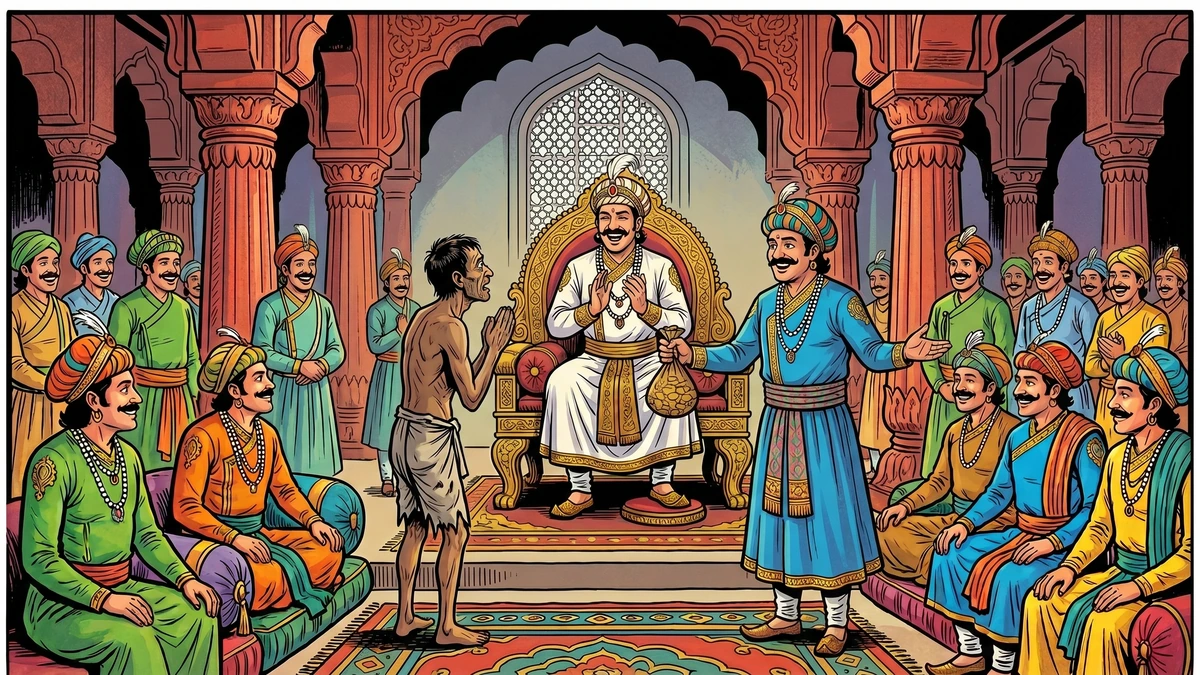
Birbal's Khichdi: The Emperor's Lesson in Logic: The Wager of the Freezing Night In the imperial court of Emperor Akbar, the greatest Mughal ruler of India
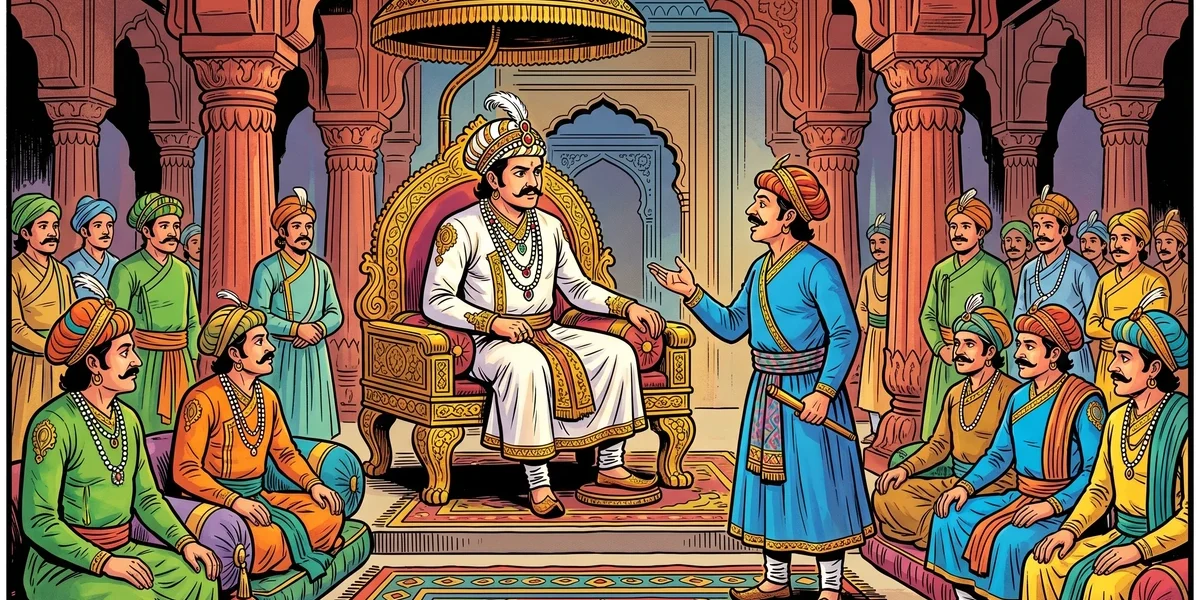
Of all the stories in the vast Akbar-Birbal cycle, none has proven more durably satisfying—or more philosophically dense—than the tale scholars have come to call Birbal’s Khichdi. Its structure is deceptively simple: a poor man wins a bet against the Emperor of Hindustan, is denied his prize on a specious technicality, and is vindicated by his minister Birbal through a counter-argument of breath-taking absurdity. Yet in this simplicity lives one of the keenest expositions of logical fallacy, judicial hypocrisy, and the ethics of contract-keeping that classical Indian narrative tradition has produced. The story has been told in Braj Bhasha, Awadhi, Urdu, Bengali, Marathi, and a dozen other languages for roughly four centuries without losing a syllable of its intellectual edge.
The Bet and the Cold Lake
The story is typically set in Agra or Fatehpur Sikri—both Akbar’s capitals at different periods of his reign—on the deepest night of winter. A poor man, variously named Chimman, Sukhia, or simply “the woodcutter” in different regional versions, rashly bets with the court that he can stand immersed to the waist in the royal lake from dusk to dawn without any external source of warmth. The prize: enough gold to transform his family’s fortunes. The penalty for failure: a public flogging.
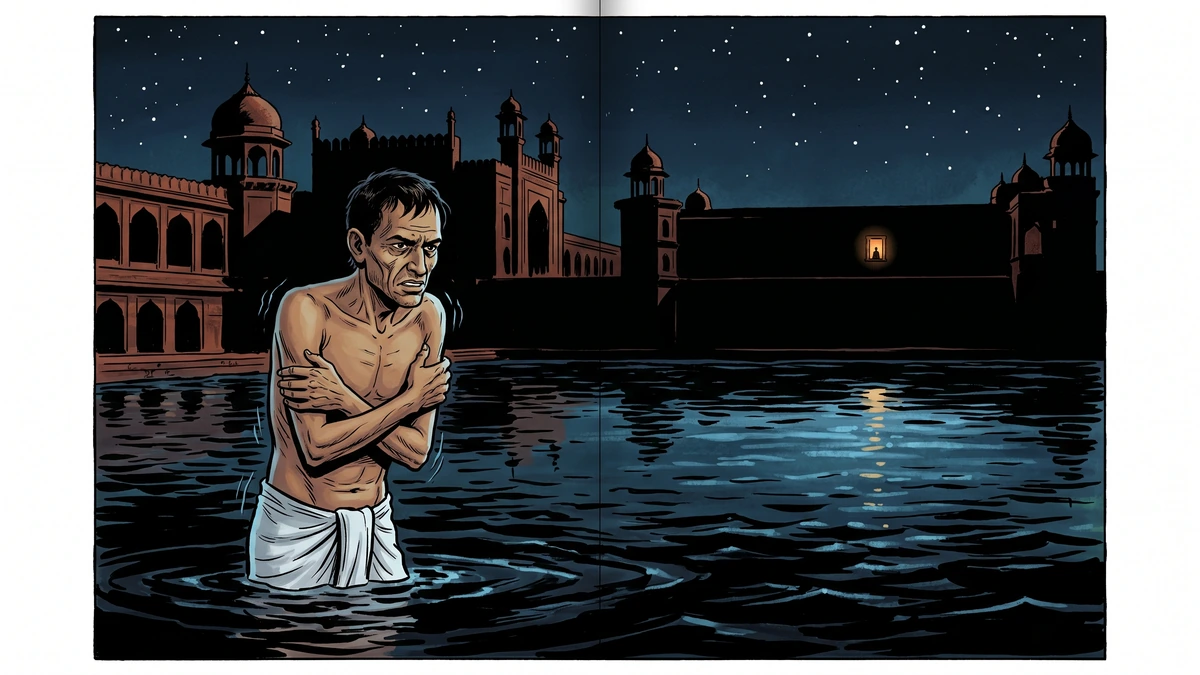
The man stands in the freezing water through the night, sustained by nothing but desperation and the tiny glow of a lamp burning in a palace window across the lake. At dawn the courtiers confirm he has succeeded—barely alive, blue with cold, but standing. He has won. Emperor Akbar, however, studies the case with the precision of a man who has spent forty years governing a continental empire and announces a ruling: the man was warmed by the palace lamp across the water. He took external heat. The bet is forfeited. No gold.
The poor man protests. The lamp was a hundred metres away. The light reached him but not the warmth. Akbar is unmoved. Heat from a distant flame is still heat. The poor man departs with nothing.
Birbal’s Khichdi: The Counter-Argument
The next morning, Birbal—the court’s chief wit, minister, and Akbar’s most trusted counsellor—is conspicuously absent from the morning audience. Akbar sends a messenger to find him. The messenger returns: Birbal is at home, cooking. He will attend court as soon as his khichdi is ready. An hour passes. Two. Akbar sends again. Still cooking. The Emperor, increasingly annoyed, finally goes himself with a retinue of courtiers to see what possible culinary undertaking could justify this absence.
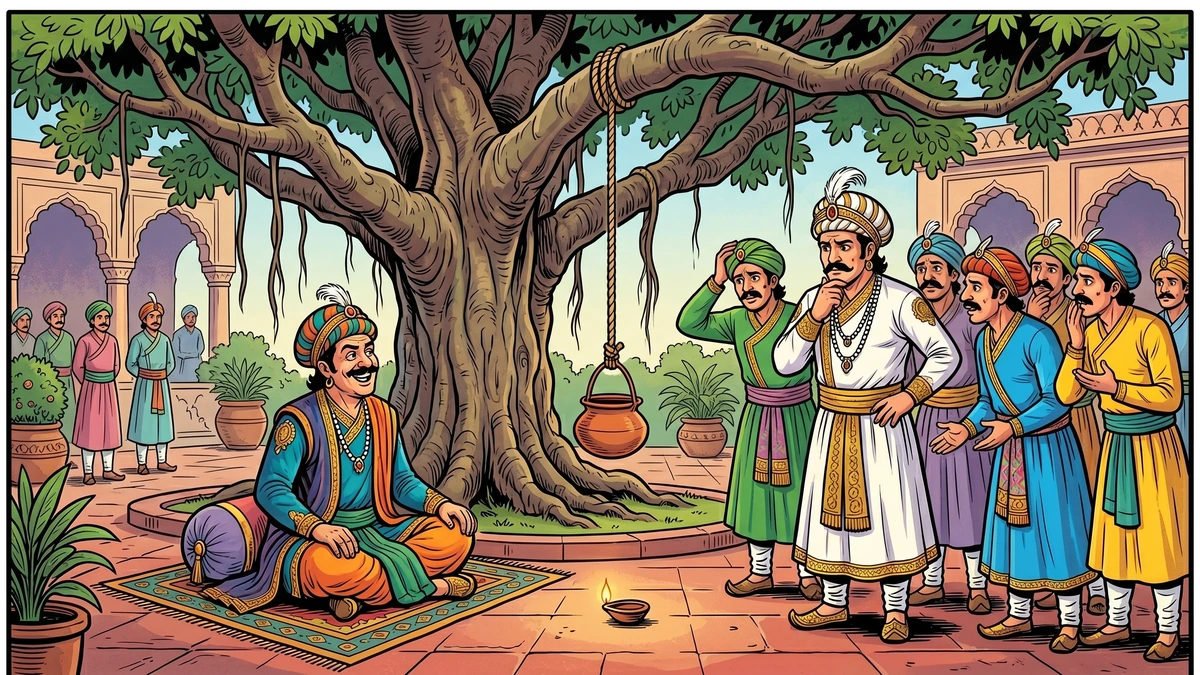
They find Birbal in his garden, sitting cross-legged under a tree. From a branch five metres above his head hangs a small clay pot. Below it, on the ground, burns a tiny earthen lamp. Between the lamp and the pot: nothing but air and distance. The khichdi in the pot is, of course, raw rice and lentils. It will never cook.
Akbar stares. He understands immediately. Birbal looks up and says, in the version recorded by historian Abu’l-Fazl’s scribal tradition: “Your Majesty, my khichdi will be ready shortly. The lamp is heating the pot. If heat can travel across a hundred metres of water to warm a man in a lake, surely it can travel five metres through air to cook a pot of rice.”
The Emperor laughs—in every version of the story, Akbar laughs—and the poor man receives his gold.
Historical Dimensions: Akbar, Birbal, and the Navratnas
The historical Birbal—born Raja Mahesh Das in 1528 in Tikvanpur (present-day Madhya Pradesh) into a Brahmin family of the Kanyakubja subcaste—rose to Akbar’s court through the patronage of the poet-king Man Singh of Amber. He received the title Birbal (“brave of heart”) from Akbar, who also gave him the exceptional honour of the title Raja for a non-Rajput, non-Muslim courtier. Birbal was one of the Navratnas—the Nine Gems of Akbar’s court—a designation that grouped the Emperor’s most distinguished advisors across military, administrative, artistic, and intellectual domains.
The historical record, primarily Akbarnāma and Āīn-i-Akbarī by Abu’l-Fazl, portrays Birbal as a genuine favourite of Akbar—unusual in its warmth and intimacy for a chronicle of imperial court life. Akbar is recorded as grieving genuinely when Birbal was killed in the disastrous campaign against the Yusufzai tribe on the northwest frontier in 1586. The Emperor reportedly did not eat for two days. The personal friendship between the emperor and the minister provides the psychological foundation on which centuries of storytelling have built the Birbal legend: only a man of unassailable personal affection could get away with the kind of public correction Birbal delivers in the Khichdi story.
It is worth noting that the historical Birbal was primarily celebrated as a poet—his Brahma* verses in Braj Bhasha survive in several manuscripts—and it is only after his death that the cycle of wit-stories began accumulating around his name. The process mirrors what happened to other great court wits: the historical Tenali Rama at Krishnadevaraya’s court, the historical Mullah Nasreddin in the Turkic tradition, the historical Till Eulenspiegel in the German tradition. The wit becomes a vessel for the culture’s accumulated wisdom about the relationship between power and intelligence.
The Logical Structure of the Joke
Birbal’s Khichdi works as a joke and as a philosophical argument simultaneously—a rare achievement. Its logical structure is a reductio ad absurdum by analogy: it accepts the Emperor’s premise (heat from a distant source counts as external warming) and applies it to a case where the absurdity of the conclusion is immediately visible. If a lamp a hundred metres away provides meaningful warmth to a body in water, then a lamp five metres away should cook a pot of rice in reasonable time. Since no one believes the second proposition, the first proposition—Akbar’s ruling—must be equally false.
In the taxonomy of classical Indian logic (Nyāya darśana), Akbar’s original error is an instance of vyabhicāra—the fallacy of the undistributed middle, where a property (heat-transfer) is attributed without attention to degree and mechanism. A lamp one hundred metres across water does not warm a body in any thermodynamically meaningful sense; the light is detectable but the thermal effect is negligible. Akbar conflates physical detectability with physical efficacy—a category error. Birbal’s counter-argument forces the same category error to its absurd logical conclusion, making it visible.
This is, in miniature, the same logical move that Socrates employed in the Platonic dialogues when confronting sophists: accept the opponent’s definitional framework, then demonstrate that it proves too much. That a folk tale in 16th-century Hindustan independently discovered and encoded this technique is testament to the universality of the logical form, and to the sophistication of the oral tradition that carried it.
The Ethics of the Imperial Wager
The story’s deeper moral concern, however, is not epistemological but ethical. Akbar’s ruling, whatever its logical deficiencies, is primarily an act of bad faith. The poor man staked his body and his safety on a contract with the most powerful ruler in the world. He performed his part of the contract under extraordinary conditions—the physiological danger of overnight cold-water immersion is genuinely life-threatening, and the story’s drama rests partly on the understanding that this was no trivial feat. For the Emperor to then discover a technicality—and a specious one—to void the contract is a betrayal of the power asymmetry the Emperor himself created by offering the bet.
In the classical Indian legal tradition codified in texts like the Arthaśāstra and the Manusmṛti, the concept of pratiśruta (a promised/pledged word) carried enormous weight. To break a pratiśruta was not merely a civil wrong but a spiritual one; kings who broke their word were held to incur adharmā, a corruption of the cosmic order that their role specifically required them to maintain. By denying the poor man his prize, Akbar is not merely being stingy—he is, in the framework the story implicitly invokes, committing a kingly sin.
Birbal’s correction thus serves a function beyond wit. He is, in the traditional role of the court jester and the minister-advisor, reminding the king of his dharmic obligation without confronting him directly. The medium of comedy—the absurd pot hanging over the tiny lamp—allows the correction to occur without humiliation; Akbar can laugh and comply without losing face, whereas a direct accusation of bad faith would have forced him into a defensive posture. The Birbal stories, in this reading, are a treatise on how to speak truth to power without getting killed.
Comparative Traditions: The Wise Fool Across Cultures
The character of Birbal belongs to the global type of the wise fool—the court jester or counsellor whose apparent license to joke grants him the actual license to correct. The type appears across cultures with remarkable structural consistency. Mullah Nasreddin (Nasruddin) of the Turkic/Persian tradition—who may or may not have been a historical person of the 13th century in Anatolia—uses exactly the same technique of comic reductio: he accepts an absurd premise and applies it faithfully until everyone sees the absurdity. His story of riding a donkey backwards (“I’m not facing backward—the donkey is facing backward”) is structurally identical to Birbal’s khichdi in its method.
In the South Indian tradition, Tenali Ramakrishna (Tenali Rama, fl. early 16th century)—the court wit of Krishnadevaraya of the Vijayanagara Empire—uses identical logic structures in his tales. His story of the mango tree that a thief claims belongs to him because he watered it as a seedling is resolved by Tenali’s counter-argument that the thief’s labour does not transfer ownership any more than a river’s labour in watering the forest gives the river title to the trees. The Birbal and Tenali Rama cycles are so structurally parallel that scholars have proposed a common ancestor in an earlier Sanskrit or Prakrit satirical tradition, possibly connected to the Vetālapañcaviṃśati or the Śukasaptati.
In the Western tradition, the closest parallel is the figure of the court jester—particularly as portrayed in Shakespeare’s King Lear, where the Fool is the only figure who speaks truth to the king consistently and from the beginning. The structural difference is one of tone: Shakespeare’s Fool speaks in riddles and verse, maintaining ambiguity as protection; Birbal speaks in acts—the cooking pot, the lamp—that make the point unmissable while still deniable as mere jest. The Indian tradition trusts comedy to do more work.
Khichdi: The Food of Democracy
The choice of khichdi—the humble one-pot dish of rice and lentils—as the vehicle for Birbal’s argument is not accidental. Khichdi is the most democratic food in South Asia: it requires no skill, minimal ingredients, and can be made in any kitchen from the palace to the hovel. It is what the sick are given, what the poor cook when nothing else is available, what pilgrims eat at temple complexes because it needs no ritual purity of preparation. In the social hierarchy of Mughal court cuisine—with its elaborate qormā and biryāni and naan—khichdi is the lowest rung.
For Birbal to use khichdi as the test case is to make a quiet social statement: the logic that protects the poor man applies even to the simplest food. The Emperor’s fallacy is not a subtle philosophical error discoverable only by learned men; it is a mistake so basic that it is refuted by the pot that every poor household puts on the fire every evening. The democracy of the refutation—available to anyone who has ever cooked a meal—is as important as its logical force.
Food historians note that khichdi’s association with simple wisdom runs deep in Indian culture. The Mughal emperor Jahangir, Akbar’s son, recorded in his memoirs (Tūzuk-i-Jahāngīrī) that khichdi was Akbar’s favourite food for the evening meal—a detail that makes Birbal’s choice of this particular dish even more pointed. He chose his argument’s vehicle with characteristic care: a food his emperor loved, cooked by a method his emperor would immediately understand, to prove a point his emperor had to accept.
The Story in Indian Education and Popular Culture
Birbal’s Khichdi is one of the handful of folk tales that appear in virtually every Indian school curriculum regardless of state or language medium—typically in the third or fourth standard, when children are first introduced to logical reasoning. The National Council of Educational Research and Training (NCERT) has included versions of the story in Hindi, English, and Urdu textbooks across multiple curriculum revisions since 1961. Its pedagogical value is transparent: it teaches children to distinguish between correlation and causation, between the presence of a factor and its effectiveness.
The story has been adapted into animated shorts by Cartoon Network India, Disney India, and multiple OTT platforms as part of Indian folk tale series. It was featured in the 1970s Doordarshan serial on Akbar-Birbal tales that introduced the cycle to a television audience for the first time. An Amar Chitra Katha comic book version (No. 149, “Birbal the Wise”) published in 1977 remains in print and is one of the best-selling titles in that imprint’s catalogue of over 400 titles.
In contemporary political discourse in India, “Birbal’s khichdi” has become an idiom for arguments that are technically clever but fundamentally unjust—or, conversely, for counter-arguments that expose such injustice through demonstrating absurdity. The phrase appears in parliamentary debates, newspaper editorials, and social media commentary whenever a government ruling is perceived as using a technical escape to void a moral obligation. The story has become, four centuries after its origin, a living piece of the language of justice.
What the Story Teaches
Birbal’s Khichdi teaches several things simultaneously, and its genius is that each lesson is accessible at a different level of sophistication. For a child, it teaches that clever thinking can defeat unfair power. For an adolescent, it teaches that arguments have structure and that bad arguments can be revealed by following their logic to its conclusion. For an adult, it teaches that power has ethical obligations—that the asymmetry between emperor and subject creates, not diminishes, the emperor’s responsibility to keep his word.
For anyone who has encountered formal logic, it is a perfect case study in reductio ad absurdum and the fallacy of equivocation—treating the same word (“warmth,” “heat”) as if it means the same thing in different contexts. For anyone who has studied jurisprudence, it is a perfect case study in the abuse of technicality—using the letter of an agreement to violate its spirit. For anyone who has thought about comedy, it is a masterclass in the use of the physical and the concrete to make abstract argument visible and indelible.
The story ends with laughter—Akbar’s laughter, the courtiers’ laughter, the poor man’s laughter. Birbal does not triumph with a solemn lecture. He triumphs by making everyone, including the person he is correcting, see the same thing at the same moment. That shared seeing—the experience of suddenly understanding a truth through its comic revelation—is what the best of the Birbal cycle does, and why it has outlasted the empire in whose courts it was born.
Frequently Asked Questions
What is the story of Birbal’s Khichdi?
Birbal’s Khichdi is a famous Akbar-Birbal tale in which a poor man wins a bet by standing in a freezing lake all night, only to have Emperor Akbar deny his prize by claiming the man was ‘warmed’ by a distant palace lamp. Birbal exposes the injustice by hanging a pot of uncooked khichdi (rice and lentils) from a tree above a tiny lamp far below, asking when the khichdi will be ready. Akbar immediately understands the absurdity—a distant lamp cannot cook food any more than it can warm a body—laughs, and orders the man to be paid.
Who was Birbal historically?
Birbal (born Raja Mahesh Das, 1528–1586) was one of the Nine Gems (Navratnas) of Emperor Akbar’s court in the Mughal Empire. Born into a Brahmin family in Tikvanpur (present-day Madhya Pradesh), he rose through the patronage of the Raja of Amber. He was celebrated in his lifetime as a poet in Braj Bhasha and as a trusted advisor and friend to Akbar. He died in 1586 during a military campaign against the Yusufzai tribe on the northwest frontier. The cycle of wit-stories accumulated around his name largely after his death, following the same pattern as Tenali Rama in the Vijayanagara tradition.
What logical fallacy does Akbar commit in the story?
Akbar commits the fallacy of equivocation—using the word ‘heat’ or ‘warmth’ as if it means the same thing in two different contexts. A lamp 100 metres across water is physically detectable (its light can be seen) but provides no thermodynamically meaningful warmth to a human body. Akbar conflates physical detectability with physical efficacy. In the framework of Indian classical logic (Nyāya darśana), this is a form of vyabhicāra—an undistributed middle term. Birbal’s counter-argument is a reductio ad absurdum: he applies the same premise to a visible case (cooking rice) where everyone can immediately see it is false.
Why is khichdi significant in the story?
Khichdi—the simple one-pot dish of rice and lentils—is the most democratic food in South Asia, associated with poverty, illness, and pilgrimage rather than courtly cuisine. Birbal’s choice of this humble dish makes a quiet social statement: the logic that protects the poor man applies even to the simplest food, and the Emperor’s error is refutable by anyone who has ever cooked a meal. Food historians also note that Akbar himself reportedly loved khichdi for his evening meals, making Birbal’s choice of the dish a characteristically pointed one.
How has Birbal’s Khichdi influenced Indian culture and language?
The story has been included in Indian school curricula across all languages since the 1960s as a lesson in logical reasoning. It was adapted by Amar Chitra Katha (comic No. 149, 1977), Doordarshan’s Akbar-Birbal television serial, and multiple OTT animated series. The phrase ‘Birbal’s khichdi’ has entered Indian political discourse as an idiom for arguments that use technical cleverness to evade moral obligation—or for counter-arguments that expose such evasions through reducing them to visible absurdity. The story has been continuously retold for roughly four centuries without losing its intellectual edge.
You May Also Like
 Indian Folk Tales
All Ages
Indian Folk Tales
All Ages
The Beetle And The Silken Thread
The Beetle And The Silken Thread: In a bustling town in ancient India, A tiny beetle accomplished what seemed impossible by following a silken thread. The
 Indian Folk Tales
Ages 12+ / YA
Indian Folk Tales
Ages 12+ / YA
The Story Behind The Congress Party’s Hand Symbol – Story of Hemambika
The Pallassana goddess of two raised palms — Parashurama’s remorse, temple lore, and the debated link to the Congress hand symbol.
 Indian Folk Tales
All Ages
Indian Folk Tales
All Ages
The Wrestlers
The Wrestlers: There was, once upon a time, long ago, a wrestler living in a far country, who, hearing there was a mighty man in India, determined to have a