The Blind Men and the Elephant
The Blind Men and the Elephant: In a city famous for its universities and temples, there lived six blind men who were considered among the most learned in the

This is one of the most famous and most universally loved of all the teaching-stories of ancient India — a small clear philosophical parable in which six blind sages of an Indian village are each led, one at a time, to a great Indian elephant standing in the village square, and each is asked to feel the elephant with his hands and report back what an elephant is. The story belongs to the great Indian Buddhist Pali canon — preserved in the Udāna 6.4 in the words of the Buddha himself (5th-4th century BCE) — and to the broader Indian story-tradition of the Jain Anekāntavāda teaching of “many-sidedness,” and to the Hindu Upanishadic commentary tradition. The classical Persian Sufi master Jalāl ad-Dīn Rūmī retold it in his Masnavi-ye-Maʿnavi (Book III, c. 1273 CE) — and the American poet John Godfrey Saxe retold it in his celebrated 1872 English verse, “The Blind Men and the Elephant,” bringing the parable into the modern English-speaking world.
The classical Pali source-form is the Tittha Sutta (Udāna 6.4 of the Khuddaka Nikāya). The Jain canonical form appears in the Anuyogadvāra Sūtra. The Sufi form is Rūmī’s Masnavi Book III lines 1259-1268. The fable is classified in the Aarne-Thompson-Uther index as motif J91 — Blind Men Examine an Animal.
This is the story.
The Six Blind Sages of the Indian Village

It happened, the old Indian tellers said, in a small dusty Indian village in the warm green valley of the Ganga, in the long bright summer of the days when the Buddha himself was walking the dusty roads of north India teaching his quiet patient teachings to whoever cared to listen. In the small dusty village there lived six wise old blind sages — six elderly Indian Brahmins with long white beards and long flowing white dhotis, each of them famous throughout the small green valley of the Ganga for his wisdom, each of them blind from birth and never having seen with his own eyes any of the bright colourful things that the seeing world took for granted.
The six wise old blind sages had spent their long lives, the old Indian tellers said, in scholarly disagreement about almost every subject under the warm Indian sun. They argued about the nature of the soul. They argued about the nature of liberation. They argued about the right way to perform the morning puja at the temple. They argued — most fiercely of all — about what an elephant might look like, since none of them had ever managed to find anyone who was willing to bring an elephant close enough to their hands for them to feel one.
And on this particular bright morning of this particular long summer of the days of the Buddha, by a small piece of luck, a great kind Indian mahout had brought a large gentle Indian elephant down from the deep green forest of the upper valley into the dusty market square of the small village — and the kind mahout, hearing of the long disagreement of the six wise old blind sages, said: “Sirs — please. Come and feel the elephant. Each of you — one at a time. Touch him with your hands. Feel him. And tell us, finally, what an elephant is.”
Each Sage Touches a Different Part
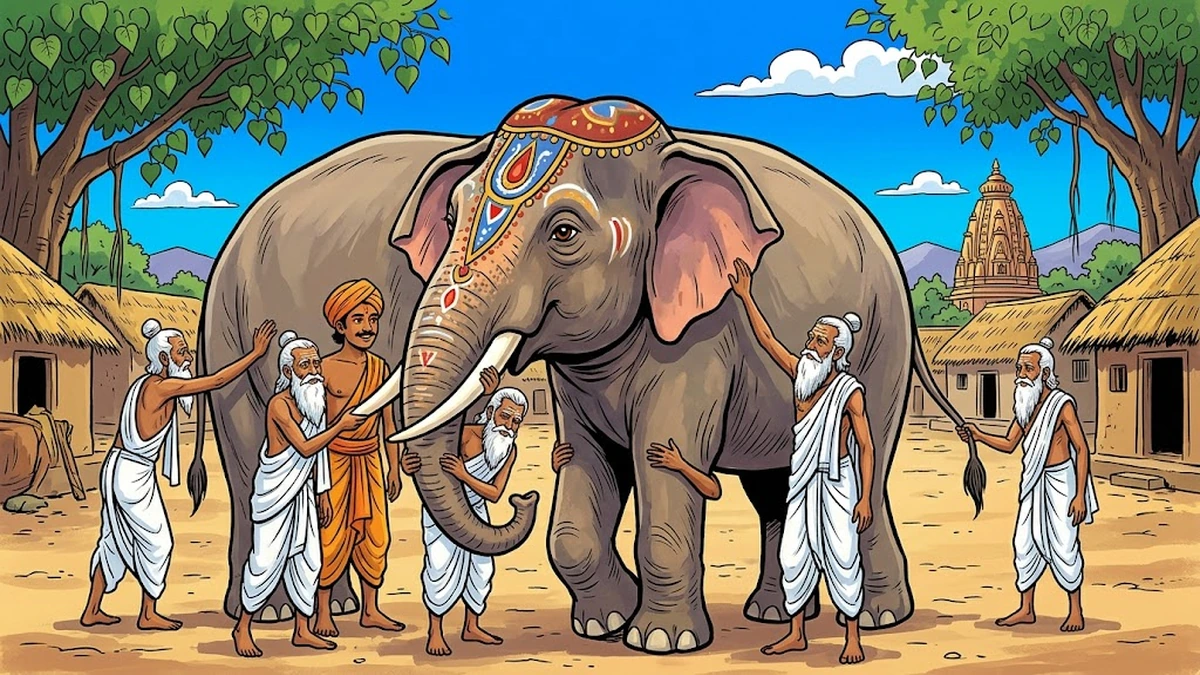
The first wise old blind sage — a tall thin Brahmin with a long white beard down to his belt — was led by the kind mahout to the great gentle elephant’s side, and laid his thin old hands flat upon the elephant’s vast warm grey leathery flank. He felt with his hands. He felt up and down the elephant’s broad warm grey side. He felt the slow gentle rise and fall of the elephant’s breathing. He drew back, and said with the slow patient certainty of a wise old Brahmin: “An elephant — my brothers — is a wall. A great living wall of warm grey stone. That is what an elephant is.”
The second wise old blind sage — a small wiry Brahmin with a hooked nose — was led to the elephant’s great tusk, and laid his thin old hands upon the long smooth curving cool ivory. He felt with his hands. He felt the long smooth taper. He felt the sharp pointed tip. He drew back, and said with equal certainty: “An elephant — my brothers — is a spear. A long smooth curving cool spear of polished ivory. That is what an elephant is.”
The third wise old blind sage — a stout round Brahmin with a kind face — was led to the elephant’s long curling trunk, and laid his thin old hands upon the long warm grey muscular hose. He felt with his hands. He felt the long curling flexibility. He felt the small gentle nostrils at the tip. He drew back, and said with the slow patient certainty of a stout round wise old Brahmin: “An elephant — my brothers — is a snake. A great long warm grey curling snake. That is what an elephant is.”
The fourth wise old blind sage — a short bent Brahmin with a kind smile — was led to the elephant’s great pillar-like leg, and laid his thin old hands upon the thick rough warm grey column of muscle and bone. He felt with his hands. He felt the great solid thick strength of it. He drew back, and said with equal certainty: “An elephant — my brothers — is a tree-trunk. A great solid thick rough warm grey tree-trunk. That is what an elephant is.”
The fifth wise old blind sage — a tall lean Brahmin with sharp features — was led to the elephant’s huge floppy ear, and laid his thin old hands upon the great wide thin leathery fan. He felt with his hands. He felt the great wide thinness. He felt the slow lazy flap. He drew back, and said with the slow patient certainty of a tall lean wise old Brahmin: “An elephant — my brothers — is a fan. A great wide thin leathery fan. That is what an elephant is.”
The sixth and last wise old blind sage — a small bent old Brahmin with a long white beard — was led to the elephant’s small tail at the rear, and laid his thin old hands upon the thin flexible rope-like tail with its small tuft of black hair at the tip. He felt with his hands. He felt the thin twisting flexibility. He felt the small tuft. He drew back, and said with the slow patient certainty of a small bent wise old Brahmin: “An elephant — my brothers — is a rope. A thin twisting rope of warm grey leather with a small tuft of hair at the end. That is what an elephant is.”
The Quarrel of the Six Sages

And the six wise old blind sages, standing in the dusty market square of the small green Indian village under the warm bright morning sun, the old Indian tellers said, immediately fell into the loudest and most bitter scholarly disagreement that any of them had ever had in any of their long quarrelling lives.
“It is a wall!” said the first sage.
“It is a spear!” said the second sage.
“It is a snake!” said the third sage.
“It is a tree-trunk!” said the fourth sage.
“It is a fan!” said the fifth sage.
“It is a rope!” said the sixth sage.
And each of the six wise old blind sages, the old Indian tellers said, was completely and absolutely and unshakeably certain that he alone was right and that the other five were fools and frauds and false scholars and liars. The first sage knew with the certainty of his own honest hands that the elephant was a wall. The second sage knew with the certainty of his own honest hands that the elephant was a spear. And so on, around the circle of the six wise old blind sages, each man absolutely and unshakeably certain in his own truth, each man absolutely and unshakeably wrong about the truth of the other five, each man absolutely and unshakeably right — and absolutely and unshakeably wrong — at the same time.
The Buddha Speaks the Truth

And as the six wise old blind sages stood in the dusty market square of the small green Indian village, quarrelling at the top of their old voices about wall and spear and snake and tree-trunk and fan and rope — there came down the dusty road, the old Indian tellers said, the kind serene radiant figure of the Buddha himself, walking slowly with his small wooden begging-bowl in one hand and his small calm patient smile on his kind broad brown face.
The Buddha stopped at the edge of the dusty market square. He listened, with the kind serene patient listening of an enlightened teacher, to the loud bitter scholarly quarrel of the six wise old blind sages. And then — gently, with the small calm authority of a teacher who had seen this small clear lesson taught a great many times before — the Buddha said:
“My brothers. Each of you, with your own honest hands, has touched a small true part of the great elephant. Each of you, with your own honest mind, is reporting honestly the small true part you have touched. Each of you is right about the small true part. And each of you is wrong about the great whole. The wall is the elephant. The spear is the elephant. The snake is the elephant. The tree-trunk is the elephant. The fan is the elephant. The rope is the elephant. But none of these — by themselves — is the elephant. The elephant is all of them, woven together, into one great living warm grey gentle creature standing patiently in the morning sun. And so it is — my brothers — with every great truth in this universe. Each of us touches a small honest part. Each of us reports honestly the small part we have touched. None of us, alone, holds the great whole. Stop quarrelling. Listen to each other. Weave the parts together. That — my brothers — is the only path to the great whole truth of any great living warm grey gentle creature standing patiently in the morning sun.”
And the six wise old blind sages, the old Indian tellers said, fell silent under the warm bright morning sun in the dusty market square of the small green Indian village, considered for a long quiet moment the kind serene words of the Buddha, and slowly — one by one — bowed to the great gentle elephant, and to the kind mahout, and to the Buddha, and to each other. And the long bitter scholarly quarrel of their long quarrelling lives ended that morning — once and forever — in the dusty market square of the small green Indian village.
The Moral
The Pali Tittha Sutta (Udāna 6.4) preserves the moral in the words of the Buddha himself:
“Iti eke samaṇabrāhmaṇā andhā acakkhukā atthaṃ na jānanti, anatthaṃ na jānanti, dhammaṃ na jānanti, adhammaṃ na jānanti.”
“Thus do these blind ascetics and Brahmins, who do not see the whole, fail to know the right and the wrong, the true and the false.”
And Rūmī, in his celebrated Persian Sufi Masnavi Book III (c. 1273 CE), preserves the same teaching in the closing line: “The eye of the senses is like the palm of the hand — and the palm cannot grasp the whole.” The pithy modern English form, descending through John Godfrey Saxe’s celebrated 1872 verse:
“Each was partly in the right, and all were in the wrong.”
The Sanskrit Anekāntavāda teaching of the Jains summarises it in three words: syād-asti-syāt-nāsti — “perhaps it is, and perhaps it is not.” And the Hindu Upanishadic teaching summarises it in five Sanskrit words: ekaṃ sad viprā bahudhā vadanti — “Truth is one, the wise speak of it in many ways” (Rig Veda I.164.46).
Why This Story Has Lasted
It has lasted for two and a half thousand years because every adult who has ever, in his life, sat in any kind of room — a courtroom, a boardroom, a family dining room, a parliament, a religious council, a scientific conference — and watched two or three or six or twenty intelligent honest sincere human beings argue at the top of their voices about the same great truth — and watched each of them be partly right about the small part he had touched and entirely wrong about the great whole he had not touched — already knows, in his bones, the dusty market square of the small green Indian village in the warm bright morning sun, and the kind serene voice of the Buddha asking the six wise old blind sages to please, please, weave the parts together.
Two and a half thousand years after the Buddha, the small clear voice of the kind serene teacher in the dusty market square is still telling us — in our own age of hot scholarly argument and hotter political quarrel and hottest religious dispute — the same five-word lesson: weave the parts together. The wall is the elephant. The spear is the elephant. The snake is the elephant. The tree-trunk is the elephant. The fan is the elephant. The rope is the elephant. None of these alone is the elephant. The elephant is all of them, woven together, standing patiently in the morning sun.
You May Also Like
 Indian Folk Tales
All Ages
Indian Folk Tales
All Ages
The Brahmarakshas And The Hair
The Brahmarakshas And The Hair: Long ago, in a small town near the banks of the river Narmada, there stood an ancient banyan tree so vast that its aerial roots
 Indian Folk Tales
Ages 3-5
Indian Folk Tales
Ages 3-5
Chandralekha And The Eight Robbers
Chandralekha And The Eight Robbers: There was an ancient city named Kaivalyam, in the Pânḍiya country, and in that city there lived a dancing girl named
 Indian Folk Tales
Ages 6-8
Indian Folk Tales
Ages 6-8
The Foolish Weaver
A weaver’s foolish obedience to a farmer’s absurd commands nearly destroys him.