How Raja Rasalu Swung the Seventy Fair Maidens
How Raja Rasalu Swung the Seventy Fair Maidens: Now, as Raja Rasâlu, tender-hearted and strong, journeyed along to play chaupur with the King, he came to a
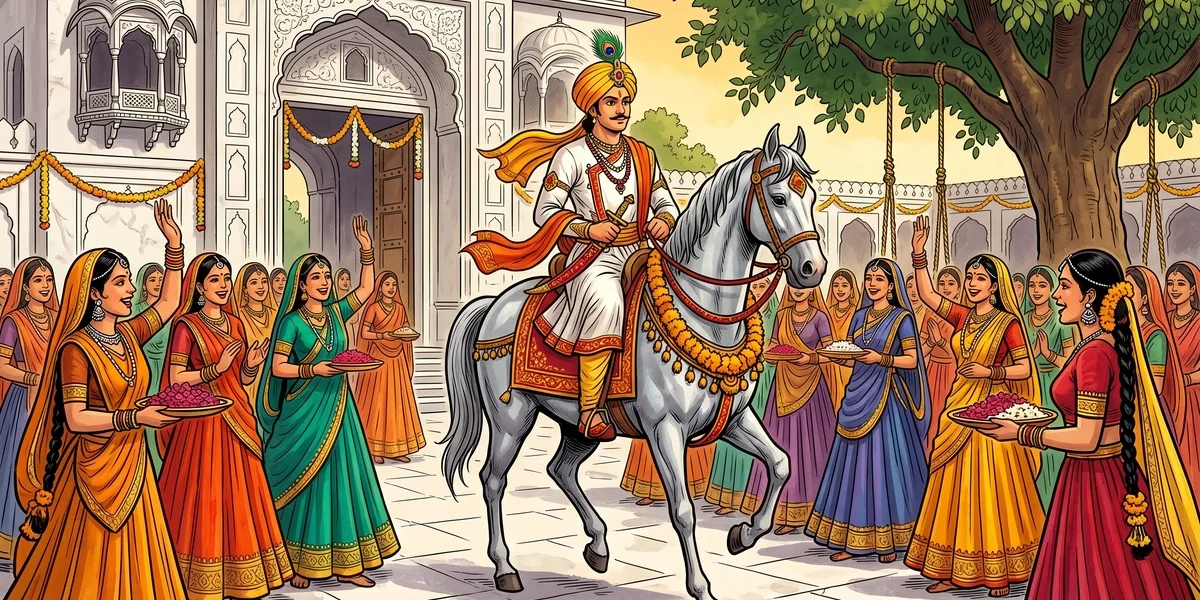
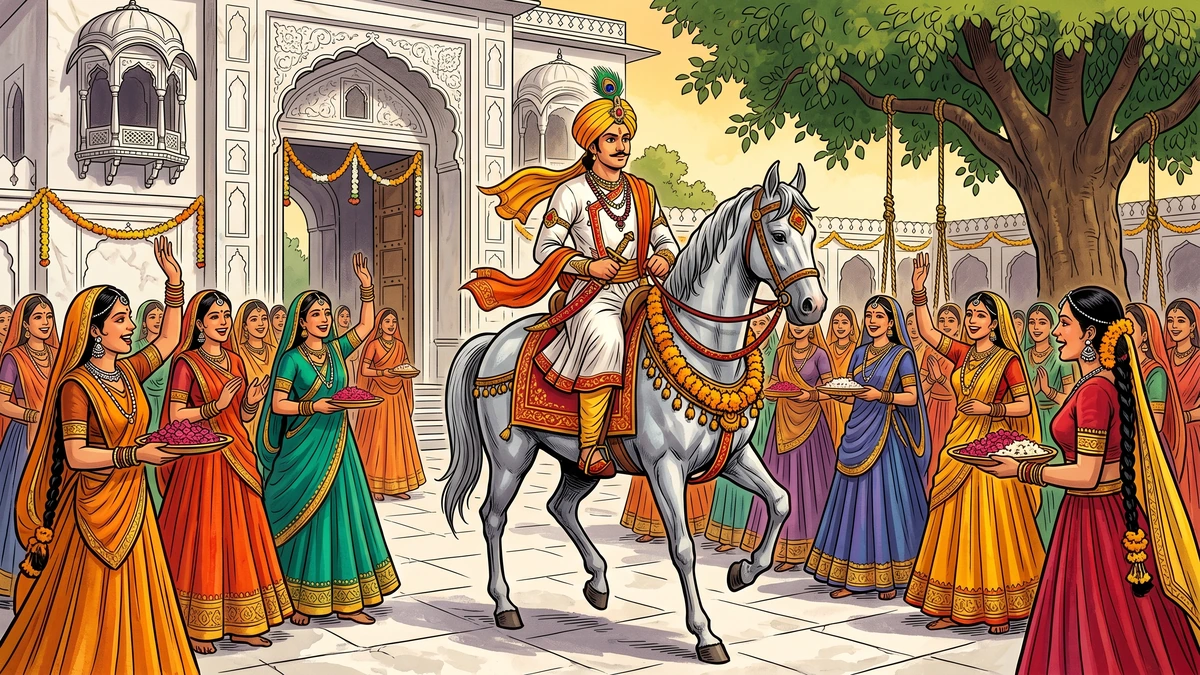
How Raja Rasalu Swung the Seventy Fair Maidens is one of the best-loved episodes in the great Punjabi epic cycle of Raja Rasalu of Sialkot, collected by Flora Annie Steel and her co-editor Major Richard Carnac Temple for Tales of the Punjab Told by the People (Macmillan, London, 1894), with line illustrations by John Lockwood Kipling. The episode forms a single panel in the larger frame-tale of Rasalu’s chaupur match with King Sarkap of Kot Bithaur — a story sung at Punjabi village fairs, recited by mirasis at noble weddings, painted on the walls of Bari Doab haveli courtyards, and quietly shelved as Tale XXIX of the 1894 Macmillan volume that introduced Rasalu to the wider English-speaking world.
It is a story in which the hero arrives at a fortified city of riddles and is met not by warriors but by seventy laughing princesses; in which the smallest creature he ever spared — a cricket plucked from a burning forest — repays him with the gift of seventy more crickets and a single useful feeler; and in which strength is mocked, then tested, then revealed as a gift of compassion rather than of conquest. To open Tales of the Punjab at this page is to step into a Bari Doab village courtyard at dusk, marigold-jasmine garlands swinging from a peepal branch, the smell of mustard-oil lamps, and an old grandmother’s voice carrying the Rasalu-cycle through the hot Punjab night.
The Burning Forest and the Grateful Cricket
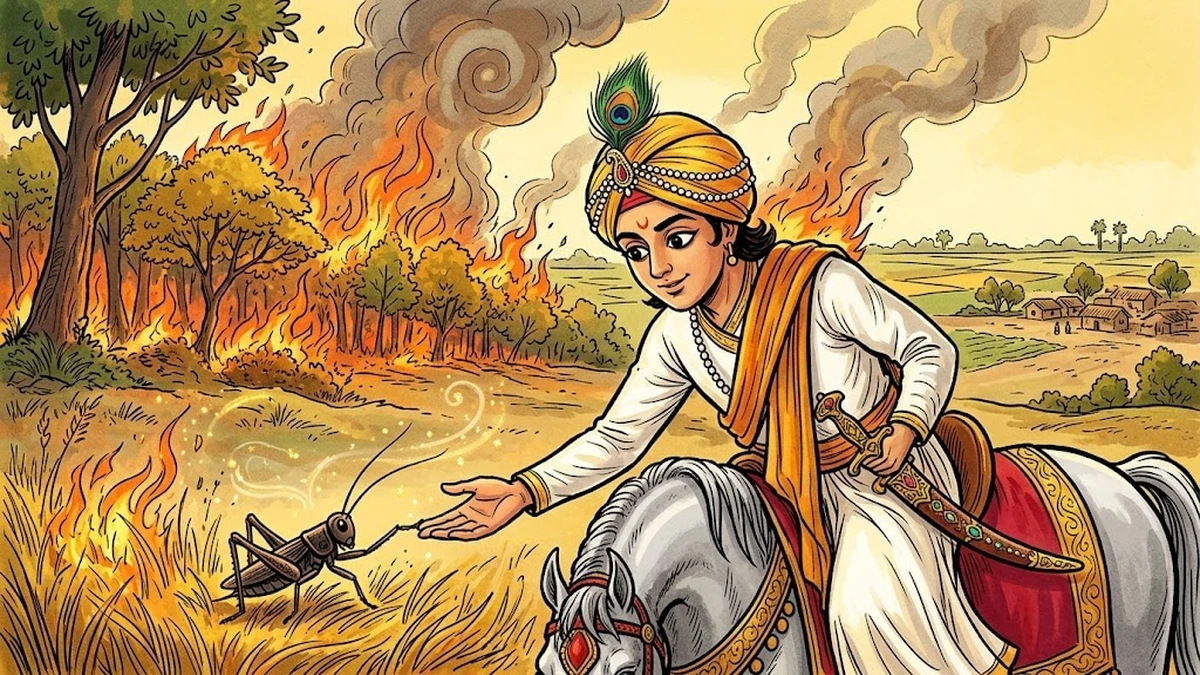
The episode opens on the road to Kot Bithaur. Raja Rasalu, son of Salivahan of Sialkot and rider of the loyal Marwari horse Bhaunr Iraqi, is on his way to play chaupur with King Sarkap — the merciless dice-player who has built his palace of human heads. As Rasalu rides through the forest of sal and kikar trees, a fire breaks out in the dry grass, and from the heart of the flames a small voice cries, O traveller, for God’s sake save me from the fire!
The voice belongs to a cricket — a creature so small that any other prince in the cycle would have ridden on without a glance. But Rasalu in the Steel-Temple recension is tender-hearted and strong, and the formula matters: in the Punjabi heroic tradition tenderness precedes strength because tenderness alone discovers what strength is for. He bends from the saddle, pulls the cricket out of the burning grass, and sets it free in the cool earth at the edge of the fire. The cricket, in the gratitude common to all kataknai creatures of folktale, plucks one of its long thread-like feelers, hands it to the prince, and says: Keep this. Should you ever be in trouble, put it into the fire, and instantly I will come to your aid.
Rasalu smiles — the prince’s smile that is half courtesy, half disbelief — pockets the feeler, and rides on. The smile is important. He has not understood the bargain he has just made. Steel and Temple, with the dry note of nineteenth-century folklorists, simply record that he kept the hair and went on his way. The story knows what the prince does not: that the smallest debt incurred in kindness is the one that will save him.
The Seventy Daughters of King Sarkap
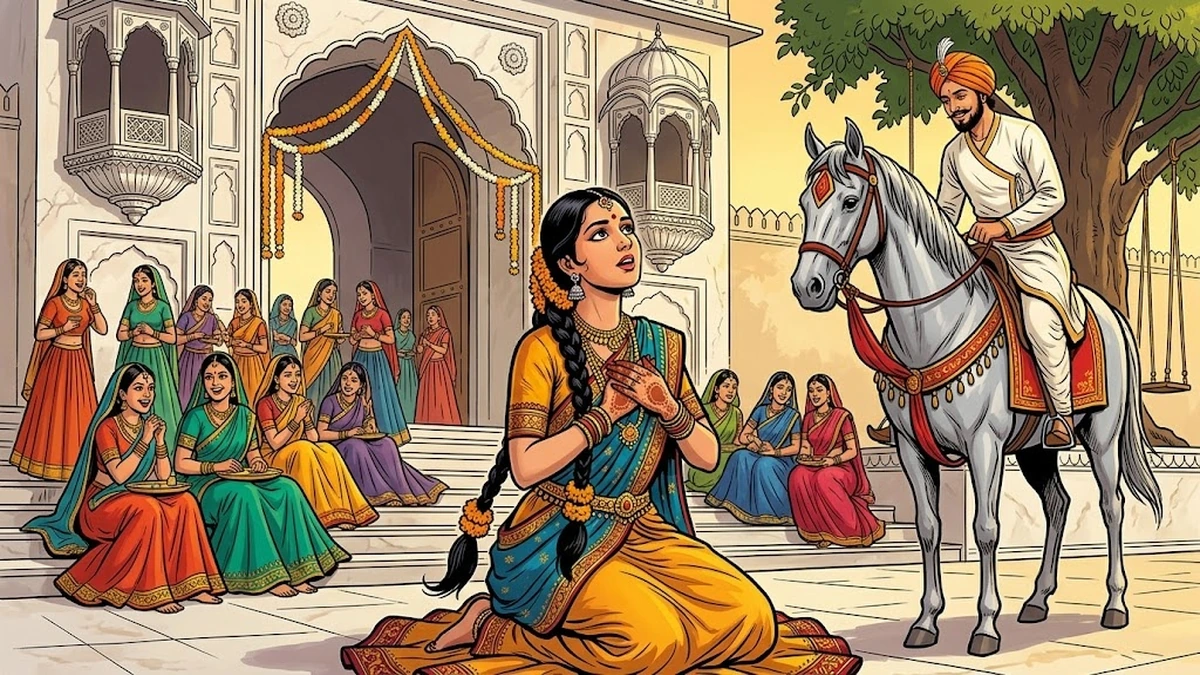
At the gates of Kot Bithaur, Raja Rasalu is met by a sight no other hero in the cycle survives: seventy maidens, daughters of the King, came out to meet him — seventy fair maidens, merry and careless, full of smiles and laughter. They are dressed in jewel-tone lehengas of saffron, vermilion, and peacock-emerald, with marigold garlands in their long oiled braids and silver jhumkas at their ears. They carry trays of brass thalis heaped with sweetened rice and rose-petals. They are Sarkap’s prettiest weapon: every previous traveller has lost his head before he reached the dice-board, dazzled by the welcome.
The youngest, however, is different. When she sees the gallant prince on the silver-grey Bhaunr Iraqi, riding gaily to his doom, pity catches at her throat, and she sings out the warning that has become the most quoted couplet of the entire Rasalu cycle:
Fair Prince, on the charger so gray,
Turn thee back! turn thee back!
Or lower thy lance for the fray;
Thy head will be forfeit to-day!
Dost love life? then, stranger, I pray,
Turn thee back! turn thee back!
And Rasalu, unshaken, sings back his celebrated reply:
Fair maiden, I come from afar,
Sworn conqueror in love and in war!
King Sarkap my coming will rue,
His head in four pieces I’ll hew;
Then forth as a bridegroom I’ll ride,
With you, little maid, as my bride!
The youngest maiden — whom later Rasalu retellings name Kokilan, after the Persian-Punjabi nightingale — falls in love at the gate. The other sixty-nine, jealous of the sister to whom the prince has spoken first, decide on the punishment that gives the episode its title. They will not let him pass to Sarkap until he has performed two impossible tasks: the sorting of the millet, and the swinging of the swings.
The Hundredweight of Millet and the Hundredweight of Sand
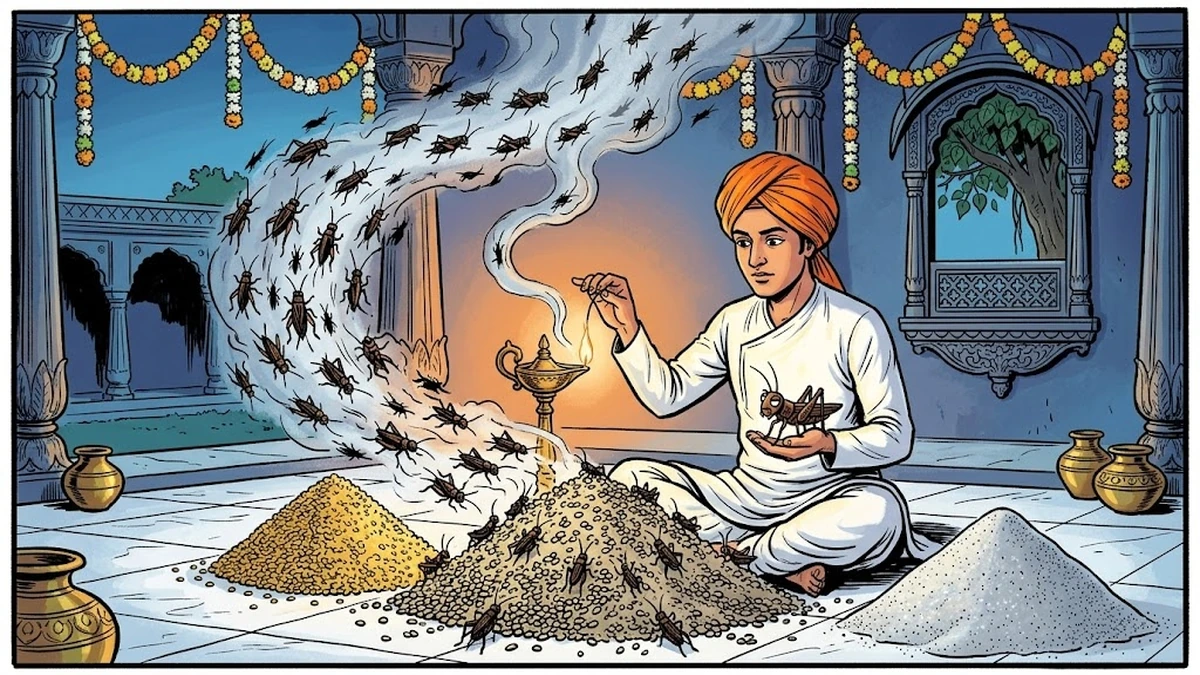
The first task is the older of the two: the sixty-nine sisters mix a hundredweight of bajra millet with a hundredweight of fine river-sand and command the prince to separate every grain of seed from every grain of sand by morning. It is the classic impossible task of the European Cinderella tale (ATU 510A) and the Indian sub-type of the kind-and-unkind girls (ATU 480), set as a riddle that no ordinary hand can finish in one night.
Rasalu sits down beside the heap and, for the first time, remembers the cricket. He draws the feeler from his pocket and lays it in the embers of the maidens’ fire. There is a sudden whirring like a small storm. Out of the dark Punjab night a great flight of crickets descends — perhaps seventy of them, perhaps seventy thousand — and at their head the cricket whose life he saved in the burning forest. Separate the millet from the sand,
says the prince. Is that all?
answers the cricket, in the dry comic note that runs through the entire Rasalu cycle. Had I known how small a job you wanted me to do, I would not have assembled so many of my brethren.
The crickets fall to work, antennae touching every grain, and by morning the heap of seed and the heap of sand stand separately on the courtyard floor like two perfect dunes.
This is the moment in which the moral economy of the Rasalu cycle reveals itself. The kindness shown to the smallest creature, on a forest road, in a moment when no one was watching, is the exact debt that buys the prince his life at the gates of Kot Bithaur. Steel and Temple do not labour the point — Punjabi storytellers never do — but every village listener understood it: jo sadda upkar karda hai, oh kade naheen daubda — the one who shows kindness never sinks. It is the rural Punjabi cousin of the Sanskrit verse krtasya pratikriya (gratitude is the return-action of the noble), and of the Tamil couplet of Tiruvalluvar from the Tirukkural:
செய்யாமல் செய்த உதவிக்கு வையகமும்
வானகமும் ஆற்றல் அரிது.
For a kindness done without expectation, neither this earth
nor the sky is great enough to repay it.
— Tirukkural 101, Cheyyamai Cheyda Udavi
The Seventy Swings and the Tired Sisters
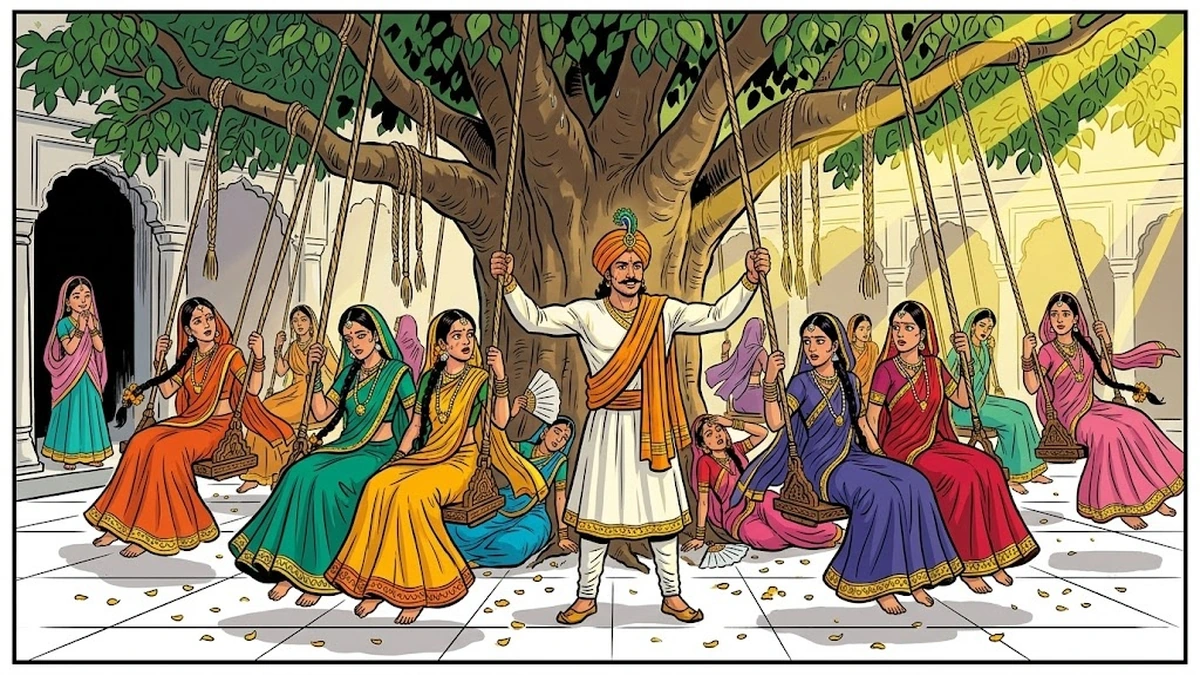
Defeated by morning at the millet-task, the sixty-nine sisters set the prince his second test. Punjabi peeng swings — long ropes of plaited moonj grass tied to the lower branches of a great peepal tree, with carved shisham-wood seats at the ends — hang in a circle around the courtyard. The sisters seat themselves one to a swing and command Rasalu to push every one of them, in turn, until each declares herself tired.
The trick is double. To swing seventy women without rest is the work of seventy strong men; and even if the prince could endure, the sisters mean to keep their feet on the rope and refuse to call themselves tired, swinging until he collapses in the dust at their feet. It is a Punjabi village peeng game turned cruel — the same game that on Teej festival evenings draws laughing village girls to the peepal-shade, transformed here into the slow torture of a fortified court.
But Rasalu, with the same patient strength that pulled the cricket from the fire, takes his stand under the great peepal and pushes. He pushes the eldest sister and her sandalwood seat rises until her saffron dupatta brushes the upper branches. He pushes the second and the third and the fourth, and the swings rise like a wheel of marigolds against the morning sky. He never stops; he never weakens. By noon the eldest is silent; by afternoon the middle sisters are dizzy; by sunset the last of the sixty-nine, whose name no village storyteller has ever bothered to remember, calls down for mercy. The youngest, Kokilan, watches from the shaded threshold and smiles. The prince has used neither sword nor cunning — only the strength a hero keeps in reserve for those moments when violence will not do.
It is a perfectly Punjabi resolution. The Rasalu cycle as a whole turns on the proposition that a hero’s task is rarely to kill a giant — it is more often to outlast a courtyard full of laughing princesses, to outwait a riddling tyrant at his dice-board, to outwalk a forest and outsing a goddess. Strength in the cycle is patience plus compassion plus the small debts that come back grown.
Moral
The lesson at the heart of How Raja Rasalu Swung the Seventy Fair Maidens is the lesson of the small kindness that is never small. It is the lesson the Punjabi grandmothers of Bari Doab call chhotta upkar, vadda phal — a small kindness, a great fruit. The cricket Rasalu saves on the forest road is the cricket that saves him at the gates of Kot Bithaur. The sister he greets first is the sister who will, in later episodes of the cycle, save him from her own father at the chaupur board. The whole moral architecture of the cycle is the architecture of a Punjabi village economy: every act of kindness is a deposit, every act of cruelty a withdrawal, and the ledger always balances.
परोपकारः पुण्याय पापाय परपीडनम्।
Paropakaraḥ puṇyāya pāpāya parapīḍanam.
The doing of good to others is the highest merit;
the giving of pain to others is the deepest sin.
— attributed to Vyasa, Mahabharata, Anushasana Parva (cited in the Hitopadesha frame)
And here is the second teaching, embedded in the swing: that strength refuses to humiliate. Rasalu could have hewn the sixty-nine sisters down where they stood and ridden in a pool of their blood to Sarkap’s gate. He chooses instead the long, patient pushing of the swings — strength in service, not strength in punishment. The Punjabi proverb the village teaches as the tale ends is exactly this: tagdi bhuja oh hi hai jo komal di rakhsha karde — strong is the arm that protects the gentle.
Why the Tale Has Lasted
How Raja Rasalu Swung the Seventy Fair Maidens has lasted in Punjabi memory for seven centuries because it does, in the space of a few thousand words, what only the very best folktales do: it disguises a moral lesson as an adventure, an adventure as a love-story, and a love-story as the entry-card to a longer tragedy. The seventy maidens are a single moment in the cycle that ends at the chaupur board with Sarkap’s defeat, the marriage to Princess Kokilan, the long unhappy silence in the desert-fortress of Murti, and the prince’s eventual death at the hands of a deer. The episode is the bright morning of a story whose evening is already dark, and Punjabi listeners around the peepal know all of it in advance — which is why the laughter of the seventy maidens, the singing of the youngest, the whirring of the crickets, and the slow patient rising of the swings carry the half-sad half-tender weight that they do.
Origin and Canonical Attribution. The text retold here is taken from Flora Annie Steel & Major Richard Carnac Temple, Tales of the Punjab Told by the People, Macmillan & Co., London & New York, 1894 (Tale XXIX, “How Raja Rasalu Swung the Seventy Fair Maidens”), illustrated by John Lockwood Kipling; collected from oral storytellers in the Bari Doab and Sialkot region of Punjab between 1882 and 1894. Cross-references in the Rasalu corpus include Charles Swynnerton‘s The Adventures of the Panjab Hero Raja Rasalu (W. H. Allen, London, 1884), Joseph Jacobs‘s adaptation in Indian Fairy Tales (David Nutt, London, 1892), the Pothohari-language Rasalu ballads recorded by Sir Aurel Stein in 1900, and the Hir Ranjha-cycle parallels in the Heer of Waris Shah (1766). Tale-type classification: ATU 554 (The Grateful Animals) crossed with ATU 480 (The Kind and Unkind Girls) and ATU 313H* (The Magic Helper); Stith Thompson motifs B481.1 (Helpful insect — cricket), H1091.1 (Task: separating grains, performed by helpful animals), H1129.5 (Task: swinging maidens until tired), K2235 (Treacherous princess at the gate), N825.3 (Old or kind helper), Q40 (Kindness rewarded). Thematic parallels: the millet-and-sand task in Apuleius’ Metamorphoses VI.10 (Psyche sorted by ants), the Russian Vasilisa the Beautiful (Afanasyev, 1855), the Brothers Grimm KHM 21 (Aschenputtel, lentil-sorting doves), and the Tamil Madanakamarajan Kathaikal impossible-task cycle.
For Punjabi readers, the tale should be read aloud with the line endings paused for breath, the verse passages sung if possible to the simple Punjabi tappa tune, and the listener invited to call out the cricket’s exasperated reply at the millet — Had I known how small a job you wanted, I would not have assembled so many of my brethren!
— which Punjabi grandmothers have been quoting at unhelpful relatives for at least a hundred and fifty years.
You May Also Like
 Indian Folk Tales
Ages 6-8
Indian Folk Tales
Ages 6-8
Birbal’s Khichdi: The Emperor’s Lesson in Logic
Birbal's Khichdi: The Emperor's Lesson in Logic: The Wager of the Freezing Night In the imperial court of Emperor Akbar, the greatest Mughal ruler of India
 Indian Folk Tales
Ages 3-5
Indian Folk Tales
Ages 3-5
Nails In The Fence | An Inspirational Moral Story For Kids
Nails In The Fence | An Inspirational Moral Story For Kids: Once upon a time, there lived a boy. He used to lose his temper very quickly and become angry. Each
 Indian Folk Tales
Ages 9-12
Indian Folk Tales
Ages 9-12
Savitri and the Lord of Death
Savitri and the Lord of Death: In the kingdom of Madra, along the banks of the great Sutlej River, there lived a princess of unparalleled virtue and wisdom.