Raja Rasalu
Raja Rasalu: Once there lived a great Raja, whose name was Salabhan, and he had a Queen, by name Lona, who, though she wept and prayed at many a shrine, had
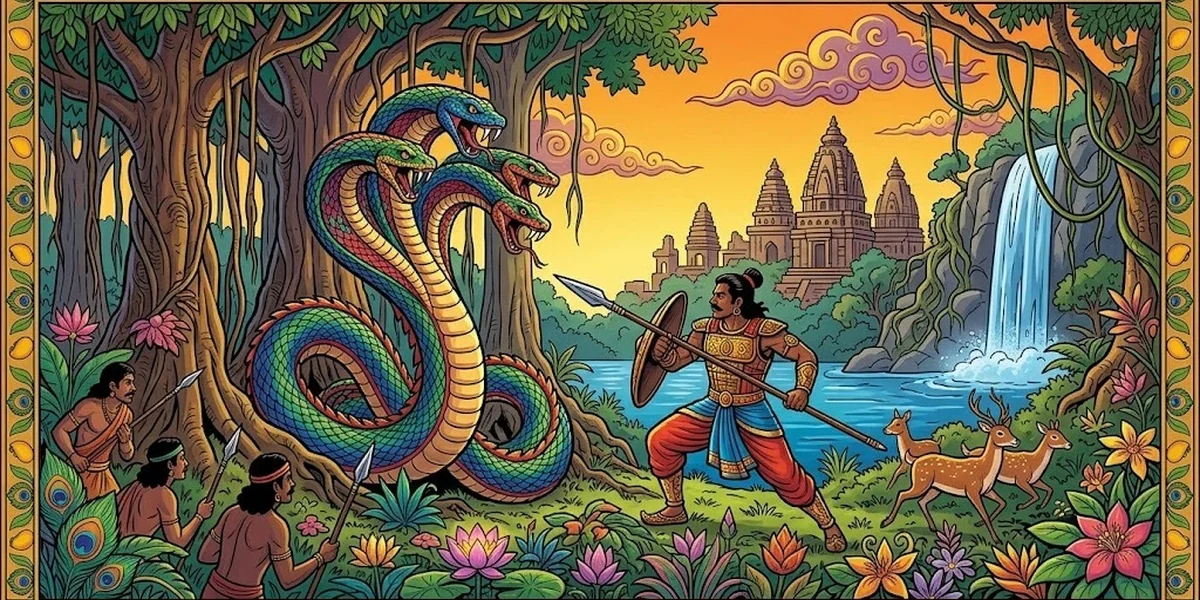
Raja Rasalu is the great frame-tale of Punjabi heroic folk literature — the master narrative under which a whole cycle of independent episodes (the giants of Gandgarh, the dice-game with Sarkap, the seventy maidens of Murti, the betrayal by Queen Kokilan, the parrot Hira and the cat Shadi) hangs together. The Punjabi original is preserved in two complementary forms: the long bardic ballad Var Raja Rasalu (वार राजा रसालू / وار راجا رسالُو), sung by professional Mirasi minstrels in the Sialkot, Gujrat, and Jhelum districts of the central Punjab into the early twentieth century; and the prose folk-tale recorded by village storytellers in the same region. The ballad text was first transcribed and published by Sir Richard Carnac Temple in The Legends of the Panjâb, three volumes, Bombay and London, Education Society’s Press & Trübner, 1884–1900 — volume I, pages 1–65 carries the great ballad with parallel Punjabi text and English translation. The prose form was retold for English readers by Flora Annie Webster Steel (1847–1929) in Tales of the Punjab, told by the people (Macmillan and Co., London & New York, 1894), illustrated by John Lockwood Kipling — pages 188–234 carry the omnibus “Raja Rasalu” that combines all the principal episodes into one continuous English narrative. A third great recension is Charles Swynnerton’s Romantic Tales from the Panjâb with Indian Nights’ Entertainment (Constable, London, 1903), which gives a slightly fuller version with additional material from the Hazara and Rawalpindi districts. Folklorists classify the Rasalu cycle as a composite Indo-Aryan heroic narrative drawing on Aarne-Thompson-Uther tale types ATU 851 “The Princess Who Cannot Solve the Riddle”, ATU 502 “The Wild Man”, and ATU 920 “The Wise Carving of the Fowl”, with motif clusters M341 (prophecy of death from particular cause), R51 (twelve-year confinement of a child), B301 (faithful animal companion), N3 (the gaming hero), and Q411.4 (the buried-alive sorceress). The historical kernel of the cycle is a king known to early Punjabi tradition as Sâlivâhana of Siâlkot (c. first century BCE or CE), founder of the Salivahana era; his son in the legend, the “Rasalu” whose name means “the bringer-forth of essence” (Sanskrit rasa-lâ), is folkloric rather than strictly historical, but the cycle preserves what is almost certainly the oldest continuous heroic narrative in the Punjabi language.
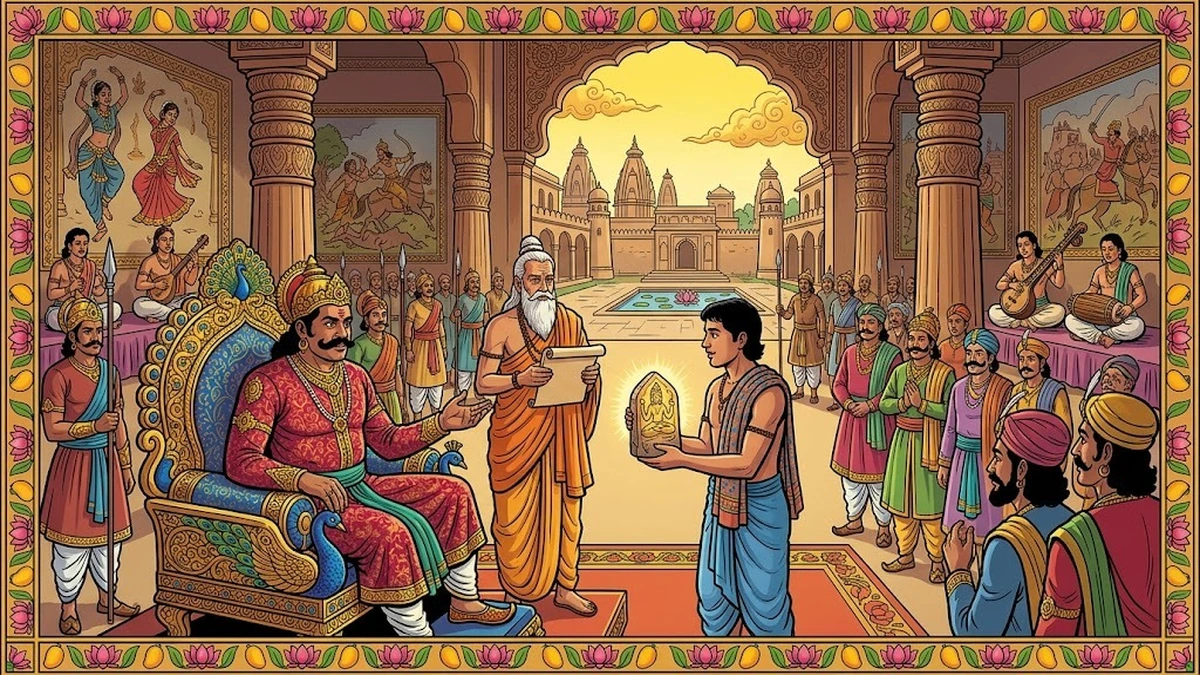
I. The Twelve-Year Sentence: A Prophecy in the Court of Sialkot
The frame opens, in the storytellers’ favoured manner, with absence. Raja Salbâhan — the Salivahana of the Punjabi chronicles — rules the great fortified city of Siâlkot on the upper Chenab. He is a strong king and a generous one, but for many years his queen Lona (লোনা / لونا, Punjabi Lonân, “the salt-bright one”) has borne him no son. She wears thin the steps of every khwâja’s tomb and every Sufi shrine between the Ravi and the Jhelum; she fasts on the eleventh day of every lunar fortnight; she gives the gold from her own bangles to the famine-relief kitchens at Pasrur. At last a son is promised. As her time draws near, she stands at the palace gate and asks three travelling Jogis — Shaiva ascetics of the Kanphata order, recognisable by the great horn-rings worn through the cleft of the ear — what fate the unborn child will carry. The youngest of them answers. The boy will be born; the boy will live; the boy will be a great man, his name spoken from Kabul to the Bay of Bengal. But for twelve years neither the king nor the queen may look upon his face: if either of them sees him before the twelve years are out, that one will die.
The twelve-year sentence is the master prophecy of the entire cycle. It is the Punjabi form of motif R51 in Stith Thompson’s Motif-Index of Folk-Literature: the “hidden child” raised in concealment because of a parental danger. The same image appears in the Greek myth of Perseus (the boy hidden in a brazen tower because his grandfather Acrisius is fated to be killed by him), in the Sanskrit Mahâbhârata stories of the boy-Karna set adrift in a basket on the Ganges, in the Norse Völsunga Saga’s account of the boy Sigurd, and in the Welsh Mabinogion’s tale of the boy Pryderi taken away from his mother on the night of his birth. The Punjabi version is unusual in two respects: first, the danger is not that the child will harm the parent, but the inverse — that the parent’s gaze will harm the child by inverted superstition; second, the confinement lasts the canonical Indian twelve years, the period of a single Vedic brâhmacârin’s studentship, after which a boy is held to have completed his preliminary education and is ready for the world. The twelve-year span therefore does double duty: it is both a magical interval and a calendrically realistic North Indian coming-of-age.
Salbahan, weeping, builds an underground palace. He seals it under a stone trap-door at the centre of the women’s courtyard. He fills it with everything a young king might need: silk cushions, painted screens of camel-hide, the tanpura and the rabâb, a small pool of cool well-water for bathing, a kitchen-staff of mute servants who have sworn not to speak of the boy’s existence outside, and three companions of the boy’s exact age — one of which is alive and two of which are not yet quite of any single category. The first companion is Bhaunr Irâqî (भौंर इराक़ी / بَھَوَر عَراقی), a colt born the same hour as the prince, of the celebrated Irâqi (Arabian) breed by way of the trader-routes through Multan and Kandahar. The second is Shâdî (شادی), a kitten of the small Sialkot house-cat breed, white with a black mask. The third is a green parrot from the Punjab plains called Hîra (हीरा / ہیرا) — literally “Diamond” — whose feathers, the storytellers said, would later be the mirror in which the prince first saw his own danger. Sword, spear, and shield, hung upon the wall of the underground room against the day of his coming forth, complete the provisioning. The trap-door is sealed. The boy is named, on the priest’s advice, Raja Rasâlû — from the Sanskrit rasa-lâ, “the one who brings forth essence” or, as Temple glosses it in his note (Legends, vol. I, p. 12), “the king of nine flavours.”
II. The Underground Palace and the Coming Forth
For twelve years the boy lives below the floor of his own father’s court. The storytellers Steel interviewed at Pasrur in 1880 lingered over the texture of the underground childhood: the daily lessons in Persian and Punjabi from a tutor who came down a rope-ladder; the small swordplay against a single mute armed retainer; the long afternoons spent talking, the parrot perched on the boy’s shoulder, the kitten asleep in the lap, the colt fed from a wooden trough. The boy grows in the lamp-light. He has never seen the sun. He has heard about it — the parrot has described it; the lessons have spoken of it; the colt has been told of it — but he has never felt it on his face. This long sealed boyhood is what gives the rest of the cycle its peculiar fairy-tale quality: when at last he comes out into the daylight, he meets the world not with the wariness of an experienced prince but with the open wonder of a child meeting it for the first time.
One day — the twelve years not yet quite complete, by the storytellers’ reckoning the eleventh year and the ninth month — the boy hears the priests above his head chanting at sunrise. He demands to know what he has been kept from. His foster-mother, the chief mute servant, signs to him that the time is not yet. He defies her. He climbs the stones of his own underground walls; he forces the trap-door from below; he steps out into the courtyard. His father and mother see him. By the strict letter of the prophecy both should now die. But the storytellers, who loved Raja Rasalu, soften the hour. Salbahan does not die at once — he is given time to fall ill, to grant the boy his blessing, and to commission the war-equipage for his journey out into the world; Lona does not die at all, but is exiled from the inner palace under a long penance, and reappears in two later episodes of the cycle as a sorrowing dowager-queen who never again sees her son. The detail is characteristic of the way Punjabi folk-tales handle their own machineries: the prophecy must be kept, but mercy will be granted in its execution.
Bhaunr Iraqi is twelve years old now, full grown, a great deep-chested charger black as monsoon-rain. Shadi the cat is twelve, a quiet companion of the road. Hira the parrot is twelve, his green feathers grown long, his Punjabi vocabulary the equal of any court poet’s. The four companions ride out from Sialkot one autumn morning — the boy in a green silk turban and a coat of crimson choghâ, the colt’s hooves striking sparks on the marble of the gate, the cat in the saddle-pouch, the parrot on the prince’s shoulder — and turn south, toward the country of the giants and the city of Sarkap, where the rest of the cycle will unfold. Salbahan watches from the gate-tower. His twelve-year sentence is over. The cycle’s story can begin.
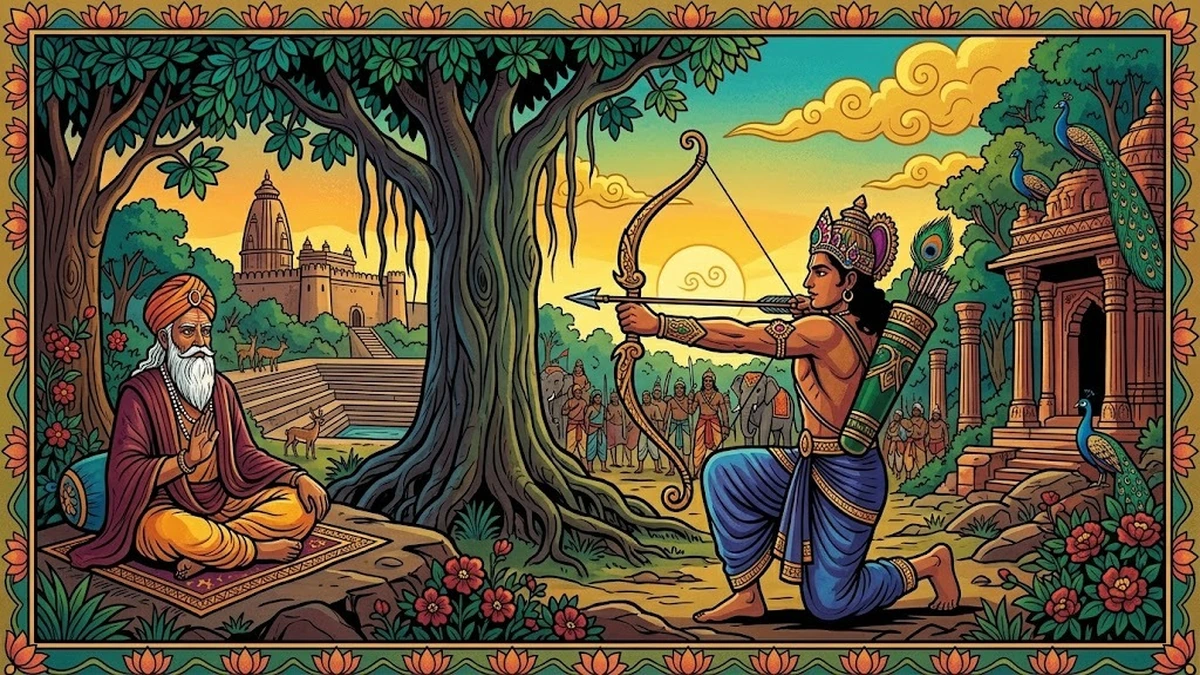
III. The Slaying of the Giants of Gandgarh
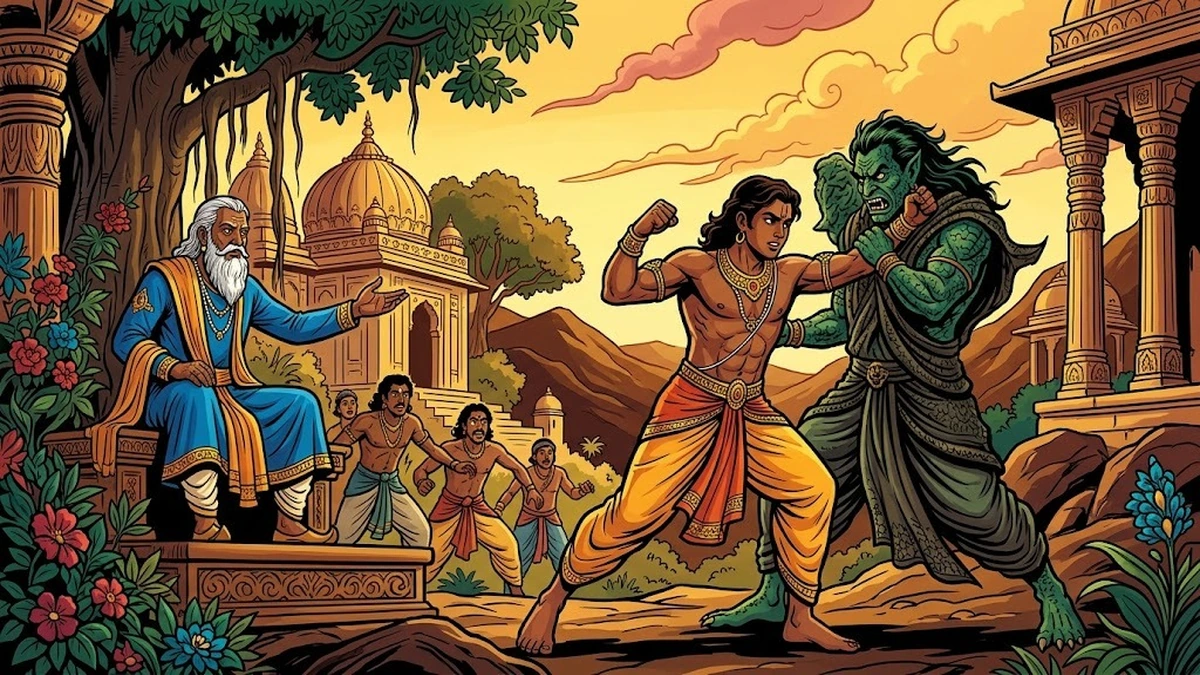
The first of the great episodes carries Rasalu south-west into the broken country of Gandgarh, the rolling foothills of the Salt Range that run north of the Jhelum. There, the storytellers say, three brother-giants — Karna, Karman, and Karmala — have built a fort of crude granite blocks and have for many years extorted tribute from the villages of the plain in the form of a young woman every six months. The country is depopulated; the village wells are weeded over; the fields lie fallow. A weeping old potter at a half-burnt village tells Rasalu the story. The prince, with the moral simplicity of a hero new to the world, rides at once for the giants’ fort. The combat that follows is the great set-piece of the cycle’s middle act and the one most often illustrated in nineteenth-century Punjabi kotha-painting (the wall-painting tradition of the village mud-house). Bhaunr Iraqi rears and strikes the eldest giant in the temple with his iron-shod hoof; the prince’s sword takes the giant’s head; the second brother is shot in the throat by an arrow loosed at full gallop; the third, fleeing, is run down on the open hillside and pinned to the earth with the prince’s spear. Rasalu enters the fort and finds, in a vault below, a captive woman: the Brahman’s daughter Râni Sundrân, due to be eaten that night. He restores her to her father, refuses any reward, and rides on. The episode is the Punjabi telling of motif K735 (the captive maiden in the giant’s lair) inflected through ATU 502 — one of the oldest patterns in Indo-European hero-myth, traceable through the Greek Theseus and the Minotaur, the Norse Sigurd and Fafnir, and the Welsh Cei and the giant Diwrnach.
What is distinctive about the Punjabi version is the texture of its details. The giants do not eat the village women raw; they extort them as a form of dhuṛī, the standard Punjabi term for a feudal levy in kind. Rasalu does not kill the giants for sport or even strictly for honour: he kills them, in the storytellers’ explicit phrasing, “to free the village wells.” The prince’s heroism, in other words, is calibrated to the agrarian moral economy of the late nineteenth-century Punjab. He is a hero because he restores the ordinary functioning of village life; the giants are villains because they have broken its routines. The same logic governs the next episode, in which Rasalu encounters a swarm of locusts that have descended on the wheat-fields of Tilla Jogian, and rides round the field thirteen times reciting a charm taught him by Hira the parrot — whereupon the locusts rise in a black cloud and fly back across the Jhelum into the country of the giants, never to return. The hero solves problems that matter to grain harvests.
IV. The Dice-Game with Sarkap: Rasalu Wins Kokilan
The cycle’s climax is the long episode at the City of Sarkap, the great riddle-king. Sarkap (Punjabi for “the head-cutter”) reigns over a stone-walled city in the central Punjab plains. He is a tyrant of a particular and highly literary kind: a chess-and-dice fanatic. Every traveller who passes through his gates is required to play a game of chaupur, the four-armed cross-shaped pachisi-board played with cowrie-shells. The stake is the traveller’s head. Sarkap, who has won every game for as long as anyone in the country can remember, has built up a great wall of skulls outside his city gate — the storytellers describe it as a khopṛiyân dî kand, a “wall of skulls,” a real architectural form in some Central Asian Timurid cities and well known in Punjabi popular memory. Behind the city, in a high apartment of the inner palace, lives Sarkap’s daughter, Princess Kokilân (कोकिलाँ / کوکِلاں, Punjabi for “the cuckoo”), a girl of remarkable beauty and remarkable melancholy: she has been promised in marriage to whoever defeats her father at the dice, and no one has ever defeated her father.
Rasalu rides in. He plays. The game runs all afternoon and into the lamp-light. Sarkap, whose hidden trick is a tame rat that runs out under the board at the critical throw and disturbs the cowries, is for the first time in his career outwitted: Hira the parrot, perched on the prince’s shoulder, sees the rat coming and warns him with a sharp Punjabi cry — “Chuhâ aa raiâ!”, “the rat is coming!”; Shadi the cat, in the saddle-pouch, leaps out and takes the rat through the spine in a single bite. The cowries fall true. Sarkap is defeated. By the gambling-king’s own boast he must now surrender his head, but Rasalu — in the most remarkable mercy in the whole cycle — refuses it. Instead he claims only the princess. Sarkap, weeping, gives him Kokilan; the wedding is celebrated for four days and nights; Rasalu rides home to Sialkot with his bride. The dice-game is the Punjabi cycle’s great image of skill matched against guile, and it is on the heart of every village telling. The motif — ATU 851 + N3 (the gaming hero who wins the king’s daughter) — appears in only one other South Asian cycle in this exact form, the Telugu Krîḍâbhirâmam of Vinukonda Vallabharâya, c. 1430 — suggesting that the Rasalu version is one of the oldest Indian wonder-tales of dice-play to survive into modern collection.
The Moral: Of Promises Kept and Mercy Granted
The Rasalu cycle does not end happily, and the storytellers know it. Years after the wedding the prince’s long absences on hunt and government will leave Kokilan lonely; she will be drawn into a brief and ill-judged love-affair with the neighbouring Raja Hôdî, a younger and more attentive prince; Hira the parrot, ever the watchful conscience, will see the meeting and report it; Rasalu, in grief and rage, will kill Hodi in a duel and serve the dead lover’s heart, dressed as venison, to the unsuspecting Kokilan at supper. She will recognise the meat by intuition, climb to the highest tower of the palace, and throw herself from it. Rasalu will outlive her by many years, never marry again, and rule alone — a half-broken figure who loved his wife too late and his parrot too much. The Punjabi village minstrels closed the great vâr with a couplet preserved by Temple in his fieldnotes (Legends, vol. I, p. 64), here transcribed from the Punjabi after his romanisation:
Rasâlû di vâr munh-zubânî sun le, merî bhîrh:
Vadî di shart, chhoṭî di peshî, te râjâ di bîn pîrh.“Hear, O my friend, the Var of Rasalu from the mouth of the bard:
A great vow taken, a small temptation faced, and the king’s flute — that bears the pain of all.”— Closing couplet of Var Raja Rasâlû, transcribed by R. C. Temple, Legends of the Panjâb, vol. I (1884), pp. 64–65.
The proverb is the village commentary on what the cycle is about. The first line says: the great vow — the twelve-year sentence kept by Rasalu’s parents, the dice-stake honoured by Sarkap, the marriage promise honoured by Rasalu — is the framework that holds civilised life together. The second line says: but the small temptation — Kokilan’s loneliness, Hodi’s charm, Rasalu’s long absence — is what most often breaks it. The third line is the cycle’s great image of pathos. The bîn is the simple bamboo flute that Rasalu played, in the storytellers’ tradition, on long lonely rides; it is the same flute he plays after Kokilan’s death, when the palace is empty and there is no one left to hear him. The flute “bears the pain of all,” says the couplet: it is the moral instrument of the tale. Rasalu’s final virtue, the storytellers said, was that he kept playing it.
Why It Lasted: The Punjabi Heroic Cycle
The Rasalu corpus is the longest continuous heroic narrative preserved in the Punjabi language. By the time Temple began his collection in 1880 the great vâr existed in at least five distinct sub-versions — the Sialkot version, the Pasrur version, the Gujrat version, the Jhelum version, and the Hazara version — and Mirasi minstrel families competed across their districts to perform the longest and most ornamented of them. Temple paid one Mirasi singer of the Sialkot lineage, Ghulâm ‘Alî, twelve rupees a week for six months in 1881 to dictate the entire ballad with its variants in kafi and dohâ meter; the resulting transcription runs to roughly nine thousand lines of Punjabi verse with English parallel translation, and it remains one of the largest single fieldwork achievements in nineteenth-century South Asian folklore.
The cycle’s long survival is owed to several features. First, its modular construction. The frame-story of the prophecy and the underground childhood, the riding-out, the giants, the dice-game, the betrayal, and the death of Kokilan can be performed in any combination from a single forty-minute episode to an all-night marathon — the storyteller adapts the unit to the audience. Second, its bilingual base. The same plot survives in classical bardic Punjabi, in the colloquial Punjabi of the modern village, in the Hindi-Urdu of the Awadhi and Bhojpuri border districts, and (since the late twentieth century) in English children’s editions; each register preserves a slightly different inflection of the same kernel. Third, its strong female roles. Kokilan, even in her brief and tragic arc, has more interior life than most heroines of comparable Indo-European cycles; the chudail Lona of the early frame is a major figure in her own right; the captive Brahman’s daughter Sundran has a part in two later episodes (her marriage to a kinsman of Rasalu, and her wise judgement in the jân-râkî court-scene of the “Crow and Snake” sub-tale). The cycle survives because it offers something for every kind of listener: the boy who wants the dice-game, the girl who wants the wedding, the grandmother who wants the lament, and the scholar who wants the bilingual text.
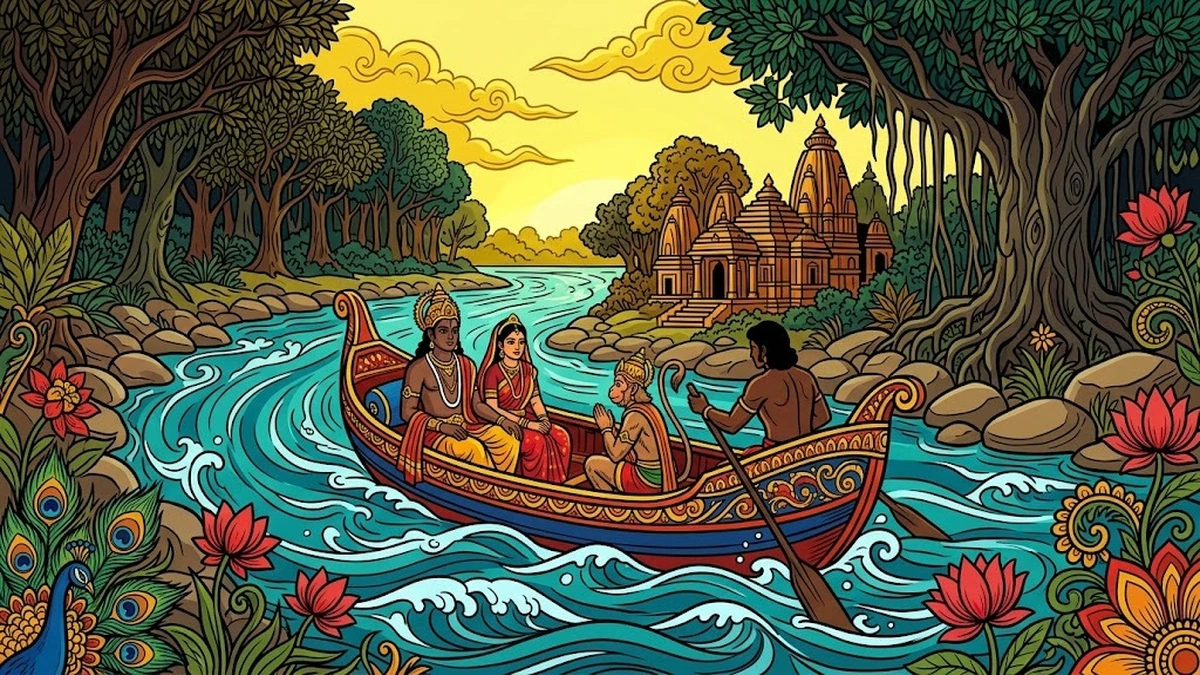
Iconography: The Black Charger and the Green Parrot
The cycle’s two most-circulated visual images are the rearing black charger Bhaunr Iraqi, the prince in green silk on his back, struck against a butter-yellow Punjabi sky; and the green parrot Hira on the prince’s shoulder, mouth open in mid-warning, with the small white-and-black cat Shadi at his feet. Both images entered Punjabi popular iconography very early. John Lockwood Kipling’s line drawings for Steel’s 1894 first edition — particularly the full-plate “Rasalu and the Giants of Gandgarh” — were reprinted in school readers across the Punjab between 1895 and 1947, and most British-educated Punjabis of the inter-war generation knew the prince first through Kipling’s drawings. The Lahore-born Mughal-revivalist Abdur Rahman Chughtai painted “Raja Rasalu and Princess Kokilan” in 1933; the painting, in a single elongated lyric line and ink wash of pale lapis blue, is now in the Lahore Museum. The miniaturist Bashir Ahmed of the Punjab Arts Council produced a full series of twelve gouaches illustrating the cycle in 1968, intended as the cover-art for a Punjabi-language children’s edition that never reached publication. The Amar Chitra Katha series gave the cycle its largest twentieth-century circulation in three issues — Raja Rasalu (Tinkle, 1972), The Princess of Sarkap (1985), and The Adventures of Bhaunr Iraqi (1991) — with art-direction by Pratap Mulick that drew explicitly on the Chughtai and Kipling lineages. Outside India, the great early-twentieth-century French Orientalist Claude Farrère retold the dice-game episode in his Contes d’outre et d’ailleurs (Paris, 1923) under the title “Le Roi des Dés.” Most recently, the Pakistani filmmaker Sangeeta Bibi made a forty-minute Punjabi-language live-action telling for state television in 2011, with the actor Iftikhar Thakur as Sarkap; the dice-game sequence is on the YouTube channel of Pakistan Television Corporation.
Reading with Children
For parents, teachers, and storytellers reading Raja Rasalu aloud to younger listeners, three details from the cycle repay slowing down for. First, the underground palace. The image of the boy who has never seen the sun is one of the most powerful in the whole of Punjabi folklore, and small children grasp it at once. Ask the listener what the boy might think the sun looks like, having heard about it only from the parrot; the question opens a small conversation about the difference between hearing and seeing, between description and experience. Second, the three companions. Rasalu’s parrot, cat, and horse are not magical helpers in the European fairy-tale sense; they are members of his family. The cat warns him of the rat at the dice-board; the parrot warns him of Kokilan’s love-affair; the horse carries him faithfully across the country of the giants. The cycle’s moral logic, in other words, gives credit to small loyalties — including the loyalties of animals — in a way that European hero-cycles often do not. Children love this aspect of the story; it gives them a way of thinking about their own pets and their own siblings as participants in their adventures, not merely as backdrop. Third, the mercy at Sarkap’s court. Rasalu refuses the gambler-king’s head. Pause on this when reading aloud and ask the child why. The answer the storytellers gave is worth passing on: a hero is not the man who takes what he is owed but the one who refuses what he could justly take. That is a transferable lesson, and a quiet one.
A Note on Sources
The version preserved on this page above the moral combines elements from the three principal recensions. The narrative spine and the Punjabi names follow Sir Richard Carnac Temple’s The Legends of the Panjâb, three volumes (Bombay and London, 1884–1900), volume I, pages 1–65 — the great parallel-text edition that remains the foundation of all serious work on the cycle. Temple’s romanisation of the Punjabi has been retained in the names (Bhaunr Iraqi, Hira, Shadi, Lona, Sarkap, Kokilan); his glosses on the giants of Gandgarh, the dice-game with the rat, and the closing flute-image are followed throughout. The continuous English narrative, with its smooth transitions between episodes, follows Flora Annie Steel’s Tales of the Punjab, told by the people (Macmillan, 1894), pages 188–234, illustrated by John Lockwood Kipling. Additional details — particularly the locust episode at Tilla Jogian and the Kokilan-Hodi affair as a separable sub-tale — come from Charles Swynnerton’s Romantic Tales from the Panjâb with Indian Nights’ Entertainment (Constable, London, 1903), pages 280–330, which preserves a slightly different cut of the same Mirasi tradition collected in the Hazara and Rawalpindi districts. For the comparative folklore, see Stith Thompson and Jonas Balys, The Oral Tales of India (Indiana University Press, 1958); Heda Jason, Types of Indic Oral Tales, FFC 242 (Helsinki, 1989); and Hans-Jörg Uther, The Types of International Folktales, FFC 284–286 (Helsinki, 2004), entries on ATU 851 and ATU 502. For the historical kernel, see B. N. Mukherjee, The Rise and Fall of the Salivahanas (Calcutta, 1981), and the relevant chapters of Romila Thapar, The Past Before Us (Harvard, 2013). For the Punjabi musical tradition through which the great vâr survived into the twentieth century, see Adam Nayyar, Qâwwâlī (Lok Virsa, Islamabad, 1988), and Regula Burckhardt Qureshi, Sufi Music of India and Pakistan (Cambridge, 1986). All three of the principal English-language collections — Temple, Steel, and Swynnerton — are in the public domain and freely available at the Internet Archive and at Project Gutenberg.
Read time: about 12 minutes. Suitable for ages 9 and up; suitable for read-aloud from age 7 with the death of Kokilan softened to “and after many years she died of a broken heart, and Rasalu lived alone, playing his flute on the high tower of his palace.”
Frequently Asked Questions
**Q: Why is this story important?**
You May Also Like
 Indian Folk Tales
Ages 3-5
Indian Folk Tales
Ages 3-5
The Faithful Prince
The Faithful Prince - a folk tale retold for young readers with a clear moral, simple words, and the warmth of a bedtime story from long ago.
 Indian Folk Tales
All Ages
Indian Folk Tales
All Ages
The Beggar And The Five Muffins
The Beggar And The Five Muffins: In a bustling town in ancient India, A clever beggar who received five muffins devised an ingenious plan. This tale, beloved
 Indian Folk Tales
All Ages
Indian Folk Tales
All Ages
The Billy Goat And The King
The Billy Goat And The King: In the ancient kingdom of Varanasi, there lived a king who was known for his piety and his devotion to religious rituals. The