The Fish Prince
The Fish Prince: Once there were a king and queen who had two sons. The older of the two was a very short and ugly man with only one eye, and that was in the

Origin & Tradition. A Hindustâní folk-romance taken down in the Punjab and the United Provinces in the late nineteenth century, “The Fish Prince” is best known in the recension printed by Mary Frere as “Truth’s Triumph; or, The Fish Prince” in Old Deccan Days; or, Hindoo Fairy Legends Current in Southern India (London: John Murray, 1868), pp. 55–76, and in the closely related Punjab variant collected by Flora Annie Steel and R. C. Temple in Tales of the Punjab Told by the People (London: Macmillan, 1894), pp. 138–152, where it appears as “The Son of Seven Mothers” and in linked form as the “Athon-Rajah” episode (Indian Antiquary, vol. XI, 1882). The hero’s name — Athon-Rajah, sometimes Ãthón Rájá or Ãthán Rájá in Steel’s romanisation — means literally “the Fish-King,” from Hindustâní áthón, an old north-Indian word for the carp; and the closing benediction by which the fakir blesses the queen’s rohu-aquarium uses the same root that Bengali Vaishnavas use in addressing the avatar Matsya at the Janmashtami fish-tank rituals. The tale circulated orally across the Indo-Gangetic plain at least a century before its first printing; Frere notes that it was given to her, in English, by her ayah Anna Liberata de Souza of Goa-Konkani-Marathi-Catholic descent, who herself learned it as a child from old men in the bazaar at Belgaum.
Folk-narrative type. The plot belongs to the international tale-type ATU 450 (“Little Brother and Little Sister” / hero transformed into a fish or animal by a hostile relative, raised in secret, restored by love) crossed with ATU 707* (“The Wonder Child” / royal child cast into water and recovered) and the closing recognition-and-restoration sequence of ATU 433B (“King Lindorm” / animal-bridegroom whose true human form is recovered through sacrificial love). Stith Thompson and W. Norman Brown attest motifs D170 (transformation: man to fish), D683.2 (transformation by sorceress with magic powder), K2212 (treacherous sister-in-law), S331 (exposure of hero in basket / cast into river by relative), B175 (magic carp / rohu — Labeo rohita — sacred fish of the north Indian river), R131.10 (royal fish raised in palace tank by childless queen), D766.1 (disenchantment by tears or by sacrificial blow), B313 (helpful animal who is reincarnated kindred), F913 (victims rescued from the swallower’s belly — cf. Jonah, the Mahabharata’s Matsya-avatar, and the Konjaku Monogatari fish-rescue), L162 (lowly heroine wins prince), and Q261 (treacherous wife punished). Brown’s 1919 study of north-Indian tale-types (The Indian and Christian Miracles of Walking on the Water, Open Court) explicitly classes the Athon-Rajah figure with the Pauranic Matsya as a folk-vernacular reflex of the divine fish.
Lineage & recorders. The Frere recension of 1868 is the foundational printing; it preceded by fifteen years Lal Behari Day’s Folk-Tales of Bengal (London: Macmillan, 1883), and by twenty-six years the Steel-Temple Tales of the Punjab. Together these three collections form the late-Victorian triumvirate that preserved the bulk of nineteenth-century north-Indian fairy-tale repertoire. Frere’s ayah Anna Liberata de Souza — whose biography is given in the prefatory matter of Old Deccan Days, pp. xxi–xxxv — was the daughter of a household servant in the Bombay Presidency and spoke fluent Marathi, Konkani, Hindustâní and English; she is acknowledged by both Joseph Jacobs (Indian Fairy Tales, David Nutt, 1892) and A. K. Ramanujan (Folktales from India, Pantheon, 1991, pp. xxx–xxxii) as one of the earliest named native informants of the Indian fairy-tale corpus. Modern comparative scholarship: Wendy Doniger, The Hindus: An Alternative History (Penguin, 2009), pp. 473–479, on the Matsya-avatar substratum; Sadhana Naithani, The Story-Time of the British Empire (Univ. Press of Mississippi, 2010), pp. 30–45, on Frere as collector; Heda Jason, Types of Indic Oral Tales (FF Communications 242, 1989); and the standard motif-listings in Stith Thompson and Jonas Balys, The Oral Tales of India (Indiana Univ. Publications, Folklore Series 10, 1958), under D170, B175, and S331. Read time: 10 minutes.
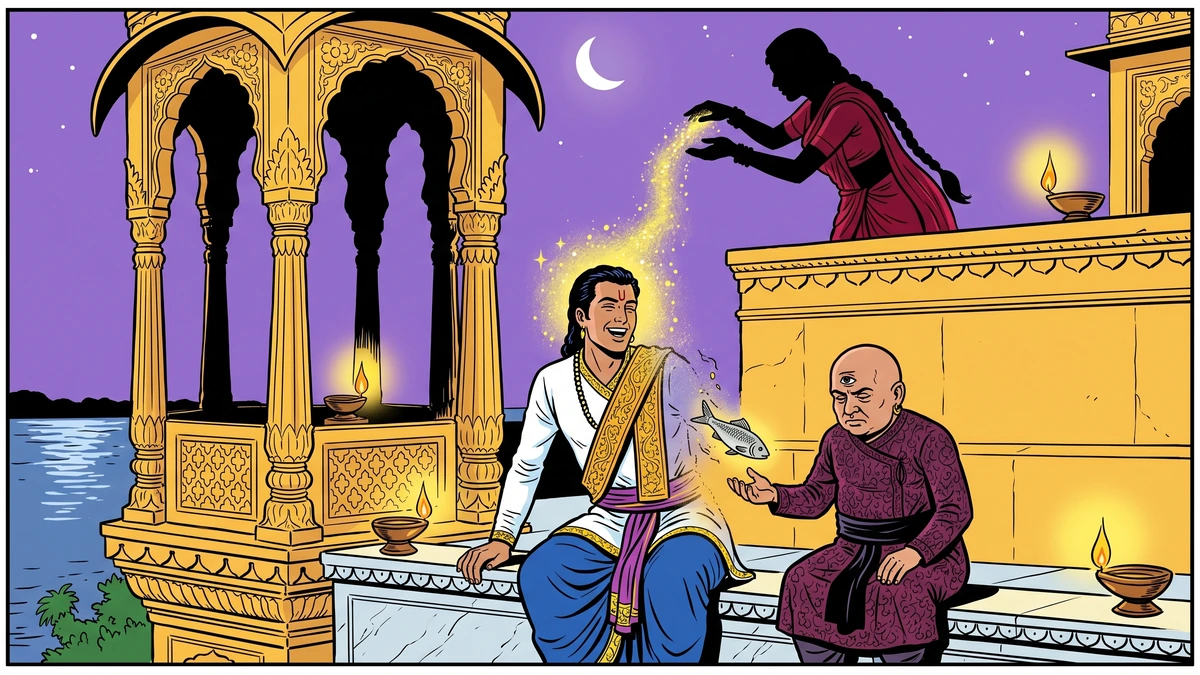
Beat I — The Brothers, the Enchantress, and the Powder on the Balcony
There was, in the time when the great rivers of north India still ran clear enough that a prince fishing from a balcony could see a carp turning ten feet down, a king and queen of one of the river-kingdoms whose name the storyteller does not record — only that it lay where the Bhágírathí bends north-east before joining the Padma. They had two sons, born of the same mother and within two years of each other. The elder, called Deesa — a name some recensions give as Dhísa, “the dark one” — had been born unfortunate in his body: a single eye in the middle of his forehead, a back bent forward at the shoulders, a height that brought his head no higher than his younger brother’s belt. The younger prince, whose name the Frere recension does not record but whom the Punjab variant calls Athon, was tall and straight, with the colouring that north-Indian folk storytelling reserves for the rightful heir — black hair plaited like a Rájpút’s, dark brown eyes, the unmarked smooth skin of a boy who has never had to fight for his place at the table.
The king, watching his sons grow up, said what folk-fathers always say in such tales: “My people will never obey a one-eyed dwarf for a king. The kingdom must go to the younger.” He spoke openly, before the court, before the elder son’s wife. This was his first cardinal sin as a folk monarch: the sin of declaring inheritance aloud while there was still time for treachery. Deesa heard it; he went home to his wife — a woman called Matni, of whom the storyteller now reveals what no one in the palace yet knew: that she was an enchantress, of the lineage that the Hindustâní folk-bestiary calls jadugarní, the female magician whose specialty is transformation rather than divination. Matni had married into the royal household for precisely such an emergency. She listened to her husband’s grievance; she did not weep, did not raise her voice; she only said, in the cool tone of folk-witches in every part of the world: “Leave it to me. The kingdom shall be ours by sundown next moon.”
What Matni did was elegant in the way that folk-magic is elegant. She invited the younger brother to a banquet on the river-side balcony of her wing of the palace. She was a famous cook, and the rice was good, and the goat-curry was good, and the prince, suspecting nothing, ate well and stayed late. After supper Matni went up onto the flat roof above the balcony, carrying a small leather pouch in her left hand. Deesa, below, sat with his brother on the railing overlooking the night-river. At the agreed moment Matni leaned over the parapet and dropped a pinch of yellow powder onto the prince’s head — the same yellow powder, the storyteller tells us in a parenthesis, that the courtesans of Lucknow used to call haldi-i-jadu, the “turmeric of magic,” though Matni’s was the genuine kind and not the courtesans’ counterfeit. The powder fell. The prince, in mid-laugh, in mid-sentence, became a fish — a small, silver, scaled river-carp, no longer than a man’s forearm, with two startled black eyes and a tail that beat the air. Deesa, calm as a butcher, picked the fish up by the gills and tossed it over the parapet into the running water of the Bhágírathí. The current took it. By morning the elder brother was the only living son of the king, and Matni was queen-in-waiting.
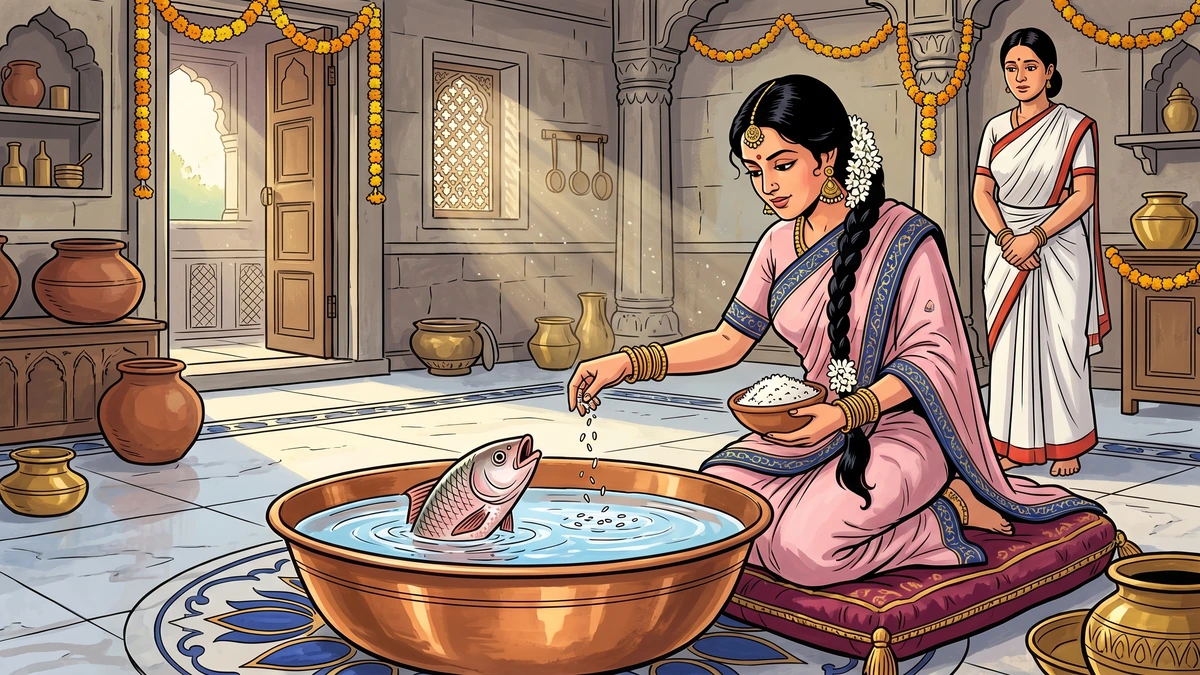
Beat II — The River, the Fishermen’s Net, and the Childless Queen
The second movement of “The Fish Prince” is one of the loveliest river-passages in the Frere corpus, and folklorists know it as the great Indian inversion of the Mediterranean Jonah-pattern. In the Old Testament and in its Greek and Persian retellings, the swallowed man is preserved inside the fish; in “The Fish Prince” the swallowed prince is the fish, and the test of his survival is not endurance in a belly but adoption into a new household. The swimming-down passage of the tale lasts two days: the prince, still half-stunned by his transformation, swims with the current on the back-eddies of the Bhágírathí; he eats the small water-flies that the rohu-carp eats; he learns, by trial, the language of fishes — which is silence, broken only by the small clucking the carp make when frightened. He swims past the temple-ghats of his father’s capital. He swims past the cremation-ghat where his great-grandfather’s ashes had been scattered. He swims past Matni’s window, where she sat combing her hair, and she did not see him.
By the third dawn he was outside the boundary of his father’s kingdom and into the territory of Rájá Karan — the storyteller does not give a fuller name; Frere’s ayah was vague on this point. There a small boat of fishermen, working the shallows with a hand-net, scooped him up in the early light. The fishermen, seeing him to be a particularly handsome rohu, brought him alive in a clay pot to the palace kitchen, intending him for the Ráni’s evening soup. But in the kitchen one of the serving-women, named Sundri in the Steel-Temple recension, paused with the fish in her hand. “He is too pretty for the pot,” she said. “The Ráni has no children; perhaps he will amuse her in a bowl.” She carried him up the stairs in a copper basin of cold water and set him before the queen.
The Ráni was a woman of about thirty-five, daughter of the king of Kashmír, married eight years and still without a child — a condition the Hindustâní folk-bestiary calls bandhyá, “the bound one,” and which is treated in folktale not as a personal misfortune but as a structural opening through which a marvellous child may yet enter the household. She looked at the small silver fish; the small silver fish looked at her. From that first look she fell in love with him in the way that childless folk-mothers fall in love with marvellous changelings — with a totality that left no room for husband, court, or cousin. She named him Athon-Rajah, “the Fish-King,” and called for a glass bowl, then a clay tank, then, when he had outgrown the tank, an inset stone pool fed by a channel from the river itself. She fed him boiled rice twice every day, by hand, dropping each grain so it floated; she kept marigolds on his pool-rim; she sang to him the lullabies her own mother had sung to her in Kashmír, and at first he merely circled in the water but in time he learned to come to the surface and put his nose against her palm. The queen’s ladies-in-waiting, watching this, said to one another: “She has found her son. He happens to be a fish; but she has found her son.”
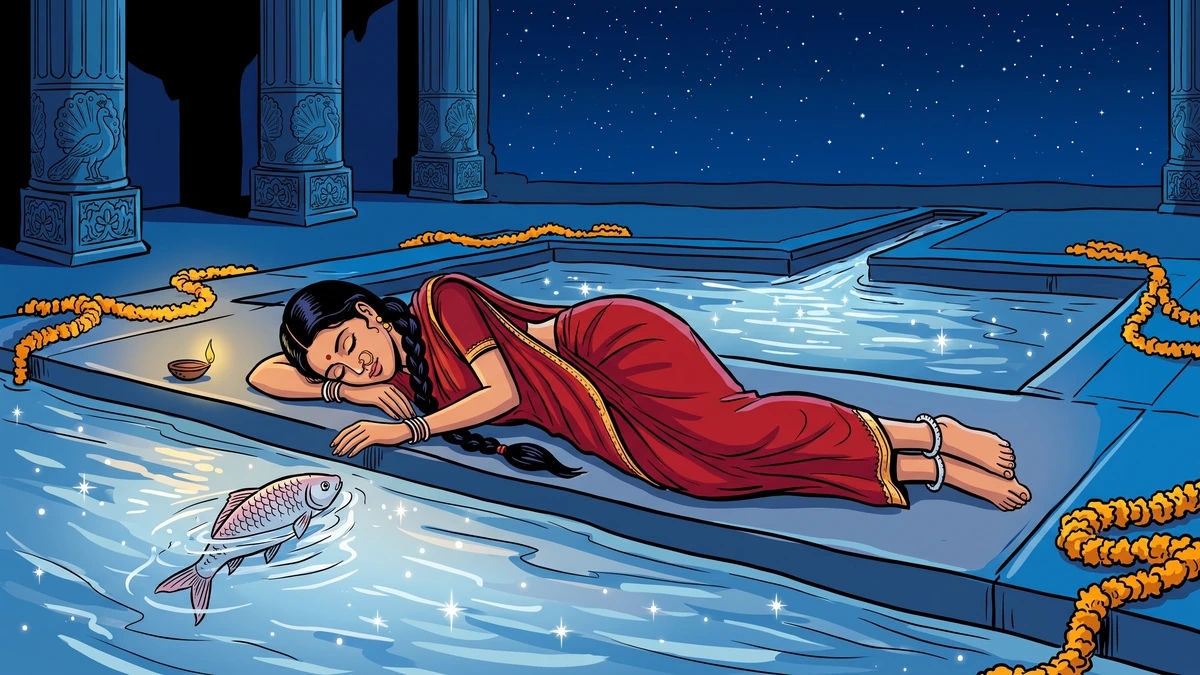
Beat III — The Brahman’s Daughter, the Wedding under Water, and the Bride who Slept on a Stone
The third movement of the tale is the one that gives “The Fish Prince” its specific Hindustâní flavour, distinguishing it from the Mediterranean and Slavic variants of ATU 450. The Ráni, growing older, became anxious that her fish-son was lonely. “A son must have a wife,” she said, in the voice that folk-mothers reserve for the immovable conviction. “Even a fish-son. Especially a fish-son.” She summoned her household Brahman, an old scholar named Pándit Vishwánáth, and told him: “Find me a girl willing to marry the Fish-King. I will give her father a thousand gold mohurs and the bride herself a silver anklet for each foot.” The Brahman bowed; he went out into the city; he made enquiries in the way that household Brahmans make enquiries in folktale, by sitting on a particular stone outside the temple and listening to the women who came to draw water at noon.
He found, on the third morning, a Brahman widow with seven daughters and no rupees. The eldest six daughters, when the proposal was put to them, refused: “Marry a fish? Mother, send him back; we will sooner sweep the temple courtyard than be wife to a carp.” The seventh daughter, the youngest, named Balna in some recensions and Sundari in others — a girl of about fourteen, whose only dowry was the patience that comes of being seventh in a family of seven — said, slowly: “Mother, if it pleases the Fish-King to take me, I will go. He cannot beat me, since he has no hands; he cannot scold me, since he has no voice. It is, on the whole, a gentler match than the village offers.” The widow wept, but accepted the gold. The Brahman led the bride to the palace.
The wedding was conducted as Hindustâní folk-weddings are conducted between mismatched parties: with the formal seven steps round the fire performed by the bride alone, while a small silver image of a fish (cast for the occasion by the palace goldsmith) stood on a cushion beside her. The Ráni gave Balna a wing of the palace adjoining the Fish-King’s pool. Each evening Balna sat on a stone by the pool-rim, lowered her hand into the water, and the fish came up and put his cold scaled side against her wrist; this was their nightly conversation. Each evening she sang to him the long Hindustâní bridal-songs of Awadh — the banna-banní songs, which are addressed by the bride to the absent groom — and the fish learned the tunes and would beat his tail in time against the stone. After a season, on the night of the new moon, something happened that Balna had not asked for and the Ráni had not foreseen. As Balna lay on the stone — she had been sleeping there to be near her fish-husband — she felt a hand, a human hand, brush her cheek. She opened her eyes; on the rim of the pool, naked and dripping water, sat a young man with black hair plaited down his back, dark brown eyes, the smooth unmarked skin of a prince who had never had to fight for his place. “I am Athon-Rajah,” he said. “The enchantment lifts at moonless nights, but only here, by this pool, and only between the falling and the rising of the tide. Speak softly. Tell no one. If anyone learns of this before the spell is fully broken, I shall be a fish for ever.”
Balna kept his secret for seven moons. Each new moon they sat together on the stone; she brought him rice and fish (the small fry of the river, which he ate with a slight grimace, joking that it was cannibalism only in form); they spoke; they planned. He told her the whole history — Matni, Deesa, the powder on the balcony, the river-journey of two days. Balna learned, in those moonless conversations, what no one in either palace knew: that the rightful prince of the upstream kingdom had been swimming in the downstream queen’s tank for nine years.
Beat IV — The Fakír, the Salt, and the Restoration of the Prince
The closing movement of “The Fish Prince” is the breaking of the spell, and it follows the tightest folk-logic in the Frere corpus. After seven moons of secret meetings, Balna found that she could no longer bear the half-life. She walked, one morning, to the river-bank, and there, sitting in the shade of a bo-tree, she found a wandering fakír with his begging-bowl and his single brass water-pot — the storyteller now informs us, in her usual parenthesis, that this fakir was a siddha in disguise, a perfected ascetic of the Nath order whose order traces itself back to Gorakhnath of the eleventh century. Balna fell at his feet. She told him everything. “Holy one,” she said, “is there nothing to be done? Must my husband swim till he dies of old age in a tank?”
The fakir was silent for some minutes. Then he said: “Daughter, the spell is in salt. Matni cast her powder on land, and a fish swims in fresh water; therefore the antidote is the element opposite to the spell’s element. Bring me a basin of clear river water and a handful of common rock-salt.” Balna ran. She brought the basin; she brought the salt. The fakir said the small mantras of the Nath order over the basin — the storyteller does not give the words; she remarks only that they were of the kind that fakirs say at the river-ghats of Káshí on the night before Shivaratri — and dropped the salt into the water. The salt dissolved with a hiss like a small fire being put out. “Take this water,” the fakir said, “and pour it into your husband’s pool at the very moment the moon is new and the tide turns. Stand back. Say nothing. Wait.”
Balna obeyed. On the new-moon night she went to the pool with her basin; she watched the tide-channel; at the moment of slack water, when the river itself paused in its breathing, she poured the salt-water in. The pool boiled white for one heart-beat. Up out of the water rose her husband — not as he had risen on the seven previous nights, briefly and on suffering, but fully, walking out onto the marble pool-rim with the salt-water streaming off his shoulders, his black hair already drying in the night wind. He turned to her. He laughed once, in pure relief, the laugh of a man who has not used his voice for nine years. The Ráni, woken by Balna’s small involuntary cry of joy, came running in her night-shawl; she saw the prince standing wet in the moonlight; she fell at his feet and called him son, in the same voice with which she had once named him fish.
The remaining business of the tale is the upstream business. King Karan, the next morning, sent embassies to the upstream king — the prince’s father — informing him that his lost younger son had been recovered, alive, married, and well, and that he was now riding north with a small escort to be reintroduced. The old king, when he heard, wept the tears that folk-fathers reserve for restored sons; he had grown thin in the nine years; he had stopped eating sweets; he had begun to suspect Matni and Deesa, but had been too tired to act. Now, with his younger son riding into the courtyard, he acted. Matni was put on trial — the storyteller is brief, in the Frere recension, on what was found in her possession; only that the yellow powder was found in a pouch under her marriage-bed, and the pouch was the same kind of leather Punjab witches use. She and Deesa were exiled, by the prince’s own request — for the prince refused to put his brother to death, on the grounds that a one-eyed dwarf had been the brother of his childhood and had taught him to skip stones on the river before either of them knew what jealousy was. They were sent across the Indus, to live among the foreign kingdoms of the west, on a small pension. The prince and Balna were crowned together; the Ráni of the downstream kingdom came to live in the upstream palace; the old king, before he died, rebuilt the river-balcony from which his younger son had once been thrown, and laid its parapet with the same yellow stone that Matni had once climbed to drop her powder, as if to ensure that no future witch could climb that particular wall without the stone itself remembering.
The Moral — सत्यमेव जयते
“सत्यमेव जयते” — satyam eva jayate — “Truth alone triumphs”
(Muṇḍaka Upaniṣad 3.1.6, c. 800–500 BCE; the half-line that gives Frere her sub-title for this tale, Truth’s Triumph, and that is now the official motto of the Republic of India inscribed below the Lion Capital of Ashoka).
“The Fish Prince” is a folk-meditation on the Muṇḍaka Upaniṣad’s most quoted half-line, but it is a meditation in the major key rather than the minor. The Upaniṣadic verse is an austere statement: satyam eva jayate, nánṛtam — truth alone triumphs, not falsehood. The folktale takes that statement and clothes it in scales and water and the patience of a queen who feeds a fish boiled rice for nine years. The truth that triumphs in the tale is not declamatory truth, the truth shouted in the courtroom; it is the slower, water-borne truth that survives transformation, exile, and silence. Athon-Rajah cannot speak for nine years. He cannot accuse his brother. He cannot tell his adoptive mother who he really is. He can only swim, and eat the rice he is given, and wait. Balna, when she finally comes, is not a sword-bearing rescuer; she is a Brahman widow’s seventh daughter who chooses to marry a fish because she is, by household position, used to choosing the lesser portion. Together they enact what the Muṇḍaka calls satyam: the kind of truth that is not loud but durable.
The tale’s second moral, more practical and equally Hindustâní, lies in the figure of Matni. She is the household enchantress whose magic is private — whispered between husband and wife, dropped from a roof in the dark, sealed in a leather pouch under a marriage-bed — and who therefore cannot survive the moment her secret is laid in open court. The folk-saying that Frere’s ayah used to add at the end of this tale, after the formal ending, was: “Jho doodh ka jala, woh chhachh bhi phoonk-phoonk ke peeta hai” — “He who has been burned by milk, blows even on his buttermilk” — meaning that a household which has once admitted a secret enchantress will be cautious of all daughters-in-law for three generations. The wisdom is not misogynist; it is structural. It says: the household that does not name its inheritances aloud, in the open hall, in front of all the relatives, is a household where the leather pouch under the marriage-bed will eventually find its yellow powder.
Why This Story Has Lasted
“The Fish Prince” has lasted, in the Hindustâní ayah-repertoire from Belgaum to Lucknow, for at least three reasons that bear on the way folk children listen. The first is the figure of the fish itself. North India has, in its religious imagination, an unusually rich freight of holy fish: the avatar Matsya of Vishnu (Bhagavata Purana 8.24), who saves Manu from the deluge by carrying his ark on a horn; the fish-eyed goddess Mina-akshi at Madurai, whose name — mínákṣí — means “the woman with eyes like a fish”; the carved fish on the Mughal-period imperial standard of the Nawabs of Awadh; and the rohu-carp itself, which Bengali fishermen tie a thread of red cotton round before cooking, in apologetic memory of the Matsya-avatar. When a Hindustâní child hears that her prince has become a fish, the child is not in a strange country; she is in a country where fish are already half-divine. The transformation is therefore not a humiliation but a translation into a higher language. This is a different emotional territory from the European frog-prince stories, in which the transformation is a punishment to be reversed; here it is a sojourn to be honoured.
The second reason for the tale’s survival is the figure of the childless queen. Indian folk literature is full of bandhyá queens — the queens-without-children — and they are not figures of pity but of strategic opportunity. The childless queen is the structural slot through which the divine, the marvellous, or the displaced may enter a household: in the Mahabharata, Kunti receives the gods’ children through a mantra; in the Ramayana, Kaushalyá receives Rám by the eating of charu; and in the folktale tradition, the childless queen receives Athon-Rajah in a fishing-net. The grandmothers who tell this tale to little girls are saying, very gently, something that the surface plot does not say: that the absence of a child is not the end of the story but its beginning, that the household which seems closed is in fact the very household through which the next prince may swim.
The third reason is the figure of Balna. Of all the heroines of the Frere corpus, Balna is the most modest. She is not beautiful (the storyteller never calls her so); she is not clever (she does not solve a riddle); she is not brave (she does not draw a sword). She is patient. She sits on a stone by a pool for seven new moons, putting her hand into cold water and learning the small clucking the carp make. The tale rewards her with a prince, but the reward is almost an afterthought; the tale is interested in her capacity for the long, undeclared marriage to a fish, the marriage that is not announced and not photographed and not gossiped about, the marriage in which a wife sits beside her husband’s pool and sings him the bridal songs of Awadh until the salt is mixed with the water and the spell breaks. North-Indian folk-pedagogy has always honoured this kind of patience; in the Vaishnava devotional tradition it is called nishkáma seva, “service without desire for reward,” and the Bhagavad Gitá (3.19) calls it the highest of householder-virtues. Balna is a Bhagavad-Gitá heroine in the smallest possible domestic frame, and that is one reason a hundred and sixty years after her tale was first printed, grandmothers in Belgaum and Lucknow still finish it with the same small hand-pat on the listening child’s head: “Beti, dhíraj rakho” — “Daughter, hold patience.”
Frequently Asked Questions
**Q: Why is this story important?**
You May Also Like
 Indian Folk Tales
Ages 3-5
Indian Folk Tales
Ages 3-5
Raja Rasalu
Raja Rasalu: Once there lived a great Raja, whose name was Salabhan, and he had a Queen, by name Lona, who, though she wept and prayed at many a shrine, had
 Indian Folk Tales
All Ages
Indian Folk Tales
All Ages
The Bronze Ring
The Bronze Ring: There was once a poor young man who lived with his aged mother in a small hut at the edge of a great forest. Despite their poverty, they were
 Indian Folk Tales
Ages 3-5
Indian Folk Tales
Ages 3-5
The Mother And The Daughter Who Worshipped The Sun
The Mother And The Daughter Who Worshipped The Sun: Once upon a time there lived a mother and a daughter who worshipped the Sun. Though they were very poor