The Bronze Ring
The Bronze Ring: There was once a poor young man who lived with his aged mother in a small hut at the edge of a great forest. Despite their poverty, they were

The Bronze Ring — the opening tale of Andrew Lang’s celebrated Blue Fairy Book (Longmans, Green & Co., London & New York, 1889) — is, for all its English fame, a story that began as a piece of Anatolian Greek and Turkish village storytelling. Lang, in his preface, identifies the source precisely: the tale was translated by his wife Leonora Blanche Alleyne Lang from Émile Henry Carnoy and Jean Nicolaïdès, Traditions Populaires de l’Asie Mineure (Paris: Maisonneuve, 1889), volume 28 of the celebrated comparative-folklore series Les Littératures Populaires de Toutes les Nations. Carnoy, a Belgian folklorist, and Nicolaïdès, a Greek collector working among the Greek-speaking villages of Constantinople, İzmir, and the Black Sea littoral, had recorded the tale in the late 1870s under the title L’anneau de bronze — the bronze ring — from an aged Greek grandmother in Anatolia.
The international classification of the story is Aarne–Thompson–Uther type 560, The Magic Ring — the senior cousin of ATU 561 Aladdin’s Lamp and ATU 562 The Spirit in the Blue Light. The Finnish folklorist Antti Aarne first catalogued the type in 1910; Stith Thompson revised it in 1928 and 1961; and Hans-Jörg Uther finalised it for the International Folktales Index (FF Communications 284–286, Helsinki, 2004). What distinguishes ATU 560 from its more famous neighbour ATU 561 is the presence of animal helpers: a serpent, a dog, a cat, or — as in this Asia-Minor recension — three lame, blind, and one-eyed mice who at the climax retrieve the stolen ring from the magician’s mouth. The motif catalogue lists this story’s essential elements as D1076 (the magic ring), B435.4 (the helpful mouse), D2074.2.1 (rats summoned by mouse-queen), N812 (the witch as supernatural helper), and K1810 (deception by branding).
The tale’s Anatolian recension is one node in a vast diffusion-network that runs from Sanskrit India through Persian, Arabic, and Greek into the Balkans and on to Brittany, Iceland, and Iceland’s Faroes. The earliest documented branch is the Indian: a magic-ring core appears in the eleventh-century Kathāsaritsāgara of Somadeva (Kashmir, c. 1070 CE), and in many of the Pañcatantra recensions where a snake gives a poor man a ring of fortune. Folklorist Kurt Ranke, in Enzyklopädie des Märchens (Berlin: de Gruyter, II.911–920), traced its westward migration through the Persian Tuti-Nāma, the Arabic Alf Layla wa-Layla (1001 Nights, MS Galland), and into Anatolian Greek; Karel Horálek, in his comparative monograph Studie o slovanských lidových pohádkách (Prague, 1964), counted more than four hundred recorded versions across Eurasia. Lang’s English translation simply happens to be the door through which most of the modern world entered the story. It became the first tale of the first volume of his epoch-making coloured fairy-book series, and so, for a hundred and thirty years, the bronze ring has rested at the gateway of childhood reading in English.
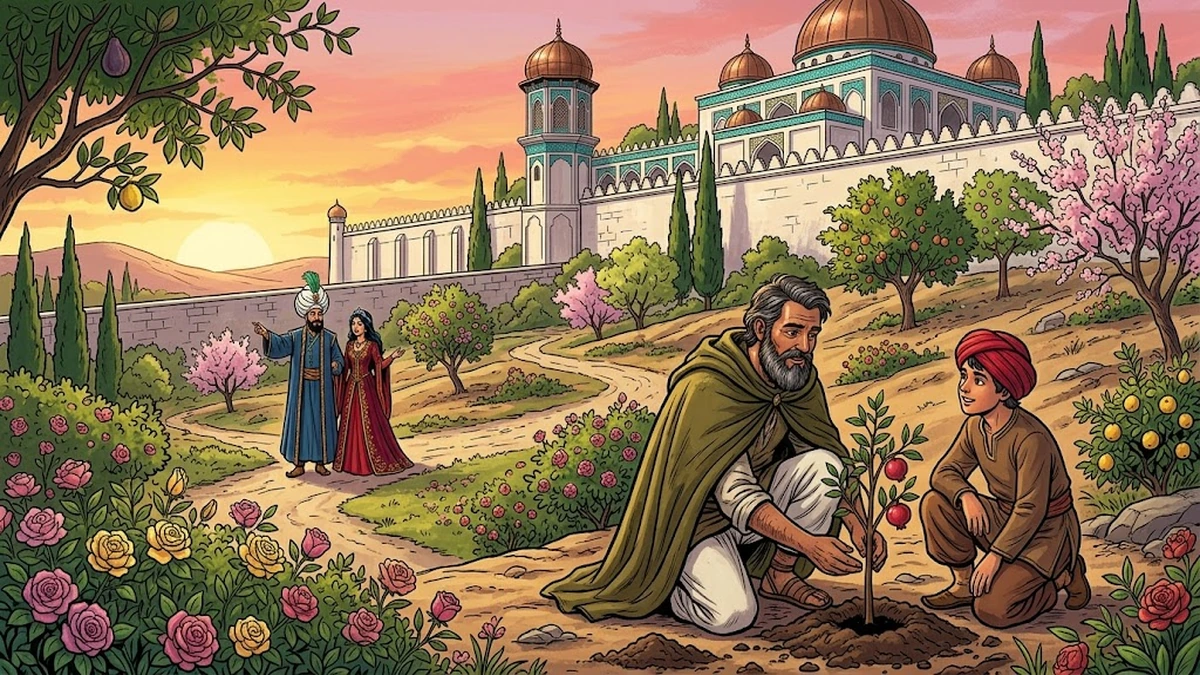
I. The Gardener’s Son and the Sultan’s Garden
In an age that the Anatolian storytellers placed simply as görülmemiş-zaman, “the time that has not been seen,” there ruled a sultan whose palace stood upon a barren hillside above a sea the colour of beaten copper. The walls were of white marble inlaid with turquoise; the towers were tipped with copper finials that caught the noon sun; the seven inner courts were paved with black-and-white pebbles in interlocking arabesques. But all around the palace the land was waste — thistle, dust, broken stones — and the sultan suffered from this barrenness the way a man suffers from a stain on his finest robe. He summoned every gardener in the realm. None could make the soil bloom. The chief vizier, an old and patient man, said at last, “Efendim, my lord, the soil will not answer to a hired hand. Find a gardener whose father was a gardener and whose father’s father was a gardener — for the love of plants is a thing that travels in the blood, three generations deep.”
The herald rode out into the dust, and after many weeks he returned with a quiet man named Mehmet and his only son, a brown-skinned boy of seventeen called Yusuf. They were poor — their cloaks were patched at the elbow and their sandals were tied with palm-fibre — but in their hands lay the dark loam of three generations of garden-work. Within a year the hillside outside the marble walls was black with watered earth; within two, the rose-bushes of Işparta bloomed beside cypresses from Bursa; within three, pomegranate, fig, almond, peach, and quince trees made arches under which the sultan walked at sunset, his hand resting on the shoulder of his only daughter, the princess Selimé — a girl with hair the colour of wet ink and eyes that the courtiers compared, at her insistence, only to almonds and never to stars.
It was perhaps inevitable. The princess walked among the orange trees almost every afternoon; the gardener’s son carried the watering-pot and the pruning-knife; a glance went between them one evening at the orchard’s gate, and after that they were lost. Selimé informed her father, with the patient ferocity of girls in love, that she would marry no one but Yusuf. The sultan informed her, with the patient ferocity of fathers, that the prime vizier’s son had already been promised the bride-cup; and there matters might have stood, with the princess weeping in her chamber and the gardener’s son weeping in the rose-bushes, except that the vizier himself, who was a man of devices, suggested a contest. The two suitors should ride out to a far island in the southern sea, fetch back a token of having reached it, and the first to return should wed the princess. The sultan, relieved to be rid of the decision, agreed.
The two young men were not equipped on equal footing. The vizier’s son, a sallow boy named Halil, was given a fine Arabian stallion, a chest of gold dinars, a kaftan stitched with silk, and a retinue of three armed servants. The gardener’s son was given a lame piebald nag, a leather purse of copper pul, a coarse brown cloak of homespun goat-wool, and the smile of his father, who said only this at the gate: “Iyi yolculuklar, oğlum — ve daima yardım et: a good road, my son — and always help.”
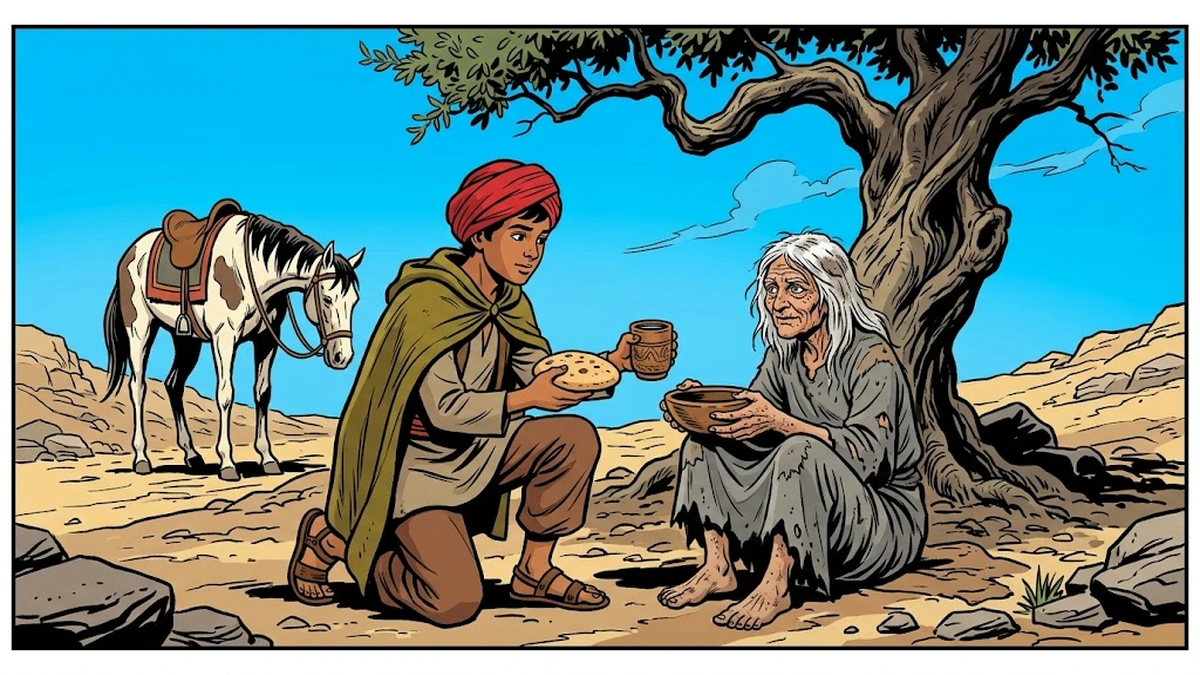
II. The Beggar-Witch and the Three Sick Dogs
For three days Halil rode hard along the southern road, dust spurting from his stallion’s heels. On the fourth morning, at a dry crossroads under a single olive tree, he came upon an old woman in rags. Her hair was white and matted; her feet were bare and bleeding; the ribs showed under the worn cotton at her shoulder; her eyes were the bright, indifferent eyes of someone who has been hungry too many days to bother with shame. She held out a wooden bowl. “Bir lokma ekmek, oğlum,” she said. “A morsel of bread, my son.” Halil reined in. He looked at the bowl, at the dust, at the small pinched face. He laughed. “I have business with sultans,” he said, “not with old crows of the road.” He spurred his horse and was gone in a curtain of dust.
Two days later the gardener’s son rode the same crossroads on his lame nag. He saw the old woman. He stopped. He climbed off the horse, untied his copper purse, and laid it in her bowl. He divided his last loaf of bread in half. He filled the wooden cup at his hip with water from his goat-skin and held it to her lips. He did this without thought, the way Mehmet had taught him in the orchard: kim olursa olsun, whoever it is. When he made to remount, she looked up at him with eyes that had ceased to be tired and were, of a sudden, very bright. “Will you take an old woman behind you on your horse?” she asked. “The next city is far, and my feet are done.” He helped her up.
They rode together to the seaport-city of Antalya. The streets were hung with black cloth. In every kahve the men sat silent over their cups. The herald at the city gate was crying out, in the slow regretful chant of public mourning: The sultan of this place is dying. Whoever cures him shall name his own reward, even unto half the kingdom. Yusuf shook his head sadly — he had no medicine. The old woman, behind him, leaned forward and whispered into his ear in a voice that was no longer the voice of any beggar he had ever heard. She said that he was to find three particular dogs, in a certain courtyard at the edge of the city — one black, one red, one white, all three of them sick — and to put them out of their misery by a clean knife, and to burn their bodies into a single jar of ash. Then he was to go to the dying sultan’s bedside and, with the help of the chief physicians, place the sultan into a great copper cauldron of water on a fire, and boil him into clean bones, and arrange the bones on a white sheet exactly as a living man lies, and then sprinkle the dogs’ ashes over the bones. Do not be afraid, she whispered. I tell you the words of an old medicine, older than the sultans of Anatolia. The flesh that comes back will be young flesh.
The boy went pale, but he had been raised to do what he had been told by his elders, and a stranger who has eaten your last bread, in the desert ethics of those people, becomes an elder. He found the three dogs — a great mastiff with a tumour, a thin red salukis with the staggers, a little white village-dog blind with cataracts. He dispatched them gently. He burned them, weeping. He did, with the chief physicians, all that the old woman had said. The bones came up clean from the cauldron, white as ivory; the boy laid them on a sheet of Bursa silk in the shape of a sleeping man; he sprinkled the dogs’ ashes; and at the moment of sprinkling, in the great room of the dying, the bones blushed pink, the bones grew flesh, the bones were a young king of twenty-five with a healthy beard and astonished black eyes. The court fell on its faces. The young-restored sultan said, “Boy, name your reward.”
The old woman, at his ear again: Ask only for the bronze ring he keeps on a copper chain in the lowest drawer of the sandalwood chest beside his bed. Yusuf asked. The chamberlains brought out gold; he refused. They brought out an Arab mare; he refused. They brought out the documents of half the kingdom; he refused. He asked for one bronze ring, no thicker than a wedding-band, dark with verdigris, plain as the loop on a porter’s sandal. The court laughed at him. The young sultan, who knew what the ring was, gave it to him with a half-smile and a small bow.
III. The Branding, the Voyage, and the Theft of the Ring
Outside the city the old woman had vanished. In her place upon the lame nag’s saddle was a curl of paper, on which she had written the words: Rub the ring three times. Wish. Yusuf rubbed the ring. The air shivered as if someone had tapped a bronze cymbal under water; a tall figure of smoke and copper light stood up out of the dust beside the horse and bowed, and said in a voice like distant rain on a tin roof: “I am the djinn of the bronze ring. What does my master command?” The boy, after a long moment of staring at his own hand, asked for a ship to take him to the far island. He asked it humbly, like a boy.
What rose up out of the harbour at Antalya was a ship the like of which the sailors of the Aegean still remembered three generations later. Its hull was beaten gold; its sails were Damascus brocade in scarlet and indigo; its anchor-chain was silver; its twelve sailors were tall young men in robes the colour of evening, each of them so handsome that the merchants’ daughters fainted on the seafront. Yusuf went aboard barefoot in his goat-wool cloak and made his salaam to the captain. The ship sailed south.
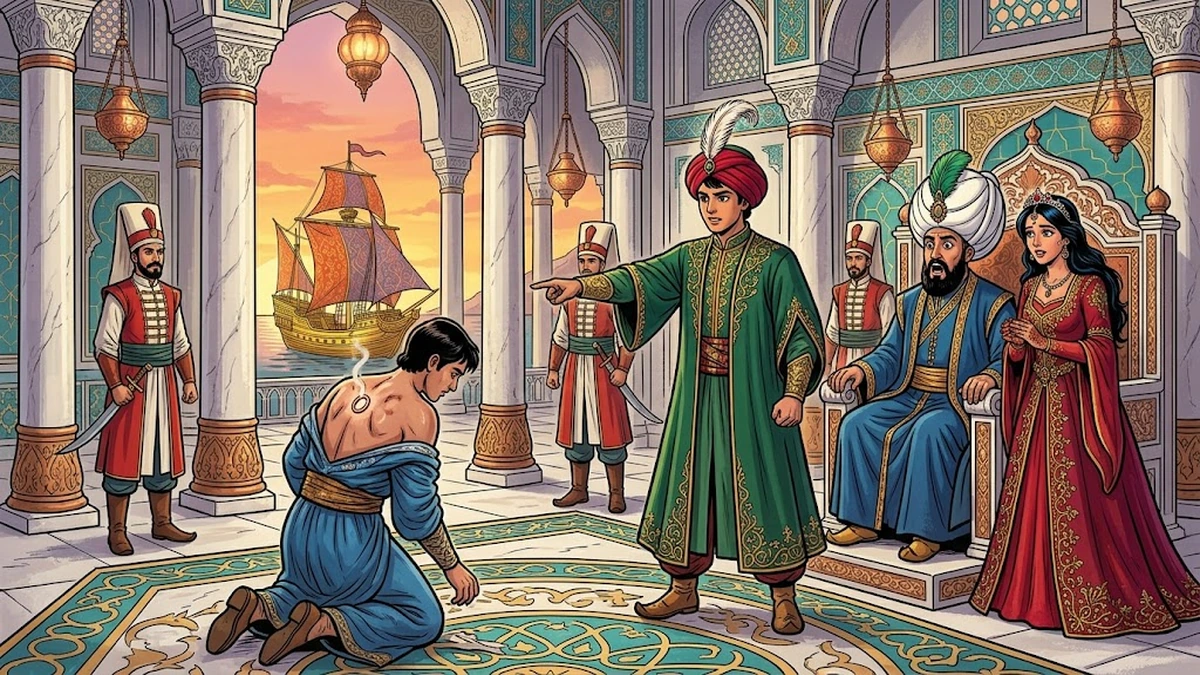
On the second day at sea they passed a small dirty caique drifting under a torn sail. In it sat the vizier’s son, his fine kaftan stained with vomit and salt, his stallion sold for water in a pirate-port, his money gone, his stomach empty. He did not recognise the gardener’s son under his new bearing. Yusuf, who was a kind boy but no fool, called the caique alongside and offered him passage in the golden ship and supplies for his return — on a single condition. The condition was this: that Halil submit to having the seal of the bronze ring, heated red in a brazier, pressed once between his shoulder blades. Halil, exhausted and cold, agreed without thinking. The brand was applied. It was the size of a small coin, deeply burned, the impression of a plain bronze ring against the skin. Halil sailed home in a wretched second ship the djinn made for him — rotten timbers black with pitch, ragged sails, a maimed crew — and he reached the sultan’s harbour first, and claimed the princess with all the bombast of a man who has cheated death.
The sultan’s harbour, on the next day, saw a second ship enter under a forest of indigo brocade. The sultan, who was no fool, sent a herald to fetch the captain to the palace. Yusuf came up the marble staircase in a robe stitched by his djinn, and the sultan, taken by a stranger’s grace, asked him to give away the bride. He came to the wedding cushion. He looked at Halil. He bowed to the sultan. “O my lord,” he said, “this man is not worthy. He is no vizier’s son. He is my own slave. He bears my brand between his shoulders.” The kaftan was lifted; the brand was found; the court gasped; and the vizier’s son was carried away in chains, and Yusuf married Selimé that night under a moon as round and copper as the basin of his ship’s anchor-light.
IV. The Three Mice and the Return of the Ring
For a season they lived as the very young live when they have just found one another — in a private country with its own dawns and its own dialect. But the world remembers what it has lost. In the city of Smyrna across the water lived a Magrebi sorcerer, a man learned in the dark sciences of sihr, who had been hunting the bronze ring of the Anatolian sultans for forty years; he heard now that a green boy in the marble palace had it on a copper chain. He came over the sea disguised as a fish-pedlar, with red mullets in a basket, and he stationed himself under the orchard wall on a morning when Yusuf had sailed for the islands in his golden ship. The sorcerer cried his fish so prettily that the princess, who loved red mullets, sent her maid to bargain. The pedlar would take no coin; he would take only that small dull bronze ring on the lady’s little finger, in exchange for a basket of fish. The maid carried the message back; Selimé, who did not yet understand the worth of the ring she had been gifted on her wedding morning by her husband’s laughing kindness, slipped it from her finger and sent it down. The sorcerer left the basket of fish on the wall and was at sea before the kitchen bells rang for noon.
That afternoon, two miles offshore, the gardener’s golden ship was suddenly a black hulk of half-rotten timber; its scarlet sails were rags; its twelve handsome sailors were misshapen and hideous; the gold cargo was a hold of howling black cats; and Yusuf, alone at the wheel in his goat-wool cloak, knew at once what had happened. He was a gardener’s son; he kept his head. He set what course he could. The wreck blew for three days before a hot southerly wind, and on the fourth morning grounded gently on the sand of an island so small that the chart-makers had never bothered to give it a name. The island was a kingdom of mice. The Mouse-Queen, a small grey lady with a coronet of woven barley-straw, came down to the shore with her court and looked at the howling cats and at the boy and at the wreck. She said, with the courtesy of a small queen, “O foreign captain, our island is not made for cargo of cats. Take them away, and we shall do anything for you.” Yusuf said, “Sultanam, my queen, I have lost my bronze ring. Find it for me, and I will sail away today.”
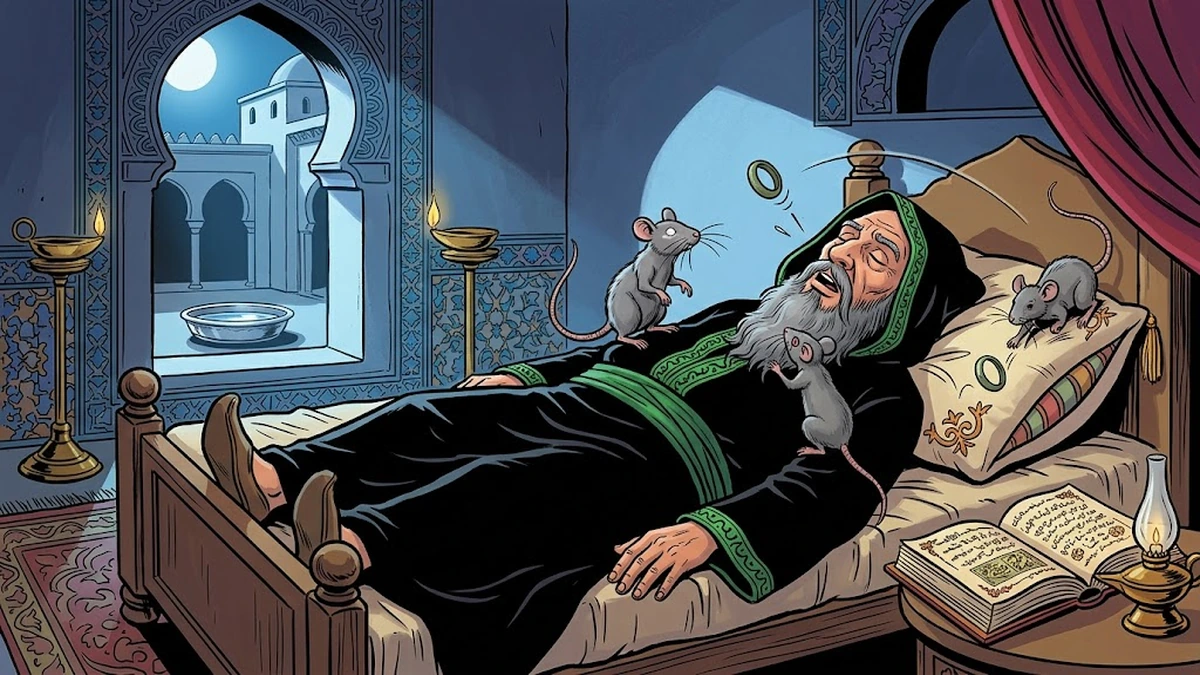
The Mouse-Queen sent her heralds to every mouse in the world. They went out under floors and through grain-stores, along the cellar-beams of caravanserais and the bilges of dhows, and after seven days three mice came back with the news. They were three peculiar mice. The first was lame — a leg lost long ago in a Magrebi kitchen-trap. The second was blind — both eyes white as pearl, navigating only by the long reach of her sensitive whiskers. The third was one-eyed — her right eye gone to a sleeping mongoose two years before, but her left eye sharp as a tailor’s needle. These three mice had grown up under the floorboards of the sorcerer’s house. They knew his every habit. They reported: the sorcerer kept the bronze ring in his pocket while waking, but at night, when he slept, he placed it on his tongue and closed his lips. They volunteered together for the theft.
The Mouse-Queen sent them with her blessing. The three mice crossed the sea on a piece of driftwood (the lame one steering with her good leg, the one-eyed one watching for hawks, the blind one keeping the time of the wind by the song of her whiskers) and entered the sorcerer’s house at the hour of the third watch. He was already asleep. The blind mouse climbed his chest in the dark and located the parted lips by warmth alone. The one-eyed mouse climbed up his beard with the precise care of a clockmaker. The lame mouse, with her tail, tickled the inside of the sorcerer’s left nostril until he gave one great fountaining sneeze that nearly blew the candle out, and the bronze ring bounced once on the pillow and rolled into the lame mouse’s grateful paw.
What followed was nearly disaster: the lame mouse, swimming the ring across a silver basin of moonlit water in the courtyard, lost her grip and the ring sank; the one-eyed mouse dived; the blind mouse fished; and at last by their three peculiar gifts together they brought the bronze ring back across the sea to the island and laid it at Yusuf’s feet. He rubbed it three times. The wreck was a golden ship again; the cats were gold cargo; the misshapen crew were tall princes of the evening once more; and the boy sailed home and walked into Selimé’s chamber and laid the ring on her palm and folded her fingers gently over it. The sorcerer, when they caught him, was given over to the executioner of Antalya and was tied (as the Carnoy-Nicolaïdès text records, with the matter-of-fact violence of nineteenth-century Anatolian story-telling) to the tail of a savage black mule and dragged into history.
V. The Moral — The Bread You Throw on the Water
For the Anatolian Greek and Turkish villages out of which Carnoy and Nicolaïdès collected this tale, its moral was no mystery. The story is a long, jewelled commentary on a single proverb that any child of those hills could repeat by heart, and that the storyteller would speak softly as the listeners blew out the candle:
İyilik yap, denize at —
balık bilmezse, Hâlık bilir.“İyilik yap, denize at: balık bilmezse, Hâlık bilir.”
“Do good and cast it into the sea — if the fish does not know it, the Maker knows it.”
The proverb, recorded across both the Greek and the Turkish folk traditions of Anatolia (the Greek version, Káne to kaló ki ríxe to sti thálassa, “do good and throw it in the sea,” carries the same wisdom), is the moral key to every turn of the plot. The vizier’s son refuses the beggar at the crossroads — he calculates — and his ship rots. The gardener’s son gives his last copper without calculation, and the ring of all the kingdoms of the south is dropped into his hand. Even the mice make the same calculation: kindness given returns by paths the giver cannot foresee. The lame, the blind, and the one-eyed are the three mice who answer the call — the broken animals returning a kindness paid forward by other broken animals long ago. There is no other moral arithmetic in the bronze ring.
The Anatolian storytellers placed this teaching inside a particular cultural value: misafirperverlik, hospitality — literally “the love of the guest” — which the Turkish and Greek mountain villages still hold as the highest of virtues. The traveller at the door, the beggar at the crossroads, the unknown old woman with the wooden bowl — she is, in this ethics, the most dangerous and the most blessed of all visitors, because what is given to her is given to God. The verbal blessing the gardener’s father gives at the gate, daima yardım et, “always help,” is not a piece of advice; it is the operative spell of the entire story. The bronze ring is what kindness looks like when it has hardened in the hand: dull, plain, no thicker than a wedding-band, more powerful than gold.
VI. Why This Tale Has Lasted
The Bronze Ring has lasted in living memory for at least a thousand years — from the Sanskrit Kathāsaritsāgara, through the Persian Tuti-Nāma, the Arabic Nights, the Anatolian Greek-Turkish villages of the Ottoman vilayet, the French Littératures Populaires, and on through Andrew Lang’s blue cloth-bound first edition into the English-speaking nurseries of the twentieth century — for one strong reason. It has, more clearly than any other ATU 560 variant, the shape of an audit. Every kindness the gardener’s son performs is recorded; every unkindness his rival performs is recorded; and at the climax, in the courtroom-like scene of the wedding cushion, the brand of the bronze ring — pressed into Halil’s back during a moment of cynical convenience — functions exactly as a bookkeeper’s seal. The branding is the audit-mark. The body of the man who refused the beggar carries, beneath his fine kaftan, the receipt for that refusal. The story tells the listener: every transaction of kindness is recorded somewhere on a body, and the books always balance in the end.
The other reason for its endurance is the strange tenderness of its three mice. Folktale-typology B435.4 (helpful mouse) usually appears as a single talking creature; here we have three, and they are catalogued by their hurts. The lame, the blind, and the one-eyed: the storytellers of Smyrna and Trabzon understood, intuitively, that a story which ends with golden princes saving the day is sentimental, and that a story which ends with three mutilated little mice solving a problem none of the human heroes can solve is something far more durable. The mice are us, in our usual condition. The bronze ring is recovered not by perfect creatures but by broken ones, each contributing the one faculty she has left. The lame mouse has her tail. The blind mouse has her whiskers. The one-eyed mouse has her one good eye. Together they steal back the world.
For the modern reader, the lesson is unchanged. We do not, most of us, have golden ships or magic rings; we have lame, blind, and one-eyed kindnesses, given in the half-dark to people we will never see again. The Anatolian grandmothers who told this story to Carnoy and Nicolaïdès in the late 1870s knew that a single piece of bread shared with an old woman at a crossroads is not, in any honest accounting of the universe, a small act — that, in the deep mathematics of folktale and the deep mathematics of life, it was the act around which a sultan’s palace was about to rearrange itself. İyilik yap, denize at. Do good and throw it into the sea. The fish do not know. The Maker knows. The ring comes back.
And that is why — in 1889, in Paris, in London, in İzmir, and in every nursery library of the English-speaking world ever since — the bronze ring has rested at the gate of childhood reading: a small dull-green metal hoop, plainer than gold, that knows the names of every kindness it has ever passed through.
Canonical attribution · “The Bronze Ring,” first tale of The Blue Fairy Book, edited by Andrew Lang, illustrated by H. J. Ford and G. P. Jacomb-Hood (London & New York: Longmans, Green & Co., 1889; pp. 1–11); English translation by Leonora Blanche Alleyne Lang from L’anneau de bronze in Émile Henry Carnoy & Jean Nicolaïdès, Traditions Populaires de l’Asie Mineure (Paris: Maisonneuve, 1889) — volume 28 of the series Les Littératures Populaires de Toutes les Nations, pp. 68–74. International tale-type ATU 560 The Magic Ring (Aarne 1910; Thompson 1928, 1961; Uther, FF Communications 284–286, Helsinki 2004); related ATU 561 (Aladdin) and ATU 562 (The Spirit in the Blue Light); Stith Thompson motifs D1076 (magic ring), B435.4 (helpful mouse), D2074.2.1 (rats summoned by mouse-queen), N812 (witch as supernatural helper), K1810 (deception by branding). Comparative scholarship: Kurt Ranke, Enzyklopädie des Märchens II.911–920 (Berlin: de Gruyter); Karel Horálek, Studie o slovanských lidových pohádkách (Prague, 1964). Indian comparanda: Somadeva, Kathāsaritsāgara, c. 1070 CE (Tawney/Penzer trans., London 1924–28). Closing Anatolian proverb: İyilik yap, denize at: balık bilmezse, Hâlık bilir (Turkish folk-saying); Greek parallel: Káne to kaló ki ríxe to sti thálassa. Reading time: ~10 min.
Frequently Asked Questions
Where does “The Bronze Ring” come from, and how did it reach English readers?
The story was collected from Greek-speaking villages in Asia Minor (Anatolia) by Émile Henry Carnoy and Jean Nicolaïdès in the late 1870s under the title L’anneau de bronze, and published in their Traditions Populaires de l’Asie Mineure (Paris: Maisonneuve, 1889) as volume 28 of the comparative-folklore series Les Littératures Populaires de Toutes les Nations. Leonora Blanche Alleyne Lang translated it into English from the French, and her husband Andrew Lang placed it as the very first tale of The Blue Fairy Book (Longmans, Green & Co., London & New York, 1889). It has stood at the gate of childhood reading in English ever since.
What is the international tale-type, and how does it relate to Aladdin?
The story is classified as Aarne–Thompson–Uther type 560, The Magic Ring, the senior cousin of ATU 561 Aladdin’s Lamp and ATU 562 The Spirit in the Blue Light. The decisive distinguishing feature of ATU 560 is the presence of animal helpers — a serpent, a dog, a cat, or, as in the Anatolian recension, three lame, blind, and one-eyed mice — who recover the magic object after it has been stolen. ATU 561 (Aladdin) does not use animal helpers; the protagonist himself recovers the lamp by his own resourcefulness or by the aid of a princess. The folklorist Hans-Jörg Uther formalised the classification in his 2004 revision The Types of International Folktales (FF Communications 284–286, Helsinki).
Are the three lame, blind, and one-eyed mice unique to this version?
The three peculiar mice are an Anatolian distinctive. In the broader ATU 560 type the helpers are most often a single dog and a single cat, sometimes joined by a mouse; the elaborate trio of mutilated mice — each one contributing her single remaining gift — appears most strongly in the Greek-Turkish recensions of Asia Minor and in the Aegean islands. Stith Thompson catalogues the mouse-helper at motif B435.4 and the mouse-queen at D2074.2.1; the “peculiar mice” arrangement is one of the small details that lets folklorists place a recension geographically. It is also the most poignant element of the tale: the broken animals are the only ones with the gifts the moment requires.
What is the Anatolian moral, and what does the closing proverb mean?
The closing proverb in both the Turkish and Greek folk-traditions of Anatolia is İyilik yap, denize at: balık bilmezse, Hâlık bilir — “Do good and cast it into the sea: if the fish does not know it, the Maker knows it.” The Greek parallel runs Káne to kaló ki ríxe to sti thálassa, “do good and throw it in the sea.” The teaching is that an act of kindness must be performed for its own sake, with no expectation of return: the gardener’s son gives his last copper to the beggar without calculation, and the bronze ring is the form in which kindness, hardened in the hand, comes back. The story is also a cultural lesson in misafirperverlik, “the love of the guest,” the highest virtue of Anatolian household ethics.
Was there an Indian or Sanskrit version of this story?
Yes — the magic-ring core of the tale is among the most widely diffused narrative elements in Eurasian folklore, and the earliest documented branch is Indian. A version appears in the eleventh-century Sanskrit Kathāsaritsāgara (“Ocean of the Streams of Story”) of Somadeva of Kashmir, c. 1070 CE, where a serpent-king gifts a poor man a magic ring; related forms appear in several recensions of the Pañcatantra. The folklorist Kurt Ranke, in Enzyklopädie des Märchens II.911–920, traced the westward migration through the Persian Tuti-Nāma and the Arabic Alf Layla wa-Layla into Anatolian Greek and Turkish; Karel Horálek (1964) counted more than four hundred recorded versions across Eurasia. The Asia-Minor recension is therefore a node in a great network whose Indian end is older by a thousand years.
You May Also Like
 Indian Folk Tales
Ages 3-5
Indian Folk Tales
Ages 3-5
Prince Wicked And The Grateful Animals
Prince Wicked And The Grateful Animals: Once upon a time a king had a son named Prince Wicked. He was fierce and cruel, and he spoke to nobody without abuse
 Indian Folk Tales
Ages 3-5
Indian Folk Tales
Ages 3-5
The Tiger The Brahman And The Jackal
A classic Panchatantra-style Indian folk tale about a trapped tiger, a kind Brahman, and the clever jackal who saves the day through wit and logic.
 Indian Folk Tales
Ages 3-5
Indian Folk Tales
Ages 3-5
Dorani
Dorani: Once upon a time there lived in a city of Hindustan a seller of scents and essences, who had a very beautiful daughter named Dorani. This maiden had a