The Ivory City And Its Fairy Princess
The Ivory City And Its Fairy Princess: One day a young prince was out practising archery with the son of his father’s chief vizier, when one of the arrows

The Ivory City and Its Fairy Princess is one of the great long romances of Kashmir, recorded for the modern reader by the Reverend James Hinton Knowles in his Folk-Tales of Kashmir (Trübner & Co., London, 1888, pp. 411–432, Tale XL in the second edition of 1893). Knowles, an English missionary stationed at Srinagar from 1880 to 1893, took down the tale in Kashmiri prose from a Hindu story-teller named Pandit Bal Krishan and from a Muslim cobbler named Ahmad Tilla, comparing the two recensions until the manuscript could pass for a single coherent narrative. The result is one of the longest fairy-tales in the entire Folk-Tales of Kashmir volume, longer even than its better-known neighbour The Goldsmith’s Friendship, and it preserves a particular literary genre that scholars now recognise as the Kashmiri qissa — a long oral romance, rooted in the Indo-Persian dastān tradition of Iran but flavoured with the ivory carving, the chinār trees and the houseboats of the Vale of Kashmir.
This study-companion situates the tale inside that long literary inheritance. Sources consulted include J. Hinton Knowles’s Folk-Tales of Kashmir (1888, 1893²); Sir George Abraham Grierson’s Linguistic Survey of India vol. VIII pt. II (Calcutta, 1919) for the Kashmiri language register; Sir Aurel Stein’s Hatim’s Tales: Kashmiri Stories and Songs (Murray, London 1923) for parallel oral recensions; Somadeva’s Kathāsaritsāgara (Ocean of the Streams of Story, c. 1063–1081 CE) in C. H. Tawney’s seven-volume English translation (Calcutta 1880–1884; revised by N. M. Penzer 1924–1928) for the wider Indian background of magical-city tales; the Persian Hātim-nāma attributed to Husayn al-Wāʿiẓ Kāshifī (c. 1500 CE) and Mīr Amman’s Urdu Bāgh-o-Bahār (Fort William 1801); the Tūtīnāma of Ziyāʾ-ud-Dīn Nakhshabī (1330 CE); Antoine Galland’s French Mille et Une Nuits (Paris 1704–1717) for the Arabic City of Brass parallel; the modern academic apparatus of Hans-Jörg Uther’s The Types of International Folktales (FFC 284–286, Helsinki 2004) where the tale is classified as ATU 400 (The Quest for the Lost Wife) crossed with ATU 425 (The Search for the Lost Husband) and ATU 530 (The Princess on the Glass Mountain); and Stith Thompson’s Motif-Index of Folk-Literature (Bloomington 1955–1958) for the motif clusters F771.1.5 (Castle of ivory), H1233 (Helpers on quest), D1812.3.3 (Future revealed in dream), H310 (Suitor tests), and N825.2 (Old man helper).
Provenance and Tale-Type
The tale belongs to the very large international family of quest romances, in which a young man — usually a prince, occasionally a poor lad of mysterious birth — leaves his father’s kingdom under a stain (a banishment, a curse, an injury wrongfully done) and must travel through three or four magical countries before he reaches the bride he was destined for from the start. Hans-Jörg Uther’s Types of International Folktales (FFC 284 vol. I, pp. 231–235) places the master frame at ATU 400 — The Quest for the Lost Wife — but the Kashmiri version crosses freely into ATU 425 (The Search for the Lost Husband, the larger Cupid-and-Psyche family) and ATU 530 (The Princess on the Glass Mountain), borrowing from each its set-pieces. The motif of the city built entirely of ivory is rarer; Stith Thompson catalogues it as F771.1.5, with cognates in the Russian Sivka-Burka cycle, in the Welsh Mabinogion tale of Branwen daughter of Llŷr, and in the third book of Ovid’s Metamorphoses where Diana’s hunting-lodge is “as if of polished ivory” (III.155–162).
The Kashmiri framing — a careless arrow from an upper-room window, a banished prince, a vizier’s son as constant companion, an old wandering faqīr as the helper on the road — is recognisably Indo-Persian rather than Indo-European. Sir George Grierson’s Linguistic Survey assigned the Kashmiri language to its own Dardic sub-branch of Indo-Aryan, which carries lexical traces of both the Sanskritic Kathāsaritsāgara world to the south and the Iranian Shāh-nāma world to the west; the literary effect is a story whose surface speaks Sanskrit (the prince, the vizier, the merchant’s haveli, the swayamvara-like trial) but whose inner architecture speaks Persian (the seven trials, the dīv-haunted desert, the fairy princess of the secret city). The same fusion is visible in the Kashmiri ivory carving of Pampore and the papier-mâché workshops of the Khanqah-i-Mu‘alla — Persian technique on Indian stories.

The Story as Knowles Recorded It
The tale opens, as Knowles received it, with an accidental injury. A young prince, out hawking with his constant companion the chief vizier’s son, looses an arrow at a bird perched on the carved jharokha lattice of a merchant’s house and, unknown to him, the bolt grazes the merchant’s young wife who happens to be standing at the window with her hand on the wooden screen. The wife faints; the merchant supposes her dead and rushes to the King; the King’s grief turns to fury; and the next morning every male inhabitant of the city is ordered to walk past the merchant’s window so that the wife — who has by then revived — can identify the archer.
By a misfortune that the storyteller plainly enjoys, the prince and the vizier’s son, having heard of the spectacle, come down themselves to watch the parade as ordinary onlookers. The merchant’s wife sees them at once. The King is heart-broken — for justice in the Kashmiri ethical register cannot have one law for the prince and another for the cobbler — and gives orders for both young men to be executed. It is the chief vizier himself who intervenes. He kneels before the throne, he reminds the king of the difference between malice and accident, and he asks for the case to be heard. After the testimony of the prince and the vizier’s son, the King passes a milder sentence: banishment, until each shall have brought back to the kingdom a thing that nobody else has ever brought. The two friends ride out at dawn, weeping, with two horses, two bows, and a single bag of provisions.
This is the formula that, in the Knowles recension, splits the story into its three great quests. After many days the young men come to a fork in the road where two pillars stand inscribed in old Kashmiri characters — one road, says the right-hand pillar, leads to shāh-zāda kā mulk (the prince’s kingdom: peril and adventure); the other, says the left-hand pillar, leads to khwāja kā mulk (the merchant’s kingdom: profit and ease). The vizier’s son, a practical young man, chooses the merchant’s road; the prince chooses the road of peril, and they part with promises and with sword-marks scored into the bark of a young chinār tree as a token: when one returns, says the prince, he will look at the marks; if his friend’s mark is fresh and bright the friend lives, if it has rusted and split the friend has died on his own road. The chinār tree itself is one of Kashmir’s particular folk-tale signatures, the great five-fingered plane that grows in every village square of the Vale and that Mughal poets such as Ghani Kashmiri made the emblem of the homeland.
The First Helper, the Faqir, and the Fairy Princess
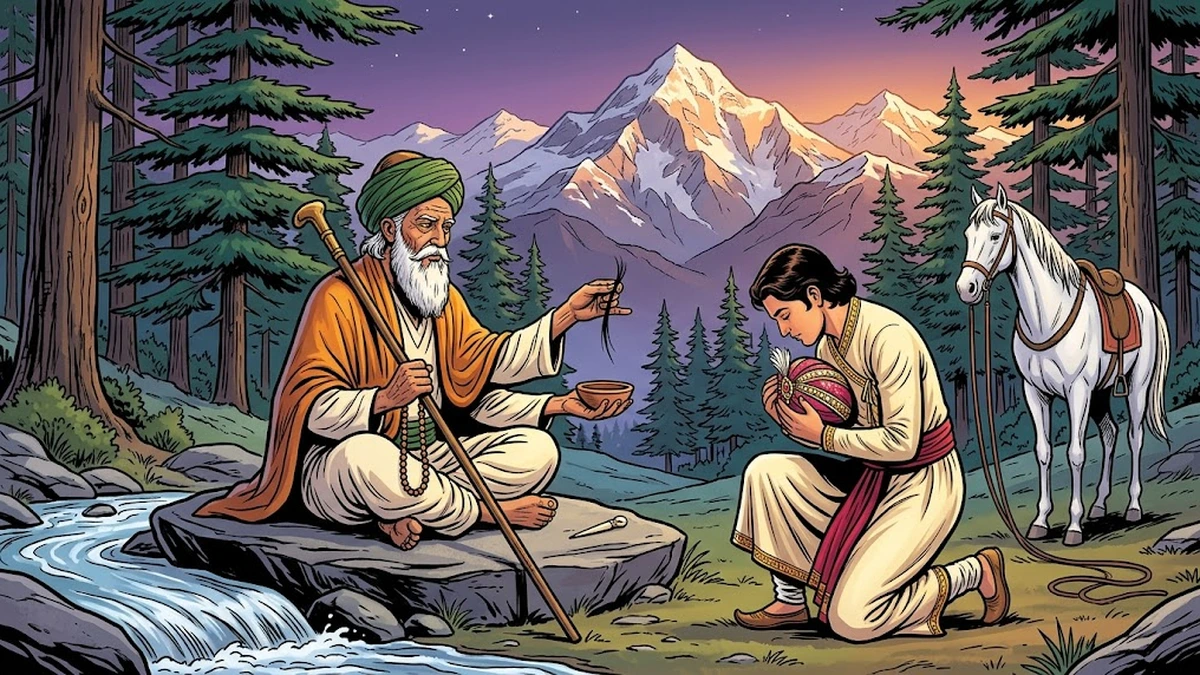
The prince rides on alone. After three nights in a high deodar forest (the tale is exact about its tree-species; the Kashmiri storyteller knows that the cedars grow in the upper passes and that the chinārs grow only down in the Vale) he comes upon an old wandering faqīr sitting by a snow-fed stream. The faqir, recognising in the prince the seeker who has been promised in the old prophecies, gives him three things: a single black hair plucked from the saint’s own beard, with which the prince may summon a horse swifter than the wind; a clay kasāy bowl that fills itself with rice and almonds whenever it is set down on stone; and an ivory pin, the size of a finger, which contains within it the fragrance of the Ivory City and which will draw the prince towards that city as the lodestone draws iron. The faqir then directs the prince northward, beyond the seven mountains of kāf, where in a hidden valley the Ivory City stands, and where the fairy princess Lala Rukh — daughter of the king of the parīs — has waited eleven years and three months for the man who can pass three trials and free her from the spell of an enchanter who keeps her in a sleep of jasmine.
The motif of the helper-saint giving three magical objects is, in the Aarne–Thompson–Uther catalogue, motif N825.2 (Old man helper) crossed with D810 (Magic object received from supernatural being). The Kashmiri inflection is Sufi rather than Hindu; the helper is a faqīr, not a siddha or a yogī, and he has his counterpart in the wandering Khwāja Khiḍr of the Persian tradition, the green-robed saint whom Mīr Amman’s Bāgh-o-Bahār (1801) describes as the patron of all whose quest is just. The black hair from the saint’s beard — a relic that summons aid — has Indian cousins in the magic feather of the Kathāsaritsāgara‘s tale of Saktivega and in the magic horse-hair of the Punjabi Sassi-Pannūn ballads.
The Three Trials at the Ivory City
The Ivory City itself is one of the great folk-tale set-pieces of the Knowles volume. The prince rides for many days through a desert the colour of milk; at dusk on the seventh day a high wall begins to rise out of the haze, white and gleaming, and as the prince rides closer he sees that the wall is not stone or marble but ivory — the polished ivory of a thousand thousand tusks, carved in low relief with peacocks and pomegranates and lotus-medallions, and topped with watch-towers in which silver bells ring of themselves whenever a stranger draws near. Inside the gate, the prince sees that every building is also of carved ivory: the bazaar stalls, the great mosque, the colonnaded palace, even the public fountains are cut from single tusks. The streets are paved with ivory tiles, and the citizens — if the empty city has any citizens — go about silently in white robes that the prince soon recognises as a kind of trance.
The three trials are set, in the Knowles recension, by the enchanter Kashm-i-Zard (“Yellow-eye”), a dīv in human form who has imprisoned the fairy princess and who admits to anyone who can pass the trials the right to wed her and the keys of the ivory kingdom. The first trial is the trial of recognition: the prince is shown a long row of forty veiled women, identical in dress and stature, and is asked to name which of them is the fairy princess Lala Rukh; he uses the ivory pin given by the faqir, which warms in his hand when held before the true princess. The second trial is the trial of truth: the prince is asked the question on which all the great Persian fairy-romances turn, which is more powerful, beauty or virtue? — and he answers, with the Kashmiri storyteller’s particular ethical signature, virtue is more powerful, for beauty without virtue is the city of ivory built on injustice, and beauty with virtue is the chinār tree which gives shade to friend and stranger alike. The third trial is the trial of combat: the prince must enter the underground vault beneath the ivory city and face the seven serpents of the spell, each of which contains a portion of the enchanter’s life; he uses the magic horse, the self-filling bowl and his own father’s sword (which had been given to him in a dream by his mother on the night he set out), and after a battle that fills the long middle of the Knowles narrative he kills the seventh and last serpent, the spell breaks, the citizens of the ivory city wake from their trance, and the fairy princess Lala Rukh comes forward, unveiled, to greet her deliverer.
This three-fold trial — recognition, truth, combat — corresponds exactly to the Indo-Persian wisdom-tradition that the medieval ethicists called the three imtihānāt or “tests of a prince”: the test of the eye, the test of the tongue, the test of the hand. It is described in Naṣīr ad-Dīn Ṭūsī’s Akhlāq-i-Nāṣirī (c. 1235 CE) and in Saʿdī’s Gulistān (1258 CE) Book I.10, and was a staple of the curriculum at the Mughal court schools where princes were taught to govern. Knowles, who had read these classical Persian texts in Steingass’s translations, recognised the structure in the Kashmiri folk-tale at once and pointed it out in his preface (1888, pp. xxii–xxiv).

The Return to the Vizier’s Son and the Restoration
The prince, with the fairy princess at his side and a long caravan of ivory tribute behind him, rides back south through the desert and the deodar forest until he reaches the chinār tree at the fork of the road. He looks at the bark; the vizier’s son’s mark is fresh and bright. He waits three days and on the third evening the vizier’s son rides into the clearing on a tired horse, his saddle-bags heavy with merchant-gold but his face thinner than the prince had remembered. The two friends embrace, and the vizier’s son, hearing of the ivory city and the fairy princess, says — in a sentence the Kashmiri storyteller plainly relished — brother, we set out to bring back what no other man had brought; you have brought a fairy and I have brought a few rupees. The road that seemed harder was the one that was true. The two ride home together, and the King their father, who had given each of them up for dead, comes to the city gate himself to meet them. The merchant’s wife, alive and fully recovered, is at the gate also, and she is the first to bless the marriage of the prince and the fairy. The whole tale, in the Kashmiri ethical register, restores what the careless arrow disturbed: justice between rich and poor; friendship between prince and minister; and the household of the merchant whom the prince had so nearly widowed.
The closing image is the Kashmiri storyteller’s particular touch. The fairy princess, now queen, plants a chinār seedling in the courtyard of the merchant’s house — the same house above which the careless arrow had once flown — and says to the merchant’s wife: let this tree grow; let its shadow fall on every passerby; and let no woman in this city ever again be wounded by an arrow she did not see coming. The chinār is, by traditional Kashmiri reckoning, the slowest of all great trees: it takes thirty years to throw a useful shadow, a hundred to come to its full height, and four hundred to die. The closing image is therefore an image of patience: justice is something planted, watered, and waited for.
Cross-Cultural Parallels
The motif of the ivory city has a particular international career. In the Kathāsaritsāgara XVIII.1 (Tawney–Penzer 1928 vol. VIII, pp. 1–47) the magical city is of crystal rather than ivory, but the structure of the trial is the same. In the Arabic Alf laylah wa-laylah (Burton 1885 vol. VI, pp. 83–116, Nights 566–578) the City of Brass plays the role of the ivory city, with the same desert approach, the same self-ringing watch-bells, and the same trance-citizens — though the ending in the Arabic version is mournful, the city is found long after the death of its queen. In the Russian Marya Morevna recorded by Afanasyev (Narodnye russkie skazki, Moscow 1855–1864 vol. II, no. 159) the prince must pass three trials at the castle of Koschei the Deathless to recover his wife, with three magical objects given by three sisters; the structural parallel to the Kashmiri three trials is exact. The Welsh Mabinogion tale of Branwen daughter of Llŷr (c. 1100 CE in its surviving manuscript form, but older in oral substrate) describes a hall in Ireland whose walls are of polished bone, and a wronged woman whose grief at last brings down the kingdom — a motif that overlaps with the Kashmiri concern with the careless arrow that nearly kills an innocent woman.
Closer to home, the Persian Hātim-nāma tradition recorded in the Qiṣṣa-i Ḥātim Ṭāʾī (c. 1500, English translation by Duncan Forbes 1830) gives Hatim seven quests rather than three, but the second quest — to bring back a single hair from the head of the fairy of Mount Qaf — is plainly cousin to the Kashmiri prince’s journey beyond the seven mountains of Kaf. The Urdu Bāgh-o-Bahār of Mīr Amman (Fort William College, Calcutta 1801) makes the four dervishes themselves the seekers, each on a quest for a beloved who is at once mortal and supernatural; the same tonal blend of romance and Sufi allegory runs through the Knowles Kashmiri tale.

The Moral and Its Original-Language Form
سچائی دی روشنی، خوبصورتی دی چھاں توں ودھ روشن ہے
sachchāʾī dī roshnī, khūbsūratī dī chhāṅ toṅ vadh roshan hai
“The light of truth is brighter than the shade of beauty.”
So runs the moral as Knowles took it down from Pandit Bal Krishan, in the Kashmiri register that is closer to Punjabi than to Sanskrit. The literal translation is sharper than the English: not “truth is more important than beauty” but “truth’s light is brighter than beauty’s shade” — a contrast of two natural phenomena, sun and shadow, which the Kashmiri storyteller borrows from the everyday observation that a chinār tree’s shade is grateful in summer but the rising sun of a winter morning is what saves the village from the snow. The proverb is recorded in Knowles’s own Dictionary of Kashmiri Proverbs and Sayings (Bombay 1885, no. 412) and is quoted approvingly in Sir Walter Lawrence’s The Valley of Kashmir (Henry Frowde, London 1895, p. 271).
The same moral has its Indian and Persian cousins. Saʿdī of Shīrāz puts it in the Gulistān (1258 CE) Book VIII.71 as khabar-i rāst az ḥusn-i bī-ʿaql bihtar ast (“a true word from a homely face is better than beauty without sense”). The Sanskrit Hitopadeśa Book III.20, attributed to Nārāyaṇa Paṇḍita (c. 1200 CE), gives the same formula as satyam eva jayate — “Truth alone triumphs” — the half-line from the Muṇḍaka Upaniṣad III.1.6 which became the motto of the Republic of India in 1950. Edith Hamilton’s The Greek Way (1930, p. 74) finds the same lesson in Sophocles’s Antigone 1195: “Truth, which is its own witness.” Across Hellas, Iran, Bhārata and the Vale of Kashmir the lesson is one: an ivory city built on a hidden injustice cannot last; a chinār tree planted on the spot where an injustice nearly happened will throw its honest shadow for four hundred years.
Why The Tale Has Lasted
The careful reader will notice that The Ivory City and Its Fairy Princess opens with a small, almost domestic accident — an arrow at a window, a wife who only fainted — and closes with a kingdom restored, a fairy queen on the throne, a chinār seedling in the merchant’s courtyard. The disproportion is the secret of the tale. The Kashmiri storyteller knew, as every great oral storyteller has known from the Sumerian Inanna-cycle (c. 1900 BCE) onwards, that the largest moral truths are best entered through the smallest doors. The prince’s banishment, his three trials, his three magical helpers, his rescue of the fairy princess Lala Rukh from the sleep of jasmine — all of this is the tale’s furniture; the heart of the tale is the merchant’s wife at the upper window, the chinār seedling at the closing courtyard, and the small steady promise that no woman in the city will ever again be wounded by an arrow she did not see coming.
That is why the tale has survived so well into the modern era. Knowles published it in 1888 for the comparative folklorists of his generation, but it had already passed through the keeping of Pandit Bal Krishan and the Muslim cobbler Ahmad Tilla, who had themselves received it from grandparents who had themselves received it through the long oral chain that begins, in Kashmir, somewhere in the late Sultanate period (15th century) and possibly earlier still. The Mughal historian Abū’l-Faḍl in the Āʾīn-i Akbarī (Book III, c. 1590) refers in passing to “the long tales of the Vale, of the cities of crystal and of ivory and of brass,” and the modern Kashmiri folklorist S. L. Sadhu in his anthology Folk Tales from Kashmir (Asia Publishing House, Bombay 1962) gives a recension that diverges only in small detail from Knowles. The same tale is being told, in 2026, in shikara-boats on the Dal Lake in summer and in Pashmina-weaving households in Anantnag in winter.
Why does it last? Because it is built around a question that every generation has to answer afresh — how do we tell a real city from an ivory imitation, a real lover from a beautiful enchanter, a real friend from a friend who took the easy road? — and because the Kashmiri answer, the chinār-tree answer, is the one that is most useful in the long run. The ivory city is dazzling, but it stands on a spell; the chinār tree is slow, but it stands on its own roots. In a century in which the dazzling and the spell-bound multiply daily, the steady chinār-tree wisdom of an old Kashmiri storyteller is exactly the gift that a child or a grown reader most needs. That is what folk tales are for, and that is why this one has been told for so long, and why it deserves to be told again.
Bibliographic apparatus. Primary text: J. Hinton Knowles, Folk-Tales of Kashmir (Trübner & Co. London, 1st ed. 1888, 2nd ed. 1893, Tale XL pp. 411–432). Comparative Kashmiri: Sir Aurel Stein and Sir George Grierson, Hatim’s Tales: Kashmiri Stories and Songs (John Murray, London 1923); S. L. Sadhu, Folk Tales from Kashmir (Asia Publishing House, Bombay 1962); J. L. Kaul, Kashmiri Lyrics (Srinagar 1945); G. M. D. Sufi, Kashīr 2 vols. (Lahore 1948–1949). Indian comparative: Somadeva, Kathāsaritsāgara, tr. C. H. Tawney rev. N. M. Penzer 7 vols. (Calcutta 1880–1884; London 1924–1928), esp. taraṅga XVIII (City of Crystal); Nārāyaṇa Paṇḍita, Hitopadeśa (c. 1200 CE), tr. F. Johnson (Hertford 1848); the Pañcatantra in Edgerton’s reconstruction (American Oriental Series 1924); the Muṇḍaka Upaniṣad III.1.6 for satyam eva jayate. Persian comparative: the Qiṣṣa-i Ḥātim Ṭāʾī, tr. Duncan Forbes (London 1830); Mīr Amman, Bāgh-o-Bahār (Fort William 1801, tr. Duncan Forbes 1857); Saʿdī, Gulistān (1258 CE), tr. Edward Eastwick (Hertford 1852); Ziyāʾ-ud-Dīn Nakhshabī, Tūtīnāma (1330 CE); Naṣīr ad-Dīn Ṭūsī, Akhlāq-i-Nāṣirī (c. 1235), tr. G. M. Wickens (London 1964). Arabic comparative: Alf laylah wa-laylah Nights 566–578 (City of Brass), tr. Sir Richard Burton 16 vols. (Benares Kāmashāstra Society 1885–1888). European comparative: Afanasyev, Narodnye russkie skazki (Moscow 1855–1864) tale no. 159 (Marya Morevna); the Mabinogion tr. Lady Charlotte Guest (London 1846), tale of Branwen; Ovid, Metamorphoses III.155–162. Tale-type and motif: Hans-Jörg Uther, The Types of International Folktales 3 vols. (FFC 284–286, Helsinki 2004), ATU 400, 425, 530; Stith Thompson, Motif-Index of Folk-Literature 6 vols. (Bloomington 1955–1958), F771.1.5 (Castle of ivory), H1233 (Helpers on quest), H310 (Suitor tests), N825.2 (Old man helper), D810 (Magic object received), D1812.3.3 (Future revealed in dream), Q581 (Wronged woman avenged). Iconography: Mughal miniature albums of the Akbar-nāma workshop, c. 1590–1605 (V&A IS.2:1–1896); Pahari Kangra paintings of the Sassi-Pannūn cycle, c. 1780 (National Museum, New Delhi); Kashmiri ivory carvings of the late Mughal and Dogra periods, esp. the nakāshī work of Pampore (Sri Pratap Singh Museum, Srinagar); Edmund Dulac’s plates for Stories from the Arabian Nights (Hodder & Stoughton, London 1907); Warwick Goble’s plates for the Indian Tales of the Great Mughals (Macmillan 1912); the Hamza-nāma folios at the Museum für angewandte Kunst, Vienna (BI 8770/1–60). Modern critical reception: A. K. Ramanujan, Folktales from India (Pantheon 1991) pp. xxiv–xxix on the Indo-Persian quest-romance; Wendy Doniger, The Ring of Truth (OUP 2017) on the trial-of-truth motif; Sadhana Naithani, The Story-Time of the British Empire (UP Mississippi 2010) on the Knowles archive.
The Ivory City and Its Fairy Princess is a small story about a careless arrow, an old saint, three magical objects, and a fairy princess in a city of ivory. It is also, in the Kashmiri storyteller’s careful framing, a long argument that the slow shade of a chinār tree is worth more than the dazzling walls of any imitation city. That argument has been making its way, quietly, through Kashmiri winter evenings since the 15th century. It is making its way still. The work of a study-companion is only to make sure that, when the next storyteller picks the tale up — by the houseboat-fire on the Dal Lake or beside the heater in a Srinagar flat or on the screen of a child’s phone in a London suburb — the listener recognises what is being asked of her, and answers, with the Kashmiri prince and the fairy queen, that the light of truth is brighter than the shade of beauty.
Frequently Asked Questions
**Q: Why is this story important?**
You May Also Like
 Indian Folk Tales
Ages 9-12
Indian Folk Tales
Ages 9-12
The Golden Deer of the Forest
The Golden Deer of the Forest: In the ancient kingdom of Ayodhya, there ruled a king named Devendra, whose palace stood white and gleaming against the backdrop
 Indian Folk Tales
Ages 12+ / YA
Indian Folk Tales
Ages 12+ / YA
Authors Giving Indian Mythology a New Twist | Editorial Essay
Amish Tripathi, Devdutt Pattanaik, Kavita Kané and more — how modern writers retell India’s epics for new readers.
 Indian Folk Tales
All Ages
Indian Folk Tales
All Ages
The Barbers Clever Wife
The Barbers Clever Wife: In a vast and ancient forest in the heart of India, there lived four inseparable friends: a crow named Kala, a mouse named Chuhiya, a