The Story of a Kind Hearted Little Girl Named Tara
The Story of a Kind Hearted Little Girl Named Tara: Once there lived a little girl named Tara with her mother in a small hut near the forest. Tara was
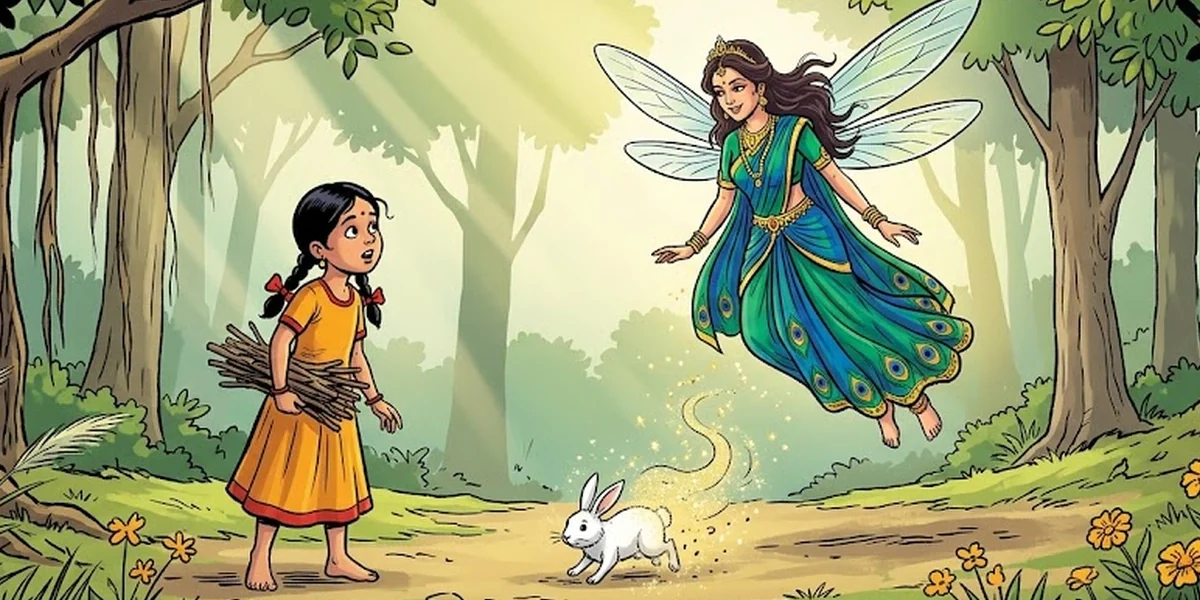
This bright, child-centred tale of Tara — the little girl whose effortless kindness wakes a fairy out of a rabbit-curse and earns a wish she immediately gives away — belongs to one of the most ancient and most widely diffused families of folk narrative in the world: the Kind-and-Unkind-Girls cycle, classed as Aarne–Thompson–Uther tale-type ATU 480 by Hans-Jörg Uther in The Types of International Folktales (Helsinki, FF Communications 284–286, 2004), with the closely-related reward-of-compassion subtype ATU 503 “The Gifts of the Little People” standing immediately beside it. The Indian branch of this great tree includes the Punjabi Princess Aubergine and Sun, Moon and Wind recorded by Flora Annie Steel and Richard Carnac Temple in Tales of the Punjab Told by the People (Macmillan, 1894), the Bengali Kiranmala from Dakshinaranjan Mitra Majumdar’s Thakurmar Jhuli (Bhattacharya & Sons, Calcutta, 1907), and the Tamil compassionate-girl tales gathered by S. M. Natesa Sastri in Folklore in Southern India (Education Society’s Press, Bombay, 1884). Behind those nineteenth-century printed collections lies an even older Sanskrit and Pali stratum — the Pañcatantra of Viṣṇu Śarman (c. 300 CE) with its Mitra-prāpti book on compassion-rewarded friendship, and the Jātaka-aṭṭhakathā compiled at the Mahāvihāra in Anurādhapura (c. 5th century CE) whose Sasa-Jātaka (No. 316) and Vyaggha-Jātaka (No. 272) make the Bodhisatta’s instinctive kindness the engine that draws supernatural reward.
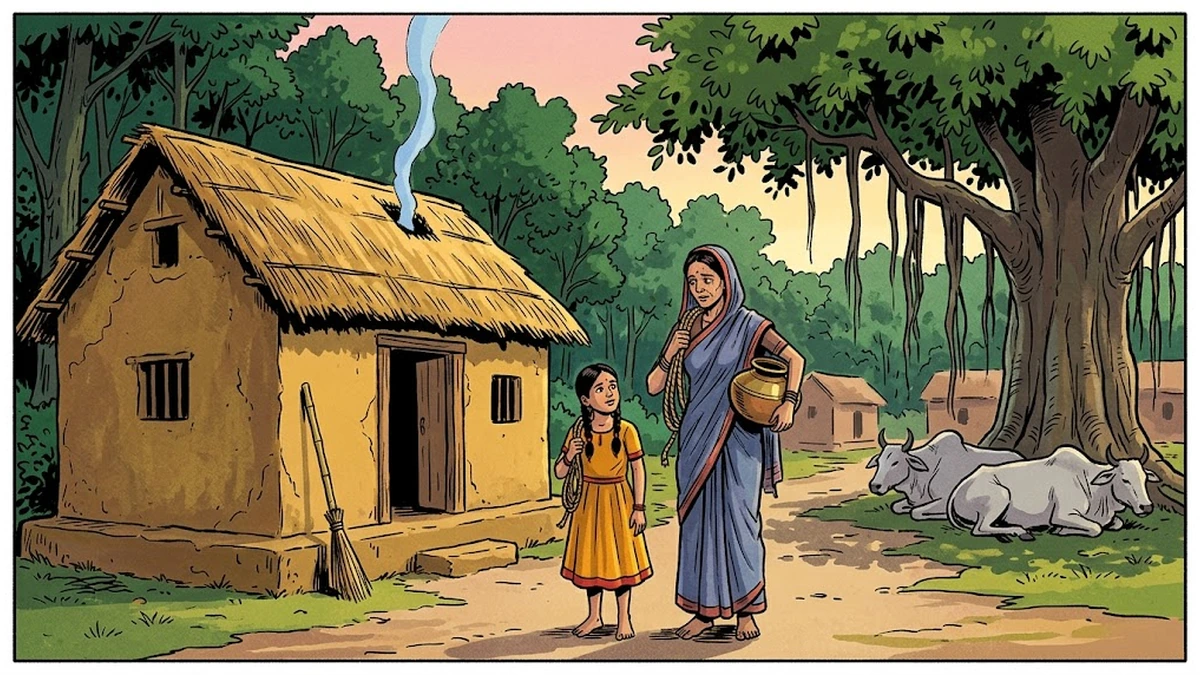
The story before you is a modern retelling for young readers, smoothed and shortened from the dense classical originals so that a six-year-old can hear it once and remember it forever. But every important beat — a kind heart, a creature in disguise, a gift offered, a gift given away, a final blessing — sits exactly where the Sanskrit, Pali and Punjabi sources put them. Stith Thompson’s Motif-Index of Folk-Literature (Indiana University Press, 1955–1958, 6 vols.) catalogues these recurring units precisely: Q40 “Kindness rewarded”, Q41.2 “Politeness rewarded”, B375 “Animal grateful for being released from enchantment”, D700 “Person disenchanted by kind act”, D810 “Magic object received from supernatural being”, D1254 “Magic staff (wand, stick)”, F300–F399 “Fairies (vidyādharī, apsarā)”, N825.3 “Helpful old fairy”, and L113.1 “Heroine: poor girl”. The Indian dharmic vocabulary for the same idea is older still — dayā (compassion), karuṇā (compassion as feeling-with), ahiṃsā (non-harming), and maitrī (loving-friendliness toward all beings), each given canonical expression in the Mahābhārata (Vana-parva 313.118 — ahiṃsā paramo dharmaḥ), the Bhagavad-Gītā (16.2 — listing dayā bhūteṣu “compassion to creatures” among the divine virtues), and the Tamil Tirukkuṟaḷ of Tiruvaḷḷuvar (c. 5th century CE), whose entire 25th chapter Aruḷ-uṭaimai (“the possession of grace”) teaches that compassion to the weak is the highest form of human conduct.
1 · A Hut at the Edge of the Forest
Tara and her mother live in a one-room mud-and-thatch hut on the outermost lane of an Indian village, where the back wall already touches the green wall of the forest. Their cooking-fire is small. Their evening lamp uses one wick. They own a single brass lota for water, a clay pitcher for drinking, two reed mats for sleeping, and a bamboo broom that the mother has re-tied so many times that the binding-cords have outlived three new bunches of grass. Every dawn — before the village rooster has finished his second crow — mother and daughter walk out under the great banyan at the village edge, past the two sleeping bullocks, into the sal and mahua and bamboo of the forest, and there they spend the morning gathering the dropped wood that the village pays them in coppers for. The mother’s bundle is large. Tara’s bundle is small. Neither bundle is ever taken on credit, and neither is ever taken from a tree that has not already finished with the branch.
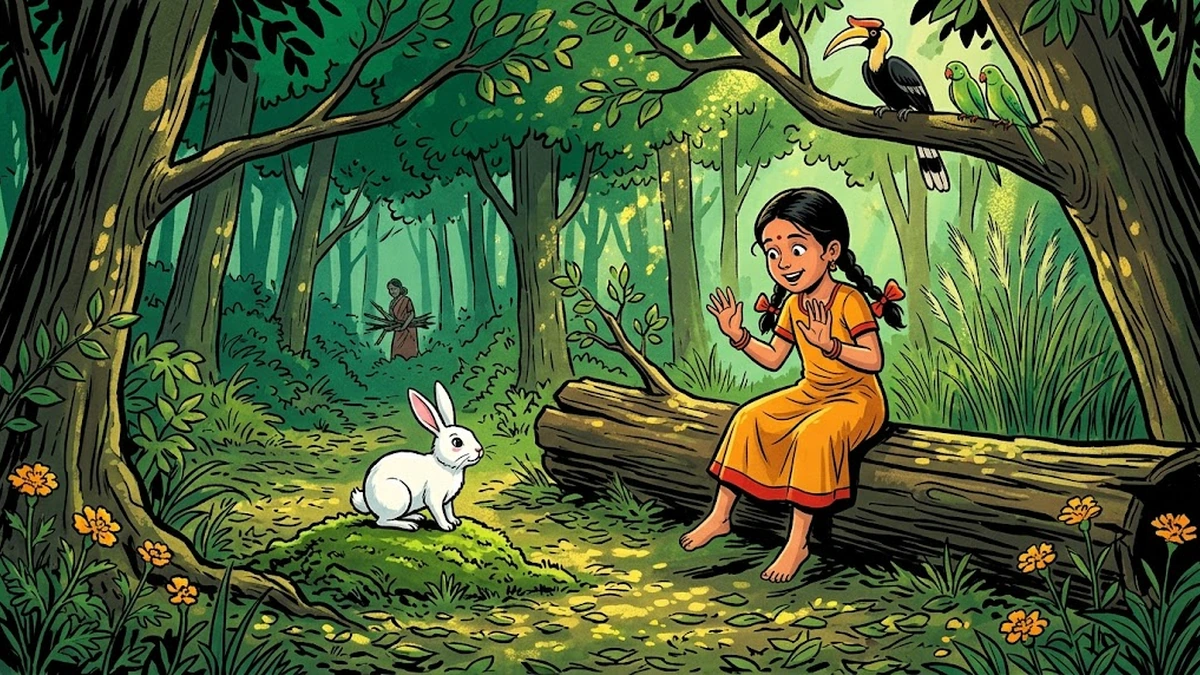
The opening of the story plants a deliberately humble economic scene because the whole tradition behind it — from the Bodhisatta-as-poor-brahmin in the Jātakas to the unnamed kanyā (“girl”) of the Punjabi reward-of-kindness cycle — insists that magical reward only descends on those who would be kind whether or not it descended. Stith Thompson H1554 “Test of compassion” and L114.1 “Lazy hero” together draw the structural point: the heroine is identified as worthy before the supernatural arrives, by the way she lives when no one is watching. Tara’s careful gathering, her habit of leaving the just-budding branches alone, her uncomplaining small bundle next to her mother’s larger one, her sitting on the log “admiring the trees and the birds” — all of these are not pretty narrative ornaments, they are the sober dharmic bookkeeping by which Indian storytelling decides who gets the wish-granting fairy.
2 · The Rabbit That Was Not a Rabbit
The cute rabbit that hops out from under the kāś-grass and lets Tara catch it is the second great folkloric signal, and one of the oldest. Animal-disguised-divinity (Stith Thompson D100–D199 “Transformation: man to animal”, D300–D399 “Animal to man”, D621 “Daily transformation”) is the spine of an enormous Indian sub-tradition: Indra disguised as a hawk testing King Śibi’s compassion in the Mahābhārata (Vana-parva 197), Agni disguised as a brahmin testing the same king in Jātaka 499 (the Sivi-Jātaka), the gods disguised as a starving brahmin to test the hare-Bodhisatta in Jātaka 316 (the Sasa-Jātaka, the most famous compassion-test in all of Buddhist literature, where the hare leaps into the sacrificial fire to feed the brahmin and is set in the moon by Indra as the śaśa-lakṣaṇa “hare-mark” we see there to this day). The rabbit-form is not accidental. The hare is, in pan-Indian mythology, the canonical animal of self-emptying compassion, and its appearance in this children’s tale silently inherits the entire Buddhist Sasa-cycle behind it.
The fairy’s curse-explanation — that a wicked witch had bound her in rabbit-form until “an innocent and kind-hearted person” should touch her — is itself a precisely catalogued motif: Stith Thompson D700 “Disenchantment by appropriate act”, with the specific subtype D712.6 “Disenchantment by being touched by a pure soul”. It runs through Indian story-cycles from the Kathāsaritsāgara of Somadeva (Kashmir, c. 1063–1081 CE, Tarangas 22–24, where curses are lifted by acts of compassion at sacred fords) to the Bengali Thakurmar Jhuli tales in which rajkanyas caught in animal-form are released by the simple, unselfish kindness of a passing villager. The fairy’s grateful offer of “one wish” is ATU 503 “The Gifts of the Little People” in its purest Indian form: not a treasure-hoard, not a kingdom, not a wedding to a prince — a single, weighable wish, the ethical X-ray that the rest of the story will use to read Tara’s heart.
दया धर्मस्य जन्मभूमिः ।
dayā dharmasya janmabhūmiḥ
“Compassion is the birthplace of dharma.”
— Sanskrit nīti-vacana, attested in the Cāṇakya-nīti-darpaṇa (c. 4th century BCE tradition, manuscript transmission via Kṣemendra and the Kashmir florilegium tradition), and quoted by the Tamil Tirukkuṟaḷ commentator Parimēlaḻakar (c. 13th century CE) at Kuṟaḷ 25.
3 · The Magic Stick and the Wounded Elephant
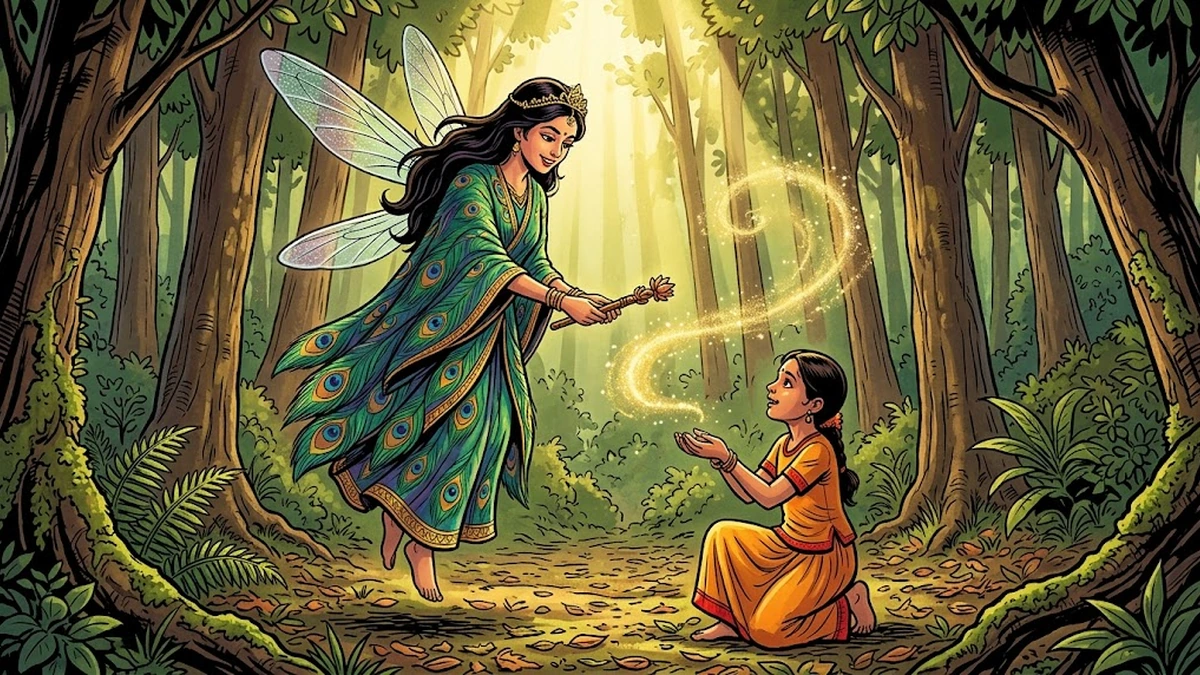
Tara comes home with a length of polished sandalwood in her small fist — a wand, a daṇḍa, a yaṣṭi, a cetana-daṇḍa (“staff of intention”) in classical Sanskrit poetic vocabulary. The magic stick that grants a single wish, given by a grateful supernatural to a poor but pure protagonist, is Stith Thompson D1254.1 “Magic wand” with the gift-context D817 “Magic object received from grateful fairy” and the narrative governor D1761.0.1 “Limited wishes”. In the Indian sub-stratum the same object appears as the kalpataru-twig (a fragment of the Wish-Tree from Indra’s heaven), the cintāmaṇi-bead, the akṣaya-pātra (inexhaustible bowl) given by Sūrya to the Pāṇḍavas in Mahābhārata Vana-parva 3.36, and the brahmin’s water-pot in the Bengali Saat Bhai Champa cycle. Folklorist A. K. Ramanujan, in his magisterial Folktales from India: A Selection of Oral Tales from Twenty-Two Languages (Pantheon Books, 1991), groups all of these under what he called “the limited-magic motif” — the storyteller’s deliberate constraint that forces the protagonist’s character to choose which single wish, since unlimited magic would dissolve the moral test that the tale is built to administer.
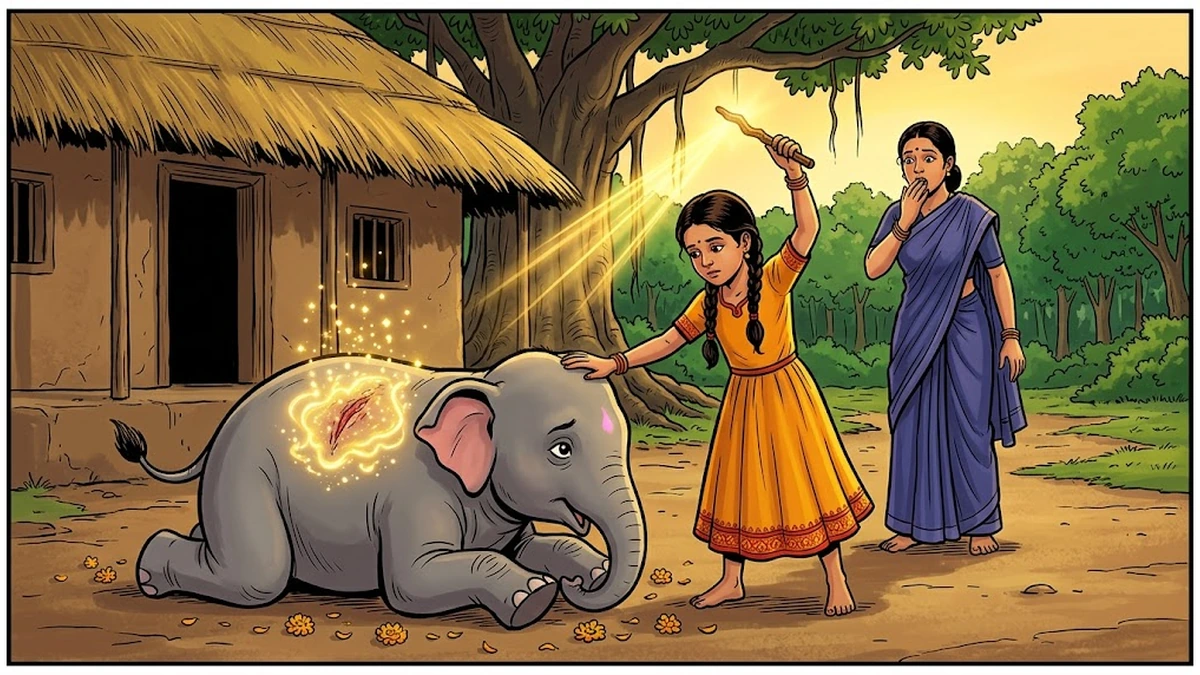
And then, exactly when the constraint is in place, the wounded baby elephant appears in front of the hut. The detail is doing precise dharmic work. The elephant calf (karī-śiśu in Sanskrit, gaja-bāla in Pali) is the third great Indian symbol in the tale, after the rabbit and the wand. Elephants are gaṇeśa-vāhana (the vehicle of Gaṇeśa), airāvata (Indra’s white mount in Ṛgveda 4.42 and Bhagavad-Gītā 10.27), and the canonical figure of remembered kindness in the Mātaṅga-Jātaka (No. 497) and the Catu-Posatha-Jātaka (No. 441), where elephants who have been treated with compassion repay the kindness across whole lifetimes. To wound an elephant calf in a story is to summon the entire compassion-to-elephants tradition into the foreground; to heal it is to step inside it. Tara’s swirl of the wand — used not for clothes, not for sweets, not for a palace, but for a stranger animal’s pain — is the precise narrative gesture catalogued by Stith Thompson as Q42 “Generosity rewarded” and L113.1.0.1 “Heroine gives away her own gift”, the second motif being the deepest signature of the Indian sub-cycle. The Punjabi Princess Aubergine heroine gives her one fruit to the wandering yogi; the Bengali Kiranmala gives her last lamp-oil to the blind beggar; Tara gives her one wish to the bleeding elephant. The pattern is rigorously identical because the moral physics of the cycle is identical.
4 · The Fairy Returns
The fairy’s second appearance — punarāgamana, the “returning manifestation” in classical Sanskrit narrative theory codified by Bharata’s Nāṭyaśāstra (c. 200 BCE – 200 CE) and refined by Ānandavardhana’s Dhvanyāloka (Kashmir, c. 850 CE) — is the formal closing-bracket of the test. In the Sanskrit theatre tradition, a divine character who has appeared once disguised will reappear undisguised only after the human protagonist has made the choice that justifies the revelation. Tara has now done so. The fairy’s blessing — that Tara and her family will be granted “all the riches of the world” — is therefore not a ladder-climb from rags to wealth (the modern Western wishing-tale sometimes treats it that way), but the ritual conferral of the dharmic reward that was already due. The Sanskrit term is phala-prāpti, “the obtaining of the fruit”: a kind action sown unwitnessed in the forest at dawn now ripens, witnessed, at the threshold of the hut at dusk. Stith Thompson Q1.1 “Hospitality rewarded” and Q44 “Reward for charity” map the closure exactly. The Tamil Tirukkuṟaḷ 211 says it once and finally: “The reward of compassion is compassion’s own ripening; it asks for nothing else and is paid in nothing else.”
The Moral
The story’s moral is the sentence that Pañcatantra, Jātaka, Mahābhārata, Tirukkuṟaḷ and the modern children’s retelling all agree on, in different surfaces of the same dharmic substance: kindness offered without calculation is the only kindness that bears fruit. Tara does not stroke the rabbit because she suspects it is a fairy. She does not heal the elephant because she expects a second visit from the fairy. She acts because acting kindly is what her nature, schooled by her mother’s poverty and her own quiet attention to the suffering around her, has made automatic. The Sanskrit phrase for that automaticity is svabhāva-dāna — “giving as one’s nature” — and it is the pivot on which the whole Indian compassion-literature turns.
அருளில்லார்க்கு அவ்வுலகம் இல்லை பொருளில்லார்க்கு
இவ்வுலகம் இல்லாகி யாங்கு ।
aruḷ-illārkku av-ulagam illai poruḷ-illārkku
iv-ulagam illāgi yāṅgu
“Just as those without wealth find no place in this world, those without compassion find no place in the next.”
— Tirukkuṟaḷ 247, Tiruvaḷḷuvar (c. 5th century CE), translated G. U. Pope, The Sacred Kurral of Tiruvalluva-Nayanar, W. H. Allen, London, 1886.
Why This Story Has Lasted
What keeps this small Indian fairy-tale fresh for a child in 2026 — when the rabbit, the hut, the bundle of forest-wood and even the village edge are receding from most listeners’ direct experience — is that the moral physics it dramatises has not changed. A kind act done without expectation still acts on the doer the way Tara’s act acts on Tara: it reorganises the inner life into a shape that the external world, sooner or later, will reward. Modern psychological research has independently rediscovered the principle (the literature on “prosocial spending”, “compassion satisfaction”, and the “helper’s high” maps onto svabhāva-dāna with uncanny precision) but the story has known it for at least two thousand years. Maive Stokes’s Indian Fairy Tales Collected and Translated (Ellis & White, London, 1879), Joseph Jacobs’s Indian Fairy Tales (David Nutt, London, 1892), Lal Behari Day’s Folk-Tales of Bengal (Macmillan, 1883), and Verrier Elwin’s Folk-Tales of Mahakoshal (Oxford University Press, 1944) all carry close cousins of this tale, each filed under a different language, each preserving the same compassion-rewarded armature beneath its local clothing. That cross-regional persistence — Punjabi, Bengali, Tamil, Gondi, Santali, Marathi, Kashmiri, all telling versions of the same story — is the empirical sign that the lesson is not regional but human.
For families reading the tale aloud to a small child today, the most useful pause is the moment before Tara sees the elephant. Ask the listener: “If you had a magic stick that could do one wish, what would you ask for?” Then read on, and watch the child notice that Tara, given the same stick, did not even have to think. That noticing is the work of the story. It is not a lecture against selfishness; it is a quiet demonstration that a heart trained to kindness will reach for kindness automatically, the way a trained hand reaches for the right tool. The trained heart is the only kind of magic the story actually believes in. The wand, the fairy, the elephant, and the riches are simply the visible forms it borrows so that a six-year-old can see the lesson clearly enough to remember it forty years later, when no rabbit and no fairy has yet appeared in the bedroom and the test has come, as it always does, in some plainer dress.
Cultural Context and Continuing Influence
The “kind little girl rewarded by a forest spirit” tale has been the spine of Indian children’s moral literature throughout the twentieth century. Anant Pai’s Amar Chitra Katha series (Bombay, India Book House, founded 1967) reused the structural template across dozens of titles in its Folktales and Fables and Humour sub-series; the Children’s Book Trust in New Delhi (founded by K. Shankar Pillai in 1957) carried it through its Tales from Indian Folklore imprint; the National Book Trust of India rendered it in Hindi, Tamil, Bengali, Marathi, Gujarati, Kannada, Malayalam, Oriya, Punjabi and Assamese under the Nehru Bal Pustakalaya series from 1957 onwards. In the academic register, A. K. Ramanujan‘s Folktales from India (1991), Sadhana Naithani‘s The Story-Time of the British Empire (University Press of Mississippi, 2010), and Stuart Blackburn‘s Moral Fictions: Tamil Folktales from Oral Tradition (Academia Scientiarum Fennica, 2001) have each placed the Indian kind-girl cycle alongside its global ATU 480 / 503 cousins — Grimm’s Frau Holle (KHM 24), Perrault’s Les Fées (1697), the Russian Morozko (Afanasyev 95), the Korean Heungbu and Nolbu, the Japanese Shitakiri Suzume, and the Aesopic Androcles and the Lion (Perry 563) — and shown how the deep structure travels intact across language while the surface decoration changes country by country. Tara’s village is one stop on a route the story has been walking for two and a half millennia.
Reading This Story With Children
When reading Tara aloud, slow at three places: the moment Tara catches the rabbit (let the child guess what it really is), the moment the fairy offers the wish (let the child say what they would ask for), and the moment Tara sees the wounded elephant (let the silence of the page do the work — most children, given a few seconds, will arrive at the right answer themselves). After the reading, the most productive question is not “what was the moral?” but “where in the story did Tara already become the kind of person who could pass the test?” — because the story’s actual claim is that the test was passed in the years before the fairy ever arrived, in the unrecorded morning-walks to gather wood and the unrecorded sharings of food in lean seasons, and the visible test in the forest only ratified what was already true. Children who hear the tale this way are receiving the oldest piece of Indian moral education there is: character is the long, quiet rehearsal that the visible moments only reveal. That is a lesson worth a hundred tellings.
Frequently Asked Questions
**Q: Why is this story important?**
You May Also Like
 Indian Folk Tales
Ages 12+ / YA
Indian Folk Tales
Ages 12+ / YA
How Raja Rasalu Swung The Seventy Fair Maidens Daughters Of The King
How Raja Rasalu Swung The Seventy Fair Maidens Daughters Of The King: The story of Raja Rasalu has echoed through the ages in Indian folk tradition, capturing
 Indian Folk Tales
Ages 3-5
Indian Folk Tales
Ages 3-5
Kaliya Daman – Krishna Tames The Serpent Kaliya – Indian Mythological Story
Kaliya Daman – Krishna Tames The Serpent Kaliya – Indian Mythologica: In the Dvapara Yuga, Krishna lived in Vrindavan as an incarnation of Vishnu, born to
 Indian Folk Tales
Ages 9-12
Indian Folk Tales
Ages 9-12
The Blind Men and the Elephant
The Blind Men and the Elephant: In a city famous for its universities and temples, there lived six blind men who were considered among the most learned in the