Sir Buzz
Sir Buzz: Once upon a time a soldier died, leaving a widow and one son. They were dreadfully poor, and at last matters became so bad that they had nothing left
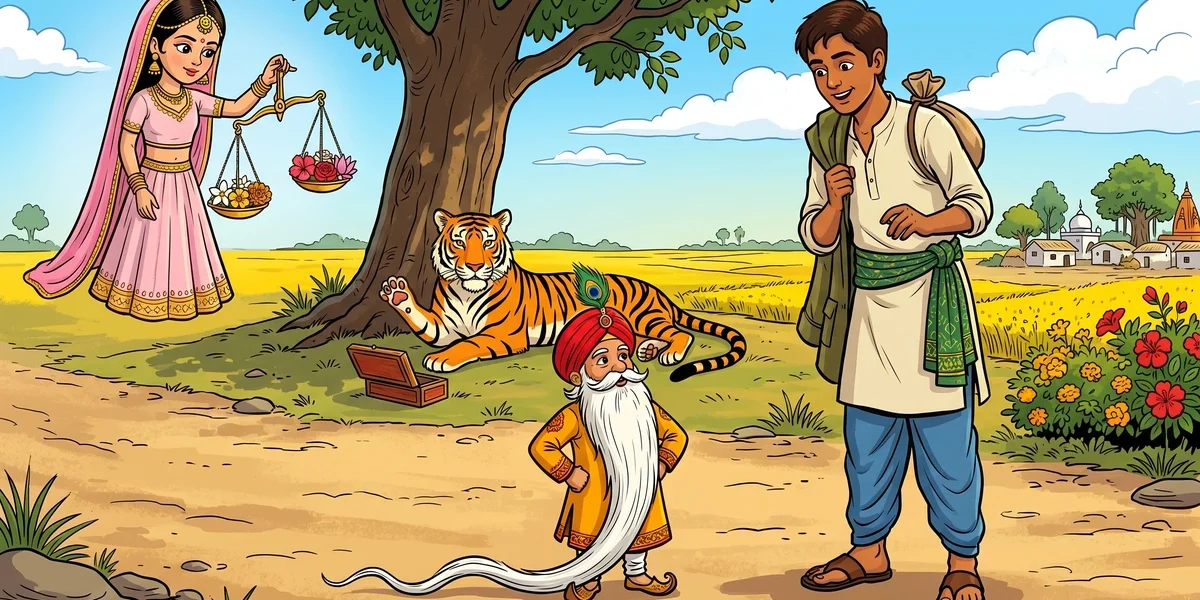
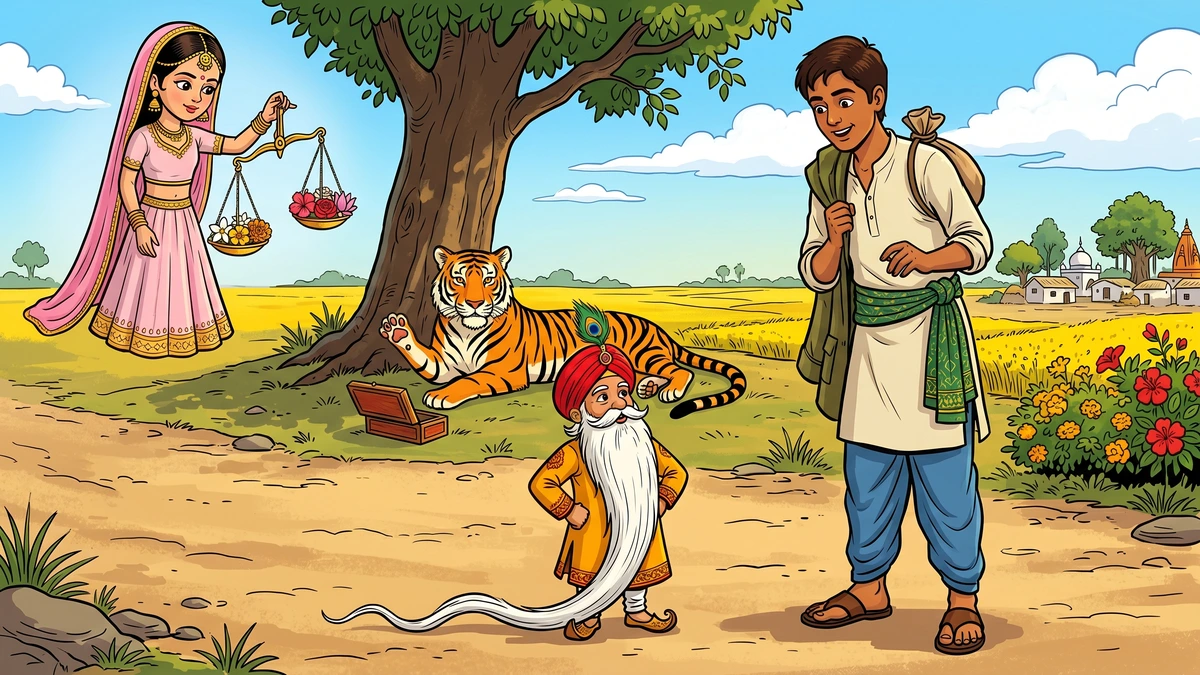
Sir Buzz is one of the most beloved comic-magical Punjabi folk-tales in the English-language record, the opening story of Tales of the Punjab: Folklore of India, collected and translated from oral Punjabi tellers by Flora Annie Steel in 1894, illustrated by John Lockwood Kipling (the father of Rudyard Kipling), and annotated comparatively by the great Indian folklorist Sir Richard Carnac Temple. Its hero is not the soldier’s son who walks out into the world with six shillings in his pocket but the irascible one-span mannikin, with a beard a quarter-span longer than himself, who springs out of a tigress’s wooden box, fetches a hundredweight of sweets and two hundredweights of flour from the bazaar without paying a single shilling, carries his master through the air to the chamber of a fair Princess named Blossom (so slender she weighs only five flowers in golden scales), uproots a tree to rout the King’s cavalry, and at last fights a shape-shifting duel against a vampire-Brāhman through rain and wind, dove and hawk, rose and mouse, before delivering the lovers home and vanishing forever with one final loud boom! bing! boom!. The story is, all at once, a Punjabi village comedy, an echo of the Arabian Nights, a domestic Indian Aladdin-tale, and a children’s-bedtime distillation of the most ancient Indo-European motif in folk literature: the helpful supernatural servant who arrives small, departs unthanked, and leaves only the gift of a single hair.
The tale belongs, in the Aarne-Thompson-Uther international classification, to the great compound family of ATU 561 (Aladdin) — the magical genie summoned from an enclosed object — overlapping at its climax with ATU 325 (The Magician and his Pupil), the universal shape-shifting battle in which two enchanters chase one another through a sequence of forms (rain–wind, dove–hawk, rose–mouse–cat) until one wins by anticipating the other’s last transformation. Steel’s Tales of the Punjab was the first major English-language collection to set the Punjabi oral tradition into print with full scholarly notes, and Sir Buzz — whose name imitates the whiz! boom! bing! of his bee-like flight — is the volume’s signature character, a tiny, irritable, fiercely loyal helper who has lived in the Indian children’s-bedtime imagination for more than a hundred and thirty years.
The Six Shillings, the Tigress, and the Box that Grew Heavy
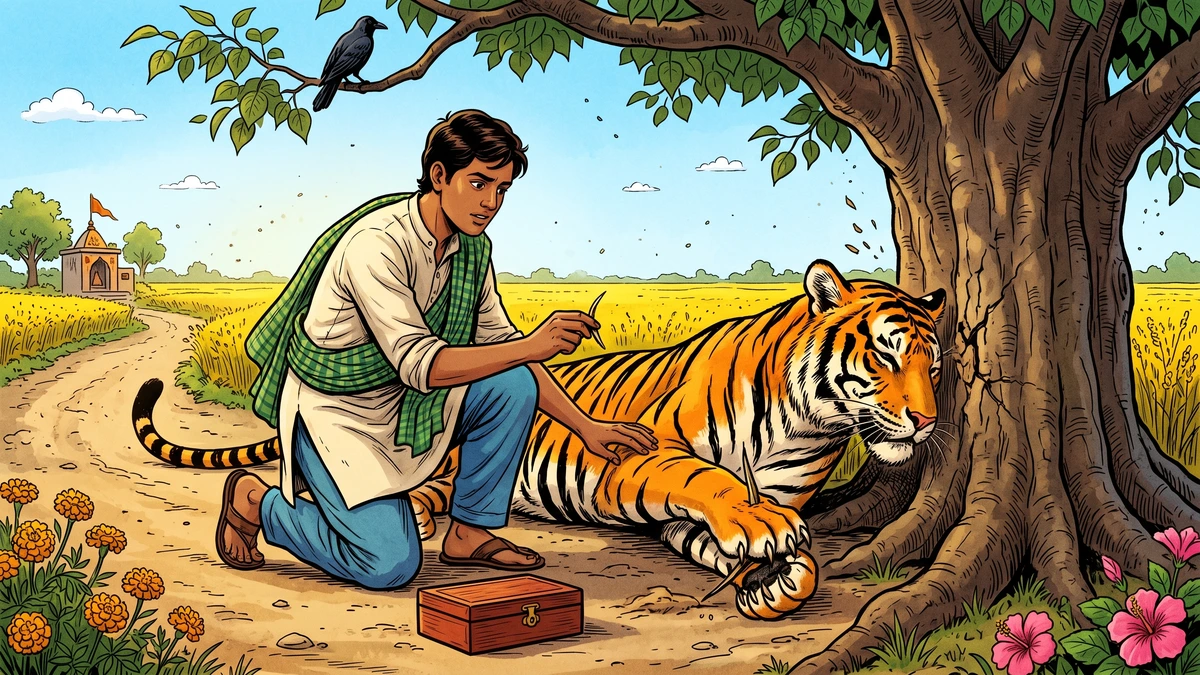
The story opens with the oldest narrative situation in the Punjabi village repertoire: a poor widow’s son, all his father’s wealth gone, sets out on the long road to make his fortune. He asks his mother for four shillings; she reaches into the pocket of his dead father’s old soldier’s coat and finds, against all hope, six. Two are left for her, four are tied into a corner of his sash, and the lad walks out of the village onto the dusty Punjab plains. The first beat of the story turns on his immediate decency — he does not pocket the extra two shillings; he leaves them with his mother — and on his courage, because the very first thing he meets on the road is a tigress, lying in the shade of a tree, licking her great paw and moaning with the pain of a thorn.
This is the test motif that unlocks every Indo-European helpful-animal tale, from the lion-and-Androcles fable of Aulus Gellius (Noctes Atticae V.14, 2nd century CE) through the Pañcatantra‘s lion-and-mouse stories through the European märchen of grateful beasts. The lad knows perfectly well that a wounded tiger can kill him with a single pat, and he says so plainly. The tigress, with the courteous Indian wit characteristic of Steel’s Punjabi sources, replies that she will turn her face to a tree and beat the trunk when the pain comes. The lad pulls the thorn; the tigress strikes the tree so hard that its trunk splits to splinters; and the soldier’s son receives, in solemn gratitude, a small wooden box with the strange instruction not to open it before he has walked nine miles.
The walk that follows is itself a small Punjabi comic masterpiece. At five miles the box already feels heavier than at first; at six it is heavier still; at seven it is almost intolerable; at eight and a quarter the lad’s patience snaps, and with a kind of village-irritation that any Punjabi grandmother in the audience would recognise instantly, he flings the box down with the words, “Lie there, you wretched old box! — heaven knows what is in you, and I don’t care.” The box bursts open and out climbs a one-span mannikin — a creature about nine inches tall, his beard a span and a quarter long, trailing on the ground in front of him — already in a towering rage about the rough handling of his transport. He gives his name as Sir Buzz, and the second beat of the tale begins with the comic confrontation of a small, furious magical servant and a large, hungry, slightly bewildered young master.
The Hundredweight of Sweets and the Two Hundredweights of Flour
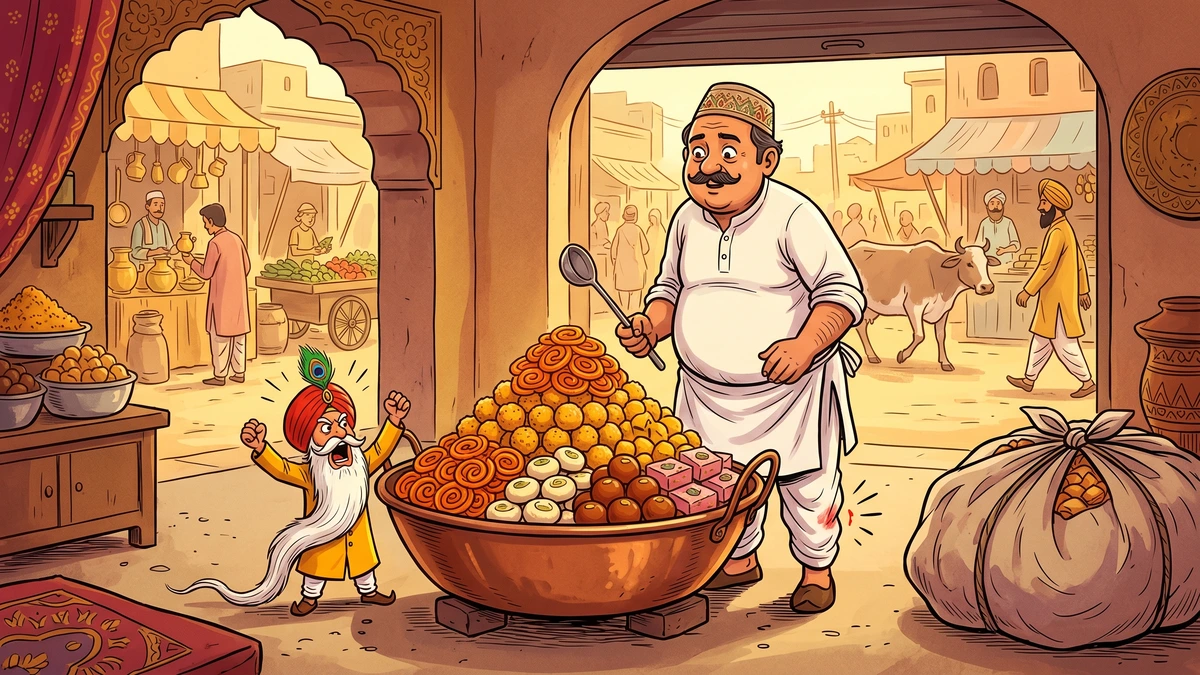
The middle beat of the tale is its broadest comedy and the source of Sir Buzz’s enduring popularity in the Indian children’s repertoire. The soldier’s son, hungry from his walk, hands his servant the four shillings tied in his sash and asks for dinner. With a whiz! boom! bing! like a great bee, Sir Buzz flies off through the air to the nearest town and into a confectioner’s shop, where he stands hidden behind the great preserving-pan of boondi and jalebi and roars in the loudest possible voice: “Ho! ho! Sir Confectioner, bring me sweets!” The confectioner cannot see his customer; Sir Buzz bites him on the leg, kicks him on the foot, and demands, with the imperious manner of a Punjabi nobleman, a hundredweight of his finest sweets. He carries the entire hundredweight away on one outstretched palm and — crucially — flies off with the four shillings still in his pocket.
The same scene then repeats at a corn-chandler’s shop, where Sir Buzz orders two hundredweights of flour, bites and kicks the chandler with the same cheerful violence, and again flies off with both the flour and the unspent money. The pattern is the Punjabi village version of the Arabian Nights‘s genie-of-the-lamp — a magical servant who fulfils his master’s command with terrifying excess — but rendered, as Steel’s translation faithfully preserves, in the dust and laughter of a Lahore or Multan bazaar rather than in the marble courts of Baghdad. When Sir Buzz returns, it is the small servant who eats most of the food, gobbling sweets and girdle-cakes by the handful and complaining at every mouthful that “you men have such terrible appetites, such terrible appetites.” The reversal — the tiny helper out-eating the grown master — is a stock comic image in Punjabi village storytelling, and the storyteller-grandmother always lets the children laugh at it before the tale moves on.
What this entire central episode preserves, beneath its broad comedy, is one of the deepest commercial-ethical jokes of the Punjabi oral tradition. Sir Buzz takes the goods and keeps the money; but neither shopkeeper is the worse for it (we never learn that Sir Buzz’s coins were not paid; only that they were not spent), and the children of the audience are quietly trained to notice that the size of the customer is not the measure of the order, that the loud voice in the shop may issue from a hidden mannikin, and that the Indian bazaar is a place where the visible and the invisible transact every day. It is, in miniature, the same lesson the Pañcatantra‘s book on Mitra-bheda teaches in larger form: judge not the agent by the size, but by the result.
Princess Blossom, the Golden Scales, and the Tree that Fought
The third beat carries the story from comedy into romance. The soldier’s son and his miniature servant travel onward and reach the King’s city, where the Princess Blossom — so lovely, and tender, and slim, and fair, that she only weighed five flowers — is weighed every morning in golden scales, the scale always turning when the fifth flower is set in. Steel’s translation preserves the exact Punjabi figure of the five-flower princess, an image of female delicacy and refinement that runs through the Punjabi qissa tradition (the romance literature of Heer–Ranjha, Sohni–Mahiwal, Sassi–Punnu, Mirza–Sahiba, the four great love-tragedies of Punjab) and surfaces, here, in the gentlest possible folk-tale form. The soldier’s son catches one glimpse of her, falls instantly into the love-sickness of the qissa-hero (ishq, in Punjabi-Urdu poetic idiom), and refuses to eat or sleep until Sir Buzz consents to carry him to the Princess.
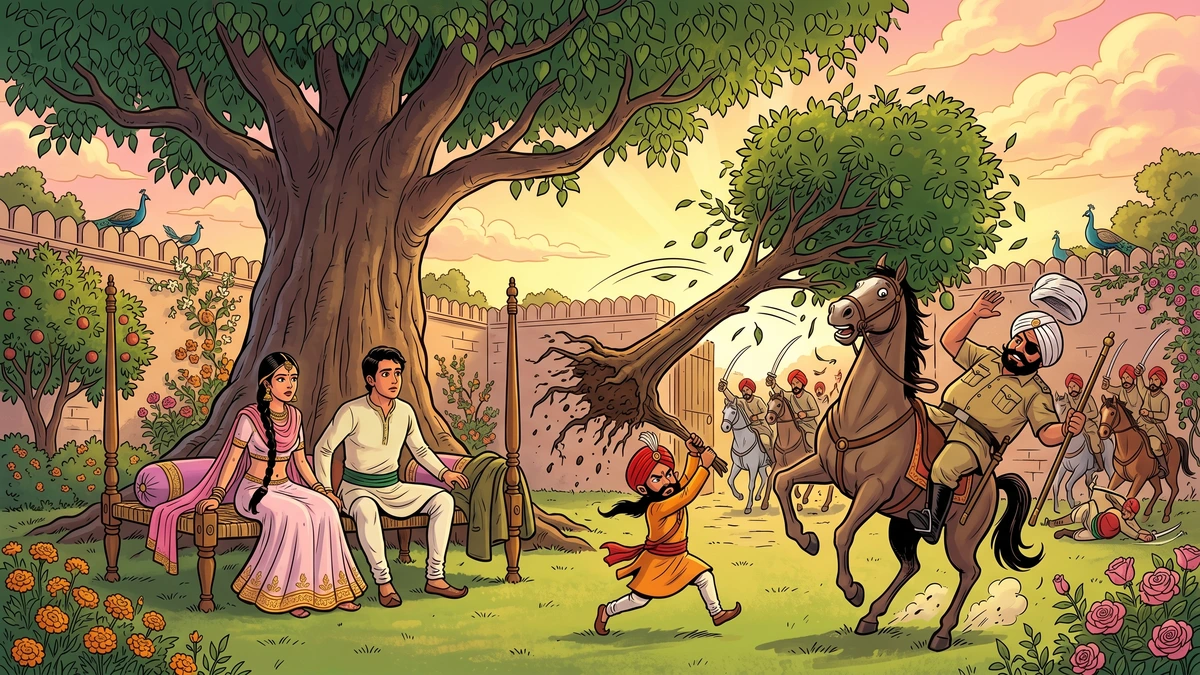
The carrying itself is one of the most-quoted small images in the entire Tales of the Punjab: the one-span mannikin, with the soldier’s son sitting on his outstretched hand, whizzing through the night sky with a tremendous boom! bing! boom! directly to the Princess’s chamber. There the lovers meet, talk all night about everything delightful — Steel’s tactful Victorian phrase that her Punjabi tellers would have rendered with much more amorous specificity — while Sir Buzz, with the comic decorum of a faithful family servant, sets a brick up on end at the doorway so that he may not seem to pry upon the young people. At dawn, when the lovers have fallen asleep, Sir Buzz lifts the entire bed and flies it out to a great garden outside the town, sets it down beneath the largest tree, uproots the second-largest tree, throws it over his shoulder like a club, and stands sentry.
What follows is one of the great visual-comic set-pieces of nineteenth-century Indian folk-collection. The one-eyed Chief Constable rides up to investigate the disappearance of the Princess; Sir Buzz, invisible behind the tree, swings the tree like a giant’s mace and beats the Constable’s pony so hard it bolts. The King sends an entire cavalry; Sir Buzz routs them all from behind the same tree, half killed, half running. The combat, as remembered by Punjabi storytellers, is funny and frightening at once — funny because the assailant is a nine-inch mannikin with a long beard, frightening because the tree he wields is real. The Princess and the soldier’s son wake to the sound of cavalry breaking against a tree and decide, on the spot, to elope together; and Sir Buzz, having delivered them safely to the open road, plucks a single hair from his great beard, hands it to his master, and says with characteristic gruff affection: if you should get into trouble, just burn it in the fire. I’ll come to your aid. Then he booms off, and the lovers travel on alone.
The Vampire-Brāhman and the Shape-Shifting Battle
The fourth and most archaic beat of the tale is its great climactic shape-shifting duel, the moment when Sir Buzz reveals itself, beneath its Punjabi village comedy, as one of the oldest narrative structures in Indo-European folk-literature. The lovers, lost in a forest, are rescued by what appears to be a kindly Brāhman — but who is in fact a rākṣasa-vampire of the most classical kind, descended in the Indian imagination from the vetāla of the Sanskrit Vetāla-pañcaviṃśati (the “Twenty-five Tales of the Vampire”, c. 11th century CE), the corpse-spirit of Kathāsaritsāgara, and the long line of disguise-eating demons that haunts every Sanskrit and regional Indian tale-cycle. The vampire takes them home, sets them up in his house, and gives them the keys to all his cupboards save the one with the golden key — the universal forbidden-room motif that runs from Bluebeard to the Pandora-myth to the door-of-the-locked-chamber in countless Indian stories.
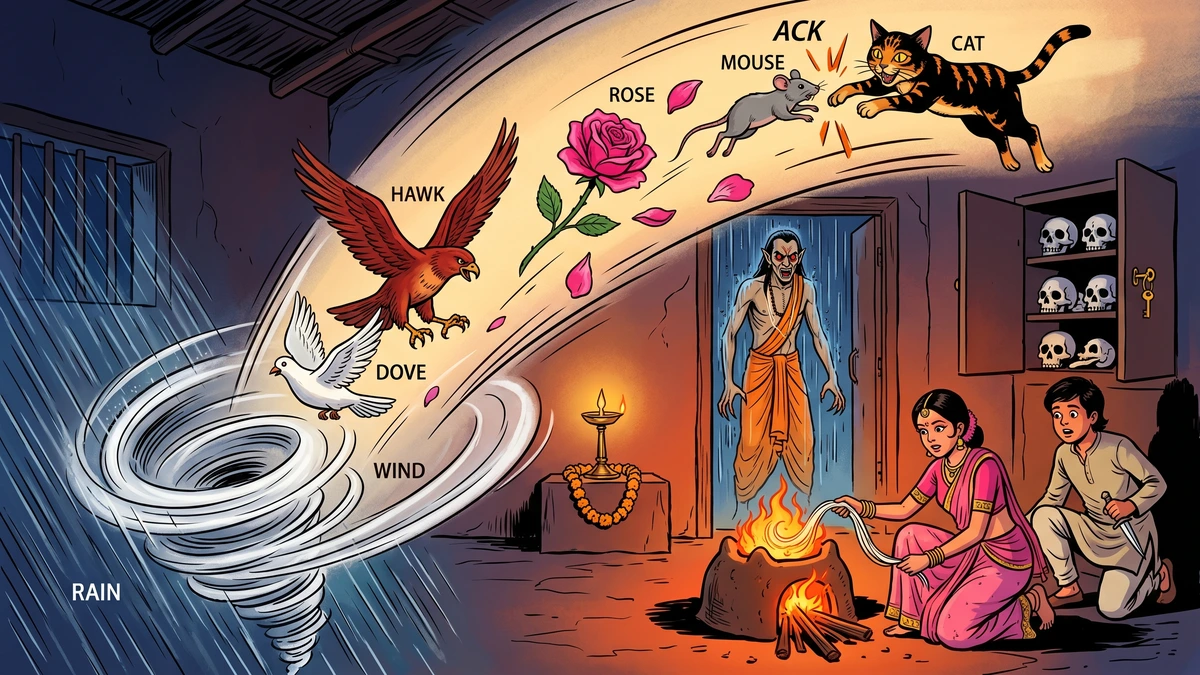
The soldier’s son opens it; the cupboard is full of polished human skulls. The Princess Blossom — the small bright detail that distinguishes the Punjabi telling — is the one with the presence of mind to act. She thrusts Sir Buzz’s hair into the kitchen fire just as the vampire, with sharp teeth and fierce eyes, walks in at the door. From outside comes the rising roar of the boom–bing–boom, and the shape-shifting battle begins. The vampire becomes a heavy rain to drown Sir Buzz; Sir Buzz becomes the storm-wind that beats it back. The vampire becomes a dove and flies for refuge; Sir Buzz pursues as a hawk and presses him so hard that he changes again into a rose and falls into the lap of King Indra in the celestial court. Sir Buzz, with the speed of thought, becomes an old musician, displaces the bard at Indra’s side, plays so wonderfully that Indra grants him any boon, and asks for the rose. Indra throws it; the petals scatter; one petal escapes as a mouse; Sir Buzz, with the speed of lightning, becomes a cat and gobbles it up.
This sequence — wind chases rain, hawk chases dove, cat catches mouse — is the great shape-shifting battle of Indo-European folklore, classified as the climax of ATU 325 (The Magician and his Pupil). It appears in the Welsh Hanes Taliesin (the chase of Gwion Bach by the witch Ceridwen, c. 16th century manuscript over much older oral matter), in the Greek myth of Zeus pursuing the shape-shifting Metis, in Scottish ballad The Twa Magicians (Child 44), in countless Russian magician-tales, and across the entire South-Asian Indo-European belt. Steel’s Punjabi version of the motif is one of the most economical, vivid, and complete in print: five transformations, no wasted gesture, the cat eating the mouse and the battle ending in a single cleared sentence. Then with a final boom! bing! Sir Buzz arrives back at the vampire’s hut, gathers the jewels and gold of the dead vampire’s house in one hand, places the Princess and the soldier’s son in the other, flies them home to the widow — who has been living all this time on the two shillings — and, with the loudest boom! bing! boom! of the entire story and without waiting for a single word of thanks, whizzes out of sight forever.
Moral
The moral of Sir Buzz, as Punjabi grandmothers have always told it, is twofold. The surface lesson is the lesson of the kept promise: the soldier’s son pulls the thorn from a stranger’s paw without expecting a reward, and the universe — through the medium of a tigress, a wooden box, a one-span mannikin, and one hair from a long beard — repays him a hundredfold. The deeper lesson is the lesson of the small helper: that the greatest powers in the world arrive in the smallest packages, and that the agent who looks too small to carry a hundredweight of sweets may, in fact, be the only being in the universe who can save you from the vampire. The Punjabi proverb that closes most tellings of the tale captures both lessons in a single line:
ਛੋਟੀ ਜਿਹੀ ਮਿਰਚ, ਵੱਡਾ ਜਿਹਾ ਸੁਆਦ।
chhoṭī jihī mirch, vaḍḍā jihā suād.
The chilli is small, but its taste is great.
— Punjabi village proverb, recorded by R. C. Temple in Legends of the Panjâb (1884–1900), III.412
The same teaching surfaces in the Sanskrit nīti-tradition as the closing verse of the Hitopadeśa‘s Mitralābha book — na deśakālau na guṇau na jātir | na vidyate yatra na vā vayāṃsi | tatraiva kāryaṃ samupaiti siddhim | yatrāsti pumsāṃ pratibhāsamṛddhiḥ, “not place, not time, not virtue, not caste, not learning nor age determines a deed’s success — but the resourcefulness of the doer alone.” In the Pañcatantra‘s framing it surfaces as the verse on the smallness of the wise (buddhirjayati nāṅgala-balam, “intelligence conquers, not the strength of arms”); in the children’s-Punjabi rendering it surfaces as Sir Buzz himself, who is the smallest figure in the entire tale and the most important.
Why This Story Has Lasted
Sir Buzz has stayed alive in the Indian children’s-bedtime canon for the same reason every great Indian folk-tale stays alive: it does, in a single half-hour at the side of a child’s bed, what the long Sanskrit and Punjabi epics do across many evenings. It tells the child that the universe is full of small invisible helpers; that loyalty is repaid with loyalty; that the irritable beard-trailing servant in the box may be more powerful than the tiger that gave you the box; that a hair from a friend’s head is a greater treasure than a cupboard full of gold; and that the most magical battle in the world ends, very simply, with a cat eating a mouse. For the modern Indian household reading the tale aloud, every set-piece — the bargaining at the bazaar, the elopement, the tree that fights, the cupboard of skulls, the chase through the elements — survives translation perfectly, because each set-piece is a complete miniature of one of the great Indian narrative situations that the household already knows from a dozen other tellings.
What the Punjabi village tradition has preserved in Sir Buzz, and what Flora Annie Steel had the rare good sense to keep in her 1894 translation rather than rewrite into a Victorian moral, is the quality the Indian children’s-literature tradition prizes above all others: the cheerful refusal of moral commentary. The story does not tell the soldier’s son that he should have been kinder to the box, or thanked Sir Buzz more handsomely, or asked the Princess’s permission before being carried to her chamber. It simply lets the action stand. The widow eats the two shillings; the lovers live happily ever after; Sir Buzz vanishes with one final boom!; and the child who has heard the tale closes their eyes already knowing, without a single word of explanation, that the small voice in the back of the shop, the small helper in the box, the small hair in the fire, are the ones to listen to. That is the Indian children’s-bedtime education in miniature, and that is why a story this old has not yet stopped being told.
The Punjabi Storytelling Lineage Behind the Tale
Behind Sir Buzz’s three-page comic-magical narrative runs a textual genealogy that the comparative folklorist can trace through at least six layers of Indian transmission. The deepest Indian layer is the Vetāla-pañcaviṃśati tradition (Sanskrit, c. 11th century CE in its surviving recension by Śivadāsa, but with oral roots much older), in which a corpse-vampire on a tree tells stories to King Vikramāditya — the same vampire-figure that surfaces in Sir Buzz‘s false Brāhman. The second is the Kathāsaritsāgara of Somadeva (c. 1070 CE, Kashmir), the great Sanskrit ocean-of-story that compiles dozens of magical-helper, shape-shifting, and disguise-eater motifs that recur in nineteenth-century Punjabi oral tellings.
The third layer is the long Punjabi qissa tradition — the verse-romances of Heer–Ranjha (Waris Shah, 1766), Sohni–Mahiwal, Sassi–Punnu, and Mirza–Sahiba — whose ishq-stricken hero, falling in love at first glance, returns in miniature in the soldier’s son’s instant infatuation with Princess Blossom. The fourth is the Punjabi village storytelling tradition of the kahānī-vālā and the nānī-kī-kahānī, the household oral matter that R. C. Temple began collecting in the 1880s and that Flora Annie Steel, fluent in Punjabi from her years as the wife of an Indian-Civil-Service officer in Kasur and Lahore, wrote down directly from the lips of village women, peasants, and bazaar storytellers between 1880 and 1894.
The fifth layer is the pan-Indian jinn-and-genie tradition imported by the long Mughal contact with the Alf Layla wa-Layla (the Arabic Thousand and One Nights), of which Sir Buzz is a domestic Punjabi village version — the Aladdin-genie reduced to one span, given a beard, named for the buzz of his own flight, and made to live in a wooden box rather than a brass lamp. The sixth and outermost layer is the modern Indian children’s-publishing movement, from the National Book Trust readers and the Children’s Book Trust collections of the 1960s onward through Tulika, Pratham, Karadi Tales, and the digital children’s-platforms of the 2010s and 2020s, all of which have re-told Sir Buzz in dozens of new editions and languages because the shape of the tale — small servant, large adventure, no commentary — is exactly the shape an Indian children’s bedtime requires.
Reading the Tale Today
For a parent or teacher reading Sir Buzz aloud to an Indian child today, the small art of the tale lies in three places: the bargain at the bazaar, the duel of trees and cavalry in the garden, and the shape-shifting battle through rain, dove, rose, and mouse. Read the bazaar scene with the loudest possible Ho! ho! Sir Confectioner! — the entire comic energy of the Punjabi original lives in that shout. Read the elopement scene with all the silliness of the brick-on-end and the bedroom-flown-into-a-garden — the Punjabi village audience always laughed at this, and modern children still do. Read the shape-shifting battle slowly, holding the suspense at each transformation; the cat-and-mouse ending is one of the oldest narrative resolutions in the Indo-European repertoire and lands as crisply now as it did in Lahore in 1894.
Above all, do not over-explain Sir Buzz. The Punjabi storyteller never did. He is the small loyal magical servant who arrives unannounced and departs unthanked, and the child who grows up listening to the tale will, of their own accord, recognise the figure all over Indian and world literature thereafter — in the Aladdin’s-genie, in the Arabian-Nights’ marid, in the brownie of Scottish folk-tale, in the dwarf-helper of the Brothers Grimm, in the Tolkien hobbit and the Bilbo-and-Gandalf pair, in every story in which the small companion turns out to be the indispensable one. That recognition, slowly built up across many bedtimes, is the long Punjabi gift that Sir Buzz still gives to the modern Indian child.
You May Also Like
 Indian Folk Tales
All Ages
Indian Folk Tales
All Ages
The Charmed Ring
The Charmed Ring: In a remote village at the foot of the Himalayan mountains, there lived a poor but honest widow and her only son, Ramu. They owned nothing
 Indian Folk Tales
All Ages
Indian Folk Tales
All Ages
The King Who Would Be Stronger Than Fate
The King Who Would Be Stronger Than Fate: Once upon a time, far away in the east country, there lived a king who loved hunting so much that, when once there
 Indian Folk Tales
Ages 9-12
Indian Folk Tales
Ages 9-12
The Magic Grove of Wishes
The Magic Grove of Wishes: There existed, in the regions beyond the mapped world, a place that legends spoke of but few had ever found - a grove of trees so