The Faithful Prince
The Faithful Prince - a folk tale retold for young readers with a clear moral, simple words, and the warmth of a bedtime story from long ago.
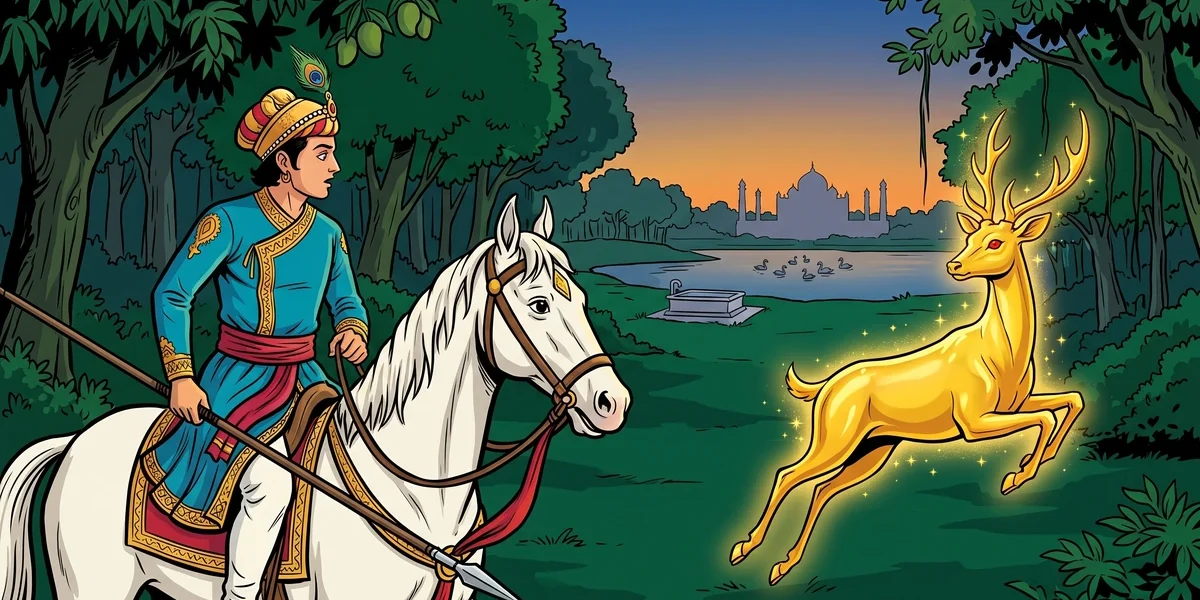
The Faithful Prince is the third tale in Flora Annie Steel’s Tales of the Punjab: Folklore of India (Macmillan & Co., London, 1894), with annotations by Captain R. C. Temple of the Bengal Staff Corps and illustrations by John Lockwood Kipling. Steel collected the story orally in north-western India during the 1870s, while her husband Henry William Steel served the Indian Civil Service in the Punjab; she heard a version of it sung by women in the village of Kasur, south of Lahore, and another in the bazaar at Gujrat. Temple’s notes (pp. 280–284 of the 1894 edition) place the tale in the long Indo-Persian “Bahram-Gor cycle”—a vast cluster of stories descended from the historical Sasanian king Wahram V (Pahlavi Warahran; reigned 420–438 CE), the Greek Vararanes V, fictionalised by Firdausi in the Shahnameh (c. 977–1010) and re-imagined by Nizami of Ganja in the Haft Paykar (“Seven Beauties”, 1197). The Punjabi peasants who told it to Steel had no idea their hero was the same monarch whose hunting exploits ornament a thousand Persian miniatures—but they preserved his epithet (gor, “wild ass”), his hunt, his fairy bride, and his magic-cap of invisibility, almost unchanged.
I. The Hunt for the Golden Deer
Long ago there lived a king who had an only son named Prince Bahrâmgor, “as splendid as the noonday sun, and as beautiful as the midnight moon.” One morning the prince rode out to hunt. He hunted to the north and found no game; to the south, no quarry arose; to the east, nothing stirred. Then he turned westward, towards the setting sun—and from a thicket flashed a deer of pure burnished gold. Burnished gold were its hoofs and horns, rich gold its body. The astonished prince ordered his retainers to form a wide ring around the strange creature so that none might escape blame if it slipped away. “I hold him towards whom the deer may run,” he said, “to be responsible for its capture.”
The deer ran straight at the prince. It bounded over his lance, leapt across his startled horse, and was gone into the forest. Bahramgor galloped after it for three days and three nights, far beyond the borders of his father’s kingdom, until at last the deer turned at bay on the edge of a still black lake. There the gold faded from its body, the horns shrank, the hoofs split into clawed feet, and there stood not a deer at all but a horned demon, taller than the tallest tree.
“I am Jasdrûl,” the demon said. “Last winter you saved my life when a snake had me in its coils, though you did not know then that I was a demon. By the law that binds my kind, I owe you any one boon. Climb upon my back and I will give you a ride such as no mortal man ever rode before.”
The prince mounted, and Jasdrûl rose into the air. For seven days and seven nights they flew above the world—over the snows of the Hindu Kush, over the burning red sands of Sistan, over the green roof of Hindustan, over the sea of pearls in the south, over the mountains of jade in the east. On the eighth day they came down in a meadow of silver grass beside a marble bath. Jasdrûl set the prince on the lip of the bath and said: “Hide yourself, faithful one, for soon Princess Shâhpasand—the Fairy ‘King-Approved’—will descend to bathe. Whoever sees her, loves her; whoever loves her, must marry her or die. The choice is yours.”
II. The Cap of Invisibility

The prince hid behind a pillar of jasmine, and a moment later a flock of seven swans circled the marble bath. Six were white, one was milk-coloured with feathers tipped in saffron. They alighted, shed their feather-coats one by one upon the marble flags—and where each plumage had fallen there stood a fairy maiden. Six of the maidens were lovely, but the seventh was Shâhpasand, and the moment Bahrâmgor’s eyes rested on her face he understood why men died for her.
The maidens slid into the bath. The prince crept out from behind the jasmine and quietly took up the saffron-tipped feather-coat of Shâhpasand and hid it in the folds of his cloak. When the bath was over the six white fairies clothed themselves and rose into the air, but Shâhpasand could find no feather-coat. She wept, beat her wrists upon the marble, and at last laid her face down upon the cool stone and said quietly: “Whoever has taken my coat, come out. If you are old, you shall be my father; if you are young, you shall be my husband; if you are a woman, you shall be my sister; for without my coat I cannot fly home, and to live alone in this place is worse than to die.”
Bahrâmgor stepped out from behind the jasmine and, at the very same instant, the demon Jasdrûl appeared and pressed into the prince’s hand the gift of his second debt—a small grey felt cap, the kuleh-i-namardi or Cap of No-Man-Sees-Me. “Whoever wears this,” said the demon, “is invisible to all save the one whom he loves. Wear it now, and learn whether the fairy who has just promised her hand will keep her word once the choice is made plain.” Then Jasdrûl vanished.
Hidden by the cap, Bahrâmgor showed himself to Shâhpasand. To her eyes alone he stood like a young man seen in early dawn, half mist, half flesh; to all others he was as the empty air. “I am Bahrâmgor, son of the king of Iran-and-Turan,” he said quietly, “and I have stolen your feather-coat because I love you. Will you have me for your husband, or shall I give your coat back and be gone?”
The fairy looked at the dawn-figure for a long moment. “I will have you,” she said. “Keep my coat. Without it I cannot leave you, and I do not want to leave.”
III. The Three Demons of the Black Mountain
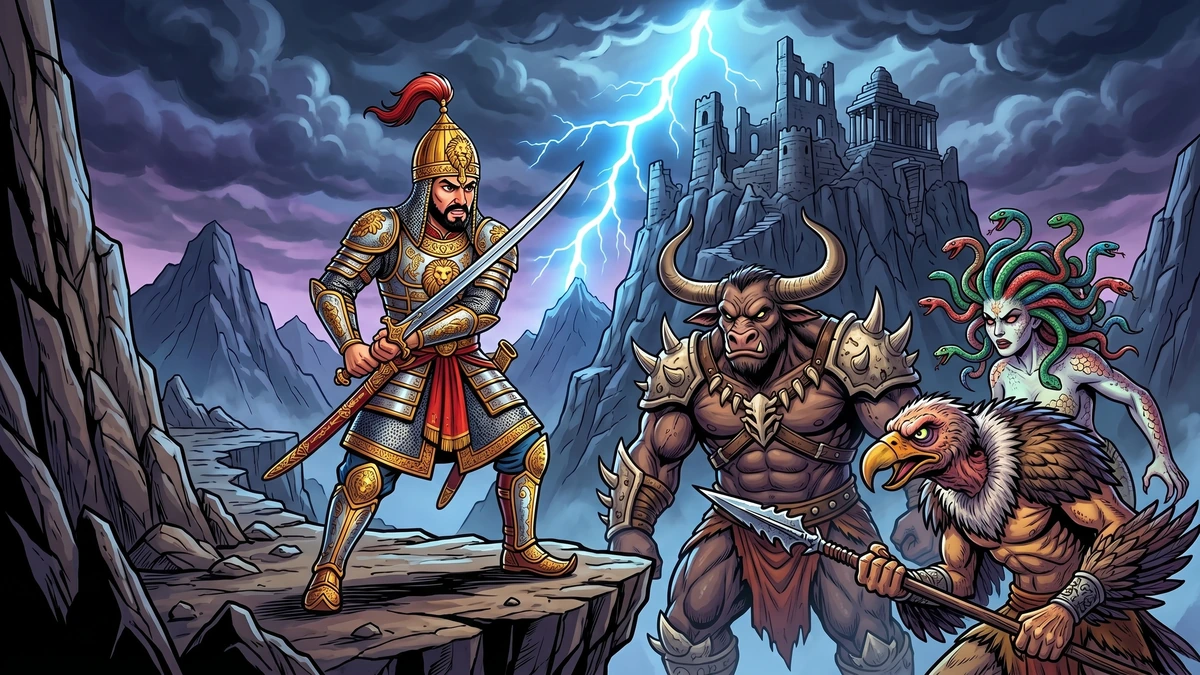
The prince and the fairy lived for some time in a marble pavilion that Jasdrûl built for them in the meadow of silver grass. But Shâhpasand’s father, the King of the Emerald Country, sent the great demon Nânak Chand to bring her home; and Nânak Chand carried her off in a whirlwind, leaving behind only one saffron feather as a mark. Bahrâmgor put the cap of invisibility upon his head and set out after her on foot.
On the road he met a woodman quarrelling with a chief constable. Each was claiming a strange object found by the roadside. “Brothers,” said the prince (visible only as a disembodied voice from inside the cap), “what is the dispute?” The woodman explained that he had found an old felt slipper, and the constable an old felt slipper, and that the two slippers, when the wearer struck them three times on the ground, would carry him a thousand kos in a single step. Bahrâmgor offered to settle the matter by a foot-race: whoever won the race should keep both slippers. The two men agreed, set off down the road—and the prince, invisible, simply put on the slippers, struck them thrice, and was gone over the horizon, leaving woodman and constable to pant home alone.
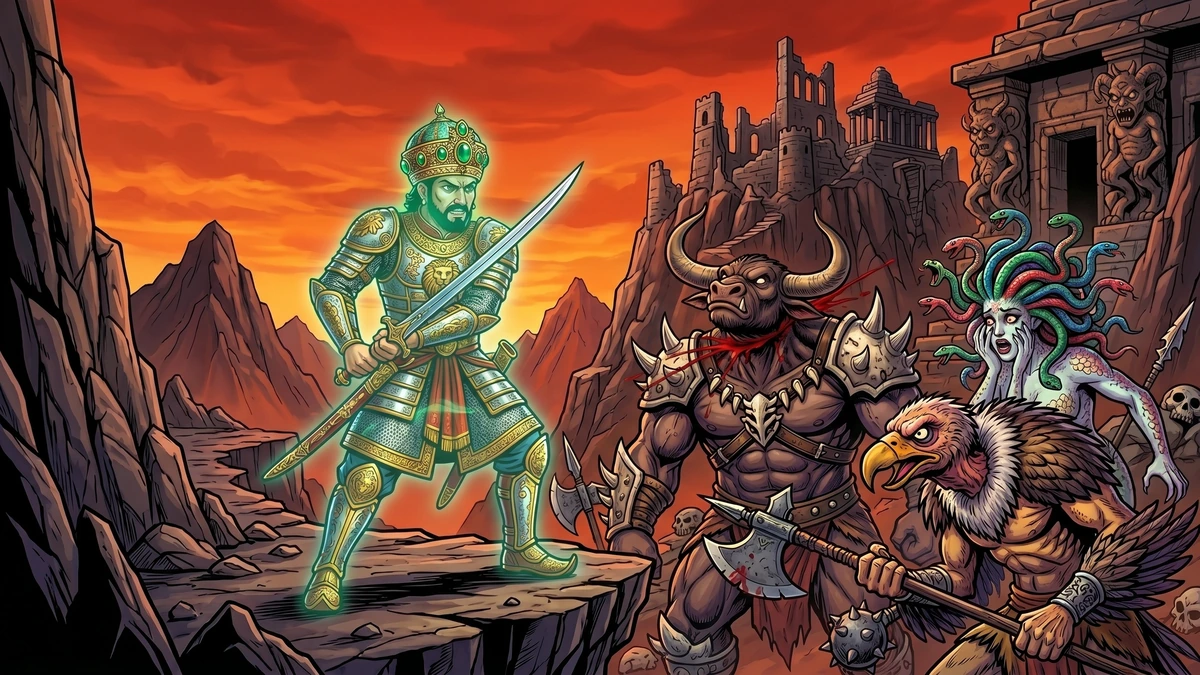
One thousand kos later he stood at the gate of the Black Mountain, where the demon Safed (“the White One”) kept Shâhpasand prisoner in a fortress of obsidian. Safed was the brother of Nânak Chand and the cousin of Jasdrûl; together the three brothers ruled all the demon tribes between Mount Qâf and the Salt Sea. Bahrâmgor, still invisible, walked through the gate, climbed the basalt staircase, and found the fairy seated by an iron brazier weeping into her sleeve. He took off the cap. She started, then laughed, then wept again, and told him quickly all she had learned: Safed’s life was not in his body but in a green parrot, the parrot was kept in a cage on a sandalwood tree, the tree grew on an island in a lake of milk, the lake was guarded by a circle of seventy giants, and only the slipper-of-a-thousand-kos could carry a man past the giants while they slept at noon.
Bahrâmgor put on the cap, took up the slippers, and at the noon hour reached the island, climbed the sandalwood tree, and brought down the green parrot. He returned and stood before Safed. “I have your life in my hand,” he said, lifting the parrot. “Give me my wife and I will give you yours.” Safed roared a roar that shook three peaks, but he opened the iron door of Shâhpasand’s cell. Bahrâmgor wrung the parrot’s neck. The Black Mountain split from crown to root and the three demon brothers vanished like smoke into the cleft. Only Jasdrûl, the faithful one, was spared, for he was at that moment in the meadow of silver grass guarding the marble pavilion he had built.
IV. The Return to the Emerald Kingdom
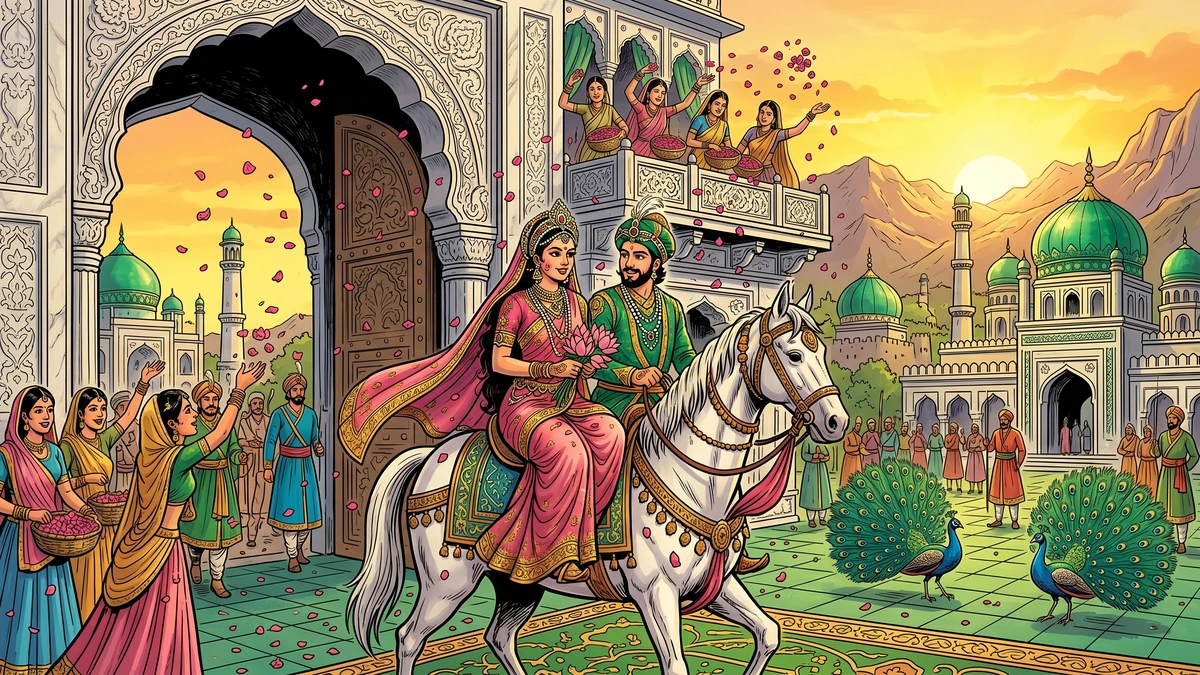
The prince and the fairy travelled together, by the slipper-of-a-thousand-kos, to the Emerald Kingdom of Shâhpasand’s father. The king at first did not believe a mortal could be his son’s-in-law, until the prince pulled the cap of invisibility from his forehead and stepped from shadow into flesh and blood; the king embraced him, called him Wafadar Shahzada—”the Faithful Prince”—and gave him the saffron-tipped feather-coat as a wedding-gift, but with this condition: “As long as you are faithful, the coat is hers; the day you are unfaithful, it will fly back to me of itself, and her with it.” Bahrâmgor took the gift and the condition; and in the Emerald Country, the chronicler ends, “the faithful prince and his beautiful bride lived happily ever afterwards”—Steel’s deliberate echo of the European fairy-tale formula, since the Punjabi original closes more soberly with the formula “Itni-si kahani / churi-mar gayi”, “so much the story; the rat ate the rest.”
Wafa-dar shahzada, na-mihrban shahzadi nahin—
Pari ke par men sach hai; / jhuth men par ur jate hain.“A faithful prince has no faithless bride;
in a fairy’s wing the truth is sewn—
when the truth is broken, the wings fly home.”— Closing couplet of the Kasur recension, transcribed by F. A. Steel, 1879; trans. R. C. Temple, 1894.
The Moral: Faith is the Cap that Makes a Man Visible
The Punjabi storyteller’s title is not “The Lucky Prince” or “The Clever Prince”: it is The Faithful Prince. Every magic object in the tale is a test of, and a reward for, faith. Jasdrûl gives the prince a flight, a cap, and a meadow because the prince was faithful to a stranger he did not know was a demon. Shâhpasand keeps her promise to the figure-of-dawn who took her coat because she is faithful to her own word. Bahrâmgor walks a thousand kos on borrowed slippers to find a woman a lesser man would have given up for dead. And the king of the Emerald Country gives the feather-coat to his daughter because her husband has proved that faith, not magic, is what binds a fairy to a mortal.
The moral closes the circle: the cap of invisibility is not a hiding-place but a revelation. Wear the cap and the world cannot see you—but the one who loves you sees you in early dawn, then in full light. Wear faithfulness, and the only person who can ever fully see you is the one who has chosen you.
Why It Lasted
“The Faithful Prince” survived two thousand five hundred years of retelling because every layer of its audience found a face it recognised in the mirror. To the Sasanian court chroniclers of Ctesiphon, c. 500 CE, the hero was the historical Wahram V—the king who hunted the wild ass on the plains of Mihrjan and who, according to Ferdowsi (Shahnameh, “Bahram Gor and Azada”), shot a doe through the hoof and ear with a single arrow. To the Pahlavi khwadāy-nāmag (“Book of Lords”) of the late Sasanian period, he was the just king who learned humility from a fairy. To Nizami of Ganja in 1197, he was the seeker of seven beauties from seven climes, a Sufi figure walking through the seven domes of the soul (Haft Paykar, vv. 2700–2900). To the Punjabi village storytellers of the 1870s, he had become “Bahrâmgor”, a chivalric hero of the local qissa tradition—cousin to Hir-Ranjha, Sassi-Punnun, and Mirza-Sahiban—who hunts a deer because the deer is destiny in feathered shape, and who marries a fairy because faithfulness is the only key that opens fairyland.
The story’s Aarne-Thompson-Uther type is a composite: ATU 400 (“The Man on a Quest for His Lost Wife”, with the Swan-Maiden / feather-coat opening) crossed with ATU 302 (“The Ogre’s Heart in the Egg”, here the parrot in the sandalwood tree on the island in the lake of milk) and a touch of ATU 567 (“The Magic Bird-Heart”, here the cap of invisibility). Stith Thompson’s Motif-Index of Folk-Literature (Indiana University Press, 1955–58) flags six recurring motifs in the Steel text: D361.1 (“Swan Maiden”), D1052 (“Magic cap of invisibility”), D1521.1 (“Seven-league boots”), E710 (“External soul”), F101.4 (“Return from lower world by helpful animal”), and H1385 (“Quest for vanished wife”). Joseph Jacobs, in his Indian Fairy Tales (London, David Nutt, 1892, notes pp. 235–238), pointed out that the same combination—Swan Maiden + External Soul + Magic Cap—appears in the Sanskrit Kathasaritsagara of Somadeva (Book IX, “Saktivega and the Vidyadhari”, c. 1070 CE), in the Pahlavi Hazar Afsan (“Thousand Tales”) that lies behind the Arabic Alf Layla wa-Layla, and in the Mongolian Siddhi-Kur tales 12–14 (Otto Böhtlingk, Über die Sprache der Jakuten, 1851, pp. 47–52).
The iconographic afterlife is just as long. The Sasanian silver plate “Bahram Gur and Azada” (c. 5th c. CE, Metropolitan Museum of Art, New York, accession 34.33) shows the king on horseback with a harp-playing slave-girl and a wild ass. The Persian miniature tradition of the Ilkhanid (c. 1330) and Timurid (c. 1430–1500) courts illustrated the Bahram-Gor cycle hundreds of times: the famous Demotte Shahnameh folio “Bahram Gur slays the wolf” (Smithsonian, Freer F1929.25), the Sultan Muhammad folios in the Shah Tahmasp Shahnameh (1525–35, dispersed; Met 1970.301.51 et al.), and the entire suite of seven-pavilion folios in the Haft Paykar manuscript copied for Shah Tahmasp (1481, British Library Or. 6810). The Punjabi version was illustrated in the Tales of the Punjab first edition by John Lockwood Kipling (Rudyard Kipling’s father, then Principal of the Mayo School of Art, Lahore), whose ink drawing of Shâhpasand and her six sisters at the marble bath remains the canonical English-language image of the story.
The tale is also the closest Indian cousin of the Norse Völundarkviða (Poetic Edda, c. 9th c.) and the German Schwanjungfrau stories collected by the Brothers Grimm (KHM 193, “The Drummer”, 1815 ms.; cf. their notes vol. III, p. 197). Wendy Doniger, in The Hindus: An Alternative History (Penguin, 2009, ch. 14, pp. 461–464), reads the Bahramgor cycle as the Indo-Iranian template for the entire “stolen-feather-coat-fairy-bride” complex that runs from Iceland to Mongolia. A. K. Ramanujan, in Folktales from India (Pantheon, 1991, pp. xxv–xxvi), treats The Faithful Prince as the Punjabi node where the Sanskrit Vidyadhari, the Persian peri, and the European Schwanjungfrau meet, “all three calling the same long-distance call from the same upstairs window.” The Amar Chitra Katha edition Bahram Gur (No. 535, ed. Anant Pai, illustrated by Ashok Dongre, Bombay: India Book House, 1989) drew its plot directly from Steel’s text, simplifying only the demon-brothers’ names.
Reading the Tale With Children
The story rewards three discussion questions. First: why does Bahrâmgor steal Shâhpasand’s feather-coat instead of asking for it? Children quickly notice the asymmetry and often invent their own answer—”because if he asked, she would have flown away first and asked questions later”—which is exactly what the Punjabi storyteller meant: the coat is the thing that makes choice possible, not the thing that prevents it. Second: what does the cap of invisibility actually do? It does not hide the prince from Shâhpasand; it hides him from everyone else. Faith, the storyteller says, is what makes one person visible to one other and the rest of the world a blur. Third: why are there three demons, not one? Because in the Punjabi qissa tradition (and behind it, the Sanskrit akhyana), the three-fold antagonist is the formula for the three obstacles of any soul-journey: false friend (Jasdrûl, who at first eats the prince and is later redeemed), false captor (Nânak Chand, the whirlwind that takes the bride away), and false body (Safed, whose life is in a parrot, not in himself). Defeat the first by mercy, the second by speed, the third by knowledge: that is the Punjabi peasant’s compressed map of growing up.
A Note on the Hero’s Name
“Bahramgor” is the Modern Persian and Punjabi reflex of Pahlavi Wahram-i-Gor, “Wahram of the Wild Ass”, a nickname earned by the historical Sasanian king Wahram V because of his preference for hunting onagers on the plains of Mihrjan. The Greek form is Vararanes V; the Arabic, Bahrām al-Jawād; the Armenian, Vrām Šahpuh. Christian Bartholomae’s Altiranisches Wörterbuch (Strassburg, 1904, col. 1366) traces Wahram to Avestan Verethragna (“smasher-of-resistance”), one of the seven Amesha Spentas of Zoroastrianism. Gor (Pahlavi gōr, Avestan gaurva-) is the wild ass of the Iranian plateau—Equus hemionus onager—a creature whose speed, surefootedness, and beauty made it the favourite quarry of Sasanian kings and the obvious totem of the king who hunts a golden deer. The Punjabi storyteller, eight centuries after the Sasanian collapse, still called the prince “Bahrâmgor” without knowing he was naming a king of Iran; the word had simply become, in the Punjab, a word for “the kind of prince who hunts a deer that turns out to be a destiny.”
Selected Sources
Flora Annie Steel, Tales of the Punjab: Folklore of India, with notes by R. C. Temple, illustrations by J. Lockwood Kipling (London: Macmillan, 1894), tale III “The Faithful Prince” pp. 23–34, notes pp. 280–284. — Captain R. C. Temple, “The Folklore of the Panjab”, Indian Antiquary XI (1882) pp. 285–290. — Firdausi, Shahnameh, “Bahram Gur and Azada”, ed. Djalal Khaleghi-Motlagh (New York: Bibliotheca Persica, 1988), vol. VI pp. 364–438; Eng. trans. Dick Davis, Shahnameh: The Persian Book of Kings (New York: Viking, 2006), pp. 561–618. — Nizami Ganjavi, Haft Paykar, ed. Vahid Dastgerdi (Tehran, 1936); Eng. trans. Julie Scott Meisami, The Haft Paykar (Oxford: Clarendon Press, 1995). — Somadeva, Kathasaritsagara, ed. Durgaprasad & Parab (Bombay, 1889); Eng. trans. C. H. Tawney, ed. N. M. Penzer, The Ocean of Story (London: C. J. Sawyer, 1924–1928), vol. III “Saktivega and the Vidyadhari”, pp. 245–292. — Joseph Jacobs, Indian Fairy Tales (London: David Nutt, 1892), notes pp. 235–238. — Stith Thompson, Motif-Index of Folk-Literature (Bloomington: Indiana University Press, 1955–58), motifs D361.1 / D1052 / D1521.1 / E710 / F101.4 / H1385. — Hans-Jörg Uther, The Types of International Folktales (Helsinki: FFC 284–286, 2004), types ATU 400 / 302 / 567. — Wendy Doniger, The Hindus: An Alternative History (New York: Penguin, 2009), ch. 14 pp. 461–464. — A. K. Ramanujan, Folktales from India (New York: Pantheon, 1991), introduction pp. xxv–xxvi. — Anant Pai (ed.), Bahram Gur, Amar Chitra Katha No. 535, illustrated Ashok Dongre (Bombay: India Book House, 1989). — Christian Bartholomae, Altiranisches Wörterbuch (Strassburg: Trübner, 1904), entries Wahram, gōr.
Reading time: ~10 minutes · Bespoke retelling and scholarly notes prepared from the 1894 Steel/Temple edition for IndianFolkTales.com
Frequently Asked Questions
**Q: Why is this story important?**
You May Also Like
 Indian Folk Tales
Ages 12+ / YA
Indian Folk Tales
Ages 12+ / YA
Story Of The Faithless Wife And The Ungrateful Blind Man
Southern Indian double tale: a wife abandons her blind husband for a pilgrim; rescued by kindness, he repays it with a false accusation — until a king’s second thought catches the lie. Ages 12+.
 Indian Folk Tales
All Ages
Indian Folk Tales
All Ages
The Bronze Ring
The Bronze Ring: There was once a poor young man who lived with his aged mother in a small hut at the edge of a great forest. Despite their poverty, they were
 Indian Folk Tales
Ages 12+ / YA
Indian Folk Tales
Ages 12+ / YA
The Disconnect | Modern Indian Wedding Satire Poem (12+)
A modern satire on lavish weddings, debt, and the quiet rebellion of simple marriages — Kabir’s wisdom in a new key.