1003+ Stories from Ancient India — Free to Read! Explore all stories →

Eating Up the Protector

Eating Up the Protector: In the country of Uttara, a Brahmin named Kusalanatha fell into poverty and had to gather bamboo rice to feed his wife and six sons.

Origin: Fairytalez
Eating Up the Protector - Cover - Amar Chitra Katha Style
Ad Space (header)

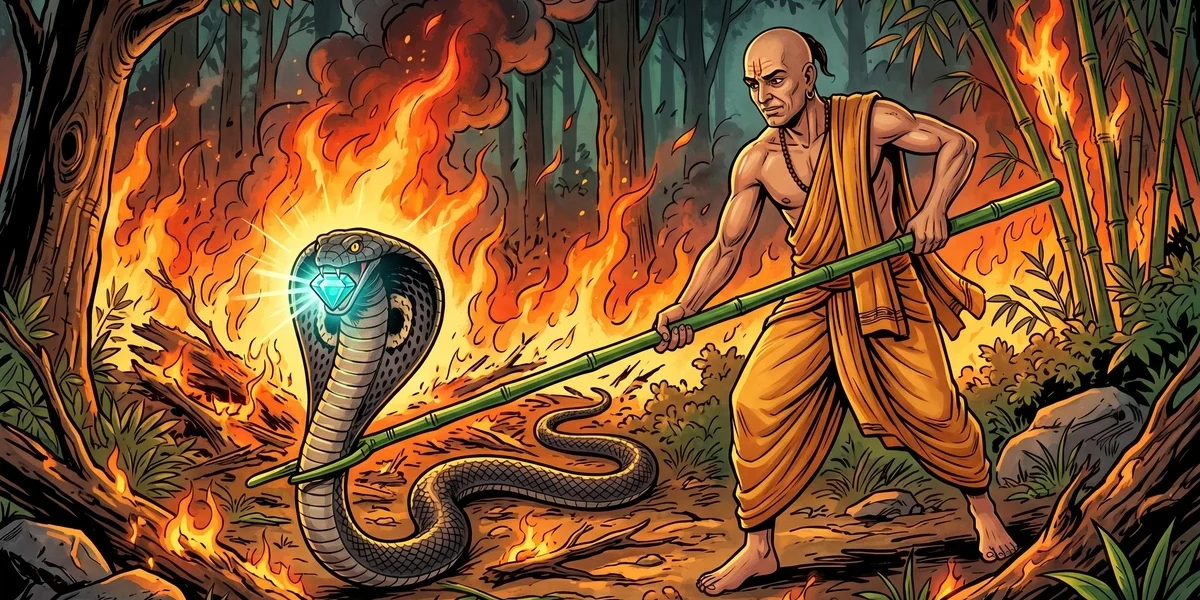
In the country of Uttara, a Brahmin named Kusalanatha fell into poverty and had to gather bamboo rice to feed his wife and six sons. One day in the forest he saw a serpent trapped in flames and rescued it with a long green stick.

No sooner had the snake escaped than it spread its hood and moved to bite him. The Brahmin wept over the fate of a man punished for doing good, but the serpent explained that it was starving and did not know how else to satisfy its hunger. The Brahmin answered that he too had hungry mouths waiting at home.

Seeing his distress, the serpent produced a precious gem from its hood and told him to take it to his family for their support, then return to be eaten. The Brahmin agreed and faithfully went home, gave the gem to his family, and came back as promised.

While waiting, the serpent reflected on its own ingratitude. It realized it would be shameful to kill the very man who had saved it from death. When the Brahmin returned, the serpent gave him a second valuable gem, wished him long life and happiness, and went away without harming him.

The frame around the tale uses the story as a lesson: even one who first int ends evil toward a benefactor can still turn back from sin. The lasting message is that gratitude should overcome appetite, anger, and selfish impulse.


The merchant’s son stood at the threshold of the old shrine, his fingers trembling as he raised his hand to push open the wooden door. The air beyond was thick with the scent of sandalwood and age – a smell that seemed to whisper of centuries. He had come because the village elders said the spirit that dwelt there was eating crops, livestock, and now children. Three months ago, a young girl had vanished near the fields at dusk. Two weeks before that, an entire herd had been found drained of life.

“You must feed it yourself,” the eldest had told him, her voice dry as autumn leaves. “Offer your own flesh willingly, and perhaps it will be satisfied. Perhaps it will leave us in peace.” The thought had churned in his belly for days – the idea of standing before something vast and hungry, of feeling its teeth find him, of knowing his death might save the others. But he was the merchant’s only son, heir to lands and fortunes that meant nothing if the fields lay barren and the people scattered in fear.

Inside the shrine, shadows pooled in corners like spilled ink. The stone idol in the center seemed smaller than the stories suggested, yet when he looked away and looked back, it appeared to grow. The protector spirit – once a guardian of the lands, now twisted into something that consumed what it once saved – was said to live behind that carved face. The merchant’s son knelt on the cool floor, his heart beating so fiercely he felt it in his throat.

“I am here,” he called out, his voice steadier than he felt. “Take me. Let the people go.” For a long moment, there was only silence and the sound of wind through the shrine’s high windows. Then, so gradually he almost missed it, the temperature dropped. His breath came white in the air before him, and he heard something – not a sound exactly, but a vibration that moved through the stone beneath his knees and up into his bones.

The spirit came not as he imagined it, but as hunger itself made visible. It rose from behind the idol, taking form from shadow and desperation. The young man did not run. Instead, as it approached, he spoke of the village – of the children who played in the fields at dawn, of the farmers whose hands built the terraces, of the old songs that once honored the protector, not feared it. He spoke until his voice gave out, and in that speaking, something shifted. The creature paused. For the first time in years, it listened.

Scene 1: Moral
Moral

Moral

Ingratitude and betrayal ultimately consume those who practise them. The creature destroyed its own sanctuary by devouring its protector, teaching that destroying goodness destroys oneself.

Scene 2: Historical & Cultural Context
Historical & Cultural Context

Historical & Cultural Context

India’s regional folk tale tradition is a vast oral inheritance carried by grandmothers, wandering bards and village storytellers, preserving moral wisdom, social commentary and cultural memory long before any of it was written down.

This tale of moral consequence belongs to the Panchatantra and Jataka traditions of cautionary animal fables. The imagery of a creature eating its sustainer echoes Buddhist moral tales about karma and rebirth. The story reinforces dharmic principles found in classical Sanskrit literature: those who harm their benefactors face inevitable ruin, often in their next birth.

Scene 3: Reflection & Discussion
Reflection & Discussion

Reflection & Discussion

  1. Why do you think the creature felt anger toward its protector?
  2. Is it possible to bite the hand that feeds you and survive?
  3. What does this tale teach about being grateful?
Scene 4: Did You Know?
Did You Know?

Did You Know?

  • India has one of the richest oral storytelling traditions in the world, with tales dating back thousands of years.
  • Many Indian folk tales were passed down through generations before being written down.
  • Indian folk tales often blend real-life wisdom with magical elements to teach moral lessons.

What This Tale Teaches Us Today

Old stories keep their power because their lessons never stop being useful. Here is how this one still applies:

  • Stories that have survived for centuries have done so because their lessons still work.
  • Shared stories are one of the strongest bonds within any community – families, cultures, or whole nations.
  • Traditional stories remind us that wisdom belongs to many cultures. No single tradition holds all the answers.

Why This Story Still Matters

Eating Up the Protector joins a vast global library of folk tales that human beings have been telling one another for thousands of years. Every culture has produced its own stories, but the deepest themes – courage, kindness, cleverness, loyalty, the cost of greed – appear again and again in different clothes. Modern readers who spend time with folk tales inherit something precious: a sense that people have always wrestled with the same basic questions, and that good stories can still help us find good answers. That is why these tales persist. Each one is a small tool for living, handed down quietly through generations.

Cultural Context and Continuing Influence

Folk tales like this one survived for hundreds of years through oral storytelling before any scholar thought to write them down. Grandparents told them to grandchildren, travelers traded them along roads and rivers, and mothers repeated them to babies who would one day repeat them to their own children. Each small retelling sharpened the story, discarded unnecessary parts, and polished the essential lesson. That long process of refinement is why a good folk tale feels so weighty – it has been shaped by thousands of listeners across generations, each contributing something small to the story we read today.

Modern readers sometimes wonder whether folk tales are still relevant in an age of apps and smartphones. The answer is yes, perhaps more than ever. The technology changes, but the underlying questions – about kindness, courage, loyalty, greed, family, fear, love – do not. These are the same questions that children asked around a fire in ancient India, around a hearth in medieval Ireland, around a campfire in 19th-century Korea. And they are the same questions children ask their parents today, just phrased differently. That is why a family that reads folk tales together is doing real cultural and emotional work, not simply entertaining itself.

Reading Folk Tales With Children

Reading folk tales aloud to children is one of the oldest and most effective forms of moral education. Unlike a lecture or a rule, a story slides past a child’s natural resistance and plants its lesson in the imagination, where it quietly grows. Years later, when the child meets a real situation that resembles the story – a bully at school, a dishonest coworker, a moment of temptation – the old tale rises to the surface of memory and offers guidance. That is why parents and teachers across every culture have trusted stories to do the work of raising good humans, long before formal schools or textbooks existed.

When reading this story with a young listener, try pausing at key moments and asking what the child thinks will happen next. Let them guess, even if they are wrong. That small act of prediction turns a passive listener into an active thinker. After the story ends, a simple open question – “What would you have done?” or “Who do you think was the smartest character?” – invites the child to connect the tale to their own life. Those conversations are where real learning happens, not during the reading itself but in the quiet moments that follow.

Older children and teenagers sometimes think they have outgrown folk tales. In reality, the best tales only deepen with age. A ten-year-old hears the surface plot; a fifteen-year-old notices the irony; a twenty-year-old sees the economic and political pressures on the characters; a forty-year-old understands the parents in the story for the first time. A good folk tale is a gift that keeps unfolding for decades. Families who read and reread the same stories across the years discover this naturally, and pass the discovery down.

A Final Word

Every folk tale carries within it the accumulated judgment of thousands of listeners across many generations. When a story has been told for a thousand years and still moves children today, that is not an accident. It is proof that the story is saying something true about the human condition. The wiser the listener, the more they see in a tale they have heard a hundred times before. Reading these stories slowly, out loud, with children beside us, we are joining the longest conversation our species has ever had with itself. Every tale we share is a quiet vote for patience, for meaning, and for the old idea that a good story is one of the finest things one generation can hand down to the next.

We hope this telling gave you something worth carrying into your day – a small lesson, a useful image, a question to ask your child at dinner. Folk tales do their best work in the hours and years after the reading ends, quietly shaping how we see the world and each other. Thank you for spending time with this story, and for keeping the old tradition of careful listening and thoughtful retelling alive.

Ad Space (in-content)
Moral of the Story
“Greed and selfishness lead to one's downfall.”

Frequently Asked Questions

**Q: Why is this story important?**

This classic tale from the indian folk tales collection teaches timeless lessons about virtue that remain relevant today.nnQ: What age group is this story for?nnThis story appeals to readers of various ages who enjoy traditional folklore and moral tales with deeper meanings.nnQ: How does this story reflect its cultural origins?nnAs part of the indian folk tales collection, this story carries the wisdom and values of its cultural tradition through universal themes.nn
Ad Space (after-content)

Get a New Story Every Week!

Join thousands of parents and teachers who receive our hand-picked folk tales every Friday. Stories with morals your kids will love.

Free forever. No spam. Unsubscribe anytime.