The Story Of The Wali Dad The Simple Hearted
The Story Of The Wali Dad The Simple Hearted: Once upon a time there lived a poor old man whose name was Wali Dad Gunjay, or Wali Dad the Bald. He had no
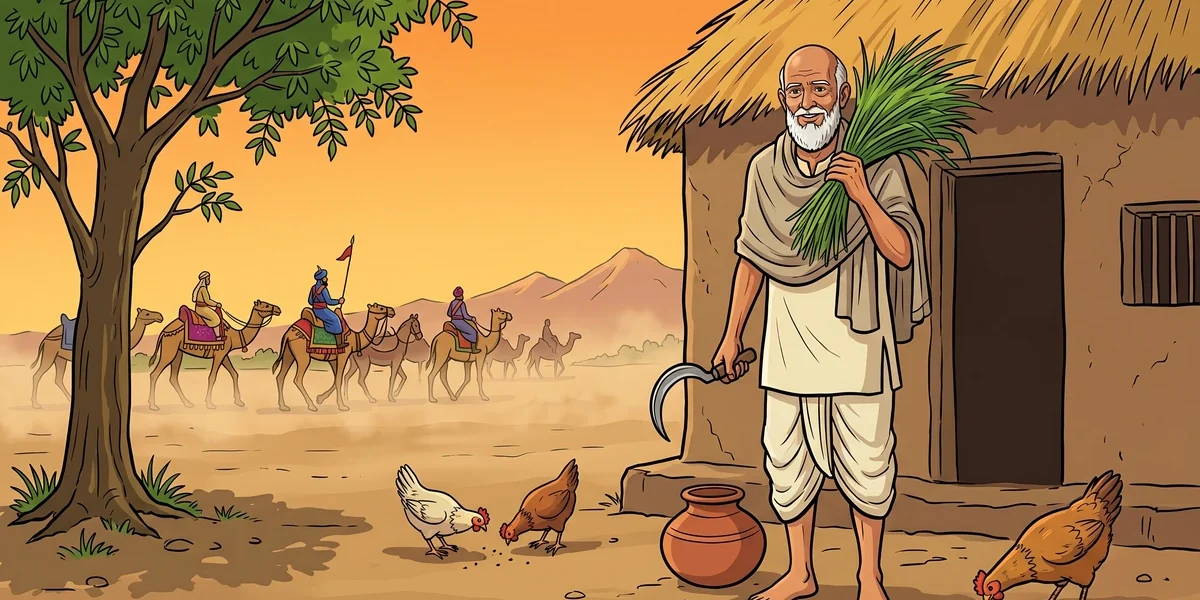
“The Story of Wali Dad the Simple-hearted” is one of the most beloved Punjabi-Hindustani fairy tales, a chain-gift fable in which an old grass-cutter’s tiny act of generosity ripens, almost despite him, into a marriage between a princess and a prince he has never met. The version most readers know in English entered the Western canon through Andrew Lang’s The Brown Fairy Book (Longmans, Green & Co., London, 1904), where Lang’s wife Leonora Blanche Alleyne Lang reworked notes contributed by Major Campbell of Feroshepore (modern Firozpur, in Punjab, on the old Indo-Afghan frontier). The tale was almost certainly collected from a Pashto- or Punjabi-speaking storyteller in the cantonment districts of late nineteenth-century British India, and its names – Khaistan, Nekabad, Wali Dad – carry the unmistakable weather of that borderland.
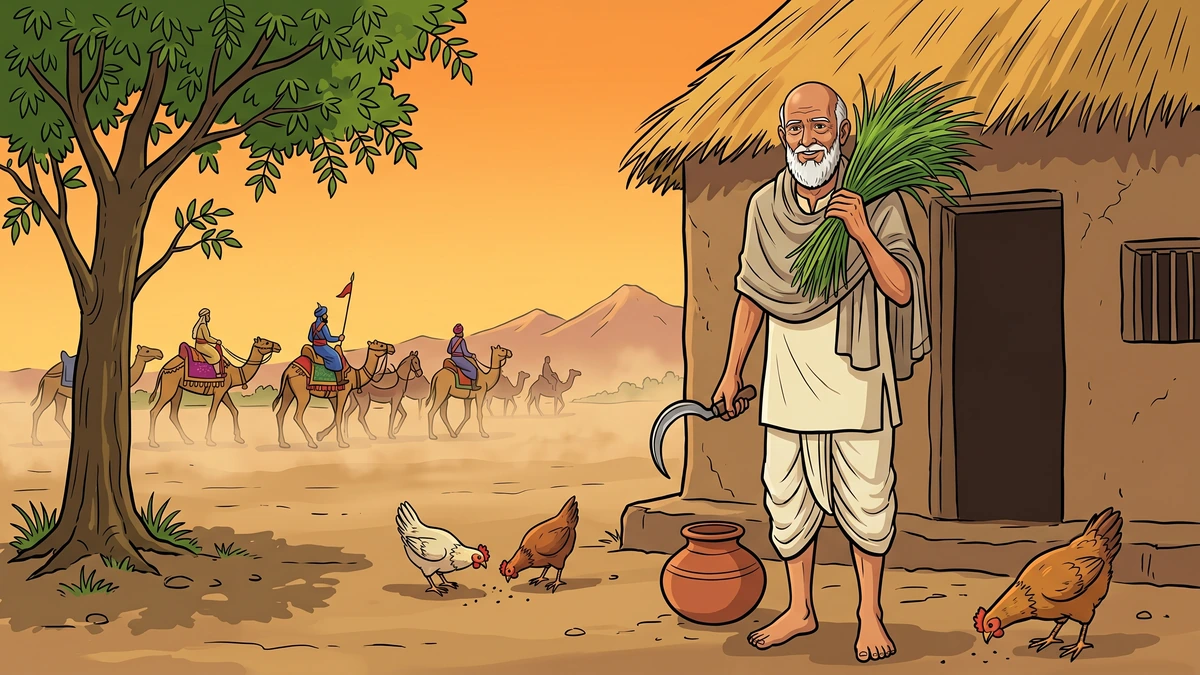
The opening picture is one of the most quietly arresting in South Asian folklore. An old man with a shaved head, his hut a few miles from any town, sits cross-legged on a beaten earth floor and counts halfpennies into a clay pot buried beneath his sleeping mat. He has done this for years without thinking about the total. He cuts jangli ghaas – jungle grass – in the hot Punjabi afternoons and sells it as fodder for the cavalry horses of small landlords; he saves one paisa from every five, eats coarse bajra roti, and sleeps in a ragged blanket. His happiness is invisible to outsiders because it makes no noise. The name the storytellers gave him, Wali Dad (Persian/Urdu walī dād, “gift of the Friend” – the Friend being God), is itself a small theological joke; the man who calls himself a beggar turns out to be a lifelong recipient of grace, and the story is the slow revealing of that fact to him.
Origin, Source & Folklore Classification
Folklorists who have indexed the tale – including W. Norman Brown in his survey of Punjabi narrative and, later, Stith Thompson in The Types of the Folktale – place it in the orbit of ATU 503, “The Gifts of the Little People”, with strong cross-currents into ATU 750A (“The Wishes”) and the Indian “chain-gift” cycles surveyed by Maive Stokes in Indian Fairy Tales (1879) and by Flora Annie Steel in Tales of the Punjab (1894). The closest South Asian cousin is the Sindhi tale of Mungo the Faqir, in which a holy man’s blessing migrates from creditor to creditor. The architecture is unmistakably North-Indian: a chain of giving in which each recipient cannot bear to be outdone by the previous one, escalating from a gold bangle to caparisoned camels to royal pavilions, until the gift-cycle itself draws two royal houses into orbit around the unwitting saint at the center.
The names anchor the tale to a specific cultural soil. Khaistan derives from the Pashto khaista (“beautiful”) – “the country of the beautiful one.” Nekabad is Persian (nek-ābād, “city of the good”). The princess and the prince are therefore “Beauty” and “Virtue” personified, and the joke of the story is that an illiterate grass-cutter is the one who marries them. The original-language proverb the storytellers tucked into the moral – “Wali Dad de naal Allah hai” (وَلِی داد دے نال اللہ ہے), “God is with Wali Dad” – has the same shape as the more famous Punjabi saying Sai te baith, “sit with the saint and the world will rise to meet you.”
Beat One – The Halfpenny That Built a Mountain
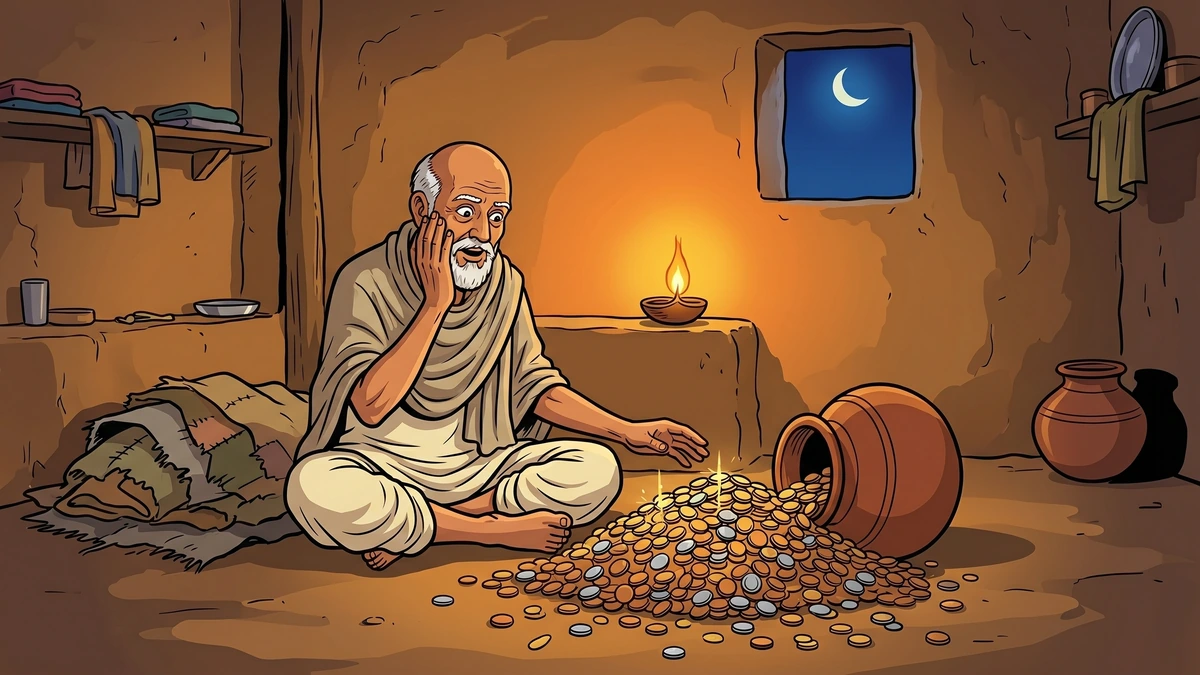
For “many years” – the storytellers do not specify, because in folk time it does not matter – Wali Dad cuts grass, sells it, eats half, and saves half a paisa. One night, on a whim he cannot quite name, he drags the heavy clay pot from beneath the floor and tips its mouth onto the swept earth. Out tumbles a small mountain of copper, of silver, and at the bottom of the heap, a few unexpected gold coins paid to him on feast days he has long forgotten. He sits and stares. The narrator is careful here: Wali Dad is not tempted. He is bewildered. “What should I do with all this?” he wonders, and the question is not rhetorical – he genuinely has no use for it, because his life has already arrived, years ago, at the small steady shape that suits him.
This is the first piece of moral architecture in the tale. The tale is not an allegory of poverty rewarded. Wali Dad is not poor in the sense the modern reader expects; he is a man whose desires have been pruned to fit his life, and whose savings have therefore quietly outgrown his desires. The Punjabi village ear hears in this an echo of the Sufi teaching of qana’at – contentment as the highest form of wealth – which the Mughal-era poet Bulleh Shah expressed as “Bulleh nu samjhavan aiyan, bhainan te bharjayian; mann lai Bulleya saadi gal, chhad de palla Rabb diyan rahan” (“They came to lecture Bulleh, my sisters and sisters-in-law: ‘Listen to us, Bulleh, leave the road of God'”). The man who has nothing to want is the man God can move through the world.
Beat Two – The Gold Bracelet to a Princess Half a World Away
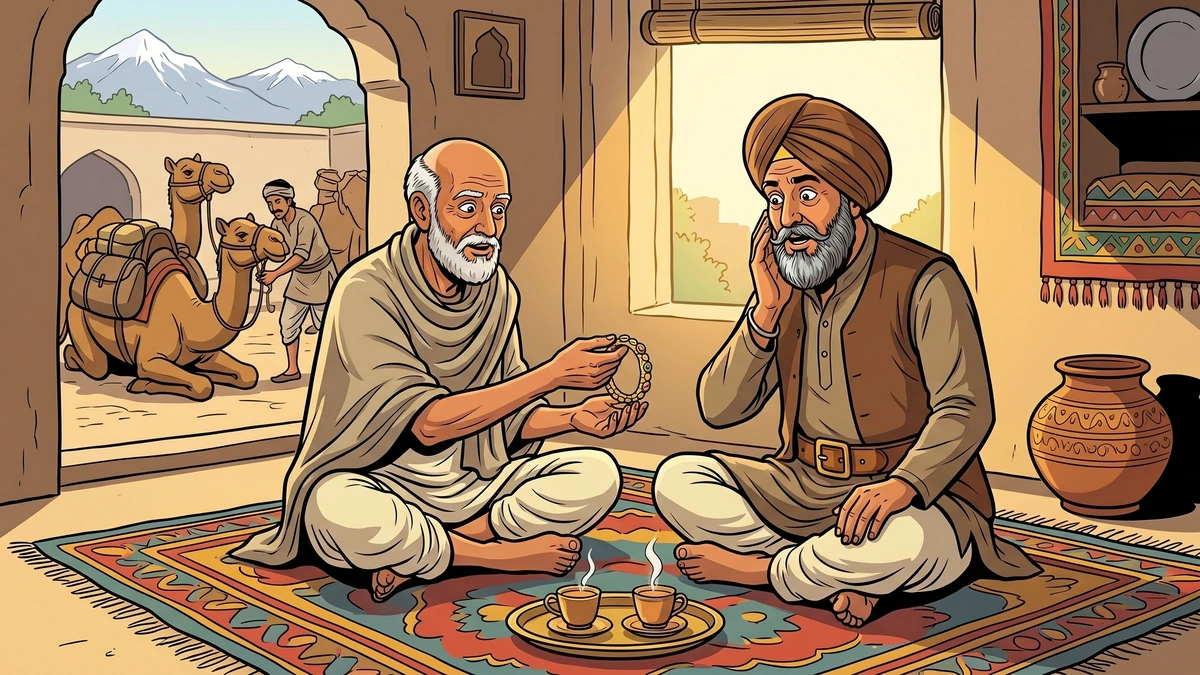
Early next morning Wali Dad shoulders his sack and walks into the bazaar. He does not buy a new coat, or land, or even a better donkey for his cart. He walks straight to a goldsmith he has known for years and bargains for a small, finely-wrought gold bracelet – one bracelet, exquisite of its kind. With it tied carefully into his cotton waistband he visits a wealthier friend, a saudagar who travels with caravans of camels into the Pashtun north and east into the kingdoms of the Hindu Kush. After the customary three cups of tea, Wali Dad asks his friend, with the careful indirection of village politeness, who is the most virtuous and beautiful princess of all the lands he has seen. The merchant, surprised but courteous, names the Princess of Khaistan – renowned for her grace and her generosity to the poor.
“Then,” says Wali Dad, untying the bracelet, “next time your camels go that way, give her this with the respectful compliments of a man who admires virtue more than he desires wealth.” The merchant, even more astonished, tucks the bangle into his own waistband and says nothing. He is a worldly man; he knows that to refuse a saint’s gift is to refuse a blessing, and that to mock it is worse. So the bracelet rides north on a camel’s neck for many weeks, through passes the grass-cutter has never seen, and is at last laid on a silk cushion before the Princess of Khaistan with the message exactly as Wali Dad gave it.
The princess, raised in court etiquette and unused to anonymous gifts, weighs the bracelet against the message and concludes, correctly, that this is no ordinary tribute. She sends back with the merchant a bolt of finest Bokhara silk and a casket of the rarest spices of her country. The reciprocal ratio, an old Persian courtesy, requires the second gift to be larger than the first. The cycle has begun.
Beat Three – The Avalanche of Generosity
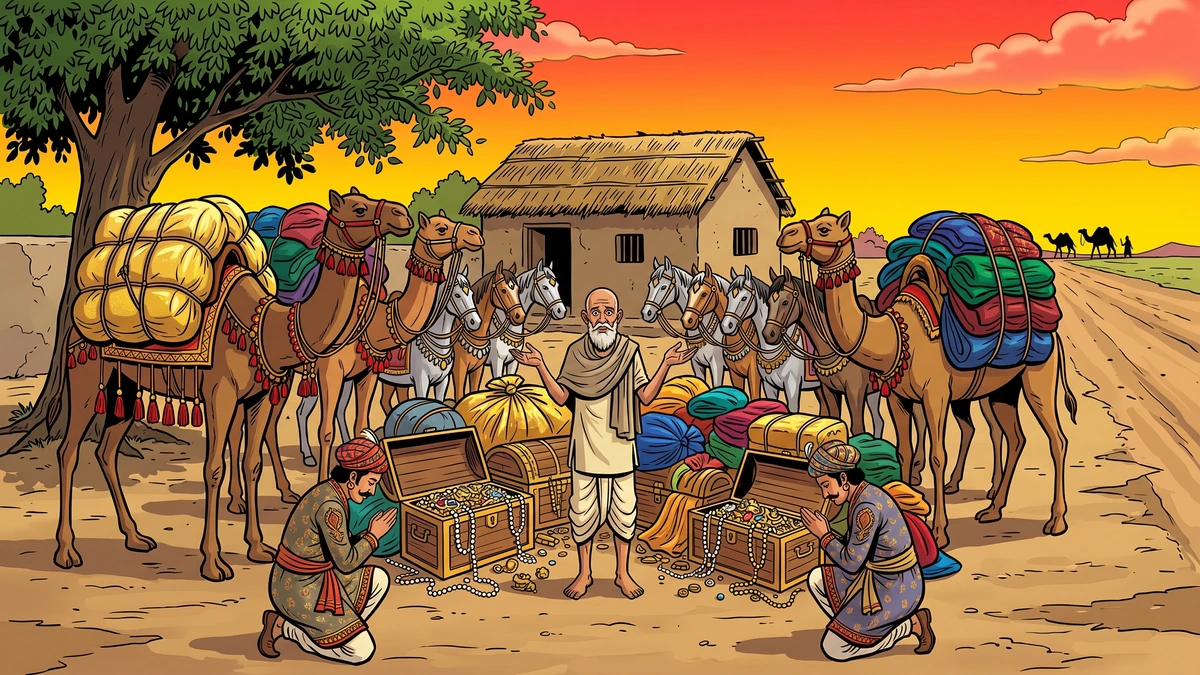
What follows is the comic engine of the tale, and the source of its enduring delight. The merchant returns to Wali Dad’s hut with the silk and spices. Wali Dad, more bewildered than before, asks who is the most virtuous and noble prince of the lands the merchant has crossed. The merchant names the Prince of Nekabad. So the silks and spices are dispatched to the Prince of Nekabad – “with the compliments of one who admires virtue far more than he desires wealth.” The prince, in turn, sends back twelve fine horses with silver bridles. Wali Dad, who has no stable and barely a courtyard, redirects them at once to the Princess of Khaistan. The princess, astonished, returns twenty caparisoned camels laden with cloth-of-gold. Wali Dad sends those on to the prince. The prince sends back a string of jewels worthy of an emperor; Wali Dad sends them on to the princess.
The grass-cutter, the storytellers are careful to note, never opens any of the boxes. He never sleeps under any of the silks. He cuts grass in the morning, eats his bajra roti at noon, and dispatches imperial caravans in the afternoon as easily as another man might forward a letter. Each gift, passing through his hut, gathers more weight on the way out than it had coming in – not because Wali Dad adds anything, but because his hands seem to bless what they touch.
At last the avalanche reaches its natural conclusion. Both the prince and the princess, each independently, decide they must travel in person to meet this extraordinary nobleman whose generosity outshines the treasury of either crown. They send word: their caravans will arrive at Wali Dad’s gate in a week. The grass-cutter receives both messages on the same afternoon, sits down on the earth floor of his mud hut, and weeps with terror. He has no palace. He has no servants. He has no banquet. He has, in fact, half a brass cup of buttermilk and a stale roti. He goes out to the riverbank, lays his forehead against the cool stones, and prays the only honest prayer he knows: “Allah, you are the Friend; this disaster is yours, not mine.”
Beat Four – The Riverbank, the Fairies, and the Marriage
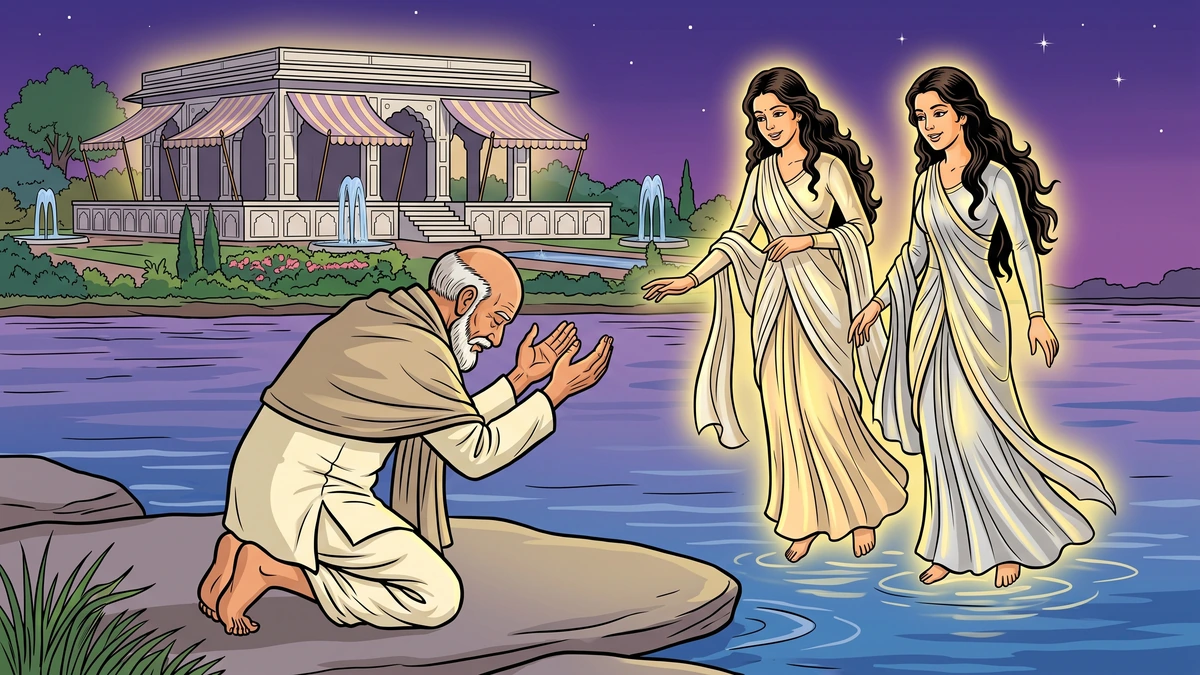
What happens next is the story’s small miracle, and folklorists have noted that almost every Punjabi narrator delivers it with the same hush. As Wali Dad is praying, two peris – the fairy-women of Persian-Pashto folklore, neither angels nor demons but shining intermediaries – descend on the river bank in robes of light. They greet him by name. They tell him not to be afraid. By morning, the open scrubland where he prayed has become a city: gardens with marble fountains, pavilions of striped silk, a banquet of forty dishes, an army of liveried servants who bow as if they have always served him. When the Prince of Nekabad arrives from the east and the Princess of Khaistan from the north, both are met by an old man in a clean white kurta, escorted through cooled gardens, and seated at a table that would shame the Mughal court. Wali Dad, when introduced, says only: “I am the gift’s caretaker. The gift is from God.” He then suggests – for he has noticed, with the keen eye of a man who has watched horses bargain for hay – that the prince and the princess seem suited to one another. By dusk they are betrothed. By the third day they are married under the same striped pavilion the fairies built. As soon as the wedding party rides away east toward Nekabad with the bride at its center, Wali Dad slips out the garden gate, walks back to his old mud hut three miles down river, lies down on his ragged blanket, and goes to sleep. The marble city, having served its purpose, vanishes by morning. Only the grass-cutter’s footprints remain in the dew.
Moral – The Saint Who Did Not Know He Was One
“Wali Dad de naal Allah hai – jis kol kuchh nahin, us kol sab kuchh hai.”
(Punjabi: “God is with Wali Dad – the one who has nothing, has everything.”)
The moral the village storytellers drew is not the modern Disney moral of “be kind and the universe will reward you.” It is older and stranger. The cycle of giving works because Wali Dad does not understand it, does not try to engineer it, and does not enrich himself by it. The instant a giver begins to expect a return, the chain of barakah snaps; the magic depends on the giver not knowing he is the magic. This is the central insight of the Sufi fakir tradition (“jo apna naam bhul jaaye, woh Khuda ka naam yaad rakhe” – “the one who forgets his own name remembers God’s”), and it is what gives the tale its peculiar warmth: it does not ask the listener to imitate Wali Dad, because imitation would already be self-conscious. It asks the listener only to consider whether he has ever known such a person, and whether the world is held up, quietly, by such people.
The Folk Texture – Camels, Caravanserai, and the Geography of Gift
One of the small joys of “Wali Dad” is the way it preserves, almost in passing, the working geography of nineteenth-century North-West India. The merchant friend is a saudagar, the long-distance trader who moved between the Punjabi plains and the Pashtun highlands along the old Grand Trunk Road, stopping at caravanserais built by Sher Shah Suri three centuries earlier. The “twelve fine horses with silver bridles” sent by the Prince of Nekabad are not Disney horses; they are the famed Kabuli Yarkandi crosses that Akbar’s court paid in gold for, and that even in 1904 still came south through the Khyber pass each spring. The “twenty caparisoned camels” are not props; they are the working backbone of the cross-frontier trade in raw silk, lapis lazuli, and Bokhara wool. When the storyteller piles up these details, she is doing two things at once: lending realism to a fairy tale, and gently reminding her listeners that the magical economy of generosity moves on the same dusty roads as the real economy of trade. The miracle is not that gifts appear out of nothing – it is that the same camels that carry profit on Tuesday can carry blessing on Wednesday, if the right kind of person sends them.
The fairies (peris) at the riverbank deserve a closer look as well. In Persian-Pashto folklore the peri is a being of light, often female, whose appearance is not predicted by the protagonist’s piety but by the protagonist’s helplessness. The peri is a friend of those who have run out of their own cleverness. This is structurally important: had Wali Dad tried to arrange the marble city – bargained for it, schemed for it, taken out a loan against the camels – the peris would not have come. They arrive precisely at the moment of his collapse, when he says, in effect, “this is yours, not mine.” The grammar of the Punjabi original captures this beautifully: the verb shifts from active to passive, from main karoon ga (“I will do”) to ho jaye ga (“it will become”). Storytellers in the Hazara and Potohar regions still mark this shift with a long pause; some lower their voices to a whisper.
Why the Story Has Lasted – and Why It Still Matters
“The Story of Wali Dad” has survived for at least two centuries in oral form before Lang’s English version, and another century in print since, because it solves a problem every culture has and few solve well: how to praise generosity without making the generous person ridiculous, naive, or proud. The Punjabi storytellers achieved this by giving Wali Dad no interior life of self-congratulation at all. He never thinks of himself as kind. He thinks of himself as confused. The fairies arrive not because he deserved them but because he had run out of his own resources and admitted it. In a century that prizes life-coaching and self-optimization, the tale’s quiet teaching – that some virtues only work when their holder is unaware of them – has the force of a slap of cold river water at dawn.
The tale is also one of the rare folk narratives that lets a poor old man be the hero without becoming either tragic (as in the Russian “Father Frost” cycle) or comically venal (as in many trickster cycles). Wali Dad is neither punished for his poverty nor rewarded with a palace; he ends the tale exactly where he began, asleep in his ragged blanket in a mud hut, having married a prince to a princess and lit no candle to himself. That refusal of the rags-to-riches arc – the deliberate choice not to elevate the saint – is, in the end, what marks the tale as authentically South Asian. The wealth in the world flows through Wali Dad. It does not stick to him. And the storyteller, when she tells it well, makes you want, for a few quiet moments, to be the kind of person it would be safe for the wealth of the world to flow through.
Read aloud at bedtime, “Wali Dad” still does what it did in 1904 and what it did a century before that on Punjabi rooftops: it tells children that the most powerful kind of goodness is the kind that does not know itself; it shows adults that the chain of generosity is held up not by the rich but by the qana’at of the contented; and it leaves everyone, child and adult alike, slightly more inclined to give without telling anyone, in case the magic is real.
Frequently Asked Questions
**Q: Why is this story important?**
You May Also Like
 Indian Folk Tales
Ages 3-5
Indian Folk Tales
Ages 3-5
The Story of a Kind Hearted Little Girl Named Tara
The Story of a Kind Hearted Little Girl Named Tara: Once there lived a little girl named Tara with her mother in a small hut near the forest. Tara was
 Indian Folk Tales
All Ages
Indian Folk Tales
All Ages
The King Who Would See Paradise
The King Who Would See Paradise: Once upon a time there was king who, one day out hunting, came upon a fakeer in a lonely place in the mountains. The fakeer
 Indian Folk Tales
All Ages
Indian Folk Tales
All Ages
A Traveler’s Tale from India
A Traveler's Tale from India: Once upon a time, in a country called India, on the coast of Nagapattinam far south, there landed a large vessel on the shores of