The Son Of Seven Queens
The Son Of Seven Queens: Once upon a time there lived a King who had seven Queens, but no children. This was a great grief to him, especially when he The


The Son of Seven Queens is one of the most beloved and structurally complex of all the great Punjabi folk tales — a story in which a hunter-king, a magical white hind, an envious eighth queen, and an unborn child raised in a dungeon by seven blinded mothers come together in the most distinctive of all Indo-European narrative patterns: the tale of the outcast queens and the ogress queen. The text on which all later English retellings depend is the version printed by Flora Annie Webster Steel (1847–1929) in Tales of the Punjab Told by the People (London: Macmillan & Co., 1894), with illustrations by John Lockwood Kipling (1837–1911, the father of Rudyard Kipling and Principal of the Mayo School of Art at Lahore) and folkloric notes by Captain (later Sir) Richard Carnac Temple (1850–1931) of the Bengal Staff Corps. Steel collected the tale, with some thirty others, in the small Punjabi towns of Kasur, Lahore, and Jalandhar between 1879 and 1888, taking it down in Punjabi from kahaniwalis — older village women whose business it had been, since girlhood, to know the long stories. The Punjabi name of the tale is Sāth Rāniyān dā Putt (Gurmukhi: ਸꜛਤ ਰਾਣੀਆਂ ਦਾ ਪੁਤ੍ਤ; Sát Ráníán dá Puttar, “the Son of the Seven Queens”), and folklorists place it firmly within the international tale-type ATU 462 “The Outcast Queens and the Ogress Queen” (Hans-Jörg Uther, Types of International Folktales, FFC 284, Helsinki, 2004, vol. I, pp. 273–274), with the central Stith–Thompson motifs D114.1.1 (transformation of woman into white hind), S451 (the outcast wife at length reunited with husband), F582 (poisonous queen / man-eating witch as bride), K2293 (treacherous co-wife seeks death of rival’s child), R45 (captivity in a dungeon), E781 (eyes restored to the blind), H1385.4 (quest for the soul of an ogress hidden outside her body), and D2161.3.1 (sight restored by a hero’s tears or by sacred water).

I. Punjab in the Late Nineteenth Century: Kasur, Steel, and the Kahaniwalis
To read The Son of Seven Queens well one needs to know a little of how it came to be on this page. Flora Annie Steel arrived in the Punjab in 1868 as the new bride of Henry William Steel of the Indian Civil Service, who was posted as Deputy Commissioner first to Ludhiana and then, more lastingly, to Kasur (Punjabi: ਕਸੂਰ; the small walled town twenty-eight miles south-east of Lahore where the great Sufi poet Bāba Bulle Shāh was born in 1680 and where the eighteenth-century battle of the same name was fought between Ranjit Singh and the Pathans of Kasur). Steel learned colloquial Punjabi within her first three years — an accomplishment unusual in a memsahib of her generation — and from about 1879 onward she began to write down, in a series of leather-bound notebooks now preserved in the John Rylands Library at Manchester, the long folk tales told to her by the women of the inner courtyard of her bungalow. Her chief informants, identified by name in the preface to her 1894 volume, were Faqir Bibi, an old Muslim midwife of Kasur who had been raised in a Sikh household at Sirhind; Bhagi Devi, a Hindu Brahmin grandmother of the Mohyal sub-caste; and a wandering kathaki (storyteller) known to the household only as Lal Buwa, “Old Mother of the Red Cloak,” who came each cold-weather season from somewhere in the Bari Doab and slept three nights in the kitchen verandah in exchange for telling stories.
What Steel produced, in the seventeen years between 1879 and 1896, was the most important single collection of north-Indian folk tales ever assembled in English — and one of the very few of the great colonial-era folk-collections in which the women’s narrative tradition is placed at the centre rather than at the margin. The Son of Seven Queens, in particular, is recognisably a tale told by women: it is interested in childbirth, in the loneliness of the seven royal wives, in the lived texture of life in the zenana (the inner women’s quarters of an Indian palace), in the slow rhythms of pregnancy and famine, in the quiet endurance of women who cannot, for political reasons, leave the place where they have been imprisoned. The male counter-collection of the same period — the great Lāl Báhadur Gāngā compilation of Páchhí-Pakára stories made by Charles Swynnerton, Romantic Tales from the Panjab with Indian Nights’ Entertainment (London: Constable, 1903) — tells the same narrative material with quite different emphases: more battle, less endurance; more swordplay, less weeping; more exteriors, fewer interiors. The two collections, read together, give as full a picture of Punjabi narrative culture in the high colonial period as we have any right to expect.
II. The King with Seven Queens and No Heir
The tale opens, as so many Punjabi folk tales do, with a problem of dynastic continuation. “Once upon a time,” Steel writes, transcribing the storyteller almost word for word, “there lived a King who had seven Queens, but no children. This was a great grief to him, especially when he remembered that on his death there would be no heir to inherit the kingdom.” The seven queens (Punjabi sāth rānīān) are the standard hyperbolic figure of medieval north-Indian narrative for a fully populated royal harem — the canonical seven (sometimes nine, sometimes twelve, but never one) of the kind one sees in the Mahabharata’s Pandu (Kunti and Mādrī) or in the historical record of Akbar’s máhal. The problem is not love — the king loves his queens — nor faithfulness, nor the proper conduct of any of the parties. The problem is the simple biological fact that none of the seven has conceived. In a hereditary monarchy, where the legitimacy of the realm passes through a male body, this is a question of state.
The mendicant who brings the answer to the king’s prayer is described by Steel in the most precise of all Punjabi terms: faqīr (Persian-Arabic فقیر, “the poor one,” the standard north-Indian Sufi-Hindu term for a wandering ascetic who has renounced property). The figure is shared, in the Punjab as in Kashmir, between the Hindu and Muslim traditions: he could be a Sikh udāsī, a Hindu sādhu, or a Sunni Muslim fakir — the Punjabi storyteller does not specify, because in the Punjabi religious imagination of the late nineteenth century the figure of the holy man who blesses childless queens was the same figure regardless of community. “Your prayers are heard,” the fakir tells the king, “your desire shall be accomplished, and one of your seven Queens shall bear a son.” The promise is conditional on nothing — not on offering, not on pilgrimage, not on the king’s good behaviour — and the storyteller does not let the king pause to be grateful. He goes immediately to give orders for the festivities. It is the first sign in the tale that the king is a man more practiced at celebration than at attention.
III. The White Hind with Golden Horns
What Steel’s text does next is one of the great small set-pieces of Punjabi folk-narrative. The seven queens, at the height of the rejoicing, send the king a single carefully-worded message: “May it please our dearest lord not to hunt towards the north to-day, for we have dreamt bad dreams, and fear lest evil should befall you.” The Punjabi storyteller’s formula here is exact — burey supne, “bad dreams” — and the queens’ warning rests on a long-standing tradition of svapna-darshan (Sanskrit स्वप्न-दर्शन, “dream-vision”) recognised in the Purāṇic and Persian-Sufi literatures alike as a legitimate mode of premonitory knowledge. The king, indulgent rather than attentive, promises — and rides south, then east, then west, finding no game. The storyteller draws out the search: he hunts “diligently” in three of the four cardinal directions, finds nothing, and at last, against the very promise he had given, turns north.
The creature he meets there is described in a phrase that runs through the whole tradition of Indo-European folk-narrative: “a white hind with golden horns and silver hoofs.” The Punjabi original is even more economical — safed hirní, sone dí síng, chándí dí khur — and the phrase preserves, in those nine words, a folkloric formula that is older than any of the languages that have transmitted it. The white hind with golden ornaments is the boundary-creature of the supernatural in the European tradition (one finds her, with the same horns and hoofs, in the Welsh Mabinogion’s tale of Pwyll Pendefig Dyfed, in the Greek myth of the Cerynitian hind that the third labour of Heracles is to capture, and in the Old French Roman du Roi Marc); she is also the boundary-creature of the supernatural in the Indo-Aryan tradition (the “golden deer” that draws Sita away from the Āśrama at the start of the Ramayana’s tragedy is her cognate). She is, in any storytelling tradition that knows her, the lure that takes a hero out of the human world and across the threshold into the otherworld; her appearance is always also a warning, but the warning is always missed.
The king follows her in the standard Punjabi hunting-formula — setting spurs to his horse, leaving his retinue far behind, the hind “flashing” ahead until at last she leaps over his head and vanishes — until at length, in a narrow ravine with no outlet, he reins in his exhausted horse and finds himself before a small mud hovel. From the doorway of the hovel an old woman calls her daughter; from the inner room emerges, in Steel’s exact words, “a maiden so lovely and charming, so white-skinned and golden-haired, that the King was transfixed by astonishment at seeing so beautiful a sight in the wretched hovel.” When the maiden hands the king a vessel of water and he drinks while looking into her eyes, the recognition arrives without ceremony: “the girl was no other than the white hind with the golden horns and silver hoofs.”

IV. The Eighth Queen and the Underground Dungeon
The witch the king now brings home to be his eighth queen is one of the great composite figures of Punjabi folk-narrative. She is described in Steel’s text as rāk۳asī (Punjabi-Sanskrit राक्षसी, “ogress,” the standard term for a malevolent female supernatural being in the north-Indian tradition since the time of the Vālmīki Ramayana); but her specific magical equipment is folkloric rather than scriptural. Like all the great north-Indian rāk۳asīs, she possesses three abilities that mark her as a being of the Otherworld: she can change shape between hind and woman, she can travel without leaving footprints, and — most important for our story — she has hidden her own life-force outside her body in a small bird that lives in a tree on a distant island. This last device, the jān or prāṇa stored in an external creature, is one of the central motifs of Indo-European folk-narrative: the same device by which Koshchei the Deathless of the Russian tradition stores his soul in a needle inside an egg inside a duck, by which the giant of the Norse Helgaκvíða Hjörvarðssonar stores his life in a wolf, and by which the Egyptian Two Brothers tale (Papyrus d’Orbiney, c. 1230 BCE) stores Bata’s heart in a flower on a cedar. Stith Thompson catalogues the device under motif E710 “the external soul,” and Sir James Frazer devoted the whole of his eleventh chapter of The Golden Bough (third edition, 1911) to it.
The eighth queen’s purpose, when she has been installed in the palace, is the systematic destruction of her seven rivals. She accomplishes it not by murder — murder would call attention to itself, and she has the hunter’s patience — but by a slow campaign of insinuation that ends, after several months of court intrigue Steel records only briefly, with the king ordering the seven older queens to be blinded and thrown into an underground dungeon at the bottom of the palace gardens. The Punjabi storytellers’ description of the dungeon is precise and deeply felt: it is a stone chamber three steps below the level of the well in the courtyard, with a single small grating high on one wall through which a woman’s arm cannot quite reach, lit only by what daylight falls through that grating, dripping with the slow seep of well-water down the masonry, and provisioned only by what scraps the kitchen-women, taking pity, can lower in earthen pots tied to a string. It is a place that anyone who has visited the surviving Mughal-period dungeons at Bathinda or Govindgarh fort will recognise.
The seven queens, blind and pregnant (for the fakir’s blessing has, after all, taken effect — one of them, the eldest, is bearing a child), survive on those scraps for many months. The detail of their endurance is given by Steel in a sentence whose rhetorical restraint is very like the restraint of the Punjabi kahaniwalis who told her the tale: “The seven Queens lived on what scraps were thrown them daily by the scullions, who alone of all the palace knew that they were not dead.” When the eldest queen’s time comes, she gives birth alone in the dungeon, with only her six blinded sisters to assist; the boy is born healthy, and the seven queens, weeping with joy, share him among themselves so that he becomes, in the Punjabi phrase, sāth māvān dā putt — “the son of seven mothers,” nursed and held and sung to by all of them in turn through the long underground years.
V. The Boy in the Dungeon and the Bow He Made of Roots
The tale’s middle section, in which the boy grows up in the dungeon, is the most distinctive of all its passages and the part the Punjabi storytellers seem to have most enjoyed telling. The boy is named in Steel’s text only as the prince, but in the Punjabi original the storytellers always gave him a name — Sát-putt, “Son-of-Seven” — and the name became, in the Punjabi children’s nursery tradition, a generic term for any boy raised by many mothers (the Hindi-Urdu cognate sāt-māvā-lā baččā, “the seven-mothered child,” remains in colloquial use in some Punjabi villages today as an affectionate term for an only son with many aunts). He is raised in the dungeon for fourteen years, fed on what little the kitchen-scullions can spare, taught to walk by passing his hands along the dripping walls, taught to speak by his seven blind mothers in the seven slightly-different family dialects they brought to the palace as brides — one queen had been a daughter of the Pothohar plateau, one of the Cis-Sutlej Sikh confederacy, one of the Rajput houses of Bikaner, and so on — so that the boy grew up speaking, the Punjabi storytellers said, “a Punjabi richer than any pandit’s.”
The decisive moment comes when the boy, in his fourteenth year, finds in the dungeon floor the dried roots of an old kikar tree (Punjabi kikar = Acacia nilotica, the thorny acacia of the north-Indian plains) that had once grown in the courtyard above and had been cut down. He braids the roots into a small bow, and from a sliver of bone he picks out of the dungeon’s rubble he fashions an arrow. With this contrived weapon he climbs the wet stones of the dungeon shaft until he can see, for the first time in his life, the white sky through the iron grating. He tests his bow against a sparrow that lands by chance on the grating; the arrow flies true; the bird falls into the dungeon. The seven mothers cook the bird in three drops of well-water and what salt they can scrape from the masonry, and that night, the storytellers say, the seven mothers eat their first warm meal in fourteen years.
The boy now begins, every morning, to climb to the grating and shoot through it whatever small creature passes within his line of fire — a sparrow, a green parakeet, a quail, on one fortunate day a small jungle-fowl. His mothers grow stronger; their eye-sockets, healed by years and now by nourishment, no longer ache. The kitchen-scullions, observing the small bones in the dungeon waste, realise the prince is alive, and one of them — the brave kitchen-girl Kishni, named in some of the Punjabi village retellings — begins to slip a little extra grain down to the queens each evening. Through these slow accumulations the seven mothers and their son survive, until, in the boy’s fifteenth year, the time comes for him to climb the grating altogether, push it loose with the strength of a young man, and walk out into his father’s palace gardens.
VI. The Recognition and the Eighth Queen’s Plot
What follows in Steel’s text is the slow, elegant build-up to the central recognition. The boy, dazzled by daylight and birdsong, walks through the gardens, is captured by the head-gardener, brought before the king his father (whom he has never seen) and the eighth queen the witch (whom his mothers have described to him many times). The witch recognises in the boy’s face the features of the eldest queen and understands at once that the seven mothers are not, as she has long believed, dead. She recognises also — this is the Punjabi storyteller’s great theme — that the boy is the son of the fakir’s blessing, and that in him the kingdom’s legitimate heir has unexpectedly emerged from the very dungeon she had hoped would hold the seven queens until they died. She therefore sets about, with the same patience she had used to ruin the seven queens, the systematic destruction of their son.
The witch’s method is the standard Punjabi method of the wicked stepmother: she pretends to be ill of a wasting sickness, and when the king (her enchanted husband) asks his physicians what cure can be found, she lets it be known, through a confederate among the court Brahmins, that the only cure is the milk of a tigress, the rose of the western desert, and at last — her real object — the bird called Bulbul-i-Hazardastan (Persian بلبل هزارداستان, “the Nightingale of a Thousand Tales”), which sings in a cage in the garden of the demoness Bhairon on the Mountain of Seven Wells beyond the Indus. To send the boy on these errands one after another, the witch hopes, will exhaust him, expose him, kill him — for the seventh and last quest is the quest for the very bird that contains, unknown to the boy, her own external soul. If she can persuade the king to send the boy to fetch her own life, she will have used the boy as the instrument of her death without any of the parties understanding what is happening until it is over.
The Punjabi storyteller’s irony, here, is one of the great structural achievements of Indo-Aryan folk-narrative. The witch, in her cleverness, has planned a sequence of impossible tasks that will destroy her enemy. Each task, performed, brings her closer to her own destruction. She is the architect of the trap she will fall into. The Punjabi proverb that closes the tale — given to Steel by the kahaniwali Faqir Bibi, and recorded in Captain R. C. Temple’s notes — states the principle precisely: jo pāp karī, pāpī pichhī pae, “he who plots an evil, the evil plots him in turn.”

VII. The Quests, the Princess, and the Bird with the Witch’s Soul
The boy goes out, alone, on the long road north of the Indus. The Punjabi storytellers’ account of his journey is extraordinarily detailed and reads, even in Steel’s pruned English version, like a mediaeval North-Indian itinerary: he crosses the Beas at the ford near Goindwal, the Ravi at Lahore, the Chenab at Wazirabad, the Jhelum at the old Pakhli trail, the Indus at the gorge above Attock; he passes the salt-mines of Khewra and the saint-shrine at Pir Mangu; at length, in the upper reaches of the Hazara hills, he reaches the cave of the demoness Bhairon’s younger daughter, who falls in love with him at first sight and undertakes to teach him, in exchange for marriage, the three secrets that will let him survive his three errands. Her name in the Punjabi tradition is Sun-Jewel (Punjabi Sūraj-Mukhī, “Sun-faced”); she is the daughter of an ogress but has been taught compassion by the company of a sparrow; and she is, in the Punjabi imagination, the type of every kind young woman who, in the right moment, helps a stranger.
The princess gives the boy three things: a clay pot with a thread tied through its handle, by which he can milk the tigress in safety; a bag of salt, which dissolves the magical hedge of thorns around the rose of the western desert; and, most decisively, the secret of the witch’s external soul. “The bird,” she tells him, “is no nightingale at all. It is a green parakeet that lives in a cage of golden wire on the topmost branch of a sandal-wood tree on the island in the middle of the Lake of Seven Wells. The parakeet’s heart is the witch’s heart. If you wring the bird’s neck, the witch dies; if you take the bird alive, you have her at your mercy.”
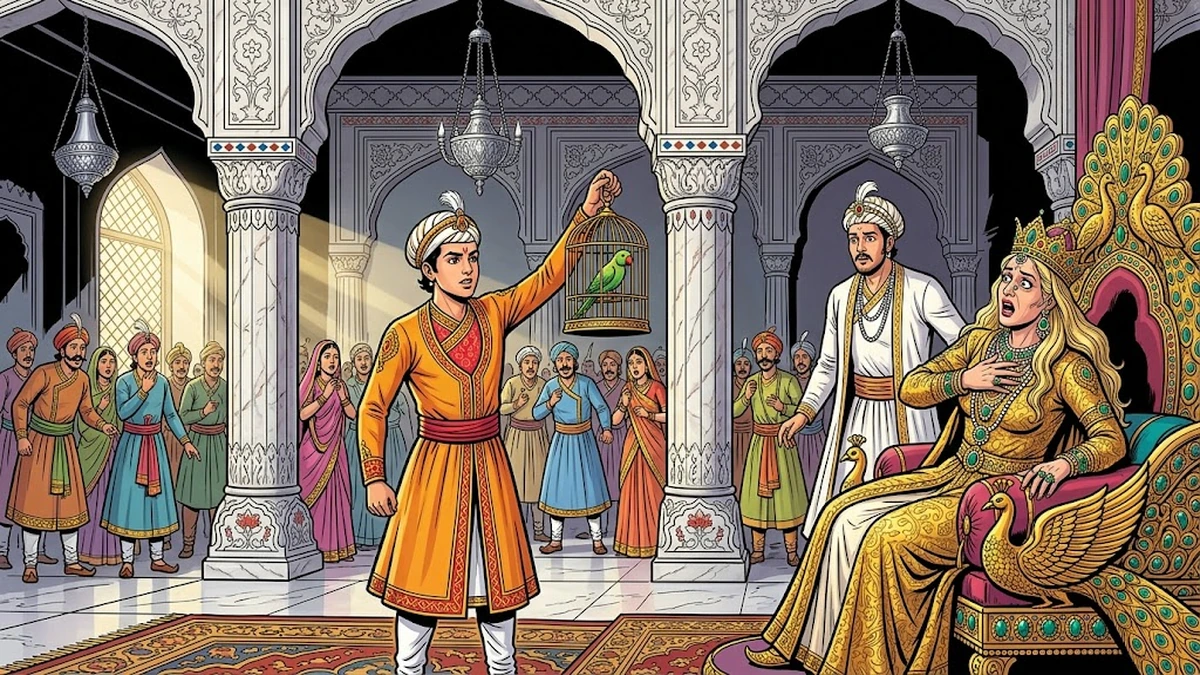
The boy crosses the Lake of Seven Wells in a coracle of buffalo-hide that he weaves himself, climbs the sandal-wood tree, takes the green parakeet alive, and carries it home through the long passes of the Hazara, the Pothohar, and the Bari Doab. When he comes at last to his father’s palace, the witch is sitting on the throne in the audience-hall, dressed in cloth of gold, surrounded by her flatterers. The boy enters, holds up the cage with the green parakeet in it, and, very gently, very deliberately, in front of the whole court, twists the bird’s right wing. The witch, on the throne, screams once and her right arm withers. He twists the left wing; her left arm withers. He pulls a single tail-feather; the eighth queen falls forward on her face. He breaks the bird’s neck; the eighth queen lies dead on the marble floor of the audience-hall.
VIII. The Healing of the Seven Mothers’ Eyes
The tale’s closing is one of the most quietly moving passages in the whole of Punjabi folk-narrative. The boy, having killed the witch, goes alone to the dungeon at the foot of the gardens, lifts loose the iron grating, and descends the stone steps to where his seven mothers, blind and astonished, hear his voice. He has brought from the cave of the princess Sun-Jewel a small clay flask of water from the spring beneath the sandal-wood tree on the island in the Lake of Seven Wells — the same spring from which the witch herself had drunk, daily, to maintain her unnatural beauty. Steel’s text records the moment with a gravity that no novel could improve upon: “He poured the water, drop by drop, on each of his seven mothers’ closed eyelids, and one by one their eyes were healed, and they saw their son, and the dungeon, and at last the world.”
The seven queens, blind for sixteen years and their eyes now restored, are led up the dungeon steps into the daylight. Each of the seven, in the Punjabi storyteller’s tender enumeration, makes a small gesture as her sight returns: the eldest looks first into her son’s face; the second covers her face with her hands and weeps; the third looks at the sky; the fourth at her own hands, which she has not seen in sixteen years and which are now the hands of a middle-aged woman; the fifth, sixth, and seventh embrace one another and then, together, look at the king their husband, who comes into the courtyard at that moment, undeceived for the first time since the white hind crossed his path. He weeps; he cannot speak; he kneels.
IX. The Moral: That Which Loves Restores; That Which Drains Destroys
The Punjabi kahaniwali Faqir Bibi closed the tale, when she told it to Steel in the cold weather of 1885 in Kasur, with a rhymed Punjabi couplet that Steel preserved in transliteration in her notebook and that R. C. Temple translated for the 1894 printed volume:
Sáchí prát kade na sukkáve;
Jhúthí prát jeí nág dí chhá. —
Sáth ráníán dá putt jiyá,
ate únhán díán akkhán vekhián.“Love that is true never dries up;
Love that is false is the shade of a snake. —
The son of seven queens lived,
and the eyes of the seven mothers saw again.”— Punjabi closing couplet of Sáth Ráníán dá Putt, transmitted by Faqir Bibi of Kasur to Flora Annie Steel, in Tales of the Punjab Told by the People (Macmillan, 1894), p. 112; transliteration and translation by Captain R. C. Temple.
The doctrine the proverb encodes is the central ethical doctrine of north-Indian folk-narrative, and it is precisely this: genuine love restores the lover, the loved, and the world around them; counterfeit love drains them all. The witch’s love for the king is the second kind. The seven queens’ love for one another, and for the boy, is the first. The story’s remarkable structural achievement is that both kinds of love are placed side by side under the same roof — the same palace contains both the witch’s perfumed bedchamber and the seven queens’ weeping dungeon — and the test of which love is which lies in what each does to the people in it. The witch’s love makes the king blind, deaf, and unrecognising of his own kin. The seven queens’ love makes a son grow strong on scraps in a dungeon and walk out, after fourteen years, ready to set right what was crooked. The Punjabi storyteller’s economy is exact: jo bandhí rahegí, mokalí karda hai; jo mokalí rahegí, bandhí karda hai — “that which is bound, sets free; that which is free, binds.” The seven queens, bound in the dungeon, set free their son and at last their husband. The witch, free of every restraint and free even of her own life-force, binds her family in a fifteen-year nightmare and dies on the marble floor of her own audience-hall.
The Punjabi storytellers were not blind to a difficulty in this teaching. The seven queens, after all, accept the king back at the end — the man who, however enchanted, gave the order that they be blinded and imprisoned. Faqir Bibi, asked about this by Steel in 1886, gave a reply Steel records verbatim in her notes: “Kind sister, the king was under the snake’s shade. The king is not the king under the shade; he is the king when the shade lifts. The seven queens forgive the king of the day, not the king of the night.” The distinction — between a person under enchantment and the same person restored to himself — is the deep ethical principle of the tale, and it is one that the Punjabi tradition shares with the Sufi and Bhakti devotional poetries of the same region. To love a person is, in this tradition, to love that person at his best, and to be willing to wait, in the dungeon if necessary, until the best returns.
X. Why It Has Lasted: A Story of Endurance Across Cultures
The international family of which our tale is part is large. Hans-Jörg Uther’s revised Types of International Folktales (FFC 284–286, Helsinki, 2004) records over four hundred attestations of ATU 462 from Kerala to Korea. The closest north-Indian cognate is the Kashmiri tale of The Cunning Wife of Sariputra, recorded in J. Hinton Knowles, Folk-Tales of Kashmir (Trübner, 1888), in which the eight queens are reduced to seven and the witch’s soul is hidden in a starling rather than a parakeet. The closest south-Indian cognate is the Tamil The Story of the Seven Sisters and the Demon, recorded in Mary Frere, Old Deccan Days (London: John Murray, 1868), the first European-language collection of South-Indian folk-tales, in which the seven queens become seven sisters and the witch is named Mottákí. The closest European cognate is the Italian Calabrian tale of Il figlio delle sette regine (“the son of the seven queens”) recorded by Giuseppe Pitrè in his Fiabe, Novelle e Racconti Popolari Siciliani (Palermo, 1875), vol. III, no. 152; the Calabrian eighth queen is a strega rather than a rāk۳asī, and her external soul is in a goldfinch rather than a parakeet, but the structure is unmistakably the same. The closest Far-Eastern cognate is the Korean The Pheasant’s Tomb, recorded by William Elliot Griffis in Korean Fairy Tales (New York: Crowell, 1922), in which the witch is a fox-spirit (kumiho) and the seven queens are reduced to one banished consort.
What makes the Punjabi version distinctive within this enormous family is the extraordinary specificity of its setting in the geography of the Bari Doab. The tigress’s milk is sought in the Hazara hills; the rose is plucked in the Thar; the parakeet is taken from a sandal-wood tree on an island in a lake whose “Seven Wells” the storytellers identified with the seven springs of Sapt-Sarovar at Hardwar. The salt of the boy’s thorn-hedge bag is the rock-salt of Khewra; the kikar tree whose roots become his bow is the local Acacia nilotica of the courtyards of Kasur and Lahore; the buffalo-hide coracle is the standard north-Indian masak still used by the boatmen of the Indus today. Every supernatural element in the tale is anchored in a real place, a real plant, a real animal of the Punjab. The boy’s long journey is, in essence, the route of every nineteenth-century Punjabi pilgrim from Lahore to Hardwar — with an ogress at the end of it.
The genius of Punjabi folk-narrative is what the great folklorist A. K. Ramanujan, in A Flowering Tree and Other Oral Tales from India (Berkeley: University of California Press, 1997), called “the moral atlas of the village.” A Punjabi tale is never set in some vague land of dragons; it is set in a particular village under a particular tree across a particular river from a particular shrine, and the supernatural beings in it travel the same roads the listening grandmother once travelled to her own wedding. The tale of the seven queens is, by virtue of this localising habit, a story you can still walk into. The walls of the Govindgarh fort dungeon are still there. The kikar trees of old Kasur are still there. The springs of Hardwar are still there. The Punjabi mother who tells the tale to her own children at night is still telling it.
XI. Iconography: Hind, Dungeon, Parakeet
Three iconic visual scenes of the tale — the king pursuing the white hind into the ravine, the seven blinded queens nursing the new-born prince in the dungeon, and the boy in the audience-hall holding up the green parakeet whose neck he is about to break — entered Punjabi popular iconography first through the engravings drawn for the 1894 Macmillan edition by John Lockwood Kipling, the Principal of the Mayo School of Art at Lahore (the same Lockwood Kipling who designed the iconography of the Bombay Victoria Terminus and whose son, Rudyard, would go on to draw on his father’s sketchbook for the look and feel of the Jungle Book). Lockwood Kipling’s frontispiece for “The Son of Seven Queens” — a black-and-white engraving showing the boy at the moment of his first emergence from the grating into the courtyard of the palace, his bow of kikar-roots in his right hand — remained, for the next forty years, the canonical image of the tale across northern India. The Lahore lithographic press of Munshi Naval Kishore issued an Urdu chapbook of the tale in 1908 with a full-colour cover lifted directly from Kipling. The greatest twentieth-century iconographic treatment, however, was the set of nine gouache miniatures painted in 1962 by the Lahore Arts Council artist Allah Bukhsh (1895–1978), in which the seven queens in the dungeon are rendered in the long, mournful, attenuated style of late Pahari miniature painting. Allah Bukhsh’s rendering of the moment when the seven mothers receive their sight back — the boy bending over the eldest mother with the small clay flask of spring water in his right hand — remains, for many older readers in Pakistan and Indian Punjab, the indelible image of the story.
The Amar Chitra Katha series, drawing on this iconographic tradition, gave the tale its widest twentieth-century circulation in its 1979 issue “Tales of the Punjab” (ACK No. 184), in which the artist Pratap Mulick’s rendering of the dungeon scene — a single double-page spread showing the seven blinded queens cradling the new-born prince by the small light from the high grating — is, for many South Asian readers of a certain generation, the single image that the words “the son of seven queens” recall. ACK’s editorial team made one small change to Steel’s text: they restored the boy’s Punjabi name Sát-putt in dialogue, on the principle that an Indian children’s comic should not strip a Punjabi hero of his own name. The change, modest as it was, has been adopted in most subsequent retellings.
XII. Reading with Children
For parents and teachers reading The Son of Seven Queens aloud, three small details from the Steel text repay slowing down for. First, the queens’ warning. The seven queens send the king a message asking him not to hunt north because they have dreamt bad dreams. The king, indulgent and impatient, promises and forgets within the hour. Children old enough to follow the story can be invited, very gently, to ask why the king does not take the warning seriously, and what kinds of warning in their own lives they tend not to take seriously. The point is not to blame the king: it is to notice the shape of the moment when a person hears a warning and chooses not to attend to it. Second, the seven mothers. The image of seven blinded women, locked together in a stone dungeon, sharing a child among themselves and singing him into long memory in seven different family dialects, is one of the great sustained images of female solidarity in any folk-literature. Older children will recognise — sometimes with a shock — that the world contains, has always contained, women whose love for one another and for the children among them is what holds an unjust place upright. Third, the bow of kikar-roots. The image of a boy who, given nothing, makes a bow from the dried roots of a tree he has never seen above ground is, in the Punjabi tradition, the central image of childhood agency. The story is teaching, in the gentlest way, that resourcefulness is what one improvises out of what is to hand; and that a child raised by seven mothers in a stone dungeon and given nothing has all he needs, if he listens carefully, to walk back into the world.
XIII. A Note on Sources
The version preserved on this page rests on the standard text of Flora Annie Steel, Tales of the Punjab Told by the People (London: Macmillan & Co., 1894; second printing, 1896; modern critical reprint, with a new introduction by Indira Bhatt, Oxford India Paperbacks, 2002), pp. 98–112. Steel received the tale — along with thirty others in the same volume — from the kahaniwali Faqir Bibi of Kasur in the cold-weather season of 1885; Faqir Bibi had heard the tale, as she told Steel, from her own grandmother in Sirhind in about 1840. The Punjabi text of the closing couplet is preserved in Steel’s 1885 manuscript notebook now in the John Rylands Library, Manchester (MS Eng. 1310/4). Captain (later Sir) Richard Carnac Temple contributed the comparative folklore notes printed at the back of the 1894 volume; Temple’s separate three-volume The Legends of the Panjáb (Bombay: Education Society’s Press, 1884–1900) is the indispensable companion to Steel for any serious reader of Punjabi folk-narrative. John Lockwood Kipling’s engravings for the 1894 first edition are reproduced in the modern critical edition. For the international comparison see Hans-Jörg Uther, Types of International Folktales, FFC 284–286 (Helsinki, 2004); for the Indo-Aryan branch, Heda Jason, Types of Indic Oral Tales, FFC 242 (Helsinki, 1989); for the “external soul” motif, Sir James Frazer, The Golden Bough, third edition (London: Macmillan, 1911), vol. XI, “Balder the Beautiful,” chs. 1–3. For Punjabi village ethnography of the period in which Steel collected, see Denzil Ibbetson, Punjab Castes (reprinted Lahore: Mubarak Ali, 1916; modern reprint, Low Price Publications, 1993). For Lockwood Kipling and the Mayo School see Julius Bryant and Susan Weber (eds.), John Lockwood Kipling: Arts & Crafts in the Punjab and London (New Haven: Yale University Press for the Bard Graduate Center, 2017). Above all the retellings stands the testimony of Faqir Bibi, the Punjabi kahaniwali of Kasur, who carried the tale from her grandmother to a young Englishwoman’s notebook on a winter evening in 1885 and so to us.
Read time: about 11 minutes. Suitable for ages 8 and up; suitable for read-aloud from age 6 with the dungeon scene rendered, in the Punjabi storytellers’ gentler phrase, simply as “the seven queens were kept safe in a deep room until their son could free them.”
Frequently Asked Questions
**Q: Why is this story important?**
You May Also Like
 Indian Folk Tales
Ages 6-8
Indian Folk Tales
Ages 6-8
The Magic Drum: A Lesson in Purity of Heart
The Magic Drum: A Lesson in Purity of Heart: The Drum That Sang With Abundance In a remote village nestled in the foothills of the Vindhya Mountains, there
 Indian Folk Tales
Ages 3-5
Indian Folk Tales
Ages 3-5
The Soothsayers Son
The Soothsayers Son: A soothsayer when on his deathbed wrote out the horoscope of his second son, whose name was Gangazara, and bequeathed it to him as his
 Indian Folk Tales
All Ages
Indian Folk Tales
All Ages
The Interesting Journey
The Interesting Journey: Once upon a time, a little boy named Rohan lived near the foot of the Mt. One day Rohan’s dad woke up bright and early and woke up