Mr Bunnys Carrot Soup
Mr Bunnys Carrot Soup: Once upon a time Mr. Bunny picked four carrots. I will make carrot soup, he thought. Rat asked, “May I have a carrot please?” “Yes, take
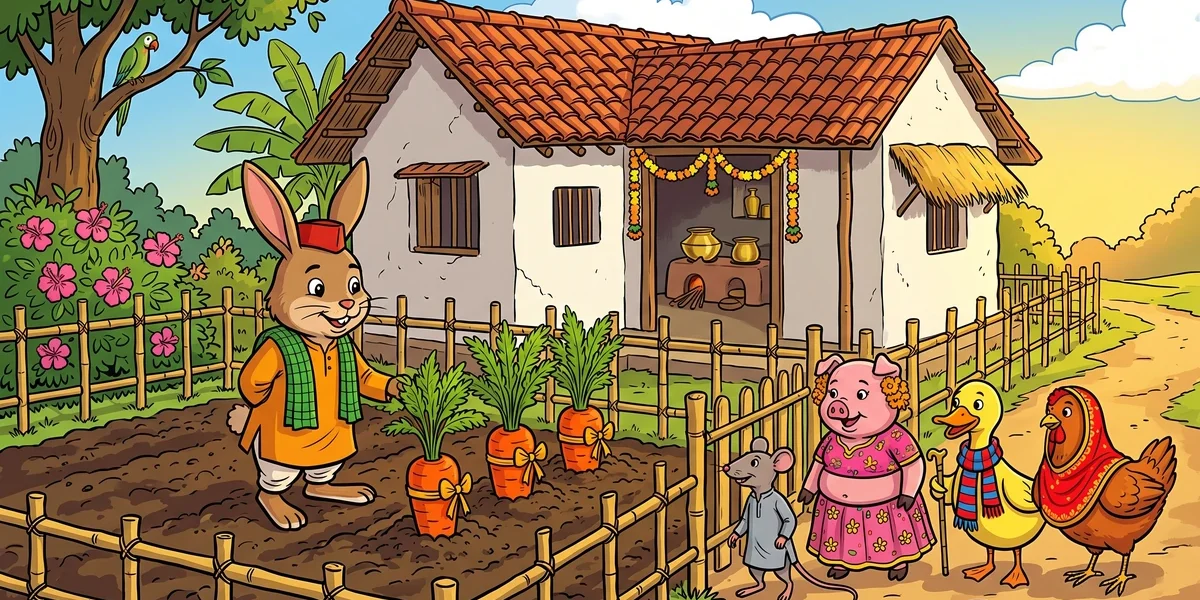
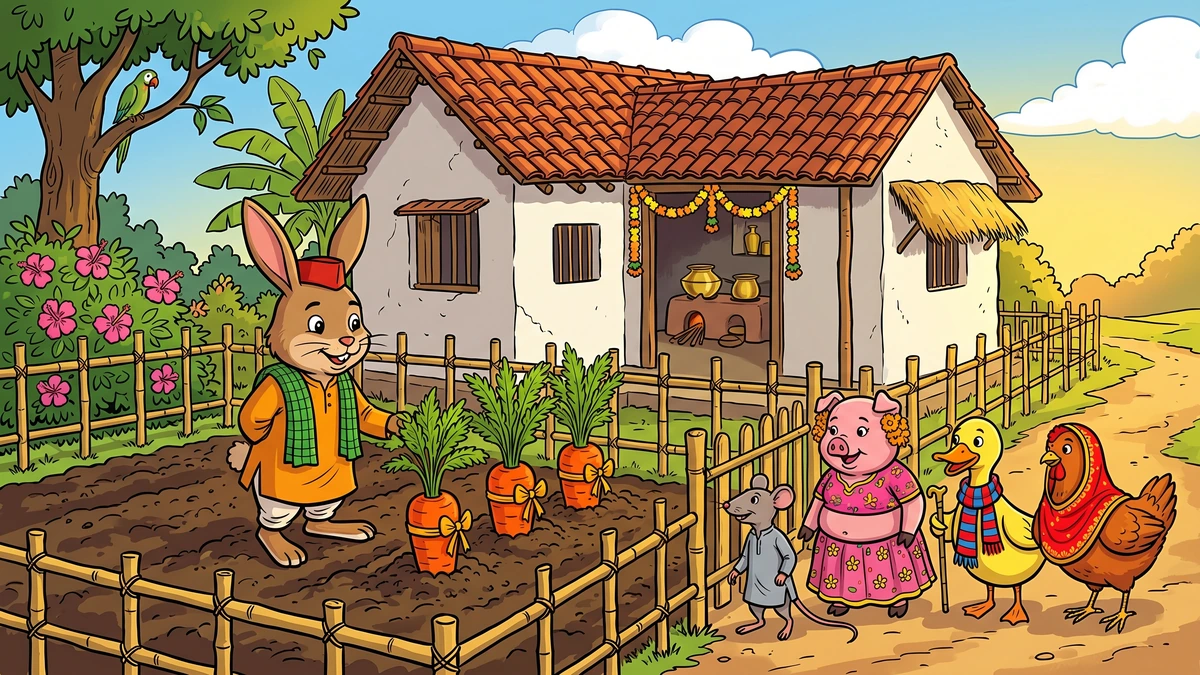
Mr Bunny’s Carrot Soup is a contemporary Indian children’s animal-fable in the long ATU 1548 (Stone Soup) tradition of food-sharing tales — a small, plainly-told story about a rabbit who picks four carrots intending to make soup, gives every one of them away to the four neighbours who knock at his garden gate, and then discovers that the friends he fed have come back to his door with a basket each, so that the simple supper he could no longer cook for himself becomes a shared meal richer than anything four carrots alone would ever have made. The version that circulates today on Indian Folk Tales derives from the digital children’s-reading collection Tell-a-Tale (Mumbai, c. 2014), itself a modern Indian retelling of a story-pattern that the Indian subcontinent has carried — through the dāna-ethic of the Mahābhārata, the Buddhist Jātaka tales of generosity, and the village-fable tradition of grandmothers and uncles — for at least two thousand years.
The plot belongs to the international stock of food-sharing tales that folklorists classify under Aarne-Thompson-Uther type ATU 1548 — The Soup-Stone (sometimes ATU 1564 / ATU 1567): a hungry traveller, a closed door, a clever pretext, and a meal that emerges from the combined small gifts of an entire village. Mr Bunny’s Carrot Soup inverts this pattern with a particularly Indian sweetness — Mr Bunny does not trick the village; he simply gives, and the village gives back. The closing image of the doorbell ringing “ding-dong, ding-dong” with four laden friends on the threshold is the quiet Indian children’s-literature answer to the European mendicant who tricks soup out of stingy peasants: in the Indian telling, the gift, freely given, returns multiplied. To open this little tale is to step back into the cool earthen kitchen of an Indian village burrow, the smell of mustard oil and curry-leaves on the small stove, and the steady moral that runs from the Hitopadeśa through the Panchatantra through the radio-stories of the late twentieth century: paropakāra — the welfare of others — is the highest food a household can serve.
The Garden, the Four Carrots, and the First Knock
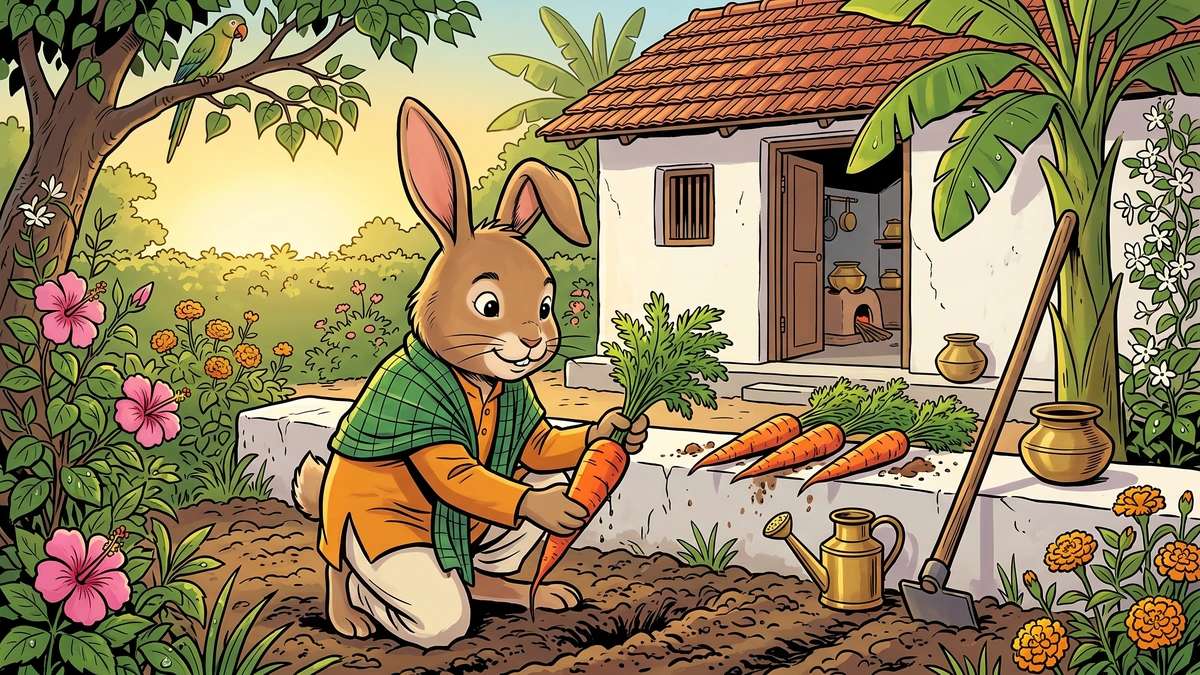
The story opens on a bright Indian village morning in Mr Bunny’s neat little garden, where four plump orange carrots stand in a row in the dark turned earth. Mr Bunny — a sober, soft-eared brown rabbit in a small kurta and a checked shawl — has been tending this patch since the spring rains, watering it with a little brass lota, weeding it with patient paws, and waiting for the day the carrots would be ready. Today is that day. He pulls them from the soil one by one, dusts them gently against his apron, and lays them in a row on the garden wall. I shall make carrot soup, he thinks, picturing the steam, the chopped coriander, the warm bowl on his own kitchen table. He has waited all summer for this small private ceremony.
It is exactly at this moment of quiet anticipation that the first knock comes at the garden gate. Mr Rat — thin, polite, whiskers trembling — bows and asks if he might please have a carrot. The first beat of the story turns on the simplicity and immediacy of Mr Bunny’s reply. He does not weigh the request, does not calculate, does not estimate his remaining stock. He looks at the row of four carrots, then at Mr Rat’s hopeful eyes, and he says yes, take one. The transaction is finished in two heartbeats; the moral economy of the whole tale is established in those four small words. The narrative has begun the way every great Indian generosity-tale begins — with an ordinary householder and an ordinary request, met by an answer given without hesitation.
Three More Knocks: Miss Pig, Mr Duck, Miss Hen

The middle of the story is built on the oldest narrative engine in folk literature: the rule of three (or here, three more), each repetition tightening the moral pressure on Mr Bunny’s resolve. After Mr Rat departs gnawing happily on the first carrot, Miss Pig arrives, plump and pink in a flowered ghagra, and asks the same polite question; Mr Bunny gives the second carrot away. Then Mr Duck waddles up the garden path in a small striped scarf and asks for the third; Mr Bunny gives the third carrot. Finally Miss Hen, in a neat red chunni, peers over the gate and asks, very gently, if there might be a carrot to spare; and Mr Bunny — looking down at the single remaining root — answers yes, take the last one.
The Indian children’s-literature tradition, descending from the Pañcatantra through the Akbar-and-Birbal cycle and the modern Tulika and Tell-a-Tale picture-books, has always preferred this pattern of quiet, unforced giving over the European pattern of trial-and-test. Mr Bunny is not being tested by gods in disguise (as in the Greek Philemon and Baucis of Ovid’s Metamorphoses VIII.611 or the Indian Markandeya episode of the visiting sage); he is simply being asked, by ordinary neighbours, for an ordinary thing. He gives because giving is what one does. By the time Miss Hen is walking home with the last carrot, Mr Bunny is left with empty paws and an empty pot, and the late-morning sun is already too high to plant another row. He goes home, the story says simply, without any carrots. There is no soup. There will be no soup. The narrative has placed its hero, with perfect Indian-fable economy, at the precise point where European versions of the tale would now turn on the dishonesty of the world.
The Doorbell at Noon: Ding-dong, Ding-dong
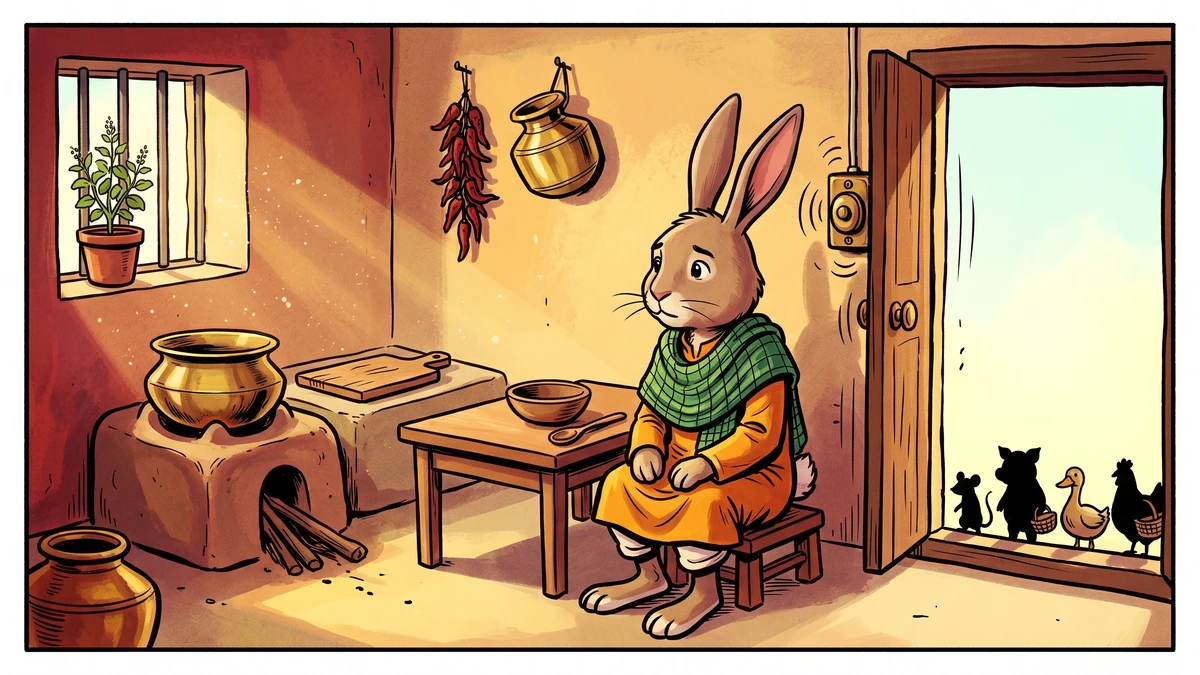
The third and longest beat of the tale is its quietest — the empty kitchen, the cold stove, the rabbit at his small wooden table with no soup before him, only the memory of four carrots and four polite faces. The story holds this stillness for one short paragraph, exactly the length a grandmother telling the tale at bedtime would hold the silence to let the child feel the weight of the choice. Outside, the Indian noon settles over the meadow with its bright dust and its drone of bees. Mr Bunny does not regret the giving — that is the central refinement of the Indian version — but he does feel, plainly and without performance, the simple smallness of his hunger.
And then, at the precise narrative moment when European tales would deliver a moral lesson by punishing or saving the hero, the Indian tale does something gentler. The doorbell rings. Ding-dong, ding-dong — the onomatopoeia is preserved across every published version because the sound is the moral hinge of the whole story. On the threshold stands Mr Rat with a small basket of onions; behind him Miss Pig with a basket of potatoes; behind her Mr Duck with a bunch of fresh coriander and turmeric; and behind him Miss Hen with a small jar of ghee and a packet of salt. Each has come back, of their own accord, with a small gift to thank Mr Bunny for the carrot. None of them has spoken to the others. They simply, separately, returned. The four small gifts are exactly the four ingredients a country kitchen needs to make soup — provided, of course, there were carrots in the pot. The reader-child realises, before Mr Bunny does, what is about to happen. This anticipatory pleasure is the moral architecture of the story.
The Shared Pot and the Long Table
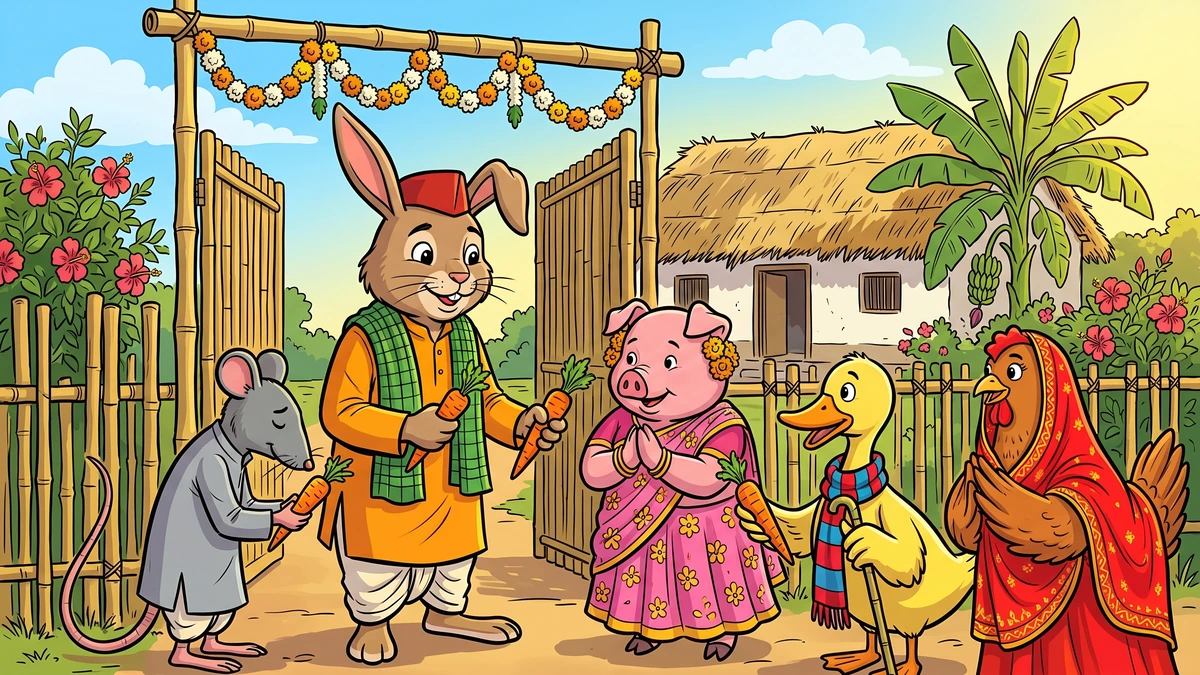
The fourth beat is the cooking and the meal. Miss Pig and Miss Hen take charge of the kitchen, Mr Duck chops the coriander, Mr Rat lights the small clay chulha, and Mr Bunny — who an hour ago was quietly facing an empty pot — finds his own small kitchen suddenly fragrant with the smell of a real soup. The four carrots that were given away in the morning have come back as four other vegetables, plus the spice and salt and the ghee that an unaccompanied carrot soup would in any case have needed. The Indian-village miracle of the shared pot is not magic but arithmetic: four small kindnesses, returned as four small kindnesses, become a feast for five. It is the same arithmetic that the Buddhist Jātaka of the Sasa Jātaka (Jātaka 316, the Hare’s gift) celebrates and that the Mahābhārata‘s Anuśāsana Parva enjoins on every householder.
The meal is eaten at Mr Bunny’s small table, which has been pulled out into the garden because the house is too small for five. The five animals sit on rush mats, the soup is ladled from a single brass pot, and the conversation is the easy unremarkable chatter of friends who did not plan to meet but are now glad to be together. The story does not make a speech. It simply lets the noon sun warm the garden, the soup steam in five small bowls, and the laughter rise the way laughter does at any village meal. By the time the bowls are empty and the friends are walking home in the cool of the early afternoon, Mr Bunny has discovered, without anyone needing to say it, that the soup he could not make alone has been made for him by the giving-away of the very carrots he thought he had lost.
Moral
The moral of Mr Bunny’s Carrot Soup is the cardinal moral of every Indian generosity-tale from the Buddhist Sasa Jātaka onward: generosity is not subtraction; it is multiplication, delayed in time. Mr Bunny does not lose four carrots; he lends them, briefly, to the meadow, and the meadow returns them as soup, friendship, and a meal eaten in company. The Sanskrit moral of the Hitopadeśa closes the tale exactly:
परोपकाराय पुण्याय पापाय परपीडनम् ।
paropakārāya puṇyāya pāpāya parapīḍanam |
The doing of good to others is the highest merit; the giving of pain to others is the deepest sin.
— Hitopadeśa, prefatory maṅgala-śloka (c. 12th century, traditionally attributed to Nārāyaṇa Paṇḍita)
The same teaching rises in the Bhagavad Gītā‘s injunction to act without attachment to fruit (karma-phala-tyāga, BG 2.47), in the Buddhist Dāna-pāramitā (the perfection of giving, first of the six pāramitās), and in the village proverb of north Indian Hindi grandmothers: baant ke khao to barakat hoti hai — eat after sharing and the food multiplies. Mr Bunny’s four carrots are the children’s-bedtime version of the same idea: a small object, given freely, returns as a larger gift than it ever could have been if hoarded.
Why This Story Has Lasted
Mr Bunny’s Carrot Soup is a story of the late-twentieth and early-twenty-first centuries — its Tell-a-Tale text first circulated in printed Indian children’s collections around 2014 and has since been carried into thousands of Indian homes through school readers, after-school storytelling apps, and bedtime picture-books. But the bones of the tale are older than India’s printing presses. It is at once a children’s Stone Soup (the European motif first written down in French in 1720 and Anglicized in the 1808 Tabart’s Tales); a domestic version of the Buddhist Sasa Jātaka‘s teaching that the smallest creature, giving everything, gives most; and a quiet contemporary echo of the Hitopadeśa‘s opening verse on the householder’s duty of paropakāra. Because the story trains the youngest Indian reader, in a single half-page narrative, to recognise that giving and receiving are the same gesture viewed from two ends of a single afternoon, the tale has spread quickly through Indian schools and bedtime libraries since its first printing — and will, on present evidence, keep spreading. It is the smallest possible folk-tale machine for teaching the largest possible Indian virtue: dāna, the art of giving without counting.
What the modern Indian household preserves in retelling this little story is an entire moral world: the door that opens to a knock; the carrot that is given, not bargained over; the doorbell that returns at noon with the gift redoubled; the table that grows as the friends arrive. In a country that has, for two thousand years, refused to draw a line between hospitality and holiness — where the guest is atithi devo bhava, “the guest is god,” in the Taittirīya Upaniṣad‘s old Sanskrit verse — Mr Bunny’s small story is the children’s-bedtime entry-point to the same lesson. That is why a tale four short paragraphs long, with five animals and one pot of soup, has the staying power of a far longer epic: it does, in miniature, the work that the largest Indian texts have always done, which is to remind a child that the household whose door opens easily is the household that will never go hungry for long.
The Indian Storytelling Lineage Behind the Tale
Every short children’s story published in modern India sits, whether the author intends it or not, on a stack of much older Indian texts. Mr Bunny’s Carrot Soup is no exception. Behind its four short paragraphs runs a textual genealogy that scholars of Indian narrative trace through at least five layers of transmission. The deepest layer is the Buddhist Jātaka corpus (c. 3rd century BCE — c. 5th century CE, Pali canon), whose Sasa Jātaka (Jātaka 316) tells of a hare who, when a hungry brahmin appears at his hermitage, leaps into the cooking-fire to offer his own body as food, and is rewarded by Sakka (Indra) by being painted in the moon’s face — the lunar “rabbit” that Indian children still point to in the night sky. Mr Bunny’s offering of his four carrots is a tiny domestic version of this same Buddhist moral architecture.
The second layer is the Sanskrit nīti-śāstra tradition of the Pañcatantra (c. 3rd century CE, attributed to Viṣṇu Śarmā) and its later abridgement the Hitopadeśa (c. 12th century, Nārāyaṇa Paṇḍita), where book-after-book of animal fables explores the precise calibration of dāna (giving), mitra-lābha (the winning of friends), and sandhi (alliance). The fourth book of the Pañcatantra, Labdha-praṇāśam (the loss of what was gained), explicitly warns against the false giving that hopes for return; the very next book, Aparīkṣita-kārakam, warns against giving without thought. Mr Bunny’s Carrot Soup teaches the precise via media between these two cautions: give freely, but to those who will, in their own time and in their own way, complete the cycle.
The third layer is the long oral tradition of Indian grandmother-tales (in Hindi, nānī-kī-kahānī; in Bengali, ṭhākurmā-r jhuli; in Tamil, pāṭṭi-k-kataikaḷ) — the household-fire stories that no modern reader can date but that every Indian household has carried forward. Tales of polite animal neighbours, shared pots, and unexpected kindness fill these collections; Mr Bunny is a contemporary Hindi-children’s reflection of the rabbit-and-hedgehog characters of the village retelling. The fourth layer is the modern Indian children’s-publishing movement of the 1970s and 1980s — Tulika Books (founded Chennai, 1996), the National Book Trust’s children’s-line, and the Children’s Book Trust readers — which translated this oral tradition into printed picture-books in English and the regional languages. The fifth and outermost layer is the digital children’s-platform movement of the 2010s, including Tell-a-Tale, Pratham Books’s StoryWeaver, and Kutuki, which have re-circulated stories like Mr Bunny’s to a generation of children reading on tablets and family phones.
Reading the Tale Today
For a parent or teacher reading Mr Bunny’s Carrot Soup aloud to an Indian child today, the small art of the story lies in its four-beat structure and its refusal to moralise on the page. Ask the child, after the second knock, how many carrots are left, and how many neighbours might still be coming. Ask, after the fourth knock, what Mr Bunny will eat for lunch. Hold the silence over the empty stove. And then let the doorbell ring. The story will do its own teaching; the child’s face at the moment of the second doorbell-ring is the entire moral lesson, delivered without a single word from the adult. This is exactly how the Indian oral tradition has always preferred to teach — not by sermon but by sympathetic recognition, the moment when the listener works the moral out for themselves. A short, gentle story like Mr Bunny’s is a complete miniature pedagogy in itself: a carrot, a knock, a knock, a knock, a knock, an empty pot, a doorbell — and the long quiet afterwards in which the child silently understands.
More from the Indian Folk Tales collection
- Keep It For The Beggar — a Tamil tale of generosity and divine reward.
- Her Childhood — a quiet remembered Indian girlhood.
- Brahma’s Wife and the Mongoose — the Pañcatantra’s classic ATU 178A faithful-mongoose fable.
- A Lac of Rupees for a Piece of Advice — a Kashmiri ATU 910 tale of bought wisdom.
- A Crow and His Three Friends — Pañcatantra Mitra-Samprapti, ATU 554.
Canonical Attribution
Story type: ATU 1548 (The Soup-Stone) / ATU 1567 / ATU 750 (Hospitality rewarded). Stith Thompson motifs: Q42 (Generosity rewarded), Q45.1 (Reward of hospitality), J1322.1 (Soup of stones), W11.5 (Generosity in giving food), N825.3 (Helpful old man at meal), B435 (Helpful animals). Indian textual lineage: Buddhist Sasa Jātaka (Jātaka 316, Pali canon, c. 3rd century BCE); Pañcatantra Books II (Mitra-Lābha) and IV (Labdha-Praṇāśam), Viṣṇu Śarmā, c. 3rd century CE; Hitopadeśa (Nārāyaṇa Paṇḍita, c. 12th century, prefatory verse paropakārāya puṇyāya pāpāya parapīḍanam); Taittirīya Upaniṣad I.11.2 atithi devo bhava; Mahābhārata Anuśāsana Parva 104.59-65 on dāna. European parallels: ATU 1548 Soupe au caillou (French, 1720); Stone Soup in Tabart’s Tales for the Nursery (London, 1808); Marcia Brown’s Stone Soup (Scribner, 1947); Gabriel Djurklou, Spiksoppa (Sweden, 1883). Modern Indian text: Tell-a-Tale digital children’s reading platform (Mumbai, c. 2014); referenced also in Pratham Books’s StoryWeaver and the Tulika Books picture-book tradition.
You May Also Like
 Indian Folk Tales
Ages 3-5
Indian Folk Tales
Ages 3-5
The Farmer And The Money Lender 2
The Farmer And The Money Lender 2: There was once a farmer who suffered much at the hands of a money-lender. Good harvests, or bad, the farmer was always poor
 Indian Folk Tales
Ages 9-12
Indian Folk Tales
Ages 9-12
King Shibi and the Dove
King Shibi and the Dove: In a kingdom known throughout the ancient world for the justice and compassion of its ruler, there reigned a King named Shibi. joins a
 Indian Folk Tales
Ages 12+ / YA
Indian Folk Tales
Ages 12+ / YA
The Disconnect | Modern Indian Wedding Satire Poem (12+)
A modern satire on lavish weddings, debt, and the quiet rebellion of simple marriages — Kabir’s wisdom in a new key.