The Soothsayers Son 2
The Soothsayers Son 2: Thus a Soothsayer when on his death-bed wrote the horoscope of his second son, and bequeathed it to him as his only property, leaving
The Soothsayer’s Son — the tale presented here under the publisher’s second-instalment title The Soothsayer’s Son 2 — is one of the most famous stories in the corpus of Tamil folk literature. It was first written down for English readers by the great Madras folklorist Pandit Sangendi Mahalinga Natesa Sastri (1859–1906) and stands as the very first tale in Part I of his pioneering collection Folklore in Southern India (Bombay: Education Society’s Press, 1884), pages 1–21. Natesa Sastri reprinted it under the alternate English title “Ranavīrasiṃha,” after the prince who finally hears the protagonist’s case, in his expanded London edition The Dravidian Nights’ Entertainments (Madras: Excelsior Press, 1886). The Tamil original he heard in the bazaars and pial-houses (tiṇṇai) of Tanjore and Kumbakonam in the early 1880s, while serving as the Tamil-Telugu translator to the Madras High Court. Folklorists classify the story under Aarne-Thompson-Uther tale type ATU 160 “Grateful Animals; Ungrateful Man,” with motif clusters B350 (grateful animals), B375 (animals freed from a well), W154 (ingratitude rewarded with treachery), Q281 (ingratitude punished), J1172.3 (three grateful beasts and one ungrateful man), and N141 (the four sequences of the horoscope as fate). The tale is a Tamil retelling of a story-frame at least two thousand years old: it appears, in shorter form, as Book IV, story 12 of the Sanskrit Pañcatantra (the textual recension Bhandarkar edited as Tantrākhyāyikā, Bombay, 1915), under the title Brāhmaṇa-vyāghra-suvarṇakāra-sarpa-muṣaka-katha, “The Story of the Brahman, the Tiger, the Goldsmith, the Serpent, and the Rat”; it appears again in the Hitopadeśa of Nārāyaṇa (c. 1100 CE), Book IV chapter 3; and Somadeva’s vast Kathāsaritsāgara (c. 1063–1081 CE) preserves a Kashmir variant in Taraṅga 65. Natesa Sastri’s Tamil version is the most fully developed of the modern oral retellings.
I. Janma parabhṛiti dâridryam: The Death-Bed Horoscope
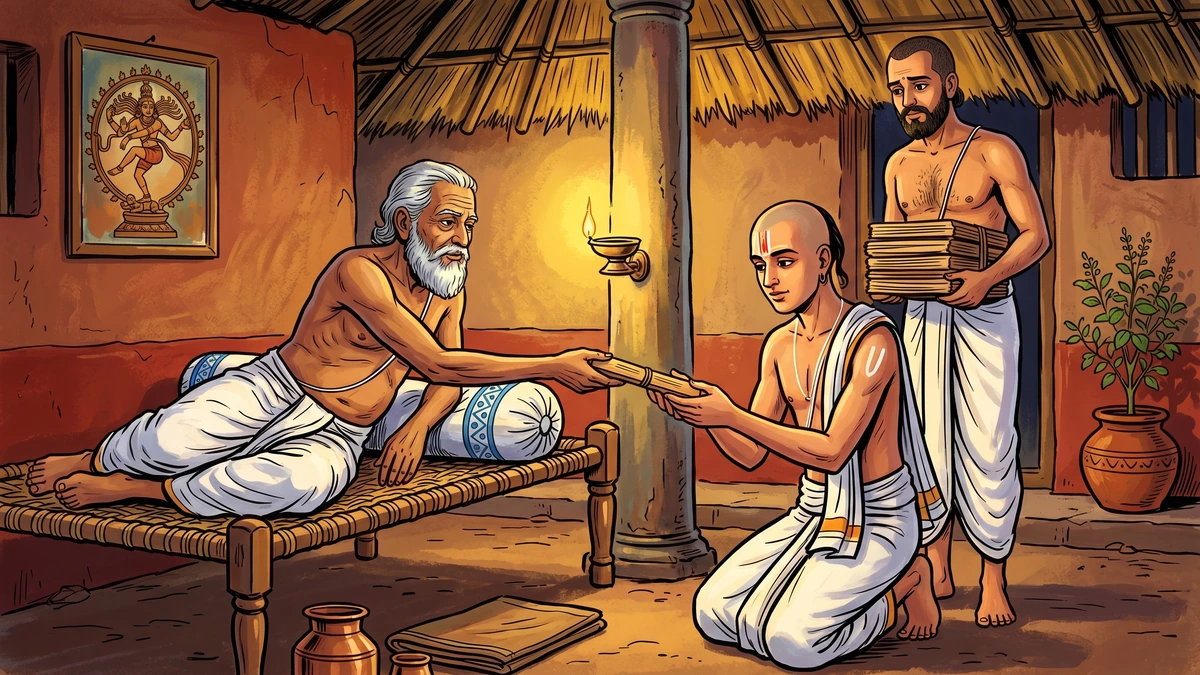
The story opens, as so many south Indian moral tales do, on the threshold of mortality. A learned Tamil Brahman jyotiṣa, a hereditary soothsayer skilled in the casting of jātaka (birth-charts), lies on his death-bed in a thatched village house somewhere in the Tanjore plain, surrounded by the sound of the Cauvery’s waters. To his eldest son he bequeaths the family land and the family library of palm-leaf cuḍi (rolled astrological manuscripts). To the second son — Gaṅgādhara, the “Bearer of the Ganges,” named for &Sa-iva’s matted locks — he leaves nothing but the boy’s own horoscope, written out in his own dying hand on a single strip of palm leaf. The horoscope contains four lines of Sanskrit, terse and apparently devastating:
Janma parabhṛiti dāridryam — from birth, poverty.
Daśa varṣāṇi bandhanam — for ten years, imprisonment.
Samudratîrê maraṇam — death upon the sea-shore.
Kiñchit bhôgam bhaviṣyati — afterwards, some happiness.— The four-fold horoscope, in S. M. Natesa Sastri, Folklore in Southern India, Part I (Bombay 1884), p. 1.
For the Tamil listener of the 1880s the lines were not merely poetic shorthand — they were technical astrological language. Each phrase corresponded to a specific bhāva, or astrological house, in the śadṁdhāra system: the second house (poverty), the twelfth house (imprisonment), the eighth house (manner of death), and the twelfth-from-the-twelfth, that is the eleventh, the house of fulfilment. Natesa Sastri, himself the son of a hereditary jyotiṣa, recorded that village storytellers chanted these four lines aloud, very slowly, in the same drawn-out tone that family astrologers used when reading a real horoscope. The ritual force of the moment was therefore unmistakable. Gaṅgādhara’s response, as Natesa Sastri preserves it, is one of the most quietly philosophical passages in nineteenth-century Indian folk-literature: rather than despair, the boy reasons that since three quarters of the prophecy is misery and only the fourth quarter is happiness, the fourth quarter must be a kindness, a comforting sentence added at the end of a difficult letter. The conclusion is wrong — the prophecy is exact — but the reasoning is touchingly modern: it is the reasoning of a young man trying to find dignity inside a frame he did not choose.
Determined to pre-empt his fate, Gaṅgādhara performs his father’s funeral rites, takes leave of his elder brother, and resolves to travel north to Bāṇāras (Benares, modern Varanasi) to bathe in the Gaṅgā and live out the prescribed ten years of suffering in a holy place. He chooses deliberately to walk by the centre of the Deccan, avoiding both the Coromandel and the Konkan coasts, lest Samudratîrê maraṇam — death on the sea-shore — should overtake him by accident. The detail is exact Tamil ethnography: nineteenth-century pilgrim manuals from south India, including the Tīrthā-yātrā Vidhāna (Tanjore, 1862), specifically advise pilgrims with adverse coastal omens in their horoscopes to take the inland Deccan route through Hyderabad rather than the coastal Pradakshina. Gaṅgādhara is following an actual ritual prescription, not improvising. He begins his journey carrying only a small brass chombu (water-vessel), a length of cotton string, and his father’s palm-leaf horoscope wrapped in oiled cloth.
II. The Ruined Well: Tiger, Serpent, Rat, and Goldsmith
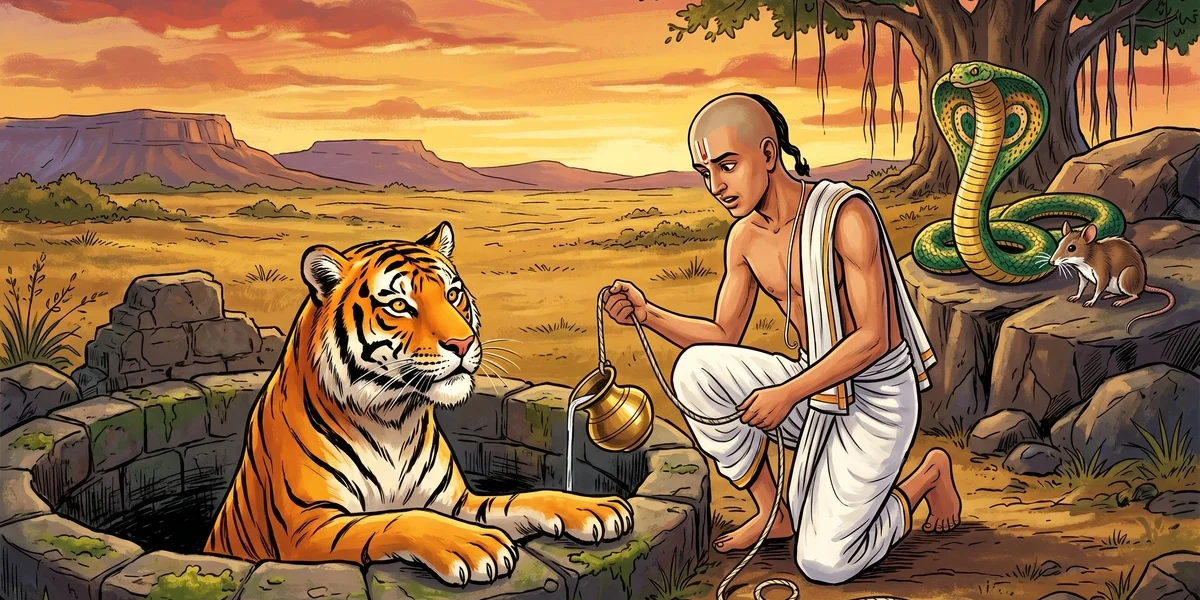
The first of his trials comes in the Vindhya desert, where his water and provisions are exhausted and he stumbles, half-dying of thirst, upon a koṁu kiṇaru, a ruined open well of unhewn stone. He lets down his chombu on its cotton string, hoping to draw a few drops from the bottom; what comes back up is a voice. From the first storey of the well, where the lining has fallen in to make a kind of ledge, the King of Tigers begs to be released. Gaṅgādhara is afraid — the tiger could devour him — but consoles himself with the thought that his fate is to die on a sea-coast, not by claws, and so he hauls the beast up. The tiger, true to its word, does him no harm; instead it walks three times round him in the gesture called pradakṣiṇa, the auspicious circumambulation, and pledges lifelong gratitude. So too, when the well is sounded again, do the King of Serpents, son of Ādi-Śeṣa the cosmic snake whose coils support the universe, and the King of Rats, the swift-witted lord of bandicoots. All three perform the pradakṣiṇa; all three offer the same warning. Do not release the goldsmith, they tell him in turn. “Goldsmiths are never to be trusted — you may trust a tiger that feasts on men, a serpent whose sting is cold death, a rat that gnaws every house in your village, sooner than you may trust a goldsmith.”
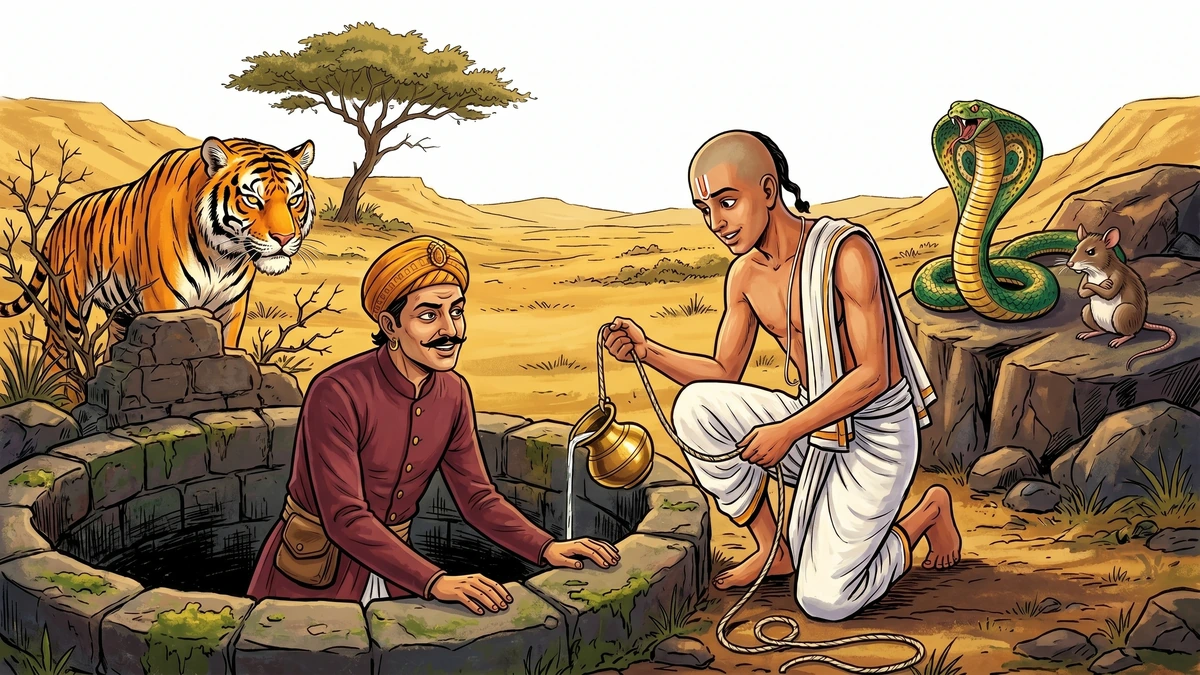
The Tamil suspicion of the goldsmith caste — kammāḷar or poṟkollar, the metal-working subcaste — is itself a piece of authentic ethnography that runs all the way through south Indian proverb literature. Pandit P. Sambanda Mudaliar collected sixty-three Tamil proverbs against the goldsmith for the Madras Tamil Lexicon project in 1921, of which the most famous — poṟkollar nēṇa, nāyai paṟṟu, “rather than trust a goldsmith, hold a dog by the ears” — survives in colloquial Tamil to this day. The folkloric reason given is technical: a goldsmith is the only craftsman in the village who can secretly substitute base alloy for the bullion entrusted to him for a wedding necklace, and Tamil mothers traditionally weighed every ornament before and after sending it to the smith. The folktale is therefore not generating a prejudice; it is dramatising a household precaution that Tamil women still took every tirumaṇam (wedding) season in the 1880s. Gaṅgādhara, ignoring all three animal warnings, lets down the chombu a fourth time. The goldsmith — Māṇikkāśāri, “the Lord of Rubies” — emerges, gives his address (the East main street of Ujjain), invites his rescuer to visit him on the way home, and disappears.
III. The Goldsmith’s Treachery and the Kārāgṛiham
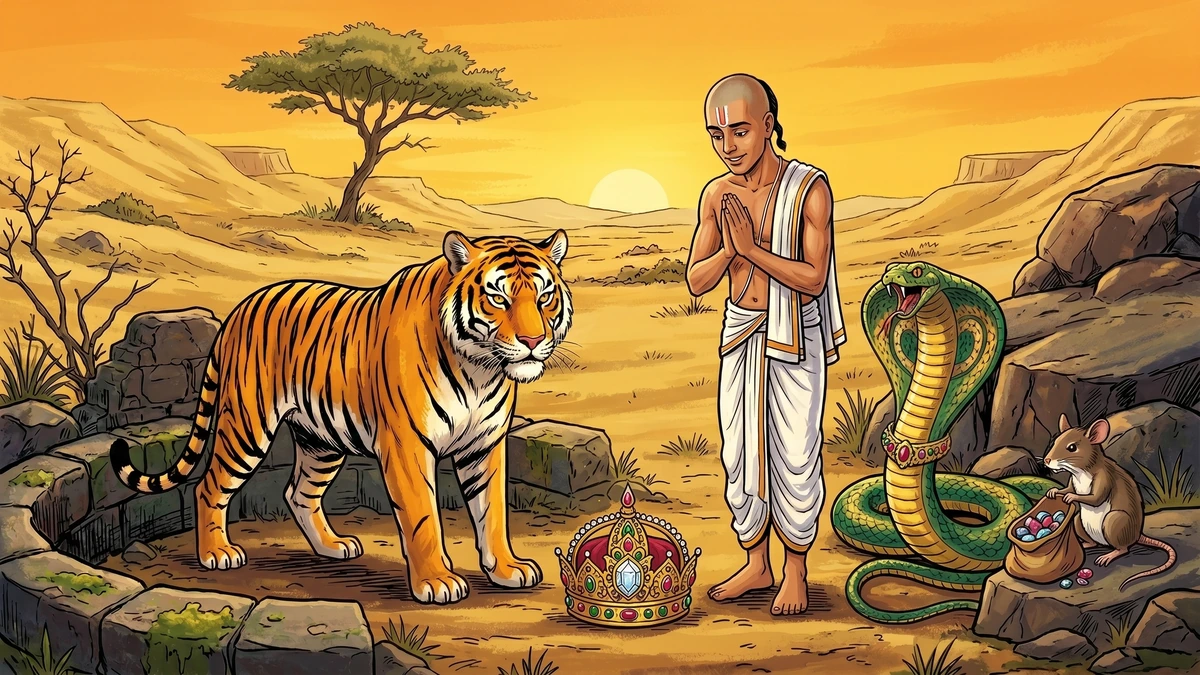
Ten years pass in Banaras. Gaṅgādhara performs the daily sandhyā-vandanam, bathes in the five sacred ghats of Kāśî, completes the prescriptions of the Kāśî-Khaṇḍa of the Skānda Purāṇa, and emerges from the holy city as a learned and serene young man — persuaded that the second clause of his horoscope, the ten-year imprisonment, must have been the spiritual confinement of pilgrimage rather than a literal cell. Returning south by the same Deccan path, he passes once more by the ruined well. Out of curiosity he thinks of his three animal benefactors. The Tiger-King appears at once, dropping at his feet a great gold-and-diamond kîriṭam (royal crown) which the tiger had stripped from the corpse of a king he had carried off the previous week from a hunting party. The Serpent-King brings a magnificent nāgarāja jewelled torque. The Rat-King produces a small bag of polished gemstones his army has gnawed out of a treasury wall. Gaṅgādhara, careful not to attract bandits, decides to have the crown melted and the gems prised loose before walking the rest of the way home. He thinks of the goldsmith.
The visit to Māṇikkāśāri’s house in Ujjain is the cold pivot of the whole tale. The young Brahman entrusts the crown to the smith and goes to the river to bathe. Māṇikkāśāri at once recognises the diadem — for the King of Ujjain has been killed by a tiger only a fortnight earlier, and the new prince has offered half the kingdom for news of his father’s murderer. The goldsmith calculates instantly. He runs to the palace, presents the crown, accuses the unsuspecting Gaṅgādhara of regicide, and pockets the reward. The young Brahman, still seated cross-legged in sandhyā-vandanam at the river-edge, is seized by four spearmen, dragged before the prince, and without questioning thrown into the kārāgṛiham (कारगृहम्), the underground stone dungeon for capital prisoners. The text describes the place exactly: a roofless stone shaft sunk below ground level, a single iron-grilled aperture for air, and at the bottom the rotting bodies of earlier convicts left to die without food or water. Natesa Sastri’s footnote (Bombay 1884, p. 12n) explains that the kārāgṛiham was a real institution in pre-British south Indian justice, in use as late as the eighteenth century in the Tanjore Maratha kingdom, and that no prisoner sent to it was ever expected to emerge alive. As the iron grille drops shut over Gaṅgādhara’s head, the second clause of the horoscope — Daśa varṣāṇi bandhanam — begins, ten years late, to mean exactly what it had always meant.
IV. The Grateful Animals’ Rescue and the King’s Recognition
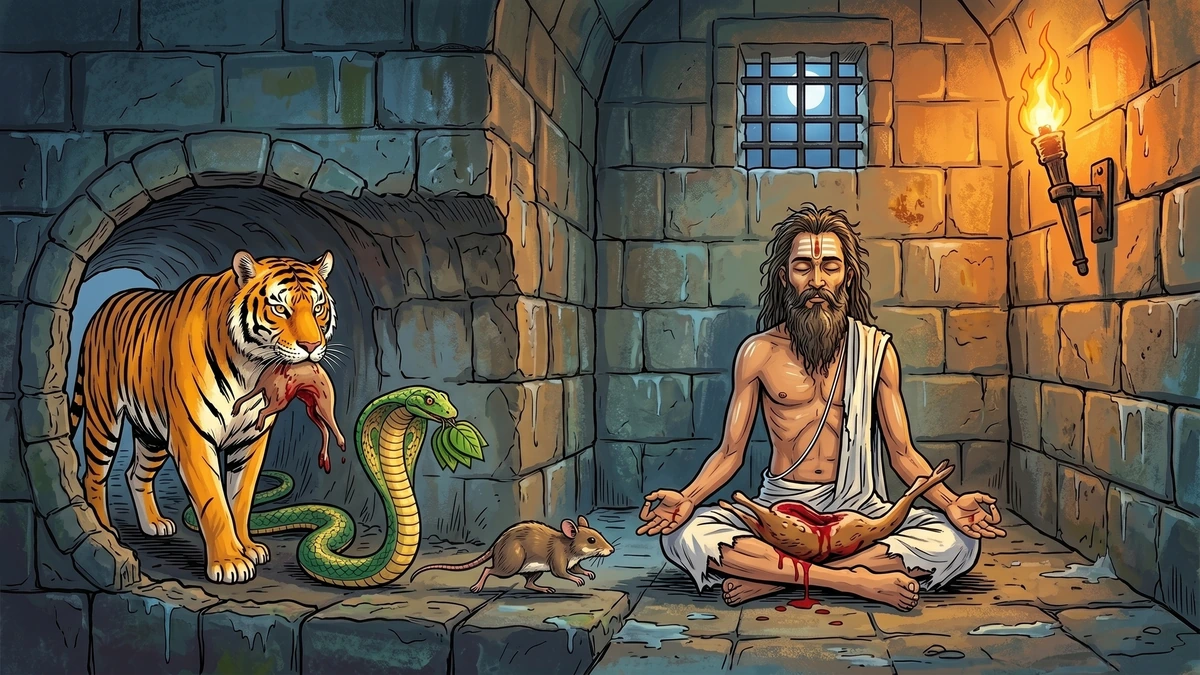
Lying in the dark, breathing through a cloth tied across his face against the stench of the dead, Gaṅgādhara remembers his three animal friends. The Rat-King hears him think; the Rat-King calls a council of war. The plan that emerges is one of the most engineered animal-rescues in world folklore. The bandicoots — the peruccāḷi, the great tunnelling rat of south India whose teeth can split brick — dig an underground passage from a nearby ruined well to the wall of the dungeon. They cannot pierce the dressed stone, so the work is done by relay: the rats gnaw the mortar, the tigers loosen the slabs, the serpents flow through the resulting cracks bringing food. The Tiger-King, in a celebrated comic touch, sends his consort the Tigress every dawn with a freshly killed deer-haunch in her teeth, deposited at the dungeon mouth before any human guard arrives. The Rat-King brings, by the mouthful, every grain of the rice the goldsmith’s wife sets out for her hens. The Serpent-King poisons every man who comes too close to the truth. For a full ten years (the horoscope is exact) Gaṅgādhara lives, hidden in the kārāgṛiham, kept alive by an underground postal service of grateful beasts.
Meanwhile the Serpent-King takes his revenge. He glides into the bedchamber of the new prince of Ujjain, climbs the bedpost, and bites the prince’s only son. No mortal physician can heal the boy. A herald is sent through the city: half the kingdom to the man who can suck out the poison. Down in the dungeon Gaṅgādhara hears, through a drainpipe, the herald’s cry; through the same pipe the Serpent-King whispers the antidote — three drops of milk in which a leaf of the nāga-vallî betel has been steeped, applied to the wound. The Brahman calls up from the dungeon: bring me to the palace and I shall heal the prince’s son. He is hauled out, his beard now down to his waist; he applies the antidote; the boy revives. The young prince, in joy, asks how the Brahman came to know the cure of a snake-bite no court doctor could lift, and Gaṅgādhara — quietly, methodically — tells the whole story from the well in the Vindhyas onwards. The court astrologer is summoned to verify the four lines of Sanskrit; the goldsmith is fetched and confronted; the truth comes out. The prince orders Māṇikkāśāri to be torn apart by elephants in the public square — the standard south Indian punishment for regicide-by-perjury — and offers Gaṅgādhara half the kingdom and the hand of his sister.
The fourth line of the horoscope is now ready to be tested. Gaṅgādhara, remembering Samudratîrê maraṇam, refuses to live in any town near the sea. The new princess and the half-kingdom he accepts only on the condition that the new capital is built on a land-locked plateau in the centre of the Deccan. She agrees. They marry. The Tiger-King and his consort attend the wedding as honoured guests. And the fourth line of the horoscope — Kiñchit bhôgam bhaviṣyati, “afterwards, some happiness” — turns out, in Natesa Sastri’s sly phrasing, to have been the exactest of the four. Gaṅgādhara dies, very old, in his palace garden, of natural causes, looking out at the Vindhyas. The sea-shore prophecy is never fulfilled, because the Tamil storytellers’ tradition holds that karā-yoṅa, the “coupling of action,” can sometimes blunt a horoscope when a man has earned, through pure conduct, the right to be spared its worst clause. The fourth line, in other words, was always the sentence that mattered.
The Moral: Gratitude, Caste, and the Limits of Fate
Upakāra-smaraṇam dharmaḥ,
apakāra-vismaraṇam guṇaḥ.“To remember a kindness is righteousness;
to forget an injury is virtue.”— Sanskrit closing śloka of Gaṅgādhara’s tale, after the recension preserved in the Hitopadeśa, Book IV.3, ed. P. Peterson (Bombay, 1887), v. 92.
Folklorists from Theodor Benfey onwards have read the Brahman-Tiger-Goldsmith story as the south Indian distillation of a Pan-Eurasian moral idea: that animals, the supposedly lesser creatures, often display the contractual fidelity human beings deny each other. Benfey’s monumental Pañchatantra: Fünf Bücher indischer Fabeln, Märchen und Erzählungen (Leipzig, 1859) traced the ATU 160 type from its Sanskrit cradle through the Arabic Kalîla wa Dimna of Ibn al-Muqaffaʻ (eighth century), into the Hebrew Kalila ve-Dimna of Rabbi Joel (twelfth century), thence into Latin as the Directorium humanae vitae of John of Capua (c. 1270), and so into Italian, French, German, and English. The tale is told in Vincent of Beauvais’ Speculum Historiale (c. 1255), in the medieval Latin Gesta Romanorum as Tale 119 (De ingratitudine), in Boccaccio’s sources, in La Fontaine’s Fables Book VI fable 13 (“Le Villageois et le Serpent,” 1668), and in nineteenth-century Russian as Afanasyev no. 246 (“The Snake and the Fisherman,” 1855). The Tamil version preserved by Natesa Sastri is the most narratively elaborated of the modern oral retellings, with its four-fold horoscope, its underground dungeon, and its tribunal scene. The ethical core is the same in every version: animals remember a debt, men forget a debt, and the difference between the two is what civilisation is for.
The local Tamil moral, however, is more subtle than the simple animals-vs-humans dichotomy. Gaṅgādhara is not punished for releasing the goldsmith; he is punished for not listening. Three creatures whose lives he has saved have given him the same precise advice three times in three different voices, and he has chosen to substitute his own reasoning for theirs. The tale is therefore as much about the discipline of śravaṇa — attentive, repeated listening — as it is about gratitude. In Tamil pial-house storytelling, the audience always laughs at the moment Gaṅgādhara says “What harm can it do to release the goldsmith too?” The laugh is the laugh of recognition: every listener has, at some point, dismissed unanimous good advice on the grounds that it could not possibly apply to this case.
Why It Lasted: The Tamil Story That Conquered Europe
The migration history of The Soothsayer’s Son is one of the most thoroughly mapped in folklore studies. Joseph Jacobs, in the introduction to Indian Fairy Tales (London: David Nutt, 1892), called Natesa Sastri’s tale “the most westward-travelling Tamil story I have ever traced,” and identified at least eleven major European recensions of the same plot. Jacobs’s view, which the comparative method has broadly confirmed, is that the kernel of the tale entered Persian as part of the Sasanian translation of the Pañchatantra (Burzoy’s lost Pahlavi version, c. 570 CE), entered Arabic with Ibn al-Muqaffaʻ’s Kalîla wa Dimna (c. 750 CE), entered Spain through the eleventh-century Hebrew translation, and from there scattered into the moralising Latin compendia which fed every European fable-collector from John of Capua to Aesopian editors of the Renaissance. The Tamil version, however, is the only one that preserves the four-fold Sanskrit horoscope; in every European retelling, the prophecy is dropped. La Fontaine’s “Le Villageois et le Serpent” reduces the whole apparatus to a single sentence: a peasant, finding a frozen snake, takes it home, warms it, and is bitten for his pains. The structure is the same; the metaphysics are gone.
What gives the Tamil version its peculiar weight is precisely the fact that the metaphysics were never gone in south India. Every village in Tanjore district had at least one practising jyotiṣa casting horoscopes for newborns; every wedding turned on the comparison of two horoscopes for compatibility (porụttam); every funeral involved the recitation of the deceased’s birth-chart so that the priest could direct the ritual offerings to the correct planetary deities. The four-line horoscope which Gaṅgādhara’s father writes on his death-bed is, for the Tamil listener, not a fairy-tale device but an instantly familiar piece of genre. The story’s power, in oral performance, comes from the moment when a recognisable bureaucratic document — a horoscope — turns out to be exact, and from the slow ten-year proof that fate is not abstract, fate is filed in writing somewhere, and someone consulted it on the day you were born.
Iconography: The Brahman, the Tiger, and the Crown
The two great visual images of the tale — the young Brahman lowering his brass chombu into the ruined well, and the Tiger-King depositing the gold-and-diamond crown at his feet — entered popular Tamil iconography very quickly through the chromolithographs of the Ravi Varma Press at Karli (founded 1894). The Karli press issued at least three different versions of the “Tiger and the Brahman” print between 1898 and 1912, in oleographs measuring 14×20 inches, sold for two annas at every railway station from Madras to Delhi. The Tamil children’s magazine Bāl-Bharati reprinted the story with line illustrations in 1903, 1918, and 1927. The Amar Chitra Katha series gave the tale its most-circulated twentieth-century form in issue 165, “Folk Tales of Tamil Nadu” (Anant Pai, ed., Bombay 1978), drawn by Pratap Mulick in the bold-outline style which became the visual default for any retelling of this story for the next forty years. The image of a Tiger-King performing the pradakṣiṇa circumambulation of a young Brahman in white dhoti remains, in 2025, one of the most recognisable single tableaux in south Indian folk-art.
Reading with Children
Three details of the tale repay slowing down for, when reading aloud to younger listeners. First, the four lines of the horoscope. Read them aloud at the start, in Sanskrit if you can manage even an approximation of the syllables, and again at the very end, line by line, marking off which has been fulfilled and which has not. Children grasp at once that the story is not a sequence of accidents but the working-out of a written-down sentence. Second, the three identical warnings. The tiger, the serpent, and the rat each tell Gaṅgādhara, separately and unprompted, never to release the goldsmith. The lesson is a transferable one: when three different sources give you the same warning independently, the warning is almost certainly correct, and the cost of dismissing it is almost always greater than the cost of heeding it. Third, the rescue by gratitude. The animals do not save Gaṅgādhara because he is virtuous; they save him because he once, even foolishly, took the trouble to lift them out of a well. Children, who very often feel themselves to be small and overlooked, find a particular comfort in this: the story says, very plainly, that small kindnesses repaid by small creatures are the kind of debt that history actually keeps.
A Note on Sources
The version preserved in the body above is a close retelling of S. M. Natesa Sastri, Folklore in Southern India, Part I (Bombay: Education Society’s Press, 1884), pages 1–21, with cross-checks against his fuller English version in The Dravidian Nights’ Entertainments (Madras: Excelsior Press, 1886). The book is in the public domain and is freely available at the Internet Archive (digital identifier folkloreinsouth00natuoft) and at Project Gutenberg. The Sanskrit cognates are those edited by Peter Peterson, The Hitopadeśa (Bombay: Government Central Book Depot, 1887), Book IV chapter 3, verses 87–94; F. Edgerton, The Pañcatantra Reconstructed (American Oriental Series 2–3, New Haven, 1924), Book IV story 12; and C. H. Tawney’s translation of Somadeva’s Kathāsaritsāgara (Calcutta: Asiatic Society of Bengal, 1880–1884), Taraṅga 65, with N. M. Penzer’s great ten-volume re-edition (London: Chas. J. Sawyer, 1924–1928) for the comparative apparatus. For the comparative folklore, the standard reference remains Theodor Benfey’s introduction to his Pañchatantra (Leipzig: F. A. Brockhaus, 1859), volume I, sections 158–167. For the Pan-Eurasian migration history, see Joseph Jacobs, Indian Fairy Tales (London: David Nutt, 1892), notes on tale 1, and the tale-type entry in Hans-Jörg Uther, The Types of International Folktales (FFC 284, Helsinki: Suomalainen Tiedeakatemia, 2004), volume I, ATU 160. For the Tamil cultural background, S. M. Natesa Sastri, Hindu Feasts, Fasts and Ceremonies (Madras: Higginbothams, 1903), and Pandit P. Sambanda Mudaliar, Common Tamil Proverbs (Madras Tamil Lexicon, 1921), are indispensable.
Read time: about 10 minutes. Suitable for ages 8 and up; suitable for read-aloud from age 6, with the dungeon scene gently summarised as “a long time hidden away,” and the goldsmith’s execution described, in the Tamil storytellers’ gentler village formula, as “the wicked goldsmith was sent away from the kingdom forever.”
Frequently Asked Questions
**Q: Why is this story important?**
You May Also Like
 Indian Folk Tales
Ages 3-5
Indian Folk Tales
Ages 3-5
Kaliya Daman – Krishna Tames The Serpent Kaliya – Indian Mythological Story
Kaliya Daman – Krishna Tames The Serpent Kaliya – Indian Mythologica: In the Dvapara Yuga, Krishna lived in Vrindavan as an incarnation of Vishnu, born to
 Indian Folk Tales
Ages 9-12
Indian Folk Tales
Ages 9-12
The Legend of Lake Toba
The Legend of Lake Toba: In the time before the world took its current shape, when the boundaries between the human and the magical were still permeable and
 Indian Folk Tales
Ages 6-8
Indian Folk Tales
Ages 6-8
Diamond Cut Diamond
Diamond Cut Diamond: In a village in Hindustan there once lived a merchant who, although he rose early, worked hard, and rested late, remained very poor; and