Kaliya Daman – Krishna Tames The Serpent Kaliya – Indian Mythological Story
Kaliya Daman – Krishna Tames The Serpent Kaliya – Indian Mythologica: In the Dvapara Yuga, Krishna lived in Vrindavan as an incarnation of Vishnu, born to
Origin & Tradition. A pan-Indian Vaishnava narrative belonging to the Kṛṣṇa-līlā cycle of Krishna’s childhood in Vraja. Sanskrit title: Kāliya-damana (“the subduing of Kāliya”). The episode is canonically located in Bhāgavata Purāṇa, Daśama Skandha (Book X), chapters 15–17 (compiled circa 9th–10th century CE), with parallels in the Viṣṇu Purāṇa V.7 (4th–5th c. CE) and the Hari-vamśa, Viṣṇu-parvan ch. 11 (1st c. CE), the earliest Sanskrit recension we possess. The dance of Krishna upon the serpent’s heads is the iconographic referent of the South Indian bronze type Kālīya-mardana Kṛṣṇa, attested from the Choḷa period onward.
Folk-narrative type. Aarne–Thompson–Uther ATU 300 (the dragon-slayer), refined by motifs B11.11 (multi-headed dragon-serpent), B91.5 (water-serpent poisoning a river), D1711 (divine child as wonder-worker), F420.5.2.7.3 (water-spirit subdued by music), and R155.1 (rescue of community from chthonic monster). The story belongs alongside the Greek Apollo-Python contest at Delphi, the Iranian Ferīdūn–Zāhhāk duel, and the Vedic Indra–Vṛtra hymn (Ṗg-Veda I.32) in the Indo-European corpus of cosmogonic dragon-fights.
Lineage & recorders. The story is preserved in Sanskrit by Vyāsa’s redactors (Bhāgavata), in Marathi by Sant Eknātha’s Ekanāthī Bhāgavata (16th c.), in Brajbhāṣā by Sūrdās in the Sūrsāgar (16th c.), in Tamil-Telugu Sanskritized devotional verse, in Bengali by Caitanya’s associates and the Caitanya-Caritāmṛta. It is recited every monsoon at the festival of Kāliya Nāga Caturthī (also called Nāg Nathaiyā in Banaras’s Tulśī Ghāṭ observance) and is the principal subject of the Lāl-Līlā open-air rāsa-līlā theatre of Mathurā-Vṛndāvana. Modern scholarly anchors: A. K. Ramanujan, ‘On Folk Mythologies and Folk Purāṇas’ (1989); Wendy Doniger, The Hindus: An Alternative History (2009), pp. 401–404 on the līlā economy of mercy; Edwin Bryant, Kṛṣṇa: A Sourcebook (Oxford, 2007), pp. 119–124. Read time: 10 minutes.
Beat I — The River that Forgot How to Be a River
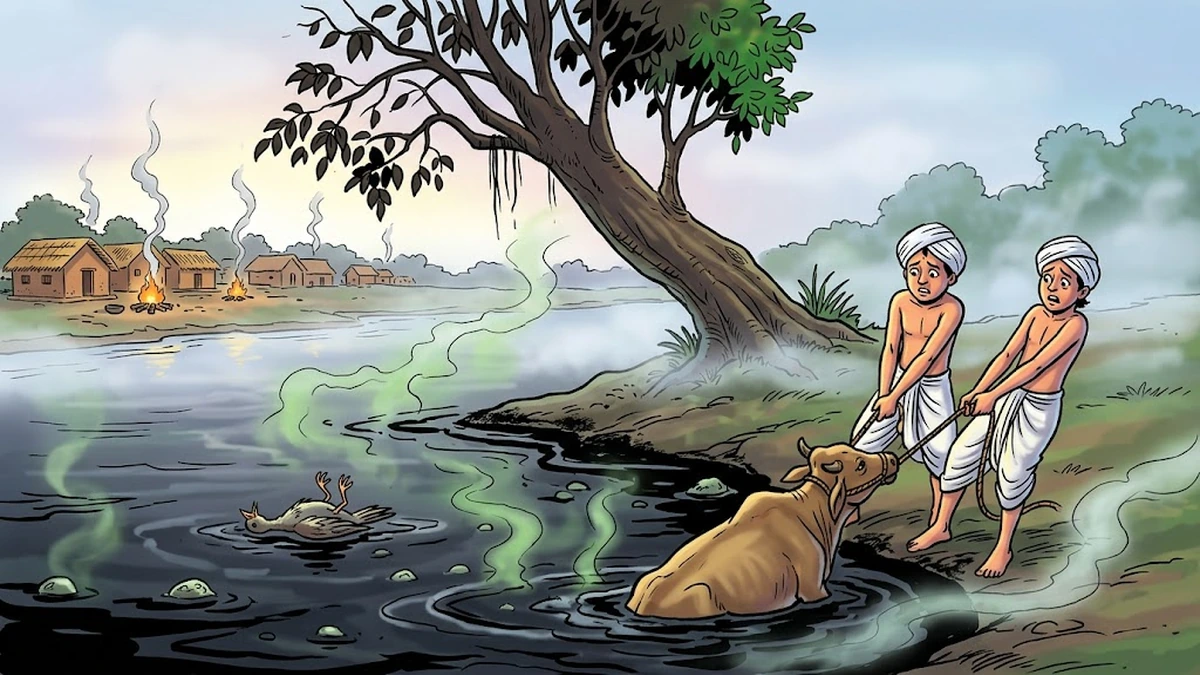
The Yamunā runs blue-black through the long memory of the Bhāgavata, but in those days, in one of her bends below Vṛndāvana, she had forgotten how to be a river. The water in the deep pool at Kālīya’s residence had stopped behaving like water. It bubbled when no fire was lit beneath it. It steamed at midday and froze a thin black crust at dawn. Birds that flew across it dropped mid-flight and lay floating with their feet in the air. Cows that touched it with their lips died standing up, and the cowherds had to pull them down. Even the tall kadamba tree that bent over that pool had withered on the river-side; its leaves were green only on the side facing the village.
The cowherds called it the kaliyahrada — Kālīya’s house. They walked their cattle a long way around. Mothers told their children that no one had drunk from that bend since the days of grandfathers. The Bhāgavata gives the explanation in Book X chapter 16: Kālīya, a nāga of the Kadrū lineage with one hundred and ten heads, had once dwelt on Ramaṇaka Dvīpa, the islands of his clan. There he had quarrelled with his cousins, then with the eagle Garuḍa himself, who had been promised a tribute of one serpent each fortnight by all the nāga clans. Kālīya alone had refused the tribute. He had stolen the share due to Garuḍa, eaten it himself, and grown so monstrously that Garuḍa had come for him personally. Kālīya had fled, and the only place on earth Garuḍa could not reach was a particular bend of the Yamunā near Vṛndāvana. There the sage Saubhari had once cursed the bird never to set foot, after Garuḍa had eaten one of the sage’s consecrated fish. So Kālīya had moved into that pool and stayed there, and the venom of his hundred and ten mouths had darkened the water for many years.
The text is precise about what this means in the body. Sapta-yojana, seven yojanas — about eighty kilometres of river-air — were unbreathable. The fishermen’s nets came up empty and tarred. The reeds along the bank were brittle as glass. Children born in Vṛndāvana that monsoon were born with the marks of the venom in their lungs, and the elder cowherds counted three or four such children every year. The world was being slowly poisoned at a single point on a single river, and the Bhāgavata says of that pool: na cakāra hi tat-toyaṁ snānāya pānāya na cakāra hi — “it served no one for bathing nor for drinking, and that was the way of Kālīya’s mansion.”
Beat II — A Ball Falls into the Forbidden Pool
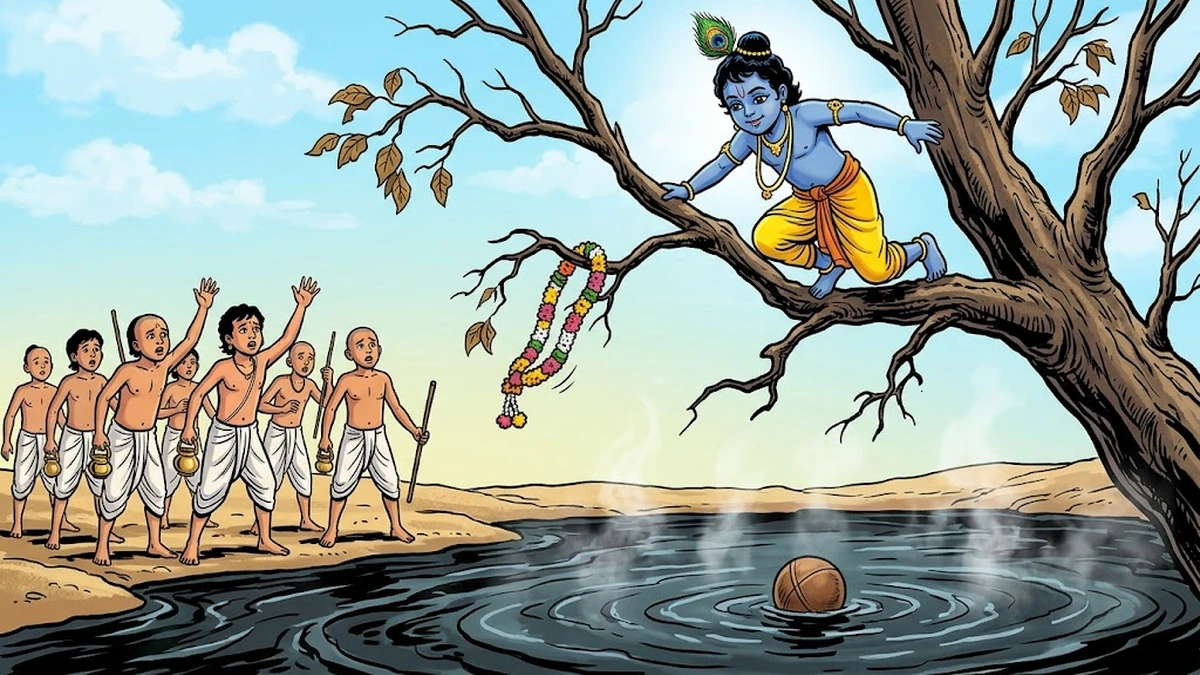
Krishna in those days was a boy of about eleven. The Bhāgavata fixes him in this episode at the precise age at which the upanayana would have been performed in a Brahmin home; his cousin Balarāma was older. They had grown up among the gopāla children, half-divinities living the tactile life of the cattle-camps, eating curds-and-buttermilk-and-rice on banana leaves, racing each other up the trunks of kadamba trees. On the day that mattered, they were playing a ball-game called kanduka — a ball stitched from cow-leather and stuffed with bran — on the Yamunā bank near the forbidden pool. The other boys had been warned a hundred times. Krishna had not.
The Bhāgavata is careful here. It does not say the ball fell by accident. It says: kanduka-līla-vyapadeśena — “under the pretext of the ball-play.” That is the verbal sign in Sanskrit of līlaṁ, divine play: a thing that has the appearance of an accident and the substance of a plan. Krishna’s ball, on his own toss, sailed over the heads of the other boys and dropped into the centre of the black pool. The boys froze. They knew what the pool was. Krishna walked to the edge of the pool, took off his garland of vana-mālā, hung it on the “dead” kadamba tree, climbed the tree, and from a high branch leapt feet-first into the water.
The water received him with a sound the cowherd boys later described as a low groan, not a splash. The pool churned. Vapour rose in plumes. Krishna disappeared. The boys ran screaming to Vṛndāvana. Yaśodā and Nanda came running, with the village behind them. Balarāma stood at the edge of the pool but did not jump. The Bhāgavata says he alone, of all those present, knew exactly what was happening; he said nothing because līlaṁ requires the witness as well as the actor.
Beat III — The Coil and the Counter-Coil
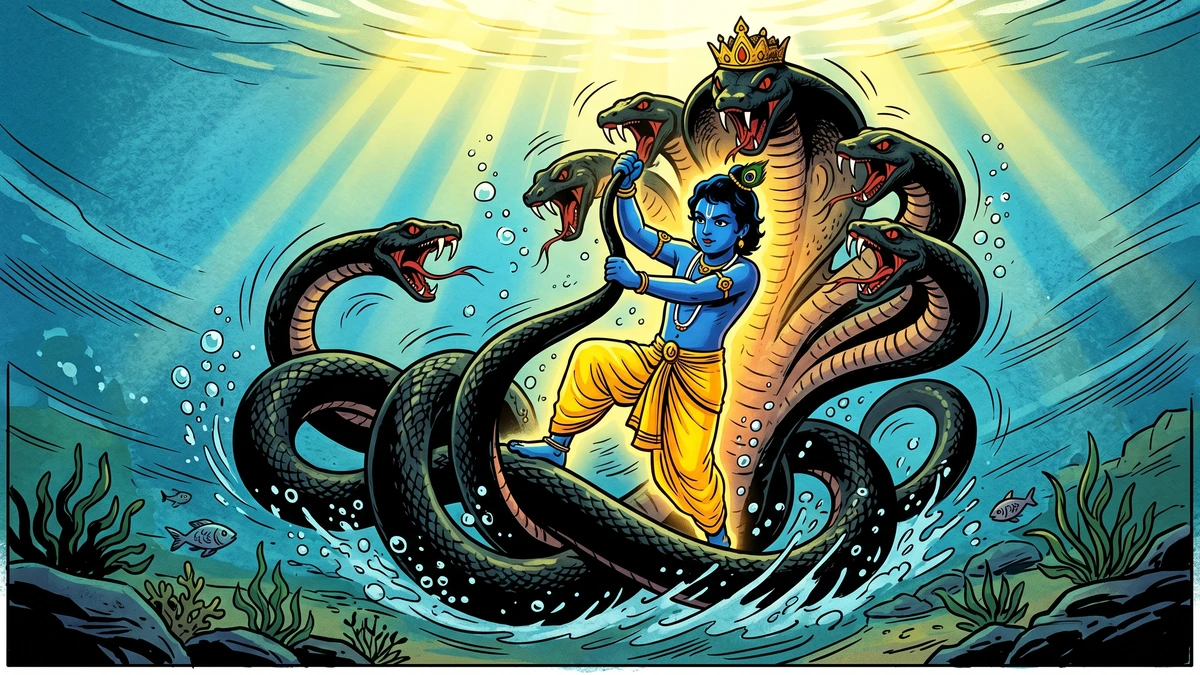
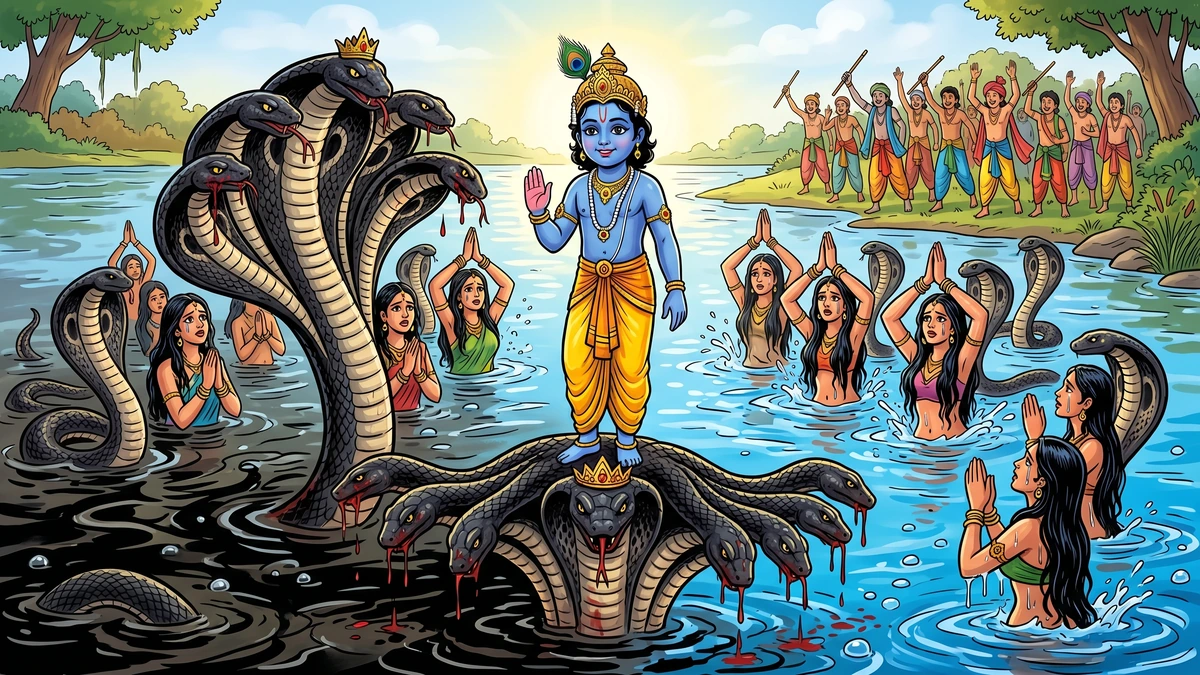
Below the surface, Kālīya was waiting. The Bhāgavata describes his form with the precision of a temple sculptor: a hundred and ten heads, each crowned, each with eyes of red coal, fangs the colour of pearl, breath that was a slow river of green-black smoke. His tongues moved in and out of his mouths like the tongues of separate creatures. His body was the colour of burnt iron. He was as long as the river was wide. The first thing he did, on seeing the human child paddling above him, was laugh: not a sound but a vibration that went through every coil of him.
Then he struck. Two coils first — thick as banyan trunks — came up from below and wrapped around Krishna’s legs. A third came around his chest. A fourth around his neck. The five fanged heads pressed close, and one of them bit into his shoulder, releasing a measure of poison that, the Bhāgavata says, would have stopped the heart of a hundred elephants. Krishna did not move. The poison entered his body and dissolved into nothing. The boy stood inside the coil as a flame stands inside a glass lamp.
For three quarters of an hour, the cowherds on the bank saw nothing but the pool. They saw the thrash of coils, the rise of vapour, the surface of the water turning, then turning still. Yaśodā was held back by Nanda and by the older men. The women began the long chant of haridrāka-stava. Then, in the language of the text: kṛṣṇaṁ sva-vapur vyacita — “Krishna expanded his own body.” He grew, inside the coils. His chest, his arms, his thighs, all swelled. The coils could not hold. They cracked, then split, then loosened. Kālīya, hissing, tried to retighten them and could not. Krishna stepped out of the coils as a man steps out of unfastened ropes.
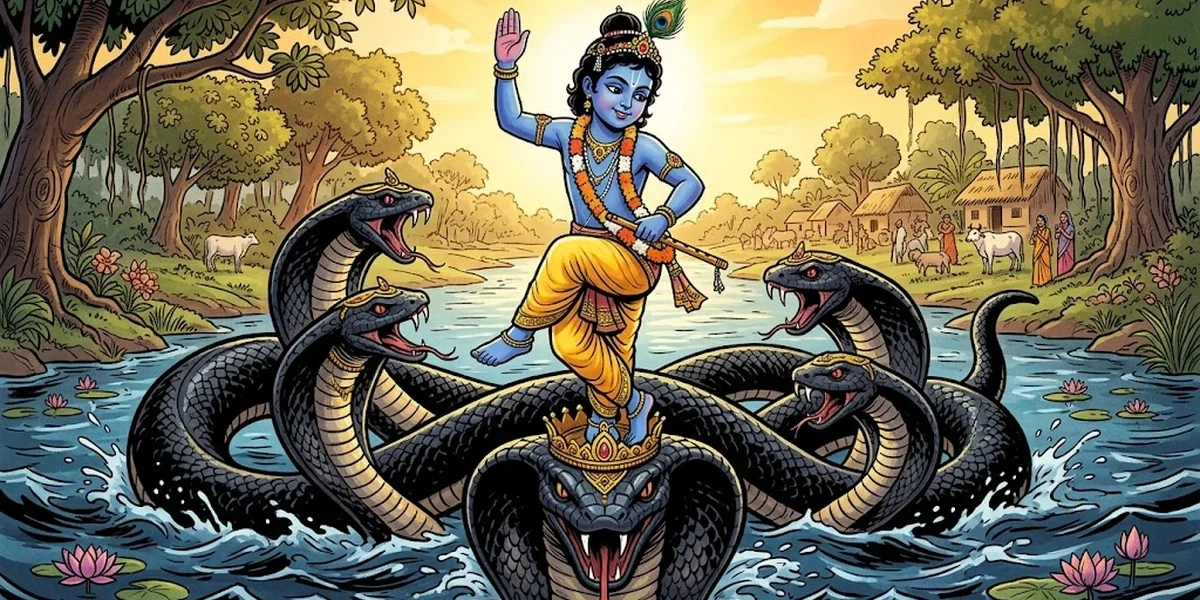
The dance came next. Krishna seized the central head — the largest, the king-head — by the upper hood, and pulled it down beneath his foot. He stepped onto the head. Then onto the next, and the next, and the next. He danced. The Bhāgavata calls this the nṛtya on Kālīya’s heads, and it gave its name to the entire South Indian iconographic genre of Kālīya-mardana bronzes — Krishna with one foot lightly on a bent serpent-hood, the right hand raised in the abhaya-mudrā of fearlessness, the flute tucked at the waist, an expression on the face that is neither anger nor effort but only the calm of a child finishing a dance step.
Beat IV — The Wives of Kālīya and the Mercy of Vaikuṇṭha
Kālīya’s many heads cracked under the dance. Blood and venom poured from his hundred mouths. He could not hold his form. He could not breathe. He bent. The Bhāgavata says the dance lasted as long as it took for Kālīya to recognize. That is the word the text uses: pratyabhijñā-anta, “until the moment of full recognition.” Until then, the dance was only a dance. After it, it was a teaching.
The wives of Kālīya rose then to the surface. The text gives them as nāga-patnīs, serpent-women, with hoods like flowers and human faces. They came up from the deep coils of the pool with their hair loose, with their hands joined above their heads, weeping. They prostrated themselves on the surface of the water as best a serpent can prostrate, and they sang — in twenty-eight Sanskrit verses preserved as the Kālīya-Patnī-stuti, “the prayer of the wives of Kālīya” — what is one of the most theologically sophisticated short hymns in the Purāṇas. They sang that Kālīya’s evil was not a private moral failure but the working out of past karma; that the dance upon his heads was not punishment but anointing; that to be trodden by Krishna was to be released; that the dust of his feet was the gift the gods themselves prayed for. They asked, with that paradox, that he be spared.
Krishna heard them. He stepped off the heads. Kālīya, still bleeding, spoke for the first time in his own voice and admitted what he was: a serpent who had stolen a tribute and brought a curse on his own head. He asked forgiveness. Krishna gave him a single condition. He was to leave the Yamunā that night with all his wives and all his retinue, return to Ramaṇaka Dvīpa, and never come back. As proof of Kālīya’s safety thereafter, Krishna placed his footprint in red on the central hood of the serpent. The print, the Bhāgavata says, would frighten Garuḍa himself: no eagle would touch a serpent who carried the mark of Krishna’s foot. The terms were accepted. Kālīya departed that night with his wives and children, swimming downstream in a long black line toward the sea, and from there back to the islands.
Krishna walked out of the pool dry. The boy who had been swallowed three quarters of an hour earlier stepped onto the bank, picked up his garland from the kadamba tree, embraced his mother, and asked, the text records, for buttermilk. Behind him the Yamunā began to clear. By dawn the next day the water in the bend was visible to the riverbed for the first time in living memory. Birds returned. The cattle drank. The reeds flowered.
The Moral — Mercy Is the Language of Power
The teaching of Kālīya-damana is not the teaching that one usually hears about it from the pulpit. The cheap reading is “good defeats evil.” That is the surface and it is also wrong. The Bhāgavata is not a story about defeating evil; it is a story about the precise moment at which power, having defeated evil, is asked to be merciful, and refuses to refuse.
“nāga-patnīnāṁ vacasā karuṇayā ca prabodhitaḥ / kṛṣṇo nāgaṁ samutṣṛjya pratishṭhate sva-pure.”
— “Awakened by the words of the serpent-wives and by his own compassion, Krishna released the nāga and returned to his village.” (Bhāgavata Purāṇa X.16.65, paraphrase)
The verse gives the structure. Power gathers, exercises itself fully, breaks the back of the wrong, and then — and this is the difficult thing for any power to do — listens to the petitioners. Kālīya’s wives are the witnesses Krishna chooses to honour. They speak for the family of the offender, and Krishna treats their plea as binding. The lesson is that mercy, in the highest tradition of Indian polity, is not weakness postponed but power completed. A power that cannot finish in mercy is not a full power. It is rage that has not learned its job.
The boy who walks out of the pool dry and asks for buttermilk is the figure that Indian mothers have drawn for their children for two thousand years: terrible at noon, ordinary at supper, the whole arc invisible to anyone but the witness who saw the dance. Līlaṁ — the divine play — is the name given to this arc. The point of līlaṁ is not that god plays. The point is that god, having all the power in the universe, treats it lightly enough to dance on it; and that having been merciful, god goes home for buttermilk. The day continues. The river continues. The eclipse passes.
Why It Has Lasted — A Story of Two Audiences
The Kālīya episode has lasted in continuous oral and written tradition for at least sixteen hundred years — from the Hari-vamśa of the early Common Era to the Bhāgavata recensions of the 9th–10th century, through the bhakti-kaṣṭa poetry of the 13th–17th centuries and the South Indian bronze-casting workshops of the same period, into the rasa-līlā theatre of Mathurā today. It has lasted because, like all great folk-religious narratives, it is doing two pieces of work at once for two different audiences.
For the child it is a brave-boy adventure, complete with monster, danger, hidden strength, victory and a happy ending. The cowherds clap. The mother weeps. The river clears. The hero is given buttermilk. This is the layer that keeps a four-year-old listening for ten minutes without moving.
For the adult, the same narrative is a contained meditation on what political and religious power should do at the moment of victory. The narrative offers, in the figure of Kālīya, a perfect target for self-righteous violence: a monstrous polluter, a serial poisoner, a hoarder, an outsider, a refugee from his own clan, a known thief. He has earned every kind of vengeance. The Bhāgavata withholds vengeance. The text takes the trouble of giving Kālīya wives, gives the wives a long Sanskrit prayer, and gives Krishna’s ear to that prayer. That is the actual political and spiritual instruction: that the question “what to do with the offender at the moment of his defeat” is the question on which the dharma of the victor finally turns. Daṇḍa (punishment) and karuṇā (compassion) are the two halves of the discipline. The full ruler exercises both.
Wendy Doniger has called this the “līlā-economy of mercy”: the structuring habit of Vaishnava narrative to place the moment of release immediately next to the moment of conquest, so that the conquering action is never read as final without the releasing action. A. K. Ramanujan, writing on the cross-talk between ‘classical’ Purāṇa and ‘folk’ recension, observes that the Kālīya episode is one of the rare cases where the village retelling preserves the Purāṇic moral exactly: the cowherd grandmother in Vṛndāvana, asked what the story is about, will say aruṃam paṇā daye jitā — “the unbroken dance — mercy that has won.”
The Iconography — The Bronze the World Knows
The single image of Krishna with one foot on a serpent-hood, flute in hand, head lightly tilted, is the most recognizable Vaishnava sculpture outside the dancing-Śiva of the South. It first appears in the Pallava-period stone reliefs of Mahābalipuram (7th c. CE). It is canonized in the Choḷa bronze tradition (10th–13th c. CE), where every great Kālīya-mardana is signed with three details: (i) the dancing leg lightly bent, never stiff; (ii) the right hand in the abhaya-mudrā, never holding a weapon; (iii) the serpent’s remaining hoods curling upward in śaraṇāgati — the gesture of total surrender. The right hand says “do not be afraid,” and the curled hoods say “I am not afraid.” Iconographically, the bronze is a contract between the conqueror and the conquered, and it has the form of a dance.
This same iconography travels north to Vṛndāvana stone-work, west to Gujarat’s Pāṭan haveli paintings, and east into Bengali paṭ recensions. It travels with the bhakti-revival from Sūrdās and his contemporaries into the public songbook of north India. By the 16th century it is no longer a story; it is a household reference, the way the lifting of Govardhana hill is a household reference. The festival of Nāg Nathaiyā at Tulśī Ghāṭ in Banaras — a 17th-century festival still observed every Bhādrapada — is the public re-enactment of the dance: a child in the dress of Krishna is rowed across the Gaṅgā to a platform on the river and dances upon a paper-mâché Kālīya, while the assembled city watches from the ghats.
Reading With Children
This is a story that wants two passes. On the first pass, read it for the adventure: the boy, the ball, the leap, the coils, the dance, the dry walk home. Children love the precision of the moves and the moment when Krishna grows. They love that he does not fight; he expands. Let them ask why he does not just kill the serpent.
On the second pass, read the moment of Kālīya’s wives. Pause there. Ask: “why does Krishna listen?” This is the question on which the rest of the moral life turns. The story has built the listening-moment with great care: Krishna has earned the right not to listen, because he has just won; and in that moment, listening anyway is the form of his power. Children understand this immediately. It is the structure of every fair playground argument: the kid who has just won the wrestling match and lets the other one up. The Bhāgavata is teaching the same lesson on the scale of the cosmos.
The story ends with a small line that is easy to miss: Krishna asks for buttermilk. The dance is over. The river is clear. The serpent is gone. And the divine boy, who has just performed the cosmic act of conquering the polluter and pardoning him, sits down on the verandah and asks his mother for the same buttermilk he asked for yesterday. That ordinariness is the point. The teaching is not that great deeds belong to a great life; the teaching is that great deeds, properly done, return one straight to the buttermilk-and-rice of an ordinary day. The day continues. The mother is there. The river is clear. The eclipse has passed.
Frequently Asked Questions
**Q: Why is this story important?**
You May Also Like
 Indian Folk Tales
Ages 9-12
Indian Folk Tales
Ages 9-12
The Legend of the Merlion
The Legend of the Merlion: In the days when the seas between lands were still being charted by explorers and when magic and reality existed in closer proximity
 Indian Folk Tales
All Ages
Indian Folk Tales
All Ages
Why Brahma Cannot Eat in the Dark
Why Brahma Cannot Eat in the Dark: Among Hindûs, especially among Brâhmaṇs of the Madras Presidency - and I now see from personal observation that it is the
 Indian Folk Tales
Ages 3-5
Indian Folk Tales
Ages 3-5
The Two Brothers Indian Folktale
The Two Brothers Indian Folktale: Once upon a time there lived a King who had two young sons; they were good boys, and sat in school learning all that kings’