How The Rajas Son Won The Princess Labam
How The Rajas Son Won The Princess Labam: In a country there was a Raja who had an only son who every day went out to hunt. One day the Rani, his mother, said
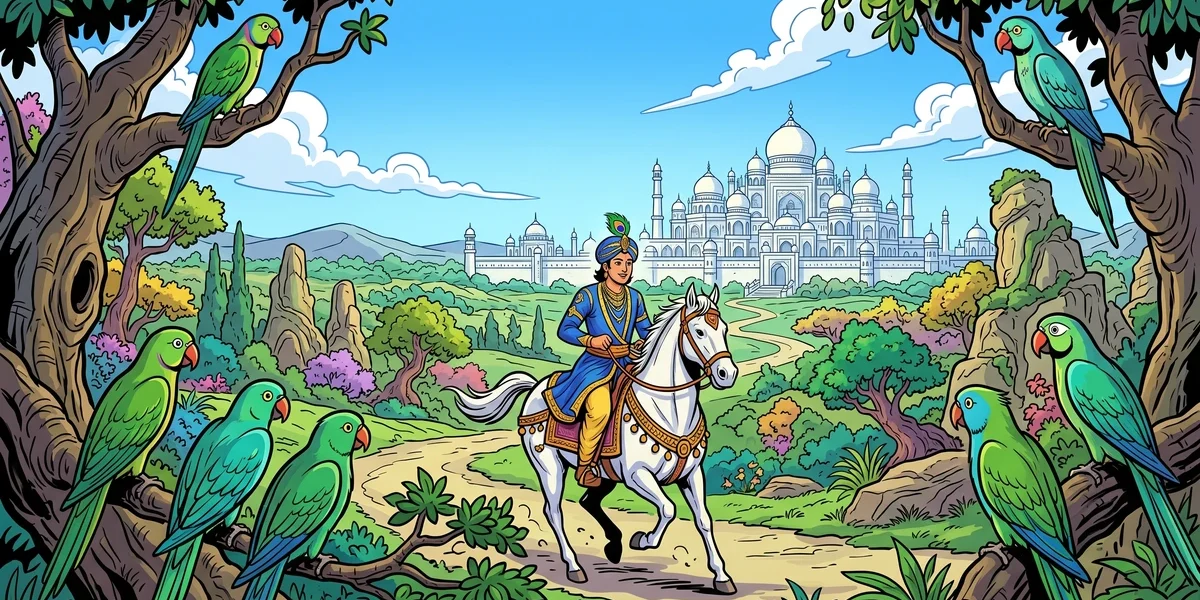
How the Raja’s Son Won the Princess Labam — A Bengali Nursery Tale
This tale was first written down in 1879 in Calcutta by Maive Stokes, the seventeen-year-old daughter of the Indian Civil Service jurist Whitley Stokes, who heard it from her ayah Múniyá. It was published as Tale XXII of her Indian Fairy Tales (Calcutta, 1879). Joseph Jacobs reprinted it as the second story in his Indian Fairy Tales (London: David Nutt, 1892), illustrated by John Dickson Batten — the version from which the text here follows. Folklorists place the tale under ATU 554 “The Grateful Animals”, with embedded motifs from ATU 313 (the impossible bridal tasks) and ATU 851 (the bride-wager frame). The thorn-in-the-tiger’s-foot episode connects the tale to the Greco-Roman Androclus legend, which Theodor Benfey traced back to a north-Indian Buddhist Jātaka source.
The Story
The Forbidden Fourth Side
In a country whose name Múniyá never gave — “the country of fairy-tales is always the next country” — there lived a Raja who had only one son. The son was a passionate hunter, and every day went out at dawn to track deer in the great forests around his father’s city. The Rani his mother, who knew what mothers in Indian folk-tales have always known, took him aside one morning and said in the slow Hindustani of country counsel: “Tin tarafon mein, beta, jahan jee chahe shikar karo: chautha taraf na jaiyo.” “On three sides, my son, hunt where you will. But on the fourth side you must never go.”
The prince went, for some days, where his mother had pointed him. But the prohibition worked, as prohibitions in folk-tales always work, like a slow magnet. One day, when his quarry had led him near the forbidden border, he crossed into the fourth direction and found a part of the forest he had never seen, full of green parrots roosting in the high branches of peepul trees. He raised his bow — the flock startled and rose into the sky — all but one. That one was their Raja: Hiraman, “Diamond,” the standard name in Hindi-Urdu romance for the talking parrot whose feathers shine like the stones in a king’s signet-ring.
Hiraman called down to the prince: “Who is so bold as to hunt in my forest?” The prince, astonished that a bird could speak, put down his bow and asked who Princess Labam was and where her country lay. Hiraman would only repeat, again and again, that the country of Princess Labam could never be reached. The prince returned home and took to his bed, refusing food for four days. On the fifth day he told his mother what name the bird had spoken; the Rani, with the dread that mothers in the cycle always feel at this point, understood that her warning had failed and her son was already lost to a quest she could not stop.
The Sweetmeats, the Ant-Raja, and the Thorn in the Tiger’s Foot
The young prince left his father’s city with one horse, one bag, a small purse of gold, and a packet of sweetmeats his mother pressed into his hand at the gate. On the third day’s road, he stopped at noon to eat. He opened the sweetmeats and found that ants had got into them. “I cannot eat what is already eaten,” he said to himself; “and I will not waste what they have already begun.” He laid the whole packet down on the grass and let the ants finish.
From the centre of the movement on the grass, a single very small voice rose — the kind of voice that signals an animal-king in disguise. It was the Ant-Raja, and his promise is the first of three that will carry the story to its end: “You have been very good to us. Whenever you are in trouble, think of me, and we will come and help you.”
The next day the prince found a tiger lying in the road, breathing in the long uneven gasps of an animal in great pain. A thorn was buried deep in the soft pad of the tiger’s right forefoot. The prince did not pause to consider whether tigers eat princes. He dismounted, knelt down, and worked the thorn free with his small dagger, slowly and carefully. The tiger, when it could stand, bowed its great head and gave him the second promise of the helper-cycle: “You have done me a great service. Whenever you need a tiger, call upon me, and I will come.” Captain Temple’s note, written from his cantonment at Lahore in 1884, is worth pausing over: the thorn-in-the-tiger’s-foot, he writes, “is especially common in north-Indian folktale” and may be, as Theodor Benfey argued in 1859, the ultimate Eastern source of the Greco-Roman Androclus story — the Greek Androclus, as Wendy Doniger puts it, being “an Indian tiger wearing a Roman lion’s mane.”
The Fakir, the Magic Bed, and the Country of Labam
Many days further on, the prince came to the hut of an old fakir beside a banyan tree. The fakir, who knew the prince’s errand before the prince had spoken a word of it — “the fakirs of folk-tales always know,” Stokes notes — gave him three objects on the morning of his departure: a bed that would carry its rider through the air to whatever country he named; a stick that, when laid over a bag, would draw out whatever its owner desired; and a bag that would yield without limit. The prince lay down upon the magic bed, named the country of Princess Labam, and was lifted away over the hills.
The bed set him down at the edge of a city paved in marble, at whose centre stood a palace with seven gates guarded by seven gatekeepers. He sought an audience with the princess’s father, the Raja, who received him with the slow courtesy that Indian folk-fathers always use with princes who have come for their daughters — and only at the end of a long meal named his price. “If you would marry my Labam, you must perform four tasks.” He named them: husk a hundred maunds of rice in a single night; build a wall of human bones around the city in a single night; plough an iron field with iron plough and iron bullock in a single day; and cross the demon-river and bring back a flower from a tree on its far bank guarded by two asuras. The Raja smiled — the smile, Múniyá would say, “of a man who already knows the answer to a question he is asking only for politeness.”
The Four Tasks, and the Calling-Down of the Helpers
Each of the four tasks is solved by one of the helpers the prince has earned along the road, in a steady, almost ritualistic rhythm. For the rice-husking he thinks of the Ant-Raja: the Ant-Raja comes with every ant in three countries, and through the long night they husk a hundred maunds of rice grain by grain, dropping husks in one heap and kernels in another — by morning the floor is as orderly as a Mughal accountant’s ledger. For the wall of bones he thinks of Hiraman: the parrot comes with all his green subjects, who fly out over the country through the second night gathering every bone from every battlefield, cattle-pasture, and cremation ground, and lay them in a perfect crenellated rampart around the city. For the iron field he thinks of the tiger: the tiger comes with every tiger of the southern jungles, a great striped army that tears the iron field open in a single dawn.
For the fourth task — the demon-river and the flower — there is no animal-helper. The prince must go himself. He flies across the demon-river with the magic bed, meets the two asuras on the far bank, draws warriors and weapons from the magic bag with the magic stick, fights a long battle, and carries the flower back to the Raja’s palace. The Raja, defeated by his own bargain, gives him Princess Labam in marriage.
The tale’s dharmic logic is as clear as any line in the Āraṇyakas: the prince’s life is a ledger, every kindness is an entry, and the impossible tasks are the moment the ledger is read aloud. He wins not by strength or gold or cunning, but by the slow harvest of the man he had been on the road. Múniyá ended every telling of it with the same closing line that Stokes preserved: “Aur woh dono khush rahe, aur tum bhi khush raho” — “And the two of them lived happily, and may you live happily too.”
Moral
The Hindustani folk-saying that closes the tale is: jo neki kare, woh kabhi akela nahin marta — “He who does kindness never dies alone.” The cycle’s old listeners always told their children that a hero who tries to win a princess by force — by armies, by gold, by lies — will fail, because the only currency the Raja’s tasks accept is the currency of accumulated small generosities. The prince wins because, on the way, he had let ants finish his sweetmeats and pulled a thorn from a wounded tiger’s foot. The tale is, in its deepest sense, an instruction in how to live the first half of a life so that the second half is possible — the Indian philosophical view of cause-and-effect rendered in nursery prose.
Princess Labam herself is, in the cycle’s deepest grammar, not a person whom the prince has won but a condition he has earned: the condition of a young man who has done enough small good in the world to be ready for a partner’s company. To win Princess Labam is to become the kind of person who could keep her company. That is what the parrot meant when he said the country could not be reached, and what the four tasks meant when the Raja set them.
Why This Tale Has Lasted
“How the Raja’s Son Won the Princess Labam” has been continuously in print since 1879 — through Stokes’s Calcutta volume, Jacobs’s London edition with Batten’s drawings, the Macmillan school readers of the 1900s, All India Radio’s Bal Sabha programmes from 1948 onward, and unbroken Amar Chitra Katha, Pratham Books, and Tulika reprints to the present day. Its survival is not accidental. Múniyá’s tale gave Indian children a moral framework that no later education has replaced: the framework that kindness compounds. The ant-king, the tiger, the parrot, and the fakir are Múniyá’s mnemonics for a doctrine the Āraṇyakas had laid out in three thousand verses; she reduced it, with the genius of every great oral storyteller, to four animals and one prince.
About This Tale’s Origins
The story was collected in 1879 Calcutta by Maive Stokes from her ayah Múniyá, a Bengali nursemaid whose spoken Hindustani preserves the linguistic texture of the Mughal-era north-Indian oral tradition. Joseph Jacobs reprinted it in Indian Fairy Tales (David Nutt, London, 1892) with illustrations by John Dickson Batten — the edition held by the British Library and now digitised by Project Gutenberg and Sacred Texts. Folklorists note its connection to the oldest known layer of Indo-European helper-quest tales, placing it alongside the Buddhist Jātaka stories and the Persian Sindibad cycle as one of the cleanest surviving specimens of that tradition in English.
Frequently Asked Questions
**Q: Why is this story important?**
You May Also Like
 Indian Folk Tales
Ages 9-12
Indian Folk Tales
Ages 9-12
The White Elephant of Thailand
The White Elephant of Thailand: In a kingdom where mountains descended into valleys and rivers wound through forests of extraordinary abundance, there ruled a
 Indian Folk Tales
Ages 9-12
Indian Folk Tales
Ages 9-12
How Raja Rasalu Swung the Seventy Fair Maidens
Punjabi hero Rasalu saves a cricket, sorts millet with insect helpers, and swings sixty-nine princesses until they tire — Steel & Temple episode. Ages 9–12+.
 Indian Folk Tales
Ages 9-12
Indian Folk Tales
Ages 9-12
The Golden Deer of the Forest
The Golden Deer of the Forest: In the ancient kingdom of Ayodhya, there ruled a king named Devendra, whose palace stood white and gleaming against the backdrop