The Legend of the Merlion
The Legend of the Merlion: In the days when the seas between lands were still being charted by explorers and when magic and reality existed in closer proximity

The Legend of the Merlion: How the Lion City Got Its Name
Long before the gleaming towers of Singapore rose above the Straits of Malacca, before the trading ships of a dozen empires crowded its harbour, a young prince stood on the prow of a royal vessel and watched the sea erupt in a storm of supernatural fury. What he saw on that tempestuous shore — a creature unlike any known to the courts of Srivijaya — would give an island its name, and that name would echo down a thousand years of history. This is the legend of Singapura, the Lion City, and the prince who dared to claim it.

The Prince of Palembang and His Restless Spirit
In the prosperous port-kingdom of Palembang, on the great island of Sumatra, there ruled a line of princes descended from the mythic kings of the ancient world. Among them was Sang Nila Utama — “the Noble Indigo Prince” — son of Srivijayan royalty and heir to a tradition that blended Hindu-Buddhist cosmology with Malay custom. The Sejarah Melayu, the Malay Annals compiled by the royal scribe Tun Sri Lanang in the early seventeenth century, records him as a prince of extraordinary quality: courageous, curious, and burning with the ambition to found a kingdom of his own.
His Majesty the Maharaja of Palembang had sent Sang Nila Utama to survey the islands of the southern straits. The year was approximately 1299 CE, by the reckoning of later historians. The prince sailed in a great fleet, banners streaming, his vessel crowded with ministers, warriors, and holy men. They rounded the coasts of Bintan and made landfall at Tanjong Bemban on the northern tip of the island of Bintan, where the prince went hunting in the forest.
It was there, on the crest of a hill thick with jungle, that Sang Nila Utama gazed southward across the strait and saw — barely visible through the haze — a long, low, green shape lying in the water. He asked his minister, the Bendahara Demang Lebar Daun, what island lay before them. The minister replied that it was called Temasek, the Sea Town, and that it was rich with game, fresh water, and fertile ground. The prince’s eyes lit with the fire of destiny. He resolved to cross the strait and see this island for himself.

The Storm, the Crown, and the Sea’s Bargain
The fleet set out at dawn across the Straits of Malacca, but when they reached the middle of the channel, the sky without warning turned black as iron. A great storm arose — wind like the breath of demons, waves that crashed over the decks and swept sailors from their posts. The helmsmen cried that the ships were doomed; the vessels wallowed dangerously, shipping water with every roll. Sang Nila Utama’s ship was heaviest-laden of all, and it began to sink.
The ship’s captain appealed to the prince to lighten the vessel. At once, the order was given to heave cargo overboard: silks and spices, chests of provisions, bales of trade goods — all went into the churning sea. Yet still the ship rode low and the waves clawed at it. In desperation, the prince’s counsellors urged him to part with one final treasure: the sacred royal crown of Palembang, a diadem of gold and jewels that embodied the divine authority of the Srivijayan kings. To cast it away was to relinquish his inheritance — yet to keep it was to drown.
Without hesitation, Sang Nila Utama lifted the crown from his head and cast it into the sea. The Malay Annals are clear on what happened next: almost immediately, the storm relented. The waves subsided, the wind dropped to a whisper, and the great ship righted itself. Scholars of Malay literature have long understood this episode as more than mere narrative convenience. The casting of the crown into the sea represents a ritual transaction with the spirit world — the prince surrendering his old identity, his inherited authority, to receive in return a new sovereignty over the land ahead. He had, in the language of Malay cosmology, paid his bride-price to fate.
The Beast on the Shore
The fleet landed safely on the shores of Temasek. The island received them with silence and green abundance: tall trees hung with fruit, clear streams running to the sea, the calls of unknown birds in the forest canopy. Sang Nila Utama stepped ashore with his ministers and warriors and ordered a hunting party to be prepared. They spread through the forest, flushing deer and wild boar, the dogs running far ahead.
It was then that one of the hounds gave a great cry and came bounding back through the undergrowth, followed by the rest of the pack — not in pursuit of prey but fleeing from something unseen. The prince pushed forward to investigate. And there, at the edge of the forest where the trees thinned and the shore curved away, Sang Nila Utama saw an animal he had never encountered before.
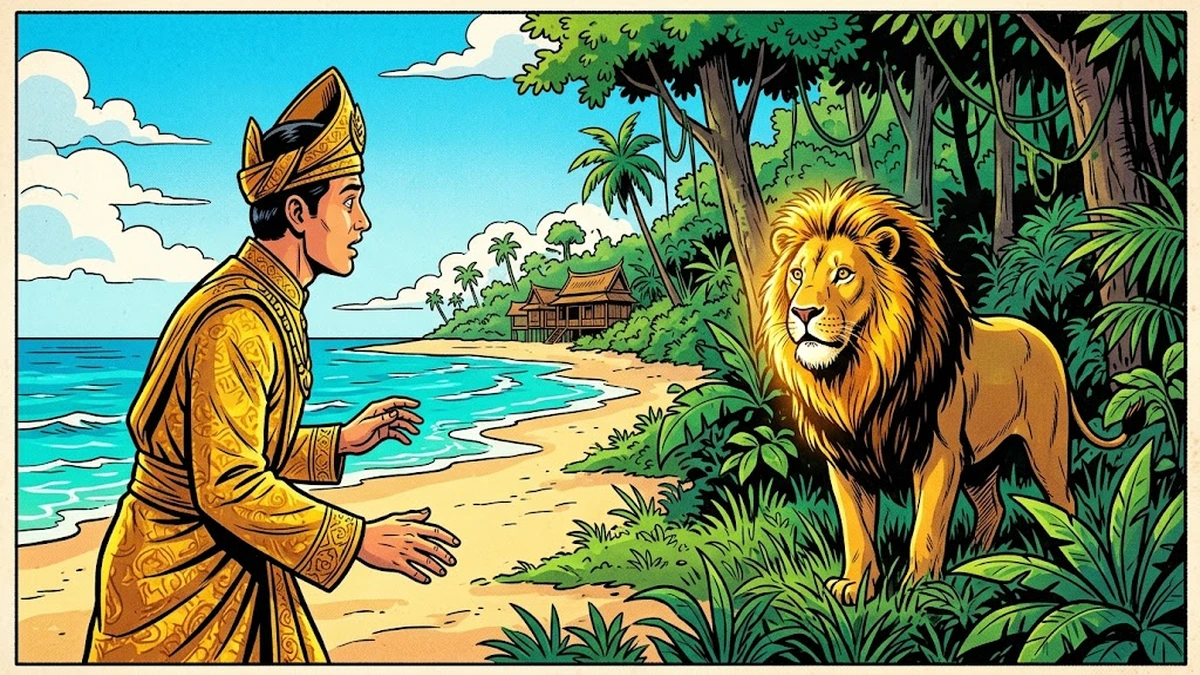
The creature was large, powerfully built, with a magnificent dark mane and the body of a great cat. It moved with a liquid, terrifying grace. Its coat gleamed like burnished copper in the afternoon light. The prince stared at it and the creature stared back — for a long, suspended moment, hunter and beast regarded each other across the forest floor. Then the animal turned and vanished into the shadows.
Sang Nila Utama turned to his minister, Demang Lebar Daun, his eyes shining. “What manner of beast was that?” he demanded. The minister considered: it was swift, powerful, and noble — an animal the like of which he had never seen in all the islands of the southern seas. He replied: “Your Highness, I believe that was a singa — a lion.” A lion! The royal beast of ancient legend, the symbol of sovereignty carved on the walls of Hindu temples across Asia, the animal that formed the crest of kings. Sang Nila Utama took it as an omen beyond all others. If a lion walked this island, it was a land fit for a king.
Modern zoologists have noted, with gentle scepticism, that lions have never naturally inhabited the islands of Southeast Asia. What Sang Nila Utama most likely saw — if the episode records a genuine sighting rather than a literary device — was a Malayan tiger (Panthera tigris jacksoni) or possibly a large clouded leopard (Neofelis diardi). But for the purpose of founding legend, truth is always subservient to meaning. The creature the prince saw was a lion, because Singapore needed to be a Lion City.
The Founding of Singapura and the Merlion’s Legacy

Sang Nila Utama wasted no time. He summoned his Bendahara and his chief ministers to the beach and made his declaration before the assembled court: this island, he proclaimed, would henceforth be known as Singapura — from Sanskrit siṃha (सिंह, lion) and pura (पुर, city, fortress) — the Lion City. He would build his capital here. He would plant the banners of his dynasty in this soil and call its people to him.
The founding of Singapura was not merely a political act but a cosmological one. By naming the city after the lion he had seen, Sang Nila Utama was claiming the animal’s qualities for his new kingdom: strength, sovereignty, nobility, the power to command fear and respect. He was also, scholars argue, drawing on a deep vein of Indic political symbolism. From the lions on Ashoka’s pillars in Sarnath to the Sinha dynasty of Sri Lanka (whose very name, like Singapore’s, derives from siṃha), the lion had long been the supreme emblem of legitimate kingship in the South and Southeast Asian world.
The Sejarah Melayu records that Sang Nila Utama ruled Singapura for forty-eight years and founded a dynasty of five kings whose capital flourished as a trading port of regional importance. Archaeological excavations at Fort Canning Hill — the hill known in the Malay Annals as Bukit Larangan, the Forbidden Hill — have uncovered thirteenth and fourteenth century Javanese gold ornaments, Chinese ceramic fragments, and other material traces consistent with the Annals’ account of a prosperous royal settlement. Singapore’s history, it turns out, is considerably older than the famous 1819 founding by Sir Stamford Raffles.
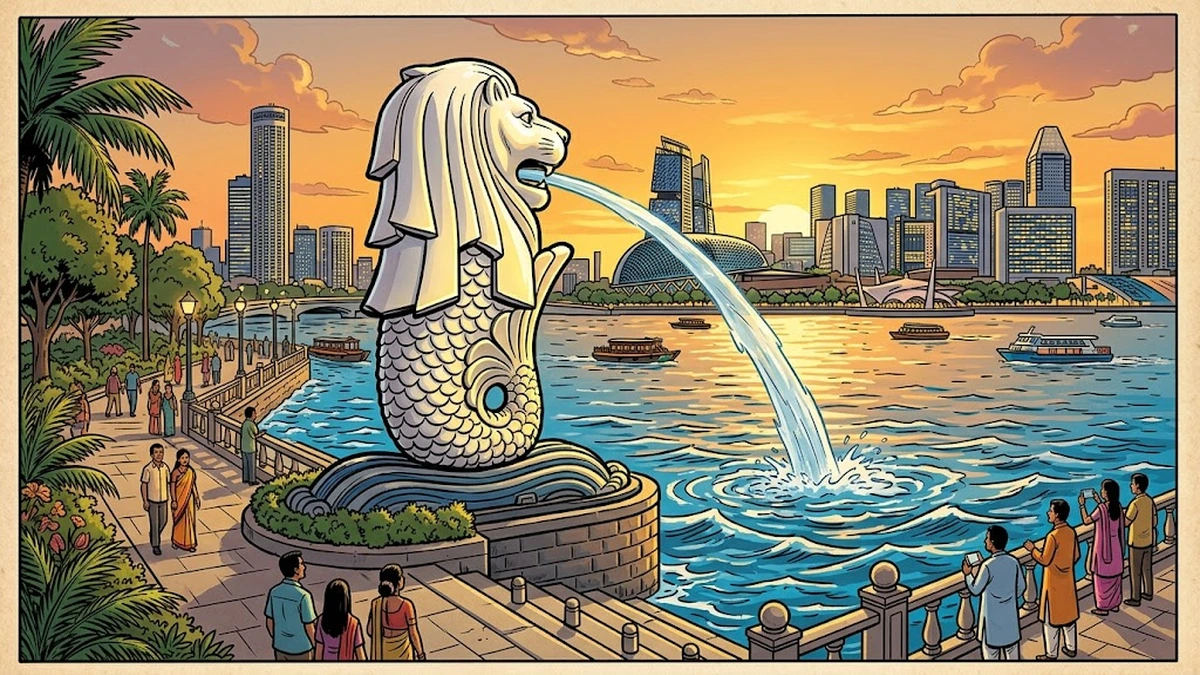
In 1964, the Singapore Tourism Board commissioned the artist Fraser Brunner to design a symbol for the young nation: a creature that united the founding legend of the land-lion with the maritime identity of the island — a Merlion, singa above and ikan (fish) below, white as the foam of the straits, with five waves on its crown representing Singapore’s five founding ideals. The original Merlion statue, unveiled in 1972, now stands at the Marina Bay waterfront, one of the most recognisable civic emblems in Asia. Every year millions of visitors photograph it, many unaware that behind the tourism logo lies a seven-hundred-year-old legend about a prince, a storm, a sacrificed crown, and an animal that may or may not have been a lion.
Moral of the Story
“Adapun negeri itu namanya Singapura.”
The Legend of the Merlion teaches that true sovereignty begins not with inheritance but with sacrifice. Sang Nila Utama could have preserved his father’s crown and turned back from the storm — but he chose instead to cast away his past in order to claim his future. The founder who abandons the comfort of what he already owns, and reads the signs of a new land with open eyes, builds something that outlasts him by centuries. Every city, every nation, every institution worth preserving was once a single person’s daring act of interpretation: to look at an unknown shore, see a creature no one else recognised, and say — here, this is where we begin.
Scholarly Context and Historical Notes
The Sejarah Melayu (Malay Annals) survives in multiple manuscript traditions, the earliest dated 1612 CE, composed at the court of Johor-Riau by the court official Tun Sri Lanang. The text narrates the history of the Malacca Sultanate and its predecessor states, tracing royal genealogies back to Alexander the Great (Iskandar Zulkarnain) in a characteristic blending of Islamic, Hindu-Buddhist, and local Malay traditions. Historians treat it as a literary source of considerable sophistication whose historical accuracy varies by episode.
The name Temasek (also spelled Tumasik) — from Old Javanese tasek, sea or lake — appears in fourteenth-century Chinese records (Zhu Fan Zhi by Zhao Rugua) and in the Nagarakretagama (1365 CE), a Javanese court poem that lists Temasek among the dependencies of the Majapahit empire. These external corroborations confirm that a settlement called Temasek existed on the site of modern Singapore before the Malay Annals’ account of Sang Nila Utama’s arrival.
The Sanskrit etymology of Singapura — siṃha-pura, lion city — links the legend to a widespread pattern of South and Southeast Asian city-naming that employs the lion as a marker of royal power: Sinhala (Sri Lanka), Simhavishnu (Pallava king), Simhapura (a city in the Mahabharata), and the Narasimha (nara-siṃha, man-lion) avatar of Vishnu. The motif of the heroic founder who sees a noble animal and names his city accordingly belongs to ATU type 8* in the Aarne-Thompson-Uther index, a classification that covers aetiological founding legends tied to animal encounters. Related motifs include B256 (lion as royal omen), A901 (topographic features explained by myth), and H1229.3 (quest leads to founding of city).
Frequently Asked Questions
Who was Sang Nila Utama?
Sang Nila Utama was a Srivijayan prince of Palembang, Sumatra, who according to the Sejarah Melayu founded Singapura around 1299 CE after sighting a lion on the island of Temasek. He ruled for approximately forty-eight years and established a dynasty of five kings.
What does the name Singapore mean?
Singapore derives from Sanskrit siṃha (सिंह, lion) + pura (पुर, city), meaning “Lion City.” The same root appears in Sinhala (Sri Lanka) and other South Asian place-names evoking royal lion symbolism.
Did Sang Nila Utama really see a lion?
Lions have never naturally inhabited Southeast Asia. Zoologists believe he most likely saw a Malayan tiger or clouded leopard. The founding legend treats it as a singa (lion) for its symbolic power as an emblem of sovereignty, not for zoological accuracy.
What is the Merlion and why does it represent Singapore?
The Merlion — lion head, fish body — was designed in 1964 by Fraser Brunner for the Singapore Tourism Board, uniting the founding lion legend with Singapore’s identity as a maritime island nation. The original statue, unveiled in 1972, stands at Marina Bay.
How reliable is the Sejarah Melayu as a historical source?
The Sejarah Melayu (c.1612 CE) blends genuine historical memory with royal mythology. Its Temasek account is partially corroborated by 14th-century Chinese records (Zhu Fan Zhi) and the Javanese Nagarakretagama (1365 CE).
You May Also Like
 Indian Folk Tales
Ages 3-5
Indian Folk Tales
Ages 3-5
5 Dark Original Stories Behind Disney Movies — The Real Fairy Tales
5 REAL Stories Behind Fairy Tales Made Into Disney Movies – NOT For: Disney adaptations of fairy tales always end with a “happily-ever-after”. But these fairy
 Indian Folk Tales
All Ages
Indian Folk Tales
All Ages
The King Who Would See Paradise
The King Who Would See Paradise: Once upon a time there was king who, one day out hunting, came upon a fakeer in a lonely place in the mountains. The fakeer
 Indian Folk Tales
Ages 3-5
Indian Folk Tales
Ages 3-5
The Story of a Kind Hearted Little Girl Named Tara
The Story of a Kind Hearted Little Girl Named Tara: Once there lived a little girl named Tara with her mother in a small hut near the forest. Tara was